Skip to content

Best Shoe Glue for Canvas and Rubber Shoes: A Practical Guide to Strong, Flexible Repairs
Your trusted adhesives glue & cleaner manufacturer

Choosing the best shoe glue for canvas and rubber shoes is less about finding the product with the most aggressive strength claim and more about finding an adhesive that behaves correctly when a shoe is actually worn. Canvas stretches, rubber bends, midsoles compress, toe areas flex repeatedly, and repaired footwear may be exposed to rain, road dust, sweat, cleaning products, and temperature changes. A successful repair therefore needs a bond that remains strong without turning the repaired area into a stiff patch that cracks after a few days of normal movement.
The best shoe glue for canvas and rubber shoes is a footwear-specific adhesive that bonds porous fabric and dense rubber while staying flexible after curing. It should resist water, tolerate repeated bending, dry cleanly, and allow accurate application. For sole separation, toe-cap lifting, loose edges, and mixed-material sneaker repairs, flexibility and surface compatibility are usually more important than an extremely fast setting time.
Consider a familiar situation: a favorite pair of canvas sneakers still feels comfortable, the upper looks good, and the tread has plenty of life left, but one section of the rubber sidewall has started separating. Replacing the shoes feels wasteful, yet a poor adhesive can make the damage worse by leaving a hard white line or failing after the first wet walk. Understanding what makes a footwear adhesive work is what separates a temporary patch from a repair that genuinely extends the useful life of the shoe.
What Makes a Shoe Glue Suitable for Canvas and Rubber Shoes?
A suitable shoe glue for canvas and rubber shoes needs strong adhesion, lasting flexibility, water resistance, and compatibility with different footwear materials. It should create a secure bond without becoming brittle as the shoe bends. A clean finish, controlled application, and sufficient working time also matter because real footwear repairs often involve narrow gaps, curved edges, porous fabric, and smooth rubber surfaces.
What Materials Can Shoe Glue Bond?
Canvas and rubber behave very differently when adhesive is applied. Canvas is porous and woven, which means a low-viscosity adhesive can penetrate into the fibers instead of remaining only on the surface. Rubber is denser and often smoother, so successful bonding depends more heavily on clean contact, appropriate surface preparation, and a formula capable of maintaining adhesion to a material that continuously flexes. Many modern shoes also contain synthetic leather, vinyl, EVA foam, TPU components, textile linings, and layered midsoles, which makes broad compatibility especially useful.
The difficult part is not simply attaching one surface to another. It is keeping the bond intact while both materials move at different rates. A canvas upper can fold and stretch around the foot, while a rubber outsole may deform less in the same area. This difference creates peel and shear stress along the glue line. A footwear adhesive must tolerate that movement rather than concentrating all the force at one brittle edge.
A practical shoe repair adhesive should therefore be selected according to the location of the damage as well as the material. A small decorative element experiences far less stress than a forefoot sole edge. Likewise, an insole repair does not face the same water, abrasion, and ground impact as an outsole repair. Treating every shoe repair as the same job is one of the easiest ways to get inconsistent results.
Why Do Canvas and Rubber Need Flexible Adhesives?
Footwear bends every time the wearer takes a step. The forefoot flexes, the heel compresses, and the sidewall twists slightly as body weight moves from one part of the foot to another. If the cured adhesive becomes too rigid, the glue layer may initially feel strong but begin to fracture at the boundary between the repaired and unrepaired areas. Flexibility allows the adhesive to distribute stress across a larger section rather than creating one hard failure point.
This is especially important for sneakers, school shoes, walking shoes, and lightweight casual footwear. These shoes typically use thin canvas or textile uppers attached to flexible rubber or foam-based sole structures. A repair that feels acceptable while the shoe is sitting on a table can behave very differently once the wearer walks several kilometers, climbs stairs, crouches, or runs. Real durability needs to be judged under movement rather than by how hard the glue feels after drying.
Water resistance adds another layer of protection. Moisture can enter small gaps along a damaged sole, carrying dirt and reducing the contact quality between materials. A cured adhesive intended for footwear should resist ordinary exposure to rain, damp pavements, and routine use. Waterproof does not mean every repaired shoe becomes suitable for full submersion, but it does mean the bond should not soften or immediately fail simply because the shoe gets wet.
| Performance Factor | Practical Importance | What to Look For |
|---|---|---|
| Flexibility | Helps the bond move with the shoe | Elastic cured layer rather than a brittle joint |
| Water resistance | Supports everyday outdoor use | Bond remains stable after normal moisture exposure |
| Material compatibility | Allows mixed-material repairs | Compatibility with canvas, rubber, leather, vinyl, and common synthetics |
| Clear finish | Improves appearance on visible repairs | Transparent cure with minimal visible residue |
| Application control | Prevents mess around narrow seams | Fine nozzle or precision applicator |
| Working time | Allows accurate positioning | Enough time to align sole and upper before final curing |
What Features Should Reliable Shoe Glue Have?
A useful shoe adhesive should make the repair easier, not merely promise high strength. Precision is particularly important because many failures begin as a narrow separation only a few millimeters wide. A fine metal nozzle can reach inside those gaps without forcing the user to pull the shoe apart further. Controlled flow also reduces excess adhesive around light-colored canvas, white rubber foxing, decorative stitching, and visible sneaker edges.
Surface preparation tools also matter more than many consumers expect. Light sanding can create additional mechanical grip on smooth rubber, while an applicator helps spread adhesive evenly across larger areas. Holding pressure is equally important because newly bonded parts can slowly move apart before the adhesive has developed enough strength. Rubber bands, clamps, or other gentle holding methods help keep both surfaces in contact during the curing period.
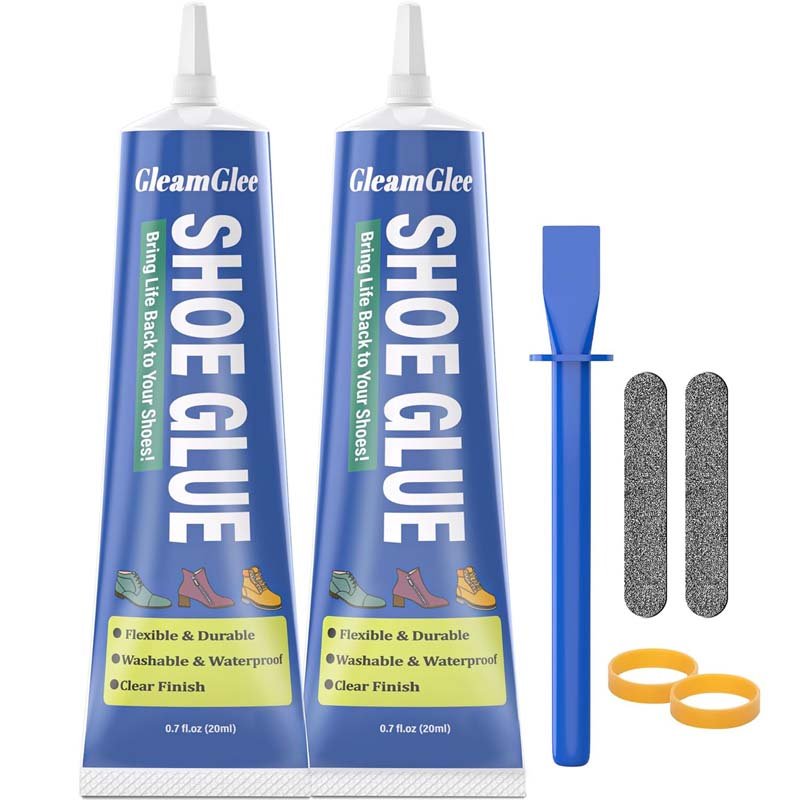
For this reason, complete repair kits can be more practical than a tube of adhesive alone. GleamGlee’s shoe repair configuration, for example, combines two 20 ml glue tubes with an applicator, two pieces of sandpaper, and two rubber bands. The value of these accessories is not decorative; each supports a specific stage of the repair process, from surface preparation and controlled application to maintaining pressure while the bond develops.
A good adhesive should also remain usable after the first repair. A reusable nozzle, stable storage behavior, and packaging that limits accidental leakage can make a noticeable difference for people who repair footwear occasionally rather than using the entire product at once. These seemingly small design details often determine whether a product becomes a reliable tool in a household repair drawer or is discarded after one frustrating use.

Which Shoe Glue Works Best for Canvas and Rubber Shoes?
For canvas and rubber footwear, a flexible shoe repair adhesive generally works better than a rigid instant glue because it is designed to handle repeated movement, mixed materials, and moisture exposure. The most suitable option depends on the repair location, but sole separation, rubber-edge lifting, toe-cap repair, and canvas-to-rubber bonding usually benefit from an adhesive specifically formulated for footwear rather than a general household glue.
Which Glue Is Best for Canvas Sneakers?
Canvas sneakers require a formula that can interact with textile fibers without creating an excessively rigid repair line. The adhesive must also bond successfully to the rubber sidewall or outsole found on most casual canvas shoes. When the separation occurs near the forefoot, flexibility becomes especially important because that area repeatedly folds during walking. A hard adhesive may hold briefly but can create uncomfortable stiffness or encourage the separation to move farther along the seam.
Appearance deserves equal attention. White canvas shoes and light-colored rubber often show adhesive residue more clearly than dark footwear. A transparent cured finish helps keep the repaired area discreet, particularly around toe caps, foxing strips, and sidewall edges. Users should still apply the minimum amount needed for full surface contact because even clear adhesive can become visible if excessive material squeezes out around the seam.
Canvas also absorbs liquids more readily than rubber, so flooding the surface with adhesive is rarely useful. A thin, controlled layer allows the product to wet the fibers without saturating a large visible area. If the repair involves only the canvas fabric itself rather than the connection between canvas and rubber, users should first determine whether adhesive is appropriate at all. Large structural tears may need stitching, reinforcement fabric, or a combination repair rather than glue alone.
Which Glue Works on Rubber Soles?
Rubber outsole repairs place higher demands on an adhesive because the repaired area is exposed to flexing, abrasion, impact, moisture, and sometimes oils or road contaminants. A peeling edge at the front of a sneaker is one of the most common examples. The repair needs to resist repeated peel forces each time the toe bends, which is why a flexible bond usually performs better than a very hard, glass-like bond in this location.
Preparation is critical. Dirt, waxes, silicone-containing treatments, or oily residues can interfere with adhesion, even when the glue itself is well formulated. The surface should be cleaned and completely dry before bonding. Lightly roughening very smooth rubber with fine sandpaper can increase mechanical contact, but the goal is to create a slightly textured surface rather than aggressively remove material or alter the shape of the sole.
For rain boots or waterproof outdoor footwear, users should pay particular attention to the type of damage. A small separation between bonded components can often be repaired with adhesive, while deep structural cracks or damage to load-bearing areas may require professional attention or replacement. Shoe glue extends the useful life of footwear when the underlying materials are still sound; it should not be treated as a substitute for a structurally intact sole.
Which Adhesive Is Suitable for Mixed Materials?
Modern shoes rarely consist of only two materials. A single sneaker can combine canvas or mesh, rubber, EVA or PU foam, synthetic leather, thermoplastic reinforcement, fabric lining, and decorative components. This is why product labels that simply say “strong glue” tell the user very little. The better question is whether the formula remains flexible and compatible across the particular materials found in the damaged area.
| Adhesive Type | Canvas | Rubber | Flexibility | Typical Footwear Use |
|---|---|---|---|---|
| Instant cyanoacrylate | Fair for small areas | Fair to good on some rubbers | Low | Small, rigid details rather than flex zones |
| General-purpose craft glue | Good on porous fabric | Variable | Low to medium | Light decorative work |
| Rubber/contact adhesive | Good | Very good | High | Soles, sidewalls, larger flexible areas |
| Footwear repair adhesive | Very good | Very good | High | Mixed-material shoe repair and sole separation |
A footwear-specific formula offers the advantage of being designed around the conditions users actually encounter. GleamGlee Shoe Glue, for example, is positioned for leather, rubber, vinyl, canvas, and other common shoe materials, with a flexible, water-resistant, transparent cured finish. That makes it useful for households that own many different shoe types and do not want a separate adhesive for every pair.
The term “best” should therefore be interpreted as “best matched to the repair” rather than as a universal ranking. A tiny rigid ornament and a flexing outsole edge do not require identical performance. The more clearly users identify the material, location, movement, and moisture exposure involved in a repair, the easier it becomes to choose an adhesive that is genuinely suitable instead of simply choosing the fastest or strongest-sounding product.
How to Repair Canvas and Rubber Shoes with Shoe Glue?
Successful canvas and rubber shoe repair depends on four stages: clean the surfaces, prepare the bonding area, apply a controlled layer of adhesive, and hold the parts securely until the bond has developed. Rushing preparation or wearing the shoe before sufficient curing is complete can reduce repair quality even when the adhesive itself is suitable. Clean contact and patient curing are often as important as the glue formula.
How Should Shoes Be Prepared Before Gluing?
Start by examining the damage carefully. A partially lifted sole edge can often be repaired without removing the entire outsole, while loose dirt, old adhesive flakes, or deteriorated material should be cleared away before new glue is applied. Pulling the shoe apart farther than necessary can enlarge the repair area, so preparation should be controlled rather than aggressive. The goal is to expose enough clean surface for bonding without creating additional damage.
Both surfaces should be dry and free of dust, grease, mud, polishing residue, or cleaning chemicals. If the shoe was recently washed, allow enough time for moisture trapped inside canvas fibers or seams to evaporate. Applying adhesive to damp material can reduce effective contact and trap moisture inside the repair. This is particularly important for thick canvas, hiking footwear, and shoes with padded linings that can remain damp longer than they appear from the outside.
Smooth rubber can be lightly abraded with sandpaper to increase the available bonding area. Fine scratches provide more mechanical grip than a polished surface, but aggressive sanding can weaken thin edges or change the fit between components. After sanding, remove all loose particles before applying adhesive. This is one reason a small sheet of sandpaper is a useful addition to a dedicated shoe repair kit.
How Much Shoe Glue Should You Apply?
More adhesive does not automatically create a stronger repair. The objective is full, even contact between the surfaces rather than a thick pool of glue. Excess adhesive can squeeze out of the seam, collect dirt, increase curing time, and make the repaired area more noticeable. On canvas, too much liquid can also spread beyond the intended zone through the woven fibers.
A precision metal nozzle is useful because it allows adhesive to be inserted inside narrow separations without opening them excessively. For a small toe or sidewall separation, apply enough glue to cover the bonding surfaces and then press the parts together so the layer spreads evenly. For a larger area, an applicator can help distribute adhesive instead of leaving thick ridges concentrated in one spot.
| Repair Stage | Practical Action | Common Mistake to Avoid |
|---|---|---|
| Inspection | Identify loose edges and sound material | Pulling the sole apart farther than necessary |
| Cleaning | Remove dirt, oil, and loose residue | Applying adhesive to a damp or dirty surface |
| Surface preparation | Lightly roughen smooth rubber if needed | Sanding deeply enough to damage the sole |
| Application | Use a thin, even adhesive layer | Flooding the repair with excess glue |
| Holding | Keep surfaces firmly aligned | Allowing the parts to shift during curing |
| Final cure | Leave the shoe unused for adequate time | Walking in the shoe too soon |
How Long Should Shoe Glue Cure?
Curing time varies by chemistry, adhesive thickness, temperature, humidity, and the materials being bonded. Users should always follow the instructions supplied with the specific adhesive rather than assuming every shoe glue behaves the same way. An adhesive may feel dry at the surface well before it has developed its full internal strength, especially in a narrow enclosed gap where solvents or moisture escape more slowly.
For repairs that experience substantial load, such as a separating outsole, allowing a longer undisturbed cure is generally safer than testing the bond too early. During this period, rubber bands or suitable clamps can keep the sole and upper aligned. Pressure should be firm enough to maintain contact but not so strong that it deforms foam midsoles or forces all adhesive out of the joint.
Temperature also influences curing. Extremely cold conditions can slow many adhesive systems, while excessive heat may alter viscosity or accelerate surface drying before a good bond forms. A clean indoor environment at a moderate room temperature is usually preferable. The repaired shoe should remain stationary, away from water and heavy flexing, until the curing period recommended for the product has passed.
How Can You Get a Cleaner Repair?
The cleanest repairs begin before the glue is opened. Masking adjacent areas may be useful when working on white canvas or decorative footwear, while careful nozzle placement reduces the need for cleanup afterward. If a small amount of uncured adhesive escapes from the seam, follow the manufacturer’s cleaning guidance rather than spreading it across the surface with repeated wiping.
Alignment matters just as much as cleanliness. Before applying glue, press the components together without adhesive and check how naturally they sit. This dry fit shows where pressure is needed and prevents the user from discovering alignment problems after the glue has already been applied. On curved sneaker soles, several rubber bands placed at different points can provide more even holding pressure than one tight band.
A controlled process is particularly valuable for valuable sneakers, dress shoes, dance shoes, and other footwear where appearance matters. The objective is not only to restore function but also to keep the repair visually discreet. Transparent, flexible adhesives paired with precise application tools provide a useful combination for these situations because they allow strong bonding without creating an obvious hard repair line.

What Shoe Repairs Can Be Fixed with Canvas and Rubber Shoe Glue?
Shoe glue can repair many common problems where the original materials are still structurally sound, including separating soles, lifting rubber edges, loose toe caps, detached insoles, small heel separations, and mixed-material joints. It is especially useful for sneakers, casual shoes, work footwear, hiking boots, and other shoes that need a flexible bond. Severe structural damage, however, may require professional repair or replacement.
Can Shoe Glue Repair Separated Soles?
Sole separation is one of the most suitable applications for a dedicated footwear adhesive because the problem usually involves two materials that were originally bonded together. Small separations along the toe, sidewall, or heel can often be restored when the rubber, foam, and upper remain intact. The key is to clean the internal surfaces, apply adhesive evenly, align the sole accurately, and maintain contact throughout the required curing period.
The condition of the existing sole matters. Adhesive cannot reverse material deterioration. If foam is crumbling, rubber has become brittle, or the midsole has broken into multiple pieces, attaching the surfaces may not restore safe performance. Consumers should distinguish between adhesive failure, where two intact parts have separated, and material failure, where the component itself has degraded.
This distinction becomes particularly important for older athletic footwear. Some midsoles deteriorate with age even when the shoe has not been worn frequently. If the foam tears apart easily when gently pressed or flexed, applying more glue may simply move the failure deeper into the damaged material. In such cases, professional resoling or replacement is usually a more responsible choice.
Can Shoe Glue Fix Sneakers and Athletic Shoes?
Sneakers are strong candidates for adhesive repair because they contain numerous bonded components. Common jobs include lifted outsole edges, separating rubber toe caps, detached trim, loose insoles, and small gaps between uppers and sole units. A flexible shoe adhesive allows these areas to continue moving after repair, which is critical for walking and casual athletic use.
Performance footwear needs a more cautious approach. Running shoes, basketball shoes, cycling shoes, and football boots experience higher impact and torsional forces than ordinary casual sneakers. A small cosmetic edge separation may be repairable, but damage affecting the structural midsole, cleat plate, protective shank, or another load-bearing component should not automatically be treated as a simple glue job.
The same principle applies to climbing shoes and specialty footwear. Reattaching a small peeling rubber edge may extend service life, but heavily worn rand rubber, deformed soles, or structural damage can affect safety and performance. Good repair practice involves knowing the limits of adhesive, not simply applying it to every damaged area.
Can Shoe Glue Repair Boots and Outdoor Footwear?
Work boots, hiking boots, hunting footwear, and rain boots encounter wet surfaces, dirt, repeated flexing, and heavier loads, making flexible water-resistant adhesives particularly useful for minor bonding failures. Lifted sole edges and small gaps between compatible materials can often be repaired when both surfaces remain stable. Cleaning becomes especially important because outdoor footwear may contain mud, waterproofing treatments, waxes, and other residues that interfere with bonding.
Waterproof footwear also deserves careful inspection before repair. A visible sole separation may be only one part of a larger leak path. If a waterproof membrane is torn or stitching has failed, bonding the exterior edge may improve the connection without fully restoring the original waterproof construction. Users should test repaired boots conservatively before relying on them in demanding wet environments.
A German hiking enthusiast described in one GleamGlee use case repaired a separating boot sole, allowed the adhesive to cure overnight, and then continued using the footwear on later hikes. Experiences like this illustrate the value of a flexible bond, but they should not be treated as a guarantee for every boot. Surface condition, repair size, material age, and environmental exposure all influence the outcome.
What Other Shoe Repairs Are Practical?
Shoe glue is useful beyond conventional sneaker sole repair. Loose insoles, decorative components, sandal straps, house-shoe soles, and some costume footwear can often be restored with carefully controlled adhesive. The same principle applies to school shoes and children’s footwear, although repaired shoes should be inspected carefully because children may subject footwear to particularly high levels of bending, dragging, and playground abrasion.
Fashion footwear can also benefit from precise repairs. A transparent adhesive may help with lifting sole edges on dress shoes, decorative components on designer sneakers, or selected areas of high heels. However, heel structures and load-bearing components deserve extra caution because failure while walking can create an injury risk. If the damage affects a structural heel attachment rather than a cosmetic layer, professional shoe repair is the safer choice.
A useful rule is simple: adhesive performs best when it reconnects intact materials that were meant to stay bonded. It performs poorly when asked to replace missing structure, rebuild deteriorated foam, or compensate for components that have already lost mechanical strength. Recognizing that boundary gives users better results and prevents unnecessary disappointment.
Why Choose a Professional Shoe Glue Manufacturer for Your Brand?
A professional shoe glue manufacturer provides more than finished adhesive. Reliable manufacturing requires formula development, raw-material control, application testing, packaging compatibility, regulatory documentation, scalable filling, and consistent quality management. For retailers and private-label brands, these capabilities reduce the risk of receiving a product that performs well in a sample but becomes inconsistent when production volumes increase or the packaging changes.
How Is Professional Shoe Glue Developed?
A footwear adhesive formula has to balance several properties that can conflict with one another. Increasing initial tack may reduce working time, changing viscosity can affect both application control and fabric penetration, and modifying flexibility can influence curing behavior. This is why development should be based on application testing rather than on a single laboratory number. A high strength result on one rigid material does not automatically predict good performance on a flexing canvas-to-rubber seam.
Experienced formulation teams examine polymer behavior, surface compatibility, aging, environmental exposure, and user handling. GleamGlee’s development operation includes more than 25 chemists, materials specialists, and process engineers working across adhesive and related chemical product categories. Application laboratories are used to evaluate bonding behavior under conditions intended to approximate real consumer use, including humidity, repeated wear, and different substrate combinations.
Packaging also becomes part of product performance. A formula that works well in bulk may be frustrating if the nozzle clogs, the tube leaks, or the adhesive becomes difficult to control after several uses. Coordinating formula development with tube design, nozzle structure, labels, and accessories reduces the gap between laboratory performance and actual customer experience.
What Quality Checks Matter for Shoe Glue?
Quality control should focus on consistency rather than relying only on a final visual inspection. Manufacturers typically need to monitor incoming raw materials, mixing conditions, viscosity, filling weight, container compatibility, seal integrity, labeling accuracy, and finished-product performance. For adhesives, changes in raw-material batches or processing conditions can influence application behavior even when the formula appears identical on paper.
Finished products should also be evaluated against intended use conditions. Shoe glue may be exposed to bending, humidity, moisture, storage temperature changes, and repeated opening and closing of the package. Testing does not mean every consumer will experience exactly the same result, but it helps reduce avoidable variation between batches and gives brands stronger technical information when customer questions arise.
Integrated production provides an additional advantage when problems need to be corrected quickly. GleamGlee operates across chemical processing, raw materials, packaging containers, and label printing, which allows several parts of the product system to be coordinated internally. For brands, this can simplify adjustments involving formula viscosity, tube size, nozzle design, multilingual labeling, or pack configuration without relying on completely separate suppliers for every component.
Can Shoe Glue Be Customized for Private Labels?
Private-label projects often start with a straightforward request such as placing a new logo on an existing shoe glue, but commercial requirements can become more detailed once the project develops. A brand may need a specific tube volume, metal nozzle, color scheme, multilingual instructions, carton configuration, bundled sandpaper, rubber bands, applicators, or a formula adjusted for a particular target market.
GleamGlee supports customization from a stated MOQ of 200 units for suitable projects, with design work that can be prepared in as little as two days depending on project complexity. Typical sample preparation is stated at approximately 7–14 days, while standard mass production is around 20 days, with faster production possible for selected urgent projects. Exact timing should always be confirmed for the selected formula, packaging, artwork, and regulatory requirements.
This flexibility is useful for established retailers as well as smaller footwear-care brands that want to validate a product before moving into larger volumes. Instead of committing immediately to a very large production run, a company can evaluate samples, check customer response, refine packaging, and then scale the program once the commercial fit is clearer.
What Should Brands Ask Before Ordering?
A productive supplier discussion should begin with the actual use case rather than price alone. Brands should explain which footwear materials they expect customers to repair, the target tube size, desired accessories, selling region, label language, packaging style, expected order quantity, and any benchmark products they want to match or improve. These details allow the manufacturer to recommend a more appropriate formula and package combination.
Samples should be tested on realistic footwear materials rather than only examined visually. A brand selling to sneaker users may want canvas-to-rubber and synthetic-to-rubber tests, while an outdoor footwear retailer may care more about flexible bonding after moisture exposure. The sample evaluation should also include nozzle control, odor, curing behavior, packaging convenience, and the clarity of the final repair.
Price becomes more meaningful after these variables are defined. Two adhesive products with the same tube volume can differ substantially in raw materials, accessories, nozzle design, packaging, testing, and documentation. Evaluating the complete product system makes supplier comparisons more useful than comparing only the lowest unit price.
How to Choose the Right Shoe Glue Supplier for Global Markets?
The right shoe glue supplier should combine reliable formulation, consistent manufacturing, practical packaging, documentation support, customization capability, and international logistics experience. For companies selling across North America, Europe, the United Kingdom, or Asia, product performance is only one part of the decision. Labels, safety documentation, packaging durability, lead times, and the ability to maintain repeatable production are equally important.
What Certifications and Documents Should Suppliers Support?
Adhesive products are chemical products, so documentation and labeling requirements should be addressed early in the sourcing process. Depending on formulation and destination market, brands may need safety data, hazard communication information, transport documentation, ingredient or regulatory declarations, and labels designed around the applicable chemical classification rules. Requirements vary by product chemistry and jurisdiction, so suppliers should not treat compliance as a one-size-fits-all checklist.
GleamGlee’s production system is described as operating with ISO 9001 and ISO 14001 management systems and supporting documentation related to requirements such as REACH, CLP, GHS, and other market-specific needs where applicable. For a commercial project, the relevant documents should still be reviewed against the exact finished formula, package size, shipping method, and destination before production.
Multilingual labeling can become particularly important for European and Asian markets. Packaging may require several languages, warning statements, instructions, product identifiers, or market-specific symbols. A supplier with in-house packaging and label production can reduce coordination time because artwork adjustments do not have to pass through several unrelated vendors before the finished product can be approved.
How Can Brands Evaluate Production Reliability?
Production reliability is best evaluated through a combination of manufacturing capacity, quality systems, communication, and repeat-order consistency. A factory may have substantial machinery but still struggle if raw materials, packaging, or inspection processes are poorly coordinated. Buyers should ask how incoming materials are checked, how filling quantities are controlled, how packaging leaks are tested, and how production samples are approved before a larger run is released.
| Supplier Factor | Practical Question | Commercial Benefit |
|---|---|---|
| Formula capability | Can the supplier adjust viscosity, flexibility, or curing behavior? | Better fit for target footwear applications |
| Packaging control | Are tubes, nozzles, labels, and cartons coordinated? | Fewer compatibility and leakage problems |
| MOQ flexibility | Can the project begin at manageable quantities? | Lower initial market-entry risk |
| Sampling | Can finished samples be produced before mass production? | Allows application and packaging validation |
| Documentation | Can the supplier support required product information? | Easier compliance review and retail onboarding |
| Logistics | Can goods be prepared for international and marketplace shipping? | Simpler replenishment and fulfillment planning |
GleamGlee states annual production capacity exceeding 12 million finished units across its broader daily chemical manufacturing operation. Capacity alone should not be treated as proof of quality, but it matters when a brand needs seasonal restocking, promotional inventory, or multiple regional versions of the same product. Integrated access to raw materials, packaging, labels, and filling also makes it easier to coordinate production schedules.
Are International Shipping and FBA Services Important?
For online brands, manufacturing is only half the supply problem. The finished product must also reach the correct warehouse in suitable packaging, with the right carton quantities and documentation. Adhesive shipping may involve additional handling considerations depending on formulation, classification, quantity, and transport mode, so logistics should be discussed before the purchase order is finalized rather than after production is complete.
A supplier familiar with marketplace fulfillment can help prepare carton configurations, labels, and shipment information for Amazon and similar channels. GleamGlee works with logistics providers such as DHL, UPS, FedEx, and freight-forwarding partners, while maintaining overseas inventory and warehouse support in major markets including the United States, United Kingdom, Germany, and Canada through its broader distribution network.
Local inventory can shorten replenishment for some finished products, while factory-direct export remains useful for customized private-label orders. Brands should decide which model fits their volume and cash flow: smaller, more frequent restocking may reduce inventory risk, while larger shipments can improve unit economics when demand is predictable.
How Should You Compare Shoe Glue Suppliers?
The most useful supplier comparison looks beyond the sample price. Start by evaluating how well each supplier understands the intended repair problem. A team that immediately asks about canvas, rubber, sole separation, target market, tube size, curing expectations, and packaging has a better chance of recommending a suitable solution than one that simply sends a generic quotation.
Communication quality also matters over the life of the project. Formula questions, artwork changes, sample revisions, compliance documentation, and shipping details often involve different departments. A supplier with experienced international sales staff and direct access to development and production teams can resolve technical questions faster than an organization where information passes through several disconnected intermediaries.
Finally, compare the consistency of the entire commercial package: adhesive performance, accessories, instructions, visual design, documentation, lead time, MOQ, logistics, and after-sales responsiveness. Strong procurement decisions come from reducing total project risk rather than minimizing one line on the quotation. This approach is especially important for footwear-care products because customer satisfaction depends heavily on whether the product works reliably in everyday repair situations.

Conclusion
The best shoe glue for canvas and rubber shoes is not simply the product that dries fastest or produces the hardest bond. Footwear is a moving structure, so a useful repair adhesive must stay flexible, maintain contact with different materials, resist ordinary moisture exposure, and allow the user to make a clean, controlled repair. Canvas sneakers, rubber soles, hiking boots, work footwear, and mixed-material shoes all place different stresses on the adhesive, which is why material compatibility and real-world flexibility deserve close attention.
For home users, good results come from combining the right adhesive with careful preparation. Clean surfaces thoroughly, allow them to dry, lightly roughen smooth rubber when appropriate, apply a controlled amount of glue, align the components before the bond sets, and give the repair enough undisturbed curing time. These simple steps can make the difference between a sole that lifts again after a few walks and a practical repair that extends the useful life of footwear that still has plenty of wear left.
For retailers, footwear-care brands, distributors, and private-label projects, choosing the right product also means choosing a manufacturer capable of controlling the formula, packaging, labeling, quality checks, and supply process. A dependable shoe glue program is built around repeatable performance rather than a single impressive sample. Combining formulation experience, application testing, practical repair accessories, flexible customization, and international supply support creates a more reliable product for both the company selling it and the person eventually repairing their shoes.

Frequently Asked Questions
What is the best glue for canvas shoes with rubber soles?
The best choice is generally a flexible footwear adhesive designed to bond both porous canvas and dense rubber while tolerating repeated bending. Look for compatibility with mixed shoe materials, water resistance after curing, a transparent finish, and controlled application. A rigid instant adhesive may work for small non-flexing details, but sole edges and toe areas usually benefit from a formula designed specifically for footwear movement.
Can shoe glue permanently fix a separated rubber sole?
Shoe glue can create a long-lasting repair when the rubber and upper materials are still structurally sound, the surfaces are cleaned correctly, and the adhesive is given enough curing time. No adhesive can guarantee a permanent result in every case because old foam, deteriorated rubber, contamination, or very large structural failures can cause the surrounding material to fail even when the glue line itself remains intact.
Is shoe glue waterproof after it dries?
Many dedicated shoe repair adhesives are formulated to resist normal moisture exposure after they have fully cured, making them useful for shoes worn in rain, on damp pavements, or during everyday outdoor activities. Water resistance should not automatically be interpreted as complete waterproofing of the entire shoe, however, because membranes, stitching, seams, and other components can still allow water to enter independently of the repaired bond.
How long should shoe glue dry before wearing the shoes?
Drying and full curing are not always the same thing, so users should follow the specific instructions supplied with their adhesive. The surface may feel dry while the bond is still developing internally. Repairs involving sole separation or other high-stress areas generally benefit from a longer undisturbed curing period, with the surfaces held firmly together and the shoe kept away from water, bending, and walking until the recommended curing time has passed.
Can shoe glue be used on sneakers and running shoes?
Yes, shoe glue can be useful for sneaker repairs such as lifting rubber edges, separating toe caps, loose decorative parts, and selected sole separations when the underlying materials remain intact. Running and performance footwear should be inspected more carefully because damage to structural midsoles, shanks, plates, or severely deteriorated foam can affect safety and performance. Adhesive is best for reconnecting sound components rather than rebuilding damaged structural materials.
What is the difference between shoe glue and super glue?
Super glue is often valued for very fast setting and hard bonding, while footwear adhesive is usually designed to remain more flexible after curing. That flexibility matters because shoes bend repeatedly during walking. Super glue can be useful for certain small rigid details, but a dedicated shoe repair adhesive is generally better suited to sole separation, canvas-to-rubber bonding, toe edges, and other areas exposed to continuous movement and moisture.
What should a brand look for in a shoe glue manufacturer?
A brand should evaluate formula capability, material testing, quality control, packaging development, documentation support, sample preparation, production consistency, MOQ, and international logistics rather than comparing price alone. It is also useful to test finished samples on realistic canvas, rubber, and mixed-material footwear. Suppliers that can coordinate adhesive formulation, precision nozzles, accessories, multilingual labels, and shipment preparation usually provide a more complete and lower-risk commercial solution.
Share:
Table of Contents
Here, creating your adhesives glue & removal cleaner collection is no longer a barrier—it’s a collaborative journey where GleamGlee helps brands and businesses transform their vision into durable, certified, and market-ready solutions.
Partner with GleamGlee
Join hundreds of global partners who trust GleamGlee for adhesives and cleaners that combine innovation, compliance, and speed. Our vertically integrated system—from R&D to warehouse—guarantees consistent performance and reliable delivery.
Whether you’re sourcing FBA-ready stock or developing your own formula, our team provides unmatched technical support and responsive service.