Skip to content

Ceramic Glue for Lladró Figurine Repair: A Curatorial Guide
Your trusted adhesives glue & cleaner manufacturer

A broken Lladró figurine is not quite the same repair problem as a cracked plant pot, loose bathroom accessory, or ordinary ceramic decoration. These figurines often contain slender fingers, flowers, ribbons, hats, animal features, instruments, and other finely modeled details where even a small alignment error becomes noticeable. The owner may also care about sentimental or collectible value, so choosing the strongest available adhesive without considering precision, clarity, working time, seam thickness, and future repair options can create more problems than it solves. A successful repair begins by understanding the fracture itself before deciding which glue belongs on it.
For a clean Lladró break where both porcelain surfaces fit tightly together, a clear precision ceramic adhesive is usually the most practical home-repair option. The adhesive should be applied in a very thin layer, provide enough initial grip to keep a small part aligned, and cure with minimal visible residue. Larger gaps, missing porcelain, complicated fractures, or valuable collectibles may require epoxy, reconstruction materials, or professional restoration instead of ordinary ceramic glue.
Imagine finding a tiny porcelain hand beside a figurine that has stood in your family cabinet for twenty years. The natural reaction is to grab the nearest glue and put it back before the piece gets lost. A more successful repair begins with a short pause: find every fragment, check the fit, inspect nearby areas for hidden cracks, and rehearse the alignment before opening any adhesive. Those few minutes often matter more than buying a glue with a dramatic strength claim, because a well-prepared joint can remain subtle while a rushed repair can leave a crooked or glossy scar.
What Glue Is Best for Lladró Figurine Repair?
For most simple Lladró repairs, choose a clear ceramic or porcelain adhesive that can be applied in a controlled, extremely thin layer. Tight fractures benefit from precise bonding rather than heavy gap filling, while chipped or incomplete joints may need a different material. The best adhesive is the one that matches the break geometry, visibility, part size, and value of the figurine rather than simply offering the highest advertised strength.
What Makes a Glue Suitable?
A Lladró repair places unusually high demands on application control because many fracture surfaces are tiny and sit in highly visible locations. A suitable adhesive should bond glazed porcelain effectively while forming a thin joint that does not push the broken pieces apart. Transparency helps, but clear glue alone cannot hide a repair if too much adhesive is applied or the pieces are slightly misaligned. Fine dispensing, manageable setting behavior, and a predictable cured finish are therefore just as important as bond strength when repairing a collectible figurine.
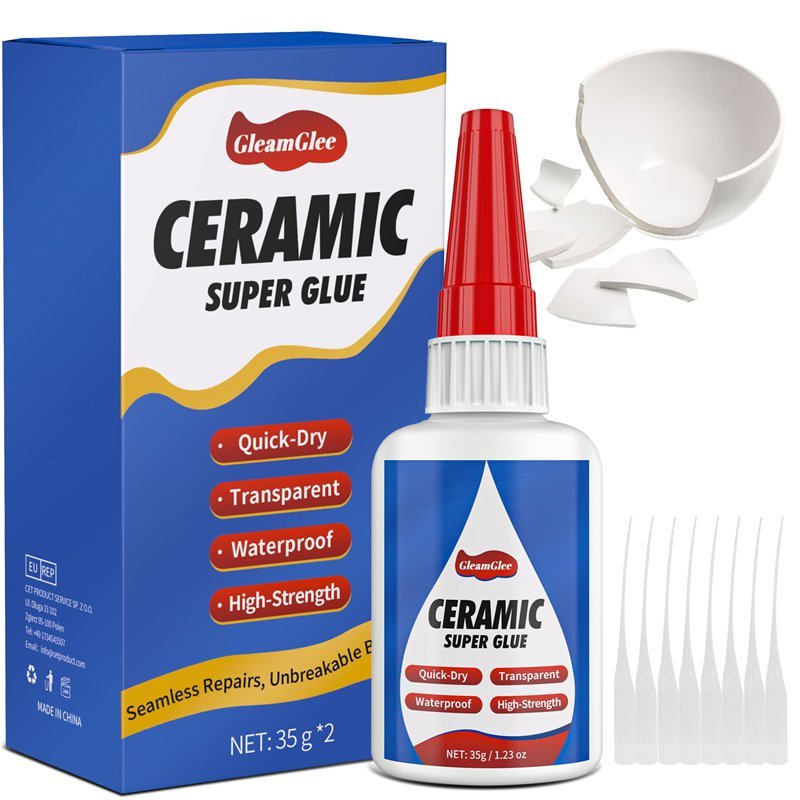
Precision becomes especially important around fingers, flowers, ribbons, accessories, facial details, or narrow clothing folds. A normal bottle opening can dispense much more glue than these areas need, increasing the chance of squeeze-out across the glazed surface. Fine nozzles make it easier to wet only the fracture faces. GleamGlee Ceramic Glue, for example, is supplied with multiple precision nozzles specifically intended for small cracks and difficult locations, allowing users to place a controlled amount of adhesive rather than flooding the surrounding porcelain.
Another useful distinction is the difference between initial grip and full cure. A fast-setting adhesive can hold a lightweight component after several seconds of pressure, which is convenient when clamps cannot be used on delicate figurine parts. That does not mean the repair has reached its maximum strength. Freshly joined pieces should still be protected from vibration, cleaning, packaging, or unnecessary handling while the adhesive continues developing. Treat the first few seconds as the positioning stage rather than the end of the repair process.
| Repair Factor | What to Look For | Why It Matters |
|---|---|---|
| Bond-line thickness | Very thin application | Preserves original alignment |
| Cured appearance | Clear or nearly clear | Reduces visual contrast |
| Application control | Fine precision nozzle | Useful for fingers, petals, and accessories |
| Initial hold | Fast enough for small parts | Reduces movement during positioning |
| Gap filling | Appropriate to fracture | Thin glues are not fillers |
| Working time | Enough for accurate alignment | Prevents rushed placement |
| Long-term behavior | Suitable for intended use | More important for valuable pieces |
Which Glue Works for Clean Breaks?
A clean break is the most favorable type of Lladró repair because the original fracture surfaces can usually guide the pieces back into their correct position. When the part fits naturally, without rocking or leaving a visible gap, the adhesive does not need to rebuild the shape. It only needs to maintain intimate contact between the two porcelain surfaces. This usually favors a thin, controlled ceramic adhesive rather than a thick layer of glue or filler.
Before using any adhesive, place the pieces together several times without glue. Check the fracture from the front, side, top, and any angle from which the figurine will normally be viewed. A hand can look properly positioned from the front while still being slightly rotated from the side. Flower petals and ribbons are even more deceptive because several positions may seem plausible until the neighboring contours are compared carefully. Accurate dry fitting is one of the most effective ways to reduce a visible repair line.
For a clean joint, apply only enough adhesive to wet the bonding faces. A thick bead can hold the parts slightly apart and create a raised seam. The pieces should return to essentially the same position they occupied during dry fitting. If a large ridge of glue appears around the entire fracture after pressure is applied, the amount was probably excessive. Controlled application is particularly important on pale porcelain because glossy residue can reflect light differently from the surrounding surface.
Which Glue Works for Gaps or Chips?
A visible gap means the repair is no longer a simple bonding problem. Thin ceramic adhesive works best when two original surfaces can meet, but it cannot replace missing porcelain. Repeatedly adding more instant glue to a chipped area usually creates a thick polymer-filled seam rather than recreating the original sculpture. The result may be structurally acceptable for a basic household object but visually disappointing on a figurine where the broken area is easy to see.
Small irregular spaces are sometimes better handled with an appropriate two-part epoxy because epoxy can occupy more volume than a thin fast-setting adhesive. This can help when a larger fracture has slightly uneven edges or a small amount of material has been lost. Epoxy also provides more positioning time in many formulations. The trade-off is a thicker bond line, additional mixing steps, greater squeeze-out risk, and more difficult cleanup after curing, all of which matter on lightly colored collectible porcelain.
If a chip affects a flower, face, finger, decorative edge, or another focal area, a convincing restoration may require filling, shaping, surface finishing, and color matching after structural bonding is complete. These procedures go beyond normal glue use. A practical rule is to think of tight complete fractures as bonding problems and missing or crushed material as restoration problems. Recognizing this difference prevents users from trying to solve every form of damage by simply applying more adhesive.
Is Clear Glue Always Better?
Clear glue is usually preferable for visible figurine repairs, but transparency is only one part of the visual result. A colorless adhesive can still create an obvious repair if the layer is thick, contains bubbles, spreads over the glaze, or holds the two pieces slightly apart. The best-looking repair normally comes from accurate alignment and minimal adhesive volume first, with cured clarity supporting those factors rather than replacing them.
The importance of clarity also depends on the location of the break. A seam beneath a base or behind a figurine may tolerate more visible adhesive than a fracture across a hand, face, flower, or garment detail. On pale porcelain, a thin transparent joint can blend surprisingly well when the contours meet correctly. On highly visible areas, even a small glossy residue patch may catch the light and reveal where the repair was made.
For ordinary decorative pieces being restored for personal display, a clear precision ceramic adhesive offers a practical balance between appearance and ease of use. For rare, expensive, or historically important pieces, the decision can be different because long-term stability and future removability may become important. Household repair adhesives and conservation materials are designed around different priorities, so owners should decide whether their goal is practical home repair, high-end visual restoration, or preservation for future professional treatment.

Which Is Better: Ceramic Glue, Epoxy, or Super Glue?
Ceramic glue, epoxy, and super glue each solve different repair problems. Fast-setting ceramic or cyanoacrylate-type adhesives are best suited to small, tightly fitting fractures. Epoxy is more useful when the joint is broader or slightly irregular and requires limited gap filling. For collectible restoration, the decision should also consider seam visibility, working time, aging behavior, and whether future removal may be necessary.
Is Fast-Setting Glue Good for Fine Breaks?
Fast-setting adhesive is particularly useful for lightweight decorative parts where holding perfect alignment for many minutes would be awkward. A detached finger, flower petal, thin ribbon, small ornament, ear, or accessory may provide only a tiny bonding area. When the fracture surfaces fit very closely, rapid initial grip can reduce movement from gravity or hand tremor during the most critical stage of positioning, making these adhesives practical for detailed home repair.
The main disadvantage is limited correction time. An adhesive that develops grip within seconds also leaves very little opportunity to rotate or reposition the piece after contact. Dry fitting should therefore be treated as part of the bonding process rather than an optional preparation step. Before applying glue, rehearse exactly how the part will be picked up, where your fingers will hold it, and which visual reference will confirm the final alignment.
Very small fractures also benefit from precision dispensing because they often need far less than one ordinary drop. A fine nozzle allows the adhesive to be transferred directly to the contact area without coating nearby petals, fingers, clothing folds, or decorative surfaces. GleamGlee Ceramic Glue uses precision nozzles and, according to the supplied directions, can establish an initial connection after approximately 5–10 seconds of firm pressure, making it suitable for carefully prepared lightweight ceramic repairs where quick stabilization is helpful.
Is Epoxy Better for Larger Breaks?
Epoxy becomes more useful as the fracture becomes broader, less regular, or structurally demanding. Two-part epoxy contains resin and hardener that are mixed before application, producing a thicker bonding material than most instant ceramic adhesives. This added body can help bridge small irregularities where the two ceramic surfaces do not meet uniformly, which is why epoxy is commonly considered for larger body sections, broad bases, or more substantial broken components.
The additional working time available with many epoxies can also be an advantage. A large piece may need several contours aligned at once, and a few extra minutes can help the user make small positioning corrections before the adhesive begins to harden. This is very different from a tiny clean flower petal, where rapid initial grip may be more desirable than extended working time.
The disadvantages are equally important. Epoxy must be mixed accurately, and excessive material can create a thick visible seam. It may squeeze onto the surrounding glaze, and once fully cured it is generally more difficult to remove than fresh adhesive. For a large but perfectly fitting clean fracture, epoxy is therefore not automatically superior. Its main advantage appears when the repair genuinely benefits from additional gap-filling ability or working time.
| Adhesive Type | Best Use | Main Advantage | Main Limitation |
|---|---|---|---|
| Precision ceramic glue | Tight porcelain fractures | Clear, controlled application | Limited gap filling |
| Cyanoacrylate-type glue | Tiny close-fitting details | Rapid initial grip | Very short repositioning time |
| Two-part epoxy | Larger irregular joints | Gap filling and working time | Mixing and thicker seam |
| Restoration adhesive | Valuable collectible work | Long-term treatment considerations | Often specialist use |
Does Clear Glue Stay Invisible?
Clear glue can make a repair discreet, but an invisible-looking result depends far more on the geometry of the joint than on the color of the adhesive. If one edge sits slightly higher than the other, light catches the step and reveals the repair immediately. The same happens when a thick layer of transparent adhesive separates the two porcelain surfaces and creates a glossy optical line between them.
This is particularly noticeable on Lladró-style porcelain because the sculptures often depend on smooth continuous contours and subtle colors rather than heavily textured surfaces. A small displacement across a wrist, flower stem, facial edge, garment fold, or animal feature can interrupt those lines. Careful dry fitting and minimal glue application therefore contribute more to visual quality than simply choosing a product labeled “clear.”
Long-term appearance also varies with adhesive chemistry, environmental exposure, and the conditions in which the figurine is displayed. Household users should avoid assuming that a clear adhesive will necessarily remain unchanged for several decades. For an ordinary sentimental piece, this may be an acceptable compromise. For an important collectible where long-term preservation matters, owners may prefer a professional restorer who can select materials according to aging, reversibility, and future conservation needs.
Which Glue Should You Avoid?
Avoid selecting an adhesive only because the package advertises extreme strength. Figurine repair requires a balance between strength, control, appearance, and working behavior. A glue can produce an exceptionally strong bond while still being unsuitable if it cures opaque, leaves a bulky seam, flows uncontrollably into decorative areas, or sets so quickly that proper positioning becomes nearly impossible.
Avoid using repeated layers of thin instant glue as a substitute for missing porcelain. If a physical gap remains because material has been lost, adding more glue does not recreate the original contour. It simply replaces part of the sculpture with a polymer mass that may cure differently from the surrounding ceramic and become more visible over time.
Unknown general-purpose adhesives should also be approached carefully. Some remain soft, some shrink during curing, some dry cloudy, and others are designed for flexible materials rather than glazed porcelain. On an inexpensive decorative object, experimentation may be acceptable. On a rare or cherished Lladró figurine, uncertainty about the adhesive is a good reason to stop and select a product with clearly stated ceramic compatibility or seek professional restoration advice.

How Do You Repair a Broken Lladró Figurine?
A successful Lladró repair follows a careful sequence: collect every fragment, inspect for hidden cracks, dry-fit each piece several times, prepare only the bonding surfaces, apply a very small amount of suitable adhesive, align the joint accurately, and protect the figurine while the bond develops. Most visible repair problems come from rushed alignment or excess glue rather than insufficient adhesive strength.
How Do You Inspect the Broken Pieces?
Start by creating a stable, well-lit work area covered with a soft, pale surface. White or light-colored material makes tiny porcelain fragments easier to find while reducing the risk of another chip if a piece is accidentally dropped. Before sweeping or vacuuming the area where the figurine broke, search carefully for small fragments because even a piece only a few millimeters wide can determine whether a fracture fits tightly again.
Examine more than the obvious detached component. An impact strong enough to break an arm or flower can also create a hairline crack in nearby ankles, stems, wings, accessories, bases, instrument handles, baskets, or animal features. Use strong side lighting and rotate the figurine slowly without flexing delicate parts. Secondary cracks should be identified before the first joint is glued because later handling can cause them to spread.
Photograph the damaged figurine before assembly, especially when several fragments are involved. Place loose pieces on the work surface in their approximate positions and compare the fracture edges. Do not write directly on the porcelain. A photograph or simple paper diagram is enough to keep track of assembly order. This initial inspection often reveals whether the repair is a straightforward two-piece bond or a more complicated reconstruction that should be approached differently.
How Do You Dry-Fit the Pieces?
Dry fitting means placing the broken parts together without adhesive until you are confident about their exact orientation. The irregular microscopic edges created when porcelain fractures can function like a three-dimensional puzzle, helping the pieces return naturally to their original position. The goal is to identify that position without grinding, twisting, or forcing the edges against each other, because aggressive movement can crush fine fracture details.
Check the fit from several directions rather than trusting a single view. A hand may appear correct from the front but point slightly downward when viewed from the side. Flower petals can be particularly difficult because similar curves may make several orientations look plausible. Compare the repaired detail with neighboring features, clothing folds, symmetrical elements, or the original photographs of the figurine if they are available.
For a simple repair, repeat the dry fit at least two or three times until the placement becomes predictable. More complex repairs may need much more rehearsal. If you cannot confidently position the fragment without glue, adding adhesive will not make the task easier. The short working time of many ceramic adhesives means all alignment decisions should be solved before the bottle is opened.
How Much Glue Should You Apply?
For a tight porcelain fracture, less adhesive is usually better than more. The goal is to coat the fracture face with a thin continuous film that wets the surface without forming a thick cushion between the pieces. Too much material can hold the porcelain apart, change the alignment, and squeeze onto the finished surface where cleanup becomes more difficult.
A precision nozzle is especially useful on small Lladró details because the required amount can be a fraction of a normal drop. Place the adhesive directly on the broken surface rather than around it. Once the glue is applied, bring the parts together using the same movement practiced during dry fitting. Press in the direction that closes the fracture rather than sliding the pieces sideways.
According to the supplied GleamGlee Ceramic Glue directions, the bonded pieces can be pressed together for approximately 5–10 seconds to establish the initial grip. That short interval is useful for lightweight figurine components, but it should not be confused with complete curing. After the part stops moving, continue treating the repair gently and avoid bending or testing the joint.
How Long Should the Repair Cure?
Cure time depends on the specific adhesive formulation, joint thickness, temperature, surface contact, and size of the repaired part, so the instructions for the product being used should always take priority. Fast-setting ceramic glue may create an initial bond within seconds, but the internal adhesive layer can continue developing strength long after the fragment appears stable.
After initial bonding, place the figurine somewhere protected from vibration, children, pets, cleaning, packaging, and unnecessary handling. For delicate decorative work, allowing approximately 24 hours of undisturbed time before normal handling is a sensible conservative practice unless the specific adhesive instructions state otherwise. Large joints or thicker adhesive layers may need additional time.
| Cure Factor | Practical Effect |
|---|---|
| Thin close-fitting joint | Usually develops evenly |
| Thick adhesive layer | May require longer cure and look more visible |
| Cool environment | Can slow some adhesive systems |
| Movement during cure | Can weaken or misalign the joint |
| Heavy attached part | Needs more support |
| Early handling | Can damage a bond before full strength develops |
Testing a fresh repair by bending, pulling, or tapping the repaired component is unnecessary. A successful figurine repair is designed to survive normal display and careful handling, not deliberate stress testing. Leaving the joint alone for an adequate period is one of the simplest ways to improve both strength and alignment.
How Do You Make a Lladró Repair Less Visible?
A less visible Lladró repair depends on restoring the original geometry of the figurine, not covering the fracture with more glue. Precise alignment, a thin transparent bond line, minimal squeeze-out, and careful handling create the cleanest result. Missing chips cannot be hidden by clear adhesive alone because both the original shape and surface finish have been lost.
How Do You Prevent Visible Glue Lines?
The most effective way to hide a repair line is to keep the original fracture surfaces as close together as possible. When the pieces fit tightly during dry fitting, they should return to essentially the same position after adhesive is introduced. A thick layer of glue works against this goal because it becomes a spacer that pushes the porcelain apart and creates a wider, more reflective seam.
Alignment is equally important. Lladró-style sculpture depends heavily on continuous visual lines, including arms, sleeves, fingers, flowers, ribbons, clothing folds, animal bodies, and facial contours. Human vision notices even small interruptions in those curves. A transparent adhesive cannot hide a one-millimeter step where two edges fail to line up correctly.
Use side lighting during the dry fit because low-angle light reveals small changes in surface height more clearly than flat overhead lighting. If the joint appears smooth from several angles before gluing, the final result has a much better chance of remaining discreet. If the parts refuse to close naturally, check for a missing chip, crushed edge, or old adhesive rather than forcing them together.
How Do You Remove Excess Glue Safely?
The safest approach to excess glue is to prevent it from appearing in the first place. A tiny porcelain fracture usually needs very little adhesive, and precision dispensing significantly reduces cleanup. If fresh material appears along the edge of a repair, follow the cleanup instructions for the specific adhesive rather than automatically reaching for a common household solvent.
Porcelain itself may tolerate materials that decorative finishes do not. A Lladró figurine can contain glazed, matte, painted, metallic, luster, or previously restored surfaces. Acetone, alcohol, blades, heat, or aggressive rubbing may affect those areas differently from the ceramic body. This is especially important when the repair sits next to facial color, flower decoration, metallic accents, or subtle surface shading.
Once adhesive has cured, cleanup becomes much more difficult. Scraping can scratch glaze or chip a fracture edge, while unfamiliar solvents can affect decorative coatings. If a small amount of residue remains but the repair is otherwise successful, repeated aggressive attempts to achieve absolute perfection can cause more visible damage than the original excess adhesive. On valuable pieces, uncertainty is a good reason to stop.
How Do You Repair Fingers and Flowers?
Fingers, petals, flower stems, ribbons, and other miniature details are among the most demanding porcelain repairs because they combine a very small bonding area with high visual importance. A tiny alignment error at a wrist or petal can be easier to notice than a larger fracture hidden behind the figurine. The part may also be difficult to hold securely without applying excessive pressure.
Work over a shallow tray or cushioned surface so a dropped fragment cannot fall far. Dry-fit the piece repeatedly and compare its orientation with surrounding features. A finger should follow the natural direction of the hand, while a petal should match the spacing, curvature, and height of the nearby flower structure. Do not rely only on how the fracture feels; confirm it visually from more than one angle.
Use a precision nozzle to place the smallest practical amount of adhesive on the fracture face. Heavy clamping is generally unsuitable for delicate components because clamp pressure can exceed the strength of the porcelain itself. Gentle finger pressure or carefully arranged temporary support is usually safer. If the finger or flower is missing entirely instead of detached, the problem has moved beyond adhesive bonding into reconstruction.
Can You Hide Chips or Missing Pieces?
A missing chip remains visible because the original contour has changed, not simply because there is an empty space. Filling the opening with transparent glue does not recreate the ceramic surface and often produces a glossy patch that looks different from the surrounding porcelain. On an inconspicuous underside, leaving a tiny loss visible may be perfectly acceptable after the structural joint has been stabilized.
On a highly visible area, a more complete restoration may require a filler that can be shaped to match the missing form. After shaping, the repaired section may need surface refinement, color matching, and adjustment of gloss or matte character. These processes require different materials and skills from ordinary ceramic gluing, particularly when the original Lladró finish includes subtle color transitions.
Owners should decide what level of restoration they actually need. A figurine can look excellent at normal shelf-viewing distance while still revealing a small repaired chip under close inspection. Trying to achieve museum-level invisibility without professional materials or experience may create unnecessary intervention. For many sentimental home-display pieces, a clean structural repair with a discreet seam is a better outcome than an overworked attempt to erase every sign of damage.
How Do You Fix a Previously Glued Lladró?
Do not place fresh adhesive directly over a failed old repair. Hardened glue can prevent the original porcelain surfaces from fitting correctly and may become the weakest layer in the new joint. Identify the previous adhesive where possible and remove residue only with methods compatible with both the adhesive and the figurine finish. Valuable pieces should be handled conservatively when old glue is unknown.
Why Did the Previous Glue Fail?
A failed repair does not necessarily mean the old adhesive lacked strength. Problems often begin with dirty surfaces, incorrect alignment, excessive glue thickness, movement during curing, or stress concentrated on a small joint. If a fracture was coated with dust, oil, or old residue, part of the adhesive may have bonded to contamination rather than directly to the porcelain.
Joint geometry can also create difficult loads. A repaired hand may have only a small wrist contact area while the fingers project outward several centimeters. Light pressure at the fingertips can act like a lever and concentrate much greater stress at the fracture. Flowers, umbrellas, animal ears, instrument handles, and similar protruding components behave in much the same way.
Premature handling is another common cause. A fast-setting adhesive may feel secure shortly after application while still developing strength internally. Moving, packaging, wiping, or repeatedly “checking” the repair can disturb the joint during this stage. Before changing to a different glue, identify what caused the original failure so the same preparation or handling mistake is not repeated.
Can You Glue Over Old Adhesive?
Applying new glue directly over an unknown cured layer is usually a poor repair strategy. The fresh adhesive is no longer bonding clean porcelain to clean porcelain; it is bonding to an aged polymer whose chemistry, surface condition, and attachment strength may be uncertain. Even if the new adhesive grips that layer strongly, the original failed material can remain the weakest part of the joint.
Old residue also interferes with alignment. On a finely modeled figurine, a hardened layer considerably smaller than 1 mm may be enough to create a visible step at a wrist, flower, sleeve, or face detail. Adding another adhesive layer only increases the separation and moves the parts farther from their original position.
Before rebonding, perform another dry fit. If the surfaces rock, stop short of full closure, or form a raised edge, existing adhesive or missing porcelain may be interfering. Do not compensate with more glue. If the old material is difficult to identify or extends across decorated areas, professional removal is generally safer than experimenting with several different solvents or mechanical tools.
How Do You Remove Old Glue?
The appropriate removal method depends heavily on what the old adhesive actually is. Cyanoacrylate, epoxy, silicone, craft glue, and contact adhesive can look different and respond differently to solvents, heat, or mechanical treatment. Begin by observing the residue: note whether it is thin and glassy, thick and hard, flexible, rubbery, clear, yellowed, or spread beyond the fracture surface.
Avoid soaking the complete figurine in liquid or applying aggressive heat. Do not pry the parts apart by force simply because porcelain feels rigid. Small decorative elements remain brittle, and pressure intended to break an adhesive layer can remove original ceramic at the fracture edge instead.
Blades are particularly risky near visible areas because one slip can scratch the glaze or remove painted decoration. Strong solvents may soften one adhesive while leaving another almost unchanged, and decorative finishes can introduce additional uncertainty. If removal begins to require increasing force, repeated chemical trials, or scraping close to paint or metallic decoration, the repair has moved into a level of risk better handled by a professional restorer.
When Should You Stop a Failed DIY Repair?
Stop when the repair becomes less predictable than the original fracture. Several layers of old adhesive, missing fragments, unstable paint, metallic decoration, multiple misaligned pieces, or joints that require physical force are strong signs that another home attempt may create more damage rather than improve the object.
Uncertainty about the obstruction between the pieces is another warning sign. If the joint will not close and you cannot determine whether the cause is cured adhesive, crushed porcelain, an overlooked fragment, or missing material, repeated scraping and solvent testing may remove original material while failing to solve the real problem.
The value of the figurine should influence the decision as well. A common decorative piece repaired primarily for sentimental display may justify a careful second home attempt. A rare, discontinued, inherited, or expensive Lladró should have a much lower tolerance for experimentation. Preserving the current condition for a restorer can sometimes be the most practical decision, even when it means leaving the figurine unrepaired for the moment.

When Is Professional Lladró Restoration Better?
Professional restoration is usually the safer choice when a Lladró has missing porcelain, several interlocking fragments, uncertain alignment, extensive old adhesive, damaged painted or metallic finishes, or significant financial value. DIY ceramic glue is best reserved for clean, complete, straightforward fractures. A restorer can address reconstruction, color matching, old adhesive removal, and preservation issues that household glue alone cannot solve.
Is a Clean Break Safe to Repair Yourself?
A simple clean fracture is the strongest candidate for home repair. The ideal situation involves one complete detached piece, no missing porcelain, no old glue, and fracture surfaces that return naturally to their original position during repeated dry fitting. When the seam almost disappears before adhesive is applied, a clear precision ceramic glue can often produce a neat and durable practical repair.
Small lightweight details such as a complete hand, accessory, decoration, or small sculptural element can be particularly suitable when alignment is obvious. A precision nozzle helps keep adhesive inside the fracture rather than spreading it across the finished surface. GleamGlee Ceramic Glue is designed for ceramic and porcelain and includes multiple fine nozzles, while its supplied instructions specify approximately 5–10 seconds of firm pressure for the initial bond.
The qualification is collectible value. A fracture can be mechanically simple while still affecting an expensive object. If the figurine is rare, limited, inherited, or important to a serious collection, professional assessment may still be worthwhile because household adhesives are generally intended to create permanent practical bonds rather than conservation-style reversible treatments.
Are Multiple Fragments Hard to Repair?
Multi-fragment repair becomes significantly more difficult because each bonded section affects the position of every remaining piece. A two-piece fracture usually involves one main alignment problem, while four or five fragments can require several edges to close simultaneously. A small error in the first joint can create a much larger gap by the time the final piece is added.
Before applying adhesive, assemble as much of the damaged area as possible without glue and determine the correct sequence. Some fragments physically block others once they are attached, so the most obvious piece may not be the correct first piece. Photograph the arrangement before starting and rehearse each movement until the order is clear.
Complex repairs may also require temporary supports while several joints develop strength. Improvised clamps or elastic pressure can easily damage delicate porcelain if used too aggressively. When the assembly sequence is uncertain, multiple pieces will not remain aligned, or several joints must close at the same time, professional restoration offers a much lower risk of locking the figurine into an incorrect shape.
Do Missing Pieces Need a Restorer?
Missing pieces are one of the clearest dividing lines between ordinary gluing and restoration. Adhesive can reconnect original material, but it cannot create a missing finger, flower petal, ribbon end, ear, facial edge, or section of clothing. Reconstructing these details requires a replacement material that can be shaped to match the original sculpture and securely attached to a very small remaining surface.
After the missing form is rebuilt, its color and finish may also need to be matched. Lladró-style porcelain often contains subtle shading, matte areas, glossy sections, or delicate decorative transitions that are more difficult to reproduce than a flat single-color ceramic surface. A structurally successful fill can still look obvious if its tone or reflectivity differs from the original area.
Some owners choose not to reconstruct very small losses, especially if the figurine is primarily a sentimental display piece. Rejoining the surviving components cleanly and accepting a minor missing detail can be a reasonable choice. The important point is to recognize that adding extra household adhesive will not replace lost porcelain and can make a later professional reconstruction more difficult.
Does Repair Affect Collectible Value?
Condition is an important part of how collectibles are assessed, so a repaired figurine should not automatically be regarded as equivalent to an undamaged example. Even an excellent repair may remain relevant to future collectors. However, once an object is already broken, the more useful question is how to restore appearance and stability without introducing unnecessary additional damage.
A thin, well-aligned repair can return excellent display quality and preserve the visual character of a sentimental piece. A thick or crooked repair with visible residue can create a second problem and may make future professional work more complicated. The quality and reversibility of the intervention therefore matter alongside the fact that a repair occurred.
For many owners, resale value is not the primary concern. Returning a family figurine to the cabinet may matter more than maintaining perfect collector condition. For expensive or rare pieces, professional assessment provides an opportunity to consider both current restoration and future retreatment. The following framework can help owners decide how much DIY risk is reasonable.
| Figurine Condition | DIY Repair | Professional Restoration |
|---|---|---|
| One complete clean break | Often reasonable | Optional for valuable pieces |
| Complete tiny finger or petal | Possible with precision | Better if alignment is uncertain |
| Three or more interlocking fragments | High difficulty | Usually preferred |
| Missing porcelain | Limited benefit | Usually preferred |
| Old hard adhesive present | Higher risk | Recommended |
| Paint or metallic finish damaged | Glue alone is insufficient | Recommended |
| Rare or expensive collectible | Greater consequence | Strongly worth considering |
| Common sentimental display piece | Often practical | Personal choice |
Conclusion
Repairing a Lladró figurine successfully is less about finding the strongest glue and more about matching the adhesive and technique to the exact fracture. A complete, close-fitting hand, flower, ornament, or other small component can often be repaired effectively with a clear precision ceramic adhesive when the pieces are thoroughly dry-fitted and only a thin layer is applied. Larger imperfect joints may benefit from a different adhesive system, while missing material, old failed repairs, and complex fragmentation belong closer to the restoration end of the spectrum.
For straightforward porcelain repairs around the home, precision remains one of the most useful qualities an adhesive can offer. GleamGlee Ceramic Glue is designed for ceramic and porcelain surfaces, dries clear, includes multiple fine nozzles, and provides rapid initial grip for carefully prepared small repairs. Those characteristics are particularly relevant to figurines where controlling a fraction of a drop can matter more than applying a large amount of adhesive. The same product category can also be adapted for retailers, private-label projects, and customized packaging requirements where different application formats or market positioning are needed.
A well-repaired figurine does not need to survive deliberate strength testing to be successful. It needs to return to its shelf with the original shape restored, the joint stable, and the repair as unobtrusive as reasonably possible. Sometimes that result comes from an extremely small amount of well-placed ceramic glue. In other situations, the best decision is recognizing that the porcelain deserves the patience and skills of a professional restorer.

Frequently Asked Questions
What is the best glue for a broken Lladró figurine?
For a clean fracture where the original porcelain surfaces fit tightly, a clear precision ceramic or porcelain adhesive is usually the most practical home-repair option. Fine dispensing is important because Lladró figurines often contain small visible details where excess adhesive becomes obvious. Larger irregular joints may be better suited to epoxy, while rare, fragmented, previously repaired, or highly valuable figurines should be assessed more conservatively because professional restoration can address issues that ordinary glue cannot.
Can I use super glue on a Lladró figurine?
A cyanoacrylate-type fast-setting adhesive can work on very close-fitting porcelain breaks, especially tiny lightweight parts such as fingers, petals, hands, or small accessories. Its main advantage is rapid initial grip, while its main disadvantage is very limited repositioning time. If you choose this type of adhesive, dry-fit the piece repeatedly before application and use a minimal amount. It is less suitable for wide gaps, missing porcelain, or repairs where several fragments require extended alignment time.
Is epoxy better than ceramic glue for porcelain figurines?
Epoxy is better in some situations but not all. A two-part epoxy is useful when fracture surfaces are slightly irregular, the joint needs limited gap filling, or a larger piece requires more positioning time. Precision ceramic glue is often easier to use on small, tightly fitting fractures because it can form a thinner bond line and requires no mixing. The correct choice depends on the geometry of the break rather than assuming that epoxy is automatically stronger or more appropriate.
How do I repair a broken Lladró flower or finger?
If the complete original finger, petal, or flower component is available, first work over a soft surface and dry-fit the fragment until its orientation is obvious. Apply a very small quantity of clear precision ceramic adhesive directly to the fracture surface, bring the part into position using the movement already rehearsed, and hold it gently while the initial bond develops. If part of the finger or flower is missing, adhesive alone cannot recreate the original shape and professional reconstruction may produce a better result.
How long should ceramic glue cure on a Lladró figurine?
Curing instructions vary by adhesive, so the product directions should always take priority. Fast-setting ceramic glue can establish enough initial grip to hold a lightweight part after several seconds, but this should not be treated as complete cure. For delicate figurine repairs, leaving the piece undisturbed for approximately 24 hours before normal handling is a sensible conservative practice. Large joints, thick adhesive layers, or cooler working environments may require additional curing time.
Can I remove old glue from a Lladró figurine and repair it again?
Old glue can sometimes be removed, but the safest method depends on whether the previous adhesive is cyanoacrylate, epoxy, silicone, craft glue, or another material. New adhesive should generally not be applied directly over a failed cured layer because the old glue can prevent accurate alignment and remain the weakest part of the joint. If removal requires strong solvents, heat, scraping near decorative surfaces, or significant force, professional restoration is safer than continued experimentation.
Should an expensive Lladró figurine be repaired professionally?
Professional restoration is worth serious consideration when the figurine is rare, expensive, heavily fragmented, missing original material, covered with old repair adhesive, or damaged across painted, metallic, or highly visible areas. A simple complete fracture may still be manageable at home, but permanent DIY bonding changes the condition of the collectible. For financially significant pieces, a professional can consider reconstruction, color matching, old adhesive removal, long-term stability, and future retreatment rather than focusing only on immediate bonding strength.
Share:
Table of Contents
Here, creating your adhesives glue & removal cleaner collection is no longer a barrier—it’s a collaborative journey where GleamGlee helps brands and businesses transform their vision into durable, certified, and market-ready solutions.
Partner with GleamGlee
Join hundreds of global partners who trust GleamGlee for adhesives and cleaners that combine innovation, compliance, and speed. Our vertically integrated system—from R&D to warehouse—guarantees consistent performance and reliable delivery.
Whether you’re sourcing FBA-ready stock or developing your own formula, our team provides unmatched technical support and responsive service.