Skip to content

Transparent Wood Glue for Fine Woodwork: A Discerning Guide
Your trusted adhesives glue & cleaner manufacturer

A woodworking joint can be perfectly strong and still look disappointing. That problem becomes obvious when a carefully fitted maple frame, decorative wooden box, repaired cabinet, miniature model, or visible furniture joint is finished beautifully everywhere except for a yellow, cloudy, or oversized glue line cutting across the grain. Fine woodwork asks more from an adhesive than simple holding power. The glue must suit the joint, stay where it is placed, give the user enough control, cure reliably, and leave as little visual evidence as possible after the project is sanded and finished.
Transparent wood glue is especially useful when appearance matters as much as bonding performance. It can reduce visible glue lines on exposed joints, light-colored woods, furniture repairs, models, crafts, decorative parts, and other precision applications. The best results come from combining clear curing with tight joint fit, controlled adhesive volume, proper holding or clamping, complete curing, careful squeeze-out removal, and suitable surface preparation before staining or applying a clear finish.
Consider a narrow split at the corner of a pale birch display box. The repair may require only a small amount of adhesive, yet those few drops can determine whether the eye sees restored wood grain or a shiny repair scar every time light crosses the corner. That difference explains why choosing a clear adhesive is only the beginning. In fine woodwork, application control, surface preparation, and finishing discipline matter just as much as the color of the cured glue.
What Is Transparent Wood Glue?
Transparent wood glue is an adhesive designed to cure clear, translucent, or nearly colorless so the bond line is less noticeable after assembly. The term describes the appearance of the cured adhesive rather than one specific chemistry. A suitable product should therefore be judged by clarity together with bond strength, working time, curing behavior, moisture resistance, substrate compatibility, sandability, and application control.
What Does “Dries Clear” Mean?
“Dries clear” means the visible adhesive film becomes transparent, translucent, or nearly colorless after the carrier evaporates or the formulation cures. In woodworking, this does not necessarily mean the glue becomes optically invisible like glass. A thick cured drop may still look slightly cloudy, while the same adhesive inside a tight wood joint can become very difficult to see because the actual bond line is extremely thin.
Wood species and surface condition also affect the result. Pale maple, birch, beech, basswood, ash, and light plywood tend to reveal yellow or amber glue lines more easily than darker woods. Clear-drying adhesive can therefore make a noticeable visual difference on picture frames, decorative boxes, miniature parts, furniture repairs, craft projects, and exposed edge joints where even a narrow line can interrupt the grain.
The surface around the joint matters as much as the glue itself. A colorless film left on raw wood can still reflect light differently from the surrounding fibers, particularly after sanding or clear coating. For this reason, the practical objective is not to make every drop of adhesive invisible. The objective is to keep the bond line thin, controlled, and visually quiet enough that the wood remains the dominant feature.
| Term | Practical Meaning | What It Does Not Guarantee |
|---|---|---|
| Clear-drying | Low-color cured film | Automatic stain compatibility |
| Translucent | Light passes through the cured film | Complete invisibility in thick layers |
| Nearly invisible joint | Low-contrast bond line under normal viewing | Invisible surface residue |
| Sandable | Cured adhesive can be leveled mechanically | Easy cleanup on every wood species |
| Fast-setting | Early grab develops quickly | Immediate full cure |
Is Clear Glue Different From PVA Glue?
Clear wood glue and PVA wood glue are not opposite categories. PVA describes a common adhesive chemistry, while “clear” generally describes the cured appearance. Some clear woodworking products are water-based PVA adhesives, while other transparent repair products use faster-setting systems designed for cracks, small components, mixed-material repairs, or detailed projects where long clamping times would be inconvenient.
This distinction matters because two products that both dry clear can behave very differently. One may provide several minutes of open time for furniture assembly, while another may grab within seconds. One may be designed mainly for porous wood-to-wood bonding, while another may also support selected metal, plastic, or ceramic applications. Moisture resistance, viscosity, flexibility, sanding behavior, and final cure time can also vary considerably.
Conventional PVA glue remains highly effective when two wood surfaces fit closely together and can be held under pressure during curing. Faster transparent formulations are often more convenient for narrow cracks, picture frames, models, small furniture components, ornaments, and household repairs. The right choice therefore depends less on whether the product is called “clear” or “PVA” and more on how its full performance profile matches the actual project.
Is Transparent Glue Completely Invisible?
Transparent wood glue should not be assumed to disappear completely in every project. Bond-line visibility depends on adhesive thickness, joint fit, wood color, surface texture, sanding quality, finish type, viewing angle, and lighting. A clear adhesive can reduce color contrast, but it cannot hide a large gap, missing wood fibers, an uneven break, or a poorly aligned joint simply because the cured film has little color.
A tightly fitted joint usually produces the cleanest result because only a very thin layer of adhesive remains between the parts. When the gap becomes wider, the adhesive itself begins to form part of the visible structure, and even a transparent material can appear glossy or slightly different from the surrounding wood. This is one reason experienced woodworkers treat good joint preparation as the first step toward an invisible repair.
For appearance-sensitive work, a small offcut test is extremely useful. Bond two pieces from the same wood, allow the adhesive to cure fully, sand them with the same abrasive sequence planned for the final project, and apply the intended stain or clear coat. This simple test shows how the complete glue-and-finish system behaves under real conditions instead of relying only on the appearance of the uncured adhesive.

Why Does Clear Glue Matter in Fine Woodwork?
Clear glue matters in fine woodwork because a visible adhesive line can distract from matched grain, precise joints, decorative edges, and carefully finished surfaces. Transparent curing reduces the color contrast inside exposed seams, but it delivers the best result only when joint fit, glue volume, cleanup, sanding, and finishing are controlled with the same level of care.
Why Are Glue Lines Visible?
Glue lines become visible when the cured adhesive differs from the surrounding wood in color, gloss, thickness, texture, or finish absorption. Traditional yellow or amber wood glue may create an obvious stripe in pale timber, while even a clear formula can become noticeable if too much material remains on the surface and forms a glossy ridge beside the actual joint.
The problem often becomes more obvious after finishing. Raw wood can hide small areas of adhesive contamination surprisingly well, particularly on pale species. Once stain, oil, lacquer, polyurethane, or another finish is applied, glue-covered fibers may absorb color differently from untreated wood. The result may be a lighter patch, a dull spot, or a reflective area that attracts more attention than the original seam.
Joint geometry also plays a major role. Well-fitted woodworking joints require a thin adhesive layer, while loose joints leave more room for cured glue to become visible. This is especially important in fine work because adhesive should reinforce the joint rather than become the material that visually fills it. Good machining, careful repair preparation, and accurate alignment often do more for appearance than switching products alone.
Which Woods Show Glue Lines Most?
Light-colored woods usually make contrasting adhesive easier to see. Maple, birch, beech, ash, basswood, pale plywood, and many craft timbers provide less natural color variation to disguise an amber or yellow line. Decorative veneers can be even less forgiving because heavy sanding is not an option when the visible face layer may be only a small fraction of the total panel thickness.
Open-grained woods such as oak and ash create another issue. Their natural pores may visually break up a narrow seam, yet excess adhesive can enter the surrounding grain and interfere with stain absorption. In this situation, the repair may look acceptable before finishing but develop a pale halo once the wood is stained because the contaminated fibers no longer respond like the rest of the surface.
Highly figured woods deserve similar attention. Curly maple, birdseye maple, figured walnut, and decorative veneers are selected because the eye follows the grain. A straight artificial line across that natural movement can become noticeable even when it is very narrow. Transparent adhesive helps reduce contrast, but accurate placement and disciplined cleanup remain essential when appearance is the main reason the wood was chosen.
Does Clear Glue Improve the Finished Look?
Clear glue can improve the finished appearance when the bond line would otherwise contrast with the wood. The benefit is most obvious on picture frames, small furniture parts, decorative boxes, miniatures, visible edge repairs, light-colored timber, wooden ornaments, display pieces, and other objects that are viewed closely rather than simply used as hidden structural assemblies.
The main advantage is visual neutrality. Instead of introducing a yellow or cloudy line between two pieces, a clear-drying adhesive allows grain, finish, and shape to remain visually dominant. That does not make surface preparation unnecessary. Transparent residue can actually be harder to notice on raw wood, which means the user must inspect the project carefully before staining or applying a clear topcoat.
A practical way to think about transparent adhesive is as an additional safeguard inside the seam rather than a replacement for good technique. Clear curing reduces one source of visual contrast. Controlled dispensing, correct pressure, careful cleanup, sanding, and finish preparation reduce the others. When all of those steps work together, the glue line becomes something the viewer stops noticing rather than something the maker has to explain.
Which Projects Benefit From Clear Wood Glue?
Clear wood glue is most useful where the seam remains visible, the parts are small or detailed, or excess adhesive would spoil the finished appearance. Common applications include furniture repair, frames, decorative crafts, models, boxes, toys, shelving, small cracks, household repairs, and selected mixed-material assemblies where neat application matters as much as reliable adhesion.
Is It Good for Furniture Repair?
Transparent wood glue is particularly useful for furniture repairs where the repaired area remains visible after the work is complete. Cracked table edges, separated cabinet panels, loose decorative trim, split drawer parts, picture frames, shelving, and certain chair components can all benefit from a low-visibility bond line, especially when the surrounding wood will remain natural rather than being painted.
Structural demand still has to be assessed carefully. Reattaching a decorative strip is different from repairing a chair joint that supports a person. Load-bearing furniture repairs depend on sound wood, correct joint geometry, suitable adhesive coverage, proper alignment, enough pressure where required, and sufficient cure time before the piece is returned to service. Clear curing is valuable, but strength and joint integrity come first in safety-relevant areas.
Fast-setting transparent formulas can be convenient for localized repairs because they reduce the time small parts need to be held manually. Precision nozzles are especially useful for reaching cracks and narrow seams without spreading adhesive over surrounding finished surfaces. For valuable antiques or historically significant objects, however, conservation requirements may call for reversible or traditional adhesive systems rather than a modern permanent repair glue.
| Furniture Repair | Main Requirement | Value of Clear Glue |
|---|---|---|
| Picture frame corner | Accurate fit and low-visibility seam | Very high |
| Cabinet trim | Clean application and neat finish | High |
| Drawer crack | Penetration into a narrow split | High |
| Table edge split | Strength and finishing compatibility | High |
| Decorative molding | Small controlled adhesive volume | Very high |
| Load-bearing chair joint | Strength, fit, and structural reliability | Secondary to structure |
Is It Good for Crafts and Models?
Clear wood glue is highly practical for crafts and models because small components magnify every application mistake. Balsa structures, dollhouses, miniature furniture, model ships, decorative boxes, wooden jewelry, ornaments, signs, frames, school projects, and hobby displays often use parts only a few millimeters wide, so a broad bead of adhesive can cover a large percentage of the visible surface.
Fine-tip application becomes especially valuable in this context. A narrow nozzle allows the user to place a small dot or thin line directly along the joint rather than coating the surrounding wood. This reduces cleanup and makes it easier to keep stain, paint, or clear finish areas free from adhesive contamination. Products supplied with several precision nozzles are particularly convenient for repeated model work or a series of small household repairs.
Fast setting can also help because traditional clamps are difficult to position on very small pieces. The trade-off is reduced repositioning time, so dry fitting becomes important. When a model section contains several components that must be aligned together, a slower formulation may still be more suitable. Small parts benefit from speed only when the assembly sequence is simple enough to complete before the adhesive begins to grab.
Can It Bond Wood to Other Materials?
Some transparent wood adhesives can bond wood to selected metals, plastics, ceramics, and other materials, which is useful in modern DIY projects containing more than one substrate. Wooden handles may connect to metal fittings, decorative boxes can include ceramic elements, furniture may use plastic trim, and craft projects often combine wood with several non-wood components in a single assembly.
Compatibility depends on the actual formulation. Traditional PVA wood glue generally performs best on porous materials, particularly wood-to-wood joints, while nonporous surfaces may require different chemistry. Smooth metal, glazed ceramic, factory-finished wood, and many plastics can be much harder to bond because the adhesive has less opportunity to penetrate or mechanically key into the surface.
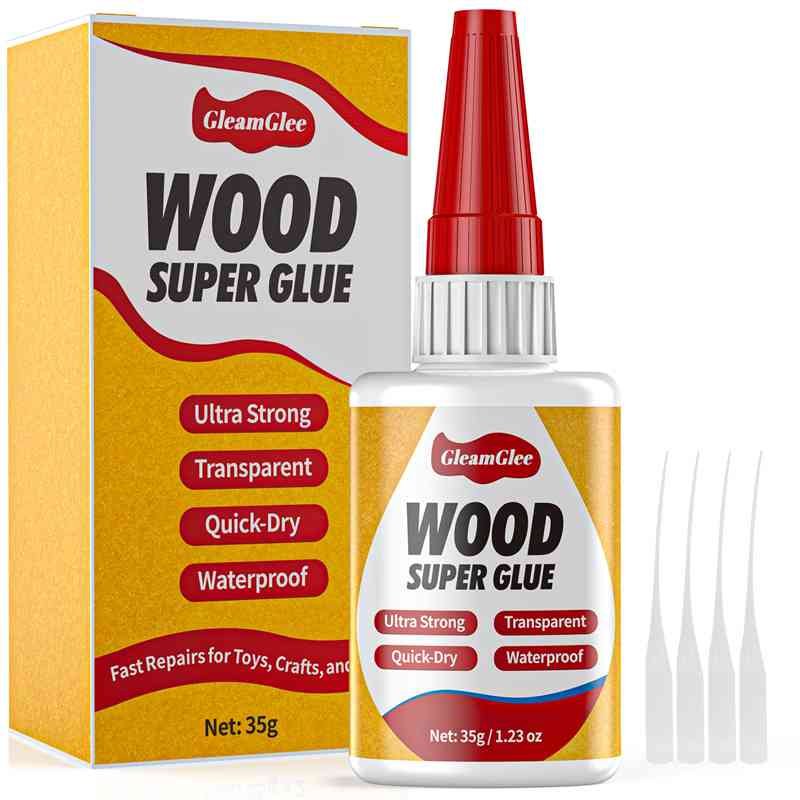
EPN’s current transparent wood glue is designed not only for wood but also for selected metal, plastic, and ceramic repairs, making it useful for mixed-material household and workshop projects. Even so, the safest practice is to test the exact substrates when the joint will carry meaningful load, experience movement, or remain exposed to moisture. “Multi-purpose” is helpful as a category description, but real material compatibility should always be confirmed in practical use.

How Do You Make Glue Joints Look Invisible?
Nearly invisible glue joints come from close-fitting parts, controlled adhesive volume, accurate placement, appropriate holding or clamping, complete curing, and careful cleanup. A clear-drying adhesive reduces color contrast inside the seam, but the finished appearance still depends more on preparation, glue-line thickness, squeeze-out control, sanding, and surface finishing than on transparency alone.
How Much Glue Should You Apply?
Apply enough glue to cover the mating surfaces completely without leaving an unnecessarily thick reservoir inside the joint. There is no universal number of drops because the correct amount depends on joint area, wood porosity, adhesive viscosity, surface condition, and formulation. The practical target is complete wetting across the bond area with as little excess as reasonably possible.
Too little adhesive can leave dry sections that weaken the bond, while too much creates squeeze-out and increases the chance of surface contamination. Once proper coverage has been achieved, adding more glue does not automatically make the joint stronger. In fine woodworking, excess adhesive often creates more finishing work without offering a meaningful mechanical advantage.
For narrow cracks, the challenge is reaching the full depth of the damaged area. A large bead applied only at the opening may make the crack look filled while leaving deeper surfaces poorly bonded. Fine extension tips help introduce adhesive where the two surfaces actually meet. This is one reason precision applicators are particularly useful for furniture cracks, models, frame corners, decorative components, and narrow household repairs.
How Do Precision Tips Help?
Precision tips improve control by positioning the adhesive outlet close to the actual bond line. Instead of dispensing a broad bead near a crack and pushing glue across the surrounding surface, the user can deliver a smaller amount directly into narrow joints, miniature components, frame corners, furniture splits, decorative edges, and confined repair areas where cleanup would otherwise be difficult.
This control produces several practical benefits at once. It reduces adhesive waste, limits squeeze-out, and lowers the chance of contaminating wood that later needs to accept stain or finish. It also makes fast-setting products easier to manage because less time is spent wiping away excess adhesive after the pieces have already begun to bond.
EPN’s current transparent wood glue is supplied with four fine-tip nozzles per tube, with eight nozzles in a two-pack. That packaging detail is useful for repeated small repairs, especially when a nozzle becomes blocked after storage. The accessory may appear simple, but in precision woodworking the applicator is part of the overall performance system because cleaner dispensing directly supports cleaner finished joints.
Do You Need to Clamp Wood Glue?
Clamping requirements depend on adhesive chemistry, set speed, joint design, wood density, and product instructions. Conventional PVA woodworking glue usually needs sustained pressure while the adhesive develops early strength, while fast-setting repair formulas may require only brief firm positioning. The important distinction is that initial grab, handling strength, and full cure are not the same stage.
A joint can feel secure within seconds or minutes and still require additional time before it is ready for load, vibration, outdoor exposure, or repeated movement. Furniture, shelving, outdoor items, and other functional repairs should therefore remain unloaded until the product has reached the recommended cure condition. Returning the piece to service too soon is one of the easiest ways to turn a good-looking repair into a premature failure.
Clamp pressure should also be reasonable. The purpose is to bring the mating surfaces into close contact, not to squeeze every trace of adhesive out of the joint. Excessive pressure can starve some joints, while insufficient pressure may leave a visible gap. Fast-setting precision formulas require the same judgment, even when conventional clamps are not used.
| Step | Practical Check | Main Risk If Skipped |
|---|---|---|
| Dry fit | Parts close correctly before gluing | Wide or uneven bond line |
| Clean surfaces | Dust, grease, and failed old glue removed | Reduced adhesion |
| Apply controlled amount | Full coverage without flooding | Excess squeeze-out |
| Align immediately | Joint sits in final position | Visible misalignment |
| Hold or clamp | Pressure suits the adhesive and joint | Joint movement |
| Allow full cure | Product instructions are followed | Premature failure |
| Inspect before finish | Residue is removed | Stain or clear-coat defects |
How Do You Remove Squeeze-Out?
Squeeze-out should be handled according to the adhesive formulation instead of using one cleanup method for every glue. Some water-based products can be removed while wet, while other adhesives are easier to trim, scrape, or sand after they have reached a defined stage of cure. The aim is to remove excess without spreading it deeper into the surrounding wood fibers.
Aggressive wiping can create a larger finishing problem than the original bead, particularly on open-grained species such as oak or ash. A surface may look clean while wet but later develop a pale stain-resistant area because adhesive has been pushed into the pores. Inside corners are especially difficult to correct after assembly, so preventing excess in those locations is often better than depending on cleanup.
After curing, inspect the joint under low-angle side lighting. Transparent residue often reflects light differently from bare wood and becomes much easier to see from this perspective. Running a fingertip lightly over the surface can also reveal raised adhesive. The cleaner the glue-up process is from the beginning, the less corrective sanding is needed around sharp edges, thin veneers, and delicate decorative profiles.
Is Clear Wood Glue Compatible With Finishing?
Clear wood glue can work well in sanded, painted, stained, or clear-coated woodworking, but clear curing does not automatically mean the adhesive itself will accept stain. Residue left on the wood can block penetration or reflect light differently under a finish, so exposed glue should be removed, fully cured surfaces should be inspected carefully, and important projects should be tested on scrap first.
Can You Sand Transparent Wood Glue?
Many transparent woodworking adhesives can be sanded after full cure, although sanding behavior varies by formulation. The adhesive should be sufficiently hardened before abrasive work begins. Sanding too early can smear soft glue across the grain, clog abrasive paper, pull material from the bond line, or create a contaminated area that becomes more difficult to finish evenly.
The type of wood determines how aggressively sanding can be used. Solid hardwood usually gives the user more margin than thin veneer, balsa, decorative laminate, or sharply profiled trim. On veneer, removing only a small amount of material may expose the core beneath, which creates a far more obvious defect than the original glue residue.
After sanding, examine the repaired area from several directions. Clear adhesive can be visually subtle under direct overhead lighting but become obvious when light travels across the surface at a low angle. A professional finish depends on removing residue without changing the geometry of the surrounding wood, so careful application before cure remains more effective than relying on heavy sanding afterward.
Can You Stain Over Clear Wood Glue?
Do not assume that a clear wood glue is stainable simply because the cured material has little or no visible color. Wood stain changes appearance by penetrating or coloring exposed fibers. If cured adhesive seals those fibers, the surrounding wood may darken normally while the glue-covered area remains lighter, creating a patch that is often more noticeable than the original bond line.
This problem is common because transparent residue can be difficult to see on raw pale wood. The glue-up may look excellent before finishing, only for the contaminated area to become obvious after stain is applied. The issue is not necessarily the color of the adhesive. It is the difference in surface absorption between clean wood and wood that has been sealed by cured glue.
For valuable projects, test the complete finishing system on an offcut. Use the same wood species, adhesive, curing time, sanding grit, stain, and topcoat planned for the final piece. In production environments, this type of compatibility test should be part of adhesive qualification because a mechanically strong bond can still be unacceptable if it repeatedly creates visible finishing defects.
How Do You Prevent Finish Marks?
Finish marks are best prevented before the adhesive cures. Dry-fit the assembly, apply only enough glue for full coverage, control squeeze-out, and pay particular attention to inside corners and decorative profiles that will be difficult to sand later. Good application control reduces finishing problems far more effectively than trying to correct a large cured glue film afterward.
Once the adhesive has cured, inspect the wood under strong side lighting rather than relying only on overhead workshop light. Glossy patches, raised ridges, or areas with different surface texture can indicate remaining adhesive. Sand evenly through the same grit sequence used on the surrounding wood so the repaired area does not develop a depression, rounded edge, or different scratch pattern.
Before applying an expensive stain or high-gloss clear coat, test a small sample whenever possible. High-gloss finishes tend to reveal surface differences more strongly than matte finishes, while darker stains can make sealed fibers particularly noticeable. The most reliable finishing rule is straightforward: keep glue where the joint needs it and keep exposed wood clean where the finish needs to penetrate.
Which Transparent Wood Glue Should You Choose?
Choose transparent wood glue by matching the adhesive to the project rather than selecting on clarity alone. Compare bond strength, working time, cure behavior, moisture resistance, substrate compatibility, application control, sandability, and finishing requirements. Fine decorative repairs may favor rapid precision bonding, while larger furniture assemblies may require more open time or a different moisture-performance level.
Is Fast-Drying Glue Better?
Fast-drying glue is better when the project benefits from quick positioning and short handling time. Narrow cracks, miniature components, decorative parts, picture frames, wooden toys, model assemblies, and localized furniture repairs often fall into this category because the user can dry-fit the pieces first and complete the bond in a simple, controlled sequence.
The advantage becomes smaller in complicated assemblies. Cabinets, large frames, multi-dowel joints, furniture structures, and panel work may require several minutes to apply adhesive, align components, square the assembly, and install clamps. A formula that grabs too quickly can create unnecessary pressure and may actually reduce accuracy when several parts must be adjusted at the same time.
EPN’s transparent wood glue is designed to set in seconds, making it well suited to small repairs and detailed applications where rapid early grab is useful. That speed also means preparation matters more. The parts should already fit correctly before adhesive is dispensed. As with any fast-setting product, initial firmness should not be confused with complete cure, particularly when the joint will carry load or experience moisture.
Do You Need Waterproof Wood Glue?
Waterproof or water-resistant wood glue becomes important when a project is exposed to humidity, repeated dampness, occasional water contact, garden use, or outdoor conditions. Indoor decorative work in a stable room may not need the same level of moisture performance, so water resistance should be matched to the real service environment instead of being treated as a universal indicator of quality.
The terminology deserves careful attention. “Water-resistant,” “weather-resistant,” “waterproof,” and “suitable for continuous immersion” do not describe the same exposure level. A product that performs well on garden furniture or a fence may still be unsuitable for a permanently submerged structure or a marine application where the adhesive faces constant water pressure and movement.
EPN’s current transparent wood glue is positioned as waterproof and weather-resistant for applications such as garden furniture, wooden fences, outdoor craft projects, and damp household environments. Users should still follow the limitations of the exact product. Temperature cycling, repeated wetting and drying, ultraviolet exposure, wood movement, and mechanical load can all influence durability, so outdoor suitability should be assessed as a complete service condition rather than a single label claim.
Which Features Matter Most?
The most important features depend on the project. Fine crack repair usually places high value on transparency and precision dispensing. Furniture work places greater emphasis on bond strength and long-term service performance. Outdoor projects require stronger moisture resistance, while model building and decorative crafts often prioritize a fine applicator, rapid handling, and clean cured appearance.
A balanced adhesive performs best when formula, packaging, and application method support the same task. A high-strength adhesive with poor dispensing control can create unnecessary finishing work in miniature projects. A beautifully clear fast-setting product may be inconvenient for a large assembly that needs several minutes of positioning. No individual feature should be judged without considering how the user actually works.
| Feature | Fine Repair | Furniture | Outdoor Work | Models & Crafts |
|---|---|---|---|---|
| Clear cure | Very high | High | Medium | Very high |
| Bond strength | High | Very high | Very high | Medium |
| Precision nozzle | Very high | Medium | Medium | Very high |
| Fast set | High | Medium | Medium | High |
| Longer open time | Low | High for complex assemblies | Medium | Low |
| Water resistance | Low to medium | Depends on use | Very high | Usually low |
| Sandability | High | High | Medium | High |
| Mixed-material adhesion | Medium | Medium | Medium | High |
EPN’s current formula combines transparent curing, rapid setting, moisture and weather resistance, selected mixed-material bonding, and four fine nozzles per tube. That feature combination is particularly practical for furniture cracks, frames, models, craft projects, small household repairs, and other applications where the user wants a clean bond without applying a large amount of adhesive around the joint.
What Should Professional Buyers Verify?
Professional sourcing should go beyond the words “transparent wood glue.” Retailers, distributors, private-label brands, online sellers, woodworking companies, and institutional users need to know whether the approved formula can be produced consistently at scale. Important checks include cured appearance, bond performance, viscosity, dispensing consistency, cure behavior, moisture resistance, packaging durability, storage stability, shelf life, and compatibility with the destination market’s documentation and labeling requirements.
Representative samples should be tested on the actual wood species and surface finishes used in the intended application. A laboratory result on generic timber does not always predict appearance on pale maple, veneer, painted components, or mixed-material assemblies. Commercial testing should include the planned sanding and finishing sequence as well as packaging performance after repeated use, storage, and transport.
For customized programs, formulation, packaging, nozzle design, multilingual labeling, artwork, and carton configuration can all influence commercial performance. A low starting MOQ around 200 units can support early market testing for suitable customization projects, while sample development commonly requires about 7–14 days. Standard larger production programs may require around 20 days, with faster schedules possible when formula, packaging, printing, and materials are already prepared.
A dependable manufacturing partner should be able to explain which formulation fits a given application, provide samples before bulk production, support relevant technical documentation, and reproduce the approved result consistently. The goal is not to claim that one adhesive works for every woodworking task. The goal is to match performance, packaging, and end use closely enough that the product remains reliable after it moves from the test bench to real customers.

Conclusion
Transparent wood glue earns its place in fine woodworking because the strongest repair is not always the best-looking repair, and the cleanest-looking joint is not automatically the strongest. Good results come from balancing both. A low-visibility cured adhesive can preserve the appearance of pale timber, frames, decorative boxes, furniture, models, and exposed joints, but only when the underlying wood surfaces fit properly and the adhesive is applied with control.
The practical habits are simple but important: dry-fit first, clean the bonding surfaces, use enough adhesive for complete coverage without flooding the joint, keep squeeze-out under control, allow the product to reach its proper cure, and inspect the wood carefully before finishing. Transparent adhesive reduces the chance that the bond line will interrupt the grain, while careful sanding and surface preparation prevent hidden residue from appearing later under stain or clear coat.
For everyday DIY work, that combination can mean repairing a cabinet corner without leaving an obvious yellow line, assembling a miniature with a precision nozzle, restoring a picture frame, fixing a cracked wooden toy, or bonding a small outdoor item with a formula suited to moisture exposure. For larger commercial programs, the same category demands consistent formulation, reliable packaging, appropriate documentation, sample testing, and repeatable production.
A successful fine woodworking bond should eventually stop drawing attention to itself. When the adhesive, joint preparation, application method, curing process, and finish all work together, the viewer sees the grain, shape, craftsmanship, and finished object rather than the repair line. That is the real value of transparent wood glue: not simply being clear, but helping the wood remain the visual focus of the finished work.

Frequently Asked Questions
Is transparent wood glue stronger than regular wood glue?
Transparent wood glue is not automatically stronger or weaker than regular wood glue because cured color does not determine mechanical performance. Strength depends on adhesive chemistry, substrate condition, joint fit, application amount, pressure, curing time, and service environment. Some clear products are designed for precision repairs, while conventional PVA formulations may be better for larger wood-to-wood assemblies. Compare the actual specifications rather than using transparency as a strength rating.
What is the best clear wood glue for light-colored wood?
The best clear glue for light-colored wood is one that cures with low visible color, creates a thin bond line, suits the required joint strength, and does not interfere unnecessarily with the planned finish. Maple, birch, beech, ash, basswood, and pale plywood can reveal yellow adhesive easily, so a clear-drying formulation with precise dispensing is particularly useful. Testing the glue and finish together on offcuts is still the safest approach.
Can transparent wood glue be used on outdoor furniture?
Transparent wood glue can be used on outdoor furniture only when the specific formulation is rated for the moisture and weather conditions involved. A clear indoor craft adhesive should not be assumed to withstand repeated rain, humidity, temperature changes, or seasonal wood movement. For garden furniture, fences, gates, planters, and outdoor decorative projects, check whether the product is described and tested for water-resistant, waterproof, or weather-resistant service.
Does clear wood glue work on stained or finished wood?
Clear wood glue may bond poorly to some stained, painted, lacquered, waxed, or factory-finished surfaces because the adhesive is contacting the coating rather than the wood fibers underneath. Many woodworking adhesives perform best on clean, bare, sound wood. When repairing a finished item, evaluate whether the existing coating should be removed from the bonding area, and test adhesion before relying on the repair for meaningful structural load.
Can I stain wood after using transparent glue?
You can stain wood after using transparent glue, but exposed adhesive should be removed from surfaces that need to accept stain. Clear curing does not mean the glue itself will absorb color in the same way as wood. Cured residue can seal fibers and create lighter patches after staining. Allow the joint to cure, sand carefully, inspect under side lighting, and test the complete glue-and-stain combination on scrap when appearance is important.
How long should clear wood glue cure before sanding?
Cure time depends on the formulation, so there is no single sanding time that applies to every transparent wood glue. Some products develop early handling strength rapidly, while others need many hours before the cured adhesive is firm enough for sanding. Sanding too soon can smear soft glue or pull material from the joint. Follow the product instructions and wait until the adhesive has hardened sufficiently before surface preparation.
Is fast-drying clear wood glue good for furniture repair?
Fast-drying clear wood glue can be very useful for small furniture repairs such as narrow cracks, loose trim, picture frames, drawer components, and decorative parts where quick positioning and clean appearance matter. It may be less convenient for large or complex furniture assemblies that require extended adjustment time. Structural repairs should also be allowed to reach full cure before the furniture is placed back under normal load.
Share:
Table of Contents
Here, creating your adhesives glue & removal cleaner collection is no longer a barrier—it’s a collaborative journey where GleamGlee helps brands and businesses transform their vision into durable, certified, and market-ready solutions.
Partner with GleamGlee
Join hundreds of global partners who trust GleamGlee for adhesives and cleaners that combine innovation, compliance, and speed. Our vertically integrated system—from R&D to warehouse—guarantees consistent performance and reliable delivery.
Whether you’re sourcing FBA-ready stock or developing your own formula, our team provides unmatched technical support and responsive service.