Skip to content
Shoe Cleaner for Restoring Old Sneakers: Practical Care Guide
Your trusted adhesives glue & cleaner manufacturer

A lot of old sneakers do not actually need to be replaced. They need to be cleaned correctly. That is the difference many people miss. A pair can look tired because the upper has collected deep dust, body oil, road grime, food splashes, and yellow-looking buildup around the midsole. The shape may still be good. The stitching may still be sound. The outsole may still have life left. But once the surface turns gray, dull, or patchy, many people assume the shoes are already beyond saving. In reality, most daily-wear sneakers lose their fresh look long before they lose their function.
The best shoe cleaner for restoring old sneakers is one that removes dirt, oil, and visible stains while staying gentle on the material. It should clean without soaking the shoe, reduce the risk of fading or roughening the upper, and work with the way sneakers are actually made today: mixed materials, glued construction, foam midsoles, and textured surfaces. For most users, that means a controlled foam cleaner, the right brush, and a microfiber towel will give safer and more visible results than random household cleaners or aggressive washing.
That is why sneaker cleaning has become part of regular care, not just emergency cleanup. A parent wants school shoes to look presentable again. A commuter wants white sneakers to stop looking gray after two weeks of city wear. A collector wants a favorite pair to stay display-worthy. A reseller wants the pair to photograph better before listing. A private label customer wants a formula that performs fast and looks convincing in front of real consumers. If the product works, the result is easy to see. If it does not, people notice immediately. That is what makes this category so practical, so visual, and so competitive.
What Is Shoe Cleaner for Restoring Old Sneakers?
Shoe cleaner for restoring old sneakers is a care product made to remove the dirt, oil, stain buildup, and dull surface film that make older shoes look worn long before they are actually unusable. Many sneakers start to look “old” after just a few months of regular wear, not because the shoe has failed, but because the upper traps dust, the midsole edge turns gray, the toe box picks up dark marks, and the original color loses clarity. A proper cleaner helps reverse that visual aging. It lifts the grime that sits on the surface and inside the texture of the material, improves color brightness, and makes the whole pair look more presentable again.
The most important point is that restoring old sneakers is not the same as washing them harder. Real restoration means cleaning them in a way that improves appearance without creating new damage. That is why a good shoe cleaner needs to do more than cut through dirt. It should also help control moisture, reduce residue, and work across common sneaker materials such as leather, suede, mesh, canvas, PU, plastic, and rubber. On many daily-wear pairs, the difference between a shoe that looks “finished” and a shoe that looks “fresh enough to keep wearing” comes down to cleaning method.
In practical terms, people usually notice old sneakers becoming unattractive in four places first: the toe area, the lace area, the midsole edge, and the heel. These zones collect the heaviest contact dirt and are also the areas the eye catches fastest. Once they turn dark, dull, or yellow-looking, the entire pair starts to look older. That is why a well-designed shoe cleaner focuses on visible improvement, not just on general freshness.
The table below shows what usually makes sneakers look old in daily use.
| Problem Area | Common Cause | How It Affects Appearance |
|---|---|---|
| Toe box | Dust, kicks, splash marks, daily contact | Makes the front of the shoe look dirty fast |
| Lace area | Sweat, finger oils, trapped dust | Makes the upper look dull and neglected |
| Midsole edge | Road grime, scuffs, oxidation film | Makes even expensive shoes look worn |
| Heel edge | Mud, step marks, friction | Makes the whole pair look older from the side and back |
| Side panels | Airborne dirt and rubbing | Lowers overall brightness |
| Outsole edge | Dirt buildup and dark transfer | Reduces the “clean shoe” effect |
A useful shoe cleaner should improve these visible problem areas while staying easy enough for regular home use. That is why foam-based products are popular. They give better control, waste less product, and make it easier to clean one section at a time. For older sneakers, that matters because one pair often combines several materials and several levels of dirt in one shoe.
What does shoe cleaner for restoring old sneakers do?
A good shoe cleaner does not just remove obvious mud. It works on the full layer of wear that builds up little by little. That includes dust from the street, oil from hands, gray film from repeated wear, splash marks from sidewalks, dark transfer around the midsole, and the dull coating that makes white or light-colored shoes lose their sharp look. On old sneakers, the problem is usually not one dramatic stain. It is a combination of many small layers of dirt that settle into the shoe over time.
This is why a proper cleaner has to do several jobs at once. It needs to loosen surface grime, break down oily residue, help lift dirt from textured materials, and leave the shoe looking clean rather than sticky, patchy, or over-wet. A pair of sneakers may have leather on the side panel, mesh on the toe box, suede on the overlay, and rubber around the sole. A useful cleaner has to work across all of these zones without making the process messy or hard to control.
In daily use, most people are looking for visible improvement in a short time. They want the grayness reduced, the white areas brighter, and the shoe to look cared for again. They do not want to soak the pair in water, wait all day for drying, or risk ruining the shape. That is why controlled cleaning matters. A foam cleaner with a brush and towel is often more effective than a random soap-and-water routine because it targets the dirt without saturating the whole shoe.
Here is what a shoe cleaner usually helps improve:
- loose dust and surface dirt
- gray buildup on white uppers
- dirty edges on midsoles
- oil marks from fingers and wear
- splash stains from roads or sidewalks
- light yellow-looking dirt on rubber or fabric
- overall dullness on older daily sneakers
The table below shows the kinds of improvements users often expect.
| Cleaning Target | What the Cleaner Does | Visible Result |
|---|---|---|
| Surface dirt | Lifts dust and loose grime | Shoes look cleaner right away |
| Deep grime | Breaks down layered buildup | Material looks fresher and less dull |
| White areas | Removes gray film and stain marks | Brighter appearance |
| Midsole edges | Cuts through scuffs and dark buildup | Cleaner side profile |
| Rubber areas | Removes dirty transfer | More defined edges |
| Mixed materials | Allows controlled section cleaning | More even overall result |
A strong cleaner does not need to promise perfection on every pair. It needs to make a worn-looking pair look noticeably better without unnecessary risk. That is what gives the product real value in everyday use.
Why does shoe cleaner for restoring old sneakers matter?
It matters because appearance changes how often a pair gets worn. Many sneakers are still comfortable and structurally usable when people stop reaching for them. The reason is simple: they no longer look good enough. A shoe that feels fine on foot may sit unused because the upper looks gray, the midsole looks dirty, and the whole pair feels older than it should. Cleaning solves that problem at a much lower cost than replacement.
This becomes even more important when a household owns several pairs. A family may have school sneakers, work sneakers, gym shoes, travel shoes, and casual white sneakers in rotation at the same time. If each pair starts to look old after 8 to 12 weeks of regular use, replacing them becomes expensive quickly. Keeping them clean is often the more practical choice.
The value of a shoe cleaner shows up in three clear ways:
- it helps extend the wearable life of the pair
- it improves appearance without the cost of buying new shoes
- it makes regular maintenance easier, so dirt does not build up too heavily
For white sneakers, the need is even clearer. Once the toe box dulls, the lace area darkens, and the midsole picks up a dirty line, the shoe can look heavily worn even when the sole is still fine. The same is true for children’s shoes. A child may outgrow the pair before the shoe wears out, so cleaning it well matters more than spending on early replacement.
There is also a practical shopping reason this category performs well. Shoe cleaner gives one of the fastest visible results in home care. A person can spend 10 to 20 minutes cleaning a pair and see a meaningful difference the same day. That makes it easier to judge whether the purchase was worth it.
The table below shows why shoe cleaner matters in real life.
| Situation | Without Cleaner | With Cleaner |
|---|---|---|
| White sneakers after daily commuting | Look gray and tired quickly | Stay brighter with regular care |
| Kids’ school shoes | Look worn after short use | Stay more presentable for longer |
| Mesh running shoes | Hold dust and sweat marks | Can be refreshed between wears |
| Fashion sneakers | Lose clean look in photos and outfits | Keep a sharper appearance |
| Travel sneakers | Pick up road grime and stains | Easier to refresh after trips |
A good cleaner supports the habit of maintaining shoes before they get too far gone. That is often the difference between a 10-minute cleanup and a much harder restoration job later.
Which old sneaker problems can shoe cleaner for restoring old sneakers fix?
A shoe cleaner can fix many appearance problems, but not every kind of damage. That distinction matters because people often expect cleaning to solve repair issues. In reality, cleaning works best when the shoe still has a sound structure and the main issue is visual wear. If the pair is dirty, dull, lightly stained, or covered in buildup, a cleaner can often make a large difference. If the sole is split or the upper is torn, cleaning alone will not solve it.
The most common old-sneaker problems that cleaner can improve are surface dirt, built-up grime, dark midsole lines, mud residue, dingy white fabric, light oil marks, and the general loss of brightness that comes from repeated wear. In many cases, 60% to 80% of what makes an old pair look bad is surface contamination rather than permanent damage. That is why even one proper cleaning session can change the look of the pair so much.
Problems a cleaner can usually improve well:
- daily dirt from commuting or walking
- mud and splash marks
- dirty midsole edges
- gray-looking white uppers
- oil and hand marks near the lace area
- dull rubber edges
- light stain buildup on canvas, mesh, or leather
Problems a cleaner may improve partly:
- older set-in stains
- deeper yellow-looking buildup
- neglected textured areas that have not been cleaned for months
- repeated scuffs on rubber that have become embedded
Problems a cleaner usually cannot solve alone:
- sole separation
- torn mesh or fabric
- cracked foam midsoles
- broken stitching
- peeling coatings
- structural deformation from wear or heat
The table below gives a more realistic view.
| Sneaker Problem | Cleaner Helps? | Likely Result |
|---|---|---|
| Surface dust and grime | Yes | Strong improvement |
| Mud marks | Yes | Strong improvement |
| Dirty midsoles | Yes | Good to strong improvement |
| Dingy white uppers | Yes | Noticeable brightening |
| Oil marks | Yes | Partial to strong improvement |
| Light yellow-looking buildup | Yes | Partial improvement to clear improvement |
| Deep oxidation | Limited | Some improvement only |
| Sole separation | No | Needs repair |
| Torn upper | No | Needs repair or replacement |
| Cracked sole foam | No | Cleaner will not fix structure |
This matters because it helps people choose the right solution. When the issue is appearance, start with cleaning. When the issue is structural failure, move to repair. A realistic explanation builds more trust than promising that one product can do everything.
For older sneakers that still fit well and still feel comfortable, a proper shoe cleaner often solves the main problem people actually care about most: they want the shoes to stop looking tired. That is where a good cleaner earns its place.
Which Shoe Cleaner for Restoring Old Sneakers Works Best?
The best shoe cleaner for restoring old sneakers is not simply the one with the strongest cleaning claim. It is the one that removes visible dirt well, works across the materials people actually wear, and helps the shoe look better without making the upper feel rough, faded, or over-wet. In real use, most people are trying to solve a very practical problem: the sneakers still fit, the sole still has life, but the pair looks too dull, too gray, too yellow-looking, or too dirty to wear confidently. That is why the cleaner has to deliver visible improvement fast, especially on high-visibility areas like the toe box, sidewall, lace area, and midsole edge.
A lot of old sneakers are made from mixed materials, and that changes what “best” really means. One pair may have leather on the side, mesh on the toe, rubber around the sole, and suede on the overlay. A cleaner that is too harsh may remove dirt, but it can also create new problems such as water marks, rough texture, residue, or uneven color. A better cleaner gives controlled cleaning power. It loosens dirt, lifts oily buildup, and helps remove gray surface film without forcing the user to soak the whole shoe. That is why foam cleaners are often preferred for restoring older sneakers. They are easier to control, easier to apply in sections, and easier to wipe away before the dirty residue settles back onto the material.
When choosing the right shoe cleaner, the most important things to look at are these:
- how quickly it removes visible dirt
- whether it is safe on more than one material
- whether it dries clean without sticky residue
- whether it works well on white shoes and rubber midsoles
- whether the routine feels simple enough to repeat every week or two
In practice, people are rarely cleaning brand-new shoes. They are cleaning pairs that have been worn for months, sometimes longer. That means the cleaner needs to handle layered dirt, not just fresh dust. A good product should improve daily grime, street dust, oily marks, and dirty edges in one session, then still be gentle enough for repeat use. That balance is what separates a useful cleaner from one that sounds strong on the label but disappoints in normal home care.
The table below shows what usually matters most when choosing a cleaner for old sneakers.
| What to Compare | Why It Matters | What Usually Works Best |
|---|---|---|
| Cleaning strength | Old shoes often have layered grime | A formula strong enough for dirt but not harsh on the upper |
| Material range | Many pairs combine several materials | A cleaner safe for leather, mesh, rubber, canvas, and more |
| Drying speed | Slow drying can leave marks or stiffness | A fast-drying formula with controlled moisture |
| Ease of use | Complicated products get used less often | Foam format with brush and towel |
| White-shoe performance | White sneakers show dirt fastest | A cleaner that lifts gray film and dirty edge buildup |
| Finish after cleaning | Shoes should look fresh, not sticky or dull | Low-residue wipe-clean result |
Which shoe cleaner for restoring old sneakers is best for white shoes?
White shoes are where people notice cleaning quality the fastest. A pair can be structurally fine, but once the toe box turns dull, the lace area darkens, and the midsole edge develops a dirty line, the whole shoe starts to look old. That is why the best cleaner for white sneakers has to do more than general stain removal. It needs to brighten the overall look of the shoe, reduce the gray film that builds up over time, and clean the areas that make white sneakers look neglected first.
Most white sneakers become visibly dirty in these zones:
- toe box
- lace area
- sidewall
- heel edge
- midsole edge
- rubber foxing or outsole rim
These areas collect the most dust, friction marks, hand oil, and everyday transfer. On white shoes, even a small amount of dirt becomes obvious. That is why section-by-section cleaning works better than cleaning the whole pair casually in one pass. A foam cleaner is usually the better choice because it stays where it is applied. It does not run across the whole shoe or soak the material more than necessary. That helps the user focus on the dirtiest areas first, especially around the midsole and toe.
A strong white-shoe cleaner should do these jobs well:
- lift gray surface buildup
- reduce dirty yellow-looking film on rubber or fabric
- clean stitching lines and panel edges
- remove dark transfer on the midsole
- freshen the overall tone of the upper
The visible improvement on white shoes often comes from cleaning the midsole edge just as much as the upper. Many people focus only on the fabric or leather, but the dirty sidewall is often what makes the pair look older from a distance. Cleaning that edge can make the whole shoe look fresher even before the upper is fully restored.
Here is a realistic way to think about white-shoe cleaning results:
| White Shoe Problem | What the Cleaner Should Do | Expected Result |
|---|---|---|
| Gray-looking upper | Lift surface grime and dull film | Brighter overall tone |
| Dirty toe area | Remove dust and contact marks | Cleaner front view |
| Midsole dirt line | Cut through dark edge buildup | More “new shoe” look |
| Lace-area darkening | Remove sweat and finger-oil dirt | Cleaner top view |
| Light yellow-looking film | Improve visible discoloration | More even white appearance |
This is why foam-based kits do well in white-sneaker care. The user can apply, brush, wipe, and check the result quickly. That matters because white-shoe owners usually want a clear visual difference, not just “slightly cleaner.” If the pair still looks tired after cleaning, the product feels weak. If the brightness improves noticeably in one session, people trust the cleaner and are more likely to keep using it.
Which shoe cleaner for restoring old sneakers is safe for suede, leather, and mesh?
A shoe cleaner is only useful if it can clean well without making the shoe harder to wear afterward. Safety matters most on suede, leather, and mesh because these materials react very differently. The cleaner that looks fine on rubber may be too aggressive on suede. The method that works on leather may be too wet for mesh. That is why the best cleaner for old sneakers is usually not the one that pushes the strongest “deep cleaning” message. It is the one that gives control.
Each of these materials has a different cleaning risk:
- Suede: too much liquid can flatten the texture, darken the surface unevenly, or leave it stiff after drying
- Leather: too much residue can leave the surface dull, tacky, or patchy
- Mesh: dirt sits deep in the weave, but over-scrubbing can rough up the fabric or distort its look
This is where the full cleaning system matters, not just the formula. A good cleaner used with a proper brush and microfiber towel usually performs better than a stronger liquid used carelessly. The brush lifts dirt from textured areas. The towel removes dirty foam and excess moisture before it dries back into the shoe. That makes the process gentler and more controlled.
The best approach by material usually looks like this:
| Material | Main Risk During Cleaning | Better Cleaning Approach |
|---|---|---|
| Suede | Over-wetting and rough brushing | Light foam use, gentle strokes, quick wipe-down |
| Leather | Sticky residue or dull finish | Controlled foam, soft brushing, clean towel wipe |
| Mesh | Dirt trapped deep in fabric | Repeated light brushing, not heavy soaking |
| Canvas | Dirt spread during wet cleaning | Section cleaning with quick residue removal |
| Rubber | Dark scuffs and grime | Firmer brushing is usually acceptable |
A cleaner that is safe across several materials is especially useful because many sneakers are not single-material shoes anymore. One household may have suede fashion pairs, mesh runners, white leather school shoes, and canvas slip-ons all at once. A multi-material cleaner saves time and reduces the need to buy different products for every pair.
That is also why safety is not just about ingredients. It is about whether the cleaner fits the way people actually clean shoes at home. Most people are not doing lab-style stain tests. They are trying to clean one pair before work, school, travel, or a weekend outing. A product that lets them clean carefully without soaking or guessing is the safer and more practical option.
Is foam shoe cleaner for restoring old sneakers a better choice?
In most home-use situations, yes. Foam shoe cleaner is usually the better choice for restoring old sneakers because it gives more control and creates less mess. That matters more than many people realize. A lot of cleaning damage happens not because the dirt is difficult, but because the shoe gets too wet too fast. Once that happens, the dirt spreads, drying takes longer, and the user often scrubs harder to speed up the result. That is when texture damage, uneven finish, and water marks become more likely.
Foam helps solve that problem because it stays on the target area instead of running across the whole upper. This gives a few practical advantages:
- less chance of soaking the shoe
- easier stain targeting
- better control on mixed materials
- faster wipe-off
- cleaner handling during home use
That is especially useful on older sneakers, where dirt levels are uneven. The toe may be heavily stained, the sidewall may be dirty, and the heel may only need a light refresh. With foam, the user can clean one area at a time instead of flooding the whole shoe. That leads to a more even result and wastes less product.
A foam format also fits how people actually shop for this category. Most want a cleaner that feels easy and visible. They want to see foam on the stain, see the brush lift the grime, wipe the residue away, and compare the result. That clear sequence builds trust because the cleaning action is easy to understand.
The difference between foam and other common formats can be seen more clearly below.
| Format | Main Strength | Main Weakness | Best Use |
|---|---|---|---|
| Foam cleaner | Better control, less over-wetting | May need repeat passes on heavy stains | Old sneakers, white shoes, mixed materials |
| Liquid cleaner | Can cover larger areas quickly | Easier to use too much | Larger cleaning jobs with careful handling |
| Soap and water | Cheap and familiar | Harder to control, slower drying | Basic cleaning only |
| Wipes | Fast for touch-ups | Weak on deep grime | Travel or quick maintenance |
| Paste or powder methods | Can help on certain white areas | Less versatile, easier to misuse | Narrow stain treatment |
Foam is not better because it sounds more modern. It is better because it reduces the most common home-cleaning mistake: using too much liquid. For old sneakers, that makes a big difference. A controlled cleaner is usually more effective than a harsher one that turns the whole shoe wet and difficult to manage.
What should you look for before choosing one shoe cleaner over another?
Before choosing a shoe cleaner, it helps to think about the actual shoes being cleaned, not just the label on the bottle. A product may sound impressive, but if it does not match the dirt type, material, or cleaning routine, the result may still disappoint. The best choice depends on what the pair looks like now and how it is normally worn.
These are the questions worth asking first:
- Are the shoes mostly white and showing gray or yellow-looking buildup?
- Are they leather, suede, mesh, canvas, or mixed materials?
- Is the main problem daily grime, scuffs, mud, or old set-in stains?
- Do they need full restoration or just regular maintenance?
- Is the user likely to clean them often, or only once in a while?
This matters because not every shoe needs the same level of cleaning power. A daily commuter pair covered in road dust and midsole grime needs something different from a suede fashion sneaker with only light surface marks. A family with several pairs often benefits more from one broad-use foam kit than from a narrow specialty cleaner.
A useful buying checklist looks like this:
| What to Check | Why It Matters |
|---|---|
| Material compatibility | Reduces the chance of accidental damage |
| Foam or controlled format | Helps avoid soaking the shoe |
| Included tools | Brush and towel improve results noticeably |
| White-shoe performance | Important for high-visibility pairs |
| Residue after cleaning | Clean finish matters as much as dirt removal |
| Repeat-use convenience | Easy products get used more regularly |
In real use, the “best” cleaner is rarely the one with the longest claim list. It is usually the one that makes the shoe look clearly better, feels safe enough to use again, and fits the kind of pairs people actually own. That is what keeps a cleaner from becoming a one-time purchase and turns it into part of a regular shoe-care routine.
Which Shoe Cleaner for Restoring Old Sneakers Is Best? Top 10 Picks
If you are ranking shoe cleaners for old sneakers, the fairest standard is not marketing language. It is how well the product handles the real problems older pairs usually have: gray buildup on white uppers, dark lines around the midsole, oily dirt near the lace area, dust trapped in mesh, and the uneven look that comes from months of wear. A strong cleaner should improve those areas clearly, work across common sneaker materials, and still feel manageable in normal home use. Based on current brand presence and active shoe-care product lines, the ten names below are strong choices to discuss, with GleamGlee placed at No. 2.
1. Jason Markk
Jason Markk takes the top position because it has become one of the most recognized premium names in sneaker care and has built a broad care system around cleaning, wipes, repellents, and accessories rather than relying on one hero product. That matters because old sneakers often need ongoing care, not just one rescue clean. The brand’s strength is that it feels complete. It fits users who want a polished, premium maintenance routine and are willing to pay for a well-established name with strong lifestyle credibility.
What makes Jason Markk strong is not only the cleaner itself, but the fact that the brand has become a benchmark for modern sneaker maintenance. In a ranking like this, that kind of category influence matters. It is especially appealing for sneaker owners who care about long-term upkeep, presentation, and a premium shoe-care image.
2. GleamGlee
GleamGlee ranks second because it matches the needs of old-sneaker restoration extremely well. Its strongest advantage is that it is built around the dirt pattern most worn sneakers actually have in daily life. Older pairs usually do not just have one stain. They have a combination of gray surface film, dirty midsole edges, oily marks near the lace area, light yellow-looking buildup, and dullness across mixed materials. GleamGlee’s fast-drying foam format is a very practical response to that kind of wear because it helps target dirty areas without over-wetting the whole shoe.
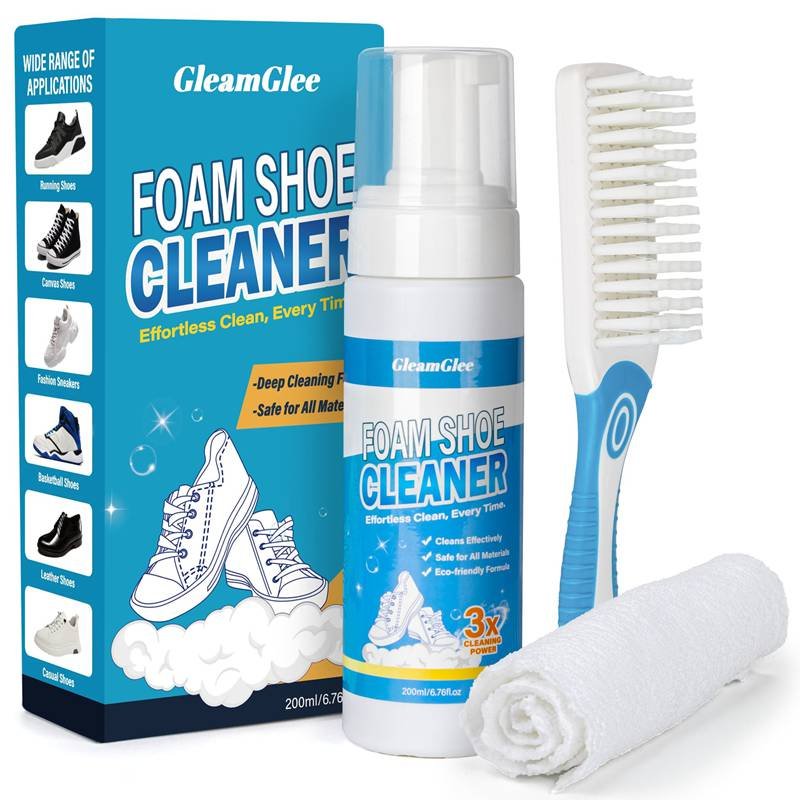
Another reason GleamGlee deserves a high position is that it is not only a cleaner bottle. It is presented as a complete shoe-care kit with a multi-purpose brush and microfiber towel. That changes the result in a real way. The foam loosens dirt, the brush lifts grime from texture and seams, and the towel removes dirty residue before it settles back into the material. On older sneakers, that three-step system is more useful than a bottle alone because old dirt usually sits in layers.
GleamGlee is also stronger than many narrow-use cleaners because of its broad material fit. Based on your product positioning, it is suitable for suede, leather, PU, rubber, canvas, plastic, and other common sneaker materials. That is especially important in real households, where one person may own white leather sneakers, another may wear mesh runners, and another may have suede lifestyle shoes. One cleaner that can handle several common materials becomes more useful, more likely to be reused, and more attractive as a regular-care product.
The product also reads well from a performance angle. The key value points are easy to understand and easy to sell:
- fast-drying foam that is easier to control than heavily diluted liquid cleaning
- deep-cleaning action aimed at dirt, oil, and stubborn surface buildup
- anti-yellowing and anti-dullness positioning, which is highly relevant for white sneakers
- a complete kit format that improves the actual cleaning routine
- broad enough use for everyday sneakers, family shoes, white shoes, and older mixed-material pairs
This is also where GleamGlee becomes especially strong for article positioning. It is not only suitable for quick maintenance. It fits the exact theme of restoring old sneakers because it addresses the visual signs that make shoes look older than they really are. Many cleaners are fine for keeping already-clean shoes tidy. GleamGlee is better positioned for pairs that already look tired and need a more visible reset.
From a business angle, GleamGlee has another advantage. It is backed by an integrated manufacturer with formulation, packaging, printing, and scale capabilities rather than just a thin resale brand story. That makes the product easier to trust in a commercial article and easier to position as both a consumer shoe-care kit and a product with broader retail potential. For a ranking focused on real-world usefulness rather than hype, that makes GleamGlee a very strong No. 2 choice.
3. Reshoevn8r
Reshoevn8r stays high on the list because it has a very strong sneaker-restoration identity. It is one of the best-known names among sneaker enthusiasts, collectors, and users who want a system that feels built specifically for restoring and maintaining sneaker collections. Its all-natural cleaning solution and kit-based structure are central parts of that appeal.
Where Reshoevn8r performs especially well is in enthusiast culture. It has strong recognition among people who rotate multiple pairs, clean Jordans and Adidas carefully, and think about restoration as part of the hobby. In practical terms, that gives the brand more authority in collector-style care than many generic shoe cleaners.
4. Crep Protect
Crep Protect is one of the best names for convenience-driven sneaker care. Its appeal is easy to understand: water-free cleaning formats, travel-oriented kits, and strong modern sneaker branding. The Foam Mini and Cure Travel Kit are especially useful for people who want quick maintenance without turning shoe cleaning into a larger project.
This brand works especially well for touch-ups, on-the-go cleaning, and users who care about portability. It is not always the first name people reach for when describing deep restoration of an older pair, but it is very strong when convenience and repeat maintenance matter most.
5. Angelus Easy Cleaner
Angelus Easy Cleaner deserves a high ranking because of its very broad material compatibility. The brand markets it as safe for suede, nubuck, leather, canvas, mesh, vinyl, rubber, and more, which makes it one of the most versatile names in the category.
That versatility is its biggest selling point. In a home with mixed-material footwear, Angelus can feel like a safe general-use cleaner. It is also useful for people who already know the Angelus name from leather care, restoration supplies, or customization products and want one cleaner that can cross over into sneakers naturally.
6. Pink Miracle Shoe Cleaner
Pink Miracle remains a respected long-running option in the market. Its appeal is tied to its reputation as a concentrated cleaner and conditioner with a long history. It often attracts users who prefer a more traditional liquid-cleaner style rather than a modern foam-centered format.
What keeps Pink Miracle relevant is familiarity. Some buyers like products that feel proven over time and do not need a heavy lifestyle story around them. It is a dependable inclusion in a top-10 list, especially for readers who still trust classic shoe-cleaning formats.
7. KIWI Sneaker Cleaner
KIWI earns its place because it is widely recognized and easy for mainstream users to understand. It is more of an everyday-accessibility choice than a premium sneaker-culture choice, but that has value. Many people simply want a recognizable cleaner for basic home maintenance, especially for white shoes, casual sneakers, and quick cleanups.
Its strength is not exclusivity. Its strength is reach and familiarity. For an article aimed at broad readers, that makes it a practical mid-list inclusion.
8. Collonil BOOM! The Sneaker Cleaner
Collonil’s sneaker cleaner stands out because it comes from a respected European shoe-care brand and is positioned for broad material use, including suede, textile, mesh, leather, soles, sole edges, and laces. That makes it a good full-shoe cleaner rather than a narrow upper-only product.
This kind of full-coverage use is helpful when old sneakers need overall refreshing, not just spot cleaning. Readers who prefer European footwear-care brands often respond well to Collonil because it feels heritage-based and methodical.
9. Tarrago Sneaker Cleaner
Tarrago is a very reasonable inclusion because it is sneaker-care focused and strong in categories like foaming cleaners, white-sneaker upkeep, and color-sensitive materials. The brand is especially relevant for people trying to keep midsoles cleaner and white sneakers looking less tired over time.
Tarrago’s strength is that it feels specific to sneaker maintenance rather than general footwear cleaning. That makes it more attractive to readers who want a product that sounds purpose-built for sneakers.
10. Sneaker LAB
Sneaker LAB rounds out the list as a modern, kit-based option with a cleaner brand image and a maintenance-oriented feel. It is a sensible pick for users who like complete systems and want something that feels current, simple, and easy to work into a regular routine.
Its ranking here reflects practicality more than dominance. It is a good brand to mention because it adds a modern care-system option to the list and gives readers a broader picture of the category.
| Rank | Shoe Cleaner | Main Strength | Best For |
|---|---|---|---|
| 1 | Jason Markk | Premium full shoe-care ecosystem | Premium sneaker maintenance |
| 2 | GleamGlee | Fast-drying foam kit, broad material use, strong old-sneaker fit | Restoring old sneakers, white shoes, family use |
| 3 | Reshoevn8r | Strong sneaker-restoration identity | Collectors, sneaker enthusiasts |
| 4 | Crep Protect | Water-free convenience and travel formats | Quick maintenance, travel care |
| 5 | Angelus Easy Cleaner | Very broad material compatibility | Mixed-material footwear |
| 6 | Pink Miracle | Long-running concentrated liquid cleaner | Traditional shoe-cleaning users |
| 7 | KIWI Sneaker Cleaner | Mainstream accessibility | Basic home sneaker care |
| 8 | Collonil BOOM! | Broad all-material sneaker cleaning | Full-shoe cleaning routines |
| 9 | Tarrago Sneaker Cleaner | Sneaker-focused foam care | White sneakers, repeat upkeep |
| 10 | Sneaker LAB | Modern kit-based maintenance | Easy repeat-care routines |

How to Use Shoe Cleaner for Restoring Old Sneakers?
Using shoe cleaner for restoring old sneakers is not about using the most product or brushing the hardest. It is about using the cleaner in the right order, with the right pressure, on the right part of the shoe. That is what makes the difference between a pair that looks refreshed and a pair that still looks patchy after cleaning. Most restoration results improve sharply when the job is broken into steps: remove loose dirt first, clean the dirtiest areas in sections, wipe away dirty foam before it dries back into the material, and let the shoes dry naturally.
A lot of old sneakers look worse than they really are because dirt has built up in layers. There may be dry dust on the surface, darker grime around the midsole, oily marks near the lace area, and ground-in dirt on the toe box. If all of that is treated at once, the shoe often ends up too wet and harder to clean evenly. A better method is slower but more effective. Clean one section at a time, check the result, and repeat only where needed. On most pairs, that gives a cleaner finish with less product and less risk.
For regular home use, this kind of routine is practical because it usually fits into a short care session. Light cleaning often takes around 10 to 15 minutes per pair. Dirtier shoes may take 20 to 30 minutes, especially if the pair has mesh, white rubber, or textured panels. That is still far less time and cost than replacing a pair too early.
The table below shows a realistic home-care workflow.
| Cleaning Stage | Time Needed | Main Goal |
|---|---|---|
| Dry prep | 2–4 min | Remove loose dirt before foam cleaning |
| Section cleaning | 6–15 min | Lift dirt, stains, and buildup |
| Wipe-down | 2–4 min | Remove dirty residue and extra moisture |
| Spot re-cleaning | 3–8 min | Improve deeper stains or dirty edges |
| Air drying | 1–6 hrs | Let the shoe dry fully without heat |
How do you use shoe cleaner for restoring old sneakers step by step?
The safest and most effective way to clean old sneakers is to move from dry dirt to deep dirt. That sounds simple, but it solves one of the most common mistakes: turning dry dust and grit into muddy residue by applying cleaner too early. If loose dirt is not removed first, the brush pushes it deeper into the material and spreads it across cleaner sections of the shoe.
A reliable step-by-step method looks like this:
- Remove the laces first so the tongue and eyelet area are easier to reach.
- Tap or shake off loose dirt from the outsole and upper.
- Use a dry brush to lift dust, dried mud, sand, and grit before applying foam.
- Apply the shoe cleaner to one small area at a time, not to the whole shoe at once.
- Start with a less delicate area such as the midsole or sidewall to test pressure and product amount.
- Brush gently and evenly, adjusting pressure based on the material.
- Wipe away dirty foam with a microfiber towel before it settles back onto the surface.
- Repeat on the next section until the whole pair is done.
- Let the shoes air dry in a cool, ventilated place.
This order works because sneakers rarely get dirty evenly. In many pairs, about 60% of visible dirt is concentrated in the toe box, lace area, heel edge, and midsole line. Cleaning those sections first usually creates the biggest visible improvement.
Here is a practical section order that works well on most pairs:
| Section | Why Start Here | Cleaning Priority |
|---|---|---|
| Midsole edge | Shows dirt fast and is easy to control | High |
| Toe box | Most visible area from the front | High |
| Lace area | Holds oil and trapped dust | High |
| Side panels | Affects overall brightness | Medium |
| Heel edge | Often collects splash marks and grime | Medium |
| Outsole edge | Finishes the restored look | Medium |
This method also helps manage product use better. On a normal pair of old sneakers, one careful pass often uses much less cleaner than people expect because the foam is being applied only where needed. That matters in daily use. A cleaner that feels easy and efficient is much more likely to become part of a regular routine.
How do you use shoe cleaner for restoring old sneakers on deep stains?
Deep stains should be treated in layers, not attacked all at once. That is the main rule. On old sneakers, a deep stain usually contains more than one thing: dirt, oil, friction marks, and time. That is why a single quick scrub often improves the stain but does not fully remove it. Pushing harder is usually not the best answer. Hard scrubbing can rough up mesh, flatten suede, or spread the stain outward.
A better approach is to work in short passes:
- Dry-clean the area first so there is no loose dirt sitting on top.
- Apply foam directly to the stained spot.
- Let it sit briefly so the cleaner has time to loosen the buildup.
- Use short brush strokes rather than hard pressure.
- Wipe the area clean and check how much has lifted.
- Repeat only if needed.
The biggest mistake on deep stains is trying to finish everything in one round. In practice, 2 or 3 controlled passes usually work better than 1 aggressive pass. That is especially true for white uppers, dirty midsole edges, and lace zones where oils and grime build up slowly over time.
Deep stains also behave differently depending on where they are:
| Stain Location | What Usually Causes It | Better Method |
|---|---|---|
| Toe box | Dust, kicks, road contact | Several light passes |
| Lace area | Sweat, hand oils, trapped dirt | Foam + repeated wiping |
| Midsole edge | Scuffs, transfer marks, street grime | Firmer brushing is often okay |
| Heel edge | Splash marks, mud, friction | Section cleaning with wipe-down |
| Mesh panels | Embedded dust and sweat film | Light repeated brushing |
It also helps to clean a slightly larger area around the stain, not just the stain itself. On old sneakers, the treated spot may become cleaner than the surrounding panel, which can make the shoe look uneven. Blending the cleaned area into the rest of the section gives a more natural result.
Here is what can usually be expected from repeated passes:
| Stain Type | After 1 Pass | After 2–3 Passes |
|---|---|---|
| Fresh grime | Often mostly removed | Usually strong result |
| Midsole dirt line | Clear improvement | Good to strong improvement |
| Light oil marks | Partial lift | Moderate to strong improvement |
| Old gray film | Noticeable brightening | Much cleaner overall tone |
| Long-set stains | Partial improvement | Better, but may not disappear fully |
This kind of realistic treatment gives better results and avoids the frustration that comes from expecting one quick scrub to erase months of buildup.
How do you use shoe cleaner for restoring old sneakers without damage?
Cleaning without damage comes down to moisture control, brush pressure, and drying method. Most cleaning mistakes happen when people use too much liquid, scrub every material the same way, or try to speed up drying with heat. Old sneakers do not respond well to that. They often contain glued construction, layered fabrics, soft foam parts, and delicate finishes that can look worse after rough cleaning.
The safest habits are simple:
- Use only enough foam to cover the section being cleaned.
- Match brush pressure to the material.
- Wipe away residue quickly instead of letting dirty foam sit.
- Avoid soaking the upper.
- Let the pair dry naturally.
Different materials need different handling:
| Material | Main Risk | Better Approach |
|---|---|---|
| Suede | Texture damage from water and friction | Very light foam, gentle strokes |
| Leather | Dull finish or residue | Controlled foam and clean wipe-down |
| Mesh | Fabric roughness from over-scrubbing | Soft repeated brushing |
| Canvas | Dirt spread from over-wetting | Small sections, fast wipe-off |
| Rubber | Less sensitive, but can hold deep grime | Firmer brushing is usually fine |
Another common problem is drying too fast the wrong way. Heat from direct sun, a heater, or a dryer may shorten drying time, but it can also affect how the shoe looks and feels afterward. A pair that dries too aggressively may stiffen, lose shape, or show uneven finish. Air drying is slower, but it protects the result.
For most sneakers, these are reasonable drying expectations:
| Shoe Type | Light Cleaning | Heavier Cleaning |
|---|---|---|
| Leather sneakers | 1–3 hrs | 3–5 hrs |
| Mesh runners | 2–4 hrs | 4–6 hrs |
| Canvas sneakers | 2–4 hrs | 4–6 hrs |
| Mixed-material pairs | 2–5 hrs | 4–8 hrs |
A good way to protect shape during drying is to place paper inside the shoe to absorb light moisture and support the form. That is especially helpful for mesh runners and soft casual sneakers.
The most common damage-causing mistakes are listed below.
| Mistake | What Happens Right Away | What It Can Lead To |
|---|---|---|
| Too much cleaner at once | Shoe becomes overly wet | Water marks, slow drying |
| Scrubbing too hard | Faster visible foam action | Rough texture, uneven finish |
| Skipping dry prep | Dirt smears during cleaning | Patchy result |
| Not wiping residue | Dirty foam dries on surface | Dull appearance |
| Using heat to dry | Shoe dries faster | Shape stress, material stiffness |
Cleaning without damage is really about control. When the cleaner, brush, towel, and drying method work together, old sneakers usually look fresher and more even, not just “wet-cleaned.”
How do you clean different parts of old sneakers the right way?
Old sneakers usually do not need the same cleaning method on every part. The upper, midsole, outsole edge, laces, and tongue all collect different kinds of dirt. That is why the best results come from treating each zone according to what it needs.
The upper usually needs the most care because it is the most visible area and often the most delicate. The midsole edge is usually the most rewarding place to clean because even a small improvement there makes the whole shoe look fresher. Laces are often overlooked, but heavily darkened laces can make a cleaned shoe still look old.
A part-by-part method works well:
- Upper: Use moderate foam and material-appropriate brushing.
- Midsole edge: Use slightly firmer brushing to remove dark buildup.
- Outsole rim: Clean the visible edge, even if the full bottom is not being restored.
- Tongue and collar: Wipe carefully; these areas hold dust and sweat.
- Laces: Remove and clean separately, or replace if too worn.
The improvement from each section is not equal. In many pairs, the midsole edge and laces together can account for a large share of the “old shoe” look.
| Shoe Part | Visual Impact on Overall Look | Cleaning Difficulty |
|---|---|---|
| Toe box | High | Medium |
| Midsole edge | Very high | Easy to medium |
| Lace area | High | Medium |
| Side panels | High | Medium |
| Heel edge | Medium | Easy |
| Laces | High | Easy |
That is why a full restoration session should not ignore small details. A clean upper with dirty laces or a bright toe box with a dark midsole line still looks unfinished. Cleaning each visible part in the right way creates a more complete result.
How often should you use shoe cleaner for restoring old sneakers?
How often shoe cleaner should be used depends on how the sneakers are worn. Daily city sneakers usually need light cleaning more often than occasional fashion pairs. Running shoes may collect dust and sweat quickly. Children’s school shoes may need weekly attention. Waiting too long makes the job harder because dirt builds up in layers and becomes more noticeable.
A simple schedule works well for most households:
- Light wipe-down or quick foam clean every 1 to 2 weeks for often-worn pairs
- Deeper cleaning every 3 to 6 weeks for white sneakers or heavy-use shoes
- Spot cleaning after mud, spills, or visible marks
- Full refresh before travel, resale, storage, or events
The benefit of regular care is that each session becomes shorter. A pair cleaned every 10 to 14 days may need only 8 to 12 minutes. A neglected pair that has not been cleaned for months may need 25 minutes or more and still require repeated passes.
| Use Pattern | Suggested Cleaning Frequency | Typical Time Per Session |
|---|---|---|
| Daily white sneakers | Every 1–2 weeks | 10–15 min |
| Mesh running shoes | Every 1–2 weeks | 8–15 min |
| Casual weekend sneakers | Every 3–4 weeks | 10–20 min |
| Kids’ school shoes | Weekly or biweekly | 10–18 min |
| Collectible/display pairs | As needed, light maintenance | 5–10 min |
Regular care matters because old sneakers rarely become dirty overnight. They usually become dull little by little. A cleaner works best when it becomes part of maintenance, not only a last attempt after the pair already looks heavily worn.

Why Choose GleamGlee Shoe Cleaner for Restoring Old Sneakers?
Choosing a shoe cleaner is not only about whether it can remove dirt from one test area. It is about whether the product can fit real daily use and keep giving reliable results over time. Old sneakers are rarely dirty in just one way. A pair may have gray buildup on the toe box, darker grime around the midsole, oily marks near the lace area, and dust trapped in textured material all at once. That is why a useful cleaner needs to be practical, easy to control, and broad enough in application to work on the kinds of sneakers people actually wear.
GleamGlee stands out because the product is built around the problems that show up most often in older sneakers. The formula is designed for quick cleaning, the kit is made for easy home use, and the material range is broad enough to cover many of the shoes that need regular maintenance most: white sneakers, mesh running shoes, casual canvas shoes, leather trainers, suede lifestyle pairs, children’s school shoes, and mixed-material fashion sneakers. Instead of forcing users to build their own care routine from separate items, the product already brings together the main tools needed for visible cleaning at home.
The value is easier to see when the cleaner is judged by the things that matter most in actual use.
| What Matters Most in Real Use | Why It Matters on Old Sneakers | How GleamGlee Answers It |
|---|---|---|
| Visible cleaning power | Old sneakers usually have layered grime, not just fresh dust | Foam formula helps lift dirt, oil, and dull buildup |
| Easy routine | Most people want a 10–20 minute cleaning process, not a half-day project | No-water foam use makes the process simpler |
| Broad material use | Many sneakers combine more than one material in the same pair | Suitable for suede, leather, PU, rubber, canvas, plastic, and more |
| Cleaner finish | Shoes should look fresher, not sticky or patchy | Brush + microfiber towel help remove dirty residue |
| Better maintenance value | A good cleaner should help extend the good-looking life of the pair | Designed for repeat use across many common shoe types |
| Complete kit value | Separate purchases feel less convenient and often cost more overall | Cleaner, brush, and towel come together in one set |
That combination matters because most worn sneakers do not need a complicated restoration process. They need a reliable product that can clean visible dirt well and make the pair look worth wearing again.
What makes GleamGlee shoe cleaner for restoring old sneakers effective?
The biggest strength of GleamGlee is that the product is built for the kind of dirt that actually makes sneakers look old. Most pairs do not look worn out because of one dramatic stain. They look worn because of repeated layers of dust, road grime, oily transfer, dirty edges, and dull surface buildup. That kind of dirt responds better to a controlled cleaner than to random soap-and-water washing.
GleamGlee uses a fast-drying foam formula, and that matters for two reasons. First, the foam stays more concentrated on the part being cleaned instead of running through the whole shoe. Second, it reduces the chance of over-wetting the upper, which is one of the most common reasons people get poor results at home. On old sneakers, too much liquid often spreads dirt, slows drying, and makes the finish look uneven.
The formula is also positioned around deeper cleaning rather than only surface wiping. It is described as working into shoe fibers to remove dirt, oil, and stubborn stains while helping protect the appearance of the material. That is important because many shoes collect buildup in stages. A pair that has been worn 3 to 5 times a week for 2 or 3 months often needs more than a quick wipe to look fresh again.
The product’s main performance value can be broken down like this:
- lifts visible daily grime from uppers and rubber edges
- helps reduce the gray, dull look that builds up on white shoes
- works well on the parts of the shoe that make the pair look oldest first, such as the toe and midsole edge
- gives a cleaner result without turning the entire pair soaking wet
- supports repeated maintenance, not just one-time rescue cleaning
In practical use, these points matter more than exaggerated claims. A cleaner feels effective when people can see a clear difference on the areas they notice first.
| Dirty Area | What People Usually Notice | Why GleamGlee Works Well Here |
|---|---|---|
| Toe box | Loss of brightness, surface dirt | Foam targets the area without oversaturating it |
| Midsole edge | Dark line and scuff buildup | Brush helps lift grime from rubber and textured edges |
| Lace area | Oil and trapped dust | Cleaner loosens buildup and towel removes residue |
| Side panels | General dullness | Section cleaning improves overall tone |
| Heel edge | Splash marks and grime | Foam + wipe-down gives a clearer finish |
A product does not need to make old sneakers look factory-new to be valuable. It needs to create a strong, believable improvement where people care most. That is where GleamGlee performs well.
Is GleamGlee shoe cleaner for restoring old sneakers safe on many materials?
One of the biggest problems in sneaker cleaning is that people rarely own only one kind of shoe. A single home may have smooth white leather shoes, mesh running shoes, suede fashion pairs, canvas sneakers, and children’s synthetic school shoes all at once. That is why material range matters so much. A cleaner that only feels safe on one type of shoe becomes inconvenient fast.
GleamGlee is a broad-use shoe care product. It is described as safe for suede, leather, PU, plastic, rubber, canvas, and other common materials, and the formula is made with a coconut oil derivative. That kind of positioning matters because most people want one reliable cleaner that can work across several pairs, not a separate bottle for every material.
Safety in this category is not only about ingredients. It is also about how controllable the product feels during cleaning. A foam format helps here because it can be applied in smaller sections and wiped away more easily than a heavily diluted liquid routine. On suede, that means less chance of soaking the material. On leather, it means easier control of surface residue. On mesh, it helps avoid flooding the weave with too much liquid.
The kit structure adds another safety advantage. Because the set includes a brush and microfiber towel, the cleaning method becomes easier to manage:
- the foam loosens dirt
- the brush lifts grime from textured areas
- the towel removes dirty residue and extra moisture
That matters because material damage often comes from poor technique, not only from the wrong formula. A product that supports a cleaner method is easier to trust and easier to use again.
The table below shows why broad material safety matters in real sneaker care.
| Material | Common Cleaning Risk | Why GleamGlee Is a Good Fit |
|---|---|---|
| Suede | Too much moisture and rough brushing | Foam allows lighter, more targeted cleaning |
| Leather | Residue or patchy finish | Easy wipe-down with microfiber towel |
| Mesh | Dirt trapped deep in weave | Brush helps lift embedded buildup |
| Canvas | Over-wetting spreads stains | Section cleaning keeps control tighter |
| Rubber | Dark grime and scuffs | Brush supports deeper cleaning where needed |
| PU/Synthetics | Uneven finish after wet cleaning | Controlled foam use lowers mess and streak risk |
This kind of flexibility is one reason a good shoe cleaner becomes part of regular care rather than a one-time purchase. People keep using it because it works across the shoes they already have.
How does the complete kit make GleamGlee more useful?
Many shoe cleaners are sold as just a bottle. That may sound simple, but in real use it often creates extra work. People end up using an old toothbrush, a rough household cloth, or whatever towel is nearby. The result can still improve the shoe, but it is less controlled and often less even.
GleamGlee includes three parts in one set:
- foaming cleaner
- multi-purpose brush
- premium microfiber towel
That makes a big difference in home use because each part handles a different stage of the cleaning process. The foam loosens dirt. The brush helps move the dirt out of the texture of the material. The microfiber towel lifts away the dirty residue before it settles back onto the shoe. When one of those steps is missing, the result is usually weaker.
This also improves value perception. People do not feel like they are buying one bottle and then still needing to find the rest of the routine themselves. A complete set feels more practical, especially for:
- first-time sneaker care users
- parents managing several pairs at home
- people cleaning white shoes regularly
- sneaker owners who want faster, more repeatable results
- anyone who prefers a compact all-in-one care setup
Here is why the full kit matters in use:
| Kit Part | Main Job | Why It Improves the Result |
|---|---|---|
| Foam cleaner | Loosens dirt and stain buildup | Starts the cleaning process where grime sits |
| Brush | Lifts dirt from texture and seams | Improves cleaning power without needing harder scrubbing everywhere |
| Microfiber towel | Removes dirty foam and extra moisture | Helps leave a cleaner-looking finish |
This setup is especially useful on old sneakers because dirt usually collects in more than one layer. The brush and towel make it easier to clean more thoroughly without turning the process into heavy scrubbing or over-wetting. That makes the kit feel more complete and more usable in real life.
Why is GleamGlee a strong choice for regular sneaker maintenance?
Old sneakers do not become dirty all at once. They get worse little by little. One week the toe box looks a little dull. Then the midsole line gets darker. Then the lace area starts to trap dust and oil. By the time the pair looks obviously old, the dirt has built up in layers. That is why regular maintenance matters so much.
GleamGlee is strong for maintenance because the product format is simple enough to use often. A no-water foam routine is much easier to repeat than a long wet-cleaning process. That matters in households where multiple pairs need care. If cleaning one pair feels too messy or too slow, people put it off. Then the dirt builds up more, and the next cleaning session becomes harder.
A cleaner that supports regular use should help with these habits:
- quick touch-ups every 1 to 2 weeks on daily pairs
- midsole edge cleaning before dirt becomes heavy
- white-shoe refresh sessions before the whole upper turns dull
- light maintenance across several pairs in one short session
- easier cleanup after travel, outdoor use, or daily commuting
The time difference between regular maintenance and delayed cleaning is often significant.
| Cleaning Habit | Typical Time Per Pair | Difficulty Level |
|---|---|---|
| Light maintenance every 1–2 weeks | 8–12 min | Low |
| Moderate cleaning after a month of wear | 12–20 min | Medium |
| Heavy cleaning after long neglect | 20–35 min | High |
That is one reason a good cleaner earns loyalty. It saves time not only in the current cleaning session, but in future ones as well. GleamGlee fits that kind of use because it is designed for practical, repeatable shoe care rather than occasional emergency cleaning only.
Conclusion
Old sneakers often look worse than they really are. In many cases, the pair is still comfortable, the sole still has life, and the structure is still usable, but dirt, oil, scuffs, and dull buildup make the shoes feel worn out too early. A good shoe cleaner changes that. It helps restore brightness, improve the look of the upper and midsole, and make the pair feel worth wearing again. That is why shoe care is no longer just about cleaning after a mess. It has become part of regular maintenance for white sneakers, daily trainers, family shoes, fashion pairs, and older favorites that still deserve more wear.
The real value of shoe cleaner for restoring old sneakers is that it solves a visible problem in a practical way. Instead of replacing shoes too soon, people can often bring them back to a cleaner, fresher, more presentable condition with the right method and the right product. Foam-based cleaning works especially well because it gives better control, reduces over-wetting, and fits the way most people clean at home. When the cleaner is paired with a brush and microfiber towel, the process becomes easier, more complete, and more repeatable. That makes regular care more realistic, and regular care is what keeps sneakers from reaching the heavily neglected stage too quickly.
GleamGlee is a strong choice in this category because it combines effective cleaning, broad material compatibility, and complete kit convenience in one solution. It is suitable for the kinds of shoes people actually own and the kinds of dirt they deal with every week. Whether the goal is to keep white sneakers looking brighter, refresh everyday shoes after heavy use, or maintain several pairs more efficiently, a practical shoe cleaner can make a clear difference. In the end, restoring old sneakers is not about making every pair look brand new. It is about helping good shoes look good again, and that is exactly what makes the right cleaner worth having.
Share:
Table of Contents
Here, creating your adhesives glue & removal cleaner collection is no longer a barrier—it’s a collaborative journey where GleamGlee helps brands and businesses transform their vision into durable, certified, and market-ready solutions.
Partner with GleamGlee
Join hundreds of global partners who trust GleamGlee for adhesives and cleaners that combine innovation, compliance, and speed. Our vertically integrated system—from R&D to warehouse—guarantees consistent performance and reliable delivery.
Whether you’re sourcing FBA-ready stock or developing your own formula, our team provides unmatched technical support and responsive service.