Skip to content

Non-Toxic Shoe Adhesive for Kids’ Shoes: A Definitive Guide
Your trusted adhesives glue & cleaner manufacturer

Children’s shoes live a much harder life than their size suggests. A school sneaker may move from polished classroom floors to rough playground asphalt, wet grass, stairs, bicycles, and puddles within the same day. Soles flex repeatedly, toe edges scrape against the ground, and straps are pulled with more enthusiasm than precision. When a shoe begins separating, repairing it can be economical and reduce unnecessary waste, but parents naturally want more than a strong bond. They also want to understand what they are bringing into the home, how the adhesive should be handled, and whether the finished repair is appropriate for footwear their child will wear for hours at a time.
For kids’ shoes, a sensible adhesive choice combines verifiable safety information with real footwear performance. Look beyond a simple “non-toxic” label and check the SDS, formulation type, VOC or solvent information where available, ventilation instructions, compatible materials, curing requirements, flexibility, and moisture resistance. The most suitable adhesive is one that can be handled responsibly by an adult and forms a stable, flexible bond after full cure.
The challenge becomes clearer when two bottles sit next to each other on a store shelf. One may sound especially gentle but be designed mainly for crafts, while another may be developed specifically for rubber, leather, vinyl, canvas, foam, and repeated shoe flexing. The first may feel reassuring but fail after a week of playground use; the second may perform much better but require careful application and curing. Understanding that difference helps parents choose a repair that is both sensible to use and durable enough to be worth doing.
What Does “Non-Toxic” Mean for Shoe Adhesive?
“Non-toxic” should be treated as a claim that needs context rather than as a universal guarantee. For children’s footwear, parents should also consider hazard classification, SDS information, VOC or solvent content, ventilation requirements, skin and eye precautions, intended substrates, storage conditions, and full-cure instructions. A reliable adhesive gives enough information to understand both how it should be handled and how it performs after curing.
The phrase “non-toxic” can sound definitive, but adhesive safety rarely fits into one word. A formula can behave very differently while liquid, while partially curing, and after it has fully cured between two shoe components. Exposure also changes according to the amount applied, whether the room is ventilated, whether the adhesive touches skin, and how long uncured material remains accessible. For this reason, experienced footwear professionals look at the complete product profile rather than accepting one front-label statement as the whole safety assessment.
A useful distinction is between hazard and risk during actual use. Hazard describes what a substance or mixture is capable of doing under certain exposure conditions. Practical risk depends on how much exposure occurs and how the product is handled. An adhesive that requires adult application, ventilation, and careful storage may still be appropriate for a shoe repair when those instructions are followed correctly. Conversely, a product with reassuring packaging can still be a poor choice if it is not designed to withstand the mechanical demands of footwear.
| Information | What It Helps You Understand | What It Does Not Automatically Prove |
|---|---|---|
| “Non-toxic” claim | Manufacturer’s safety positioning | Harmlessness in every exposure situation |
| Water-based | Water is an important carrier | That all ingredients are hazard-free |
| Low VOC | Lower volatile organic compound content under a stated method | Zero emissions or zero precautions |
| Low odor | Reduced perceived smell | Low toxicity or low VOC by itself |
| Solvent-free | Certain conventional solvents are absent | That skin or eye precautions are unnecessary |
| SDS | Hazards, handling, first aid, storage and exposure controls | Suitability for every shoe material |
| TDS | Application, cure and performance information | Complete toxicological evaluation |
Is “Non-Toxic” a Defined Shoe Glue Standard?
There is no single universal shoe-repair definition that makes the word “non-toxic” equivalent to “safe for every child, every shoe and every method of use.” Different countries regulate chemical labeling and claims through different frameworks, and a formula that qualifies for one type of environmental or emissions claim may not automatically qualify for another. Parents therefore benefit from treating the term as the beginning of their evaluation rather than the end of it.
Specific information is more useful than broad reassurance. A manufacturer that explains whether a product is water-based, what ventilation is recommended, what its hazard classification is, which materials it bonds, how long it must cure, and how it should be stored gives the customer a much stronger basis for a decision. Retailers and private-label brands should use the same standard because unsupported “child-safe” or “non-toxic” statements can create expectations that go far beyond what a normal shoe adhesive test actually demonstrates.
For GleamGlee and similar footwear-repair brands, this distinction is especially important. A product can legitimately emphasize flexible bonding, transparent curing, water resistance, precision application, and compatibility with common shoe materials when those characteristics are supported by product data. A separate non-toxic or low-VOC claim should only be made when the specific formulation and supporting documents justify it. Clear limits make product information more credible rather than less attractive.
What Should an SDS Tell You?
A Safety Data Sheet gives considerably more practical information than the front of a retail package. Modern SDS formats generally contain 16 standardized sections covering product identification, hazards, composition, first aid, firefighting, accidental release, handling and storage, exposure controls, physical properties, stability, toxicology, ecological considerations, disposal, transportation, regulations, and other information. Household users do not need to become chemical specialists, but several sections are especially helpful before using an unfamiliar adhesive.
Start with hazard identification and handling instructions. Look for recommendations concerning ventilation, skin contact, eye contact, protective gloves, ignition sources, and storage. First-aid information is also useful because it tells you what to do if accidental exposure occurs. For products that may be stocked by retailers, schools, repair businesses, or online marketplaces, transportation and regulatory information becomes more relevant because the product may need special classification during storage or shipping.
An SDS should not be treated as a certificate proving that an adhesive is ideal for children’s shoes. It describes chemical safety and handling rather than whether the formula will bond EVA, rubber, canvas, or synthetic leather successfully. That is why experienced purchasers normally review an SDS together with a Technical Data Sheet, material compatibility information, application instructions, and performance testing. Safety documentation and footwear-performance documentation answer different questions, and a reliable product should be able to address both.
Are Low-VOC and Low-Odor the Same?
Low odor and low VOC are not interchangeable descriptions. Odor depends on whether particular compounds can be smelled at the concentrations present, and human sensitivity varies greatly. VOC information, by comparison, relates to measurable volatile organic compounds under a defined standard or calculation. A mild-smelling adhesive can therefore still contain volatile components, while a product with a noticeable smell may contain substances detectable by the nose at extremely low concentrations.
For household shoe repair, lower-VOC and water-based technologies can still be attractive because reducing conventional solvent emissions can make application more comfortable and may support broader environmental objectives. However, performance must be evaluated alongside emissions. Children’s shoes repeatedly bend, encounter moisture, and experience abrasion. A formula chosen only because it smells mild can become a poor environmental decision if the repair fails quickly and requires repeated applications or premature shoe replacement.
Good airflow remains sensible even with low-odor products. Repair shoes near an open window, in a ventilated utility area, or in another suitable workspace rather than beside a child’s bed or in a poorly ventilated cupboard. Apply only the amount needed, close the container promptly, and remove the repaired shoes from normal household traffic while the adhesive cures. These practical habits reduce unnecessary exposure regardless of the marketing language on the package.
Does Full Cure Change the Safety Question?
Full cure changes both the mechanical condition and the exposure situation of an adhesive. Before curing, shoe glue may remain liquid, transferable, tacky, or chemically reactive. Once properly cured, the adhesive is normally expected to become a stable bonded film located largely between the shoe components. The exact properties depend on the formula, which is why users should follow the stated cure time rather than assuming that a dry-looking edge means the entire joint is finished.
For children’s footwear, this waiting period has two purposes. It helps the adhesive develop its intended bond strength and prevents a child from touching, flexing, or wearing the shoe while uncured material is still present. Many flexible footwear adhesives require roughly one to two days to develop a substantially complete cure, although some formulas require longer. Layer thickness, temperature, humidity, and the permeability of the bonded materials can change the actual time needed.
A sensible final check involves more than touching the surface. Look for tacky material, wet pockets, excessive exposed glue, unusual softness, hard protrusions, or areas where the bond immediately opens when the shoe is gently flexed. If a manufacturer specifies 24, 36, or 48 hours, follow that instruction even when the exterior seems ready sooner. The additional waiting time is usually far less inconvenient than repeating a failed repair.

Which Adhesive Types Are Better for Kids’ Shoes?
There is no single adhesive chemistry that is automatically best for every children’s shoe. Water-based and lower-VOC footwear systems can offer reduced solvent exposure, while flexible polyurethane and polymer adhesives may provide excellent bonding on soles and mixed materials. The best choice combines appropriate safety documentation, compatibility with the actual shoe substrates, sufficient working time, full-cure strength, moisture resistance, and flexibility under repeated movement.
Footwear adhesives solve a more difficult mechanical problem than ordinary household craft glue. A sneaker may bend sharply across the forefoot on every step, while a school shoe outsole experiences shear, impact, surface abrasion, and occasional water exposure. A sandal strap experiences repeated pulling in a smaller bonding area. The fact that one adhesive is strong in a static test does not necessarily mean it will remain strong after thousands of bending movements.
This is why flexibility is usually one of the most important properties in a shoe-repair formula. An excessively rigid bond can move stress from the original separation to the edge of the glue line, eventually creating a new tear. A properly formulated flexible adhesive moves with the footwear and spreads mechanical stress across the bonded area. For children who run, jump, squat, climb, and drag their toes against the ground, this difference can determine whether a repair lasts several outings or becomes a repeat job.
| Adhesive Type | Typical Flexibility | Suitable Uses | Main Consideration |
|---|---|---|---|
| Water-based footwear adhesive | High when properly formulated | EVA, PU, leather, textile assembly | Drying may be slower between nonporous surfaces |
| Flexible PU adhesive | High | Soles, uppers, mixed-material joints | Follow formula-specific handling instructions |
| Flexible polymer adhesive | High | General shoe repairs and moving joints | Check exact material compatibility |
| Contact adhesive | Medium to high | Larger sole areas | Often needs controlled application and ventilation |
| Cyanoacrylate | Low to medium | Small rigid components | Very fast bonding and potential brittleness |
| General craft glue | Variable | Light decorative work | Often unsuitable for stressed outsole repairs |
Are Water-Based Shoe Adhesives a Good Option?
Water-based technology is no longer limited to lightweight craft applications. Modern footwear manufacturing uses water-based systems for a variety of materials, including EVA, PU, leather, textile components, and selected rubber compounds. Their main appeal is the ability to reduce dependence on traditional organic solvents while still delivering useful footwear performance when the formulation, surface treatment, and drying conditions are properly controlled.
For home repairs, however, the words “water-based” do not guarantee that every product will work well on a sneaker outsole. Water must escape from the adhesive during drying, and this becomes more difficult when the glue is trapped between two nonporous surfaces. Thick applications can extend drying substantially. Humidity and low temperature can also slow the process, particularly when a user closes the joint immediately without following the adhesive’s recommended open time.
The practical decision should therefore be based on the specific product rather than the technology name. Check whether the adhesive remains flexible after cure, whether it is rated for the shoe materials involved, whether moisture resistance is adequate, and whether the manufacturer provides realistic working and curing times. A well-designed water-based footwear adhesive can be an excellent option; an ordinary water-based craft adhesive is not automatically an acceptable substitute.
Are Solvent-Free Adhesives Suitable for Shoe Repair?
Solvent-free formulations can be attractive for users seeking to reduce conventional solvent exposure, but the term describes only one part of the chemistry. A solvent-free product can still contain reactive polymers, curing agents, or other components that require careful handling. For this reason, its SDS and application instructions remain important even when the formula is promoted as 100% solids or free from conventional organic solvents.
Performance is equally important. Children’s shoes can undergo considerable torsion because the foot twists during running and play. A repair adhesive needs to tolerate this movement without creating a hard block between flexible materials. It should also maintain adhesion when the shoe becomes warm, cold, slightly wet, or compressed repeatedly. The actual target is therefore not simply “solvent-free,” but “solvent-free and technically suitable for flexible footwear.”
Retailers sourcing private-label products should request more information than a consumer normally would. Useful data includes substrate compatibility, viscosity range, open time, cure time, water resistance, flexibility after aging, storage stability, and representative bonding tests. This broader technical picture prevents a seemingly attractive formulation claim from becoming the only reason a product is selected.
Is Super Glue Suitable for Kids’ Shoes?
Cyanoacrylate super glue can be useful when a small, relatively rigid component needs a very fast repair, but it is rarely the first choice for a large flexible sole separation. Traditional grades cure quickly and may form a hard adhesive line. This can work on a decorative plastic element, but a rigid joint across a highly flexible sneaker toe may experience concentrated stress when the shoe bends.
Handling speed is another consideration. Cyanoacrylates can bond skin rapidly, which leaves little time for careful repositioning. A parent repairing a crooked outsole may find that a few extra minutes of working time are more valuable than an instant set. Flexible footwear adhesives generally provide more opportunity to align the parts, remove excess material, and secure the shoe in its original shape before the adhesive becomes immovable.
The best repair chemistry depends on where the damage is. A tiny detached ornament and a 10-centimeter outsole separation are not the same engineering problem. For larger or repeatedly flexing joints, a purpose-built shoe adhesive with flexible cured properties usually makes more practical sense than selecting a product mainly because it cures in seconds.
Do Flexible Polymers Matter More Than Fast Set?
In most everyday footwear repairs, flexibility matters more than an extremely fast surface set. Consider a child walking 6,000 to 10,000 steps during an active day. The forefoot region may bend on a large percentage of those steps, meaning a repaired joint can experience thousands of movement cycles before the shoes are taken off. A bond that is impressive after five minutes but brittle after curing may perform poorly in that environment.
Flexible polymers help accommodate these repeated movements. Rather than stopping the shoe from bending, the cured adhesive layer moves with the surrounding materials. This is especially important where rubber meets canvas, leather meets rubber, or an outsole connects to a softer foam midsole. These materials can stretch or compress at different rates, creating stress at their interface.
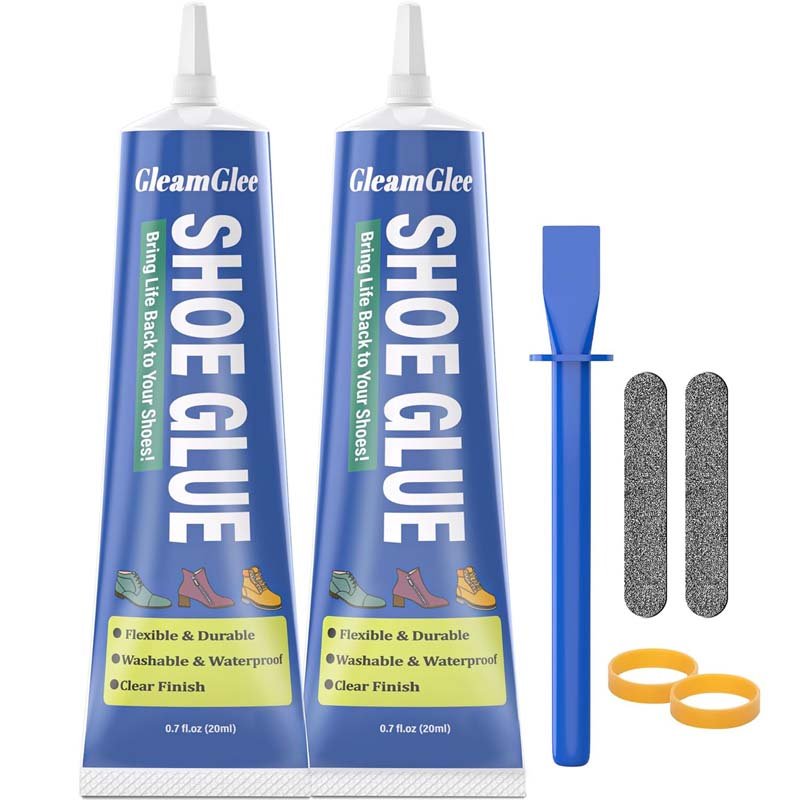
GleamGlee’s current shoe-repair configuration is designed around this practical requirement, with a transparent flexible bond intended for common footwear materials and water exposure. The kit contains two 20 ml tubes, an applicator, two sandpaper sheets, and two rubber bands. The manufacturer estimates that the quantity can cover more than 20 pairs for small repairs, although actual coverage naturally depends on the size and thickness of each repair.
How Do You Match Glue to Kids’ Shoe Materials?
Choose shoe adhesive according to the two materials being joined rather than simply selecting a product labeled “shoe glue.” Kids’ footwear may combine rubber, EVA, PU, PVC, leather, canvas, mesh, foam, and molded plastic in a single pair. Each material presents different surface-energy, flexibility, porosity, and chemical-compatibility challenges, so material identification and surface preparation are critical to a durable repair.
A single children’s sneaker can contain more material types than many household objects. The outsole may be rubber, the midsole EVA or PU foam, the upper mesh and synthetic overlays, the toe a molded polymer, and the decorative trim a different coated fabric. The adhesive has to work at the interface where two of these materials meet, which explains why “works on shoes” is much less informative than a clear list of compatible substrates.
Surface condition matters almost as much as chemical compatibility. Mold-release agents, shoe polish, waterproofing sprays, dirt, skin oils, road contaminants, and remnants of older adhesive can all form a weak layer between the fresh glue and the shoe. A high-strength formula cannot compensate indefinitely for a contaminated surface. Cleaning and controlled abrasion often improve a repair more dramatically than simply applying more adhesive.
| Shoe Material | Common Location | Main Bonding Challenge | Practical Preparation |
|---|---|---|---|
| Rubber | Outsole, toe edge | Smooth or contaminated surface | Clean and lightly roughen |
| EVA | Midsole | Foam structure and surface skin | Remove dust and test compatibility |
| Leather | School and dress shoes | Oils, polish and flexibility | Clean away wax and polish |
| Canvas | Sneaker upper | High porosity | Use a thin controlled layer |
| PU synthetic leather | Uppers and trims | Surface coating differences | Test an inconspicuous area |
| PVC/vinyl | Rain shoes and trims | Plasticizer compatibility | Check adhesive suitability |
| Mesh/textile | Athletic uppers | Adhesive penetration | Avoid oversaturation |
Which Glue Works on Rubber Soles?
Rubber outsole repair benefits from an adhesive that stays flexible after curing and can tolerate occasional water exposure. The surface itself can be challenging because rubber components may carry dirt, oils, processing residues, or fragments of older glue. Applying fresh adhesive directly over these contaminants often produces a bond that looks successful initially but peels away as soon as the outsole begins flexing again.
Start by removing loose material and cleaning the joint without damaging the surrounding shoe. Once dry, a smooth bonding area can often benefit from light abrasion. Sandpaper around the fine-to-medium repair range is frequently used to increase surface texture, but the objective is to roughen rather than aggressively grind away the outsole. Remove sanding dust before applying adhesive because loose particles create another weak intermediate layer.
Use enough glue to create continuous contact across the actual joint without filling the space unnecessarily. A narrow precision nozzle can make this much easier when the edge has opened only a few millimeters. Once the sole is aligned, continuous pressure from rubber bands or an appropriate clamp helps keep the interface closed while the adhesive develops strength.
Which Glue Works on EVA and Foam?
EVA and other footwear foams require more judgment than solid rubber because the material itself may be the weakest part of the repair. If a midsole is crumbling, permanently compressed, or tearing internally, an adhesive can connect the visible surfaces but cannot restore the original cushioning structure. Repair works best when the foam remains mechanically sound and the problem is a clean separation between components.
Different EVA formulations also vary in density and surface treatment. Some have a smooth molded skin that bonds differently from a freshly cut internal surface. Others contain pigments and additives that affect surface behavior. A product that specifically states compatibility with EVA or footwear foam is therefore preferable to a general household glue whose performance on foam is unknown.
Apply a controlled film instead of saturating the foam. Too much liquid can create a hard local area, lengthen cure time, or affect appearance. When the formula or shoe material is unfamiliar, a small test in a hidden location is sensible. If the surface becomes soft, discolored, sticky, or distorted, stop before treating the visible repair area.
Which Glue Works on Leather and Synthetic Leather?
Natural leather and synthetic leather look similar in many children’s shoes but can behave very differently during bonding. Natural leather contains oils and may have waxes, polish, coatings, or waterproofing treatments on its surface. These materials can reduce adhesion considerably, so the repair area should be cleaned carefully without damaging the finish before fresh glue is introduced.
Synthetic leather may be based on polyurethane, PVC, or other coated constructions over fabric. The coating chemistry matters because some surfaces accept adhesive readily while others contain plasticizers or finishes that make bonding more difficult. A hidden-area compatibility test can prevent discoloration, wrinkling, softening, or visible damage on a school shoe or decorative upper.
For both materials, flexibility is essential. Leather bends continuously with the foot, and a hard adhesive line can become a new failure point. Clear-drying footwear adhesives can also improve appearance where the joint remains visible. GleamGlee’s shoe-repair formula is intended for materials including leather, rubber, vinyl, and canvas, making it relevant for mixed-material repairs where a single shoe contains more than one common substrate.
Which Glue Works on Canvas and Fabric?
Canvas and fabric present a different challenge because they absorb liquid. Applying too much adhesive can allow it to wick into the fibers, creating a darkened or stiff patch that extends beyond the actual repair. A thin application at the joint between fabric and another component, such as a rubber foxing strip, is usually cleaner than spreading adhesive over a large area of textile.
Precision becomes especially important with lightweight children’s sneakers. A narrow applicator can place glue inside the separation rather than on the visible upper. After closing the joint, excess material should be removed according to the product instructions before it cures. This helps preserve the original appearance and reduces the chance of creating an uncomfortable hardened edge.
Not every torn fabric area should be glued. If the textile itself has split across a load-bearing zone, stitching, backing reinforcement, or replacement may be more appropriate. Adhesive is particularly useful when intact fabric has separated from another shoe component, while major structural textile damage requires a different repair strategy.

How Should You Repair Kids’ Shoes Safely?
An adult should perform children’s shoe repairs in a ventilated workspace, keep uncured adhesive away from children, clean and dry the surfaces thoroughly, apply only the required amount, align the joint carefully, hold it under steady pressure, and wait for the stated full-cure period. Safe handling and proper curing are just as important as choosing a strong adhesive.
Many home repairs fail before the adhesive itself has a chance to prove its quality. The user applies glue to a damp shoe, leaves old adhesive underneath, closes the joint in the wrong position, or tests it repeatedly while it is still curing. Each of these actions weakens the final result. A disciplined repair process usually produces better performance without requiring a larger quantity of adhesive.
The repair should begin with an inspection. Determine whether the damage is a clean separation, a crack, worn material, or structural failure. A lifting sole edge is usually a straightforward bonding job. A crumbling midsole, broken heel support, or severely worn outsole may not be. Knowing what type of failure you are looking at prevents glue from being used where the shoe itself has reached the end of its safe service life.
Should Children Handle Shoe Adhesive?
Children should generally not handle footwear repair adhesive unless the particular product is specifically designed and labeled for supervised child use. A shoe adhesive is formulated to bond demanding materials and is not automatically equivalent to a washable school glue simply because the repaired item belongs to a child. Adult handling provides much better control over application, contact prevention, storage, and curing.
Choose a work area away from food preparation and normal child activity. Protect the surface, arrange all tools before opening the adhesive, and use appropriate ventilation according to the product instructions. If gloves are recommended, wear them. Keep caps, needle applicators, sandpaper, rubber bands, and uncured adhesive out of reach because these accessories can present their own risks to very young children.
After completing the repair, close and store the product promptly. Do not leave a repaired shoe on a bedroom floor or hallway while uncured adhesive remains accessible. A shelf in a ventilated utility area or another protected location is more suitable until the stated cure period has passed.
How Should You Prepare the Shoe?
Preparation starts with dry, clean bonding surfaces. If the shoes were recently washed or worn in wet conditions, allow enough time for hidden moisture in foam and fabric to evaporate. An upper can feel dry while water remains trapped inside a sole joint. Bonding over this moisture can reduce adhesion and extend drying time.
Remove loose pieces of old glue rather than placing the new formula directly over unstable residue. If the material is appropriate for abrasion, lightly roughen smooth surfaces and remove the dust afterward. Do not treat every material the same way. Aggressive sanding can damage coated leather, thin synthetic surfaces, or delicate textile edges.
A practical sequence is straightforward:
- Inspect how far the separation extends before opening the joint.
- Remove dirt and loose old adhesive.
- Allow both surfaces to become completely dry.
- Lightly abrade compatible smooth surfaces.
- Remove sanding dust.
- Apply a controlled adhesive film.
- Align the parts in their original position.
- Hold the joint without repeatedly reopening it.
- Allow the full specified cure.
- Inspect the finished shoe before wear.
The two sandpaper sheets included with the GleamGlee shoe-repair kit support this preparation stage, while the supplied rubber bands make it easier to maintain pressure after assembly. These simple accessories often contribute more to repair consistency than adding an unnecessary extra layer of adhesive.
How Much Glue Should You Apply?
More glue does not automatically produce more strength. A thick bead can take much longer to cure, squeeze onto the visible upper, or create a rigid ridge after hardening. The objective is a continuous adhesive layer across the actual contact area, not a reservoir of liquid filling every empty space around the repair.
For a small toe separation, a precision metal nozzle is particularly useful because the opening may be narrow and difficult to reach with a wide applicator. Apply glue along the internal bonding surface rather than coating the exterior. Slowly close the joint and allow excess material to move outward naturally instead of aggressively squeezing the shoe.
Once the parts are aligned, avoid pulling them apart repeatedly to check progress. Early bond formation can be damaged by this movement. Secure the shoe with rubber bands or a suitable holding method and leave it alone for the required period. Patience at this stage often has a greater influence on durability than the difference between two otherwise competent footwear adhesives.
How Long Should the Shoe Cure?
Full cure time is product-specific, but many flexible household shoe adhesives require approximately 24 to 48 hours before they reach a much more complete level of bond development. Some formulas may require longer. Temperature, humidity, adhesive thickness, joint geometry, and whether the materials are porous all influence how quickly liquid components leave the bond or chemical curing reactions finish.
The safest habit is to use the manufacturer’s stated time rather than a generic internet estimate. Repair a school shoe on Friday evening rather than Sunday night when possible. If the instructions specify 24 hours, give the repair an actual full day without wear. If the instructions specify 48 hours, surface dryness after six hours is not a reason to shorten the schedule.
Holding pressure should remain consistent during the early curing stage when required. Rubber bands work well around many sneaker and school-shoe shapes because they spread pressure without heavy equipment. If clamps are used, avoid excessive force on foam midsoles or soft uppers because compression can distort the shoe even when the adhesive bond itself succeeds.
How Do You Know the Repair Is Ready to Wear?
A repaired child’s shoe should return to use only after the full stated cure time has passed and the joint remains stable during gentle inspection. Check that the adhesive is no longer tacky, the sole is correctly aligned, no hard glue protrudes into a contact area, and the surrounding shoe remains structurally sound. A successful bond does not compensate for serious midsole, tread, heel, or fit problems.
The final inspection should reproduce ordinary movement without deliberately trying to destroy the repair. Hold the heel and forefoot and bend the shoe gently in the direction it normally moves while walking. Watch the repaired edge. It should remain closed rather than opening immediately when the surrounding sole flexes. If a narrow gap appears after only a few gentle movements, additional curing or a new repair may be necessary.
Also place the shoe on a flat surface. Both sides should sit normally without a visible twist or tilt created during clamping. A strong adhesive bond in the wrong position is still a poor repair. This is particularly relevant to small children because subtle changes in alignment can affect comfort long before the child can clearly explain what feels wrong.
Is the Adhesive Fully Cured?
Time is the first indicator of full cure because surface appearance is unreliable. Adhesive exposed to air at the edge of a repair may dry much sooner than material trapped deep between a rubber outsole and a nonporous synthetic upper. Touching the visible edge therefore tells you very little about the condition of the entire bond.
Record the completion time when the repair is made. This simple step prevents uncertainty the following day. If the formula specifies one day, wait one day. When temperature is unusually low or the adhesive layer is thicker than recommended, curing may take longer. The product instructions should always take priority over convenience.
Inspect any visible glue before returning the shoes. It should not transfer to the fingers during ordinary handling or remain obviously wet. The bond line should look stable rather than swollen or soft. If there is still a strong unusual odor after the expected cure time, check the manufacturer’s guidance rather than sending the child out in the shoes simply because the sole no longer moves.
Is the Bond Still Flexible?
A footwear repair needs to survive movement, not just remain attached while sitting on a shelf. Flex the forefoot gently several times and observe whether the repaired joint follows the movement smoothly. A suitable flexible adhesive should allow the shoe to bend without creating a sharp hard hinge where the glue was applied.
This matters especially for athletic and playground shoes. The front third of the shoe bends repeatedly as the heel lifts from the ground. If the repaired area is too rigid, stress may concentrate immediately beside the bond. The adhesive might remain intact while the rubber, fabric, or foam begins tearing a few millimeters away.
Flexible cured performance is one of the practical characteristics emphasized in GleamGlee’s current shoe-repair product. The formula is intended to remain elastic rather than becoming a brittle white line, which is useful for visible sneaker, school-shoe, boot, and sandal repairs. As with any adhesive, actual durability still depends heavily on surface condition, material compatibility, application thickness, and cure time.
Is the Repair Waterproof?
A waterproof adhesive bond does not necessarily restore the entire shoe to its original waterproof specification. If a rain boot has a large material crack, water can travel through the surrounding damaged rubber even when the glue line itself resists moisture. Similarly, a sneaker may have water-resistant bonding but an upper made from breathable mesh that was never intended to keep water out.
For ordinary children’s sneakers, practical moisture resistance is valuable because shoes encounter puddles, wet pavement, rain, sweat, and periodic cleaning. Wait until full cure before exposing the repair to these conditions. Premature water exposure can weaken some adhesive systems even when the final cured product is described as waterproof.
After the first several outings, inspect the repaired edge again. Look for whitening, softening, renewed separation, or a visible crack in the adhesive film. A repair that remains flexible and closed after normal wet-weather use is giving much more useful information than an aggressive soak test performed immediately after curing.
When Should Shoes Be Replaced Instead?
Repair is worthwhile when the surrounding shoe remains mechanically sound. A localized outsole separation, lifting toe edge, detached trim, loose insole, or sandal component may be a good adhesive repair. Replacement is the safer choice when deterioration extends beyond the bonding area or the shoe can no longer provide normal support and fit.
Several signs should make a parent reconsider repair:
- The midsole crumbles when pressed.
- The outsole tread is worn nearly smooth.
- The heel structure tilts or collapses.
- A sports plate, cleat base, or structural support is cracked.
- Large sections of foam have permanently compressed.
- The shoe sits unevenly on a flat floor.
- A load-bearing strap has torn through surrounding material.
- The child has outgrown the footwear.
- Previous repairs repeatedly fail because the base material is deteriorating.
Children’s feet grow quickly, so extending shoe life is useful only when the footwear still fits properly. Adhesive can restore attachment between materials; it cannot make a too-small shoe larger, rebuild depleted cushioning, or replace structural components that have fractured. A repair should preserve a serviceable shoe rather than hide the fact that the shoe has reached the end of its usable life.

How Can Brands Verify a Safer Shoe Adhesive Supplier?
A reliable shoe-adhesive supplier should support product claims with safety documents, technical data, substrate testing, quality-control procedures, representative samples, and market-appropriate packaging information. Brands should evaluate formulation consistency, material compatibility, flexibility, moisture resistance, cure behavior, filling accuracy, packaging stability, and regulatory documentation before moving from samples to full production.
For retailers and private-label brands, purchasing shoe glue is more complex than choosing a finished product from a store shelf. The formula must perform consistently across thousands of units, packaging must remain compatible during storage and transportation, labels must match the regulatory requirements of destination markets, and product claims need enough evidence to survive marketplace review and customer scrutiny.
A supplier should also be able to separate what has been tested from what is merely possible. If a brand asks for a water-based, lower-odor, quick-curing, transparent, waterproof, highly flexible product, those characteristics may conflict with one another during formulation. Experienced development teams prioritize the requirements, produce samples, compare them with benchmarks, and adjust the chemistry rather than promising every desired property before testing begins.
| Verification Area | Practical Evaluation | Why It Matters |
|---|---|---|
| Safety documentation | SDS and relevant declarations | Supports handling and compliance review |
| Substrate compatibility | Rubber, EVA, leather, vinyl, canvas tests | Reduces real-world repair failures |
| Flexibility | Repeated bending evaluation | Important for toe and forefoot joints |
| Moisture resistance | Water exposure after full cure | Relevant to rain and cleaning |
| Cure behavior | Open time and full-cure measurement | Supports realistic instructions |
| Viscosity | Batch-controlled measurement | Maintains dispensing consistency |
| Packaging | Leakage and nozzle compatibility tests | Reduces transit and usage complaints |
| Aging | Storage and temperature studies | Supports shelf-life confidence |
What Safety Documents Should Suppliers Provide?
An SDS is the normal starting point for evaluating chemical handling, but it should not be the only document requested. A Technical Data Sheet can explain viscosity, application instructions, cure conditions, material compatibility, and other performance characteristics. Depending on destination and formulation, brands may also require REACH-related documentation, CLP or GHS classification information, restricted-substance declarations, transport information, and relevant VOC data.
Retailers should make sure the documents correspond to the exact formulation they are purchasing. A supplier’s general corporate certificate or an SDS from a different adhesive is not an adequate substitute. Formula revisions should also be controlled carefully because changing raw materials can affect classification, odor, color, viscosity, cure behavior, or bond performance.
For products aimed at family shoe repair, label language deserves particular attention. Terms such as “non-toxic,” “child-safe,” “solvent-free,” “low-VOC,” and “eco-friendly” should have clear support before they are printed. More specific, defensible claims such as “flexible after cure,” “clear drying,” “suitable for rubber and canvas,” or “water-resistant after full cure” may often communicate practical value more effectively when backed by actual testing.
How Are Adhesive Claims Verified?
A useful footwear test program evaluates the way the product will actually be used. Static bond strength is only one part of that program. Shoe joints may peel, flex, twist, absorb impact, encounter moisture, and move between warm and cold environments. A formula that performs well in one simple pull test may still fail when exposed to repeated bending.
Testing commonly considers peel or shear strength, flexible movement, water exposure, aging, cure time, viscosity consistency, and adhesion to representative substrates. The exact laboratory method and target values depend on the product category and intended claim. A repair adhesive for lightweight school sneakers may have different priorities from a formula intended for work boots or professional footwear production.
GleamGlee’s manufacturing structure includes adhesive-development and application-testing capability across common material categories. For private-label development, the most useful approach is to provide target shoe materials or a benchmark product, establish the required performance characteristics, produce samples, and compare the results before packaging and mass production are finalized.
Can Formulations Be Customized?
Formulation customization is useful when it begins with a clearly defined application rather than a list of marketing expressions. The development team should know what materials need to be bonded, how the product will be dispensed, the desired viscosity, expected cure time, target flexibility, moisture exposure, packaging size, operating market, and labeling requirements.
Possible development objectives include water-based technology, reduced-solvent systems, lower odor, faster initial grip, longer positioning time, transparent curing, improved elasticity, higher moisture resistance, and optimized adhesion to specific combinations such as EVA-to-rubber or leather-to-rubber. Each change can influence other properties, which is why samples and application testing are necessary.
Packaging can also be developed around actual use. Precision metal nozzles are useful for narrow sole separations, while wider applicators may be preferable for larger bonding areas. A complete repair kit can include surface-preparation materials and holding accessories. GleamGlee’s current consumer format, for example, combines two 20 ml tubes with an applicator, two sandpaper sheets, and two rubber bands, creating a practical reference configuration for retail shoe-repair projects.
What Should Buyers Ask Before Ordering?
Before committing to volume, commercial customers should ask questions that expose both technical capability and manufacturing discipline. Which shoe materials has the formula been evaluated on? What full cure time is recommended? How flexible is the cured film? What evidence supports moisture resistance? Can the supplier provide the exact SDS and Technical Data Sheet for the final formula? How is batch viscosity controlled?
Packaging questions are equally important. Confirm tube or bottle volume, nozzle style, cap design, leakage testing, label material, box configuration, accessory requirements, and whether the packaging has been tested with the real adhesive. A package that looks attractive during design review but leaks or clogs after storage can create more customer dissatisfaction than a minor difference in laboratory bond strength.
Private-label customers should also define destination countries, label languages, required regulatory marks, sample quantity, minimum order volume, expected production schedule, transport method, and seasonal demand. GleamGlee can support custom adhesive and packaging development from relatively low starting quantities in suitable programs, with design, sampling, and production scaled according to the project. For serious brands, the goal should be repeatable product quality rather than simply obtaining the lowest initial unit price.
Conclusion
Choosing shoe adhesive for children’s footwear is less about finding the boldest “non-toxic” statement and more about building confidence from several pieces of information. A suitable product should have understandable safety documentation, compatibility with the actual shoe materials, controlled application, enough working time, flexible cured performance, and appropriate resistance to everyday moisture and movement. Parents should perform the repair themselves, keep uncured adhesive away from children, and respect the complete cure period before the shoe returns to normal use.
The same principle applies to professional sourcing. Strong product claims become more convincing when they can be traced back to formulation data, test results, realistic application instructions, and consistent production controls. A shoe glue that is easy to dispense, bonds the right materials, stays flexible, cures cleanly, and comes with transparent documentation has more practical value than one built around a single reassuring phrase. Good footwear repair ultimately comes down to matching chemistry, material, application, and real-world use.

Frequently Asked Questions
1. What is the safest type of glue for repairing kids’ shoes?
There is no single adhesive chemistry that is automatically safest for every children’s shoe. Water-based and lower-VOC footwear adhesives may be attractive when reducing conventional solvent exposure is important, but the exact formula still needs to be evaluated. Check the SDS, ventilation instructions, intended substrates, cure time, and handling precautions. The product should also remain flexible and strong enough for footwear rather than simply carrying a reassuring label.
2. Can I use ordinary craft glue on children’s sneakers?
Ordinary craft glue can work for lightweight decorative applications, but it is usually not designed for outsole separation or other stressed footwear joints. Sneakers flex thousands of times during normal use and may encounter rain, sweat, abrasion, and changing temperatures. A dedicated flexible shoe adhesive is generally more suitable for sole edges, toe areas, and mixed-material joints because it is designed to tolerate movement after curing.
3. Is water-based shoe glue strong enough for kids’ shoes?
A properly engineered water-based footwear adhesive can provide useful strength on materials such as EVA, PU, leather, textiles, and selected rubber systems. The limitation is not simply strength but drying behavior and substrate compatibility. Water-based formulas may require adequate open time and longer drying between nonporous surfaces. Always check whether the specific consumer product is designed for the materials and stress level involved in the repair.
4. How long should shoe glue cure before a child wears the shoes?
Follow the exact instructions for the adhesive being used. Many flexible household shoe-repair products require approximately 24 to 48 hours for a substantially complete cure, while some formulas may require longer. Temperature, humidity, application thickness, and shoe materials affect curing. A dry-looking exposed edge is not proof that adhesive deeper inside the joint has reached full strength, so avoid shortening the specified waiting period.
5. Can shoe adhesive repair a peeling rubber sole?
Yes, localized rubber-sole separation is one of the most common uses for flexible shoe adhesive when the surrounding sole remains structurally sound. Clean the bonding surfaces thoroughly, remove unstable old glue, lightly roughen appropriate smooth surfaces, apply a controlled adhesive layer, align the outsole, and hold it under steady pressure during curing. If the rubber itself is crumbling or severely worn, replacement may be more reliable than adhesive repair.
6. Is waterproof shoe glue necessary for children’s footwear?
Water resistance is highly useful because children’s shoes regularly encounter damp pavement, puddles, rain, sweat, and cleaning. A flexible waterproof or water-resistant bond can help prevent a repaired outsole edge from reopening after moisture exposure. However, waterproof adhesive does not automatically make an entire damaged shoe waterproof. Cracked rubber, torn fabric, worn seams, or degraded foam may still allow water into the footwear.
7. How can I tell whether a shoe adhesive supplier is reliable?
Look for a supplier that can provide the exact SDS and technical information for the formula, explain compatible materials, supply representative samples, and discuss how flexibility, moisture resistance, cure behavior, viscosity, and packaging are evaluated. For private-label orders, also check batch quality controls, packaging compatibility, regulatory support, manufacturing capacity, artwork procedures, lead times, and whether product claims are supported by actual formulation or test information rather than promotional language alone.
Share:
Table of Contents
Here, creating your adhesives glue & removal cleaner collection is no longer a barrier—it’s a collaborative journey where GleamGlee helps brands and businesses transform their vision into durable, certified, and market-ready solutions.
Partner with GleamGlee
Join hundreds of global partners who trust GleamGlee for adhesives and cleaners that combine innovation, compliance, and speed. Our vertically integrated system—from R&D to warehouse—guarantees consistent performance and reliable delivery.
Whether you’re sourcing FBA-ready stock or developing your own formula, our team provides unmatched technical support and responsive service.