Skip to content

Is Non-Toxic Ceramic Glue Safe for Families:A Practical Guide to Safer Ceramic Repairs
Your trusted adhesives glue & cleaner manufacturer

A broken ceramic mug, a cracked vase, or a porcelain figurine with a missing piece often looks like a simple five-minute repair. In a family home, however, choosing the right adhesive involves more than asking whether the bond will hold. Parents, pet owners, hobbyists, and everyday DIY users increasingly want to understand what terms such as “non-toxic,” “low odor,” “waterproof,” and “heat-resistant” actually mean before using an adhesive around kitchens, living spaces, children, or frequently handled household objects.
The most useful answer is that non-toxic ceramic glue can be suitable for family repairs when the specific product is used according to its instructions and its safety documentation supports the intended application. A general non-toxic claim does not automatically mean an adhesive is approved for direct food contact, microwave use, dishwashers, children’s products, pet feeding items, or every heated ceramic surface. The object, repair location, curing stage, environmental exposure, and consequences of failure all need to be considered together.
Imagine two ceramic mugs with almost identical damage. One has a cleanly detached handle, while the other has a fracture running from the rim down through the inside wall. Both pieces may bond successfully, yet returning them to normal beverage use can involve very different considerations. That difference between “can be glued” and “should be returned to service” is the foundation of safer ceramic repair.
What Does Non-Toxic Ceramic Glue Mean?
Non-toxic ceramic glue generally refers to an adhesive intended to present a lower health risk when used according to its directions, but the term should never be treated as a universal safety guarantee. The actual risk depends on formulation, exposure route, application quantity, ventilation, curing condition, storage, and how the repaired object will eventually be used.
What Does “Non-Toxic” Really Cover?
The phrase “non-toxic” is appealing because it sounds absolute, yet adhesive safety is usually more specific than one front-label statement. A ceramic repair adhesive may be suitable for routine household projects when handled correctly while still requiring users to avoid ingestion, eye exposure, prolonged skin contact, or careless storage. Some formulations may also require good airflow during application even when the cured adhesive has little noticeable odor.
Experienced ceramic repair users therefore look beyond the most prominent marketing claim. They check the material compatibility, application instructions, warnings, storage requirements, curing information, and available safety documentation. Professional purchasers often go one step further by reviewing whether the formulation, labeling, and supporting documentation correspond to the exact product being supplied rather than to a generic adhesive category.
The chemistry behind ceramic adhesives can also differ significantly. A thin, fast-setting adhesive designed to penetrate narrow ceramic fractures behaves differently from a thicker adhesive intended to bridge small irregular gaps. Their handling characteristics, fixture times, curing profiles, and suitability for different repairs can therefore differ even though both products may appear under the broad description “ceramic glue.”
A practical way to judge any safety claim is to replace the question “Is this glue safe?” with a more useful question: “Is this particular adhesive appropriate for this particular object, in this particular location, under the conditions it will actually experience?” That approach prevents many of the assumptions that lead to poor repairs or unsuitable reuse.
Is Non-Toxic the Same as Food-Safe?
Non-toxic and food-safe should be treated as separate concepts. An adhesive may be suitable for fixing a decorative ceramic ornament, planter, vase, picture-frame accent, or porcelain figurine without necessarily being appropriate for a bond that repeatedly contacts food, beverages, lips, utensils, or cooking liquids. Food-contact applications introduce additional exposure conditions that ordinary decorative repairs do not face.
Consider a ceramic mug. Reattaching a broken exterior handle can be very different from sealing a crack that crosses the drinking rim or runs through the inside surface. The handle repair primarily has to withstand mechanical loads and temperature changes, while the interior crack can expose the adhesive directly to hot liquids and repeated washing. Those conditions should not be treated as equivalent simply because both objects are described as ceramic mugs.
Plates and bowls require the same distinction. Repairing a decorative foot, outer rim accent, or display plate is not the same as restoring an eating surface for continued food use. When direct food contact is expected, the product should have appropriate documentation for that intended use rather than relying on unrelated claims such as waterproofness, transparency, low odor, or rapid curing.
| Product Claim | What It Helps Explain | What It Does Not Automatically Confirm |
|---|---|---|
| Non-toxic | Intended lower-risk use under stated conditions | Food-contact suitability |
| Low odor | Reduced noticeable smell | Absence of all handling precautions |
| Waterproof | Resistance to specified moisture exposure | Dishwasher or food-contact suitability |
| Heat-resistant | Performance within a stated temperature range | Microwave suitability |
| Crystal-clear cure | Less visible repaired joint | Chemical safety classification |
| Fast setting | Rapid initial grip | Full cure or immediate normal use |
Is Ceramic Glue Safer After Curing?
Curing changes both the physical properties of an adhesive and the way users are exposed to it. Before cure, liquid or semi-liquid adhesive can transfer to skin, tools, countertops, packaging, clothing, or nearby objects. During this phase, controlling access, avoiding accidental contact, and following ventilation instructions can be more important than evaluating the final strength of the joint.
Once the adhesive has cured, it is normally far less likely to spread beyond the repair area during ordinary handling. That does not mean every fully cured adhesive becomes suitable for every possible use. Full cure cannot create food-contact approval, microwave suitability, or dishwasher resistance when the formulation was never intended or tested for those conditions.
Users should also recognize the difference between initial grab, handling strength, and full cure. A fast ceramic adhesive may hold two fragments together after only a few seconds of pressure, but that short holding period is not automatically the amount of time required before the object can be washed, filled, heated, flexed, or returned to normal service.
Waiting for complete cure is therefore not simply about achieving maximum bond strength. It gives the adhesive time to reach the performance condition on which the manufacturer’s normal-use instructions are based. Rushing that stage is one of the most common causes of otherwise avoidable household repair failures.
Which Safety Documents Matter?
For ordinary household users, the product label and instructions are the first practical sources of information. For retailers, importers, private-label brands, and experienced DIY users who want a deeper understanding, a current Safety Data Sheet can provide additional information on hazard classification, handling, storage, first aid, exposure controls, physical properties, and other safety-related topics.
A typical SDS follows a standardized 16-section structure, allowing users and professional purchasers to locate important information in a consistent format. Not every section is equally relevant to a household repair, but several sections are especially useful when evaluating how a product should be handled and stored.
| SDS Section | Information Provided | Practical Use |
|---|---|---|
| Section 2 | Hazard identification | Understand formal hazard classification |
| Section 4 | First-aid measures | Know what to do after accidental exposure |
| Section 7 | Handling and storage | Store and use the adhesive correctly |
| Section 8 | Exposure controls | Review ventilation and protective guidance |
| Section 9 | Physical properties | Understand state, appearance, and key characteristics |
| Section 11 | Toxicological information | Review available health-effect information |
A responsible adhesive supplier should be able to keep the product formulation, packaging information, safety documentation, and product claims aligned. Clear limits are often a stronger sign of technical competence than aggressive language suggesting one adhesive can safely solve every possible ceramic repair.

Which Safety Claims Should You Check?
The most important claims to verify are hazard information, cure conditions, material compatibility, moisture resistance, heat resistance, food-contact suitability where relevant, and any dishwasher or microwave claims. These properties involve different exposure conditions, so one successful performance feature should not be used as evidence for another unrelated application.
Does the Label Support the Claim?
A useful ceramic glue label should help the user understand what materials can be bonded, how the product should be applied, how long the joint needs to be held, what curing period is required, how the container should be stored, and which precautions apply. These details make a product easier to use correctly and reduce reliance on assumptions made from short promotional phrases.
Specific wording is usually more useful than broad wording. A statement such as “hold firmly for 5–10 seconds during initial positioning” gives the user an actionable step, while “instant repair” leaves more room for misunderstanding. Likewise, an instruction to allow full cure before washing or loading the repair is more meaningful than simply stating that the adhesive dries quickly.
For products sold internationally, label design also needs to consider language, regional hazard communication requirements, and the reading habits of consumers who may never have used a specialist ceramic adhesive before. Clear icons and concise instructions can prevent errors during application, particularly when the adhesive sets rapidly or is packaged with several precision nozzles.
From a manufacturing perspective, label accuracy should be treated as part of product performance. A strong formulation can still produce poor customer outcomes when application instructions are vague, cure times are inconsistent, or packaging claims exceed what the technical files can reasonably support.
Does the Product Have an SDS?
An SDS can provide valuable context when users or professional purchasers want to understand the adhesive beyond front-label marketing. It normally covers product identification, hazard information, composition details, first aid, accidental release, handling and storage, exposure controls, physical properties, toxicology, transport, disposal, and other regulatory or technical information.
The critical point is that the SDS should correspond to the actual formula being supplied. A generic document from a different adhesive family, an outdated formulation, or a similar-looking product does not provide reliable evidence for the current item. This becomes particularly important when a manufacturer offers several ceramic adhesives with different viscosities, cure speeds, raw-material systems, or targeted markets.
For larger retail programs, document version control matters because labels, formulas, packaging and safety files can change over time. A supplier should know which SDS belongs to which batch or formulation revision and be able to explain any significant changes before the finished goods reach retailers.
This level of documentation is also useful for private-label customers developing a product under their own brand. It allows safety wording, instructions, market-specific packaging, and product claims to be built around the actual formula instead of being added at the end as an afterthought.
Are Water, Heat, and Food Claims Separate?
A ceramic adhesive can resist water without being suitable for repeated dishwasher cleaning. It can tolerate elevated temperatures without being intended for microwave use. It can bond a mug handle firmly while still not being appropriate for a crack inside a drinking vessel. These distinctions are important because household ceramic items experience very different conditions even when they appear similar.
An indoor figurine may remain at room temperature and receive only occasional handling. A flowerpot may repeatedly move between wet and dry conditions. A mug can experience hot beverages, hand washing, and cyclic mechanical loading every day. A plate may face detergents, oils, food acids, cutlery abrasion, and repeated hot-water exposure. Each situation creates its own performance demands.
| Ceramic Application | Common Exposure | Primary Issue to Verify |
|---|---|---|
| Porcelain figurine | Light handling, indoor temperature | Precision and bond appearance |
| Decorative vase | Water and occasional movement | Moisture resistance |
| Flowerpot | Watering, sunlight, weather cycling | Outdoor durability |
| Mug handle | Repeated lifting and heat | Mechanical and temperature resistance |
| Plate or bowl | Food, detergents, washing | Food-contact and cleaning suitability |
| Outdoor statue | Rain, temperature change, vibration | Weather and impact resistance |
This is also useful when comparing ceramic glue products from different suppliers. Rather than looking for the longest list of claims, look for the clearest relationship between each claim and the application conditions for which it was designed.
Are the Claims Consistent?
Consistency across the product page, bottle, carton, instructions, SDS, technical answers, and customer support is an important credibility signal. A website should not state a dramatically different cure time from the packaging, and a customer-service answer should not introduce a food-contact claim that does not appear in the technical documentation.
The same principle applies inside manufacturing. A formula can perform very well in the development laboratory but still produce inconsistent finished products if the raw materials, mixing process, viscosity, filling volume, nozzle fit, or packaging seal are poorly controlled. For retailers and repeat users, consistency across thousands of units can matter more than an unusually strong one-time test sample.
Experienced suppliers therefore treat performance claims as part of a chain. Raw materials must support the formula, the production process must reproduce it, packaging must protect it, instructions must describe it accurately, and finished units must be checked before shipment.
That chain is especially important for fast-setting ceramic adhesives because even small changes in flow, nozzle blockage, or packaging leakage can quickly affect user experience despite the core formulation remaining technically strong.
Is Ceramic Glue Safe Around Families?
Ceramic glue can be used responsibly in a family home when adults control the application, follow the instructions, keep uncured adhesive away from children and pets, use appropriate ventilation, and allow the repair to cure fully before normal handling. Safety also depends on the repaired object because a decorative figurine and a child’s drinking cup present very different exposure patterns.
Is It Safe Around Children and Pets?
The simplest safety strategy is preventing access to uncured adhesive. Children may be attracted to a small tube, removable nozzle, or newly repaired ornament, while pets can step on spills, chew packaging, or disturb an object before the bond has developed enough strength. A controlled workspace solves many of these problems before they occur.
Adults should gather all required tools before opening the adhesive. Ceramic fragments, tape, supports, protective table covering, spare precision tips, and cleaning materials should already be within reach. This reduces the chance that the glue remains open or unattended while someone searches the house for a missing item.
Freshly repaired objects should then be placed in a stable location where children and animals cannot reach them until the manufacturer’s full-cure instructions have been satisfied. A figurine that normally sits on a low shelf may need to cure somewhere else, even if the adhesive appears solid after a few seconds.
The final use of the object deserves equal consideration. Repairing a decorative vase positioned high on a cabinet is very different from repairing a pet bowl, child’s cup, toy, or object likely to be chewed or placed in the mouth. Household context matters as much as adhesive chemistry.
Do You Need Ventilation?
Ventilation should follow the instructions for the actual adhesive rather than being judged only by smell. Low odor can improve the user experience, but it does not automatically eliminate all handling or airflow recommendations. Conversely, noticeable odor does not by itself indicate that a properly used adhesive is unsuitable for a household repair environment.
A clean workspace near natural airflow is often preferable for small projects. Users should avoid repairing ceramics directly next to food preparation areas, open drinks, hot cooking equipment, candles, or other unnecessary sources of contamination or ignition. The object should also rest on a stable surface where accidental movement is unlikely.
Precision application can reduce the amount of adhesive exposed during the task. Fine tips are particularly useful for narrow ceramic cracks, porcelain figures, small ornaments, ceramic jewelry, and mixed-material joints where a large bead would create unnecessary mess.
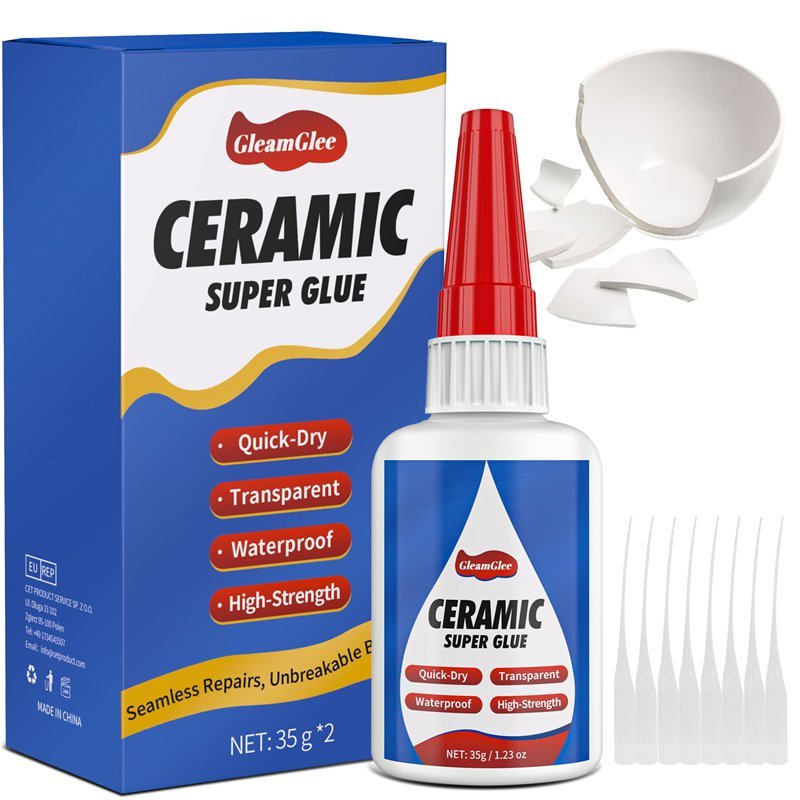
Products supplied with several precision nozzles also make repeated repairs more practical. A four-nozzle package, or eight nozzles with some two-pack configurations, gives the user spare applicators when an older tip becomes contaminated or difficult to reuse. Better dispensing control improves cleanliness, although it should never replace the handling precautions stated on the product.
How Should Ceramic Glue Be Stored?
Ceramic glue should normally remain inside its original labeled packaging rather than being transferred into another container. Keeping the original bottle or tube ensures that instructions, warnings, identification information, and storage guidance remain associated with the product every time it is used.
The cap should be closed promptly after application. A resealable anti-clog closure can reduce dried adhesive around the outlet and lower the likelihood that someone later attempts to open a blocked tube with scissors, pins, excessive force, or another unsafe improvised method.
Storage should be in a controlled DIY or maintenance area, away from food, medicine, children’s craft supplies, and pet products. Even if ceramic glue is frequently used for mugs or kitchen decorations, a general utensil drawer is not the best storage location because the product can be mistaken for an unrelated household item.
Temperature and environmental conditions should also follow the manufacturer’s guidance. Excessive heat, freezing conditions, prolonged sunlight, or poor resealing can affect both packaging and product usability. Good storage is therefore important for household safety and for maintaining reliable dispensing during future repairs.
When Is Replacement Safer?
A skilled repairer does not automatically glue every broken ceramic object. One of the most useful professional questions is, “What happens if this repair fails?” The answer often determines whether adhesive repair is sensible or whether the item should be replaced, retired from functional use, or assessed by a specialist.
A small decorative figurine with a detached ear presents relatively little consequence if the joint fails again. A heavily loaded ceramic fixture, cracked cooking vessel, damaged electrical insulator, or item that could release boiling liquid presents a much more serious situation. Even a strong adhesive should not be used as a substitute for appropriate structural design.
Severely shattered ceramics also deserve caution. Multiple tiny fragments, missing load-bearing material, contaminated fractures, or cracks extending beyond the visible break can make a repair unpredictable. For valuable antiques, professional conservation may be preferable because preservation professionals may prioritize reversibility and historical integrity over maximum permanent strength.
Repairing instead of replacing can reduce waste and preserve sentimental objects, but responsible repair also means recognizing when the safest outcome is to use the object decoratively rather than returning it to its original function.

Which Ceramic Items Are Safe to Repair?
Decorative ceramics such as figurines, vases, ornaments, picture-frame accents, planters, and many craft pieces are usually straightforward candidates when the adhesive is compatible with the material. Tableware and structural pieces require more scrutiny because food contact, heat, washing, repeated loading, outdoor exposure, and the consequences of failure can substantially change the suitability of a repair.
Are Vases and Figurines Good Candidates?
Porcelain figurines, ceramic statues, seasonal ornaments, decorative tiles, picture-frame accents, and display pieces are among the most practical adhesive repairs because they generally experience limited mechanical loading and little direct exposure to food. These projects place more emphasis on accurate alignment, clean appearance, and controlled adhesive placement.
Visible repairs benefit from a crystal-clear or low-visibility cured bond. A thick ridge of excess glue can become more noticeable than the original fracture, particularly on glossy white porcelain or finely painted ceramics. Fine applicator tips therefore have a practical advantage on small features such as figurine fingers, flower petals, ears, decorative curls, and narrow ornament hooks.
Rapid initial grip can also help when a small piece is difficult to clamp. The user can align the fragment carefully, hold it in position for the specified initial period, and then place the entire object on a support while the adhesive continues to cure.
Highly valuable antiques should be treated differently. Permanent household adhesive may interfere with future professional conservation. Where historical value, original surface preservation, or reversibility matters, consulting a conservator can be more appropriate than pursuing the strongest permanent bond available.
Can You Repair Mugs and Cups?
Some mug repairs can be practical, but the break location determines the questions that need to be answered. A detached exterior handle primarily involves repeated mechanical loading and temperature changes, whereas a fracture crossing the drinking rim or inside wall can introduce direct beverage contact, frequent washing, and repeated exposure to hot liquids.
A handle may be lifted hundreds of times throughout the life of a frequently used mug, which means the repaired joint experiences cyclic stress rather than one static load. Even after a successful repair, the user should periodically check for movement, fine cracking, separation, or whitening around the bond line.
When a repair passes through an interior beverage-contact area, the adhesive should have documentation supporting that intended contact condition before the mug returns to normal drinking use. General statements such as waterproof, heat-resistant, transparent, or low odor are not substitutes for that specific suitability.
When evidence is incomplete, a sentimental mug does not need to be discarded. It can often be converted into a pencil holder, small planter, brush cup, or decorative keepsake, preserving the object while avoiding an unsupported food-contact application.
Are Plates and Bowls Different?
Plates and bowls involve many of the same considerations as mugs but often have larger direct food-contact surfaces. A decorative break underneath a display platter may be a very different repair from a fracture passing through the center of a dinner plate used every day.
Functional tableware can be exposed to oils, acids, detergents, cutlery abrasion, hot water, repeated drying cycles, and mechanical impacts from stacking or dish handling. These conditions mean the adhesive must do more than simply maintain an initial bond between two ceramic fragments.
Users should therefore separate decorative restoration from functional restoration. A repaired decorative plate displayed vertically on a shelf may be perfectly satisfactory even when it is no longer appropriate for serving meals. This distinction allows many sentimental objects to remain useful without forcing them back into demanding service conditions.
For bowls used with hot soup, sauces, acidic foods, or repeated washing, the threshold for returning the item to normal use should be especially conservative. The more direct and frequent the exposure, the stronger the need for product-specific evidence.
What About Planters and Mixed Materials?
Ceramic planters, garden ornaments, mosaic projects, cabinet knobs, jewelry pieces, and decorative frames often combine ceramic with moisture, outdoor exposure, or a second material. These projects can be excellent candidates for repair when the adhesive is compatible with both surfaces and the expected environment.
Ceramic-to-metal joints are common in handles, knobs, badges, and decorative fittings. Ceramic-to-wood bonds appear in mosaics and framed art, while ceramic-to-glass, ceramic-to-concrete, and ceramic-to-plastic combinations are frequent in craft and household projects. A multi-material adhesive can simplify these applications, provided compatibility has been established for both substrates.
Outdoor planters introduce repeated wet-dry cycles, sunlight, temperature changes, soil pressure, and accidental impact. Repairing a decorative rim is generally less demanding than rebuilding a fractured base that supports a large volume of wet soil.
EPN ceramic adhesive is designed for ceramic and several common household materials, including metal, plastic, rubber, wood, PVC, glass, and concrete. That flexibility is particularly useful for small mixed-material repairs, but users should still assess surface condition, load, and environmental exposure before deciding whether an adhesive repair is appropriate.
How Do You Use Ceramic Glue Safely?
Safe ceramic repair begins before the glue is opened. Inspect the break, clean and dry the surfaces, test-fit the fragments, protect the workspace, prepare any supports, and read the product instructions. Apply only the required amount, align the pieces carefully, maintain the specified initial pressure, and allow the repair to reach full cure before exposing it to water, heat, movement, or load.
How Should You Prepare the Surface?
The first step is inspection. Collect all available fragments and confirm that the pieces fit naturally without being forced. Broken ceramic edges can be sharp, so users should handle them carefully and avoid sliding fingers directly along fresh fracture lines.
The bonding surfaces should be clean and dry according to the adhesive instructions. Dust, grease, soap residue, moisture, loose glaze, soil, and other contaminants can interfere with adhesion. Outdoor planters often require more preparation than indoor ornaments because the fracture may contain mineral residue, damp soil, algae, or fine debris.
Once the area is clean, perform a complete dry fit without adhesive. Align the pieces and decide exactly where your fingers, tape, holder, or support will go during bonding. If the adhesive sets rapidly, this short rehearsal can prevent a crooked mug handle or poorly aligned figurine that becomes difficult to correct once the joint begins to grip.
For visually important repairs, take time to inspect the fracture from several angles before bonding. A joint that appears aligned from the front may still be offset at the back, producing a visible ridge or uneven load across the repaired area.
How Much Glue Should You Apply?
More glue does not necessarily create a stronger ceramic bond. On a close-fitting fracture, excessive adhesive can squeeze from the joint, run across a glazed surface, bond to the user’s fingers, interfere with alignment, and leave a visible ridge around the repair.
A thin, controlled application is usually more manageable. Fine-tip applicators are particularly useful because many ceramic fractures are narrow and irregular. A precision nozzle allows the user to place adhesive along the intended joint rather than coating the surrounding decorative surface.
A practical application sequence is:
- Make sure both bonding surfaces are clean, compatible, and dry.
- Complete a dry fit before dispensing adhesive.
- Apply a controlled amount along the intended bonding area.
- Bring the fragments together carefully without unnecessary sliding.
- Apply firm pressure for the product-specified initial setting period.
- Support the object so gravity does not pull the joint out of alignment.
- Leave the repair undisturbed for the full recommended curing period.
- Delay washing, heating, loading, or outdoor exposure until the instructions allow it.
For EPN ceramic glue, the intended application method includes firm pressing for approximately 5–10 seconds during the initial bonding step. That short period describes initial positioning rather than full cure.
How Long Should Ceramic Glue Cure?
There is no single universal ceramic glue cure time because adhesive chemistries, joint thicknesses, materials, temperature, humidity, and repair geometry can differ substantially. Users should therefore rely on the product-specific instructions rather than assuming that all ceramic adhesives behave like fast household super glue.
It is useful to understand three stages. Initial grab is when the parts begin to hold together. Handling strength is when the repaired object can normally be moved carefully without disturbing the bond. Full cure is when the adhesive has reached the condition specified for its intended normal service.
These stages can be separated by minutes or many hours depending on the formulation. An adhesive that initially grips in seconds may still need considerably longer before the object should be loaded, washed, filled with water, or exposed to changing temperatures.
Repeatedly pulling or flexing the repair during cure to test whether it is “strong yet” can weaken alignment before the adhesive has finished developing. In practical ceramic repair work, patience during curing often makes a larger difference than trying to reduce a few seconds from the application process.
How Should Excess Glue Be Handled?
The easiest excess adhesive to remove is the adhesive that was never applied. Controlled dispensing, careful dry fitting, and precise alignment reduce the amount that squeezes from the bond and therefore reduce the need for aggressive cleanup afterward.
When excess adhesive does appear, users should follow the cleanup instructions for the specific formulation. Strong solvents, blades, abrasive pads, or improvised scraping should not automatically be used on every ceramic object. Decorative surfaces can be far more sensitive than they initially appear.
Hand-painted porcelain, metallic trim, decals, antique glaze, soft decorative finishes, and porous pottery can react differently to solvents or mechanical scraping. A cleaning method that works well on a plain modern tile may permanently alter the decoration on a collectible plate or figurine.
For a valuable object, testing any cleaning method on an inconspicuous area is sensible. In many cases, precise nozzles and restrained adhesive quantity provide a better result than relying on extensive cleanup after the bond has already been assembled.
How Do You Choose a Safer Ceramic Glue?
Choose ceramic glue by matching the adhesive to the real repair conditions instead of relying only on strength claims. Evaluate ceramic compatibility, any second material involved, bond visibility, precision dispensing, curing instructions, moisture and temperature exposure, food-contact requirements, packaging quality, and safety documentation. Commercial purchasers should additionally examine batch control, traceability, labeling, testing evidence, and manufacturing consistency.
Which Features Matter Most?
The object should determine the product requirements. A porcelain ornament needs accurate dispensing and a discreet finish. A planter needs appropriate moisture resistance. A ceramic-to-metal fitting needs compatibility with two different surfaces. A frequently handled mug handle requires a bond capable of tolerating repeated mechanical load and the temperatures expected during normal use.
For many household ceramic repairs, useful characteristics include compatibility with porcelain and ceramic, controlled fine-tip application, a transparent or low-visibility cured appearance, clear initial fixture instructions, realistic full-cure guidance, appropriate water or temperature resistance, and packaging that can be reliably resealed between uses.
Multi-material compatibility can also be valuable because household ceramics are frequently attached to metal, wood, plastic, glass, concrete, rubber, or PVC components. The important point is that the adhesive needs to work on both sides of the joint rather than merely carrying “ceramic glue” on the label.
Several replaceable precision nozzles can improve repeated-use convenience. Four applicator tips in a standard configuration, or eight with a two-pack setup, give users replacements if a fine nozzle becomes difficult to reuse after several projects. That small packaging decision can materially improve control on detailed repairs.
Is Maximum Strength Always Better?
A large bond-strength number can sound persuasive, but it rarely tells the complete story of a ceramic repair. Strength values depend on the test substrate, joint geometry, preparation method, cure conditions, loading direction, and test procedure. A result obtained on standardized laboratory specimens does not automatically predict performance on a curved glazed mug handle.
Real household repairs involve additional variables. The pieces may not fit perfectly, the ceramic may be porous or glazed, the joint may experience impact or vibration, and the object may repeatedly move between wet and dry or hot and cool conditions.
A very fast adhesive can be excellent for tiny pieces but may give the user less time to correct alignment. A thick adhesive may help bridge an irregular joint but can produce a more visible bond line. A very rigid adhesive may behave differently from one designed to tolerate movement.
For most users, the better choice is not simply the product with the most dramatic strength claim. It is the adhesive whose flow, cure behavior, durability, dispensing system, appearance, and documented use limits match the repair being performed.
How Does Manufacturing Affect Reliability?
A ceramic adhesive formula can perform impressively in a development sample yet create inconsistent customer experiences if production and packaging are not controlled. Raw-material variation, inaccurate mixing, viscosity drift, underfilling, leaking closures, blocked nozzles, or poor package compatibility can all affect the final product.
Consistent manufacturing normally involves incoming raw-material inspection, controlled mixing records, relevant viscosity or flow checks, filling-volume inspection, cap and nozzle fit checks, packaging compatibility assessment, leakage testing, finished-product sampling, and batch traceability. The exact procedures vary by formulation and product format, but the goal is always repeatable performance.
Packaging deserves particular attention with fast-bonding adhesives. A high-performing formula is frustrating if the bottle leaks in transportation or the dispenser dries out after one repair. Resealable anti-clog closures and correctly matched precision nozzles therefore contribute directly to practical product quality.
Integrated formulation, filling, packaging, and labeling capabilities can also shorten the feedback loop when a problem is discovered. Instead of several unrelated vendors adjusting different components, the formulation, container, applicator, and instructions can be evaluated as one product system.
What Should Professional Purchasers Verify?
Retailers, distributors, private-label brands, and online sellers need to evaluate more than the finished sample. Depending on the market and formulation, they may need safety documentation, labeling information, packaging specifications, quality-control procedures, performance test data, traceability, multilingual instructions, and evidence supporting the claims intended for the finished retail package.
Customization is particularly useful when a brand needs a specific viscosity, package size, nozzle configuration, label language, or application focus. A product intended primarily for figurines and craft work may be positioned differently from one developed for planters, mixed-material home repairs, or other defined ceramic applications.
For smaller market tests, flexible production can help reduce launch risk. Customized projects may begin at quantities around 200 units for suitable configurations, with design work sometimes completed within approximately two days once specifications are confirmed. Sample programs commonly require around 7–14 days, while routine production for established packaging configurations can be around 20 days, with shorter schedules possible when materials and production capacity permit.
The strongest supplier relationship is built around supported claims rather than exaggerated claims. When a manufacturer can explain what a formula is designed to do, which documents are available, how consistency is controlled, and which applications remain outside the product’s intended use, professional customers can make purchasing decisions with much greater confidence.

Conclusion
Non-toxic ceramic glue can be a practical part of family DIY repairs, but safer use begins with understanding what the phrase actually does and does not promise. A ceramic adhesive should be judged by its intended materials, instructions, hazard information, curing requirements, environmental resistance, packaging, and the conditions the repaired object will encounter after it leaves the workbench.
Decorative figurines, vases, ornaments, planters, mosaics, and many mixed-material household objects can often be repaired successfully with a precisely applied ceramic adhesive. Mugs, bowls, plates, kettles, high-temperature objects, heavy structural pieces, and food-contact areas demand more careful evaluation because normal household use introduces heat, moisture, repeated loading, detergents, food exposure, or more serious consequences if the bond fails.
For consumers, the most reliable habit is simple: use the correct adhesive for the correct object, apply only what is needed, control access during application, and allow the product to cure fully. For retailers and brands, the same principle extends further into formulation control, testing, documentation, packaging, labeling, and batch consistency.
A good ceramic glue should make repairing valued objects easier, not force the user to guess where the safety limits are. Clear instructions and realistic claims create confidence because they help people know not only what can be repaired, but also when a decorative repair, professional restoration, or complete replacement is the better decision.

Frequently Asked Questions
Is non-toxic ceramic glue automatically food-safe?
No. Non-toxic and food-safe describe different considerations, and a general non-toxic claim should not be treated as evidence that an adhesive is suitable for direct contact with food or beverages. If a repaired mug, plate, bowl, or serving item will place the adhesive directly in a food-contact area, check the product-specific documentation for that intended use and market. Waterproofness, heat resistance, transparency, or low odor do not independently establish food-contact suitability.
Can ceramic glue be used to repair a broken mug handle?
A detached ceramic mug handle can often be a reasonable adhesive repair because the joint may remain outside the beverage-contact surface. The repair still needs an adhesive compatible with the ceramic, suitable mechanical strength, proper surface preparation, correct alignment, and sufficient cure time. Users should also consider repeated lifting, hot-liquid exposure, and washing conditions because a mug handle experiences cyclic stress each time the cup is used.
How long should ceramic glue cure before use?
Curing time depends on the adhesive chemistry, temperature, humidity, joint thickness, and material. A product may develop initial grip within seconds while requiring many additional hours before reaching full cure. Users should distinguish initial holding time from handling strength and complete cure. Follow the exact product instructions and avoid washing, heating, filling, twisting, or loading the repaired ceramic until the stated curing period has been completed.
Is ceramic glue safe to use around children and pets?
Ceramic glue can be used responsibly in a family home when adults control the work area and follow the label, but uncured adhesive should remain inaccessible to children and pets. Keep open containers, spare nozzles, spills, contaminated tissues, and freshly repaired objects out of reach. After use, reseal the product immediately and store it in its original labeled packaging in a dedicated maintenance area rather than beside food, toys, medicine, or pet products.
Can ceramic glue repair outdoor flowerpots?
Many ceramic flowerpot repairs are possible when the adhesive is compatible with the ceramic and suitable for the expected moisture and outdoor exposure. Planters experience repeated watering, sunlight, temperature changes, soil pressure, and occasional impacts, making their service conditions more demanding than those of indoor ornaments. A decorative rim repair is usually less critical than a structural base fracture supporting heavy wet soil, so the consequence of failure should also be considered.
What is the difference between waterproof and dishwasher-safe ceramic glue?
Waterproof generally describes resistance to specified moisture exposure, while dishwasher suitability requires the bond to tolerate repeated cycles of hot water, detergents, temperature changes, spray pressure, and drying. A waterproof ceramic adhesive is therefore not automatically dishwasher-safe. The same distinction applies to heat resistance and microwave suitability. Each claim should be evaluated separately according to the product’s documented conditions rather than being inferred from another performance feature.
What should I look for when choosing ceramic glue for home repairs?
Look for compatibility with ceramic or porcelain, clear application instructions, an appropriate cure profile, controlled precision dispensing, a bond appearance suited to visible repairs, and resistance to the moisture, temperature, or outdoor conditions the object will actually experience. Multi-material compatibility is helpful for ceramic-to-metal, wood, glass, plastic, or concrete projects. Safety documentation, reliable packaging, realistic product limitations, and consistent manufacturing are equally important when choosing a dependable adhesive.
Share:
Table of Contents
Here, creating your adhesives glue & removal cleaner collection is no longer a barrier—it’s a collaborative journey where GleamGlee helps brands and businesses transform their vision into durable, certified, and market-ready solutions.
Partner with GleamGlee
Join hundreds of global partners who trust GleamGlee for adhesives and cleaners that combine innovation, compliance, and speed. Our vertically integrated system—from R&D to warehouse—guarantees consistent performance and reliable delivery.
Whether you’re sourcing FBA-ready stock or developing your own formula, our team provides unmatched technical support and responsive service.