Skip to content
Metal Glue for Restoring Old Metal Items: Essential Repair Guide
Your trusted adhesives glue & cleaner manufacturer

Most old metal items are not broken beyond saving. They are usually loose, cracked, detached, bent at a joint, or separated from another material. A drawer pull falls off a vintage cabinet. A metal photo frame opens at the corner. A bracelet clasp snaps. A garden ornament loses one small decorative piece. These problems feel annoying because the item still has value, but a single weak point makes it hard to use or display. Many people think metal repair means welding, drilling, screws, or buying a replacement. In daily home repair, that is often more work than the item needs.
Metal glue for restoring old metal items is useful for small, clean, non-load-bearing repairs such as décor, jewelry, hardware, craft pieces, tools, trims, and mixed-material parts. The best results come from cleaning away oil, dust, rust, and loose paint, applying a thin layer of glue, pressing the parts together firmly, and allowing enough curing time before use.
A successful metal glue repair is less about using a large amount of adhesive and more about making the right repair decision. The repair area must be clean. The parts must fit closely. The item should not be exposed to dangerous heat, pressure, or heavy load. When these points are handled well, a small tube of metal glue can bring back items that would otherwise sit in a drawer, garage, or trash bin.
What Metal Glue Can Fix?
Metal glue can fix many old metal items when the broken area is small, clean, and not responsible for holding heavy weight. It is useful for loose metal parts, cracked décor, detached trims, broken accessories, light tool repairs, craft pieces, and mixed-material items where metal connects to wood, plastic, rubber, ceramic, concrete, PVC, or glass. The repair works best when both surfaces fit closely and can be pressed together firmly.
Old metal items often fail at connection points, not across the whole object. A cabinet handle comes loose from repeated pulling. A photo frame opens at one corner. A bracelet clasp snaps after years of use. A garden ornament loses a wing, leaf, hook, or decorative edge. These are good repair situations because the item is still usable once the separated metal part is reattached.
Metal glue is not meant to replace welding, screws, bolts, or professional repair in every situation. It is best for visible, practical, low-risk repairs where a clean finish matters. If a part carries body weight, holds pressure, faces direct flame, or affects safety, glue should not be the only repair method. The smartest repair starts with a simple check: will failure only make the item loose again, or could it cause injury, leakage, heat damage, or collapse?
What Metal Glue Fixes at Home?
Metal glue is useful for many home repairs because household items often include small metal parts that loosen long before the whole product wears out. A drawer pull may detach from an old cabinet, a metal trim strip may lift from a storage box, or a lamp base may lose a small bracket. These problems are common in kitchens, bedrooms, garages, bathrooms, and living rooms. Most of them do not need drilling or welding. They need a clean surface, a controlled layer of glue, and firm pressure while the bond starts to set. Metal glue is especially helpful when screws would damage the item, replacement parts are hard to match, or the repair area is too small for mechanical fastening.
- Loose metal drawer pulls, knobs, handles, and decorative hardware
- Metal corners, trims, plates, labels, edging, and small brackets
- Lamp bases, photo frames, mirror frames, trays, and storage boxes
- Small non-electrical appliance panels, covers, and frame details
- Metal parts attached to wood, ceramic, plastic, or glass surfaces
| Home Item | Common Problem | Metal Glue Use | Repair Note |
|---|---|---|---|
| Cabinet handle | Loose or detached pull | Reattach to stable surface | Avoid if screw holes are fully broken under load |
| Photo frame | Open metal corner | Bond the corner joint | Tape the corner while curing |
| Lamp base | Loose decorative bracket | Bond small metal detail | Keep away from electrical or hot zones |
| Storage box | Lifted trim strip | Apply a thin glue line | Press along the full strip |
| Appliance cover | Detached metal plate | Reattach non-electrical part | Do not glue moving or heated parts |
Which Metal Glue Repairs Décor?
Metal décor is one of the best matches for metal glue because most décor repairs are about restoring appearance and light handling, not carrying heavy force. A cracked candle holder, a loose metal ornament, a broken sculpture detail, or a separated frame corner can often be repaired neatly with clear-drying metal glue. These pieces may not be expensive, but they often have personal value. A holiday candle holder, a travel souvenir, a vintage-style frame, or a small wall decoration may be difficult to replace with the same look. A clean glue repair helps keep the original item instead of replacing it with something similar but not quite right.
- Metal candle holders, ornaments, figurines, and small sculptures
- Vintage-style frames, wall hooks, decorative signs, and trays
- Metal leaves, wings, handles, trims, and raised decorative pieces
- Mixed-material décor using metal with glass, wood, ceramic, or stone
- Light indoor plant stands, display pieces, and table decorations
| Décor Type | Good Repair Area | What to Check First |
|---|---|---|
| Candle holder | Decorative arm, base trim, ring detail | Repair should not sit near direct flame |
| Metal sculpture | Small detached piece | Contact area should be wide enough |
| Picture frame | Corner seam or metal edge | Finish should not be flaking |
| Wall décor | Hook, trim, raised detail | Do not use for heavy hanging weight |
| Decorative tray | Handle or metal edge | Surface must be dry and grease-free |
For décor, the repair should look controlled. A clear glue line helps, but the amount matters more. Too much adhesive can leave a shiny ridge around the joint. A fine-tip nozzle is better for small decorative seams because it keeps the glue inside the break instead of spreading across the visible finish.
What Metal Glue Saves Accessories?
Metal glue can save many small accessories because these items often break at tiny parts rather than across the main body. A bracelet clasp, bag buckle, watchband trim, keychain tag, or costume jewelry detail may fail suddenly, even though the rest of the item is still in good shape. Precision is important here. Accessories are handled often, worn close to the skin, and usually have visible finishes. A small, clear repair is much better than a thick patch. Before gluing, the surface should be cleaned carefully because accessories collect hand oil, perfume, lotion, sweat, leather conditioner, and dust. These residues can weaken the repair if they stay on the metal.
- Bracelet clasps, small chains, charms, earrings, and brooch details
- Bag buckles, zipper pulls, decorative plates, studs, and metal tags
- Belt hardware, keychains, watchband trims, and small fasteners
- Eyeglass nose pieces or small non-load decorative frame parts
- Costume jewelry and daily accessories with light-use metal breaks
| Accessory | Metal Glue Can Help With | Avoid Glue-Only Repair When |
|---|---|---|
| Bracelet | Small clasp or charm repair | The main chain is under strong pulling force |
| Bag hardware | Loose plate, stud, or zipper pull | The fabric or leather base is torn |
| Belt buckle | Decorative trim or small metal piece | The buckle carries full belt tension |
| Watchband | Non-moving trim detail | The clasp or moving link is damaged |
| Eyeglasses | Nose pad or tiny detail | Hinge, screw, or lens alignment is affected |
For accessories, use very little glue. A tiny drop is often enough. Keep adhesive away from hinges, springs, moving links, and locking parts. After pressing, let the item rest before wearing or pulling on it. A repair that feels firm after a few seconds can still weaken if it is used too soon.
Is Metal Glue Good Outdoors?
Metal glue can repair many outdoor metal items, but outdoor repairs need more careful judgment than indoor repairs. Outdoor items face rain, humidity, wind, dust, soil, temperature changes, and vibration. A garden ornament, camping lantern, fishing lure detail, or outdoor sign may be a good candidate because the repair is usually small and non-structural. The most important step is surface preparation. Rust, dampness, and dirt are common outdoors, and glue should not be applied over them. Rust is especially risky because it can flake away after the repair, taking the glue with it. The bonding area should be cleaned back to a stable surface and dried fully before application.
- Garden ornaments, metal signs, decorative hooks, and outdoor trims
- Camping lantern details, tent pole fittings, and light gear parts
- Fishing lure parts, reel details, hooks on decorative items, and small clips
- Non-load gate accents, fence decorations, and metal nameplates
- Outdoor craft projects using metal with wood, stone, PVC, or plastic
| Outdoor Item | Suitable Metal Glue Repair | Not Suitable as Glue-Only Repair |
|---|---|---|
| Garden ornament | Small crack or decorative piece | Heavy base, support leg, or sharp load point |
| Metal sign | Loose plate, corner, or trim | Main mounting system under wind load |
| Camping lantern | Decorative handle trim | Fuel, flame, or pressure parts |
| Fishing gear | Small lure or reel detail | High-tension hook or safety part |
| Gate decoration | Accent piece or nameplate | Hinge, lock, railing, or structural joint |
Outdoor repairs should cure indoors or in a dry protected place whenever possible. Do not put the item back into rain, soil, or heavy use immediately. If the part is exposed to strong pulling, body weight, heat, fuel, water pressure, or equipment safety risk, use mechanical fastening, welding, replacement parts, or professional repair instead.
Which Metal Glue Should You Use?
The right metal glue depends on four things: the size of the repair, the surface condition, the materials being joined, and the stress the item will face after repair. A tiny bracelet clasp does not need the same adhesive behavior as a metal trim strip on a wooden box. A garden ornament exposed to rain needs more durability than an indoor photo frame. A fast, clear, precise metal glue is usually the most practical choice for small old metal item restoration.
For daily repairs, choose metal glue that can bond quickly, dry clear, and work on both metal-to-metal and mixed-material surfaces. Old metal items often include aluminum, stainless steel, zinc alloy, brass-style finishes, painted metal, plastic parts, rubber grips, wood panels, ceramic bases, or concrete details. One repair product with broad material compatibility can handle more of these real-life repair problems without needing a different tube for every item.
The repair should also match the risk level. Metal glue is a good choice for small, close-fitting, non-load-bearing repairs. It is not the right single solution for parts exposed to flame, high pressure, heavy weight, vehicle safety, structural support, or strong repeated impact. A strong household metal glue should make small repair work easier, cleaner, and faster—not replace welding, bolts, screws, soldering, or industrial repair where safety is involved.
Which Metal Glue Bonds Fast?
Fast-bonding metal glue is useful when the broken part is small, slippery, curved, or hard to clamp. Many old metal items fail in places where a clamp cannot easily hold the shape: a frame corner, a jewelry clasp, a metal trim strip, a small bracket, a model part, or a decorative sculpture detail. If the glue takes too long to grab, the part may slide out of position, leaving a crooked repair or visible glue marks. A fast bond gives more control during the first few seconds, especially for repairs done at home without professional tools.
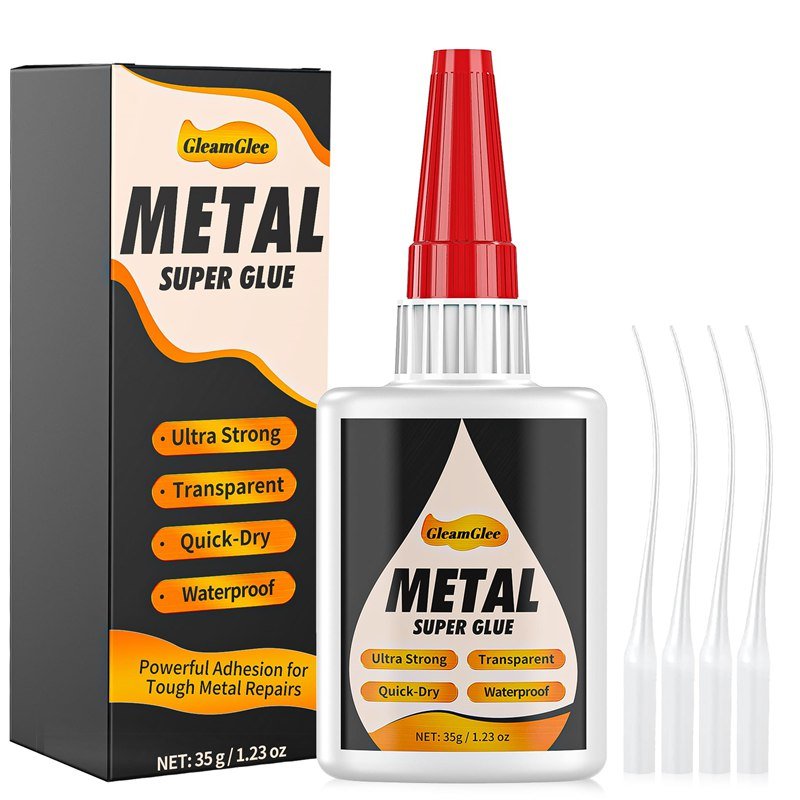
GleamGlee Metal Glue is designed for instant high-strength bonding. For many small repairs, the user can apply a thin layer, align the two surfaces, and press firmly for 5–10 seconds. That short pressing window is practical for small household fixes because it reduces the need for heavy clamping. Still, fast bonding does not mean full strength is reached instantly. The item should rest before being pulled, washed, worn, or placed outdoors.
- Best for tiny parts that are hard to hold for long
- Useful for frame corners, jewelry, trims, and small brackets
- Helps reduce sliding during alignment
- Works better when surfaces fit closely
- Should still be allowed to cure before normal use
| Repair Type | Why Fast Bond Helps | Rest Time Advice |
|---|---|---|
| Bracelet clasp | Stops the clasp from shifting | Let it rest before wearing |
| Metal photo frame | Holds the corner angle faster | Tape the corner while curing |
| Decorative trim | Reduces movement along the strip | Press evenly along the full length |
| Model part | Keeps tiny pieces in place | Avoid touching during cure |
| Small bracket | Helps initial positioning | Add tape or clamp if needed |
What Metal Glue Dries Clear?
Clear-drying metal glue is often better for restoring old metal items because many repairs are visible. A repair on a photo frame, candle holder, bracelet, ornament, bag buckle, cabinet handle, or decorative tray should not leave a cloudy patch. A clear finish helps the repaired area look cleaner, especially when the item has a polished, brushed, painted, blackened, bronze-style, or stainless-steel surface. The glue should support the repair without becoming the first thing people notice.
GleamGlee Metal Glue dries clear, making it suitable for repairs where appearance matters. However, clear glue still needs careful application. If too much glue is used, it can squeeze out and form a shiny raised edge. Even transparent glue can look messy if it spreads beyond the joint. A thin layer gives a cleaner finish and usually allows the broken surfaces to sit closer together. For older decorative finishes, apply a small amount and test hidden areas when the item has special value.
- Good for visible metal repairs
- Helps reduce obvious repair marks
- Better for décor, jewelry, trims, and collectibles
- Works best with thin application
- Should not be over-applied around polished surfaces
| Item Surface | Clear Glue Benefit | Application Tip |
|---|---|---|
| Stainless steel | Keeps repair line less visible | Wipe away excess before it cures |
| Black metal | Avoids pale glue marks | Use a very thin layer |
| Brass-style finish | Keeps vintage look cleaner | Test hidden area first |
| Painted metal | Reduces visible patching | Remove loose paint before repair |
| Jewelry finish | Keeps small repair discreet | Use a tiny drop only |
Which Metal Glue Fits Small Cracks?
Small cracks need metal glue with controlled flow, not a wide opening that releases too much adhesive. Many old metal items break in narrow areas: a split in a frame corner, a tiny crack in a sculpture, a loose chain link, a model detail, a metal edge on a box, or a thin decorative strip. These areas need glue to enter the joint cleanly without flooding the surface. A precision nozzle can make the difference between a neat repair and a visible mess.
GleamGlee Metal Glue includes 4 precision nozzles per tube, and a 2-pack includes 8 nozzles. These fine tips help guide glue into small cracks, tight seams, and difficult corners. This is useful when repairing items with detailed surfaces or narrow bonding zones. Small cracks usually need only enough glue to wet the broken surfaces. Filling the crack with too much adhesive may make the surface uneven and reduce how tightly the parts close.
- Best for narrow seams and tiny contact points
- Helps prevent glue overflow
- Useful for jewelry, models, décor, and trim repair
- Allows cleaner placement in hard-to-reach areas
- Reduces waste during small repairs
| Small Repair Area | Glue Control Needed | Best Practice |
|---|---|---|
| Thin frame seam | High | Apply inside the corner only |
| Jewelry crack | Very high | Use a tiny drop with the fine tip |
| Sculpture detail | High | Support the part while curing |
| Metal trim edge | Medium to high | Run a narrow line along the contact area |
| Model-making part | Very high | Dry fit before applying glue |
Is Metal Glue Good for Mixed Materials?
Metal glue is often used on mixed-material items because old household objects are rarely made from one material. A metal handle may attach to ceramic. A metal trim may sit on wood. A buckle may connect to leather or fabric. A decorative metal piece may be fixed to glass, plastic, stone, concrete, or PVC. A good metal glue should handle more than metal-to-metal repair because real restoration work often involves two different surfaces with different textures, hardness, and absorbency.
GleamGlee Metal Glue is suitable for metal-to-metal bonding and can also bond plastic, rubber, wood, concrete, PVC, and wall surfaces. This makes it useful for home repairs, crafts, accessories, outdoor décor, and small workshop fixes. The key is surface preparation. Smooth metal may need light roughening. Wood should be dry and dust-free. Plastic should be clean and tested first if it feels oily or flexible. Concrete should be free from loose powder. Rubber should not be in a high-stretch area.
- Useful for metal with wood, plastic, rubber, concrete, PVC, ceramic, or glass
- Good for mixed-material décor, trims, handles, and craft parts
- Helps reduce the need for multiple repair products
- Works best when both surfaces are clean and stable
- Not suitable for high-flex, high-load, or high-heat mixed-material repairs
| Material Pair | Good Use Example | Main Check Before Gluing |
|---|---|---|
| Metal + wood | Drawer pull, trim, box hardware | Wood must be dry and dust-free |
| Metal + plastic | Appliance cover, craft part | Plastic should not be oily or flexible under stress |
| Metal + rubber | Light handle detail, small accessory | Avoid stretched or bending areas |
| Metal + ceramic | Handle, ornament, decorative base | Ceramic edge must be clean and stable |
| Metal + concrete | Small bracket, craft base, décor | Remove dust and loose particles |
| Metal + PVC | Light repair or craft use | Clean surface before bonding |
| Metal + glass | Decorative trim or display piece | Keep glue line thin and controlled |
How Does Metal Glue Work?
Metal glue works by forming a thin adhesive layer between two prepared surfaces. It does not weld metal or melt the broken parts together. Instead, it grips the surface, fills tiny contact points, and cures into a firm bond. For old metal items, the repair is strongest when the glue touches clean, dry, stable material rather than rust, oil, dust, loose paint, or old polish.
The bond depends on three practical factors: surface contact, glue thickness, and curing time. Close-fitting parts create a stronger repair because the glue layer stays thin and even. A wide gap, bent metal edge, or dirty surface can reduce strength. More glue does not always mean a better repair. In many small restorations, a controlled drop works better than a thick bead.
Metal glue is most reliable on small, non-structural repairs such as décor, jewelry, trims, craft parts, light hardware, and mixed-material items. It can help restore the look and function of old metal pieces, but it should not be treated like welding for high-heat, pressure, heavy-load, or safety-related repairs.
How Does Metal Glue Bond Metal?
Metal glue bonds metal by attaching to the surface and curing into a solid adhesive layer between the two parts. Even polished metal has tiny scratches, pores, and uneven areas that help the adhesive grip. When the surface is clean and lightly prepared, the glue can spread across the contact area and hold the pieces together after curing. The repair becomes stronger when the broken parts fit closely, because a thin bond line usually performs better than a thick lump of glue sitting between two uneven surfaces.
Old metal items often have hidden layers that weaken repair results. A frame corner may have old wax or dust. A garden ornament may have rust powder. A bracelet clasp may carry skin oil, lotion, or perfume residue. A tool part may have grease. If glue bonds to these weak layers, the repair can fail even if the adhesive itself is strong. The glue must touch solid metal or a stable material surface.
- Clean metal gives the glue direct contact
- Light sanding helps smooth metal hold better
- Close-fitting parts reduce weak gaps
- Rust, grease, and loose paint should be removed first
- Stable surface preparation matters more than using extra glue
| Surface Condition | What Happens to the Bond | Repair Action |
|---|---|---|
| Clean bare metal | Best contact and better grip | Glue can be applied after dry fitting |
| Lightly sanded metal | More surface texture for adhesion | Wipe away sanding dust before gluing |
| Rusty metal | Glue may bond to weak rust, not metal | Remove loose rust first |
| Oily metal | Glue may slide or peel | Degrease and dry fully |
| Painted metal | Bond depends on paint strength | Remove loose or flaking paint |
| Polished metal | Surface may be too smooth | Roughen hidden contact area lightly |
How Much Metal Glue Is Enough?
A small amount of metal glue is usually enough for old metal repairs. The purpose is to wet the contact surfaces, not flood the joint. A thin layer allows the two broken parts to sit closer together, which often creates a cleaner and stronger repair. Too much glue can push the parts apart, increase curing time, and squeeze out around the edge. On visible items such as jewelry, frames, ornaments, or cabinet hardware, excess glue can leave a shiny raised mark that makes the repair look careless.
The right amount depends on the size and shape of the repair. A bracelet clasp may need only a pinhead-sized drop. A metal trim strip may need a narrow line. A frame corner may need a thin film on the contact edge. For porous materials such as wood or concrete, slightly more glue may be needed because the surface can absorb some adhesive. Still, the glue should not form a thick cushion between the materials.
- Use a tiny drop for jewelry and accessories
- Use a thin line for trims and narrow strips
- Use a thin film for flat metal contact areas
- Avoid thick blobs in the center of the joint
- Wipe or control overflow before it becomes visible
| Repair Area | Suggested Amount | Good Result |
|---|---|---|
| Bracelet clasp | Tiny drop | Joint closes without glue overflow |
| Metal frame corner | Thin film on contact edge | Corner sits tight and straight |
| Cabinet handle plate | Thin layer across stable contact area | Plate sits flat against the surface |
| Metal trim strip | Narrow continuous line | Trim bonds evenly along the length |
| Small sculpture part | Small controlled drop | Part holds without visible glue marks |
| Metal to wood | Thin layer, slightly adjusted for absorption | Metal sits close to the wood |
For best control, dry fit the repair first. Place the parts together without glue and check where the surfaces actually touch. If only one tiny point touches, the repair may need bending, reshaping, or support before gluing. If the parts sit flat together, a small amount of glue is usually enough. GleamGlee Metal Glue uses precision nozzles to help place adhesive in the right area, which reduces waste and keeps the repair cleaner.
How Fast Does Metal Glue Set?
Metal glue can set quickly when the surface is clean, the glue layer is thin, and the parts fit closely. GleamGlee Metal Glue is designed for instant high-strength bonding, and many small repairs can be pressed firmly for 5–10 seconds after application to help the parts stay in position. This fast setting is useful for old metal items because many repairs are small, awkward, or difficult to clamp. A loose frame corner, jewelry clasp, trim strip, or model part can shift easily if the adhesive takes too long to grab.
Fast setting does not mean the repair has reached full strength. The first few seconds help stop movement, but the adhesive still needs time to cure. If the item is pulled, worn, washed, twisted, or placed outdoors too soon, the bond can weaken before it fully develops. This is one of the most common reasons small metal repairs fail. The item may feel fixed, but the inside of the bond still needs time.
- Press firmly for 5–10 seconds after alignment
- Keep the repair still after the initial hold
- Avoid testing strength right away
- Use tape, rubber bands, or a light clamp for awkward shapes
- Allow longer rest for outdoor, handled, or vibration-prone items
| Repair Situation | Initial Hold | Extra Support Needed? |
|---|---|---|
| Small jewelry clasp | 5–10 seconds | Tweezers can help alignment |
| Photo frame corner | 5–10 seconds | Tape can hold the angle |
| Metal trim strip | 5–10 seconds per section | Tape along the strip helps |
| Small bracket | 5–10 seconds | Clamp if the bracket lifts |
| Curved ornament part | 5–10 seconds | Soft support may be needed |
| Mixed-material repair | 5–10 seconds | Rest longer before use |
Temperature, humidity, glue amount, and material type can affect setting speed. Cold or damp spaces may slow the process. Thick glue layers may also need longer to stabilize. A good repair setup should be ready before opening the glue: clean surfaces, correct alignment, support tools nearby, and a stable place for curing.
How Long Should Metal Glue Cure?
Metal glue needs curing time after the initial set. Curing is the period when the adhesive becomes more stable and develops stronger performance. A repair may stop moving after a short press, but that does not mean it is ready for normal use. Old metal items often have uneven edges, aged coatings, small gaps, or mixed materials, so giving the repair enough rest is important. A full 24-hour rest is a safe habit for many small home repairs, especially items that will be handled, worn, cleaned, or used outdoors.
Curing time should match the repair stress. A decorative metal frame that sits on a shelf may need less stress resistance than a garden ornament exposed to rain or a bracelet pulled during daily wear. The more movement, moisture, or handling the item will face, the more important curing becomes. During curing, the item should stay dry, still, and properly aligned. Moving the joint too early can break the developing bond even if the outside feels firm.
- Let small repairs rest before handling
- Keep repaired items dry during early curing
- Avoid twisting, pulling, or washing too soon
- Give outdoor items more protected curing time
- Use supports so awkward pieces do not shift
| Time After Application | Repair Condition | What to Do |
|---|---|---|
| 0–10 seconds | Parts begin to hold | Press firmly and keep alignment |
| First few minutes | Joint is still sensitive | Place item carefully and avoid movement |
| First few hours | Bond is developing | Keep dry, still, and unloaded |
| Around 24 hours | Many light repairs can return to use | Check gently before normal handling |
| Longer if exposed to stress | Better for moisture, vibration, or outdoor use | Allow extra rest before full use |
Do not test the repair by pulling it apart. This can damage the bond before it has finished curing. A better check is visual: the parts should stay aligned, the joint should look closed, and there should be no movement under light handling after curing. For heavy force, heat, pressure, or safety-related use, curing longer will not make consumer metal glue a replacement for welding, bolts, or professional repair. Use the glue where it fits the item’s real working conditions.

How to Use Metal Glue?
Using metal glue well is a simple process, but each step affects the final strength and appearance of the repair. The best method is to dry fit the broken parts first, clean the surface, remove loose rust or coating, lightly roughen smooth metal, apply a thin layer of glue, press the parts together for 5–10 seconds, and let the repair cure before use.
Old metal items need more preparation than new materials. A repaired bracelet, cabinet handle, frame corner, garden ornament, or tool fitting may look easy to glue, but old surfaces often carry oil, dust, rust powder, wax, paint flakes, or moisture. If these layers stay on the surface, the adhesive may bond to the residue instead of the metal.
A good repair should look clean and feel stable. More glue is not the answer. Better contact, controlled application, and steady pressure are more important. GleamGlee Metal Glue is designed with precision nozzles to help place a small amount of adhesive exactly where it is needed, which is useful for tiny cracks, narrow seams, and detailed metal repairs.
How to Clean Before Metal Glue?
Cleaning is the first step because metal glue needs direct contact with a stable surface. Old metal items often look clean at a glance, but the bonding area may still have invisible barriers. Jewelry may have skin oil, lotion, perfume, or sweat. Kitchen items may have grease. Garden décor may have soil, moisture, and rust powder. Furniture hardware may have wax, polish, or dust. If glue is applied over these layers, the repair may hold for a short time and then peel away. The surface should feel dry, stable, and free from loose particles before adhesive is applied. Cleaning also helps reveal whether the repair area is actually solid enough to bond.
- Wipe away dust, powder, and loose dirt first
- Remove grease, oil, wax, and polish from the bonding area
- Let the metal dry fully before applying glue
- Avoid touching the cleaned area with bare fingers
- Use cotton swabs or a lint-free cloth for small parts
| Surface Problem | Why It Matters | What to Do Before Gluing |
|---|---|---|
| Dust or loose dirt | Glue bonds to particles instead of metal | Brush or wipe clean |
| Grease or oil | Adhesive may slide or peel | Degrease and dry fully |
| Rust powder | Weak layer can break away | Remove loose rust first |
| Wax or furniture polish | Creates a slick barrier | Clean the contact area carefully |
| Moisture | Can weaken early bonding | Let the item dry completely |
| Hand oil | Reduces grip on small metal parts | Hold with tweezers or clean cloth |
For small accessories, cleaning should be extra careful because the repair area is tiny. A bracelet clasp or watchband trim may only have a few millimeters of contact surface, so even a small amount of oil can reduce strength. For outdoor metal items, wipe until no rust dust or soil transfers to the cloth. For painted metal, clean gently and check whether the paint is firmly attached.
How to Sand Before Metal Glue?
Sanding is useful when the metal surface is smooth, glossy, oxidized, or lightly coated. The purpose is not to damage the item or remove all finish. The purpose is to create a slightly rough contact area so the glue can grip better. Polished stainless steel, aluminum, plated metal, and painted metal can be too smooth for the strongest bond if no preparation is done. Light sanding on the hidden bonding area can improve contact without changing the visible look of the item. For old decorative metal, sanding should be controlled and limited because visible scratches can reduce the value or appearance of the piece.
- Sand only the hidden bonding area when possible
- Use fine sandpaper, an emery board, or a small file
- Remove sanding dust before applying glue
- Do not sand valuable patina unless the bond area requires it
- Stop if the surface coating starts lifting beyond the repair area
| Item Type | Sanding Level | Practical Tip |
|---|---|---|
| Metal frame corner | Light | Roughen only the inside contact edge |
| Cabinet handle plate | Light to moderate | Sand the back of the plate, not the visible front |
| Jewelry clasp | Very light | Use a tiny file only on the contact point |
| Garden ornament | Moderate if rusty | Remove loose rust before bonding |
| Painted metal décor | Careful and limited | Remove flaking paint, keep stable finish |
| Metal trim strip | Light | Sand the underside for better grip |
After sanding, always clean again. Fine metal dust can stay inside scratches and weaken the bond if left behind. A clean, lightly roughened surface is better than a rough but dusty surface. Dry fit the parts after sanding to confirm they still align correctly. If sanding changes the shape or causes a gap, the repair may become harder to bond cleanly.
How to Apply Metal Glue Neatly?
Neat application is important because many old metal repairs are visible. A metal glue repair on a picture frame, jewelry clasp, candle holder, cabinet handle, or decorative trim should not leave a thick shiny patch around the joint. The best method is to use a small amount and place it only where the surfaces touch. GleamGlee Metal Glue includes 4 precision nozzles per tube, and a 2-pack includes 8 nozzles, helping users apply glue into small cracks, narrow seams, and hard-to-reach areas. A fine-tip nozzle is especially useful when the broken part is only a few millimeters wide or when the repair sits near a finished surface.
- Use a thin layer instead of a thick blob
- Apply glue to one side first for most small repairs
- Keep the nozzle close to the bonding area
- Avoid spreading glue onto visible surfaces
- Close the cap after use to help prevent clogging
| Repair Area | Best Application Style | Common Mistake |
|---|---|---|
| Jewelry clasp | Tiny drop from fine nozzle | Glue flooding the moving clasp |
| Frame corner | Thin film inside the joint | Glue spreading onto the front edge |
| Metal trim | Narrow line along the back | Uneven glue beads causing bumps |
| Small bracket | Thin layer across flat contact area | Thick blob only in the center |
| Sculpture detail | Small controlled drop | Touching surrounding painted finish |
| Metal to wood | Thin layer, slightly adjusted for absorption | Using so much glue it squeezes out |
A dry fit should always happen before applying glue. Place the parts together and check the direction, angle, and pressure point. Once glue is applied, repeated repositioning can smear adhesive and reduce the clean finish. For very small repairs, work over a tray or white paper so tiny parts are not lost. If the item has a delicate finish, cover nearby areas with tape where possible, leaving only the bonding zone exposed.
How to Press Metal Glue Repairs?
Pressing helps the glue form a thinner and more stable bond line. When the parts are pressed together, the adhesive spreads across the contact area and the broken surfaces sit closer. GleamGlee Metal Glue is designed for firm pressure for about 5–10 seconds after application, which helps the repaired part stay in position during the first stage of bonding. Pressing should be steady, not rough. Too little pressure can leave gaps. Too much pressure can force all the glue out of the joint or shift a delicate piece out of place. The goal is firm contact without twisting, sliding, or squeezing the repair area too aggressively.
- Press firmly for 5–10 seconds after alignment
- Keep the parts still instead of twisting them
- Use tape, rubber bands, or a clamp for awkward shapes
- Support curved pieces with a soft cloth or foam block
- Let the repair rest before handling, washing, or loading
| Item Type | Pressing Method | Cure Support |
|---|---|---|
| Bracelet or charm | Tweezers or fingertip pressure | Lay flat and avoid movement |
| Photo frame corner | Hand pressure, then tape | Keep corner square while curing |
| Metal trim strip | Press along the full length | Use tape to hold the strip down |
| Cabinet handle plate | Firm flat pressure | Clamp lightly if surface allows |
| Small sculpture part | Gentle steady pressure | Prop with soft cloth or foam |
| Outdoor ornament | Firm pressure after cleaning | Cure indoors before outdoor use |
Do not test the bond immediately by pulling on it. A repair may feel secure after a short press, but the adhesive still needs curing time. For many light repairs, leaving the item undisturbed for several hours is sensible, and a full 24-hour rest is safer before normal use. Items exposed to moisture, vibration, outdoor conditions, or frequent handling should be given extra curing time. Good pressing starts the bond; patient curing protects it.
Do Metal Glue Repairs Last?
Metal glue repairs can last well when the repair is used in the right place. The strongest results usually come from small, clean, close-fitting parts that are not carrying heavy weight. A repaired photo frame, bracelet charm, cabinet trim, garden ornament, model part, or light bracket can stay useful when the surface is prepared properly and the glue is allowed to cure before handling.
The life of a metal glue repair depends on surface condition, joint shape, glue amount, curing time, and daily stress. A wide flat bonding area usually lasts longer than a tiny point contact. A clean, dry surface bonds better than rusty or oily metal. A thin glue layer often performs better than a thick blob because the parts sit closer together and the adhesive cures more evenly.
Metal glue should not be treated as a replacement for welding, bolts, screws, soldering, or professional service in high-risk repairs. Heat, pressure, heavy load, repeated bending, and safety-related use can push consumer metal glue beyond its practical limit. A good repair decision protects both the item and the person using it.
Is Metal Glue Waterproof?
Waterproof performance is important for old metal items used near kitchens, bathrooms, garages, gardens, workshops, and outdoor storage areas. A repair may not be placed under water, but it can still face rain, damp air, cleaning water, wet hands, condensation, or soil moisture. Metal glue can last well in normal moisture exposure when the repair area is stable, clean, and fully cured. The surface must be dry before gluing because trapped moisture can weaken early bonding. Rust should also be removed from the bonding area, since glue attached to rust may fail when the rust flakes away. For outdoor décor or damp-area repairs, curing indoors before exposure gives the bond a better chance to hold.
- Remove loose rust before applying glue
- Dry the repair area fully before bonding
- Let the repair cure before water exposure
- Avoid pressure-water repairs as a permanent solution
- Keep repaired outdoor items still during early curing
| Repair Area | Waterproof Use Level | Practical Note |
|---|---|---|
| Garden ornament | Good | Clean rust and cure indoors first |
| Bathroom trim | Good | Surface must be dry before gluing |
| Kitchen décor | Good | Avoid direct heat or heavy washing |
| Outdoor sign | Good | Press flat and seal the joint neatly |
| Pipe pinhole | Temporary only | Not a permanent pressure repair |
| Boiler or radiator | Poor fit | Heat and pressure increase risk |
Does Metal Glue Handle Vibration?
Metal glue can handle light vibration when the joint is small, clean, tightly fitted, and fully cured. Vibration matters because many old metal items move more than people expect. A cabinet door shakes when closed. A tool rattles in a drawer. A garden ornament moves in wind. A lamp base may shift during cleaning. An appliance cover may vibrate during use. These small movements can slowly stress the glue line. A repair with a wider contact area will usually last longer than a repair joined at one tiny point. If the part bends, twists, or carries pulling force every day, extra support such as tape during curing, a screw, clip, pin, or bracket may be needed.
- Wide contact areas resist vibration better
- Thin glue layers usually stay more stable
- Full curing time is important before movement
- Repeated bending weakens small glue joints
- Mechanical support helps vibration-prone repairs
| Item Type | Vibration Risk | Repair Advice |
|---|---|---|
| Photo frame | Low | Glue alone is usually enough |
| Cabinet trim | Low to medium | Press evenly along the full strip |
| Appliance panel | Medium | Avoid heated or moving sections |
| Garden ornament | Medium | Cure fully before outdoor use |
| Tool handle detail | Medium to high | Add support if the part is pulled |
| Bike frame or handlebar | High | Do not use glue as the repair method |
Is Metal Glue Safe for Heat?
Heat is one of the clearest limits for metal glue repairs. Metal itself can tolerate high temperatures, but adhesive bonds have temperature limits. A metal glue repair may be fine on a decorative kitchen item, a metal jar label, a picture frame, a cabinet handle, or a room-temperature tool part. It becomes riskier when the repaired area is exposed to direct flame, stove heat, engine heat, boiler heat, fireplace heat, or hot cookware. Heat can soften, weaken, discolor, or stress the bond depending on the item and exposure level. Before repairing, check how hot the part gets during normal use. If the item becomes too hot to touch, the repair needs stronger heat-rated methods or replacement parts.
- Avoid direct flame and stove-exposed repairs
- Do not repair engine, exhaust, or boiler parts with consumer metal glue
- Keep glue repairs away from fuel, pressure, and electrical heat zones
- Use mechanical repair for cookware handles under heat stress
- Choose heat-rated products only when the repair truly needs heat resistance
| Heated Item | Metal Glue Suitability | Safer Choice |
|---|---|---|
| Decorative kitchen tin | Good | Keep away from flame |
| Metal jar trim | Good | Clean grease before gluing |
| Candle holder base | Possible | Repair must be away from flame |
| Pot handle | Poor fit | Use screws or replacement handle |
| Grill part | Poor fit | Use heat-rated repair or replace |
| Engine or exhaust part | Not suitable | Professional repair required |
| Lamp decoration | Possible | Avoid bulb socket or wiring areas |
When Is Metal Glue Not Enough?
Metal glue is not enough when the broken part affects safety, load support, pressure control, heat resistance, or mechanical movement. A repair may look small, but its job may be important. A cracked ladder joint, chair leg, bicycle pedal, gate hinge, pressure pipe, cookware handle, brake part, or machine housing under force should not rely on glue alone. These repairs can fail suddenly and create injury, leakage, fire risk, or property damage. Metal glue is best for restoring appearance, small function, and light-use parts. If the item supports weight, controls motion, seals pressure, or protects safety, use welding, bolts, screws, soldering, replacement parts, or professional service.
- Avoid glue-only repairs on load-bearing parts
- Do not use consumer metal glue for pressure pipes or gas fittings
- Avoid vehicle, brake, ladder, and structural repairs
- Use screws, pins, brackets, or welding when force is high
- Treat glue as support only when the part carries stress
| Repair Question | If the Answer Is Yes | Best Direction |
|---|---|---|
| Does it carry body weight? | Yes | Do not use glue alone |
| Is it under water, gas, or air pressure? | Yes | Use professional repair |
| Does it face direct flame or high heat? | Yes | Use heat-rated method or replacement |
| Could failure cause injury? | Yes | Avoid glue-only repair |
| Is the repair decorative? | Yes | Metal glue may be suitable |
| Do the parts fit closely? | Yes | Metal glue has better repair potential |
| Is the surface rusty or oily? | Yes | Prepare before gluing |

Is GleamGlee Metal Glue Good?
GleamGlee Metal Glue is a good choice for restoring old metal items when the repair needs fast bonding, clear drying, controlled application, and compatibility with more than one material. It is designed for metal-to-metal bonding and can also be used on plastic, rubber, wood, concrete, PVC, and wall surfaces, which makes it practical for real home repairs where old items often combine several materials.
Its strongest value is in small, precise, visible repairs. Old metal restoration often involves narrow cracks, thin trims, decorative corners, jewelry parts, stainless steel pieces, aluminum parts, small brackets, and household hardware. In these jobs, a messy glue line can ruin the look of the item. GleamGlee’s precision nozzles and clear finish help make the repair cleaner and easier to control.
GleamGlee Metal Glue should still be used with the right expectations. It is suitable for daily repair, craft restoration, décor repair, accessory repair, and light outdoor fixes. It is not meant to replace welding, screws, bolts, or industrial adhesives for structural, high-heat, high-pressure, or load-bearing repairs. Used in the right repair scene, it gives old metal items a practical second life without complicated tools.
What Makes GleamGlee Metal Glue Clean?
Clean repair matters because old metal items are often kept for their appearance, not only their function. A metal photo frame, bracelet, candle holder, cabinet handle, decorative tray, or small sculpture may still look beautiful, but one broken joint makes it feel unusable. GleamGlee Metal Glue dries clear, which helps the repair line look less obvious when the glue is applied thinly and accurately. The clean finish is especially useful on visible surfaces such as stainless steel, aluminum, dark metal, brass-style finishes, painted metal, and mixed-material décor. The formula is designed for fast bonding, so the repaired part can be aligned and pressed quickly instead of sliding around and spreading glue over the surface.
- Clear drying helps reduce visible repair marks
- Fast bonding helps limit slipping and smearing
- Thin application creates a neater repair line
- Precision nozzles reduce glue overflow
- Better for visible repairs than thick, cloudy adhesives
| Repair Scene | Clean Result Needed | GleamGlee Benefit |
|---|---|---|
| Metal photo frame | Corner should close without a thick glue mark | Clear finish and thin application |
| Bracelet clasp | Glue should not flood the moving area | Fine nozzle controls the drop |
| Candle holder | Decorative repair should stay discreet | Clear bond line looks cleaner |
| Cabinet handle | Plate should sit flat against the surface | Thin layer reduces squeeze-out |
| Metal sculpture | Small detail should keep original shape | Fast hold helps alignment |
| Decorative trim | Long strip should bond evenly | Controlled line supports neat placement |
For the cleanest result, apply less glue than expected. A tiny drop can be enough for jewelry. A narrow line can be enough for trim. A thin film can be enough for a flat metal plate. The goal is not to cover the broken area with adhesive, but to join the two surfaces closely. Too much glue can still leave a raised glossy edge even if the glue dries clear.
How Do Metal Glue Nozzles Help?
Nozzle control is one of the most important details in metal repair because many old metal breaks are small. A broken chain link, loose model part, frame corner, eyeglass nose pad, decorative trim edge, or tiny sculpture detail cannot be repaired well with a wide glue opening. Too much adhesive comes out too quickly, spreads beyond the joint, and makes the repair look rough. GleamGlee Metal Glue includes 4 precision nozzles per tube, while a 2-pack includes 8 nozzles. These fine tips help direct the adhesive into small cracks, narrow seams, and hard-to-reach areas without wasting glue or covering the surrounding finish.
- 4 precision nozzles per tube
- 8 nozzles in a 2-pack
- Better control for tiny cracks and narrow seams
- Less glue waste during small repairs
- Easier use on jewelry, décor, models, and trims
| Nozzle Feature | Real Repair Benefit |
|---|---|
| Fine-tip opening | Places glue inside the joint instead of around it |
| Replaceable nozzles | Useful for several repair jobs over time |
| Narrow flow control | Helps prevent glue blobs on visible surfaces |
| Small crack access | Reaches corners, seams, and tiny gaps |
| Cleaner application | Reduces wiping, scraping, and surface mess |
| Better for detail work | Supports jewelry, model making, and décor repair |
Precision nozzles also reduce stress during repair. Small metal parts are often hard to hold, and once glue is applied, there is little time to fix a messy mistake. A fine nozzle lets the user place a controlled drop before pressing the parts together. For thin frame seams, the nozzle can follow the inside edge. For small jewelry parts, it can place glue only on the contact point. For metal trim, it can create a narrow line instead of uneven blobs.
Which Items Fit GleamGlee Metal Glue?
GleamGlee Metal Glue fits many old metal repair jobs because it is not limited to one metal type or one repair category. It can be used for stainless steel, aluminum, jewelry, DIY crafts, metal pipes in temporary non-critical situations, sculptures, household hardware, small tools, decorative pieces, and mixed-material projects. It also bonds metal with plastic, rubber, wood, concrete, PVC, and wall surfaces, which is useful because many old items are built from more than one material. A metal handle may attach to ceramic. A metal trim may sit on wood. A buckle may connect to fabric or leather. A decorative sign may combine metal and wall material.
- Metal-to-metal repair for small broken parts
- Metal-to-wood repair for trims, handles, and boxes
- Metal-to-plastic repair for covers, craft pieces, and accessories
- Metal-to-ceramic or glass repair for décor and kitchen items
- Metal-to-concrete or PVC repair for light utility and craft use
| Item Category | Good GleamGlee Metal Glue Use | Use With Caution |
|---|---|---|
| Household hardware | Handles, trims, plates, brackets | Do not rely on glue for heavy hanging |
| Jewelry | Clasps, charms, decorative links | Avoid high-tension chain sections |
| Home décor | Frames, candle holders, sculptures, trays | Keep away from direct flame |
| Tools | Non-critical handles, clips, small fittings | Not for striking or load tools |
| Outdoor items | Garden décor, signs, lantern details | Remove rust and cure before rain |
| Crafts | Metal models, trims, mixed-media pieces | Test slick plastic first |
| Utility repair | Small non-pressure holding or sealing | Not for permanent pipe pressure |
The best-fit items share a few traits: the broken area is small, the surfaces can touch closely, the repair is not safety-critical, and the item will not face extreme heat or heavy force. If the repaired part is decorative or lightly handled, GleamGlee Metal Glue is practical. If the part holds body weight, seals pressure, supports a structure, or works near flame, a mechanical or professional repair is safer.
Why Choose GleamGlee Metal Glue?
GleamGlee Metal Glue is supported by a manufacturer with experience in adhesives, repair products, and home care solutions. The product is designed around real repair behavior: people need a glue that bonds quickly, dries cleanly, works on more than one material, and stays usable after opening. The anti-clog cap helps prevent the glue from drying between uses, which is important because most people use metal glue for one small repair, store it, and then need it again later. The precision nozzles also make the product easier to use for detailed repair work instead of only large surface bonding.
- Instant high-strength bond for small repairs
- Clear drying finish for visible metal items
- Anti-clog cap for better repeat use
- 4 precision nozzles per tube, 8 in a 2-pack
- Works on metal, plastic, rubber, wood, concrete, PVC, and wall surfaces
- Suitable for jewelry, décor, tools, crafts, and light household repair
| Product Need | GleamGlee Metal Glue Advantage |
|---|---|
| Small repair control | Precision nozzles help place glue accurately |
| Cleaner appearance | Clear drying finish reduces visible marks |
| Repeated use | Anti-clog cap helps protect the tube after opening |
| Fast repair | Pressing 5–10 seconds supports quick initial hold |
| Mixed-material items | Bonds metal with several common surfaces |
| Home storage | Compact tube is easy to keep in a repair drawer |
| Old item restoration | Useful for trims, accessories, décor, and small hardware |
GleamGlee also supports product ordering and customized adhesive projects through LingWang (Dongguan) Technology Co., Ltd. The company has more than 25 chemists, material specialists, and process engineers, more than 18 designers, four integrated factory systems, automated filling lines, and annual production capacity of more than 12 million pieces. Custom projects can start from a low MOQ of 200 units, with design artwork available as fast as 2 days, sample delivery usually within 7–14 days, and bulk production around 20 days. For ready-made GleamGlee Metal Glue orders or customized metal glue products, businesses can request product details, samples, packaging options, and quotation support through GleamGlee’s official inquiry channels.
Conclusion
Metal glue gives old metal items a practical second life when the repair is small, clean, and not under heavy load. From loose cabinet handles and metal frame corners to jewelry clasps, garden ornaments, craft pieces, and light household hardware, the best results come from careful surface preparation and controlled application. Clean away oil, dust, rust, and loose coating first, then apply a thin layer, press firmly, and allow enough curing time before use. A neat repair is not about using more glue; it is about making the glue touch stable surfaces and keeping the joint tight, clean, and properly supported.
GleamGlee Metal Glue is designed for these everyday restoration needs, with fast bonding, clear drying, precision nozzles, an anti-clog cap, and compatibility with metal, plastic, rubber, wood, concrete, PVC, and wall surfaces. It is suitable for home repairs, décor, accessories, tools, crafts, and light outdoor items where a clean finish and easy application matter. For ready-made GleamGlee Metal Glue orders or customized metal glue products, businesses can request product details, samples, packaging options, and quotation support through GleamGlee’s official inquiry channels.
Share:
Table of Contents
Here, creating your adhesives glue & removal cleaner collection is no longer a barrier—it’s a collaborative journey where GleamGlee helps brands and businesses transform their vision into durable, certified, and market-ready solutions.
Partner with GleamGlee
Join hundreds of global partners who trust GleamGlee for adhesives and cleaners that combine innovation, compliance, and speed. Our vertically integrated system—from R&D to warehouse—guarantees consistent performance and reliable delivery.
Whether you’re sourcing FBA-ready stock or developing your own formula, our team provides unmatched technical support and responsive service.