Skip to content
Floral Adhesive for Groom Boutonnieres: A Florist-Grade Guide
Your trusted adhesives glue & cleaner manufacturer

A groom’s boutonniere may be one of the smallest floral arrangements at a wedding, yet it often faces more physical stress than a centerpiece or bouquet. It sits against a moving lapel, receives pressure during hugs, brushes against seat belts, travels between venues, and appears in close-up photographs where visible adhesive, crooked flowers, or damaged petals are difficult to hide. Choosing floral adhesive is therefore not simply a matter of finding the strongest glue.
The best floral adhesive for groom boutonnieres is a flower-compatible formula that dries clear, stays slightly flexible, and resists normal moisture without damaging petals or leaving bulky residue. It should provide controlled application, enough working time for accurate positioning, and dependable hold during refrigeration, transportation, photography, hugging, and dancing. Separate pins, magnets, clips, or holders are normally used to attach the completed boutonniere to the jacket.
A boutonniere can look perfect while resting on a worktable and still fail within an hour of being worn. A heavy flower may slowly rotate, a decorative leaf may detach after repeated movement, or a poorly chosen adhesive may create a visible glossy spot on a white petal. Reliable results come from combining the right formula with careful flower preparation, balanced construction, realistic curing time, suitable storage, and a secure jacket attachment.
What Is Floral Adhesive for Groom Boutonnieres?
Floral adhesive is a specialized bonding product used to join flowers, foliage, ribbon, decorative accents, and structural backings inside a groom’s boutonniere. A suitable formula should create a discreet, flexible connection that tolerates normal moisture and movement. It reduces visible mechanics but does not automatically replace wire, floral tape, pins, magnets, or other support systems in every boutonniere design.
How Floral Adhesive Works
A boutonniere is a wearable floral structure rather than a miniature hand-tied bouquet. Most stems are trimmed close to the flower heads, leaving fewer natural points that can be wrapped together. Floral adhesive creates localized bonds between the focal bloom, greenery, filler flowers, ribbon, and a prepared base.
The strongest connection usually forms where two firm, clean surfaces meet. The base of a flower, a short surface-dry stem, a sturdy leaf rib, or a purpose-made backing normally provides more support than a delicate petal edge. Thin petals may complete the appearance, but they should not be expected to carry the weight of the design.
Adhesive can also reduce unnecessary thickness. Traditional wiring and taping remain valuable, but wrapping every small flower and leaf may create a bulky stem bundle that pushes the arrangement away from the lapel. Small, carefully placed adhesive points can create a flatter profile that looks cleaner and remains more stable during wear.
Bond strength is only one performance factor. A very rigid adhesive may crack when the lapel bends, while a slow formula may allow the focal flower to slide before packing. Effective floral adhesive balances working time, initial tack, cured flexibility, appearance, and moisture resistance.
Materials It Can Bond
Floral adhesive may be used with fresh, dried, preserved, and artificial materials, but those categories present different bonding conditions. A formula that performs well on silk flowers may not be suitable for direct contact with fresh petals, and a product designed for living flowers may not bond equally well to every plastic backing.
| Material | Useful Adhesive Property | Main Compatibility Concern |
|---|---|---|
| Fresh flowers | Flower-compatible and flexible | Browning, wilting, or tissue damage |
| Fresh foliage | Moisture-resistant tack | Natural waxes and surface moisture |
| Dried flowers | Gentle, lightweight bonding | Brittle stems and shedding surfaces |
| Preserved flowers | Controlled flow and clear finish | Oils, dyes, and preservation treatments |
| Silk flowers | Fabric-compatible adhesion | Stiffening or visible residue |
| Plastic stems | Strong contact with smooth surfaces | Weak grip on some low-energy plastics |
| Ribbon and lace | Clear, low-bleed finish | Staining through fine fabrics |
| Metal backings | Reliable surface adhesion | Separation from smooth or coated metal |
Fresh flowers require the most careful testing because their tissues still contain water, natural oils, pigments, and delicate cell structures. Artificial materials may tolerate a broader range of products, but foam, polyester, coated wire, PVC, and polyethylene still react differently.
Before assembling an important wedding order, test the exact flower variety, backing, ribbon, adhesive, storage temperature, and application amount. A formula that performs well on a rose calyx may behave differently on an orchid petal or waxy eucalyptus leaf.
When Adhesive Is Most Useful
Floral adhesive is especially useful in compact, low-profile boutonnieres where visible wire would interfere with the finished appearance. It can secure short-stemmed blooms, lightweight greenery, berries, ribbon details, dried accents, and decorative components without adding excessive wrapping.
It also helps when a design combines several materials. A florist may need to attach preserved foliage to a plastic holder, ribbon to a backing, or dried details to a wired fresh-flower structure. Controlled adhesive points can connect those materials while keeping the front of the boutonniere visually clean.
Adhesive should not be treated as a universal replacement for mechanical support. A large flower head, hollow stem, heavy ornament, or extended decorative element may still need wire. The correct construction depends on how the weight moves through the finished arrangement.
A practical approach is to separate structural components from decorative components. Structural parts carry weight and control direction, while decorative parts provide shape, color, and texture. Adhesive may secure both, but heavier structural pieces often benefit from additional reinforcement.
Professional Use and Production Consistency
A small difference in viscosity may be manageable when making one boutonniere. The same difference can slow production when a wedding studio is assembling thirty or fifty matching pieces. Professional users need consistent dispensing, repeatable tack, predictable setting behavior, and packaging that does not leak or clog.
A useful studio evaluation should include repeated dispensing from the same container, room-temperature setting, refrigeration, return to room temperature, transport simulation, and gentle movement testing. Junior staff should also try the product because a formula that works only for an experienced florist may not suit a larger production team.
The nozzle should release small, repeatable dots without sudden flooding. The cap should protect the formula from drying between projects, and the packaging should remain clean during storage. Applicator design directly influences waste, speed, precision, and the appearance of the completed work.
Professional buyers should also verify batch traceability and shelf-life guidance. Reliable performance across different production lots matters as much as the result of one successful sample.

Which Floral Adhesive Works Best?
The best floral adhesive is the formula that matches the flowers, backing material, storage conditions, production schedule, and expected movement. For groom boutonnieres, useful qualities include controlled dispensing, a clear finish, moderate working time, dependable initial tack, flexibility after curing, and resistance to normal moisture. Professional users should also assess shelf life, packaging integrity, batch consistency, technical support, and intended material compatibility.
Key Performance Factors
Boutonniere adhesive must balance several properties that can work against one another. A very fast formula may save time but offer little opportunity to correct a crooked flower. A highly viscous formula may bridge small gaps but create a thick visible bond. A thin product may spread easily but travel into ribbon or petals.
Controlled flow is one of the most important practical features. The florist should be able to place a small dot exactly where two stable surfaces meet. Sudden dispensing can stain pale materials, increase waste, and make the boutonniere look less refined.
Working time should be long enough for accurate alignment but short enough to support an efficient production schedule. Product labels often distinguish between open time, tack time, handling strength, and full cure. Those stages should not be treated as interchangeable.
| Performance Point | Practical Requirement | Why It Matters |
|---|---|---|
| Flow control | Small, repeatable drops | Reduces waste and visible residue |
| Working time | Enough time for positioning | Prevents rushed or crooked placement |
| Initial tack | Holds after light pressure | Limits sliding and flower rotation |
| Dry appearance | Clear with low haze | Preserves close-up presentation |
| Flexibility | Bends without cracking | Tolerates jacket movement |
| Moisture resistance | Stable near hydrated flowers | Supports fresh-flower applications |
| Packaging seal | Resists leakage and drying | Improves storage reliability |
| Batch consistency | Similar flow and setting behavior | Supports repeat commercial production |
A product can achieve strong laboratory results and still be inconvenient in daily floral work. The bottle pressure, nozzle width, cap design, cleanup method, and ability to dispense after storage all influence whether the formula is practical.
Repeatability is usually more valuable than a dramatic strength statement. Several small, correctly positioned bonds often perform better than one oversized adhesive mass placed on weak botanical tissue.
Fresh-Flower Compatibility
Fresh-flower compatibility involves more than drying clear. The adhesive should not visibly damage the flower during the period between assembly and the end of the event. Reactions may include browning, translucent spots, softened tissue, curled edges, color loss, or glossy residue.
Pale flowers require particular attention because small marks are easier to see on white, cream, blush, and translucent petals. Test the exact variety and color intended for the final boutonniere rather than relying on results from a different flower.
Application thickness also matters. A small test dot may cause no visible reaction, while a thick mass can trap moisture or stress the tissue. Use the same amount during testing that will be used in actual production.
Observe samples immediately after application, after the expected setting period, after planned refrigeration, and near the expected end of the event. Testing only the first few minutes does not reveal delayed color or tissue changes.
Even a compatible adhesive cannot transform a weak petal into a structural anchor. Whenever possible, place the bond on the calyx, flower base, short firm stem, leaf rib, or prepared backing.
Fresh, Dried, and Artificial Designs
Fresh boutonnieres need moisture tolerance and botanical compatibility. Dried designs require low-pressure handling because the stems and surfaces may crumble. Artificial arrangements may involve fabric, foam, painted plastic, coated wire, and molded stems, each with different surface properties.
A product described as floral craft glue may perform well on silk flowers while being unsuitable for fresh petals. The intended application should be clearly stated in the product information or technical documentation.
Mixed-material designs need special attention because each connection may fail differently. A boutonniere containing a fresh rose, preserved eucalyptus, dried seed pods, satin ribbon, and a plastic backing has several distinct bonding interfaces.
The weakest interface determines the final reliability. Adhesive may remain attached to the painted surface of an artificial berry while the paint separates from the plastic beneath it. Adding more adhesive would not solve that problem because the coating, rather than the bond line, has failed.
Surface cleaning, light preparation, or choosing a different connection point may provide better results than increasing the amount of adhesive.
Selecting Adhesive for Commercial Supply
Wholesale distributors, floral supply brands, wedding studios, and private-label sellers need more than a sample that performs once. They require repeatable viscosity, color, odor, tack, curing behavior, and packaging performance across production batches.
A structured sourcing review should consider the following questions:
- Is the formula intended for fresh, dried, preserved, artificial flowers, or multiple categories?
- Which flowers and backing materials have been tested?
- How does the bond perform after refrigeration?
- What package sizes and applicator types are available?
- Can working time or viscosity be adjusted?
- What shelf-life and storage information is available?
- Can production lots be traced?
- Which technical, safety, and transport documents are supplied?
- Can the bottle, label, instructions, and retail box be customized?
Packaging should be evaluated together with the formula. A reliable adhesive inside an unsuitable container may leak, clog, dry around the opening, or release too much material. Precision packaging is part of product performance for boutonniere work.
Commercial evaluation should also include sample consistency. Testing several units from the same sample batch can reveal whether nozzle flow and formula behavior remain stable from one package to another.
How Do You Glue a Groom Boutonniere?
Prepare healthy, surface-dry flowers, arrange the design before using adhesive, and identify firm hidden contact points. Apply several small dots instead of one thick layer, follow the product’s recommended tack time, and press the components together without crushing them. Support the design until it reaches handling strength, then inspect every connection before refrigeration, packaging, transport, or wear.
Prepare the Flowers and Workspace
Begin with flowers that are firm, conditioned, and free from visible bruising. Remove damaged petals, loose foliage, soil, and plant debris. Trim stems with clean tools, but avoid using a freshly cut, wet stem as the only load-bearing bond point.
Arrange all components in their intended order before opening the adhesive. A typical groom boutonniere may contain one focal flower, one or two supporting blooms, two to four pieces of greenery, a filler element, ribbon, and a backing or attachment system.
Dry-fit the design from the front, top, side, and back. A boutonniere may look balanced from the front while extending too far away from the lapel when viewed from the side.
The back should remain relatively flat. A rounded or uneven rear surface moves the center of mass away from the jacket, increasing leverage and making the arrangement more likely to rotate.
Test unfamiliar materials in advance. Use an extra petal, leaf, trimmed stem, ribbon sample, and backing. Pale flowers, preserved foliage, smooth plastics, coated metal, velvet ribbon, and fine satin deserve careful testing.
Build the Boutonniere in Layers
Construct the boutonniere from the strongest components outward. The focal flower and backing form the central structure, while greenery establishes the outline and smaller elements complete the visual detail.
| Assembly Stage | Main Action | Quality Check |
|---|---|---|
| Dry fitting | Arrange all components without glue | Size and profile suit the lapel |
| Surface preparation | Trim, clean, and surface-dry | No loose fibers or visible water |
| Adhesive application | Place small hidden dots | No excess near petals or ribbon |
| Focal flower placement | Press onto a firm base | Flower does not rotate |
| Greenery placement | Build the outer shape | Rear surface remains flat |
| Detail placement | Add fillers and accents | Weight stays balanced |
| Reinforcement | Add glue only where needed | No visible buildup |
| Final inspection | Check every viewing angle | No sharp, loose, or unstable parts |
Do not use a fragile filler flower as a structural bridge between heavier components. Each major part should connect directly to a stable base or to another component capable of carrying its weight.
When the product requires a short tack stage, follow the stated timing before joining the surfaces. Joining too early may allow the pieces to slide, while waiting beyond the useful working period may reduce contact quality.
The florist should build the front-facing arrangement without losing control of the back. A beautiful floral face attached to a thick or uneven base will be difficult to secure comfortably to formalwear.
Control the Amount of Adhesive
Several small connections are usually cleaner and more reliable than one large mass. Thick adhesive can squeeze outward, remain soft in the center, increase weight, or create an unwanted space between the flower and backing.
Place adhesive on firm, hidden areas. Avoid spreading it over visible leaves or petals. A transparent product may still reflect light differently from the natural flower surface, making the application noticeable in professional photographs.
Keep protective paper, disposable applicators, cotton swabs, and the supplier-recommended cleanup material nearby. Do not smear uncured adhesive across a petal in an attempt to remove it. That action often creates a larger glossy area.
Replacing an over-glued leaf or filler flower may produce a better result than trying to clean it. Wedding floral work is judged on both reliability and appearance.
Keep the applicator close to the connection point without allowing the nozzle to touch wet plant tissue. Contact can transfer moisture, pollen, or debris into the opening and contribute to clogging.
Set, Inspect, and Pack
Initial tack, handling strength, and full cure describe different stages. A boutonniere may be stable enough to lift before the adhesive has developed the strength required for transport or repeated movement.
Allow the arrangement to remain supported until the focal flower no longer slides or rotates. Avoid placing it immediately into tight packaging where the box can press the bloom into a different angle.
Hold the backing and apply gentle movement to each component in the direction it may experience during wear. The goal is to identify loose rotation or unstable contact, not to pull the boutonniere apart.
Inspect the following points before packing:
- The focal flower faces forward.
- The design remains flat against the backing.
- No adhesive is visible from normal viewing angles.
- No wire, hard stem, or rough edge can contact the jacket.
- Greenery does not hide the focal bloom.
- The attachment system can support the total weight.
- The arrangement does not rotate during gentle movement.
Use rigid packaging that prevents finished boutonnieres from touching one another. The pieces should be held in place without placing pressure on the petals, foliage, or adhesive connections.

Do You Still Need Wire, Tape, or Pins?
Floral adhesive can reduce visible mechanics, but it does not replace every wire, tape, pin, magnet, clip, or holder. Wire supports weak stems and controls direction, tape binds and conceals internal mechanics, and pins or magnets connect the completed boutonniere to the jacket. The most dependable designs combine adhesive and mechanical support according to flower weight, shape, garment type, and event duration.
Adhesive Versus Wire
Adhesive joins surfaces, while wire creates or controls structure. A compact flower with a firm base may need only adhesive, but a large bloom with a weak, hollow, or short stem may require wire to prevent bending or rotation.
Wire is useful when a component must maintain a specific direction, extend beyond the central design, survive long-distance transport, or carry a relatively heavy decorative item. It can also support flower heads that lack enough firm surface area for adhesive alone.
The goal is not to wire every element. Excessive wiring adds weight and thickness, making the boutonniere stiff and pushing it away from the lapel.
A hybrid method often provides a cleaner result. The florist may wire the primary structural flower, tape only the necessary section, and use small adhesive points for leaves, filler flowers, ribbon, and front-facing accents.
Consider how each component carries force. A decorative leaf may need only a small bond, while a heavy focal flower may require both mechanical support and adhesive reinforcement.
The Role of Floral Tape
Floral tape groups stems and wires into a manageable structure. It can cover sharp wire ends, create a more uniform base, improve grip, and prepare the lower section for ribbon or decorative wrapping.
Tape becomes counterproductive when too many layers are added. A thick stem bundle pushes the flower mass farther from the jacket, increasing leverage and the likelihood of rotation.
Use tape only where binding is required. Stretch and apply it according to the product’s instructions so that it grips correctly.
Floral tape can provide a consistent surface for additional materials, but not every adhesive bonds equally well to waxed tape. Test the exact combination before relying on it in a commercial wedding order.
A well-constructed internal base should feel stable without becoming completely rigid. Some flexibility allows the design to move naturally with the lapel rather than resisting every small bend.
Pins, Magnets, and Holders
The method used to build the boutonniere is separate from the method used to attach it to the garment. Floral adhesive should not automatically be placed directly on the jacket.
| Attachment Method | Suitable Use | Main Advantage | Main Limitation |
|---|---|---|---|
| Traditional pins | Standard suit lapels | Adjustable and widely available | May pierce or mark fabric |
| Two-pin method | Larger or heavier designs | Reduces rotation | Requires careful placement |
| Magnets | Fine or rental garments | Avoids pinholes | Strength depends on lapel thickness |
| Buttonhole stem | Functional lapel buttonholes | Traditional, elegant appearance | Not available on every jacket |
| Clip backing | Fast event setup | Easy to attach | May move on thick fabric |
| Adhesive holder | Compatible prepared systems | Low-profile front appearance | Must be verified for the garment |
Traditional pins remain widely used because they are simple and adjustable. A light arrangement may be stable with one correctly positioned pin, while a heavier design often benefits from two support points.
Magnets avoid puncturing fabric and can suit delicate or rented jackets. Their performance depends on magnet strength, lapel thickness, flower weight, and the distance between the arrangement and the jacket.
Buttonholes create an elegant traditional presentation when the jacket has a functional opening and a supporting loop. Clips provide quick installation but should be checked for movement on different lapel materials.
Protecting Formalwear
Applying fresh-flower adhesive directly to wool, silk blends, velvet, linen, satin, or fine synthetic fabric introduces unnecessary risk unless the product is specifically designed and tested for that material.
Possible problems include permanent staining, hardened fibers, darkened fabric, glossy residue, surface distortion, and fiber loss during removal. The risk is particularly serious with rental or custom-tailored formalwear.
Use a separate backing, magnet, pin, clip, or purpose-made holder whenever possible. Any adhesive-backed garment accessory should be tested on matching fabric or an inconspicuous sample before the event.
The completed arrangement should rest close to the lapel instead of hanging outward. Reducing the distance between the flower mass and the attachment point decreases torque and places less stress on the jacket, adhesive bonds, and internal mechanics.
Inspect the attachment from inside the garment as well. Pin points should not face the wearer, magnets should be enclosed securely, and rough stems or wire ends should be fully covered.
How Do You Keep It Secure All Day?
An all-day boutonniere depends on durable flowers, balanced weight, a flat structure, sufficient setting time, appropriate storage, and an attachment suited to the jacket. Adhesive strength alone cannot correct a heavy or poorly balanced arrangement. Plan for heat, humidity, transportation, hugging, seat belts, photography, and dancing. Preparing one labeled spare is practical for long events, outdoor weddings, or designs made with delicate flowers.
Choose Durable, Lightweight Flowers
A visually impressive flower is not automatically suitable for extended wear. Large, soft, water-heavy, or easily bruised blooms may struggle through several hours of movement and direct contact.
Compact flowers with firm bases often perform more reliably. Depending on variety and condition, spray roses, miniature carnations, orchids, lisianthus, waxflower, ruscus, eucalyptus, herbs, seed pods, and dried accents may be considered.
Suitability still depends on freshness, conditioning, climate, storage, and the design itself. A flower that performs well at an indoor spring wedding may behave differently at an outdoor summer ceremony.
Evaluate the weight before applying adhesive. Hold the dry-fitted arrangement against a sample lapel. If it leans or rotates immediately, a stronger glue will not correct the underlying geometry.
Weight can be reduced by shortening unnecessary stems, removing hidden foliage, using a smaller focal flower, limiting heavy ornaments, and moving the flower mass closer to the backing.
Balanced construction distributes the load around the attachment point. A top-heavy boutonniere acts like a lever and multiplies the force placed on the adhesive and lapel.
Plan for Event-Day Movement
Boutonnieres experience repeated contact during greetings, transportation, photographs, dinner, dancing, and jacket removal. A design that remains stable in a box may perform differently once worn.
| Event Condition | Likely Problem | Practical Prevention |
|---|---|---|
| Repeated hugging | Crushed petals or rotated flowers | Use compact blooms and a flat profile |
| Outdoor heat | Wilting and softened plant tissue | Choose durable flowers and limit exposure |
| High humidity | Slower setting or moisture stress | Test under comparable conditions |
| Vehicle travel | Seat-belt compression | Attach after travel when practical |
| Long photography sessions | Gradual shifting | Inspect before formal portraits |
| Dancing | Lapel rotation | Use a secure two-point attachment |
| Jacket removal | Snagging or crushing | Explain safe handling to the wearer |
The groom should understand that a boutonniere remains a delicate floral item even when it is securely assembled. He should avoid gripping the flowers when adjusting the jacket.
A coordinator or florist can perform a quick check before the ceremony and another before formal photographs. Small corrections are easier before a leaf folds, the attachment shifts, or the focal flower rotates.
For extended events, a wider backing or two-point attachment may provide greater stability than simply increasing the amount of glue.
Store and Transport Correctly
Storage should protect the flowers from dehydration, crushing, condensation, and uncontrolled temperature changes. The appropriate conditions depend on the flower varieties, backing materials, and adhesive formula.
Confirm that the adhesive can tolerate the planned refrigeration cycle. Test cooling, storage, removal, warming, and handling rather than checking only room-temperature performance.
Use a rigid container with enough clearance to prevent flowers from touching the lid or one another. Individual supports or compartments can reduce movement during transportation.
Label each boutonniere by wearer. The groom, fathers, officiant, and groomsmen may have similar designs with subtle differences that become confusing during a busy wedding setup.
Keep the box on a level surface during transport. Repeated sliding and small impacts can loosen decorative components even when the focal flower remains attached.
Attaching the boutonniere after major vehicle travel can reduce damage from seat belts and door frames. When that is not possible, the wearer should be shown how to position the seat belt without pressing directly against the flowers.
Prepare a Spare and Repair Kit
Unexpected handling, weather, or transportation damage can affect even a well-made boutonniere. A spare is especially valuable for outdoor ceremonies, destination weddings, long schedules, and designs containing fragile flowers.
The backup should match the groom’s boutonniere and use the same attachment method. Store it separately so that one accident does not damage both arrangements.
A compact event repair kit may include:
- One labeled spare boutonniere.
- Extra pins or a backup magnetic attachment.
- Floral tape.
- Small clean scissors.
- Protective tissue.
- Compatible emergency adhesive.
- A clean cloth.
- A rigid storage container.
Emergency repairs should use clean, stable contact points. Adding a large amount of adhesive to a crushed, wet, or structurally damaged flower usually creates a temporary and visible repair.
Replacement is often the better option when the focal bloom is badly damaged. The purpose of the repair kit is to solve small attachment or detail failures, not to rebuild unsuitable materials on the lapel.

Are Floral Adhesives Safe for Flowers and Formalwear?
Floral adhesive can be safe when it is intended for the selected materials, tested on the actual flowers, applied in controlled amounts, and allowed to set according to the label. Not every craft glue is suitable for living flowers, and floral adhesive should not automatically touch formalwear. Compatibility testing, careful handling, suitable ventilation, clean tools, and a separate jacket attachment protect flowers, workers, and garments.
Test Flower Compatibility
Fresh petals, leaves, and stems can react to chemicals, heat, pressure, trapped moisture, and surface contamination. Damage may appear immediately or several hours after assembly.
A meaningful test should use the same flower variety, color, adhesive batch, application amount, backing material, storage method, and waiting period planned for the wedding order.
Observe the samples for browning, dark edges, transparent areas, curling, softening, color loss, glossy residue, adhesive migration, and unusual odor.
Pale flowers require particular attention because marks are easier to see. White roses, blush orchids, and fine translucent petals may reveal residue that remains hidden on darker materials.
Test through the complete production cycle, including application, setting, refrigeration, return to room temperature, and the expected event duration.
Whenever possible, place the adhesive on a firm flower base, calyx, leaf rib, short stem, or backing. A flower-compatible formula cannot make weak tissue structurally strong.
Handle Adhesive Safely
Use the adhesive according to the product label and available safety information. Work with appropriate ventilation, protect the table, and keep the product away from food, drinks, children, and pets.
Avoid direct skin contact and never use the mouth to clear a blocked nozzle. Follow the supplier’s cleaning method or replace the applicator when necessary.
Close the container immediately after dispensing. This reduces contamination, evaporation, and nozzle drying. Professional studios may mark the opening date to monitor storage performance.
Keep adhesive tools separate from floral knives and scissors. Moisture, plant fragments, and pollen transferred into the nozzle can affect flow and storage stability.
Packaging influences both safety and precision. Fine nozzles, metal tips, brushes, and controlled applicators can reduce spills and excessive use. The opening must still match the formula viscosity so it does not clog or dispense unpredictably.
Damaged, leaking, or visibly altered products should not be used for important wedding work. Changes in odor, texture, separation, or flow may indicate unsuitable storage or aging.
Protect Jackets and Other Fabrics
Applying floral adhesive directly to formalwear may cause permanent stains, darkening, hardened fibers, surface distortion, glossy residue, or damage during removal.
Rental and custom-tailored suits deserve extra caution because even a small mark can create cleaning charges or lasting fabric damage.
Use pins, magnets, buttonholes, clips, or purpose-made holders instead of bonding the flowers directly to the jacket. When an adhesive-backed accessory is designed for garment contact, test it on matching material or an inconspicuous area.
The backing should cover cut stems, wire ends, and hard adhesive edges. The surface touching the lapel should feel smooth and should not scrape or catch the fabric.
Check the inside of the jacket after attachment. Pin points should face away from the body, magnets should remain enclosed, and no loose mechanical parts should be able to move inside the garment.
Fabric safety should be considered independently from flower safety. A product may be suitable for fresh flowers while still being inappropriate for wool, silk, velvet, or satin.
Understand Why Bonds Fail
A detached flower does not always mean that the adhesive lacked strength. The real cause may be a wet surface, weak plant tissue, peeling coating, incomplete setting, excessive weight, poor balance, or an unsuitable jacket attachment.
Inspect both sides of a failed bond. Adhesive remaining on only one surface may indicate poor adhesion to the other. Botanical fibers attached to both sides may show that the flower tissue tore. A split through the adhesive layer may indicate excessive thickness, insufficient cure, or environmental stress.
Common causes of failure include:
- Using general-purpose superglue without flower testing.
- Applying adhesive to wet stems or leaves.
- Building one thick adhesive mass.
- Moving the components before handling strength develops.
- Using fragile petals as structural anchors.
- Packing the boutonniere too early.
- Creating a heavy, top-heavy profile.
- Skipping refrigeration tests.
- Selecting a weak garment attachment.
- Applying floral adhesive directly to fine fabric.
Understanding the failure mode prevents the same problem from being repeated. Adding more glue without correcting the surface, design balance, or curing process rarely produces a professional result.

Conclusion
The right floral adhesive for groom boutonnieres should offer controlled application, suitable flower compatibility, a clear finish, moderate flexibility, dependable tack, and resistance to normal moisture. Reliable performance also depends on healthy flowers, balanced weight, adequate setting time, correct storage, and a secure garment attachment. Adhesive joins the floral components, wire and tape provide structural support, and pins, magnets, clips, or holders attach the completed design to the jacket.
Match the Adhesive to the Design
No single formula is ideal for every fresh flower, preserved leaf, artificial stem, ribbon, backing, climate, and production schedule. Product selection should begin with the exact materials and workflow rather than a general strength claim.
Consider the flower varieties, expected working time, setting requirements, storage temperature, event duration, applicator style, bottle volume, and intended market.
Test the complete boutonniere rather than isolated pieces. A realistic evaluation should cover assembly, setting, refrigeration, transport, garment attachment, and repeated movement.
A professional boutonniere should remain visually clean and structurally stable without depending on visible amounts of adhesive. The strongest design usually comes from several well-planned contact points and a balanced internal structure.
Build a Repeatable Production Process
Consistent results come from a clear process that can be followed by different members of a floral team.
- Condition and inspect the flowers.
- Dry-fit the full design.
- Identify firm contact points.
- Apply controlled adhesive amounts.
- Follow the stated tack and cure times.
- Inspect every connection.
- Store and transport the designs correctly.
- Match the attachment to the jacket.
- Prepare a spare for high-risk events.
Documenting the procedure helps wedding studios train assistants, reduce flower waste, improve production speed, and maintain a consistent appearance across larger orders.
Commercial consistency should also include the adhesive itself. Formula viscosity, dispensing behavior, packaging seals, printed instructions, batch control, and shelf-life guidance all affect the final user experience.
Custom Floral Adhesive Manufacturing
Floral supply brands, distributors, wedding-product companies, professional studios, and private-label sellers may require an adhesive and package designed around a specific group of users.
A useful project brief can include the intended fresh, dried, preserved, or artificial flower applications, preferred working time, target viscosity, bottle size, applicator type, destination market, estimated order quantity, and benchmark performance.
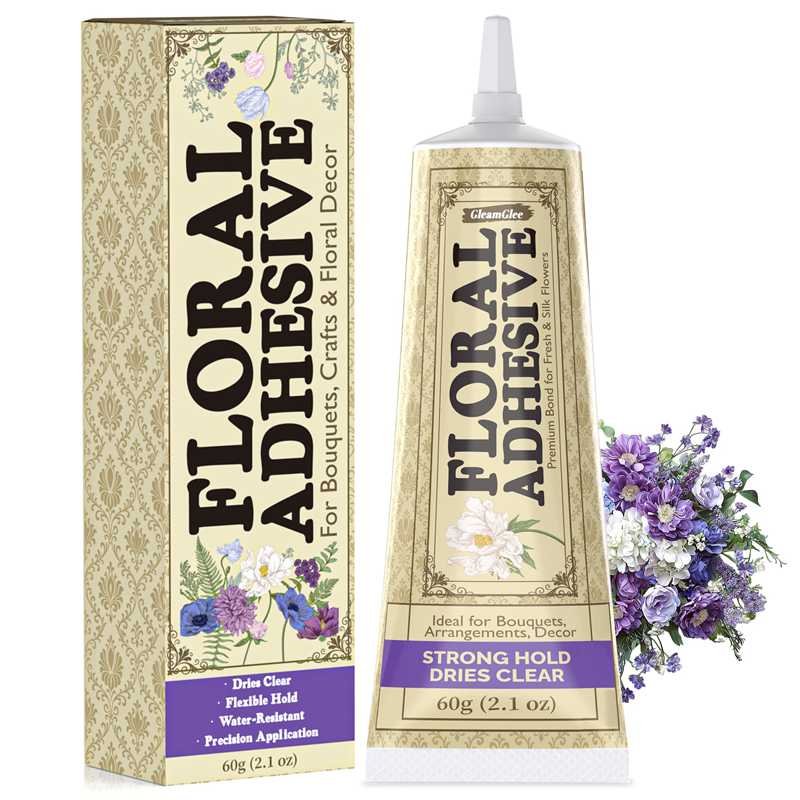
GleamGlee supports formula development, packaging selection, multilingual label design, sample production, quality control, and international supply for customized adhesive projects. Development can begin from a benchmark sample, performance target, package concept, retail price position, or existing brand requirements.
Private-label projects may include fine nozzles, metal tips, brushes, alternative bottle sizes, customized labels, retail boxes, and multilingual instructions. Available documentation and packaging requirements can be reviewed according to the destination market and final formula.
Qualified custom projects may begin from a minimum order quantity of 200 units, depending on the selected formula and package. Initial design drafts can be prepared in as little as two days, samples are generally completed within 7–14 days, and standard mass production is commonly arranged within approximately 20 days. Expedited production may be available for suitable projects.
To request a quotation, provide the intended flower materials, target package size, preferred applicator, destination country, estimated order quantity, desired working and setting behavior, and any benchmark product. The technical and international sales teams can evaluate the requirements and propose a floral adhesive solution for professional use, wholesale distribution, or private-label retail.
Share:
Table of Contents
Here, creating your adhesives glue & removal cleaner collection is no longer a barrier—it’s a collaborative journey where GleamGlee helps brands and businesses transform their vision into durable, certified, and market-ready solutions.
Partner with GleamGlee
Join hundreds of global partners who trust GleamGlee for adhesives and cleaners that combine innovation, compliance, and speed. Our vertically integrated system—from R&D to warehouse—guarantees consistent performance and reliable delivery.
Whether you’re sourcing FBA-ready stock or developing your own formula, our team provides unmatched technical support and responsive service.