Skip to content
Ceramic Glue for Villeroy & Boch Porcelain Repairs : A Practical Repair Guide
Your trusted adhesives glue & cleaner manufacturer

A broken Villeroy & Boch piece rarely feels like just another household accident. A mug handle snaps off, a dinner plate chips at the rim, a vase cracks near the base, or a porcelain ornament loses a tiny decorative part. The damage may look small, but the decision is not always simple. Many Villeroy & Boch pieces belong to matching table sets, family collections, wedding gifts, holiday displays, or discontinued patterns that are hard to replace one by one. Replacing the item may cost more than expected, and throwing it away can feel wasteful when most of the piece is still beautiful.
Ceramic glue can repair many Villeroy & Boch porcelain items when the broken edges are clean, dry, and close-fitting. A good repair needs clear adhesive, controlled application, firm pressure for 5–10 seconds, careful support during setting, and enough curing time before washing or use. The best results come from using less glue, not more.
Picture a white porcelain coffee cup sitting beside the sink. The handle is broken cleanly into one piece, the cup body is still smooth, and the pattern matches the rest of the breakfast set. It is too good to discard, but too visible to repair badly. This is where the right ceramic glue, a steady hand, and a patient repair method can turn a frustrating break into a clean, useful fix.
What Ceramic Glue Fits Villeroy & Boch?
Ceramic glue fits Villeroy & Boch porcelain when it can bond smooth, dense, glazed ceramic surfaces without leaving a thick, cloudy, or yellow-looking repair line. Villeroy & Boch mugs, plates, bowls, vases, ornaments, and serving pieces usually have polished glaze, fine edges, and visible decorative patterns, so the glue needs more than basic strength. It should apply in a narrow line, dry clear, hold firmly after pressing, and stay stable when the piece is handled, washed gently, or displayed for a long time.
A good ceramic glue for Villeroy & Boch should work best on clean breaks where the broken parts still match closely. The ideal repair gap is very small, usually less than 0.5 mm after dry fitting. When the pieces sit flush before glue is added, the adhesive can form a thinner and stronger bond. If a mug handle rocks, a plate chip leaves a wide missing area, or a vase crack cannot close naturally, glue alone may not create a clean repair. In those cases, the item may still be repairable for display, but the result should not be treated like a new piece of tableware.
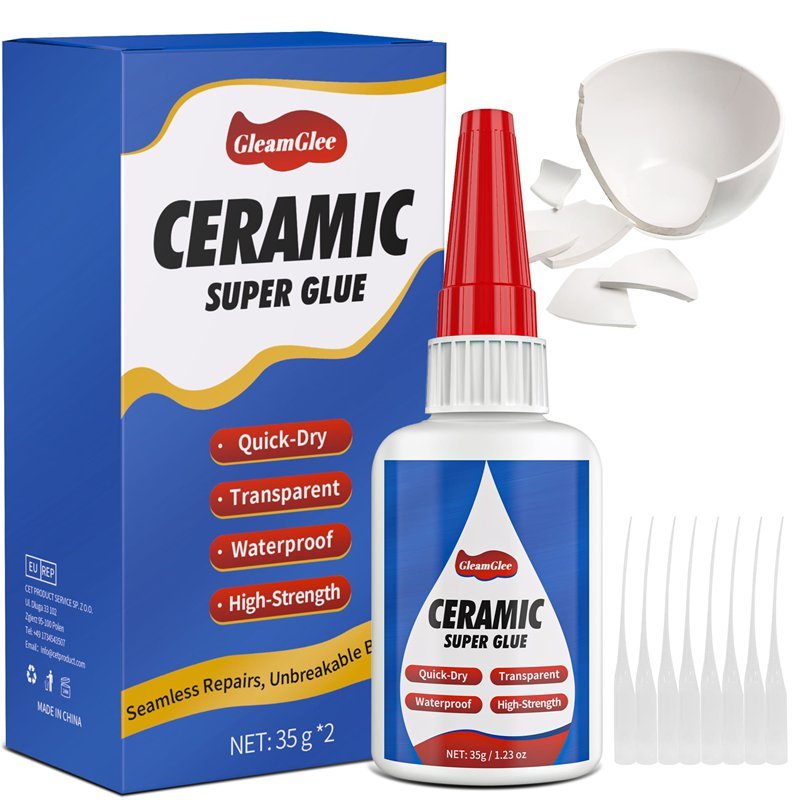
The most practical choice is a clear, fast-bonding ceramic glue with a precision nozzle. For small porcelain repairs, the nozzle can matter as much as the formula. A wide bottle opening often releases too much adhesive, causing glue to squeeze out onto patterns, rims, or glossy surfaces. GleamGlee Ceramic Glue includes 4 precision nozzles per pack, and the 2-pack version includes 8 nozzles, making it easier to place a thin bead into narrow cracks, handle joints, vase rims, and figurine details. The repair process should stay simple: clean, dry fit, apply a thin layer, press firmly for 5–10 seconds, then allow full curing before use.
| Ceramic Glue Requirement | Why It Matters for Villeroy & Boch | Practical Check Before Repair |
|---|---|---|
| Clear drying | Keeps white porcelain and printed patterns cleaner-looking | Test a tiny amount on scrap ceramic or hidden area if possible |
| Fine nozzle | Helps avoid excess glue on rims and decorations | Glue line should be narrow, not flooded |
| Strong initial hold | Helps handles, chips, and small parts stay aligned | Press firmly for 5–10 seconds |
| Water resistance | Useful for mugs, vases, planters, and bathroom pieces | Avoid soaking before full curing |
| Heat resistance | Helpful for kitchen and tableware surroundings | Avoid sudden boiling-hot shock after repair |
| Thin bond line | Reduces visible raised seams | Dry fit should close tightly before gluing |
| Multi-material use | Helps with ceramic-to-metal, ceramic-to-glass, or craft repairs | Check both materials before bonding |
What Ceramic Glue Works on Fine Porcelain?
Ceramic glue works on fine porcelain when it can grip a smooth surface without needing a thick build-up. Villeroy & Boch porcelain is usually less porous than unglazed pottery, which means the glue cannot rely on soaking deeply into the material. It needs close surface contact. This is why dry fitting matters so much. Before applying glue, the broken pieces should be placed together by hand. If the joint closes neatly and the outer surface feels level, the repair has a much better chance of looking clean and staying stable.
For a mug handle, both the upper and lower contact points should touch the mug body at the same time. If one side touches and the other side leaves a gap, pressure will not spread evenly after repair. For a plate chip, the broken piece should sit level with the rim rather than standing proud. For a vase crack, the crack should close without forcing the porcelain inward or outward. Fine porcelain repairs should not depend on a thick blob of glue to fill missing space. A thick glue layer usually creates a more visible seam and may weaken the joint because the ceramic surfaces are no longer close together.
A practical repair rule is to apply only enough glue to wet the broken edge. For small chips, this may be a dot smaller than a grain of rice. For a handle joint, a thin bead on the contact area is usually better than a round drop. For a longer crack, the glue should follow the crack line, not spread across the glaze. The best ceramic glue for fine porcelain should give enough control to place adhesive exactly where the break needs it.
| Repair Area | Better Glue Amount | What Too Much Glue Looks Like |
|---|---|---|
| Mug handle joint | Thin bead on both contact points | Glue bulges around the handle base |
| Plate rim chip | Tiny dot or short line | Raised shiny edge on the rim |
| Vase crack | Fine controlled line | Glue runs down the outer wall |
| Figurine part | Small dot | Part slides or floats out of place |
| Decorative lid knob | Thin circle or dot at contact point | Glue spreads onto the top surface |
Why Ceramic Glue Must Dry Clear
Ceramic glue must dry clear because many Villeroy & Boch pieces are used or displayed in visible areas. A repair on plain white porcelain, a floral border, a colored rim, or a glossy vase surface can become obvious if the adhesive dries cloudy, yellow, or uneven. Strength alone is not enough for this type of repair. A strong but messy bond may hold the piece together, yet still make the porcelain look damaged every time it is seen.
Clear-drying ceramic glue is especially important for four common repairs: mug handles, plate chips, vase cracks, and small decorative pieces. A mug handle repair often leaves a seam at eye level when the cup is used. A plate rim chip can catch light along the edge. A vase crack may run across the front-facing surface. A porcelain ornament may have tiny details where excess glue can cover texture. In all of these cases, the glue should become as visually quiet as possible after curing.
Clear glue still needs careful use. If too much adhesive is applied, it can dry into a raised transparent ridge. That ridge may reflect light and look like a glossy scar on the porcelain. The repair should be judged from normal viewing distance, around 30–60 cm for tableware and 1–2 meters for display pieces. If the glue line is thin and the broken edges fit well, the repaired area is usually much less noticeable. If the break has gaps or missing porcelain, clear glue can reduce visibility, but it cannot fully hide shape loss.
For patterned Villeroy & Boch pieces, avoid wiping wet glue across printed artwork. Wiping may turn one small glue spot into a thin film over the design. A better method is to apply less glue at the start, press the parts together, then dab any excess carefully near the joint before it hardens.
Which Ceramic Glue Strength Is Needed?
The strength needed depends on how the repaired Villeroy & Boch piece will be used after bonding. A porcelain figurine sitting in a cabinet needs less stress resistance than a mug handle that may support hot liquid. A vase rim needs a clean bond and water resistance. A plate rim chip may need appearance more than load-bearing strength. The right ceramic glue should be strong, but the repair plan should match the stress level of the item.
For low-stress items, such as ornaments, figurines, candle holders, decorative plates, and display vases, a clear ceramic glue with accurate application is usually the main requirement. These pieces are handled lightly after repair, so the bond does not face constant pulling, twisting, or washing. For medium-stress items, such as soap dishes, planters, vase cracks, and tableware edges, water resistance and curing time become more important. For high-stress repairs, such as mug handles, teapot handles, lid knobs, and frequently washed pieces, the repair should be treated with extra caution even when the glue is strong.
A repaired handle is always different from an unbroken handle. Even with strong ceramic glue, the joint sits exactly where stress concentrates during lifting. For hot drinks, the safest habit is to hold the mug body rather than trusting only the repaired handle. For repaired plates, avoid heavy stacking if the repair is on the rim. For repaired vases, test with a small amount of water first before placing the vase on wood, stone, or painted furniture.
| Use Level | Examples | Glue Performance Needed | Recommended Aftercare |
|---|---|---|---|
| Low stress | Figurines, ornaments, display plates | Clear bond, neat application | Dust gently, avoid drops |
| Medium stress | Vases, planters, soap dishes | Water resistance, firm curing | Hand clean, avoid soaking |
| Higher stress | Mug handles, teapot parts, lids | Strong bond, heat resistance, careful support | Avoid twisting, sudden heat, dishwasher use |
| Food-contact risk | Cracked bowls, plate centers | Extra safety judgment | Use for display unless glue label allows food contact |
Ceramic glue strength works best when the repair is not forced beyond its limits. A repaired Villeroy & Boch piece can often be saved beautifully, but daily use should be adjusted according to the break.
How Ceramic Glue Should Apply Neatly
Ceramic glue should apply neatly because porcelain repair often happens on small, curved, or highly visible surfaces. A broken Villeroy & Boch handle may have two narrow contact points. A vase crack may run vertically along a curved wall. A plate chip may sit on a thin rim. A figurine detail may be only a few millimeters wide. In these situations, the glue should come out in a controlled line, not a large drop.
A precision nozzle helps reduce three common repair problems. First, it prevents over-application. Too much glue leads to squeeze-out and visible glue marks. Second, it helps reach tight spaces, such as cracks inside a mug handle joint or a broken decorative flower. Third, it reduces hand movement because the glue can be placed directly on the break without spreading it with another tool. This keeps the repair cleaner and faster.
Before applying glue, position the piece in the way it will be held during curing. If the piece must be lifted, turned, or supported after glue application, the risk of smearing increases. For a mug handle, prepare rubber bands or tape before opening the glue. For a vase, create a towel support so the crack does not shift. For a plate chip, lay the plate flat. For a figurine, place the body in a stable position and use tweezers for the small part if needed.
The cleanest repairs usually follow a simple pattern: one thin line of glue, one firm press, one careful cleanup, and one quiet curing period. Repeated adjusting makes the repair messier. Once the broken parts are aligned, they should stay still until the adhesive has enough time to cure.
| Neat Application Step | What to Do | What to Avoid |
|---|---|---|
| Prepare support first | Set towel, tape, bands, or foam before gluing | Searching for tools with wet glue exposed |
| Use nozzle close to edge | Place glue directly on the break | Dropping glue from above |
| Apply one thin line | Let the glue wet the surface lightly | Flooding the joint |
| Press without sliding | Hold steady for 5–10 seconds | Twisting or rubbing the parts |
| Clean only excess | Dab near the seam if needed | Wiping across patterns |
| Leave it still | Cure in a dry, safe place | Testing the joint too early |

Which Pieces Need Ceramic Glue?
Ceramic glue is most useful for Villeroy & Boch porcelain pieces that break cleanly, chip at the edge, lose a small attached part, or crack in a place where the pieces can still sit tightly together. Mugs, plates, bowls, vases, figurines, ornaments, planters, soap dishes, and decorative trays are all common repair targets. The best repair candidates are pieces with complete fragments, dry surfaces, and contact edges that close with little visible gap.
The repair decision should be based on three practical checks: how the piece broke, how it will be used after repair, and whether the glued area will touch food, water, heat, or hand pressure. A porcelain figurine with a broken arm is usually easier to repair than a mug handle that must support hot coffee. A vase crack may be suitable if it can be leak-tested after curing. A plate with a small rim chip may be repaired neatly, while a plate cracked through the eating surface should usually be kept for display instead of daily meals.
A simple way to judge repair suitability is to look at stress level. Low-stress pieces sit on shelves and are handled only occasionally. Medium-stress pieces may face water, cleaning, or light daily handling. Higher-stress pieces carry weight, heat, twisting force, or repeated washing. Ceramic glue can help across all three groups, but expectations should change. A repaired ornament may look almost normal in display, while a repaired mug handle should still be used carefully even when the bond feels strong.
| Villeroy & Boch Piece | Common Damage | Repair Suitability | Main Concern | Better Use After Repair |
|---|---|---|---|---|
| Mug or cup | Broken handle, rim chip | Medium | Lifting force, hot liquid | Light use, display, pen cup |
| Dinner plate | Rim chip, edge crack | Medium | Food contact, stacking pressure | Display or careful dry use |
| Bowl | Rim chip, hairline crack | Medium to low | Soups, sauces, moisture | Display, wrapped dry items |
| Vase | Crack, broken rim, detached handle | High | Water leakage | Leak-tested use or dried flowers |
| Figurine | Broken arm, leg, flower, small detail | High | Tiny alignment | Shelf or cabinet display |
| Ornament | Snapped hanging point, broken accent | High | Storage impact | Seasonal display |
| Planter | Side crack, base chip | Medium | Wet soil pressure | Use with liner |
| Soap dish | Corner crack, broken edge | Medium | Constant moisture | Light bathroom use after full cure |
| Decorative tray | Corner chip, small break | Medium | Surface pressure | Keys, jewelry, dry display |
Which Ceramic Glue Repairs Mugs?
Ceramic glue repairs Villeroy & Boch mugs and cups when the broken area fits closely and does not rely on glue to fill a wide missing gap. The most common repair is a broken handle. A handle usually breaks at two contact points: the upper joint and the lower joint. Both points must align at the same time before glue is applied. If the handle touches at the top but leaves a gap at the bottom, the repair may cure under uneven stress. That uneven stress can later show up when the mug is lifted, washed, or filled with warm liquid.
A mug repair needs more caution than a decorative repair because the piece is often handled directly. A repaired handle sits exactly where force is concentrated. Even with strong ceramic glue, the repaired joint should not be treated like factory-fired porcelain. After curing, the mug can be tested with gentle hand pressure, but twisting the handle should be avoided. If the mug will be used for drinks, it is safer to hold the cup body instead of relying only on the repaired handle, especially with hot coffee, tea, or cocoa.
Rim chips are usually easier than handle repairs. A small rim chip can be bonded back if the missing piece is still available. If the chip is on the drinking lip, the repaired mug should be judged carefully because the glue line may touch the mouth or liquid. If the chip is on the outside rim or decorative edge, the repair can be more practical. For sentimental mugs, display use, pencil storage, makeup brush storage, or small dried-flower use can preserve the item without putting stress on the repair.
| Mug Damage Type | Repair Difficulty | Key Check | Recommended Use |
|---|---|---|---|
| Clean handle break | Medium | Both joints sit flush | Careful hand use or display |
| Small outside rim chip | Low to medium | Piece fits level with rim | Light use after curing |
| Drinking-edge chip | Medium to high | Glue may touch mouth or liquid | Display or dry use |
| Crack through mug body | High | May leak or face heat stress | Display, pen cup, dry storage |
| Missing handle fragment | High | Glue cannot rebuild missing ceramic | Display or professional restoration |
A mug repair should focus on safety first, appearance second, and regular use last. The item can still be saved even if its purpose changes.
Which Ceramic Glue Fixes Plates?
Ceramic glue fixes Villeroy & Boch plates best when the damage is on the rim, outer edge, decorative border, or a clean break intended for display. Plates are visually important because they often belong to matching sets. One chipped dinner plate can make a full service feel incomplete, especially if the pattern is older or difficult to replace. Repairing the chip can restore the look of the set and prevent the damaged piece from being discarded.
The safest plate repairs are usually outside the direct eating area. A rim chip, small edge piece, decorative plate crack, or display plate break is easier to manage than a crack through the center. If the glue line sits where food, sauce, oil, or knife pressure will touch it, regular dining use is not the best choice unless the adhesive is clearly approved for direct food-contact use. Even then, the repaired area should be inspected often because plate surfaces face scraping, washing, stacking, and temperature changes.
Plate stacking is another real issue. A repaired rim may look stable but can chip again if heavy plates press against the glued edge. After repair, the plate should be stored with a soft separator if it remains part of a stack. Felt pads, paper towels, or thin plate protectors can reduce impact between pieces. A repaired plate used for display should be placed in a stand, cabinet, or wall holder where the repaired area is not carrying weight.
| Plate Area | Repair Suitability | Main Risk | Practical Handling |
|---|---|---|---|
| Outer rim chip | High | Edge impact | Use soft stacking protection |
| Decorative border crack | Medium | Visible glue line | Display or light dry use |
| Center eating surface crack | Low | Food contact and knife pressure | Display only |
| Plate foot ring chip | Medium | Table stability | Check for wobble after repair |
| Serving platter edge | Medium | Weight and handling | Avoid heavy loads |
| Wall plate break | High | Alignment | Support while curing |
For Villeroy & Boch plates, ceramic glue often has the most value when it keeps a set visually complete. A repaired plate does not always need to return to daily meals to be worth saving.
Which Ceramic Glue Saves Vases?
Ceramic glue saves Villeroy & Boch vases when the crack, rim break, base chip, or decorative handle can be aligned cleanly and supported during curing. Vases are often good repair candidates because they are usually decorative and handled less often than mugs or plates. A broken vase may still have strong visual value, especially if it matches a room, belongs to a collection, or has a design that is hard to replace.
The main concern with vases is water. A vase can look repaired on the outside but still leak through a fine crack. After the glue has fully cured, the vase should be tested before it is placed on wood furniture, bookshelves, painted cabinets, or stone surfaces that may stain. A practical leak test is simple: place the vase on a dry paper towel, add a small amount of cool water, and leave it for 30–60 minutes. If the towel stays dry, the repair is more likely to handle light water use. If moisture appears, the vase should be used with dried flowers, artificial stems, or an inner glass or plastic liner.
Vase shape affects repair difficulty. A straight crack on a flat wall section is easier to close than a crack around a curved shoulder or narrow neck. A broken rim can often be repaired neatly if the missing piece is complete. A cracked base needs extra caution because it may carry the weight of water and flowers. If the vase is large, heavy, or expensive, the repaired area should not be forced into heavy use immediately.
| Vase Damage Type | Repair Suitability | Water Use Advice | Extra Care |
|---|---|---|---|
| Broken rim piece | High | Usually not water-critical | Align edge carefully |
| Side crack | Medium to high | Leak test after curing | Keep glue line thin |
| Base crack | Medium | Test with small water amount first | Avoid heavy flower loads |
| Detached handle | Medium | Usually decorative | Do not lift by repaired handle |
| Missing porcelain piece | Low to medium | May not seal fully | Consider display use |
| Hairline crack | Medium | Watch for slow leakage | Test longer before furniture use |
A repaired vase can remain beautiful even if it is no longer fully watertight. The safest plan is to match the repaired vase with a use that does not stress the crack.
Which Ceramic Glue Helps Décor Pieces?
Ceramic glue helps Villeroy & Boch décor pieces such as figurines, ornaments, candle holders, decorative bowls, small trays, porcelain lids, picture frame accents, and seasonal pieces. These items are often excellent repair candidates because they are not usually exposed to hot liquids, knives, dishwashers, or heavy lifting. Their main repair challenge is not strength alone; it is accurate placement and clean appearance.
Small decorative parts require a controlled glue amount. A figurine’s flower petal, animal ear, hand, foot, bow, leaf, or handle may have a contact surface of only a few millimeters. Too much glue can cover detail and create a shiny lump. A precision nozzle is useful here because it allows a tiny dot to be placed exactly where the break meets. Tweezers can help position small pieces, while soft foam or folded cloth can support the item during curing.
Ornaments and seasonal pieces need special storage care after repair. A repaired hanging loop, star point, snowflake edge, or small accent may hold well on display but break again if placed loosely in a storage box. After repair, fragile pieces should be wrapped separately in tissue, bubble wrap, or soft cloth. If the ornament hangs, test the repaired hanging point with gentle pressure before placing it on a tree, hook, or garland.
Decorative trays and bowls should be treated according to load. A repaired tray may hold keys, jewelry, watches, wrapped candy, or small dry items, but it should not carry heavy objects if the crack crosses the base or corner. A repaired candle holder should be checked carefully before use near heat. If the repaired area sits close to a flame or hot wax, display use may be safer.
| Décor Piece | Common Repair | Best Support Method | Use After Repair |
|---|---|---|---|
| Figurine | Arm, leg, flower, ear | Tweezers and foam support | Shelf display |
| Ornament | Hanging loop, small point | Soft tape or hand placement | Gentle seasonal display |
| Candle holder | Edge or decorative accent | Towel support | Check heat distance |
| Decorative bowl | Rim chip or side crack | Flat towel base | Dry items only |
| Porcelain lid | Knob or rim break | Light weight or tape | Gentle handling |
| Picture frame accent | Ceramic flower or trim | Small clamp or tape | Wall or shelf display |
| Decorative tray | Corner chip | Painter’s tape | Light dry storage |
Décor repairs are often the most rewarding because the repaired piece can return to its original visual role without facing the same stress as daily tableware.
How to Use Ceramic Glue?
Ceramic glue should be used on Villeroy & Boch porcelain only after the broken edges are clean, dry, and tested for a close fit. The repair process is simple, but the order matters: prepare the work area, clean the broken edge, dry fit the pieces, apply a thin glue line, press firmly for 5–10 seconds, support the repaired item, and allow full curing before washing, lifting, filling, or displaying it again.
A good porcelain repair is usually won before the glue touches the surface. Fine porcelain often has smooth glaze, thin rims, and curved shapes, so even a small alignment mistake can make the repair line more visible. A broken mug handle must line up at two contact points. A plate chip must sit level with the rim. A vase crack must close without forcing the wall out of shape. If the parts do not match well during dry fitting, adding more glue will not solve the problem. Too much glue often makes the repair thicker, messier, and weaker.
The safest method is to use ceramic glue in a controlled, light application. For most Villeroy & Boch repairs, the glue layer should be thin enough that only a slight amount appears at the seam after pressing. The repaired piece should then stay still while curing. Early movement is one of the main reasons ceramic repairs fail. A joint may feel firm after a few seconds, but that is not the same as full strength. Hot water, dishwasher heat, heavy stacking, twisting handles, or filling a vase with water too soon can stress the repair before the bond has fully developed.
| Repair Stage | What to Do | Time Guide | What Can Go Wrong |
|---|---|---|---|
| Prepare area | Use towel, good light, tools nearby | 2–3 minutes | Piece slides or scratches |
| Clean edges | Remove dust, oil, moisture, old glue | 2–5 minutes | Weak bond from residue |
| Dry fit | Test alignment without glue | 1–3 minutes | Crooked repair after bonding |
| Apply glue | Use a thin bead or small dot | 30–60 seconds | Glue overflow on glaze |
| Press | Hold steady without sliding | 5–10 seconds | Smearing or shifting |
| Support | Tape, towel, foam, or rubber band | During curing | Joint moves before set |
| Cure | Leave untouched as directed | Follow label | Weak early use failure |
Step 1: Clean Before Ceramic Glue
Clean before ceramic glue because adhesive bonds best when it touches the porcelain itself, not dust, grease, soap film, moisture, or old adhesive. Broken porcelain edges often look clean at first glance, but fine white ceramic powder can sit inside the break. Kitchen pieces may also have oil from fingers, food residue, dish soap, or hard-water film. These thin layers can reduce bond strength and cause the repair to fail later, especially on mug handles, plate rims, and vase cracks.
Place the broken Villeroy & Boch piece on a soft towel before cleaning. This prevents slipping and protects the glaze. Use a small dry brush, cotton swab, or lint-free cloth to remove loose particles. If the item has grease or soap residue, wipe only the broken edge with a small amount of alcohol and allow it to dry completely. Do not soak the broken porcelain right before repair. Moisture trapped inside the fracture can weaken the bond and slow curing.
Old repair attempts need extra attention. If old glue is still on the broken edge, the new ceramic glue may bond to the old adhesive instead of the porcelain. That creates a weaker layer. Carefully remove old glue where possible without damaging the piece. Avoid scraping painted decoration, gold-tone rims, or printed patterns.
| Surface Issue | How to Handle It | Why It Matters |
|---|---|---|
| Ceramic dust | Brush or wipe away | Prevents weak powder layer |
| Finger oil | Wipe with alcohol if needed | Improves surface contact |
| Soap film | Clean lightly and dry fully | Stops glue slipping |
| Moisture | Let porcelain air dry | Helps curing and bonding |
| Old glue | Remove carefully if possible | Avoids bonding to weak residue |
| Painted area nearby | Clean only the break | Protects decoration |
For best results, the broken edge should feel dry, firm, and free of loose particles before ceramic glue is applied. If the piece still feels damp or dusty, wait and clean again rather than rushing the repair.
Step 2: Test Before Ceramic Glue
Test before ceramic glue by putting the broken pieces together without adhesive. This step shows whether the repair can close cleanly and whether the pieces need support during curing. Dry fitting is especially important for Villeroy & Boch porcelain because many pieces have curved profiles. A mug handle may look simple, but both the top and bottom joints must meet correctly. A vase crack may close at one end but leave a small gap at the other. A plate chip may fit only at one angle.
During dry fitting, hold the pieces together for a few seconds and look at the seam from different angles. The outer surface should feel as level as possible. If the piece rocks, slides, or leaves a visible gap, note where support is needed. This is the time to prepare painter’s tape, rubber bands, foam blocks, folded towels, or small weights. Once ceramic glue is applied, there is less time to solve alignment problems.
Dry fitting also helps decide whether the repair should be functional or display-only. If the broken edges close tightly, the repair may be suitable for light use after curing. If the gap is wide, the missing porcelain is obvious, or the joint needs pressure to stay closed, the repaired item should be treated more carefully. For tableware, any crack crossing a food-contact surface should be judged with extra caution.
| Dry Fit Result | What It Means | Better Repair Choice |
|---|---|---|
| Edges close tightly | Stronger, cleaner repair possible | Thin glue line |
| Small visible gap | Repair may show more | Use for display or light use |
| Piece rocks | Contact is uneven | Add support while curing |
| Missing fragment | Glue cannot rebuild shape fully | Display repair or restoration |
| Handle does not sit flush | Stress may concentrate | Avoid heavy lifting after repair |
| Crack needs force to close | Porcelain may be under tension | Do not over-clamp |
A dry fit should answer four questions before gluing: Does it align? Does it sit still? Does it need support? Will the repaired area face stress later?
Step 3: Apply Ceramic Glue Thinly
Apply ceramic glue thinly because porcelain repairs usually need close contact, not a thick adhesive layer. A common mistake is using too much glue because it feels stronger. On fine porcelain, excess glue can push pieces apart, squeeze onto the glaze, cover patterns, or dry as a raised shiny line. A thin, controlled bead usually creates a cleaner repair and allows the broken edges to sit closer together.
Use the precision nozzle close to the broken edge. Do not hold the nozzle high above the piece, because the glue may drop unevenly. For a small plate chip or figurine detail, a tiny dot may be enough. For a mug handle, place a thin bead on the contact points where the handle meets the cup body. For a vase crack, apply glue carefully along the break line and avoid letting it run down the outer wall. If glue touches a visible pattern, do not wipe it across the design. Dab carefully near the seam instead.
The amount of glue should match the size of the contact area. As a practical guide, the glue should wet the broken edge without forming a puddle. After pressing, a very small amount of squeeze-out is acceptable. Heavy squeeze-out means too much was applied.
| Repair Type | Glue Amount | Application Detail |
|---|---|---|
| Tiny figurine part | Small dot | Use tweezers for placement |
| Plate rim chip | Dot or short thin line | Keep away from eating surface |
| Mug handle | Thin bead on both joints | Align both ends before pressing |
| Vase crack | Fine line along break | Prevent running on glaze |
| Lid knob | Thin circle or dot | Keep centered while curing |
| Soap dish corner | Thin line on edge | Cure fully before bathroom use |
For Villeroy & Boch pieces with glossy or patterned surfaces, glue control matters more than speed. The repair should look calm and narrow, not flooded.
Step 4: Hold and Cure Ceramic Glue
Hold and cure ceramic glue by pressing the repaired pieces together firmly for 5–10 seconds, then keeping the item still until the adhesive has fully cured. The first press helps the glue grab, but it does not mean the repair is ready for washing, lifting, or daily use. Full curing is the stage that gives the repair better long-term strength.
Press the pieces together without sliding. Sliding can smear glue across the surface and move the parts out of alignment. For a mug handle, apply steady pressure at both contact points. For a plate chip, press the chip level with the rim. For a vase crack, hold the crack closed without squeezing so hard that the porcelain shifts. For small décor parts, tweezers may help position the piece, but support should hold it afterward.
After pressing, support the repair in a stable position. Rubber bands can help mug handles, but they should not pull sideways. Painter’s tape can hold plate chips or lid pieces, but it should not be placed over fragile decoration. Folded towels and foam blocks work well for curved vases and figurines. The repaired item should sit in a dry, safe place where it will not be bumped.
| Item | Best Holding Method | What to Avoid |
|---|---|---|
| Mug handle | Rubber band with soft padding | Sideways handle pressure |
| Plate chip | Low-tack tape | Heavy clamping on rim |
| Vase crack | Towel nest or foam support | Standing unsupported if crack opens |
| Figurine part | Foam block or gentle hand placement | Touching the part repeatedly |
| Lid knob | Light tape or small support | Pressing too hard |
| Planter crack | Support from outside while curing | Filling with soil too soon |
After curing, inspect the repair before use. A mug handle should be tested gently without hot liquid first. A vase should be tested with a small amount of cool water on a paper towel for 30–60 minutes. A plate should not be stacked under heavy dishes immediately. A bathroom item should not sit in standing water right away. Care after curing is part of the repair. Strong ceramic glue performs best when the repaired porcelain is treated with reasonable care.

What Ceramic Glue Tips Help?
Ceramic glue works better on Villeroy & Boch porcelain when the repair is controlled from the beginning: small glue amount, clean edge, correct pressure, stable support, and enough curing time. Most poor ceramic repairs do not fail because the glue cannot bond porcelain. They fail because too much glue is applied, the parts move while setting, or the repaired piece is washed, lifted, or heated too soon.
Villeroy & Boch porcelain often has smooth glaze, narrow rims, curved handles, printed details, and delicate decorative surfaces. These features make repair more demanding than fixing a rough ceramic flowerpot or a plain household tile. A messy glue line on a glossy white mug or patterned plate is easy to see. A small repair mistake can leave a raised seam, shiny patch, crooked handle, or visible smear that cannot be removed easily after curing.
The most useful ceramic glue tips are simple but strict: use less glue than expected, protect visible patterns, hold the repair gently without forcing it, and allow the adhesive to cure fully before the item returns to use. A repaired porcelain piece should not be judged only by how it looks after 10 seconds. It should be judged after curing, after gentle handling, and after the first careful cleaning or water test.
| Repair Tip | Practical Purpose | Best Used On | Common Mistake Prevented |
|---|---|---|---|
| Use a small glue amount | Keeps the seam thin and clean | Mug handles, chips, figurines | Raised glue ridge |
| Protect patterns | Keeps artwork and glaze clean | Plates, cups, vases | Glue film over decoration |
| Support curved parts | Stops sliding while curing | Handles, vases, ornaments | Crooked bonding |
| Avoid heavy clamping | Prevents cracks and stress marks | Thin porcelain | Pressure damage |
| Cure fully | Builds stronger long-term hold | Tableware and vases | Early repair failure |
| Hand wash after repair | Reduces heat and vibration stress | Mugs, plates, bowls | Dishwasher weakening |
| Test water slowly | Checks leaks before use | Vases, planters | Furniture water damage |
Use Less Ceramic Glue First
Using less ceramic glue first is one of the most important tips for Villeroy & Boch porcelain repair. A thick glue layer may look reassuring, but it often creates a weaker and messier repair. Fine porcelain pieces need close contact between the broken edges. If too much adhesive sits between them, the pieces may not close fully. The result can be a raised seam, uneven surface, or visible glue bead around the repair.
For small porcelain chips, the amount of glue may be smaller than expected. A tiny dot can be enough for a rim chip or figurine detail. For a mug handle, a thin bead on each contact point is usually better than filling the whole area with glue. For a vase crack, the glue should follow the crack line instead of spreading across the outer wall. When pressed correctly, only a very slight amount of glue should appear along the joint. Heavy squeeze-out means the glue layer was too thick.
A cleaner repair starts by matching the glue amount to the contact area. If the broken piece is the size of a fingernail, it does not need a pea-sized drop of adhesive. If the joint is long and narrow, the glue should be applied as a fine line. If the area is curved, apply the glue slowly and rotate the piece only when necessary. Moving too much after application increases the chance of smearing.
| Villeroy & Boch Repair | Better Glue Amount | Visible Sign of Too Much Glue | Better Result |
|---|---|---|---|
| Small plate rim chip | Tiny dot or short line | Glue forms a shiny lump | Edge sits flatter |
| Mug handle joint | Thin bead on each joint | Glue bulges around handle base | Handle aligns cleaner |
| Vase hairline crack | Fine line along crack | Glue runs downward | Crack looks less visible |
| Figurine flower or arm | Pinpoint dot | Detail looks buried in glue | Small part keeps shape |
| Lid knob | Thin dot or ring | Glue spreads onto lid top | Knob sits centered |
| Soap dish edge | Thin line | Glue squeezes onto top surface | Edge feels smoother |
A thin glue line also makes cleanup easier. Instead of wiping a large amount of wet adhesive across the glaze, only a small amount needs to be dabbed near the seam. This protects patterns, white glaze, and rim details. On porcelain repairs, neatness is not a cosmetic extra. It directly affects whether the repaired piece feels worth keeping.
Keep Ceramic Glue Off Patterns
Keeping ceramic glue off patterns is critical when repairing Villeroy & Boch porcelain because the design is often the reason the piece is worth saving. Many items include colored borders, floral artwork, printed scenes, glossy white glaze, raised accents, or metallic-looking trim. If glue spreads across these areas, it can dry as a shiny film, dull the pattern, or make the repaired part look stained even when the bond is strong.
Before applying ceramic glue, inspect the damaged area under bright light. Check whether the crack or chip crosses a printed line, colored rim, logo mark, or decorative edge. If the break is close to a pattern, the glue should be applied from the broken edge inward rather than spread across the front surface. A precision nozzle helps place adhesive exactly where it belongs. The nozzle tip should stay close to the crack, not hover high above the piece.
Cleanup should be done carefully. Dragging a cloth across wet glue can spread adhesive over a larger area. A better method is to dab near the seam with a cotton swab or lint-free cloth, using small controlled touches. If the repair area is close to artwork, avoid rubbing in circles. Rubbing can create a thin, hard-to-see glue film that becomes visible after drying, especially on glossy porcelain.
| Surface Detail | Repair Risk | Better Handling |
|---|---|---|
| Floral pattern | Glue may cover fine lines | Apply from the broken edge only |
| Colored rim | Shiny marks may show | Use a tiny bead and avoid wiping outward |
| White glossy glaze | Raised glue catches light | Keep the glue line narrow |
| Metallic-looking trim | Surface may mark easily | Avoid tape or rubbing over trim |
| Raised decoration | Glue can pool around texture | Use very small dots |
| Printed logo or maker mark | Glue film may dull the mark | Keep cleanup away from print |
If masking is needed, use low-tack painter’s tape and place it carefully. Do not press strong tape onto fragile decoration, older painted details, or metallic-looking rims. Tape should protect the surface, not pull at it. Remove it before the glue cures too hard if the tape sits close to the seam. For valuable or sentimental porcelain, testing the method on a less visible area or a broken scrap can help avoid permanent marks.
The cleanest repairs usually happen when glue never reaches the pattern in the first place. Less glue, better nozzle control, and slower application are safer than trying to clean a large mistake afterward.
Clamp Ceramic Glue Repairs Gently
Ceramic glue repairs should be clamped or supported gently because porcelain can crack, shift, or chip under uneven pressure. Villeroy & Boch pieces may look sturdy, but many mugs, plates, vases, ornaments, and figurines have thin edges or curved walls. Hard clamping can push the broken part out of alignment or create a new stress point near the repair.
The purpose of holding pressure is simple: keep the broken edges in contact while the glue begins to set. It is not necessary to crush the pieces together. For most small porcelain repairs, steady hand pressure for 5–10 seconds followed by stable support is enough. After the first hold, the item should rest without movement. The support should stop sliding, not bend the porcelain.
Different shapes need different holding methods. A mug handle may need a rubber band, but the band must pull straight. If it pulls the handle upward or sideways, the joint may cure crooked. A plate chip may need a small piece of low-tack tape. A vase crack may need a towel nest or foam support so the curved wall stays in position. A tiny figurine part may need tweezers for placement, then a soft support to prevent drooping.
| Repair Shape | Better Support Method | Why It Works | What to Avoid |
|---|---|---|---|
| Mug handle | Rubber band with soft padding | Holds both joints steady | Sideways pull |
| Plate chip | Low-tack tape | Keeps chip level with rim | Heavy clamp on thin rim |
| Vase crack | Folded towel or foam nest | Supports curved wall | Standing unsupported if crack opens |
| Figurine arm | Foam block or careful tape | Prevents drooping | Touching repeatedly |
| Lid knob | Light tape or balanced support | Keeps knob centered | Pressing too hard |
| Planter crack | Outside support while curing | Keeps crack closed | Filling with soil early |
| Ornament loop | Soft support and light pressure | Protects tiny contact point | Hanging before full cure |
Pressure should feel firm but not aggressive. If the piece begins to slide, the clamp is pulling in the wrong direction. If a rubber band bends the handle, loosen it or change its angle. If tape lifts decoration, remove it and use a towel or foam support instead. Porcelain repair is more about balance than force.
After support is placed, check alignment one final time from several angles. Look at the seam, rim level, handle position, and decorative line. If something is crooked, adjust immediately before the adhesive starts to set. Once the glue begins grabbing, repeated adjustment can smear the repair line and weaken the bond.
Let Ceramic Glue Cure Fully
Letting ceramic glue cure fully is essential because the first hold and the final bond are not the same. Many ceramic glues can grab quickly after pressing, but the repaired joint still needs time to develop stronger performance. A Villeroy & Boch mug handle, vase crack, plate chip, or soap dish repair may feel stable after a short time, yet still be vulnerable to water, heat, twisting, and impact.
The repaired piece should be placed in a dry, safe area after bonding. It should not be moved around repeatedly to check whether the glue is working. Early movement can break the developing bond inside the seam. This is especially important for repairs with small contact areas, such as figurine parts, ornament loops, and lid knobs. The joint may look fine from the outside while still being weak inside.
Curing is also tied to future use. A repaired ornament may only need to sit still after curing. A repaired vase may later hold water, so it should be tested slowly. A repaired mug may face heat and hand pressure, so it needs more cautious handling. A repaired plate may face stacking pressure and washing. The more stress the piece will face, the more important full curing becomes.
| Repaired Piece | What to Do After Curing | First Test | Use to Avoid Early |
|---|---|---|---|
| Mug handle | Inspect joint and apply light hand pressure | Empty mug handling | Hot drink lifted by handle |
| Plate chip | Check edge smoothness and stability | Gentle handling | Heavy stacking |
| Vase crack | Test with cool water on paper towel | 30–60 minute leak check | Placing full vase on wood immediately |
| Figurine part | Touch lightly near base | Visual alignment check | Frequent handling |
| Soap dish | Rinse lightly after full cure | Short water exposure | Standing water |
| Planter crack | Use liner or dry test first | Light soil or liner test | Heavy wet soil |
| Ornament loop | Test gently before hanging | Light pull test | Hanging heavy decoration |
Dishwasher use should be avoided for most repaired porcelain. Even when a ceramic glue resists water, dishwashers create a harsh mix of heat, detergent, vibration, and water pressure. Hand washing gives the repaired joint a better chance to last. Use mild soap, rinse briefly, and dry with a soft cloth. Avoid soaking repaired pieces overnight.
For water-holding items, the first water test should be small and controlled. Do not fill a repaired vase completely and place it directly on furniture. Start with a small amount of cool water, place it on a dry paper towel, and wait. If the towel remains dry, the repair may be suitable for light water use. If moisture appears, the vase can still be used with dried flowers, artificial stems, or a hidden liner.
Full curing is not just waiting. It is the part of the repair that turns a quick hold into a more dependable bond. The more valuable the porcelain piece, the more worthwhile it is to give the repair extra time before returning it to use.
Do Ceramic Glue Repairs Last?
Ceramic glue repairs can last well on Villeroy & Boch porcelain when the broken pieces fit tightly, the surface is clean, the glue line is thin, and the repaired item is used with care. A figurine, ornament, vase, or display plate may stay stable for a long time because it faces little daily stress. A mug handle, teapot part, bowl crack, or dinner plate edge needs more caution because it may face heat, water, lifting force, stacking pressure, or repeated washing.
The life of a ceramic repair is not decided by glue strength alone. The break shape, contact area, curing time, and future use all matter. A clean mug handle break with two full contact points is more repairable than a handle with missing porcelain at one joint. A plate rim chip can often be repaired neatly, but a long crack through the center of a plate faces more stress from food, knives, washing, and stacking. A vase crack may look sealed, but it still needs a water test before holding fresh flowers on a wooden table.
For Villeroy & Boch porcelain, the most reliable repairs usually fall into three groups: low-stress display repairs, medium-stress household repairs, and higher-stress tableware repairs. Low-stress repairs include figurines, ornaments, decorative plates, and cabinet pieces. Medium-stress repairs include vases, soap dishes, planters, and trays. Higher-stress repairs include mug handles, teapot handles, bowl cracks, plate centers, and items exposed to dishwashers. Ceramic glue can help in all three groups, but the repaired piece should not always return to the exact same use as before.
| Repair Type | Expected Durability | Main Stress | Better Aftercare |
|---|---|---|---|
| Porcelain figurine detail | High | Light handling | Dust gently, avoid drops |
| Ornament part | High | Storage impact | Wrap separately after repair |
| Display plate chip | High | Low daily stress | Use stand or cabinet |
| Vase side crack | Medium to high | Water pressure | Leak test before use |
| Soap dish edge | Medium | Moisture exposure | Keep dry between uses |
| Planter crack | Medium | Wet soil weight | Use liner when possible |
| Mug handle | Medium | Lifting and heat | Hold cup body, hand wash |
| Teapot handle or spout | Medium to low | Heat, liquid, pressure | Use carefully or display |
| Plate center crack | Low for daily meals | Food contact, cutting force | Display use is safer |
| Bowl crack | Low to medium | Liquid and spoon pressure | Avoid soups and soaking |
Does Ceramic Glue Handle Heat?
Ceramic glue can handle heat better when it is designed for ceramic and porcelain repair, but heat should still be introduced carefully after a Villeroy & Boch piece has been repaired. A repaired mug, teacup, teapot lid, or serving dish should not be exposed to boiling water, oven heat, microwave heat, or sudden temperature changes unless the glue’s own instructions clearly allow that use. Even if the adhesive is heat resistant, the repaired joint is not the same as the original fired porcelain body.
Heat affects repairs in two ways. First, it can soften or stress the adhesive if the temperature is too high. Second, heat can make porcelain and adhesive expand at different rates. That small movement may not matter on a decorative shelf piece, but it matters on a mug handle or teapot part where the repair line already carries stress. A repaired handle that feels solid at room temperature may behave differently when the cup is filled with hot coffee or tea.
A safer approach is to test heat gradually after full curing. Start with room-temperature water. Then test warm water. Only after the repair remains stable should the item be exposed to hotter conditions, and even then, it should be handled carefully. For a repaired mug handle, do not lift a full hot mug by the handle alone at the beginning. Hold the cup body and watch the repaired joint over several uses.
| Heat Situation | Risk Level | Better Practice |
|---|---|---|
| Room-temperature display | Low | Safe for most repaired décor |
| Warm water rinse | Low to medium | Use only after full curing |
| Hot tea or coffee | Medium | Hold mug body, not only handle |
| Dishwasher heat cycle | Medium to high | Hand wash instead |
| Microwave heating | High | Avoid unless glue label allows |
| Oven or stovetop exposure | Very high | Not suitable for most repairs |
| Boiling water shock | High | Avoid sudden heat changes |
Heat resistance is useful, but it should not be treated as permission to use repaired porcelain roughly. The more valuable the piece, the more careful the heat exposure should be.
Does Ceramic Glue Resist Water?
Ceramic glue can resist water after full curing, which makes it useful for vases, mugs, planters, soap dishes, bathroom accessories, and kitchen pieces. However, water resistance does not mean the repaired item should be soaked for hours, cleaned in a dishwasher every day, or filled with water before the glue has cured. Water can find tiny paths through cracks, especially when the break is long, uneven, or located near the base of a vase or bowl.
For a repaired Villeroy & Boch vase, a water test is strongly recommended. Place the vase on a dry paper towel, add a small amount of cool water, and leave it for 30–60 minutes. If the towel stays dry, add a little more water and test again. If moisture appears, the repair may still be suitable for dried flowers, artificial stems, or use with an inner liner. This small test protects shelves, wooden tables, books, cabinets, and painted surfaces from slow leaks.
For mugs, plates, and bowls, water exposure should be controlled. Hand washing is much safer than soaking. Use mild soap, rinse quickly, and dry with a soft cloth. Avoid leaving repaired porcelain in a sink overnight. Avoid placing repaired items in a dishwasher, where heat, detergent, water pressure, and vibration all work against the repaired joint.
| Repaired Item | Water Contact Level | Safer Use |
|---|---|---|
| Display figurine | Very low | Dry dusting only |
| Vase rim repair | Low to medium | Usually safe after curing |
| Vase side crack | Medium | Leak test before use |
| Vase base crack | Medium to high | Use liner if uncertain |
| Mug handle | Medium | Gentle hand wash |
| Soap dish | Medium | Keep from standing water |
| Planter | High | Use plastic liner |
| Bowl crack | High | Avoid soups, soaking, and sauces |
Water resistance helps extend repair use, but moisture testing and careful cleaning are what make the repair more dependable in daily life.
Does Ceramic Glue Hold Daily Use?
Ceramic glue can hold daily use when the repaired area faces light handling, gentle washing, and low pressure. It becomes less predictable when the repair is exposed to lifting force, twisting, repeated heat, heavy stacking, or direct food contact. Villeroy & Boch porcelain pieces often have both practical and decorative value, so the best decision is to match the repaired piece with a safer level of use.
A repaired ornament, figurine, or decorative plate may handle daily life well because it usually stays in one place. A repaired vase may also last well if it passes a leak test and is not moved roughly. A repaired mug handle is different. Every time the handle is used, the repair line carries the weight of the cup and liquid. A full mug can easily weigh 300–500 g depending on cup size and drink volume. That weight pulls directly on the repaired joints. If the drink is hot, the risk becomes more serious.
Plate repairs also need realistic expectations. A repaired rim chip may last if the plate is handled gently and not stacked under heavy dishes. A repaired crack through the center may not be suitable for daily meals because it can face knife pressure, fork pressure, sauce, oil, washing, and repeated temperature changes. A repaired bowl that holds soup or cereal faces both liquid and spoon movement. These are not ideal conditions for a glued crack.
| Daily Use Factor | How It Affects Repair | Better Habit |
|---|---|---|
| Lifting force | Pulls on repaired handles | Hold the main body |
| Twisting | Weakens handle and lid repairs | Lift straight, do not twist |
| Stacking | Chips repaired plate rims | Use soft separators |
| Hot liquid | Stresses mug repairs | Test slowly after curing |
| Dishwashing | Adds heat and vibration | Hand wash only |
| Soaking | Weakens moisture-exposed seams | Wash quickly and dry |
| Knife pressure | Stresses plate cracks | Avoid food use on repaired cracks |
| Outdoor movement | Adds impact risk | Place in protected area |
A repaired item can still be useful even if its role changes. A repaired mug can become a pen cup. A repaired bowl can hold wrapped candy or keys. A repaired plate can sit in a display stand. Long-lasting repair is often about changing the use slightly, not forcing the piece back into heavy service.
Does Ceramic Glue Work Outdoors?
Ceramic glue can work outdoors on ceramic and porcelain garden ornaments, planters, decorative tiles, small statues, birdbath accents, and outdoor décor, but outdoor conditions are harder than indoor display. Rain, temperature changes, sunlight, soil moisture, wind, and accidental knocks all place stress on a repaired joint. A glue that performs well indoors may still need protection outdoors, especially during winter or long wet periods.
For Villeroy & Boch or similar porcelain décor used outdoors, the repaired item should be fully cured indoors first. It should not be placed outside while the glue is still setting. After curing, the item should be positioned where it will not sit in standing water or be knocked by tools, pets, children, or heavy planters. If the repaired item holds soil, use a plastic liner or inner pot to reduce constant moisture against the repair line.
Freeze-thaw weather is one of the biggest outdoor risks. If water enters a fine crack and freezes, it expands and can reopen the damage. This is especially important for planters, garden figures, outdoor tiles, and decorative pots. In cold regions, repaired porcelain or ceramic items should be moved indoors or placed in a sheltered area during freezing months.
| Outdoor Use | Repair Outlook | Care Advice |
|---|---|---|
| Covered patio ornament | Good | Keep away from edge and impact |
| Garden figurine | Medium to good | Avoid ground moisture and knocks |
| Planter side crack | Medium | Use inner liner |
| Planter base crack | Medium to low | Avoid heavy wet soil |
| Decorative tile | Medium | Keep surface clean and dry before bonding |
| Birdbath accent | Medium to low | Constant water may stress repair |
| Winter outdoor display | Risky | Bring indoors before freezing |
| Sunny exposed area | Medium | Check repair line over time |
Outdoor repair can be practical, but it should be protected from constant water and freezing conditions. A repaired outdoor piece lasts longer when it is treated as repaired décor, not as weatherproof new ceramic.
Is Ceramic Glue Safe for Porcelain?
Ceramic glue can be safe for Villeroy & Boch porcelain when it is applied correctly, cured fully, and used in the right repair situation. The safest repairs are usually decorative or low-contact pieces, such as vases, figurines, ornaments, display plates, candle holders, and porcelain accents. These items do not normally touch food, hot liquid, knives, forks, or dishwasher heat, so the repaired joint faces less stress and fewer hygiene concerns.
For tableware, safety needs more careful judgment. A repaired mug handle, plate rim, bowl crack, or teapot part may look stable after bonding, but the repaired area may later face heat, moisture, lifting force, or direct contact with food and drink. If the glue line sits inside a cup, across the eating surface of a plate, or inside a bowl used for soup or sauce, the piece should not return to regular food use unless the adhesive label clearly allows direct food-contact use. A repaired piece can still be valuable for display, dry storage, wrapped snacks, flowers, or decoration.
Safe repair also depends on handling during application. Ceramic glue should be used on a stable surface, away from children and pets, with good airflow and careful hand control. Skin contact, eye contact, accidental spills, and uncapped glue should be avoided. The nozzle should be closed after use, and the repaired item should stay still until fully cured. A porcelain repair is safest when the glue is used only where needed, excess adhesive is removed carefully, and the finished item is matched with a realistic use.
| Porcelain Repair Situation | Safety Level | Main Concern | Better Use After Repair |
|---|---|---|---|
| Figurine arm or flower | High | Small part alignment | Shelf display |
| Decorative vase rim | High | Visible glue line | Display or light use |
| Vase side crack | Medium to high | Possible water leakage | Leak test before use |
| Plate rim chip | Medium | Food contact if near eating area | Display or careful dry use |
| Mug handle | Medium | Hot liquid and lifting force | Hold cup body, not only handle |
| Bowl center crack | Low to medium | Liquid and food contact | Display or dry storage |
| Teapot handle or spout | Low to medium | Heat and pouring pressure | Display or careful use |
| Dishwasher use | Higher risk | Heat, detergent, vibration | Hand wash only |
Is Ceramic Glue Safe for Mugs?
Ceramic glue can be safe for mug repairs when the repaired area does not create a drinking, lifting, or burn risk. The most common Villeroy & Boch mug repair is a broken handle. This type of repair needs caution because the handle carries the weight of the cup and liquid. A full mug can weigh several hundred grams, and that force pulls directly on the repaired joints. If the mug contains hot coffee, tea, or cocoa, a failed handle can cause spills or burns.
For a broken handle, the safest method is to repair the shape, allow full curing, and test the bond gently with an empty mug first. The mug should not be filled with hot liquid immediately after repair. Even after curing, it is better to hold the mug body instead of relying only on the repaired handle. If the break is on the drinking rim or inside the cup, regular drink use becomes less suitable unless the glue label clearly supports food and drink contact.
A repaired Villeroy & Boch mug can still be useful without being used for hot drinks. It can hold pens, makeup brushes, small tools, dried flowers, wrapped candy, or display items. This keeps the piece in daily life while avoiding unnecessary risk.
| Mug Repair Area | Main Risk | Safer Choice |
|---|---|---|
| Handle joint | Lifting force | Hold mug body after repair |
| Drinking rim chip | Mouth contact | Use for display or dry storage |
| Interior crack | Drink contact and leakage | Avoid regular drinking use |
| Outer wall chip | Lower risk if no leak | Light use after curing |
| Base crack | Leakage and table damage | Test before any liquid use |
Is Ceramic Glue Safe for Plates?
Ceramic glue can be safe for Villeroy & Boch plates when the repaired area stays away from direct food contact and the plate is handled gently. A small chip on the outer rim, a decorative edge break, or a display plate crack is usually easier to manage. The repair can restore the shape and keep the plate looking complete in a cabinet, wall display, holiday table setting, or collection.
A crack through the center of a plate is different. That area may touch food, sauces, oil, knives, forks, and repeated washing. A glue line in the eating surface may trap residue or become damaged through scraping. Unless the adhesive is clearly labeled for direct food-contact use, repaired center cracks should be treated as display repairs, not everyday dining repairs. This is especially important for plates used with hot food, acidic sauces, or oily dishes.
Stacking also affects safety and durability. A repaired rim chip can break again if heavy plates press on it. After repair, place a soft separator between plates or keep the repaired plate on top of the stack. For valuable Villeroy & Boch dinnerware, cabinet display may be the best balance between keeping the set complete and avoiding daily stress.
| Plate Damage | Food Use Advice | Storage Advice |
|---|---|---|
| Outer rim chip | Possible careful dry use if glue is not exposed | Use soft separator |
| Decorative border crack | Better for display | Avoid heavy stacking |
| Center crack | Avoid direct food use | Display stand recommended |
| Foot ring chip | Check table stability | Do not stack under heavy plates |
| Serving platter edge | Avoid heavy serving loads | Store flat with padding |
Is Ceramic Glue Dishwasher Safe?
Ceramic glue may resist water after curing, but repaired porcelain is usually safer with hand washing than dishwasher cleaning. A dishwasher does much more than rinse. It exposes the repaired joint to hot water, detergent, steam, water pressure, vibration, and repeated temperature changes. These conditions can make the glue line weaker over time or more visible on glossy porcelain.
For Villeroy & Boch pieces, hand washing gives much better control. Use mild dish soap, cool to warm water, and a soft sponge or cloth. Do not scrub directly across the repair line. Do not leave the repaired item soaking in the sink. After washing, dry it with a soft towel instead of leaving water sitting in cracks, handle joints, or rim repairs. This is especially important for repaired mugs, plates, bowls, soap dishes, and vases.
A repaired piece should also be placed carefully in storage. Avoid knocking the repaired area against other dishes. For plates, use paper towels, felt protectors, or thin cloth between stacked pieces. For mugs, avoid hanging repaired handles on cup hooks. For bowls, avoid stacking if the repaired area is on the rim or sidewall.
| Cleaning Method | Safety for Repaired Porcelain | Reason |
|---|---|---|
| Soft dry dusting | High | Best for display pieces |
| Quick hand wash | Medium to high | Controlled moisture and pressure |
| Short warm rinse | Medium | Acceptable after full cure |
| Long soaking | Low to medium | Prolonged water exposure |
| Dishwasher cycle | Higher risk | Heat, detergent, vibration |
| Abrasive scrubbing | Higher risk | Can damage glue line |
| Boiling water rinse | Higher risk | Sudden heat stress |
Is Ceramic Glue Best for Display?
Ceramic glue is often best for display repairs because display pieces face fewer safety problems than daily-use tableware. A repaired Villeroy & Boch figurine, ornament, vase, decorative plate, candle holder, or porcelain keepsake can return to a shelf, cabinet, mantel, or seasonal display without touching food, hot liquid, knives, dishwashers, or heavy stacking pressure. This makes the repair more predictable and safer.
Display repair is also a practical choice for sentimental pieces. A mug from a wedding set, a plate from a discontinued pattern, or a holiday ornament from a family collection may not need to return to its original use to remain meaningful. Repair can preserve its shape, color, and place in the home. A cracked plate can stand in a cabinet. A repaired mug can hold dried flowers. A vase that no longer holds water can still display artificial stems or sit as décor.
The best display repairs still require careful technique. The glue line should be thin, clear, and kept away from patterns. Small parts should be supported during curing so they do not shift. Once repaired, the piece should be placed where it will not be bumped. Display use does not mean careless use; it means the repaired porcelain can be appreciated without being forced back into high-stress service.
| Display Piece | Best Repair Goal | Handling Tip |
|---|---|---|
| Figurine | Restore missing detail | Support small part while curing |
| Decorative plate | Preserve full pattern | Use a stand or cabinet |
| Vase | Restore shape | Use dried flowers if leak risk remains |
| Ornament | Save seasonal décor | Wrap separately after use |
| Candle holder | Restore appearance | Keep repair away from heat source |
| Keepsake mug | Preserve memory | Use as dry storage or display |

Is GleamGlee Ceramic Glue Good?
GleamGlee Ceramic Glue is a good choice for Villeroy & Boch porcelain repairs when the damage is small, clean, and close-fitting. It is designed for ceramic and porcelain surfaces, dries clear, bonds fast, and comes with precision nozzles for narrow cracks, rim chips, mug handles, vase edges, figurine parts, and decorative details. For fine porcelain, the value is not only strength. The glue also needs to stay neat, avoid cloudy marks, and let the repaired piece keep its original look.
For Villeroy & Boch pieces, the repair area is often visible. A mug handle joint can be seen every time the cup is lifted. A plate rim chip catches light along the edge. A vase crack may sit directly on the front side. A small ornament repair may involve tiny painted or raised details. GleamGlee Ceramic Glue helps in these situations because it creates a crystal-clear bond and can be applied in a very small amount. The included fine nozzles make it easier to control the glue line instead of flooding the surface.
The product is also practical for households because porcelain damage rarely happens only once. The same tube can be used on mugs, cups, plates, bowls, teapots, vases, planters, soap dishes, ceramic ornaments, small statues, mosaics, and mixed-material repairs. It can bond ceramic, porcelain, glass, wood, plastic, metal, rubber, PVC, concrete, and other common materials. Each pack includes 4 precision nozzles, and the 2-pack version includes 8 nozzles. The resealable anti-clog cap helps keep the glue usable for future repairs instead of drying out after the first use.
| GleamGlee Feature | Why It Matters for Villeroy & Boch Repairs | Practical Repair Benefit |
|---|---|---|
| Clear drying bond | Porcelain repairs are often visible | Helps reduce cloudy or stained-looking seams |
| Fast initial hold | Small parts can shift quickly | Pressing for 5–10 seconds helps alignment |
| Precision nozzles | Fine porcelain edges need control | Less overflow on glaze, rims, and patterns |
| Heat resistance | Mugs and kitchen pieces may face warmth | Better suited for careful tableware repair |
| Water resistance | Vases, planters, and bathroom items may face moisture | Useful after full curing and leak testing |
| Multi-material bonding | Some repairs combine ceramic with metal, glass, or wood | Works beyond porcelain-only repairs |
| Anti-clog cap | Glue may be stored between repairs | Helps reduce waste after opening |
| Multiple nozzles | Tiny cracks and chips need clean application | Easier to keep repairs neat over time |
Why GleamGlee Ceramic Glue Bonds Fast
GleamGlee Ceramic Glue bonds fast, which is useful when repairing small or awkward porcelain pieces that are hard to hold steady for a long time. A Villeroy & Boch mug handle has two contact points that need to align at the same time. A broken vase rim may sit at a slight angle. A porcelain figurine hand, flower, ear, or ornament loop may have only a few millimeters of bonding surface. In these repairs, slow-grabbing glue can allow the part to slide before it sets.
The repair method is simple: apply an even, thin coat, press firmly for 5–10 seconds, then let the piece cure fully before use. This short pressing time helps keep the broken edges in position during the first stage of bonding. It also reduces the need for heavy clamps, which can be risky on thin porcelain. Fine porcelain should be held steadily, not crushed.
Fast bonding is most helpful in repairs where alignment matters immediately:
| Repair Area | Why Fast Bond Helps | What Still Needs Care |
|---|---|---|
| Mug handle | Holds two joints in position | Avoid lifting full hot mug by handle |
| Plate chip | Keeps chip level with rim | Avoid heavy stacking after repair |
| Vase rim | Prevents curved piece from sliding | Support during curing |
| Figurine detail | Helps tiny parts stay placed | Use tweezers or foam support |
| Lid knob | Keeps centered placement | Do not twist during curing |
| Ornament loop | Helps small hanging point attach | Test gently before hanging |
Fast bonding should not be confused with full strength. The first 5–10 seconds help the repair stay aligned, but the adhesive still needs curing time. A repaired piece should not be washed, filled with water, placed in a dishwasher, stacked under heavy plates, or used with hot drinks immediately after bonding. The first hold gives control; the cure gives durability.
How GleamGlee Ceramic Glue Stays Clear
GleamGlee Ceramic Glue dries clear, which is important for Villeroy & Boch porcelain because many pieces have white glaze, glossy surfaces, colored rims, floral prints, decorative borders, or fine surface detail. A cloudy or yellow repair line can make even a strong bond look unattractive. For visible porcelain, appearance matters almost as much as strength.
Clear drying is especially useful on four common repair areas: mug handle joints, plate rim chips, vase cracks, and decorative figurine parts. These areas are usually seen from close range. A repaired coffee cup may be viewed from 30–60 cm away during use. A repaired vase may sit at eye level on a shelf. A repaired plate may be displayed in a cabinet or used as part of a matching set. A clear bond helps the repaired area look cleaner from normal viewing distance.
Still, clear glue only looks clean when it is applied thinly. Too much clear adhesive can dry into a raised glossy ridge. That ridge may reflect light and make the repair stand out. For this reason, the best result comes from using the smallest amount that wets the broken edge. The glue should stay inside the joint, not spread across the pattern or glaze.
| Porcelain Surface | Clear Glue Benefit | Application Note |
|---|---|---|
| White glaze | Reduces stained-looking repair lines | Use a thin bead only |
| Floral pattern | Keeps artwork more visible | Avoid wiping across print |
| Colored rim | Prevents dark or cloudy edge marks | Apply from the broken edge |
| Glossy vase wall | Makes cracks less distracting | Stop glue from running downward |
| Figurine detail | Preserves small shapes and texture | Use a pinpoint amount |
| Plate chip | Helps the rim look smoother | Remove excess before hardening |
For patterned Villeroy & Boch pieces, the goal is not to cover the damage with glue. The goal is to let the broken edges meet as closely as possible, with a narrow clear bond holding them together.
Why GleamGlee Ceramic Glue Applies Neatly
GleamGlee Ceramic Glue applies neatly because the precision nozzle helps control both glue amount and placement. This matters a lot for porcelain repair. Many Villeroy & Boch repairs are small: a chip on a rim, a handle joint, a vase crack, a figurine hand, a lid knob, or a broken ornament detail. A wide glue opening can release too much adhesive, and once glue spreads onto glossy porcelain, cleanup becomes harder.
Each pack includes 4 precision nozzles. The 2-pack version includes 8 nozzles. Extra nozzles are useful because repair jobs can be small but detailed. A fresh nozzle gives better flow control, especially when working inside narrow cracks or around curved surfaces. The fine tip allows the glue to be placed directly on the broken edge instead of spreading it with a separate tool.
Neat application reduces several common repair problems:
| Common Problem | How Precision Application Helps |
|---|---|
| Glue flooding around handle base | Thin bead controls overflow |
| Raised seam on plate rim | Small amount keeps edge flatter |
| Glue running down vase wall | Fine tip limits excess release |
| Pattern covered by adhesive | Glue stays closer to break line |
| Figurine detail buried in glue | Tiny dot preserves shape |
| Sticky fingers during repair | Less glue outside the joint |
| Wasted adhesive | Nozzle places only what is needed |
Good application also helps reduce stress during the repair. A person repairing an expensive-looking porcelain piece often worries about making the damage worse. A controlled nozzle makes the process feel more manageable. The repair can be done slowly and accurately: clean the edge, test the fit, place a thin glue line, press, support, and leave the item still.
The anti-clog cap adds another practical benefit. Ceramic glue is often used in small amounts. A tube may repair one mug today, a vase next month, and a planter later. A resealable cap helps reduce drying and keeps the product ready for future household repairs.
Where GleamGlee Ceramic Glue Works Best
GleamGlee Ceramic Glue works best on clean, dry, close-fitting repairs where the broken pieces still match their original shape. It is well suited for Villeroy & Boch mugs, plates, bowls, vases, teapots, ornaments, figurines, planters, soap dishes, ceramic trays, mosaic pieces, and decorative porcelain items. It is also useful for small household repairs involving glass, plastic, wood, metal, rubber, PVC, concrete, and other materials.
The strongest repair candidates are pieces with complete fragments and firm contact surfaces. A broken mug handle that still has both original contact points is a better repair candidate than a handle with missing porcelain. A vase crack that closes naturally is easier to repair than one that stays open under tension. A figurine flower or ornament loop can often be repaired well because it faces low stress after curing.
| Best Repair Use | Repair Suitability | Important Care Point |
|---|---|---|
| Mug handle | Medium | Do not rely only on repaired handle for hot drinks |
| Plate rim chip | Medium to high | Avoid glue exposure on food area |
| Vase crack | Medium to high | Leak test after full curing |
| Figurine detail | High | Support small parts during curing |
| Ornament repair | High | Wrap separately during storage |
| Planter crack | Medium | Use liner for wet soil |
| Soap dish edge | Medium | Keep away from standing water |
| Mosaic craft | High | Allow full cure before handling |
| Ceramic-to-metal accent | Medium to high | Clean both materials first |
There are also situations where expectations should be limited. Ceramic glue cannot replace missing porcelain, rebuild a crushed edge, or make a food-contact crack behave like new tableware. If a bowl is cracked through the center, if a plate has missing fragments in the eating area, or if a mug handle will carry hot liquid every day, the repaired piece should be used carefully or kept for display. GleamGlee Ceramic Glue performs best when the repair type, glue amount, curing time, and future use are all matched correctly.
For small porcelain repairs, the practical advantage is clear: one product can repair visible ceramic damage cleanly, handle several common household materials, and stay useful after the first repair. That makes it suitable not only for Villeroy & Boch porcelain, but also for everyday home repair kits, craft drawers, DIY shelves, and small maintenance boxes.

Conclusion
Ceramic Glue for Villeroy & Boch porcelain repairs is useful because many broken pieces are still worth saving. A snapped mug handle, chipped plate rim, cracked vase, loose lid knob, or broken figurine detail does not always mean the item belongs in the trash. When the broken edges are clean, dry, and close-fitting, ceramic glue can create a clear, firm repair that helps the piece return to display, light use, or careful household service. The best results come from a simple but disciplined process: clean the surface, test the fit, apply a thin glue line, press firmly for 5–10 seconds, support the piece, and allow full curing before handling, washing, or using it again.
Villeroy & Boch porcelain repairs should always be matched to the item’s future use. Decorative pieces, vases, ornaments, figurines, and display plates are usually the safest and most rewarding repairs because they face less heat, food contact, water pressure, and daily stress. Mugs, plates, bowls, and teapots need more caution, especially around hot drinks, eating surfaces, dishwashers, and repaired handles. A repaired piece can still be valuable even if its role changes. A mug can become a pen cup, a cracked plate can become cabinet décor, and a repaired vase can hold dried flowers or use an inner liner.
GleamGlee Ceramic Glue offers a practical choice for these repairs with its clear bond, fast initial hold, precision nozzles, water and heat resistance, anti-clog cap, and multi-material compatibility. It is suitable for porcelain, ceramic, glass, wood, plastic, metal, rubber, PVC, concrete, and many everyday repair surfaces. GleamGlee also supports branded product orders and OEM/ODM customization for retailers, Amazon sellers, distributors, and private-label brands. With low MOQ customization from 200 pieces, sample support in 7–14 days, packaging design, compliance assistance, and stable production capacity, GleamGlee can help turn ceramic glue from a single repair product into a reliable product line.
Share:
Table of Contents
Here, creating your adhesives glue & removal cleaner collection is no longer a barrier—it’s a collaborative journey where GleamGlee helps brands and businesses transform their vision into durable, certified, and market-ready solutions.
Partner with GleamGlee
Join hundreds of global partners who trust GleamGlee for adhesives and cleaners that combine innovation, compliance, and speed. Our vertically integrated system—from R&D to warehouse—guarantees consistent performance and reliable delivery.
Whether you’re sourcing FBA-ready stock or developing your own formula, our team provides unmatched technical support and responsive service.