Skip to content
If you’ve ever fixed a loose chair rung, patched a torn paper project, or helped a kid with a school craft, you’ve probably used “PVA” without even realizing it. Polyvinyl acetate glue is one of those quietly powerful materials—simple, affordable, usually low-odor, and forgiving for everyday people. But here’s the twist: the internet treats “PVA glue” like it’s one single product, when in real life there are families of PVA formulas, and they behave very differently when water, heat, smooth plastics, or glass enter the picture.
Polyvinyl acetate (PVA) glue is a water-based adhesive made from PVAc polymer dispersed in water. It bonds best to porous materials like wood, paper, and fabric because water can evaporate or absorb into the surface, allowing the polymer to form a strong film. PVA is popular for woodworking, crafts, and bookbinding due to easy cleanup and clear/neutral drying, but it’s not ideal for constant water exposure, high heat, or very smooth surfaces like glass.
The most common mistake isn’t “using the wrong brand”—it’s using the right glue for the wrong job conditions. A kitchen cabinet joint isn’t the same as an outdoor planter, and neither behaves like a glass vase repair. In this guide, I’ll show you how PVA actually works, how to choose between types (including the confusion around Gorilla Glue and Elmer’s), and what to use instead when PVA is the wrong tool—so your next repair doesn’t fail two weeks later with a clean “pop” and a lot of regret.
What Is Polyvinyl Acetate Glue (PVA Glue)?
Polyvinyl acetate (PVA) glue is a water-based adhesive made from PVAc polymer dispersed in water. When you apply it, the water leaves the joint (evaporates and/or soaks into porous surfaces), and the PVAc particles merge into a continuous film that grips the surface. That’s why PVA is a top choice for wood, paper, cardboard, and many craft materials—clean handling, strong bonds, and easy cleanup.
PVAc polymer
“PVA glue” in everyday use usually means PVAc (polyvinyl acetate) glue—the classic white glue family. Think of it as a flexible plastic film that forms inside and on top of porous surfaces. It doesn’t “melt” materials together like a weld; it creates a bonded film that spreads stress across a larger area.
From a buyer’s point of view, the key is this: PVAc is a chemistry family, not one fixed recipe. Two bottles can both say “PVA,” yet behave differently because manufacturers adjust:
- solids content (how much actual polymer you’re getting)
- viscosity (how thick it spreads)
- tack/open time (how fast it grabs)
- additives (water resistance, flexibility, sanding behavior)
At GleamGlee, we treat “PVA glue” as a performance target, not a label. Our in-house lab runs surface-compatibility checks and tensile/shear-strength testing so we can tune formulas for real use conditions (humidity shifts, temperature changes, repeated handling), not just ideal lab benches.
Water-based emulsion
A simple way to picture PVA glue: it’s a polymer-in-water emulsion. That’s why it:
- spreads smoothly
- cleans up with water while wet
- doesn’t have that heavy solvent smell many people hate
But the same water-based nature is also why it can disappoint on non-porous surfaces (glass, metal, many plastics). If water can’t escape the joint, the film can’t form properly. So the “secret” to PVA success isn’t a fancy trick—it’s matching PVA to porous surfaces and good joint fit.
Here’s a practical, buyer-friendly breakdown:
| What PVA glue is good at | Why it works | Where it struggles | Why it fails there |
|---|---|---|---|
| Wood-to-wood joints | Water leaves fast; film locks into fibers | Glass, metal, many plastics | Water can’t escape; poor wetting/anchoring |
| Paper/cardboard crafts | Fast grab; thin film; clean finish | Constant soaking / outdoor wet | Many PVAs soften or lose strength over time |
| Book/page repair (right formula) | Controlled film, flexible bond line | Large gaps, uneven fit | PVA isn’t a gap filler like epoxy |
This is the kind of table that helps readers self-select the right adhesive—exactly what Google’s AI summaries tend to reward.
Dry vs cure
Most “PVA glue failed” stories are really “I stressed it too early.”
- Dry (set/handle time): the surface feels dry and the joint holds lightly.
- Cure (full strength): the polymer film fully forms and stabilizes.
For wood and porous materials, PVA often sets relatively quickly, but reaching dependable strength takes longer—especially if the glue line is thick, the shop is cold, or humidity is high.
A simple timing guide your readers can actually use:
| Step | What you’re checking | Typical DIY-friendly rule |
|---|---|---|
| Open time | Can you still reposition? | Assemble before the glue skins over |
| Clamp time | Joint stays closed and stable | Keep pressure until the joint is stable and no longer shifting |
| Safe handling | Light movement OK | Avoid heavy stress early |
| Full cure | Best strength | Wait about a day before real load, especially on furniture joints |
Porous materials
PVA glue is basically engineered to love porous substrates. Wood fibers, paper pulp, cardboard layers—these surfaces give PVA two big advantages:
- Water escape path Water can evaporate and/or absorb into the material, so the adhesive film forms faster.
- Mechanical anchoring As the film forms, it “keys into” the surface texture and fiber structure. That creates a strong, stable bond line—especially when the joint is tight.
This is why PVA performs best when:
- surfaces fit well (no gaps)
- you apply an even film (not a puddle)
- you hold the joint steady until it sets
GleamGleee QC
If you want to sound like a real manufacturer (not a generic blog), talk about what you measure.
GleamGlee’s advantage isn’t “we make glue.” It’s that we can control the whole chain—raw materials, formulation, filling, packaging, and compliance-ready labeling—and validate the product in-house with repeatable testing.
Here’s how we typically frame PVA performance for buyers (B2C and B2B):
| What buyers care about | What we verify in-house | Why it matters in real life |
|---|---|---|
| Bond strength consistency | Tensile/shear testing + batch QC | Fewer “some bottles work, some don’t” complaints |
| Climate reliability | Humidity + temperature simulation | Prevents surprises across seasons/regions |
| User experience | Flow, spread, cleanup, nozzle control | Better reviews, fewer returns |
| Application fit | Substrate compatibility trials | Correct glue-to-surface matching |
And because GleamGlee builds products for global channels (Amazon-style retail plus wholesale/private label), we also design around what end users actually do: rushed repairs, imperfect clamping, humid basements, cold garages—real-world messiness that doesn’t show up in clean lab demos.
Which Types of PVA Glue Are Common on Google and How Are They Different?
On Google, “PVA glue” searches usually cluster into a few real product types: school/craft PVA (white glue), woodworking PVA (carpenter’s/wood glue), and water-resistant / exterior PVAs that are modified to handle moisture better. They differ mainly in viscosity (thickness), tack (grab), open time, clamp time, sandability, and water/heat performance. The “best PVA” isn’t a brand—it’s the right type for your surface and environment.
School vs wood glue
People often ask, “Can I use Elmer’s or school glue on wood?” The honest answer: sometimes, but it’s not the same experience or durability as a proper woodworking PVA.
School/craft PVA (white glue) is usually built for:
- paper, cardboard, light craft wood
- smooth spreading, easy cleanup
- flexible film, slower grab (so kids can reposition)
Woodworking PVA (wood glue / carpenter’s glue) is usually built for:
- wood-to-wood joints that carry real load
- faster tack under pressure
- better dry strength development
- sanding behavior that won’t gum up as easily
A quick comparison your readers can use:
| Type | What people call it | Best for | What it’s not great at |
|---|---|---|---|
| Craft/school PVA | white glue, school glue | paper, cardboard, foam board, light crafts | load-bearing joints, high humidity |
| Woodworking PVA | wood glue, carpenter’s glue | furniture joints, trim, cabinets | constant wet exposure, big gaps |
Water-resistant vs waterproof
This is the most misunderstood PVA topic on Google, and it’s where returns happen.
- Water-resistant PVA (often “interior/exterior” or “Type II”-style language in woodworking discussions) is meant to survive occasional moisture: humidity swings, light splashes, wipe-downs.
- Waterproof claims are stronger and usually tied to a specific test method/standard for that product. Not every PVA qualifies, and many standard PVAs will soften over time if they live wet.
Use this decision table—it keeps readers from picking the wrong bottle:
| Your job condition | What shoppers usually type on Google | Safer choice than “basic PVA” |
|---|---|---|
| Indoor wood, dry room | “best PVA wood glue” | Woodworking PVA |
| Kitchen/bathroom humidity | “water resistant PVA glue” | Water-resistant/exterior PVA |
| Outdoor rain + sun | “waterproof PVA glue for outdoor wood” | Waterproof-rated wood glue or switch chemistry (PU/epoxy) |
| Constant water soak | “PVA glue underwater” | Don’t use PVA—use epoxy/PU or a dedicated repair adhesive |
Aliphatic resin
“Aliphatic resin glue” is a phrase that makes Google users think it’s a completely different category. In practice, it’s often used as a woodworking label for PVAc/PVA-family wood glues that feel different from school glue.
What users notice (and why they search it):
- faster grab (less sliding)
- better sanding (less rubbery gum)
- more “carpenter” behavior for joints
A simple way to explain it on-page (without sounding like a textbook):
Gorilla Glue PVA
This is one of the most common confusion points on Google because people say “Gorilla Glue” like it’s one product.
The practical answer your readers need:
- Some products sold under the Gorilla brand are PVA wood glues (water-based wood glue category).
- The famous “original Gorilla Glue” product line is not PVA (it behaves differently: foaming/expanding, different cleanup, different best uses).
Elmer’s PVA
Another top Google question: “Is Elmer’s glue polyvinyl acetate?”
Most shoppers are referring to classic white glue / Glue-All style products, which are widely known as PVAc-based “white glue” in everyday use. The important detail to add (so you sound credible): Elmer’s is a brand family, and different products in the same brand can behave differently.
Quick “choose the right PVA” cheat sheet
Use this as a tight conversion-friendly block inside your article:
| If you’re fixing… | Choose this PVA type | Why |
|---|---|---|
| Kids crafts / paper / cardboard | School/craft PVA | easy spread + easy cleanup |
| Furniture joints / cabinets | Woodworking PVA | strong on porous wood joints |
| Humid rooms / light outdoor exposure | Water-resistant/exterior PVA | better moisture tolerance |
| Glass / metal / many plastics | Not PVA | use epoxy, glass glue, metal glue, or plastic-specific glue |
Where GleamGlee helps: Because we manufacture across adhesives categories (wood glue, glass glue, plastic glue, ceramic glue, construction adhesive, book glue, etc.), we can match the adhesive to the substrate instead of forcing “PVA” to do every job. That reduces customer frustration, returns, and bad reviews—especially for marketplace sellers and private label buyers.

What Materials Does PVA Glue Bond Best and What Does It Struggle With?
PVA glue bonds best to porous materials—especially wood, paper, cardboard, and some fabrics—because water can leave the joint and the PVAc film can “lock in” to the surface fibers. It struggles on non-porous or low-energy surfaces like glass, metal, and many plastics, and it’s unreliable for constant water exposure, high heat, or wide gaps. If the surface can’t absorb water or the joint sees peel stress, choose a different adhesive type.
What PVA bonds well
PVA is at its best when the surface is porous + clean + close-fitting. That’s why it’s a staple for woodworking and paper-based repairs: the water phase can escape (evaporation + absorption), and the polymer film forms a strong, even layer that spreads stress across the joint.
Best-fit materials (real-world):
- Wood-to-wood: furniture joints, trim, cabinets (tight joints win)
- Paper / cardboard: crafts, packaging, school projects
- Book & paper repair (with the right formula): page reattachment, spine reinforcement
- Porous composites: some cork, untreated fiberboard, unfinished MDF (process control matters)
A simple “fit score” helps readers choose fast:
| Material | PVA bond reliability | Typical use | Quick note |
|---|---|---|---|
| Unfinished wood | High | furniture, trim | tight fit + clamp = best results |
| Paper/cardboard | High | crafts, packaging | thin coat prevents warping |
| Untreated MDF | Medium–High | indoor panels | seal/dust control improves consistency |
| Fabric (craft) | Medium | patches, crafts | movement + washing may need fabric-specific glue |
| Painted/sealed wood | Medium | indoor repairs | scuff/clean helps; sometimes switch glue |
GleamGlee “factory reality” tip: In our application lab, the biggest performance jump we see isn’t from “stronger chemistry”—it’s from surface prep + glue-line control. For porous materials, a thin, even glue film and stable pressure during set time usually beats “extra glue” every time.
Poor surfaces
Most PVA disappointment comes from using it on surfaces that don’t let it do its job. PVA is water-based; if the joint is non-porous, water has nowhere to go, and the adhesive film can form slowly or unevenly. Add in low surface energy (common in plastics), oils, or thermal expansion (metal/glass), and you get bonds that look fine… until they pop.
Common poor fits:
- Glass: smooth, non-porous; PVA can peel cleanly
- Metal: surface oils + expansion/contraction + vibration
- Many plastics (PP/PE especially): low surface energy = weak wetting
- Constantly wet areas: repeated soak cycles can soften many PVAc films
- Gap-heavy joints: PVA is not a gap filler like epoxy
Use this “what to use instead” table to keep readers from guessing:
| Surface / job | Why PVA struggles | Better adhesive category | GleamGlee product lane |
|---|---|---|---|
| Glass décor, vase seams | non-porous + peel stress | clear epoxy / glass adhesive | Glass Glue |
| Metal brackets, tools | vibration + heat | metal epoxy / metal adhesive | Metal Glue |
| ABS/PVC repair | plastic chemistry mismatch | plastic-specific adhesive | Plastic Glue (ABS/PVC-focused) |
| Outdoor wood exposed to rain | wet/dry cycling | waterproof wood glue / PU | Wood Glue (exterior spec) or Construction Adhesive |
| Big gaps, uneven contact | PVA can’t fill | epoxy / construction adhesive | Construction Adhesive |
| Flexible items (gear, repairs) | peel + flex | flexible repair adhesive | Shoe Glue / Repair lines. |
Creep
“Creep” sounds technical, but your readers feel it as: “It held… and then it slowly shifted.” Creep is the gradual movement of a glued joint under constant load, especially when heat is involved.
Where creep matters most:
- Shelves that sag over time
- Chairs and stools that flex daily
- High-stress joints near heaters, sunny windows, hot garages, or cars
Here’s the simple way to teach it without scaring DIY users:
| Stress type | What it looks like | PVA tolerance | Better choice when extreme |
|---|---|---|---|
| Shear (sliding load) | wood joint holding weight | good (with tight fit) | — |
| Peel (edge lifting) | corner starts to lift | weaker | epoxy / construction adhesive |
| Constant load + heat | slow movement | can creep | epoxy / PU / stronger structural systems |
GleamGlee perspective: This is why we don’t treat glue as “one bottle fits all.” In our humidity/temperature simulations, we focus on what end users actually do—load a shelf too soon, put a repair near heat, or store items in a hot garage. Helping buyers match glue type to stress pattern reduces failures and returns.
Glass glue choice
This question comes up constantly because people want a quick fix: super glue or Gorilla Glue?
Here’s the everyday-accurate answer:
- Super glue (cyanoacrylate): fast, convenient, can bond glass, but often brittle—especially if the joint sees peel stress, vibration, or temperature swings. Great for tiny, clean, low-stress bonds; risky for larger seams you’ll handle often.
- Original Gorilla Glue (polyurethane): can bond many materials, but it foams/expands and can leave messy squeeze-out—usually not what you want on visible glass seams.
- What’s often better for glass: a clear epoxy or a dedicated glass adhesive, because it gap-fills better and tends to hold up longer on smooth, non-porous surfaces.
If you want to turn this into a high-converting “mini decision box” on your page:
| Glass repair type | Best “safe bet” | Why |
|---|---|---|
| Hairline chip / tiny bond | super glue (carefully) | fast tack, minimal gap |
| Visible seam / larger contact area | clear epoxy / glass glue | better gap fill + durability |
| Decorative item, needs clean look | glass adhesive | clearer finish, less stress cracking risk |
GleamGlee tie-in (customer-centered): If a buyer lands on your PVA page but their real problem is glass, don’t let them fail with the wrong glue. Point them to the right lane—GleamGlee Glass Glue—and you’ll earn trust (and repeat purchases) because you solved the real problem, not the keyword.

How Strong Is PVA Glue for Woodworking and Everyday Repairs?
PVA wood glue can be extremely strong on tight, porous joints—often strong enough that properly glued wood joints fail in the wood fibers instead of the glue line. In everyday repairs, the “strength” you get is mostly determined by joint fit, glue-line thickness, clamp pressure, and full cure time, not the logo on the bottle. If you prep the surface, clamp correctly, and wait long enough before stressing the joint, PVA is one of the most reliable adhesives for indoor woodworking.
Joint strength
If you want a realistic way to judge PVA strength, stop thinking “How strong is the glue?” and start thinking “How strong is the joint?” PVA performs best when the two pieces touch closely—because it’s designed to create a thin, continuous film that grips into wood fibers.
Where PVA feels “strongest” (real use):
- mortise-and-tenon, dowels, biscuits (high contact area)
- edge gluing panels (long glue line, mostly shear stress)
- cabinet frames and trim (tight fit, stable clamping)
Where PVA can feel weak (even if it isn’t):
- loose joints with gaps (PVA isn’t a gap filler)
- joints stressed in peel (edges lifting)
- joints moved too early (not cured)
A practical “joint stress” table your readers can understand:
| Joint situation | Stress style | PVA reliability | Best tip |
|---|---|---|---|
| Edge-glued boards | shear | High | even spread + firm clamp |
| Chair rung repair | mixed shear + flex | Medium–High | clean out old glue + long clamp |
| Small trim reattach | mostly shear | Medium | avoid heavy load for 24h |
| Gap-heavy repair | peel + gap | Low | switch to epoxy or construction adhesive |
GleamGlee manufacturing note: In our internal application lab, we see the biggest failure drop when users do two things: remove old glue/dust and clamp long enough. The chemistry matters, but process control matters more in DIY.
Clamp time
Most DIY failures come from rushing clamp time. People squeeze the joint, wipe the squeeze-out, and think “it’s done.” But PVA needs time under stable pressure while water leaves and the film forms.
Here’s a simple guide written the way real woodworkers talk:
| Repair type | Clamp time (typical DIY) | “Don’t stress it” time | Why it matters |
|---|---|---|---|
| Light-duty (trim, craft wood) | 30–60 min | 12–24 hrs | early set is OK, but full strength takes longer |
| Furniture joints (chairs, stools) | 6–24 hrs | 24+ hrs | flex + vibration need stronger film development |
| Large panels / laminations | 60–90 min | 24 hrs | wide glue line needs stable pressure |
Cure time
“Dry” is not “done.” Many PVA joints feel solid quickly, but peak performance comes closer to full cure—especially with thicker glue lines, cold temperatures, or high humidity.
A practical cure map you can put right into your page:
| Condition | What happens | What to do |
|---|---|---|
| Cold garage (low temp) | slower film formation | extend clamp + cure time |
| High humidity | water leaves slowly | avoid rushing sanding/load |
| Thick glue line | trapped moisture | use thinner spread + better fit |
| Sealed/painted wood | limited absorption | scuff or change adhesive type |
GleamGlee lab-style credibility (without sounding like a lab report): When we evaluate wood adhesive behavior, we don’t just look at “day one strength.” We watch how bonds behave after humidity cycling and temperature swings, because that’s what happens in basements, garages, and real homes.
Temperature and humidity
Temperature and humidity change PVA performance in ways users can feel:
- Open time can shorten in warm, dry air (glue “skins” faster).
- Set time can drag in cold or humid conditions.
- Bond quality suffers if the parts shift before the film stabilizes.
You can add a small “what to do” box:
If you want stronger, cleaner results:
- glue in a room-temperature space when possible
- dry-fit first (so you’re not fighting alignment while glue is setting)
- apply a thin, even layer—don’t puddle
- clamp evenly and don’t disturb the joint early
This kind of guidance is exactly what Google’s “helpful content” systems tend to reward: it solves the real problem behind the query, not just definitions.
Quick strength reality check
Many shoppers assume super glue or epoxy is automatically stronger than PVA. But for wood-to-wood joints, PVA often wins because it spreads load and bonds deeply into fibers.
| Adhesive | Best at | Where it loses |
|---|---|---|
| PVA wood glue | tight wood joints | gaps, glass/metal/plastic, constant water |
| Super glue | tiny fast fixes | brittle on flexing joints |
| Epoxy | gap filling + mixed materials | messier, slower, often overkill for simple wood joints |
Is PVA Glue Waterproof or Heat-Resistant?
Most PVA (PVAc) glues are not truly waterproof, and many will soften or weaken with prolonged water exposure. Some “cross-linking” PVAs are engineered for higher water resistance and may meet common woodworking specs like ANSI/HPVA Type II (water-resistant) or even Type I (often marketed as waterproof). Heat resistance is also limited: many PVAs can soften under heat, increasing the risk of creep in loaded joints.
Water-resistant vs waterproof
If you want this page to rank (and reduce buyer returns), make the distinction crystal clear:
- Water-resistant PVA = survives occasional moisture (humidity, wipe-downs, brief splashes).
- “Waterproof” PVA claims usually mean the formula passes a stricter test method (often referenced as ANSI/HPVA Type I)—but it still doesn’t mean “submerge forever.”
Two easy examples readers recognize:
- Gorilla Glue Wood Glue is described as a PVA wood glue that passes ANSI/HPVA Type II water resistance.
- Titebond Titebond III Ultimate Wood Glue is marketed as “proven waterproof” and states it passes ANSI/HPVA Type I.
Here’s a simple “what the label usually means” table:
| Label language you’ll see | Typical spec reference | What it’s good for | What it’s not for |
|---|---|---|---|
| Water-resistant | ANSI/HPVA Type II | indoor/outdoor projects with intermittent moisture | constant soaking, underwater use |
| Waterproof (marketed) | ANSI/HPVA Type I | harsher water exposure, higher-temp water tests (varies by standard) | “wet forever” environments, structural safety-critical wet joints |
A plain-English way to say it (and keep trust): Type I is tougher than Type II, but neither turns PVA into marine epoxy.
Kitchens, bathrooms, outdoors
The question your readers are really asking is: Will my bond fail in the places I actually live?
Use this decision chart that matches real household conditions:
| Use case | Moisture pattern | PVA OK? | Better pick |
|---|---|---|---|
| Indoor furniture (living room/bedroom) | dry | ✅ | standard woodworking PVA |
| Kitchen cabinets (normal use) | humidity + wipe-downs | ✅/⚠️ | water-resistant PVA (Type II-style) |
| Bathroom trim | high humidity + frequent condensation | ⚠️ | water-resistant PVA or construction adhesive (depending on surface) |
| Outdoor planter / patio wood | wet-dry cycles + sun | ⚠️/❌ | Type I “waterproof” wood glue or polyurethane/epoxy (job-dependent) |
| Anything that stays wet | constant | ❌ | epoxy / polyurethane / specialty repair adhesive |
Why the “⚠️”? Because even a strong glue line can lose the fight if the wood swells and shrinks repeatedly outdoors. That movement creates stress at the edges of the bond line—exactly where PVA struggles most.
GleamGlee real-world angle (keep it conversational): In our application lab, we don’t only test “fresh bonds.” We run humidity/temperature cycling to mimic what happens in basements, bathrooms, and outdoor storage—because a glue that looks perfect on day one can behave very differently after repeated moisture swings.
Heat resistance
Heat is where PVA can quietly betray you—especially when the joint carries load.
Popular Woodworking explains why application temperature matters for PVAs: if it’s too cold, the particles don’t form a tough continuous film properly.
And woodworking sources commonly note that cured PVA can soften under high heat, making it a poor choice for high-temperature environments.
What that looks like in real life:
- A shelf joint holds… then slowly shifts in a hot garage (creep).
- A glued assembly near a heater vent stays intact but “walks” a little over months.
- A cutting-board glue-up survives handwashing but struggles with extreme heat cycles.
A useful takeaway: PVA doesn’t usually “snap” from heat—it softens and creeps under load. That’s why you match glue choice to heat + stress, not just “strong vs weak.”
Alternatives
This is where you can win conversions by preventing failure. When PVA isn’t the right lane, give readers a confident, practical next step:
| If you need… | Skip PVA because… | Use instead | Best-fit GleamGlee lane |
|---|---|---|---|
| Glass repairs | non-porous + peel stress | clear epoxy / dedicated glass adhesive | Glass Glue |
| Metal repairs | heat/vibration + smooth surface | metal epoxy / metal adhesive | Metal Glue |
| ABS/PVC plastics | low surface energy / chemistry mismatch | plastic-specific adhesive | Plastic Glue (ABS/PVC-focused) |
| Big gaps / uneven contact | PVA isn’t gap-filling | epoxy / construction adhesive | Construction Adhesive |
| Outdoor wet wood | wet-dry cycling stresses bond | Type I wood glue or PU/epoxy | Wood Glue (exterior spec) |
| Heat + load | creep risk | epoxy / PU (job-dependent) | project-based recommendation |
GleamGlee credibility, without sounding “salesy”: because we manufacture across adhesives (wood, glass, metal, plastic, construction, book repair), we can guide buyers to the adhesive that matches the substrate and environment instead of forcing “PVA” to do everything. That’s how you protect ratings and reduce refunds—especially for Amazon sellers and private-label buyers.

How Do You Use PVA Glue for Clean, Reliable Results—and Is It Safe?
For clean, reliable PVA results, bond porous surfaces (wood/paper), apply a thin, even coat, assemble within open time, and clamp or press until the joint stops shifting—then wait long enough for full cure before heavy stress. Most PVAc-based PVAs are user-friendly and low-odor, but “safe” depends on the exact formula: follow the label/SDS, avoid eye contact, and use extra care for food-adjacent items by choosing glues with clear compliance claims.
Surface prep
PVA glue is forgiving, but it still rewards good prep. The goal is simple: clean contact + good fit.
Wood / MDF / porous boards
- Remove dust (dust is basically a release agent).
- Scrape old glue off repairs—fresh PVA bonds best to clean fibers, not old brittle layers.
- Dry-fit first: if parts rock or wobble, fix the fit before gluing.
Paper / book repair
- Use a thin coat to avoid warping.
- Press flat while it sets (book + wax paper + weight works well).
Painted or sealed surfaces
- PVA can work sometimes, but performance is less predictable because water can’t absorb into the surface. If you can’t scuff-sand safely, switch adhesive type.
Quick prep table :
| Surface | Prep time | What to do | Biggest mistake |
|---|---|---|---|
| Raw wood | 2–5 min | dust off + dry-fit | gluing over old glue |
| MDF | 3–6 min | de-dust edges + clamp well | starving the joint (too little glue) |
| Paper | 1–3 min | thin coat + press flat | applying too much (warps paper) |
| Sealed/painted | 3–8 min | clean + light scuff if possible | expecting “wood-glue strength” |
Glue amount
Most people use too much PVA. A thick layer stays wet inside, takes longer to cure, and can actually weaken the bond because the joint floats instead of closing tightly.
A good target is a thin, continuous film that wets the surface without puddling.
How to tell you used the right amount
- You see a light, even squeeze-out line (not rivers).
- The parts pull together firmly under clamp pressure.
- No dry patches, no gaps, no skating.
Amount control guide:
| Job | Spread style | “Right amount” look | Cleanup |
|---|---|---|---|
| Wood joint (furniture) | thin film both sides | fine bead squeeze-out | wipe damp while wet |
| Panel glue-up | thin film one side + full coverage | consistent squeeze-out | scrape semi-set, then sand |
| Paper/book | very thin coat | no visible puddles | wipe immediately |
GleamGlee real-world note: In our production and application testing, the most common cause of “weak glue” complaints is excess glue + weak clamping, not the polymer itself. When customers switch to thinner application and stable pressure, success rates jump—especially on chair rungs and trim repairs.
Clamp pressure
PVA isn’t a “hold it for 10 seconds” adhesive. You want steady pressure so the glue line stays thin while water leaves and the film forms.
What you actually need (most DIY jobs)
- Even pressure across the joint
- No shifting during early set
- Enough time so the joint becomes stable before you remove clamps
Clamp basics that work at home
- Chairs/rungs: wrap + clamp, or use strap clamps
- Panels: alternating clamps top/bottom to prevent bowing
- Small parts: spring clamps + wood pads to avoid dents
Clamp & cure cheat sheet (simple but practical):
| Repair type | Clamp/press time | Wait before real load | Why |
|---|---|---|---|
| Light trim/craft wood | 30–60 min | 12–24 hrs | early set is fast, strength keeps building |
| Furniture joints | 6–24 hrs | 24+ hrs | flex and vibration need full film development |
| Paper/book repair | 15–45 min | a few hours | thin films set quicker, but press flat |
If a joint will carry body weight (stool/chair), the rule is easy: overnight clamp, next-day use.
Cleanup & storage
PVA is popular partly because it’s clean to live with—if you clean it at the right time.
While wet
- Wipe with a damp cloth (wood) or a barely damp cloth (paper)
- Don’t flood the joint with water; you can weaken the edge fibers.
After it skins
- Let squeeze-out gel slightly, then scrape (often cleaner than smearing it around)
- Sand only after full cure to avoid gumming
Storage
- Keep the cap tight (evaporation thickens it)
- Avoid freezing (many water-based PVAs don’t recover well after freeze/thaw)
- Store at stable room temperature for consistent flow
Non-toxic & kid use
This is a top Google question for a reason: classrooms and homes use PVA constantly.
In everyday use, many PVAc-based PVAs are formulated for low odor and user-friendly handling, but “non-toxic” is not a magic word—it’s a label claim tied to a specific product. The safest guidance you can give readers (and what parents actually want) is straightforward:
Common-sense safety
- Keep it out of eyes and mouths
- Wash hands after use
- Use ventilation if you’re gluing for long sessions
- Supervise kids (especially around caps/nozzles)
Safety quick table:
| Situation | Risk level | What to do |
|---|---|---|
| Kids crafts | Low | supervise + hand wash |
| Long indoor glue-ups | Low–Medium | ventilate + avoid skin soaking |
| Sensitive skin users | Medium | gloves help + rinse promptly |
| Eyes/ingestion | High | rinse/seek help per label |
GleamGlee credibility angle: Because we sell into multiple regulated markets, our packaging and documentation are built around compliance expectations (US GHS-style labeling, EU CLP/REACH alignment where applicable) and clear step-by-step instructions—so end users don’t guess.
Food contact
“Is PVA food-safe?” is tricky because people mean different things.
What most buyers actually need:
- For cutting boards, bowls, kitchen tools: look for wood glues that clearly state indirect food contact compliance after full cure, and follow the cure schedule.
Plain-English clarity
- Indirect food contact ≠ edible
- Wet glue ≠ cured glue
- Cure time matters more than “it feels dry”
If you’re writing this for conversions, add one line that builds trust:
“If your project touches food, don’t assume—choose a glue that states its compliance clearly and let it fully cure before use.”
GleamGlee QC
Readers trust “how it’s tested” more than big adjectives. Here’s how to describe it in a real, manufacturer voice:
At GleamGlee, PVA performance isn’t guessed—it’s verified across the same messy conditions customers face:
- Tensile / shear strength checks to confirm bond consistency batch to batch
- Humidity and temperature cycling to simulate basements, garages, and seasonal swings
- Surface-compatibility screening across porous boards, coated woods, and paper stocks
- Packaging usability checks (flow control, nozzle precision, leak resistance) because user handling affects outcomes
And because GleamGlee runs vertically integrated production (raw materials → formulation → filling → packaging/labels), we can tune the glue to the job: thicker for overhead control, longer open time for assembly work, faster grab for quick repairs—without sacrificing repeatability at scale.
Quick Reality Check: Glass Repairs and the “Super Glue vs Gorilla Glue”
For glass repairs, standard super glue (cyanoacrylate) can look great at first but may become brittle and degrade over time—especially on larger bonds or parts that get bumped, flexed, or see temperature swings. Gorilla Glue Original is a moisture-activated polyurethane that expands/foams, which can be messy on glass seams. For most durable, clean-looking glass fixes, a clear epoxy or a dedicated glass adhesive is usually the safer long-term choice.
Glass reality
Glass is a “tough customer” because it’s non-porous and smooth, so adhesives can’t soak in like they do on wood or paper. That means your bond relies heavily on:
- how well the glue wets the surface (spreads thin instead of beading up),
- how the cured glue handles stress (brittle vs flexible),
- how it deals with temperature swings (glass and glue expand differently).
Here’s the everyday truth: many “failed glass repairs” aren’t about user error—they’re about using an adhesive that wasn’t designed for glass stress in the first place.
Super glue
Super glue (cyanoacrylate) is popular because it’s fast. On glass, it can cure very quickly and feel strong at first. But the long-term story can be different.
Permabond explains why standard cyanoacrylates can disappoint on glass: fast cure can create stress in the bond; combined with brittleness and thermal expansion differences, the joint may degrade over time.
When super glue can be “good enough” on glass
- tiny chips or small contact points
- low handling / low vibration items
- clean break with tight contact (no gap)
When it’s a risky choice
- large bonding areas (vase seam, glass décor)
- anything you’ll pick up often
- repairs that see temperature changes (window ledge, near kitchen heat)
- gaps (super glue is not a friendly gap filler)
Gorilla Original
When people say “Gorilla Glue,” they often mean the famous brown bottle—Original Gorilla Glue. That product is a moisture-activated polyurethane that expands into materials as it cures.
That expansion is sometimes useful on porous materials, but on glass it can cause headaches:
- foaming can push parts slightly apart
- squeeze-out can be messy and visible
- cleanup is harder if it cures where you don’t want it
Best pick for glass
Most glass repairs fall into two buckets: small, quick fixes vs durable, good-looking seams.
Here’s a practical decision table you can drop straight into the article:
| Glass repair situation | What fails most often | Best “safe bet” | Why it works better |
|---|---|---|---|
| Tiny chip / small contact point | bond snaps when bumped | Super glue (preferably tougher CA) | fast, convenient for small areas |
| Clean break with tight fit | brittle bond over time | Clear epoxy | stronger, more durable bond line for glass seams |
| Visible seam (vase, decor) | ugly squeeze-out / yellowing | Dedicated glass adhesive or clear epoxy | better aesthetics + durability (product-dependent) |
| Outdoor/exterior glass bonding | weathering / UV exposure | Glass adhesive designed for exterior | better weathering resistance |
| Gapped or uneven break | weak contact, early failure | Epoxy | gap-filling and stronger bond line |
A key point for ranking: say it plainly—“standard cyanoacrylate isn’t the best long-term glue for glass” and back it with a credible source.
Clean seam tips
Even the right adhesive can look bad if the process is sloppy. These habits make repairs look “store-bought”:
| Step | What to do | Why it matters |
|---|---|---|
| Degrease | Clean with a residue-free cleaner; let dry | skin oils are a silent bond killer |
| Align first | Dry-fit the break before glue | glass repairs don’t forgive repositioning |
| Use minimal glue | Thin line, not a puddle | reduces squeeze-out and cloudy edges |
| Clamp gently | Tape, rubber bands, or light clamps | keeps alignment without creating stress |
| Let it fully cure | Don’t rush handling | long-term durability improves |
GleamGlee fit
This is a great spot to guide readers honestly (which improves conversion and trust):
- If the reader is truly repairing wood/paper, keep them on the PVA path.
- If they’re repairing glass, don’t let them fail with the wrong glue.
GleamGlee is built for that “right lane” approach: you’re not limited to one chemistry. You can direct glass-repair readers toward a glass-specific adhesive option, while keeping woodworking readers on wood glue/PVA—and you can support marketplace sellers with consistent QC (batch checks, compatibility testing, aging simulation) so customer outcomes stay stable across seasons and regions.
Which GleamGlee Products Match Common Repair Jobs?
If you’re shopping by “job,” not by chemistry, the easiest way is to match material + stress + environment to the right product line. GleamGlee keeps a broad catalog so buyers don’t force one glue to do everything: wood joints use wood glue, pages use book glue, high-flex repairs use shoe glue, ABS/PVC use plastic glue, and multi-surface construction tasks use construction adhesive—so repairs hold longer and look cleaner.
Wood Glue
If the problem is wood-to-wood (chairs, cabinets, trim, panels), wood glue is usually the most reliable “daily driver.” It’s built to wet porous fibers, form a thin glue line, and build strength with clamp pressure. Use it for edge gluing boards, reattaching loose chair rungs (after scraping out old glue), and bonding MDF/unfinished wood parts where you can clamp tightly.
Best fit: indoor furniture joints, panel glue-ups, baseboards/trim, craft wood assemblies.
Avoid: constant soak outdoors, large gaps, oily wood without prep.
Book Glue
Book repairs fail when glue dries too rigid or soaks paper unevenly. Book glue is designed for paper fibers, spines, and covers, aiming for a clean bond line that stays neat when pages flex. Use it for loose pages, lifting endpapers, cover reattachment, and light spine reinforcement—especially for libraries, schools, and home book repair.
Best fit: loose pages, cover hinge repairs, spine touch-ups, paper crafts needing clean finish.
Avoid: glossy coated paper without testing; heavy structural rebind jobs (those may need professional methods).
Fabric Glue
Fabric glue is for no-sew fixes where flexibility matters—patches, hems, costume repairs, and light garment fixes. A good fabric glue should dry with enough flex so the bond doesn’t crack when fabric moves. It’s especially useful for quick repairs where sewing isn’t practical.
Best fit: patches on clothing, quick hemming, craft fabric projects, decorative trim attachment.
Avoid: high-stretch performance sportswear without testing; heavy wash abuse unless the formula is designed for wash durability.
Floral Adhesive
Floral work is a different world: you need fast grab, clean bonds, and compatibility with materials like floral foam, plastic stems, ribbon, and decorative wraps. Floral adhesive is used for bouquet assembly, foam-to-stem anchoring, attaching artificial flowers, and quick décor builds where you don’t want visible residue.
Best fit: artificial flower builds, wreaths, foam arrangements, event décor assembly, stem/leaf positioning.
Avoid: heavy structural bonds; surfaces that will stay wet or be submerged.
Shoe Glue
Shoe repairs are hard because they combine flex, impact, water, and mixed materials (rubber, EVA, leather, TPU). Shoe glue is formulated to stay flexible and resist cracking when the sole bends thousands of times. Use it for sole separation, toe cap lift, heel edge repairs, and reinforcing high-stress seams.
Best fit: sole separation, high-flex zones, waterproof daily wear repairs, hiking shoe touch-ups.
Avoid: crumbling midsoles (foam breakdown) or missing chunks—those need replacement, not glue.
Plastic Glue
Plastic is not one material—ABS, PVC, acrylic, and PP/PE behave very differently. Plastic glue is the right lane when you’re repairing ABS/PVC shells, rigid plastics, luggage cracks, appliances, toys, and similar items. It’s designed to improve adhesion on plastics that PVA can’t grip.
Best fit: ABS/PVC repair, rigid plastic cracks, housings, handles, DIY plastic fixes.
Avoid: PP/PE (very low surface energy) unless the product is designed for it or you use surface treatment.
Glass Glue
Glass repairs need clarity and stability on a non-porous surface. Glass glue is used for glass décor, glass-to-metal small assemblies, and clean seam repairs where you want minimal visible residue. For many glass jobs, buyers choose between super glue (fast but brittle risk) and other systems; glass-specific adhesive or clear epoxy-style solutions often hold up better long term on larger seams.
Best fit: décor, vases, glass ornaments, glass-to-metal small parts.
Avoid: food-contact glassware repairs (safety/liability concerns); high-heat areas without proper spec.
Ceramic Glue
Ceramics are often repaired for sentimental value or décor. Ceramic glue supports figurines, non-structural breaks, and household décor repairs where you want a neat bond line. It’s important to clearly guide readers: decorative repair is different from food-safe dishware repair.
Best fit: figurines, planters, decorative ceramics, non-food-contact items.
Avoid: food-contact surfaces unless the adhesive explicitly supports the compliance/use-case and the user follows cure guidance.
Metal Glue
Metal bonding typically needs high strength and stability under vibration or temperature changes. Metal glue is used for brackets, tools, small hardware repairs, and mixed material bonds (metal-to-metal or metal-to-other surfaces) where basic household glues fail.
Best fit: tool repairs, metal brackets, hardware, small mechanical fixes.
Avoid: critical load-bearing safety parts (always consider mechanical fasteners/welding where appropriate).
Construction Adhesive
Construction adhesive is the “multi-surface workhorse” for home projects—tile, stone, drywall, wood-to-masonry, and repairs where surfaces are rough or slightly uneven. It’s often chosen when you need gap tolerance and strong holding power on building materials.
Best fit: baseboards to walls, stone/brick repairs, tile fixes, multi-material bonding.
Avoid: delicate clear finishes where squeeze-out would be obvious; jobs needing removability.
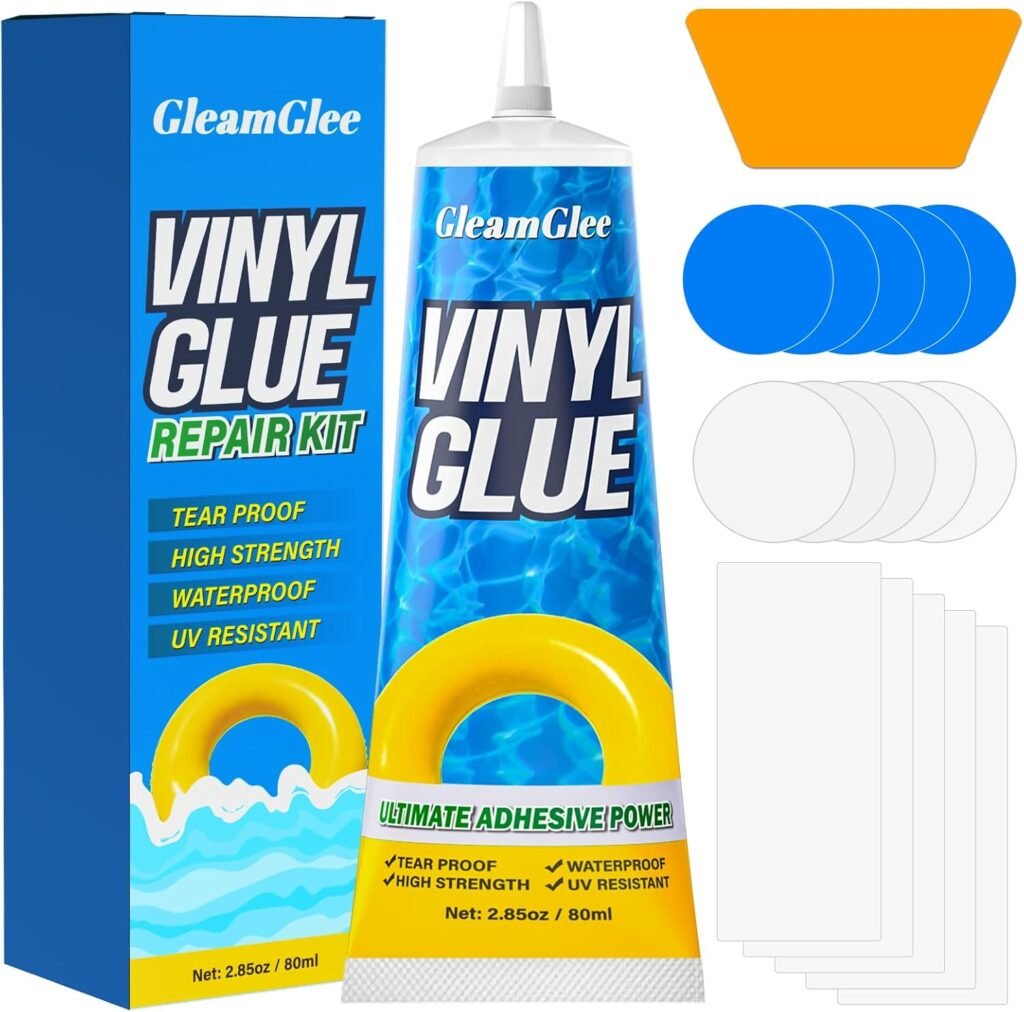
Repair Kits
Repair kits are built for “fix it now” situations: inflatable punctures, PVC/vinyl repairs, wader leaks, tent fabric tears. These systems usually combine a compatible adhesive with patches or steps designed for field-friendly repair.
Best fit: air mattress punctures, pool float leaks, wader pinholes, tent tear reinforcement.
Avoid: large structural rips or rotten material that won’t hold a patch.
Cleaners
Glue is only half of “repair.” Cleaning is the prep step that makes adhesives work—and it’s also a standalone product lane. Shoe cleaner and suede cleaner support sneaker care, while mold remover supports home hygiene.
Best fit: sneaker refresh, suede care, stain removal, mildew/mold cleanup.
Avoid: using harsh cleaners on sensitive materials without spot testing.
| Customer job / problem | Typical material | Best GleamGlee product line | Why it fits |
|---|---|---|---|
| Loose chair rung, cabinet joint | wood | Wood Glue | strong on porous wood joints with clamping |
| Loose pages, lifting book cover | paper/card | Book Glue | controlled spread + flexible bond for pages/spines |
| Patch or hem without sewing | fabric | Fabric Glue | bonds while staying flexible |
| Bouquet/wreath assembly | foam/plastic/fabric | Floral Adhesive | fast grab + clean décor bonding |
| Sole separation, toe lift | rubber/EVA/leather | Shoe Glue | high-flex, daily-wear durability |
| ABS/PVC crack, plastic housing | ABS/PVC | Plastic Glue | plastic-focused adhesion where PVA fails |
| Vase seam, glass décor repair | glass | Glass Glue | better clarity + non-porous bonding |
| Figurine break (display) | ceramic | Ceramic Glue | neat repair for decorative ceramics |
| Bracket/tool fix, metal parts | metal | Metal Glue | stronger on metal with proper prep |
| Tile/stone/drywall bonding | masonry/mixed | Construction Adhesive | gap tolerance + strong hold on building materials |
| Air mattress puncture, wader leak | PVC/vinyl/fabric | Repair Kits | system approach for waterproof repairs |
| Dirty sneakers, suede stains, mildew | textiles/leather/home surfaces | Cleaners | prep + maintenance that improves results |
Conclusion
Polyvinyl acetate (PVA) glue earns its popularity for a simple reason: on the right materials—especially wood, paper, and other porous surfaces—it’s clean, forgiving, and reliably strong. If you prep properly, apply a thin even layer, clamp with steady pressure, and give it real cure time, a PVA wood joint can hold up for years in everyday indoor life. But PVA is not a “universal glue.” Smooth non-porous surfaces like glass and many plastics, constant water exposure, wide gaps, and heat-plus-load situations are where most DIY failures start—because the chemistry isn’t designed to win those fights.
The smartest buyers don’t chase a single bottle; they build a simple rule: match glue to the job. Wood repairs belong with wood glue, pages belong with book glue, high-flex jobs need shoe glue, ABS/PVC needs plastic glue, glass repairs need glass-specific solutions, and multi-surface home projects often demand construction adhesive. That “right lane” approach is exactly how you reduce breakage, prevent ugly glue lines, and avoid the frustrating “it held… until it didn’t” experience that shows up in reviews and returns.