Skip to content

Most people do not think much about PVC rain gear until it fails at the worst possible moment. A small tear near the cuff, a puncture at the knee, or a split close to the zipper may look minor on the table, but once you are out in the rain, that small weak point becomes the place where cold water keeps getting in. That is why PVC rain gear repair is not just about making a jacket or pair of pants look better again. It is about bringing back real waterproof protection, keeping the material flexible, and stopping a small problem from turning into a larger one after another day of bending, folding, walking, working, or riding outdoors.
The good news is that many PVC rain gear problems can be repaired successfully with the right glue, the right patch size, and the right curing time. In most cases, the repair itself is not complicated. What matters is doing the basic steps correctly. Clean the damaged area well. Make sure it is fully dry. Use a glue that is made for PVC or similar flexible waterproof materials. If the tear is more than a tiny pinhole, use a patch that extends past the damaged area on every side. Press it down evenly. Then give it enough time to cure before wearing the gear again.
To repair PVC rain gear using glue, you need to clean and dry the damaged area, apply a flexible PVC-compatible adhesive, place a properly sized patch over the tear if needed, press it firmly, and allow about 24 hours for the bond to build into a strong waterproof seal. When done correctly, this method can restore waterproof performance, reduce further tearing, and extend the life of the gear instead of forcing an early replacement.
That matters to real people. A fisherman does not want to replace an expensive bib just because of one hook puncture. A commuter does not want to throw away a raincoat over one split seam. A parent does not want to buy another set of rain pants for a child after one rough week outdoors. In all of these cases, a good repair saves money, saves time, and saves a product that still has plenty of life left in it.
What Does It Mean to Repair PVC Rain Gear Using Glue?
Repairing PVC rain gear using glue means restoring the damaged waterproof barrier so the garment can keep rain out, stay flexible during movement, and avoid turning one small weak spot into a much bigger failure. In simple terms, you are not just “sticking a tear shut.” You are rebuilding a working section of the rain gear. A proper repair usually includes three parts working together: a clean surface, a PVC-compatible adhesive, and, for most tears, a patch that extends beyond the damaged area. Current repair guidance across waterproof patch and vinyl repair systems is very consistent on the basics: clean with alcohol, keep the surface dry, round patch corners, overlap the damage by at least about 0.5 inch, and allow about 24 hours for full strength.
For most customers, the real meaning of PVC rain gear repair comes down to five practical points:
- It restores function, not just appearance. A repaired jacket or pair of rain pants should do more than look better on the table. It should block water again during walking, bending, sitting, or working outside.
- It works best when done early. A pinhole, short cut, or small seam leak is much easier to stabilize than a long tear that has already spread across a flex point.
- It depends on the condition of the surrounding material. A strong patch on weak, brittle PVC still gives a weak repair. The patch is only as reliable as the healthy material around it.
- It is usually cheaper than replacement. If one damaged point can be repaired for a fraction of the cost of new rain gear, the value is obvious, especially for workwear, fishing bibs, or children’s rainwear that see frequent use.
- It is most reliable when glue and patch are used as a system. Glue seals the area, while the patch spreads force across a wider zone so the tear is less likely to reopen.
A useful customer-side decision table looks like this:
| Rain gear condition | Repair value | What it usually means |
|---|---|---|
| One pinhole or small puncture | High | Usually quick and cost-effective |
| Tear under 1 inch in sound PVC | High | Good repair candidate |
| Tear in knee, elbow, or seat area | Medium to high | Repairable, but patch support matters more |
| Several cracks in the same fold line | Medium to low | Material may already be aging |
| Large brittle or flaky area | Low | Replacement may be the smarter choice |
What damage can repair PVC rain gear using glue fix?
PVC rain gear glue repair works best on damage that is still local, clean-edged, and surrounded by material that remains flexible. In real customer use, that usually means pinholes from hooks or sharp edges, small punctures from tools or wire, short tears from snagging, edge cracks, seam leaks, and worn spots that have not yet opened into a large split. The key point is that the repair should be solving one clear weak point, not trying to rescue a whole panel that is already breaking down.
The location of the damage matters just as much as the size. A 1 cm puncture on a flat chest panel is usually easier to repair than a 1 cm split on the knee, because the knee bends dozens or even hundreds of times during normal wear. That repeated movement puts more stress on the repair line. This is why customers often feel confused: the “smallest” damage does not always mean the “easiest” repair. High-flex zones need more reinforcement and more careful patch placement.
The most common repairable problems include:
- Pinholes and needle-sized punctures These are often caused by hooks, thorns, wire ends, or sharp storage points. Small damage like this can often be sealed quickly if caught early.
- Short cuts and tears These usually happen when PVC catches on metal edges, fencing, zippers, or rough work surfaces. Once the tear has visible edges, glue plus patch is usually the safer method.
- Seam leaks Not every rain gear failure is a dramatic rip. Some problems start as slow leakage where stitching, welds, or folded zones begin to weaken. These repairs are often worth doing early before the seam opens wider.
- Wear spots from friction Knees, elbows, cuffs, and seat panels can gradually thin after repeated use. Once the area begins whitening or soft leakage starts, repair becomes more urgent.
- Small edge cracks These often appear where PVC has been folded repeatedly. If the surrounding material is still healthy, patching can help stop the crack from traveling further.
Here is a more practical repair guide customers can follow:
| Damage type | Repair outlook | Best method |
|---|---|---|
| Tiny pinhole | Very good | Thin glue layer or small patch |
| Small puncture | Very good | Glue plus patch |
| Tear under 1 inch | Good | Patch with at least 0.5 inch overlap |
| Tear in knee/elbow area | Good, but needs care | Patch and strong edge pressure |
| Light seam leak | Good | Reinforce before it spreads |
| Worn-through panel | Fair to weak | Depends on surrounding PVC strength |
| Multiple cracks nearby | Weak | Often temporary only |
For many customers, the most important lesson is timing. A small repair done early often lasts much better than a larger repair done late. Once the damage starts spreading, the repair is no longer just sealing a point. It is trying to control stress across a larger weak zone.
Which tears need repair PVC rain gear using glue plus a patch?
If the damaged area has visible edges, opens when the garment is handled, or sits in a zone that bends often, it usually needs a patch. Glue alone can sometimes seal a very small puncture, but once there is a real tear, the repair becomes stronger and more durable when the adhesive works together with a patch. This is not just a technical preference. It is a practical issue of how force moves through the garment during real use.
A tear without a patch leaves most of the stress sitting directly on the repaired line. That may hold at first, but repeated movement can gradually reopen the area. A patch changes that by spreading the load over healthy surrounding material. This is why patch overlap matters. Current repair instructions commonly recommend at least about 0.5 inch overlap around the tear, while some heavier vinyl systems recommend as much as 1–2 inches on each side for tougher repairs.
The tears that most clearly need patch support are:
- Tears with visible separation If the cut edges pull apart when you handle the garment, patch it.
- Damage in knees, elbows, cuffs, and seat panels These zones flex often and place constant stress on the repair.
- Long narrow tears Even if they look clean, longer tears carry more reopening risk.
- Seam splits Once a seam has opened, patch support helps prevent the split from continuing.
- Repairs for outdoor work or repeated heavy use If the item is used daily in fishing, farm work, hiking, or site work, patch support is usually the smarter long-term decision.
A simple way to explain it to customers is this: glue seals, patch strengthens. The two together usually outperform either one on its own when the garment will be worn repeatedly.
Patch size also matters. Below is a practical sizing guide:
| Tear size | Suggested overlap | Why |
|---|---|---|
| Under 0.5 inch | 0.5 inch around damage | Enough for light repair |
| 0.5–1 inch | 0.5–0.75 inch around damage | Better stress distribution |
| 1–2 inches | 1 inch around damage | Helps reduce reopening risk |
| Over 2 inches | 1 inch or more around damage | Needed for stronger support |
Rounded corners should also be part of the plan. They catch less during use and are less likely to start peeling than square corners. That may sound like a small detail, but in daily wear it makes a real difference, especially if the jacket is folded into a bag or rubbed against other gear.
When does repair PVC rain gear using glue not work well?
Repair does not work well when the visible tear is only one symptom of wider material failure. If the PVC around the damage has already become stiff, flaky, chalky, or cracked in several nearby places, then even a well-applied patch may not hold for long. The reason is simple: a repair depends on healthy surrounding material. If the patch is bonded to PVC that is already breaking down, the adhesive may hold better than the garment itself.
This is the situation many customers misunderstand. They assume a stronger glue will solve the problem. Often it will not. When PVC ages badly, the issue is no longer “How do I close this one hole?” The real issue becomes “Is there enough good material left here to support a repair?” That is a much more important question.
Warning signs that a repair may be weak or short-lived include:
- The PVC feels brittle instead of flexible
- Several short cracks appear around the same fold line
- The surface looks chalky, dry, or flaky
- The area around the tear whitens when bent
- A previous repair held, but a new crack formed right beside it
- Layers appear to be separating across a larger section
When customers see this kind of damage, repair may still be useful, but expectations should change. Instead of aiming for a long service extension, the repair may only buy extra time.
A realistic decision chart is helpful here:
| What you see | Likely result | Best choice |
|---|---|---|
| One fresh tear in healthy PVC | Strong repair chance | Repair |
| One seam leak, rest of garment sound | Strong repair chance | Repair now before it spreads |
| Tear plus nearby whitening and stiffness | Moderate repair chance | Repair, but monitor closely |
| Repeated cracking in the same area | Weak repair chance | Temporary fix only |
| Large flaky or brittle zone | Low repair chance | Consider replacement |
For customers, this honesty matters. Nobody wants a repair guide that pretends every jacket can be saved. A good repair is not about false optimism. It is about matching the right method to the right condition and helping the customer spend time and money where the result is most likely to be worth it.
Which Glue Is Best to Repair PVC Rain Gear Using Glue?
The best glue for repairing PVC rain gear is a flexible adhesive made specifically for PVC, vinyl, or similar waterproof materials. What matters most is not whether the glue dries the hardest, but whether it can bond tightly to the surface, stay flexible after curing, resist water, and keep holding when the garment bends during normal wear. For most real repairs, especially on tears rather than tiny pinholes, the best result usually comes from using that glue together with a patch.
When customers shop for glue, they usually care about a few practical questions more than anything else:
- Will it really hold on PVC?
- Will it stay waterproof?
- Will it crack when the jacket or pants bend?
- Will it work on small tears and awkward repair spots?
- Will the repair still look acceptable after it dries?
Those are the right questions. PVC rain gear is different from hard plastic items, wood, or metal. It moves with the body. A repair on a sleeve, knee, cuff, or seat panel has to survive repeated bending, rubbing, and folding. That is why the best glue is usually one designed for flexible waterproof repair, not a random general-purpose household glue.
A customer-friendly comparison makes this easier to understand:
| Glue type | Works on PVC rain gear? | Main strength | Main weakness |
|---|---|---|---|
| PVC / vinyl repair adhesive | Yes, best option | Flexible, waterproof, better surface match | Needs proper prep and cure time |
| General-purpose household glue | Sometimes short term | Easy to find | Often too brittle or too weak over time |
| Super glue / instant glue | Usually poor choice | Fast set | Can dry hard and crack on flex zones |
| Hard plastic cement | Usually poor choice | Strong on rigid plastics | Not suited to moving rain gear |
| Fabric glue | Sometimes on textiles, not ideal for PVC | Flexible on fabric | Often not the best bond for PVC surfaces |
For most customers, the safest buying rule is simple: choose a glue that clearly fits PVC, vinyl, or flexible waterproof repair use. That gives the repair a much better chance of lasting beyond the first few wears.
Why is PVC glue best to repair PVC rain gear using glue?
PVC glue is usually the best choice because it is built for the kind of surface and movement that rain gear actually has. A raincoat or pair of rain pants is not a rigid object sitting on a shelf. It bends at the elbows, folds at the knees, creases at the waist, and gets packed into bags, lockers, or car trunks. If the glue dries too hard, the repaired area may feel strong at first but then start cracking or peeling once the garment is used again.
What customers really need from the glue is a balance of four things:
- Surface compatibility The glue needs to bond well to PVC or vinyl-type waterproof surfaces rather than just sitting on top of them.
- Flexibility after curing The repair should move with the garment instead of turning into a stiff weak point.
- Water resistance Rain gear repair has to block water, not just hold two edges together.
- Durability under repeated wear The repair should survive more than one outing. It should keep working after folding, walking, kneeling, and normal use.
This is why “strongest glue” can be the wrong way to think about the problem. In rain gear repair, a glue that dries rock-hard is not automatically better. In many cases, that kind of hardness becomes a disadvantage because the repaired area stops moving naturally with the rest of the material.
Here is how customers can judge whether a glue is a good fit:
| What to look for on the product | Why it matters |
|---|---|
| Mentions PVC, vinyl, or inflatable repair | Better sign of surface compatibility |
| Says waterproof or water-resistant | Important for real rain use |
| Says flexible after cure | Helps prevent cracking on moving areas |
| Suitable for outdoor use | Better for rain gear, camping gear, and workwear |
| Suitable for patch use | Helps with stronger tear repair |
For customers comparing options, PVC glue is usually the safer long-term choice because it is closer to the way the garment itself behaves.
Is flexible glue enough to repair PVC rain gear using glue?
Sometimes it is enough, but often it is only part of the solution. If the damage is a very small pinhole, a tiny puncture, or a light surface nick, a flexible waterproof glue may be enough to seal it. But once the damage becomes a visible tear, a seam split, or a weak point in a bending area, glue alone is usually less reliable than glue plus patch.
The easiest way to explain this is: glue seals the damage, but the patch helps carry the stress.
Without a patch, the repaired line has to take most of the movement by itself. On a flat area with little stress, that may be acceptable. On a knee, sleeve, or seat panel, it is much riskier. Customers usually want the repair to last through actual use, not just look fixed for a day. That is why patch-supported repairs usually give better long-term value.
A practical decision guide looks like this:
| Damage type | Is glue alone enough? | Better option |
|---|---|---|
| Tiny pinhole | Sometimes yes | Glue alone or tiny patch |
| Small puncture | Sometimes | Glue plus patch is safer |
| Tear with visible edges | Usually no | Glue plus patch |
| Seam split | Usually no | Glue plus patch |
| Knee/elbow repair | Usually no | Glue plus patch |
| Large tear | No | Larger patch with careful overlap |
Customers also care about comfort. A thick glue-only repair can sometimes leave a ridge or hard spot. A well-balanced patch repair often feels smoother and spreads the repaired zone more naturally across the material.
So the honest answer is this: flexible glue is important, but on many real PVC rain gear repairs, it works best as part of a patch system rather than as the only repair material.
Do you need patches to repair PVC rain gear using glue?
In many cases, yes. If the goal is a repair that holds up better under normal wear, a patch is usually the smarter choice. Tiny punctures may not always need one, but most tears, seam splits, and high-movement damage areas benefit from patch support.
Customers often ask this because they want to save time or keep the repair less visible. That makes sense. But in real use, the patch often decides whether the repair stays stable. The patch gives the glue more bonding area, helps stop the tear from spreading, and reduces the risk of the repaired line reopening under movement.
Patches matter most in these situations:
- Tears longer than a pinhole
- Damage near knees, elbows, cuffs, or seat panels
- Repairs on workwear or outdoor gear used often
- Weak seam areas
- Places where the garment is folded during storage
Patch overlap also matters. A patch should reach beyond the damaged area into healthy material. If it only covers the hole itself, the repair has much less support. In practical customer use, that often means the edges lift sooner.
A simple patch guide is below:
| Repair situation | Patch need | Why |
|---|---|---|
| Tiny puncture | Optional | Glue may be enough |
| Small tear | Recommended | Better sealing and support |
| Tear in flex zone | Strongly recommended | Helps survive repeated movement |
| Seam split | Strongly recommended | Helps stop the split from growing |
| Larger tear | Required | Needed for strength and waterproofing |
For appearance, clear patches are often better on visible outer panels. For harder-use areas, customers may accept a more visible patch if it gives a stronger repair. That is one reason mixed patch kits are useful. They let the user match the repair method to the damage rather than forcing one patch style on every situation.
For most customers, the safest rule is simple: if there is any real tear, use a patch. It usually gives a stronger, longer-lasting, and more dependable repair.

How Do You Repair PVC Rain Gear Using Glue?
Repairing PVC rain gear using glue is basically a controlled waterproof repair job. The goal is not only to close the hole or tear, but to rebuild a section of the garment so it can handle rain, bending, folding, and daily wear again. In real use, a repair lasts best when the job is done in the right order: check the damage, clean the surface, dry it fully, prepare the patch, apply the glue carefully, press the patch evenly, and then leave the area alone long enough to cure. Most poor results come from rushing one of these steps, not from the idea of repair itself.
For customers, the biggest misunderstanding is thinking that PVC repair is mainly about the glue. In reality, the glue is only one part of the result. A good repair depends on the whole process. Even a strong adhesive can underperform if the surface is greasy, if the patch is too small, or if the jacket is worn again before the bond has fully built. On the other hand, a careful repair on a clean, dry surface often performs far better than people expect, even on gear that gets used outdoors often.
A practical repair should do four things at the same time:
- Seal the opening
- Stop water from getting in
- Reduce the chance of the tear spreading
- Stay stable when the garment bends during use
That is why customers usually get the best results when they treat the repair like a small restoration job, not like a quick emergency shortcut.
Here is a useful repair sequence:
| Step | What to do | Why it matters |
|---|---|---|
| 1 | Check size, shape, and location of damage | Helps decide whether glue alone is enough |
| 2 | Clean the repair area well | Removes dirt, oil, soap residue, and grime |
| 3 | Let the area dry fully | Moisture weakens bonding |
| 4 | Cut and test-fit the patch | Prevents mistakes after glue is applied |
| 5 | Apply glue in a thin, even layer | Improves bond quality and finish |
| 6 | Place and press the patch carefully | Helps remove bubbles and seal edges |
| 7 | Leave the repair undisturbed | Allows strength to build properly |
A customer should also think about location before starting. The same repair method is used on most PVC rain gear, but the difficulty changes depending on where the damage is:
| Repair area | Difficulty | Why |
|---|---|---|
| Flat chest or back panel | Low | Easier to clean, patch, and press evenly |
| Sleeve | Medium | Narrower space, more movement in use |
| Knee | High | Constant bending puts more stress on the repair |
| Seat panel | High | Sitting and friction increase strain |
| Seam edge | Medium to high | Shape is less flat and movement is repeated |
This matters because customers often judge the repair only by the size of the hole, when the location is sometimes the more important factor.
How do you clean PVC before repair PVC rain gear using glue?
The first thing to get right is the surface. PVC rain gear often looks clean when it still has enough residue to weaken the repair. Dirt is the obvious problem, but it is not the only one. Many jackets and pants carry body oil, detergent film, hand cream, sunscreen, fine dust, mud residue, fish slime, workshop grime, or general outdoor dirt. If the patch is placed over that layer, the glue may bond to the contamination instead of the PVC itself. That is one of the most common reasons a repair looks fine at first and then starts lifting at the edges.
The safest approach is to clean more area than you think you need. The repair is not only the hole in the middle. The patch must also bond to the surrounding healthy material. If the overlap area is dirty, that is often where failure begins. In practical terms, the customer should clean at least 1–2 inches beyond the damaged area, especially if the patch is medium or large.
The cleaning process should stay simple and consistent:
- Remove visible dirt first Wipe away mud, dust, sand, loose debris, or surface grime before doing anything else.
- Clean the actual repair zone and the overlap zone The area where the patch edges will sit matters just as much as the center.
- Use a lint-free cloth This helps avoid leaving fibers under the repair.
- Use a surface cleaner that does not leave residue Isopropyl alcohol is often the easiest choice for removing oils and light residue.
- Let the PVC dry completely Even slight dampness can reduce bond strength.
- Avoid touching the cleaned area too much afterward Skin oils can go right back onto the surface.
A practical check before moving on:
| Surface condition after cleaning | What it means |
|---|---|
| Smooth and dry | Good to repair |
| Still greasy or shiny from residue | Clean again |
| Damp or cool from recent wiping | Wait longer |
| Dust or lint visible | Wipe again |
| PVC feels brittle or flaky | Repair may still work, but long-term durability is lower |
Customers should also use cleaning time to inspect the surrounding material honestly. If the PVC around the tear still bends normally and does not crack when moved lightly, that is a good sign. If it shows whitening, dryness, or multiple tiny cracks, the repair may still help, but it should be viewed as less durable.
How do you prepare the patch before repair PVC rain gear using glue?
Patch preparation is where the repair starts becoming more reliable. Many customers skip ahead too quickly and only think about the patch after the glue is already on the garment. That usually leads to poor alignment, extra mess, and rushed handling. The patch should always be cut, shaped, and test-fitted first.
A patch should not only cover the hole itself. It should extend beyond it into healthy surrounding material. That is what gives the repair real support. If the patch is too small, the damaged area may still be sealed, but the stress stays concentrated too close to the original tear line. On rain gear, that often means the repair reopens after repeated bending.
A practical overlap guide is:
| Damage size | Recommended patch overlap |
|---|---|
| Tiny puncture | At least 0.5 inch around the damage |
| Small tear under 1 inch | 0.5–0.75 inch around the damage |
| Tear 1–2 inches | About 1 inch around the damage |
| Larger tear | More than 1 inch, depending on surrounding material |
The patch should also be shaped correctly. Rounded corners are almost always better than sharp square corners. A sharp corner catches more easily during wear, folding, or storage. Rounded edges reduce that peeling risk and usually give a cleaner-looking result.
Good patch preparation usually includes:
- Choose the patch shape that matches the damage
- Make sure the patch reaches healthy material all around
- Round the corners
- Dry-fit the patch before using glue
- Check that the garment lies flat enough for full contact
Customers working on sleeves, knees, or curved areas should be especially careful here. A patch that looks fine in the air may wrinkle once pressed onto the actual garment. That is why test-fitting on the real surface matters. It reduces surprises once the adhesive is involved.
How do you apply glue to repair PVC rain gear using glue?
Glue should be applied with control, not with excess. Customers often think more glue means more strength, but on PVC rain gear, too much glue can create a thick ridge, uneven bonding, extra squeeze-out, and a repair that feels stiffer than it needs to. A thin, even layer usually works better than a heavy one.
Before applying glue, the garment should be placed on a flat, stable surface so the damaged area is relaxed and not stretched. Then the patch should already be ready beside it. Once glue goes on, there should not be much hesitation. The goal is a smooth, deliberate repair process, not a rushed one.
The most important glue habits are:
- Apply glue evenly
- Do not flood the area
- Keep the adhesive within the target bond zone
- Avoid gaps in coverage
- Do not apply on a damp or dirty surface
- Work with the garment flat, not hanging or twisted
This is where precise packaging design makes a difference. A metal nozzle is especially helpful for rain gear because a lot of real damage is small and awkwardly placed:
- a puncture beside a seam,
- a narrow split near a cuff,
- a short cut beside a zipper,
- or a tiny worn-through point on a fold line.
In those cases, better glue control gives several practical benefits:
| Better glue control helps with | Why customers notice it |
|---|---|
| Less waste | Less adhesive lost outside the repair zone |
| Cleaner appearance | Fewer messy edges after curing |
| Better accuracy | Easier on small holes and narrow tears |
| Smoother patch contact | Less chance of thick spots under the patch |
Customers should also avoid one common mistake: applying glue while the garment is being held in the hand or across the knee. That usually leads to uneven pressure, shifting, and poor patch positioning. Even a kitchen table or workbench is usually a much better setup than trying to repair the garment mid-air.
How do you place and press the patch correctly?
Once the glue is on, the patch should be placed carefully and then pressed firmly from the center outward. This is the stage that decides whether the repair becomes flat and sealed or ends up with weak air pockets underneath. A patch that only “touches” the surface is not enough. It needs pressure so the adhesive spreads well, the contact becomes even, and the edges sit fully down.
The patch should be positioned to center the damage and keep a balanced overlap on all sides. If the patch is off-center, one side may not have enough support, which can reduce repair life. As soon as the patch is down, pressing should begin before trapped air has a chance to stay in place.
The best pressing habits are:
- Start from the middle
- Push outward toward the edges
- Check for bubbles as you go
- Give extra attention to corners and edge lines
- Use a scraper or smooth flat tool if possible
- Keep the garment flat while pressing
A scraper matters because finger pressure is often uneven. On larger patches, hand pressure alone may leave bubbles or lightly bonded areas. A simple tool can make the difference between a patch that lasts and one that starts peeling from one side later.
Here is what to look for after pressing:
| What you see | What it usually means |
|---|---|
| Patch lies flat across the full area | Good contact |
| Edges are fully sealed down | Better water protection |
| No visible bubbles | Fewer weak points |
| Glue is not heavily squeezed everywhere | Better adhesive control |
| Patch is centered over the damage | Better force distribution |
Customers repairing knees, elbows, or seat panels should pay extra attention here because these are high-stress locations. Even a small trapped bubble can become a weak point after repeated bending. On hard-use garments, a few extra seconds of careful pressing usually gives better results than applying more glue.
How do you let the repair cure without weakening it?
After the patch is pressed, the repair should be treated as unfinished until the cure period is over. This is where many customers lose a repair that was going well. They pick up the jacket to check it, fold the pants to put them away, or try on the garment too early. The patch may seem attached, but the bond is still building. Disturbing it too soon can reduce the final strength.
For most repairs, customers should aim for about 24 hours before normal wear. During that time, the repaired area should stay as undisturbed as possible. That is especially important for high-flex zones like knees, sleeves, elbows, and seat areas.
The safest curing habits are:
- Leave the garment flat if possible
- Do not fold the repaired section
- Do not test it by bending it
- Keep it away from water during curing
- Avoid stacking heavy items on top of it
- Allow extra time in cool or humid conditions
A practical cure guide:
| Time after repair | Best action |
|---|---|
| 0–30 minutes | Leave completely untouched |
| 1–2 hours | Do not wear, bend, or fold |
| 6–12 hours | Light handling only if absolutely necessary |
| Around 24 hours | Usually ready for normal use |
| Longer than 24 hours | Safer for larger or high-stress repairs |
Customers often ask whether they can speed this up. The best way is not to force faster curing. It is to create good repair conditions from the start: clean surface, dry room, thin even glue layer, proper pressing, and no unnecessary handling.
What mistakes make PVC rain gear repairs fail early?
Most early failures come from a few repeated mistakes, and customers can avoid a large percentage of repair problems by focusing on them. These are not complicated technical failures. They are usually simple handling issues.
The most common mistakes are:
- Repairing on a dirty surface The patch may bond to residue instead of the PVC.
- Applying glue while the area is still damp Moisture weakens bond quality.
- Using a patch that is too small The repair may seal the hole but still lack real support.
- Applying too much glue This often creates a thicker, messier, less even repair.
- Not pressing out trapped air Bubbles become weak zones.
- Trying the garment too early The repair may shift before it has proper strength.
- Repairing badly aged PVC as if it were fresh material If the surrounding area is brittle, the patch may not last long.
A simple failure-prevention table helps:
| Mistake | Likely result |
|---|---|
| Dirty prep | Early edge lift |
| Damp surface | Reduced bond strength |
| Small patch | Tear stress remains too concentrated |
| Too much glue | Uneven cure and messy finish |
| Weak pressing | Bubbles and poor edge seal |
| Early bending or wearing | Repair loosens too soon |
| Ignoring surrounding PVC damage | New cracking beside the patch |
For customers, this is usually the most useful part of the whole repair guide. Most people do not need advanced technique. They need a clear process and a short list of mistakes to avoid. When those basics are handled well, PVC rain gear repair becomes much more dependable and much less frustrating.

How Long Does It Take to Repair PVC Rain Gear Using Glue?
In most cases, a PVC rain gear repair needs about 24 hours to reach full strength, even if the patch feels secure much earlier. That is the practical answer customers need. A repair may look finished after a few minutes, and it may feel partly set after an hour or two, but the bond is still developing underneath. Several repair systems for vinyl and waterproof patching use the same general timeline: the patch or adhesive may hold lightly sooner, but full adhesion or strongest hold is typically reached after about one day.
For customers, the important point is this: there is a big difference between “it seems attached” and “it is ready for real use.” PVC rain gear gets bent, folded, rubbed, and compressed. A sleeve repair starts moving as soon as you raise your arm. A knee repair starts working the moment you walk. A seat repair takes pressure the first time you sit down. If the repair is stressed too early, the edges can weaken before the bond reaches its full strength.
The most useful way to understand repair time is to divide it into stages:
- Placement stage The patch is on, but the bond is still fresh and easy to disturb.
- Early hold stage The patch may feel more secure, but the repair should still not be bent, folded, or exposed to heavy stress.
- Usable hold stage Some systems allow careful use after about 1 hour, but that is not the same as maximum repair strength.
- Full-strength stage This is usually around 24 hours, and that is the safest benchmark for normal wear and wet outdoor use.
A simple timing guide is below:
| Time after repair | What is usually true | Best customer action |
|---|---|---|
| 0–30 minutes | Patch is newly placed, bond is delicate | Leave it completely alone |
| 1 hour | Repair may have light hold on some systems | Do not wear normally yet |
| 4 hours | Adhesive may be mostly set in some cases | Only light handling if necessary |
| 8–12 hours | Bond is improving | Avoid flex-heavy use |
| Around 24 hours | Full strength is usually reached | Best time to return to normal use |
For most customers, the safest rule is simple: if the item matters, wait the full day. That is especially true for outdoor workwear, fishing bibs, rain suits, and children’s rain gear that will be bent hard and used in wet conditions.
How long before you wear repaired PVC rain gear using glue?
For most repairs, the best answer is about 24 hours before normal wear. Some patch-and-glue systems can hold earlier, and some product instructions say the repair can bond for light use after around 1 hour, but the strongest hold is still generally reached after roughly 24 hours.
Customers often ask this because they are trying to solve a real problem quickly. They may need the jacket the next morning, the rain pants for work in a few hours, or the bibs for a weekend trip. The temptation is always the same: “It looks stuck. Maybe it is good enough.” Sometimes it may survive. But that is not the standard most customers actually want. They want the repair to hold through real movement and real weather, not just survive putting the garment on once.
The more the repaired area bends, the more patience matters. These areas need the most caution:
- Sleeves and cuffs Constant arm movement stresses the repair quickly.
- Knees One walk, crouch, or kneel can work the patch hard.
- Seat panels Sitting and shifting body weight creates immediate pressure.
- Waist and side seams These move more than customers often realize.
A practical wear guide looks like this:
| Repair location | Risk of early use | Best advice |
|---|---|---|
| Flat chest or back panel | Lower | Still better to wait 24 hours |
| Sleeve or cuff | Medium to high | Wait the full day |
| Knee or elbow | High | Full 24 hours strongly recommended |
| Seat area | High | Do not rush first wear |
| Seam repair | Medium to high | Wait until full-strength stage |
Customers should also think about the difference between trying on and real use. Slipping on the garment for a few seconds may seem harmless, but if that action bends the repair sharply, it can still reduce the bond. The repair is usually safest when the garment stays flat and undisturbed until the full cure period is over.
Is 24 hours enough for repaired PVC rain gear using glue to be waterproof?
In most cases, yes, 24 hours is the safest working standard for a repair to reach full adhesion and much more reliable waterproof performance. Multiple waterproof patch and vinyl repair instructions point to the same general timeline: the bond may form earlier, but full strength is typically reached after about a day.
That said, customers should know that the clock is only one part of the result. A repair can still underperform after 24 hours if:
- the surface was not cleaned well,
- the area was still slightly damp,
- the patch was too small,
- air bubbles were trapped,
- the garment was bent too early,
- or the surrounding PVC was already weak.
So the better way to say it is this: 24 hours is usually enough when the repair was done correctly. If the method was rushed, simply waiting longer does not always fix the earlier mistake.
Waterproofing is really the result of several things working together:
- Clean surface
- Dry repair zone
- Correct glue for PVC or vinyl
- Enough patch overlap
- Strong edge contact
- Enough cure time
A useful customer chart is below:
| Situation after 24 hours | Waterproof outlook |
|---|---|
| Patch lies flat, edges sealed, clean prep | Usually very good |
| Small bubbles remain | Moderate, may weaken later |
| One edge is lifting | Waterproofing is at risk |
| Area was bent early | Less reliable |
| Surrounding PVC is brittle | Waterproofing may be temporary only |
For customers who depend heavily on the garment, such as anglers, outdoor workers, farm users, and commuters in wet climates, it makes sense to do a quick inspection before relying on the repair for a full day outside. Check that the patch edges are flat, the repair area feels stable, and there is no obvious peeling or movement at the boundary.
What makes PVC rain gear glue dry slower or faster?
The main things that affect repair time are temperature, humidity, glue thickness, patch size, and how the garment is handled during curing. This is where many customers get confused, because they assume cure time is fixed. In reality, a repair done in a cool, damp garage may take longer to become reliable than the same repair done in a dry indoor room.
Several repair instructions also note helpful temperature ranges or tack stages. For example, one patch system notes that the best initial adhesion is in the range of 50–104°F (10–40°C), while vinyl cement systems often say the adhesive becomes tacky in about 2 minutes before patch placement, then continues building bond strength afterward.
The biggest timing factors are:
- Room temperature Warmer, moderate indoor conditions usually help the repair build strength more predictably.
- Humidity Higher moisture in the air can slow surface readiness and make curing feel less consistent.
- Glue thickness A thin, even layer usually behaves better than a heavy blob.
- Patch size Larger repairs often need more careful pressing and stable curing time.
- Movement during curing Folding, bending, or compressing the garment too soon can reduce bond quality.
Here is a practical customer guide:
| Condition | Effect on repair time | Best advice |
|---|---|---|
| Warm, dry indoor room | Usually helps normal cure | Best setup |
| Cool room | Slower bond development | Add extra waiting time |
| Humid environment | Slower surface readiness | Improve airflow, avoid rushing |
| Thick glue layer | Slower, less even set | Use a thinner, even coat |
| Large patch area | More sensitive to bubbles and shifting | Leave flat longer |
| Early folding or bending | Can weaken the bond | Keep undisturbed |
Customers do not need laboratory conditions for a good repair, but they do benefit from simple good habits: work on a flat surface, avoid damp conditions when possible, apply glue evenly, and leave the garment alone long enough to cure properly.
Can you speed up a PVC rain gear repair without ruining it?
Customers often ask whether they can make the repair faster. The honest answer is: you can improve the chances of a clean, timely repair, but you should not try to force it. The safest way to “speed it up” is not by rushing the cure. It is by setting up the repair better from the beginning.
The best ways to keep the repair on schedule are:
- Do the repair indoors if possible
- Work in a dry room, not a damp shed or outside in bad weather
- Clean the area properly the first time
- Apply a thin, even coat instead of too much glue
- Use a correctly sized patch before the glue goes on
- Keep the garment flat and untouched
What customers should avoid:
- using a very thick glue layer,
- testing the patch by bending it early,
- folding the item to “save space,”
- wearing it because it “looks ready,”
- or exposing it to moisture before the cure period is finished.
A few systems mention early tack or faster initial bonding, such as adhesives becoming tacky in about 2 minutes before joining or patches becoming repositionable early on, but that should not be confused with full repair readiness.
For most customers, the smartest way to get a faster usable result is not to cut the cure short. It is to repair the gear before the repair becomes urgent. A jacket fixed the night before is much safer than a jacket patched 30 minutes before leaving in the rain.

Why Choose GleamGlee to Repair PVC Rain Gear Using Glue?
GleamGlee is a strong choice for repairing PVC rain gear with glue because it offers both the product features customers need for a reliable repair and the supply capabilities that make the product practical for long-term retail or private label business. For end users, that means a kit that is easier to use, more complete, and better suited to flexible waterproof materials. For business customers, that means a supplier that can support formulation, packaging, design, compliance-minded labeling, and scalable production instead of only selling a single finished item.
For most customers, the decision usually comes down to a few simple concerns:
- Will the repair hold in rain?
- Will the patch stay down when the garment bends?
- Is the kit easy to use for a non-professional user?
- Does it include enough tools and patch choices?
- Is the supplier reliable enough for repeat orders or custom development?
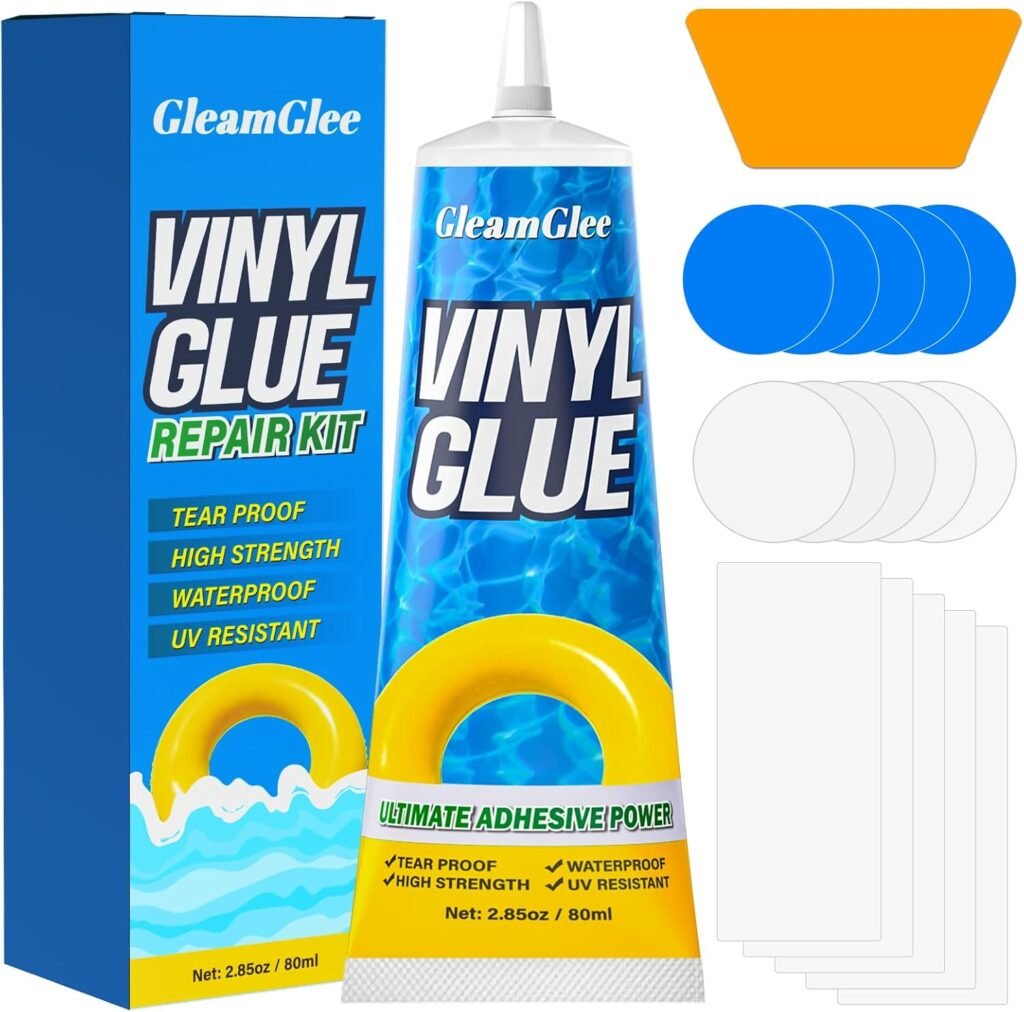
GleamGlee answers those concerns well because the product facts and the company background both line up with real customer needs. Based on the information you provided, the PVC repair kit includes:
- 80 ml premium glue
- 5 blue round patches
- 5 clear round patches
- 5 clear rectangular patches
- a rubber scraper
- an applicator
- a metal nozzle for more precise application
That is important because many repair failures do not happen because the customer lacks motivation. They happen because the kit is too basic. One tube of glue without the right patch shapes, without a pressing tool, or without enough application control puts too much guesswork onto the user. A more complete kit usually means a more successful repair.
A simple value comparison helps show why:
| What customers need | How GleamGlee responds |
|---|---|
| Flexible waterproof repair | PVC-focused glue and patch system |
| Better repair control | Precision metal nozzle |
| A cleaner-looking result | Clear patch options |
| Better support for different tear shapes | Round and rectangular patch mix |
| Easier pressing and smoothing | Scraper included |
| One kit for more than one repair | Multiple patches and 80 ml glue volume |
| Retail or custom business support | Design, packaging, production, logistics |
For business customers, the value goes beyond the repair itself. GleamGlee’s company information shows a much broader support system:
- over 25 chemists, material scientists, and engineers
- 18+ designers across product, packaging, and graphics
- 4 integrated factories
- annual output above 12 million units
- over 3,000 packaging molds
- low custom MOQ starting at 200 units
- design draft delivery in as fast as 2 days
- sample lead time around 7–14 days
- mass production around 20 days, or about 15 days when rushed
- warehouses in the US, UK, and Germany
Those numbers matter to serious buyers because they answer practical questions about stability, scale, and response speed. A retailer or Amazon seller does not only need a good repair kit. They need a partner that can maintain supply, refresh packaging, improve instructions, and handle custom requests without slowing the project down.
How does GleamGlee help repair PVC rain gear using glue more neatly?
GleamGlee helps customers make a neater repair because the kit is built around control, patch fit, and cleaner handling, not just bonding strength. For rain gear, neatness matters more than many people think. A cleaner repair usually means more accurate glue placement, better edge sealing, less waste, and a result the customer feels more comfortable wearing again.
The first practical advantage is the metal nozzle. Small damage on rain gear is often awkwardly placed:
- a puncture near a sleeve seam
- a split close to a zipper
- a short tear beside a pocket
- a leak on a narrow cuff edge
These are not easy areas to repair with a wide glue outlet. A metal nozzle gives the customer more control over glue placement, which helps reduce:
- glue overflow,
- accidental smearing,
- wasted adhesive,
- and uneven coverage.
The second advantage is the mixed patch format. GleamGlee includes both clear and blue round patches, plus clear rectangular patches. That solves a real customer problem: one patch shape does not suit every repair. A round puncture and a narrow tear do not need the same patch geometry.
This improves the repair in several ways:
- the patch fits the damage better,
- there is less trimming guesswork,
- overlap is easier to achieve,
- and the final result looks more deliberate.
The third advantage is the rubber scraper and applicator. Many low-detail repairs fail because customers do not have a good way to press the patch evenly. Finger pressure alone often leaves bubbles or weak edges. A scraper helps flatten the patch and push out trapped air, which usually improves both appearance and waterproofing.
Here is a practical breakdown:
| Feature | Why it helps the customer |
|---|---|
| Metal nozzle | Better control in tight repair spots |
| Clear patches | Less visible repair on outerwear |
| Round patches | Easier for punctures and small holes |
| Rectangular patches | Better for straight tears and seam sections |
| Scraper | Flatter patch contact and fewer bubbles |
| Applicator | Easier handling, especially for non-professional users |
For many customers, a neat repair also has an emotional value. They are more likely to repair instead of replace if the result does not look rough or temporary. That matters especially for:
- commuter raincoats,
- children’s rainwear,
- fishing bibs,
- work jackets,
- and visible outer panels on jackets and pants.
How does GleamGlee support faster and more flexible custom orders?
GleamGlee is not only suitable for end users who want a ready-to-use repair kit, but also for business customers who need faster development, flexible customization, and more reliable supply planning. For many private label sellers, importers, and online brand owners, the biggest problem is not only finding a repair product that works. The bigger problem is finding a supplier that can turn that product into a market-ready item without wasting too much time on design, packaging, sampling, and follow-up revisions.
This is where GleamGlee has a clear advantage. Based on the company information provided, the business can support custom orders starting from 200 units, which is a practical entry point for new product testing, seasonal launches, and smaller private label projects. That threshold is much easier for many Amazon sellers and growing brands than traditional large factory minimums. It lowers the risk of entering the category while still allowing customers to build their own branded version.
Speed is also important. GleamGlee can provide print-ready design drafts in as fast as 2 days, with sampling typically completed in 7–14 days, and mass production around 20 days, or roughly 15 days for urgent orders. For customers working with selling seasons, replenishment pressure, or fast-moving online channels, that timeline matters a lot. A product idea is much more useful when it can reach the market quickly enough to match demand.
The company’s support is practical in several areas:
- Low MOQ for custom projects Easier for new brands, Amazon sellers, and test launches.
- Fast design turnaround Helps reduce waiting time before sampling.
- Sampling support Lets customers check product feel, packaging, and market fit before a larger order.
- Packaging and label customization Useful for private label, multilingual markets, and brand consistency.
- Integrated production system Better control over lead time, material coordination, and packaging matching.
A simple summary for custom clients looks like this:
| Custom-order need | GleamGlee support |
|---|---|
| Lower-risk product launch | MOQ from 200 units |
| Faster market entry | Design drafts in as fast as 2 days |
| Product testing before scale-up | Sampling in about 7–14 days |
| Quicker production planning | Around 20 days production, 15 days rushed |
| Branded retail presentation | Custom labels, packaging, and design support |
| Better supply coordination | Integrated factory and packaging system |
For custom-order customers, this kind of flexibility is often just as important as the adhesive itself. A good PVC repair kit may solve the product problem, but fast design, manageable MOQ, and dependable production help solve the business problem. That combination makes GleamGlee more attractive for customers who want to build a repair product line instead of only buying one finished item.
Conclusion
In the end, repairing PVC rain gear with glue is often a much smarter choice than replacing the whole garment too early. A small puncture, short tear, or seam leak does not always mean your raincoat, rain pants, or work bibs are finished. When the damaged area is cleaned properly, patched with enough overlap, and given enough time to cure, the repair can restore real waterproof performance and add meaningful extra life to the gear. For customers, that means lower replacement cost, less waste, and more confidence the next time the weather turns bad.
What matters most is using the right method, not rushing the job, and choosing a repair system that matches how PVC rain gear is actually used. Rain gear bends, folds, rubs, and gets exposed to water again and again, so the best repair is one that stays flexible while holding firmly. That is why a PVC-focused glue, a properly sized patch, careful pressing, and a full cure period matter so much. These small details are usually the difference between a repair that lasts for real use and one that only looks good for a short time.
For customers who want a reliable ready-to-use repair solution, GleamGlee offers a practical PVC repair kit designed for waterproof, flexible, everyday repair needs. For business customers looking to launch or expand a repair product line, GleamGlee also offers strong support in custom formulation, private label packaging, design, production, and international supply. Whether you want to fix damaged rain gear for personal use or source a branded product for your market, this is a category with clear demand, strong repeat-use value, and real room for long-term growth.