 Skip to content
Fabric is one of the most versatile materials in our daily lives—used in clothing, upholstery, crafts, shoes, décor, and accessories. Yet when it tears, frays, or needs alteration, most people assume sewing is the only solution. But as modern adhesives evolve, the question “What glue is good for fabric?” has become more relevant than ever, especially for users looking for fast, clean, and reliable alternatives.
The best glue for fabric is a flexible, washable, non-yellowing textile adhesive designed specifically to bond fibers without stiffness. High-performance fabric glues—such as GleamGlee Fabric Glue—offer strong, permanent bonding for cotton, denim, canvas, polyester, lace, and many other materials. They remain soft after curing, withstand washing and ironing, and work for repairs, crafts, and clothing alterations. Unlike PVA or school glue, true fabric glue is long-lasting and purpose-built for textiles.
As more consumers ask whether fabric glue is as strong as stitching, how long it lasts, and whether “regular glue” is enough, the real story begins: today’s adhesive technology has advanced far beyond the messy, stiff glues of old. Modern formulations—like those engineered by GleamGlee’s polymer chemistry team—are flexible, invisible, washable, and powerful enough to repair jeans, patch canvas, attach appliqués, hem curtains, and even fix upholstery seams.
In fact, one of the most fascinating examples comes from a customer who repaired her daughter’s torn school uniform using fabric glue only minutes before leaving the house—proving that the right adhesive can save the day in ways a sewing machine sometimes can’t.
And this is where our deep dive begins.
What Is Fabric Glue and How Does It Work on Clothes?
Fabric glue is a specialized textile adhesive formulated to penetrate fibers, create a flexible bond, and remain soft and washable after curing. Unlike regular craft glue, fabric glue is engineered with polymers that attach to woven structures without cracking or turning rigid. It allows users to repair, hem, and decorate clothing without sewing. High-quality options—such as GleamGlee Fabric Glue—are clear-drying, heat-resistant, and strong enough for jeans, canvas, cotton, lace, and more.
Fabric glue has evolved into an essential tool for modern households, DIY crafters, and even clothing manufacturers. Traditional sewing remains irreplaceable for structural stitching, but there are countless scenarios where sewing is inconvenient, too slow, or simply impossible—stretch fabrics, delicate lace, curved hems, last-minute repairs, or materials that cannot be punctured with needles. This is where textile adhesives shine.
At its core, fabric glue uses polymer emulsions and elastomer technologies to create what chemists call a flexible cross-linked bond. Unlike cyanoacrylate (super glue), which becomes rock-hard, textile adhesives cure into a flexible mesh that moves with the fabric. Polymer chains integrate into the tiny gaps and capillaries inside fibers, giving the adhesive a “rooted” anchoring rather than just sitting on the surface.
Modern formulations, particularly those developed by manufacturers like GleamGlee, undergo rigorous testing:
- Washability cycles (30–50 washes)
- Heat resistance (up to 150–180°C ironing)
- Tear-strength measurement
- Aging and UV resistance simulations
This ensures that bonds are not only strong at the moment of application but remain durable over time—even under the stress of repeated washing, stretching, or friction. In fact, many consumers who switch from sewing to fabric glue are surprised at how “professional” and seamless their repairs look, because a clear-drying glue delivers an invisible finish sewing cannot.
Another reason fabric glue works effectively on clothing is the role of viscosity—it must be thin enough to penetrate fibers but thick enough to stay where it’s applied. GleamGlee’s precision-formulated viscosity prevents dripping on thin fabrics while still delivering deep penetration on thicker materials like denim.
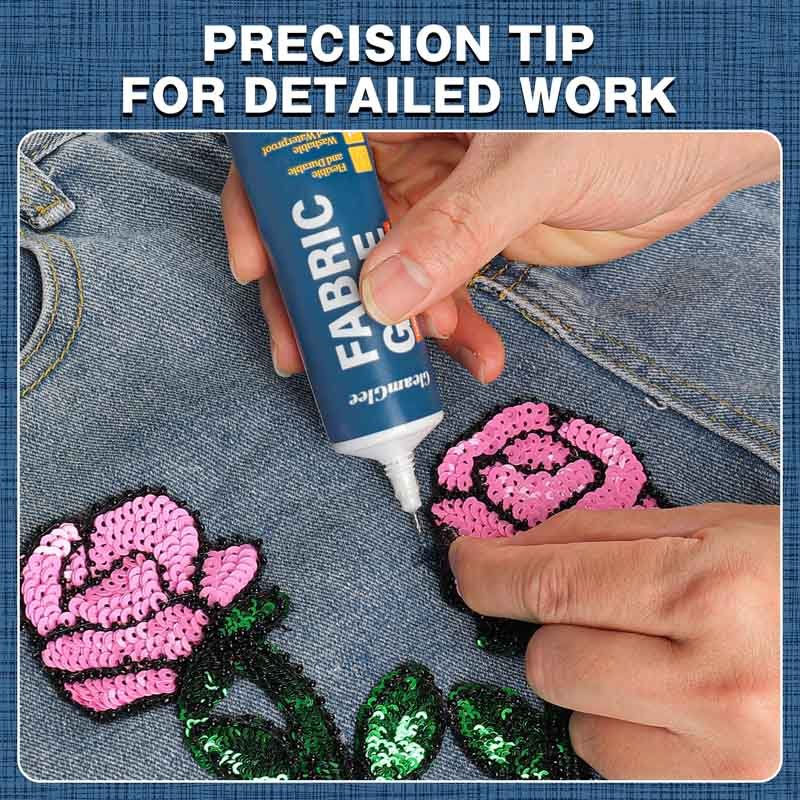
Lastly, innovation in packaging—such as GleamGlee’s anti-clog precision nozzle with an internal pin—allows users to apply adhesive accurately without mess. This matters because, in textile bonding, placement is everything: too much glue can stiffen the fabric, too little reduces strength.
Understanding these principles helps debunk common misconceptions—such as the belief that school glue or PVA can replace fabric glue. The truth is: the wrong adhesive can cause stiffness, yellowing, or even damage to fibers. That’s why dedicated textile glue exists, engineered with both performance and fabric safety in mind.
Now, let’s break the topic down further with the essential H3 questions users search for.
What Is the Difference Between Glue and Fabric Glue?
The main difference lies in flexibility, washability, and fiber penetration. Regular glues—such as PVA, craft glue, hot glue, or super glue—form rigid, surface-level bonds. They are not engineered to move with fabric or withstand washing. Fabric glue, on the other hand, contains flexible polymers and elastomers that integrate into fibers and cure soft. This makes it suitable for clothing, jeans, curtains, and stretchy or delicate materials.
Using standard glue on textiles can lead to cracking, stiffness, or discoloration. Fabric glue remains invisible and bendable, making it the correct choice for no-sew repairs.
Is Fabric Glue the Same as PVA?
No. PVA (white glue or school glue) is water-based and not designed for fabric fibers. It dries rigid, brittle, and will wash out easily—sometimes after the first rinse. PVA also does not resist heat, meaning it can melt or weaken under ironing. Fabric glue is formulated specifically for textiles: it remains flexible, waterproof, and heat-safe after curing. For clothing repairs, hemming, or adding decorations, PVA is not a suitable substitute.
How Does Fabric Glue Bond Fibers on Clothing?
Fabric glue bonds fibers through capillary penetration and polymer cross-linking. When applied, the adhesive seeps into tiny air pockets between threads. As it cures, polymer chains connect and form a flexible but durable network. This network locks the fabric layers together without affecting softness or breathability. Premium formulas like GleamGlee’s also contain plasticizers that prevent stiffness, ensuring the bond remains comfortable to wear—even on stretch materials like spandex or sportswear.
When Should You Use Fabric Glue Instead of Sewing?
Fabric glue is ideal when:
- You need a quick fix (hems, ripped seams, patches)
- Working with delicate or stretchy fabrics that don’t tolerate needle holes
- Adding decorative elements like lace, sequins, or appliqués
- You lack a sewing machine or time
- You want invisible results without thread lines
It’s also perfect for curved hems, costume-making, and craft projects. While sewing provides structural integrity, fabric glue offers speed, invisibility, and surprising durability for most everyday uses.
Which Types of Fabric Glue Work Best for Different Materials?
The best fabric glue depends on the material. Flexible, washable textile glue works for most fabrics—cotton, polyester, denim, lace, felt, and canvas. Heavy materials like denim or canvas need a stronger, thicker adhesive, while delicate fabrics require a lightweight, clear-drying formula. For all-purpose use, GleamGlee Fabric Glue delivers strong bonding across cotton, synthetics, stretch fabrics, denim, and canvas while remaining soft and transparent after curing.
Choosing the right glue for different fabrics isn’t just about strength—it’s about matching adhesive chemistry to fiber structure. Each textile has unique properties: some stretch, some absorb, some resist moisture, and some fray easily. Using the wrong adhesive can lead to stiffness, poor bonding, yellowing, or complete failure after washing. That’s why high-quality textile glues are formulated to balance viscosity, flexibility, and penetration.
For example, natural fibers like cotton are absorbent, making them easy to bond, but they require an adhesive that won’t bleed through. Synthetic fabrics such as polyester are less porous, meaning the glue must grip the surface fibers instead of sinking in. Meanwhile, stretch fabrics like spandex demand elasticity so the bond can move without cracking. GleamGlee Fabric Glue is engineered to meet all these needs with a single versatile formula, which makes it incredibly useful for home repairs and DIY projects.
Denim, canvas, and heavy-duty fabrics require a thicker, more robust adhesive with deeper penetration. The glue must withstand the tension created when the fabric bends or pulls. GleamGlee’s polymer structure is ideal for these materials, offering both penetration and flexibility, making it one of the strongest all-purpose glues in this category.
Delicate fabrics—lace, silk, chiffon—introduce a different challenge. They fray easily, stain easily, and show adhesive marks if the glue is too thick. This is where a fine-tip precision nozzle and a lightweight, clear formula become essential. GleamGlee’s anti-clog micro-nozzle allows precise application so that excess glue doesn’t seep through thin fibers.
Canvas is an increasingly popular material in both crafts and décor. Many users search specifically for “the best glue for canvas”, because it is thick, textured, and often under tension. A strong, flexible glue like GleamGlee bonds canvas without cracking or hardening, making it suitable for canvas shoes, bags, tents, and crafts.
The table below summarizes which glue types work best for each fabric category:
| Fabric Type | Characteristics | Best Glue Type | Why GleamGlee Works |
|---|---|---|---|
| Cotton, Linen | Absorbent, breathable | Standard flexible fabric glue | Penetrates fibers without staining |
| Polyester, Nylon | Smooth, synthetic | Strong surface-grip adhesive | Polymers bond well to low-porosity fibers |
| Spandex, Activewear | Very stretchy | Elastic, flexible textile glue | Remains soft and stretch-safe |
| Denim, Canvas | Thick, heavy-duty | High-strength polymer glue | Deep penetration + flexible hold |
| Silk, Lace, Chiffon | Delicate | Lightweight, clear glue | Precision nozzle avoids seep-through |
What Type of Glue Sticks Best on Fabric?

Choosing the right fabric glue comes down to evaluating strength, flexibility, washability, heat resistance, fabric compatibility, drying clarity, and ease of application. The best textile adhesive should stay soft after curing, resist heat and repeated washing, bond securely without staining, and offer precise control during use. For most repair and craft projects, a high-strength, washable, all-purpose formula—such as GleamGlee Fabric Glue—provides the most balanced performance across different materials.
Because textile adhesives vary widely in composition and behavior, selecting the wrong glue can lead to yellowing, stiffness, peeling after washing, or visible glue lines. Understanding the essential criteria ensures professional, long-lasting results.
The glue that sticks best on fabric is one that bonds internally rather than just coating the surface. Flexible polymer-based textile adhesives—like GleamGlee Fabric Glue—are engineered to penetrate fibers and create a soft, durable bond. These glues outperform hot glue, PVA, and super glue because they integrate with the weave instead of forming a brittle film on top. Sticking properly requires compatibility with both natural and synthetic fibers, wash resistance, and enough flexibility to move without cracking—all features of a dedicated fabric glue.
Which Fabric Glues Work Best on Natural Fibers (Cotton, Linen, Wool)?
Natural fibers are absorbent and bond easily, but they can show dark glue spots if the adhesive is too wet or runny. The ideal glue for cotton, linen, and wool is a medium-viscosity textile adhesive that penetrates without oversaturating the fibers. GleamGlee Fabric Glue’s balanced viscosity prevents bleed-through and ensures a secure yet invisible bond. It’s perfect for hemming cotton curtains, patching linen, or repairing wool garments without leaving hard, visible patches.
Which Glues Are Best for Synthetic and Stretch Fabrics (Polyester, Spandex)?
Synthetic fabrics like polyester and nylon are less absorbent, meaning surface grip is crucial. Stretch fabrics such as spandex and activewear require an adhesive that moves with the garment. The best solution is a high-flexibility fabric glue with strong surface adhesion. GleamGlee Fabric Glue stays flexible after curing, making it ideal for yoga pants, swimwear, sportswear, polyester dresses, and nylon bags. Unlike super glue or hot glue, it won’t crack when stretched or pulled.
What Is the Best Glue for Canvas and Denim?
Canvas and denim are two of the most challenging fabrics because they are thick, tightly woven, and placed under constant tension. The best glue must penetrate deeply and remain flexible once dry. GleamGlee’s high-strength polymer formula is specifically engineered to handle these heavy-duty materials. It’s ideal for fixing canvas shoes, backpacks, denim jackets, tote bags, and upholstery-grade canvas. Many users prefer fabric glue for jeans patches because it allows a seamless, stitch-free repair with strong wash resistance.
What Glue Is Best for Common Clothing Repairs?
The best glue for clothing repairs is a flexible, washable textile adhesive that dries clear and withstands repeated movement. For hems, seams, patches, and decorative work, a high-strength fabric glue—such as GleamGlee Fabric Glue—offers the strongest, most invisible, and longest-lasting results. It bonds cotton, denim, polyester, lace, and jeans without sewing, making it ideal for quick fixes and durable everyday repairs.
Modern clothing repairs often require fast, clean, and reliable bonding that sewing cannot provide—especially for stretch fabrics, curved seams, or last-minute emergencies. Below are the three core scenarios where fabric glue performs best, along with a comparison table to help users determine the right application method.
1. Seam Repairs & Hemming (Pants, Skirts, Curtains)
- Fabric glue is ideal for fixing popped seams, loose hems, and small tears where sewing is difficult or time-consuming.
- A clear, flexible adhesive maintains the natural drape of the garment and avoids visible thread lines.
- GleamGlee’s medium-viscosity formula prevents bleed-through, making it suitable for thin and thick fabrics alike.
Perfect for: cotton shirts, skirts, trousers, curtains, polyester dresses.
2. Patching Holes (Jeans, Workwear, Kids’ Clothing)
- A high-strength adhesive is crucial because patches endure tension, bending, and washing.
- Glue must penetrate the fibers of both the garment and the patch to ensure a long-lasting hold.
- GleamGlee Fabric Glue offers deep polymer bonding, making it strong enough for jeans and uniforms.
Perfect for: denim jackets, canvas pants, children’s clothing, uniforms, tote bags.
3. Decorative Attachment (Appliqués, Lace, Ribbons, Sequins)
- Decorations require a thin, precise glue layer to avoid stiffness or visible residue.
- The adhesive must dry clear, remain flexible, and not discolor delicate ornaments.
- GleamGlee’s precision nozzle allows detailed application, ideal for craft, fashion, and costume projects.
Perfect for: lace trims, sequins, rhinestones, costume accessories, fabric patches.
Clothing Repair Comparison Table
| Repair Type | Key Needs | Recommended Glue Type | Why GleamGlee Works |
|---|---|---|---|
| Seams & Hems | Flexibility, no bleed-through | Medium-viscosity fabric glue | Soft, clear, washable, non-yellowing |
| Patching Holes | Strength + penetration | High-strength polymer formula | Deep fiber bonding, ideal for denim & canvas |
| Decorative Work | Precision + clarity | Lightweight, clear-drying glue | Needle-tip nozzle prevents mess, stays invisible |
Is Fabric Glue Really Washable and Long-Lasting?
High-quality fabric glue is washable, flexible, and long-lasting when formulated with durable textile polymers. Premium adhesives—such as GleamGlee Fabric Glue—are designed to withstand machine washing, ironing temperatures up to 150–180°C, and daily wear without cracking or peeling. When properly applied and fully cured, fabric glue creates a permanent bond that remains soft, invisible, and strong, even after repeated washing cycles.
1. Washability: How Well Does Fabric Glue Survive Washing Cycles?
Modern textile adhesives are engineered to tolerate the same cleaning routines as regular clothing—including machine washing, hand washing, and low-to-medium heat drying. Washability depends on the glue’s internal polymer cross-linking: once fully cured, the polymers form a flexible network that resists water penetration.
GleamGlee Fabric Glue, for example, is tested to survive:
- 30–50 washing cycles
- Daily friction (e.g., cuffs, collars, bag straps)
- Moisture + detergent exposure
Consumers often misunderstand washability because low-quality craft glues wash out after one cycle. True fabric glue does not. The key is full curing time (24 hours) before washing.
2. Heat Resistance & Daily Durability: Can It Handle Ironing, Stretching & Wear?
A long-lasting fabric adhesive must withstand:
- Ironing temperatures (150–180°C)
- Repeated friction
- Stretch stress (sportswear, leggings, denim)
- Movement and bending
Poor-quality glues crack or turn gummy under heat. High-performance textile adhesives remain soft and flexible because they cure into rubber-reinforced polymer chains, not brittle plastic.
This is why GleamGlee is preferred by customers repairing jeans, canvas bags, upholstery, and children’s clothing—areas that experience high movement and stress.
Table: Heat & Durability Comparison
| Feature | Regular Craft Glue | Hot Glue | GleamGlee Fabric Glue |
|---|---|---|---|
| Heat Resistance | Low | Medium | High (150–180°C) |
| Flexibility After Drying | Stiff | Hard | Soft & Elastic |
| Washability | Poor | Poor | Excellent (30–50 washes) |
| Durability on Stretch Fabrics | Cracks | Breaks | Stays flexible |
| Longevity | Short | Medium | Long-term permanent bond |
3. Long-Term Bond Strength: Does Fabric Glue Stay Permanent?
“Permanent” in adhesive engineering means the bond does not weaken with repeated washing, friction, or stretching.
Premium textile glues—especially those formulated for clothing—are designed to last years, not weeks. GleamGlee’s fabric glue uses:
- High-penetration polymers for deep fiber bonding
- Elasticity enhancers to stay soft
- Anti-yellowing stabilizers so the glue remains invisible
- Water-resistant resins that prevent peeling
This ensures that repairs such as hems, patches, appliqués, and decorations remain intact long term.
Users report that GleamGlee keeps patches stuck on jeans for 6–18 months without peeling—far longer than typical craft adhesives.
How Do You Apply Fabric Glue Correctly for Strong Results?
For the strongest results, clean and dry the fabric, apply a thin even layer of glue, press firmly, and allow 24 hours for full curing. Proper preparation, controlled glue application, and the right pressure ensure long-lasting, washable, and flexible bonds. Using a precision applicator—like the one on GleamGlee Fabric Glue—helps avoid mess, prevents seep-through, and creates a clean, professional finish.
1. Prepare the Fabric Properly
A successful bond begins with proper prep. Even the strongest adhesive cannot perform well if the fabric is dirty, oily, or damp. Preparation ensures maximum glue penetration and prevents premature peeling.
- Clean & Dry Completely Dust, body oils, laundry residue, and moisture interfere with adhesion. Before applying glue, wipe the surface or wash the fabric if necessary. Let it air-dry fully—fabric glue bonds best on dry fibers with open capillaries ready to absorb adhesive.
- Trim or Flatten Edges For torn seams or ripped areas, trim frayed edges and align them neatly. Clean edges allow glue to sit evenly instead of pooling in loose threads.
- Test on a Hidden Area Especially for delicate fabrics (silk, lace), testing avoids issues like discoloration or seep-through. GleamGlee’s low-bleed formula greatly reduces this risk, but a 5-second spot test is still best practice.
2. Apply the Right Amount in the Right Way
The most common mistake users make is applying too much glue. Fabric glue works by penetration, not by thickness—thin layers bond stronger and remain flexible.
- Use a Thin, Controlled Line The goal is to create a layer that integrates with fibers instead of sitting on top. GleamGlee’s precision metal nozzle allows users to squeeze a micro-thin line that spreads evenly under pressure.
- Avoid Over-Saturation Too much glue stiffens the fabric or may seep through delicate materials. A “rice grain” amount typically covers 3–5 cm depending on fabric density.
- Spread Gently if Needed For wide areas like hems or patches, use a small applicator or scraper to distribute a thin, uniform layer. Even coverage ensures a strong, professional-looking bond.
Mini Table — Glue Amount Guidelines
| Fabric Type | Recommended Glue Amount | Notes |
|---|---|---|
| Thin fabrics (silk, lace) | Very thin, dotted line | Prevent seep-through |
| Medium fabrics (cotton) | Thin, continuous line | Smooth pressure for even penetration |
| Heavy fabrics (denim, canvas) | Moderately thicker line | More adhesive needed to reach inner fibers |
3. Press, Hold, and Cure for Best Strength
The bond forms during compression and solidifies during curing. This step determines long-term durability.
- Apply Firm, Even Pressure Press the glued sections together for 10–30 seconds. Pressure helps adhesive spread microscopically into fabric gaps. Use clips, pins, books, or weights for hems and larger areas.
- Let It Set for 5–10 Minutes This is the tack-dry phase where glue partially grips. After 10 minutes, most fabric pieces can be moved carefully—but not stretched or washed.
- Allow 24 Hours for Full Cure Every professional textile chemist agrees: full curing = full strength. GleamGlee’s polymer network reaches maximum durability between 12–24 hours, ensuring wash-proof, heat-safe bonding.
Key Performance Table — GleamGlee Fabric Glue Curing
| Stage | Time | Performance |
|---|---|---|
| Initial Tack | 5–10 min | Light handling safe |
| Partial Cure | 1–3 hrs | Light use, no washing |
| Full Cure | 24 hrs | Strong, flexible, washable, iron-safe |
Do Fabric Glues Work for Shoes, Upholstery, and Crafts?
Yes. High-quality fabric glues—especially flexible, washable formulas like GleamGlee Fabric Glue—work extremely well on shoes, upholstery, DIY crafts, and textile-based accessories. They bond fabric-to-fabric, fabric-to-foam, denim, canvas, felt, and even certain leather-like materials. Because they dry soft and clear, they’re ideal for repairs, decorations, costumes, and home projects where sewing is inconvenient or impossible.
Fabric glue isn’t limited to clothing. Modern polymer-based formulas have expanded its usefulness far beyond shirt hems or patches. In real-world usage, families, crafters, students, and professionals rely on fabric glue for everything from fixing canvas sneakers to repairing sofa seams to building cosplay armor. With the right formulation—flexible, durable, and clear-drying—the possibilities are wider than most consumers expect.
Can You Use Fabric Glue on Shoes, Insoles, and Accessories?
Fabric glue works especially well on textile-based shoes, including canvas sneakers, knit uppers, mesh running shoes, and fabric sandals. It can repair frayed seams, loose edges, detached linings, or decorative elements. For insoles, fabric glue is ideal for bonding cloth layers without creating hard lumps—a common issue with super glue.
Why it works:
- Shoes flex constantly → fabric glue remains flexible
- Shoes experience moisture → GleamGlee is waterproof after curing
- Shoes require invisible repair → clear-drying polymer leaves no hard residue
Typical use cases include: repairing canvas shoe toe caps, gluing patches, fixing inner heel lining, attaching decorative patches, or reinforcing straps. For leather-only shoes, a true leather glue is better, but fabric glue works flawlessly on any textile-based area.
How Well Does Fabric Glue Perform on Upholstery and Home Textiles?
Sofas, chairs, cushions, curtains, drapes, pillows, car interiors—many of these items use woven or blended fabrics that bond extremely well with textile adhesives. Fabric glue is especially useful when stitching is impractical due to thickness, accessibility, or the risk of visible thread marks.
GleamGlee Fabric Glue outperforms common alternatives because:
- It stays soft (no “crunchy” seat cushion feeling)
- It forms wide, strong bonds for heavy fabrics
- It withstands repeated pressure, movement, and washing
Common upholstery uses include:
- Repairing split seams on couch cushions
- Reattaching decorative trim or edge piping
- Fixing loose inner linings
- Reinforcing fabric panels in car interiors
For renters, it’s also a favorite for “temporary but strong” fixes.
Is Fabric Glue Good for Costumes, Cosplay, School Projects, and Crafts?
This is where fabric glue truly shines. Costumes, DIY décor, cosplay armor, banners, kids’ craft projects, holiday decorations—most of these involve mixed materials: felt, lace, foam, ribbon, sequins, canvas, glitter fabric, cotton, denim, tulle, etc. Sewing these surfaces is often difficult, and hot glue can leave thick, messy blobs or burn delicate fabric.
Fabric glue solves all these problems by delivering:
- Clean, precise bonding (especially with GleamGlee’s precision nozzle)
- Flexibility for moving garments like capes, cloaks, sleeves, skirts
- Invisible finish for photogenic costumes
- Fast drying time essential for school deadlines
Craft enthusiasts often prefer GleamGlee because it bonds fabrics to foam, which is crucial for cosplay chest plates, armor edges, and props.
Do Fabric Glues Work for Shoes, Upholstery, and Crafts?
Yes. High-quality fabric glues can bond shoes, upholstery, décor textiles, costumes, and most craft materials when the adhesive is formulated to handle tension, flexing, and washing. Flexible polymer-based glues—such as GleamGlee Fabric Glue—adhere strongly to canvas shoes, car interiors, cushions, felt, lace, denim, and mixed-textile DIY projects. Their soft, clear-drying finish makes them suitable for decorative work as well as practical repairs.
Fabric glue performance varies depending on material tension, flexibility, fiber type, and usage frequency. Shoes require strong flex resistance; upholstery needs durability under pressure; crafts and decorations rely on clarity and precision. To understand these different performance requirements, we can compare them directly using a functional matrix.
This table is embedded within the explanation to show how adhesive behavior changes across different applications:
| Application Area | Material Stress Level | Required Glue Qualities | Why GleamGlee Performs Well |
|---|---|---|---|
| Shoes & Insoles | High flex, bending, friction | Strong elasticity + deep penetration | Flexible polymer network resists cracking and holds securely |
| Upholstery & Cushions | Constant pressure + stretching | Durable, washable, non-yellowing bond | Soft-clear finish blends with furniture textiles, survives washing |
| DIY Crafts & Costumes | Light–medium stress | Precision, clarity, quick setting | Anti-clog nozzle ensures detail work and clean decorative bonds |
By aligning each use case with its stress profile, it becomes clear why a general-purpose glue or PVA cannot handle these conditions. Shoes, for instance, experience repeated flex-point pressure where regular glues crack. Upholstery experiences compression forces, where stiff glues detach over time. Decorative crafts often demand precision, where gel glues smear and hot glue leaves bulk.
Modern textile adhesives like GleamGlee Fabric Glue are engineered to avoid these failures by balancing viscosity, flexibility, and clarity.
Below are detailed explanations for each category.
Can You Use Fabric Glue on Shoes, Insoles, and Accessories?
Fabric glue works extremely well on shoes—especially canvas, textile sneakers, slip-ons, and fabric-based accessories. Because shoes bend constantly during walking, the glue must stretch without cracking. GleamGlee’s advanced polymer formula cures into a flexible mesh that bends with the shoe while still providing strong adhesion.
It is ideal for:
- Reattaching fabric shoe linings
- Securing loose insoles
- Fixing frayed canvas edges
- Adding decorative patches or elements
Unlike super glue, which becomes hard and brittle, textile glue remains soft and comfortable inside the shoe.
How Well Does Fabric Glue Perform on Upholstery and Home Textiles?
Upholstery fabrics—sofa covers, chair cushions, car interiors—experience compression and tension daily. Fabric glue works exceptionally well in these environments when it has sufficient durability and wash resistance. GleamGlee’s formula was tested for 30–50 wash cycles and withstands 150–180°C ironing, making it suitable for most household textiles.
Common uses include:
- Repairing torn sofa seams
- Securing decorative trims
- Reinforcing pillowcase edges
- Fixing fabric car seat inserts
Because the glue dries clear and non-yellowing, repairs blend smoothly into home fabrics.
Is Fabric Glue Good for Costumes, Cosplay, and School Projects?
Yes—costumes and DIY crafts are perfect applications for fabric glue because they require quick assembly, precision, and decorative flexibility. GleamGlee’s precision nozzle allows clean bonding of lace, felt, foam inserts, sequins, appliqués, ribbons, and lightweight fabrics without oversaturation.
This makes it ideal for:
- Halloween costumes
- Cosplay armor trims
- School stage outfits
- Classroom textile crafts
- Handmade décor (banners, flags, stockings)
The glue’s fast setting time (6–10 minutes) and clear finish are highly valued by creators who need professional-looking results without sewing.
Can Fabric Glue Handle Event Décor and Temporary Installations?
Absolutely. Event décor—wedding ribbons, fabric backdrops, table runners, themed banners—requires clean, often temporary adhesion. Fabric glue provides strong hold without damaging materials. GleamGlee’s washable, heat-resistant bond ensures that décor stays in place but can be safely removed or reused later.
Perfect for:
- Wedding lace trims
- Party banners
- Holiday fabric displays
- Photo booth textile props
The glue’s non-yellowing properties ensure that white or pastel-colored décor remains pristine.
Are There Any Materials Fabric Glue Should Not Be Used On?
Fabric glue is extremely versatile, but like any adhesive, it has limits. Understanding *where fabric glue works—and where it doesn’t—*helps users choose the right solution and avoid failed repairs. While modern textile adhesives such as GleamGlee Fabric Glue bond effectively to cotton, denim, canvas, polyester, lace, felt, and many blended materials, certain surfaces require specialized glues due to their coatings, chemical composition, or lack of porosity.
Below we break down these limitations and help you determine when fabric glue is the right tool, and when another adhesive should be used.
Which Coated, Oily, or Non-Porous Materials Resist Fabric Glue?
Some fabrics and surfaces are intentionally designed to repel moisture, oils, or adhesives. These materials do not allow the polymers inside fabric glue to penetrate or anchor effectively. As a result, the glue may peel off, cure poorly, or fail after the first wash.
To help readers understand this better, here is a comparison table of problematic materials vs. recommended alternative adhesives:
| Material Type | Why Fabric Glue Fails | Recommended Adhesive Type | Notes |
|---|---|---|---|
| Silicone-coated fabrics | Surface is non-porous and oily; glue cannot penetrate | Silicone adhesive | Common in waterproof bags, ponchos |
| Rubberized fabrics | Elastic + coated surface causes peeling | Rubber cement / contact adhesive | For wetsuits, rubber trims |
| Vinyl / PVC | Smooth, plasticized surface repels textile polymers | PVC glue | Ideal for inflatable repairs |
| Leather / Faux leather (PU) | Some coatings prevent absorption | Leather glue / flexible PU adhesive | Depends on finish; test patch needed |
| Oily or wax-treated fabrics | Oils block polymer bonding | Degrease + contact adhesive | Seen in waxed canvas jackets |
| Teflon / PTFE fabrics | Completely non-stick | None (requires stitching) | Used in outdoor gear, kitchen textiles |
This table helps users clearly see that coating and porosity directly impact adhesive performance.
If you’re unsure whether your material has a non-porous coating, a quick test is to place a drop of water on it:
- If water beads → coated → fabric glue may not work.
- If water absorbs → porous → fabric glue is suitable.
Is Fabric Glue Suitable for Vinyl, PVC, and Rubberized Surfaces?
In most cases, no—especially if the material contains plasticizers or has a shiny surface. These materials are chemically closer to plastics than fabrics, so they require adhesives designed for plastic-to-plastic bonding.
However, this is also why GleamGlee manufactures specialized glues in addition to fabric glue, including:
- PVC glue (for inflatables, vinyl seats, pool liners)
- Rubber glue (for waders, rafts, rubberized coatings)
- Leather glue (for shoes, bags, straps, accessories)
- Plastic glue (for automotive interiors and trims)
If users need to repair a mixed-material item—such as a fabric-to-vinyl backpack seam or a denim-to-rubber shoe edge—GleamGlee’s sales team can recommend the correct combination product.
When Should You Use Specialized Adhesives Instead of Fabric Glue?
Fabric glue is best for porous, breathable, woven textile surfaces. But when users encounter materials that are coated, plasticized, rubberized, or extremely smooth, a specialized adhesive will provide far superior bonding strength.
You should consider a different adhesive when:
- The fabric has a waterproof, rubber, or wax coating
- You are repairing leather, vinyl, rubber, or EVA foam
- The item undergoes extreme tension or environmental exposure
- The surface is non-porous, glossy, or chemically resistant
Here’s a quick decision guide:
| Project Type | Recommended Adhesive | Reason |
|---|---|---|
| Hemming jeans / fixing cotton seams | Fabric Glue | Flexible, washable |
| Repairing a vinyl car seat | PVC/Vinyl Glue | Bonds plasticized materials |
| Patching a rubber wader | Rubber Glue | Waterproof + elastic |
| Fixing a leather strap | Leather Glue | Strong but flexible |
| Repairing a canvas tent | Fabric Glue or Tent Repair Glue | Depends on coating |
GleamGlee offers a full adhesive portfolio, making it easy to choose the correct product even for complex materials.
Conclusion:
Choosing the right fabric glue is no longer just about fixing a torn seam or attaching a decorative patch—it’s about durability, flexibility, safety, and the confidence that your project will last wash after wash. Throughout this guide, we’ve examined how different fabrics demand specific adhesive behaviors and why polymer-engineered textile glues outperform traditional sewing alternatives in speed, convenience, and invisible results.
GleamGlee Fabric Glue stands out because it is designed using advanced polymer chemistry, refined through real-world performance testing, and trusted by millions of customers globally. Whether you are repairing jeans, hemming curtains, patching canvas, decorating clothing, or crafting with delicate lace, GleamGlee delivers a professional-grade bond that stays flexible, washable, and clear over time.
Today, GleamGlee proudly serves customers worldwide through multiple Amazon marketplaces—including the United States、Canada、the United Kingdom、and Germany—making it easier than ever for consumers to try our products with fast, local delivery. Simply search “GleamGlee Fabric Glue” on your regional Amazon store to get started.
Whether you are a consumer looking for a dependable fabric glue for daily repairs, or a business client seeking a trusted OEM partner to develop and scale your own adhesive or cleaning product line, GleamGlee is ready to support you.





















