 Skip to content
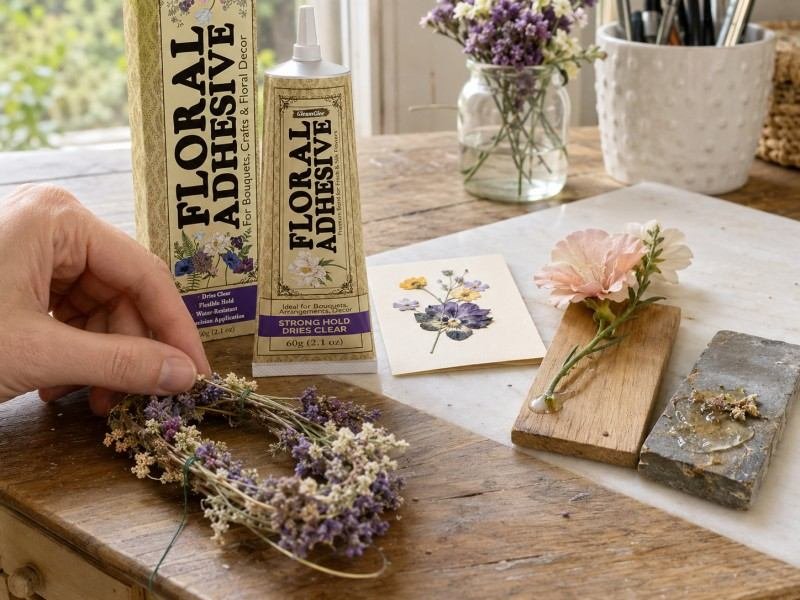
A floral project often begins with an appealingly simple idea: preserve flowers from a special occasion, refresh a seasonal wreath, decorate a glass jar, or turn pressed leaves into framed botanical art. The difficulty usually appears after the glue is opened. A formula may soak through thin petals, dry with a glossy halo, slide down a vertical frame, release from smooth plastic, or fill a room with an unpleasant smell. Reliable results depend less on choosing the strongest bottle and more on matching the adhesive to the flower, supporting material, display environment, and expected project life.
Eco-friendly floral glue is an adhesive chosen for both dependable bonding and clearly defined environmental or handling advantages. A suitable formula may use a water-based carrier, reduce certain solvents, provide controlled dispensing, limit unnecessary packaging, or support longer-lasting repairs. It must still match the flower material, dry cleanly, resist the expected moisture, and carry specific claims supported by appropriate documentation or testing.
Imagine preserving flowers from a wedding bouquet, only to discover that the petals have darkened and lifted from the backing several days later. That disappointing result rarely comes from one obvious mistake. Application thickness, flower moisture, backing paper, adhesive chemistry, curing time, and room humidity can all affect the outcome. Understanding those details turns a fragile craft experiment into a clean, lasting home project.
What Makes Floral Glue Eco-Friendly?
Eco-friendly floral glue should combine suitable bonding performance with clearly explained improvements such as a water-based carrier, reduced solvent content, controlled application, lower packaging waste, or verified ingredient screening. A credible product identifies exactly what has been improved, avoids vague environmental promises, and explains any limits related to surfaces, disposal, moisture resistance, or long-term use.
Clear Claims Matter
“Eco-friendly” is not a single technical category. It may describe the adhesive carrier, one ingredient source, packaging composition, production method, dispensing efficiency, or expected service life. These factors need to be considered separately because an improvement in one area does not automatically make the complete product environmentally preferable in every situation.
A water-based floral adhesive uses water as a major carrier for its bonding ingredients. Such formulas are often easier to spread and may allow fresh spills to be cleaned with water before curing. However, water-based does not mean the bottle contains only water, and it does not automatically establish that the product is biodegradable, harmless if swallowed, suitable for children, or safe on every flower variety.
The same caution applies to terms such as natural, non-toxic, low odor, solvent-free, plant-based, recyclable, biodegradable, and compostable. Each term addresses a different characteristic. A plant-derived ingredient may form only a small part of the finished formula, while recyclable packaging may not be collected by every local recycling system. Low odor only describes how strongly the product can be smelled during use; it does not provide a full measurement of emissions.
Specific language is more useful than broad green wording. “Water-based formula with a controlled precision nozzle” gives a reader meaningful information. “Bottle made with 30% post-consumer recycled plastic” is clearer than “earth-friendly packaging.” Specific claims allow home users, retailers, and private-label brands to compare products without guessing what a green leaf or environmental slogan is supposed to mean.
| Common claim | What it may indicate | What it does not automatically prove | Useful supporting information |
|---|---|---|---|
| Water-based | Water is a primary carrier | Non-toxic, biodegradable, or universally safe | Formula description and safety documentation |
| Low odor | Less noticeable smell during normal application | Zero VOC or absence of hazardous ingredients | Emissions or VOC test information |
| Solvent-free | Certain solvents are not intentionally included | Harmlessness or suitability for every surface | Ingredient declaration and SDS review |
| Plant-based | One or more ingredients use renewable feedstocks | Full biodegradability or lower total environmental impact | Ingredient percentage and sourcing details |
| Recyclable packaging | The container may enter suitable recycling streams | Collection or recycling in every location | Material code and regional disposal guidance |
| Biodegradable | Material may break down under defined conditions | Rapid breakdown in home compost, soil, or waterways | Test method, timeframe, and test conditions |
Formula and Packaging Work Together
Environmental performance also depends on how accurately the glue can be applied. A formula with desirable ingredients can still create unnecessary waste when the bottle releases large blobs, the nozzle clogs, or the user cannot reach a narrow stem joint without coating nearby petals.
Pressed-flower work generally needs a very thin layer. A fine metal tip, small brush, or controlled dropper can help place adhesive beneath delicate leaves without soaking the entire specimen. Dried flowers often need several small dots around uneven stems. Artificial flower heads may require a longer nozzle that can reach a hidden plastic base without spreading glue across the visible fabric.
The package size should match the expected consumption. A small bottle may create less waste for an occasional home crafter because less adhesive remains unused after opening. A florist, craft studio, school, or kit manufacturer may use larger refill formats more efficiently because the packaging weight per gram of adhesive is lower. Neither size is automatically more sustainable; usage frequency and shelf life decide which format makes practical sense.
Bottle compatibility also affects waste. Some formulas can dry inside a narrow nozzle, soften seals, or become thicker after repeated exposure to air. A reliable package should dispense consistently during its intended shelf life. Users should not need to cut the opening wider, squeeze with excessive force, or throw away a half-full bottle because the closure system failed.
Durability Reduces Waste
A weak bond is not environmentally preferable when the same project must be rebuilt several times. Repeated failures consume additional flowers, backing materials, ribbon, packaging, electricity, and working time. Durability is therefore part of environmental performance, especially when a project is intended to last through several seasons.
The required service life varies considerably. A fresh-flower corsage may only need to remain secure throughout an afternoon event. A dried wreath may be stored and displayed over several years. A pressed botanical frame may remain on a wall for decades. Each project needs a different balance of strength, flexibility, moisture resistance, appearance, and repairability.
An unnecessarily permanent bond can also create waste. Temporary event décor may be easier to reuse when flowers are held with wire, clips, removable inserts, or modular frames. Adhesive can then secure only the small decorative details rather than coating every component.
The most sensible choice is a bonding system that lasts for the intended period without making future repair or separation impossible. That approach is usually more useful than choosing a formula simply because it is described as extremely strong.
End-of-Life Planning
A floral project may contain natural flowers, synthetic petals, metal wire, plastic tape, foam, paint, and cured adhesive. Once these materials are combined, the finished piece may no longer be suitable for ordinary composting or single-stream recycling.
Designing with separation in mind makes disposal easier. Dried stems attached with removable wire can be separated from a reusable metal wreath frame. Artificial flowers mounted on clips can be replaced when their color fades. A glass jar decorated with removable flower clusters may return to normal household use after the display is dismantled.
Home composting claims require particular care because industrial composting facilities operate under different temperature, moisture, and processing conditions. A material that can break down in a controlled commercial facility may remain unchanged in a backyard compost pile.
A more practical environmental question is often, “Can the project be repaired, separated, or reused?” Clear answers to that question may provide more real value than a broad promise printed on the bottle.
Which Glue Fits Each Floral Material?
Fresh, dried, pressed, and artificial flowers require different adhesive properties. Fresh flowers need gentle bonding that accounts for moisture and delicate tissue. Dried stems need controlled gap filling, while pressed flowers need an extremely thin, low-staining film. Artificial flowers may require adhesion to fabric, plastic, foam, wire, wood, glass, or painted surfaces within the same arrangement.
Fresh Flowers
Fresh flowers are especially challenging because they contain water, natural oils, pigments, and delicate living tissue. A petal may become translucent, darken, wrinkle, or bruise when exposed to too much adhesive, heat, pressure, or an incompatible ingredient.
A formula used on fresh flowers should be specifically intended for botanical applications. Helpful properties include controlled viscosity, reasonably fast initial grab, a flexible cured film, and resistance to the moisture found naturally around stems and petals. The adhesive should be applied sparingly to a stronger concealed area, such as the calyx, the base of a petal, or a stem junction.
Different flower varieties can behave very differently. A thick rose petal does not respond like a hydrangea, orchid, carnation, or fine wildflower. Waxy surfaces may resist wetting, while fuzzy leaves can require a slightly thicker deposit to create enough contact. Highly pigmented petals can also make a clear adhesive line appear more noticeable.
Testing should use the actual flower variety intended for the project. Prepare one glued sample and one untreated flower, then store both under the same light, temperature, and humidity. Inspect them after the initial set and again several hours later. This comparison helps distinguish adhesive-related changes from natural wilting, dehydration, or bruising caused during handling.
Dried Flowers
Dried flowers are lightweight, but their surfaces are often fragile and irregular. Stems may be hollow, dusty, cracked, or covered with loose fibers. Applying adhesive directly over dust or crumbling plant material creates a bond to the loose debris rather than to the stable stem beneath it.
A soft artist’s brush can remove loose dust more safely than vigorous wiping. Unstable stem ends should be trimmed before bonding. When the contact surface is uneven, a medium-viscosity adhesive can fill small gaps without running down the flower or soaking into nearby decorations.
Flexibility matters because dried stems can move slightly when a wreath is handled, hung on a door, or stored between seasons. A very rigid glue line may hold strongly at first but crack when the base flexes. Several smaller bonding points often perform better than one thick deposit.
Dried flowers are commonly attached to wooden frames, cardboard letters, wire rings, twine, fabric, and glass containers. Every support material changes the bonding requirement. The formula that performs well on unfinished wood may not adhere equally well to varnished wood or a glazed ceramic vase.
Pressed Flowers
Pressed flowers weigh very little, but their thin structure makes every application mistake visible. Too much water can curl paper, darken petals, or create a glossy halo around the specimen. A heavy bead may also remain visible through pale or translucent flower material.
The adhesive should normally be applied as a thin film to the supporting paper rather than poured directly onto the flower. A fine brush or precision tip gives better control. Tweezers help lower the specimen into position without dragging or tearing fragile petals.
Backing material has a major influence on the final result. Lightweight office paper can wrinkle when exposed to a wet adhesive. Heavier art paper, quality card, or an appropriate mounting board generally provides better stability. When the project is intended for long-term display, the backing, mat, frame, light exposure, and room humidity matter almost as much as the glue.
Valuable botanical specimens, historic papers, and irreplaceable family keepsakes may require reversible conservation methods rather than permanent craft adhesive. Ordinary decorative glue is more suitable when permanent attachment and gradual color change are acceptable.
Artificial Flowers
Artificial flowers frequently combine polyester fabric, molded plastic, foam, painted wire, flocking, glitter, and surface coatings. A single flower head may therefore contain several bonding challenges that are not visible from a distance.
Material identification should come before product selection. Fabric petals bonded to cardboard need different properties from a smooth plastic stem attached to glass. Some low-surface-energy plastics resist general craft glues, while painted surfaces may separate because the coating releases from the underlying material.
Foam components need careful testing because certain solvents can soften or distort them. High-temperature hot glue can also melt thin plastic, flatten foam, or leave a bulky ridge under fabric petals. A foam-compatible liquid formula or lower-temperature system may provide a cleaner result.
Artificial arrangements are often stored in garages, attics, cupboards, or warehouses between seasons. Temperature cycling can make rigid bonds brittle and soften certain hot-melt joints. Testing should therefore include likely storage conditions as well as normal room-temperature display.
| Floral material | Main bonding risk | Useful adhesive properties | Typical projects |
|---|---|---|---|
| Fresh flowers | Browning, bruising, and moisture exposure | Petal compatibility, quick grab, flexibility, controlled flow | Corsages, crowns, table details |
| Dried flowers | Brittle stems, dust, and uneven contact | Medium viscosity, clear finish, moderate flexibility | Wreaths, garlands, shadow boxes |
| Pressed flowers | Staining, paper curl, and visible residue | Thin film, low staining, paper compatibility | Cards, bookmarks, framed art |
| Fabric flowers | Bleed-through, stiffness, and visible glue | Flexible film and controlled application | Textile décor and soft garlands |
| Plastic flowers | Weak wetting on smooth surfaces | Material-specific adhesion and gap filling | Vases, wall panels, outdoor décor |
| Foam pieces | Heat or solvent damage | Foam-safe chemistry and lower application temperature | Wreath forms and lightweight displays |
How Do You Choose the Right Formula?
Choose floral glue by defining the flower material, support surface, joint position, expected handling, moisture exposure, appearance, and required service life. Compare open time, initial tack, full cure, viscosity, flexibility, and substrate compatibility. The best formula is not necessarily the strongest one; it is the adhesive that performs reliably without damaging the project.
Define the Project Conditions
A useful adhesive search begins with a precise project description. “Glue for flowers” is too broad to support a reliable decision. “Clear adhesive for dried lavender stems attached to a painted wooden frame displayed indoors for one year” provides enough information to compare formulas sensibly.
Start by listing both surfaces in the joint. Include varnish, paint, glaze, coating, fabric treatment, or plastic type when known. The same piece of wood can behave differently when unfinished, painted, waxed, or sealed with polyurethane.
Orientation matters because gravity affects uncured adhesive. A pressed flower lying flat on a card experiences almost no downward stress. A vertical wall arrangement may slide before the formula reaches handling strength. A wearable floral crown experiences repeated bending, warmth, and movement.
Moisture and temperature should be considered before application. Fresh flowers introduce natural moisture. Bathroom decorations may face regular humidity. Front-door wreaths can encounter rain, condensation, direct sun, freezing nights, and hot storage conditions.
The planned lifespan should also be stated. Event décor may need to remain attractive for several hours. A seasonal wreath may need several months of dependable service. Framed pressed flowers may remain on display for years. A suitable formula should match that actual requirement rather than offering unnecessary strength at the cost of flexibility or repairability.
Compare Working Properties
Open time is the period during which the flower can still be repositioned. A short open time supports rapid repetitive production but may frustrate a beginner arranging fragile petals. A longer open time allows correction, although it may require clips, weights, or temporary supports.
Initial tack describes how well the uncured glue holds the materials together. It is particularly important on vertical displays and uneven dried stems. Final strength is measured after full curing and should never be confused with early grab. A joint that feels secure after ten minutes may still be vulnerable until the following day.
Viscosity controls how easily the formula flows. A thin adhesive can spread neatly beneath pressed flowers but may run down a vertical stem. A thick formula can bridge uneven gaps but may create visible lumps. The dispenser has to match that viscosity, otherwise a technically suitable formula may still be difficult to use cleanly.
Cure time depends on adhesive chemistry, deposit thickness, temperature, humidity, and surface porosity. Paper and unfinished wood may absorb part of the carrier and allow faster drying. Glass, plastic, glazed ceramic, and metal restrict evaporation, so thick deposits can remain soft longer.
| Project requirement | Property to verify | Practical planning consideration | Why it matters |
|---|---|---|---|
| Repetitive craft assembly | Initial grab | Holding time may range from seconds to several minutes | Reduces production delays |
| Delicate flower placement | Open time | Several minutes may be useful for correction | Prevents damaged petals |
| Pressed-flower artwork | Viscosity | A thin, brushable film is usually easier to conceal | Reduces wet halos and lumps |
| Vertical wreath building | Sag resistance | Components should remain stable during early set | Prevents downward movement |
| Wearable flowers | Flexibility | The cured film should bend without cracking | Handles repeated motion |
| Long-term display | Full cure and aging | Evaluation often begins after 24–72 hours and continues longer | Prevents premature handling |
| Humid placement | Moisture resistance | Test under the expected exposure rather than relying on vague wording | Reduces early release |
These timeframes are planning references rather than universal guarantees. The product label and technical instructions should always control the final process.
Match Strength to the Load
A heavier flower does not always create the most difficult bond. A pressed petal weighs almost nothing, but its thin, absorbent surface can be damaged by excessive adhesive. A large artificial flower may weigh more while offering a broad plastic base that creates a stronger contact area.
Joint design often matters as much as formula strength. A short stem touching a wreath at one tiny point concentrates stress. Running the stem along the frame, wrapping it with wire, or adding a small hidden backing piece spreads the load across a larger area.
Peel force is especially damaging. Adhesives generally resist an evenly distributed pull better than repeated lifting from one edge. Hanging garlands, wearable flowers, and door wreaths experience movement that can gradually peel the bond. Flexible formulas and mechanical support usually handle those conditions better than a hard, brittle adhesive.
Industrial-strength wording should not be the main selection criterion. An extremely rigid formula may crack on fabric petals, stain porous materials, or make a temporary project impossible to dismantle. Moderate strength with suitable flexibility can deliver a longer service life.
For product development, vague requests such as “very strong flower glue” should be replaced with target materials, application amount, handling time, cure time, temperature, humidity, and pass-or-fail conditions. Clear requirements allow a manufacturer to optimize the complete formula rather than maximizing one laboratory number.
Check Appearance and Aging
A formula that dries clear can still appear glossy, cloudy, or slightly yellow against a particular flower. Pale petals and transparent glass expose defects that remain invisible on a dark wreath base.
Application thickness changes the appearance. A thin film may become fully transparent while a thick deposit remains cloudy because moisture or solvent is trapped inside. Glue squeezed across a matte paper surface may also create a reflective patch even when the adhesive itself has no visible color.
Every important project deserves a realistic sample. Use the actual flower, support, application amount, orientation, and room conditions. Inspect the cured joint in daylight and under indoor lighting. Reflections often reveal residue that looked invisible while the piece remained on the worktable.
Long-term displays face ultraviolet light, heat, humidity, dust, and natural flower pigments. Keeping a sample near the planned display location for several weeks gives more useful information than judging the adhesive immediately after drying.
Commercial brands may use accelerated aging, color measurements, thermal cycling, or humidity testing to support long-term performance claims. Home crafters can use a simpler comparison sample, but both approaches follow the same principle: appearance after curing matters more than appearance immediately after application.

How Do You Apply Floral Glue Safely?
Prepare clean and dry materials, test the formula on a hidden sample, apply the smallest effective quantity, and support the joint until handling strength develops. Work with good ventilation, protect the table, avoid eye and skin contact, and follow the label. Water-based or low-odor products still require responsible storage, application, and cleanup.
Prepare Before Opening
Good preparation prevents rushed decisions after the adhesive begins to set. Arrange the complete design without glue, then take a photograph of the layout. The image provides a reference when the flowers are removed and added again in smaller sections.
Inspect every material before application. Loose dust on dried stems should be removed with a soft brush. Broken or crumbling sections should be trimmed. Fresh flowers should not have visible surface water unless the formula is specifically intended for wet application.
Artificial flowers may carry mold-release agents, oil, loose pigment, dust, glitter, or protective coatings from manufacturing and storage. These contaminants can reduce adhesion even when the glue is compatible with the underlying plastic or fabric.
Support surfaces should also be prepared carefully. Paper and card must be flat and dry. Glass, metal, ceramic, and plastic should be cleaned using a method that will not damage the finish. Finished wood requires a hidden test because cleaning products and adhesives can change varnish, paint, or stain.
Arrange the required tools before opening the bottle. A precision applicator, tweezers, protective work covering, clips, wire, disposable wipes, and a small waste container should all be within easy reach. An organized work area makes controlled application much easier.
Use Less Glue
The smallest effective quantity usually produces the neatest and most dependable bond. Excess glue increases drying time, creates squeeze-out, stiffens flexible materials, traps moisture, and may stain petals or paper.
A small flower head may need one controlled dot. A thin stem may need a narrow line. Pressed flowers generally perform better with a thin film applied to the backing. Uneven wreath materials may need several separated points rather than one large pool.
More adhesive does not repair a poorly designed joint. Increasing the contact area, changing the flower position, adding wire, or using a hidden backing piece normally provides better structural improvement.
A useful test involves preparing three samples with light, medium, and heavy application. After full curing, compare strength, clarity, flexibility, and drying time. The lightest application that meets the project requirement provides a practical target for the final work.
Studios and small manufacturers can standardize dosage by specifying a number of dots, line length, or approximate adhesive weight per component. Consistent application improves appearance and makes material consumption easier to predict.
Prevent Stains and Damage
Flower discoloration can result from adhesive chemistry, excess moisture, natural pigment movement, pressure, heat, bruising, or normal aging. A dark mark should not automatically be attributed to one ingredient without a comparison sample.
Prepare one glued flower and one untreated control from the same variety. Store both under identical light, temperature, and humidity. Inspect them after drying and again several days later. The untreated sample reveals how much natural fading or dehydration would have occurred without adhesive.
Pressed flowers should be handled with tweezers and lowered onto a thin adhesive layer. Repeated brushing across fragile petals can tear fibers and spread pigment. When gentle pressing is needed, clean release paper helps protect the surface.
Fresh flowers should be bonded at stronger, less visible structural points. Avoid crushing the petals or applying heat near delicate tissue. When browning appears only around the glue line, reduce the amount and evaluate a formula specifically developed for fresh botanical use.
Artificial flowers also require testing. Paint, flocking, metallic coatings, glitter, and printed fabric can smear or lift. A formula may create a strong bond while damaging the appearance around it.
Cure Under Stable Conditions
Drying and curing are not identical. An adhesive can feel dry on the surface while remaining soft in the center. Moving, wearing, packing, or hanging the project too early can weaken the joint.
Keep the assembly in the position that places the least stress on the bond. Wall decorations should be cured flat whenever possible. Long stems may need clips or temporary supports so gravity does not pull them downward.
Temperature and humidity influence curing. Cool rooms often slow film formation and evaporation. Thick deposits on glass, plastic, and metal may dry more slowly because the carrier cannot absorb into the supporting surface.
Direct sunlight, heaters, strong airflow, and damp rooms can produce uneven results. A stable indoor environment generally supports more predictable curing than trying to accelerate the process with heat.
Follow the stated handling and full-cure times. When the instructions are unclear, allowing additional undisturbed time is safer than testing the bond repeatedly. After use, clean the nozzle, close the package tightly, and store it away from food, children, pets, flames, and extreme temperatures.

Which Home Projects Work Best?
Floral glue works best where small, controlled bonds secure flowers without carrying the entire structural load. Suitable projects include pressed botanical art, dried wreaths, gift packaging, decorative jars, floral frames, ornaments, table accents, and reusable artificial arrangements. Wire, clips, twine, grids, and modular bases can support heavier elements while reducing unnecessary adhesive use.
Fresh Flower Details
Fresh-flower adhesive is particularly useful for compact details that are difficult to secure with bulky traditional mechanics. Corsages, boutonnieres, floral crowns, hair combs, gift accents, place settings, and small centerpiece details are common examples.
A stable base should carry most of the weight and movement. Ribbon, wire, clips, reusable rings, and combs can form the main structure. Adhesive then holds small flower heads, leaves, and finishing details in position.
Fresh designs should be assembled close to the time of use because glue cannot stop natural flower aging. Proper hydration, refrigeration, variety selection, and gentle handling remain essential. Avoid placing adhesive where it blocks water uptake unless the design is intentionally created for short-term waterless use.
Temporary home events offer good opportunities for reusable construction. Flowers can be attached to removable rings, clips, frames, or container inserts rather than permanently coating a vase or candle holder. After the event, the natural material and reusable base can be separated more easily.
Floral decorations should remain away from open flames, hot bulbs, cooking surfaces, and direct food contact. Decorative value should never outweigh safe placement around the home.
Dried Wreaths and Frames
Dried flowers are suitable for projects expected to remain attractive for months. Wreaths, garlands, shadow boxes, framed initials, wall panels, ornaments, and decorative letters can all benefit from controlled adhesive placement.
A reusable wreath ring provides a practical construction system. Main branches can be fixed with wire or twine, while small adhesive dots secure seed pods, delicate flower heads, and fine finishing pieces. When the season changes, many elements can be removed without discarding the entire base.
Vertical testing is important. A project that appears secure while lying on a table may begin to shift after several days on a wall. Cure the piece horizontally, place it upright in a protected test area, and inspect it after one day and again after a week.
Dried flowers naturally collect dust and become more brittle over time. Modular clusters are easier to repair than a design in which every stem is permanently glued. When one flower breaks, a small cluster can be replaced without disturbing the complete arrangement.
Keep dried botanical décor away from damp bathrooms, strong heating vents, and continuous direct sunlight. Humidity can weaken some bonds, while heat and ultraviolet exposure can accelerate fading and brittleness.
Pressed Botanical Art
Pressed flowers are ideal for framed art, bookmarks, greeting cards, journals, gift tags, wedding stationery, lantern inserts, and scrapbook layouts. Their low weight reduces the need for heavy adhesive, but their thin structure makes stains and glossy residue easy to see.
Choose a stable backing before arranging the flowers. Lightweight paper may wrinkle when exposed to a wet formula. Heavier card, quality art paper, or a suitable mounting board generally remains flatter.
Build the composition without adhesive and photograph it. Remove the flowers carefully, then rebuild the design one section at a time. Apply a thin film to the backing and use tweezers to lower each specimen into place.
Avoid excessive top pressure. Thin petals can split or release pigment when pressed too heavily. Clean release paper can protect the surface when gentle, evenly distributed weight is needed.
Not every botanical project should be permanently bonded. Valuable plant specimens, historic documents, or irreplaceable family materials may need reversible mounting. Decorative craft adhesive is more appropriate when permanent placement and gradual natural color change are acceptable.
Reusable Artificial Arrangements
Artificial flowers work well for door wreaths, reusable centerpieces, seasonal garlands, wall installations, storage-box decoration, and retail-style home displays. They tolerate repeated handling, but their mixed materials require careful formula selection.
Modular construction improves repairability. Build small floral clusters on wired picks, clips, mesh tabs, or removable cards. Attach those modules to the main base instead of gluing every stem permanently.
Seasonal colors can then be changed without discarding the full arrangement. A neutral wreath or centerpiece base can support spring, autumn, holiday, and event-specific flower clusters throughout the year.
Outdoor displays require additional testing. Rain, wind, condensation, ultraviolet light, freezing temperatures, and summer heat may affect both the adhesive and the flower materials. Artificial petals may fade, coatings may crack, and plastic stems may become brittle before the glue itself fails.
“Water resistant” should not be interpreted as permanent outdoor durability unless the complete assembly has been evaluated under comparable conditions. Storage in a hot attic or cold garage can also place more stress on the joint than normal display.
| Project | Main flower material | Helpful structural support | Adhesive function | Preferred cure position |
|---|---|---|---|---|
| Corsage | Fresh flowers | Wristband, wire, or clip | Holds small heads and leaves | Flat or gently supported |
| Dried wreath | Dried stems | Wire, twine, and reusable ring | Secures loose finishing details | Flat |
| Pressed frame | Pressed flowers | Art paper or mounting board | Creates a thin full-contact bond | Flat with light protection |
| Vase decoration | Artificial flowers | Grid, wire, or removable insert | Prevents rotation and movement | Upright with temporary support |
| Floral wall panel | Dried or artificial flowers | Mesh, clips, ties, or rigid board | Positions visible details | Flat modules before hanging |
| Seasonal garland | Artificial flowers | Twine, wire, or flexible strip | Holds lightweight accents | Laid out without tension |
Are Eco-Friendly Glues Strong Enough?
Eco-friendly floral glues can provide adequate strength when their chemistry matches the materials, joint design, and service conditions. Bond strength alone does not determine success. Flexibility, initial tack, cure time, moisture resistance, aging, and mechanical support also matter. A well-matched moderate-strength adhesive can outperform a stronger formula that is rigid, bulky, or incompatible with delicate flowers.
Strength Depends on the Joint
A strength figure has limited meaning unless the tested materials and joint design resemble the real project. An adhesive that holds wooden blocks may still release from a smooth artificial stem. A rigid formula may create a strong laboratory joint but crack when used on a flexible floral crown.
Increasing contact area is one of the most reliable ways to improve strength. A stem touching a frame at a single point concentrates stress. Running the stem along the frame, adding a hidden backing piece, or wrapping it with wire spreads the load.
Peel forces are especially difficult for adhesives. A joint may resist a straight pull but fail when one edge is lifted repeatedly. Door wreaths, hanging garlands, wearable flowers, and movable decorations experience peel, vibration, and bending.
Heavy components should not depend on glue alone. Wire, clips, grids, pins, cable ties, and reusable fasteners can carry the load. Adhesive can then prevent rotation, close small gaps, and secure decorative details.
Final strength should be judged only after full cure. Initial grab helps components remain in place, but it does not represent the long-term capacity of the joint.
Liquid Glue and Hot Glue
Hot glue remains popular because it sets quickly, fills gaps, and works conveniently on cardboard, unfinished wood, ribbon, and many artificial wreath materials. Its disadvantages include thick joints, visible strings, limited repositioning, burned fingers, heat damage, and reduced performance in high-temperature storage.
Liquid floral adhesive can create thinner and cleaner bonds. It avoids direct heat and often provides more time for careful placement. The tradeoff is that stems may need support while the formula develops handling strength.
Neither method is universally stronger. Hot glue may hold a lightweight artificial flower on a porous wreath ring but soften on a sun-heated exterior door. A liquid formula may achieve excellent final strength while allowing the stem to slide during the first few minutes.
The practical comparison should include initial hold, full cure, flexibility, joint thickness, visible residue, material compatibility, display temperature, moisture exposure, and repairability.
The better method is the one that completes the project with an appropriate quantity of adhesive, minimal flower damage, and a realistic service life.
Vertical and Outdoor Use
Vertical projects challenge adhesive during the uncured stage. Gravity can move a stem even when the final bond would eventually be strong. Viscosity, sag resistance, and initial tack therefore become as important as final strength.
Temporary supports solve many early failures. Clips, pins, low-tack tape positioned away from petals, foam blocks, and simple assembly jigs can keep components stable. Large wall displays are often easier to build as flat modules that cure before installation.
Outdoor environments add ultraviolet light, rain, wind, condensation, freezing temperatures, and summer heat. These conditions affect the adhesive, flower, paint, and supporting structure together.
Testing should use the final orientation and actual material combination. Inspect the sample after rain exposure, temperature changes, and repeated movement. A short indoor pull test does not establish long-term exterior durability.
Seasonal storage also matters. A wreath kept in a hot attic can experience higher temperatures than one hanging on a shaded door. Removable modules and flexible joints often survive storage more reliably than large, rigid glue deposits.
When Mechanics Work Better
Glue should not be used automatically when a mechanical method would be more reliable. Wire, floral tape, twine, clips, grids, magnets, pins, and reusable picks can provide stronger support while making the arrangement easier to repair.
Mechanical construction is especially useful for heavy artificial flowers, large wreaths, outdoor displays, rental décor, valuable household surfaces, temporary events, and pieces intended for seasonal reuse.
The most dependable design often combines methods. Wire carries the main load. Adhesive prevents rotation and secures delicate details. A removable clip allows the flower cluster to be changed without rebuilding the base.
Mechanical support can also protect walls, mirrors, cabinets, and antique frames. A freestanding base or removable hook is usually safer than bonding flowers directly to a valuable finished surface.
An environmentally responsible choice does not require avoiding every synthetic material. A small amount of compatible adhesive used with a reusable structure may create less waste than a weak formula that causes repeated repairs and replacement.
Conclusion
Choosing eco-friendly floral glue requires more than looking for a green label or the word “natural.” The adhesive must match the flower, support surface, joint design, display environment, and expected lifespan. Fresh flowers need gentle, botanical-compatible bonding. Dried and pressed flowers need controlled application and careful attention to staining. Artificial flowers often require multi-material testing and mechanical support.
The most efficient project normally uses the smallest quantity of a suitable formula. Good preparation, a precision dispenser, realistic sample testing, stable curing conditions, and thoughtful structural support can improve results more effectively than simply choosing a product described as exceptionally strong.
For home users, these principles lead to cleaner decorations, fewer damaged flowers, and projects that remain attractive for their intended life. For floral studios, craft brands, retailers, distributors, and private-label sellers, the same principles become product-development requirements involving viscosity, open time, initial tack, clarity, flexibility, odor, packaging control, shelf life, regional compliance, and repeatable batch performance.
GleamGlee supports custom adhesive development through an integrated system covering formulation research, raw-material preparation, container development, label printing, filling, testing, and international logistics. More than 25 chemists and engineers support formula development, while a team of more than 18 packaging and graphic designers can prepare localized packaging and multilingual instructions for different markets.
Private-label projects can begin from an existing mature formula or a target benchmark supplied by the customer. Customization may include water-based development goals, viscosity adjustment, clear-drying appearance, flexible bonding, controlled nozzles, bottle sizes, retail packaging, multilingual labels, and market-specific compliance documentation.
The standard customization MOQ can begin from approximately 200 units, depending on the formula and packaging configuration. Initial design files may be prepared in as little as two days, samples are commonly delivered in approximately 7–14 days, and regular bulk production is generally planned around 20 days, with faster schedules evaluated for urgent programs.
Brands requesting a quotation should provide the intended flower materials, support surfaces, target markets, bottle volume, expected order quantity, preferred packaging, required cure time, odor preference, moisture-resistance level, and any environmental claims they plan to communicate. A benchmark sample, current label, or performance target can make the development process more efficient.
Clear project information allows the formula, package, and testing plan to be developed together. That approach produces a more credible floral adhesive than forcing one generic glue into every flower material and home project.





















