Skip to content
PVC Glue for Tower Paddle Board Repair : An Essential Guide
Your trusted adhesives glue & cleaner manufacturer

A Tower inflatable paddle board can give you one of the best weekends on the water, but one tiny leak can turn that same board into a soft, unstable platform in less than an hour. Most owners do not notice the damage when packing the board. The puncture may be smaller than a grain of rice. The board may still inflate normally at first. Then, after standing, paddling, kneeling, or leaving it in the sun, the pressure slowly drops and the board begins to flex underfoot. That is the moment many people start asking the same question: can PVC glue really fix a Tower paddle board?
PVC glue can repair many Tower inflatable paddle board leaks when the damage is a small puncture, pinhole, or short tear on PVC or vinyl-compatible material. A strong repair needs waterproof flexible glue, a properly sized patch, a clean dry surface, firm pressure, and about 24 hours of curing before full inflation or water use.
The real secret is not using the biggest patch or the thickest glue layer. It is finding the exact leak, preparing the surface carefully, choosing the right adhesive, and giving the repair time to bond. A well-done patch can save a board, protect your trip, and prevent a small puncture from becoming a reason to replace expensive gear. Think of it like fixing a bike tire before a long ride: the work is simple, but every small step matters.
What Is PVC Glue for Tower Paddle Board Repair?
PVC glue for Tower paddle board repair is a flexible adhesive used with a PVC patch to seal small air leaks, pinholes, punctures, and short tears on inflatable SUP material. It is not the same as rigid pipe cement or ordinary household glue. A good SUP repair glue must bond to PVC, stay waterproof after curing, and remain flexible when the board is inflated, rolled, carried, and used on water.
For a Tower inflatable paddle board, the repair area has to handle more than simple surface bonding. The board is filled with air pressure, exposed to water, warmed by sunlight, rubbed during transport, and bent during storage. That means the adhesive must hold the patch firmly while still moving with the board. If the glue becomes too stiff, the patch edge can crack or lift. If the glue is too weak, air pressure can slowly push through the repair.
Most small Tower SUP leaks can be repaired when the damage is local and the board surface is still stable. A repair is most suitable for pinholes, short cuts, small rail punctures, bottom-panel leaks, and light scrape damage. It is less suitable for long seam splits, valve-base separation, bulging panels, or delamination. The table below shows where PVC glue works best and where caution is needed.
| Damage Type | Can PVC Glue Help? | Repair Notes |
|---|---|---|
| Tiny pinhole | Yes | Use a round patch with at least 0.75–1 inch overlap |
| Small puncture | Yes | Clean, dry, patch, press, and cure about 24 hours |
| Short surface cut | Yes | Use a larger rounded rectangular patch |
| Light scrape leak | Yes | Cover the full scraped area, not only the bubble point |
| Old patch edge lift | Sometimes | Remove loose residue and re-patch over clean material |
| Small seam-edge leak | Sometimes | Works only if the seam is not opening under pressure |
| Long seam split | Not ideal | Professional repair is usually safer |
| Valve-base leak | Not ideal | Needs careful inspection before any patch repair |
| Bulging or delamination | No | This is structural damage, not a normal glue repair |
PVC Definition
PVC means polyvinyl chloride. It is a flexible plastic material widely used in inflatable paddle boards, inflatable pools, air mattresses, kayaks, rafts, pool floats, tarps, and waterproof outdoor gear. In paddle board repair, “PVC glue” usually means an adhesive made to bond a PVC patch onto a PVC or vinyl-type inflatable surface.
This definition matters because many glues do not bond well to smooth PVC. The surface is water-resistant and flexible by design, so weak household glue may sit on top rather than form a lasting bond. A Tower paddle board also changes shape slightly during inflation and deflation. The repair glue must stay attached even when the material expands, bends, and rolls.
PVC repair is usually a patch-and-glue system, not a glue-only fix. The patch spreads air pressure over a larger area, while the glue seals the patch to the board. For example, a pinhole may look tiny, but once the board is inflated, pressure keeps pushing from inside. A patch that overlaps the hole by about 0.75–1 inch on every side gives the repair more surface area and reduces stress on the damaged spot.
Several related terms are often used in paddle board repair:
| Term | Meaning in SUP Repair | Why It Matters |
|---|---|---|
| PVC | Flexible plastic material used on many inflatables | Determines adhesive compatibility |
| Vinyl | Common name used for flexible PVC-type material | Often appears on repair glue labels |
| Patch | PVC sheet placed over the leak | Reinforces the damaged area |
| Bond | The glued connection between patch and board | Must resist air pressure and water |
| Cure | Time needed for glue to reach repair strength | Usually needs about 24 hours before full use |
| Seam | Joined area of board material | Higher stress than flat panel areas |
| Valve | Inflation and deflation part | May leak without needing a patch |
| Delamination | Material layers separating | Usually not a simple patch repair |
A common mistake is confusing PVC repair glue with PVC pipe cement. PVC pipe cement is made for rigid plumbing pipe. It is not the best choice for inflatable paddle board skin because the board needs a flexible repair. A Tower SUP bends, rolls, and expands; rigid glue can crack, whiten, or peel around the edge.
Board Material
Tower inflatable paddle boards are designed to become firm after inflation, but the outer surface still behaves like flexible inflatable material. The board may look strong enough to handle bumps and pressure, yet a small puncture can create slow air loss. This is why repair material compatibility is important.
The board surface has several real-use challenges:
- It holds internal air pressure during paddling.
- It bends slightly under standing weight.
- It rubs against bags, straps, docks, and car trunks.
- It may contact sand, gravel, rocks, and boat ramps.
- It is exposed to water, UV light, heat, and temperature changes.
- It is rolled tightly after deflation.
- It may be stored for months between seasons.
Because of these conditions, the repair cannot be treated like fixing a hard plastic chair or ceramic mug. The patch must become flexible enough to move with the board but strong enough to seal air. A glue that works on a hard household item may fail on a SUP because the surface keeps moving.
A suitable PVC glue should support several performance needs at once:
| Repair Need | Why It Matters on a Tower Paddle Board |
|---|---|
| Flexible bond | Prevents cracking when the board bends or rolls |
| Waterproof seal | Keeps the patch stable after water contact |
| Air-pressure resistance | Stops slow leaks during full inflation |
| UV resistance | Helps the patch survive outdoor sun exposure |
| Clean application | Reduces messy glue marks on visible board areas |
| Patch compatibility | Allows a stronger bond with PVC repair patches |
The repair area should also be chosen carefully. Flat areas on the deck, bottom, or side panel are easier to patch than tight curves or raised hardware areas. A patch that sits flat has a better chance of sealing. If the leak is close to a valve, fin box, handle, D-ring, or seam ridge, the patch may need extra shaping and pressure to avoid lifting.
Repair Range
PVC glue can repair many small Tower paddle board leaks, but it should be used for the right damage type. A small, clean puncture is a good repair target. A long seam split or a swollen board panel is not the same problem.
Best repair situations include:
- Small pinholes from gravel, thorns, fishing hooks, or sharp storage items.
- Small punctures on the bottom panel.
- Short cuts caused by dock edges or rough ground.
- Rail leaks where the patch can still sit flat.
- Light scrape leaks from dragging the board.
- Minor old patch failure after old residue is cleaned.
- Small air leaks found by a soapy-water test.
Less suitable repair situations include:
- Long seam openings that grow during inflation.
- Air loss around the valve base.
- Large torn areas under heavy tension.
- PVC layers separating from each other.
- Board bulging after inflation.
- Multiple leaks across aged or brittle material.
- Repair areas that cannot be cleaned or flattened.
A simple repair decision can be made with three checks:
- Does the leak come from one small point?
- Can a patch cover the damaged area with enough overlap?
- Does the board keep its normal shape when inflated?
If the answer is yes, a PVC glue repair is usually reasonable. If the damage spreads, the board bulges, or the seam opens under pressure, the problem is more serious. In that case, glue may only hide the issue for a short time.
For most small repairs, patch overlap is more important than using a large amount of glue. A patch should normally extend at least 0.75–1 inch beyond a pinhole. For a short tear, the patch should extend past both ends of the cut. For scrape damage, the patch should cover the entire worn area, not only the exact bubble point.
Glue Features
A good PVC glue for Tower paddle board repair should be strong, waterproof, flexible, and easy to control. These features affect the real repair result more than broad “strong glue” claims. On an inflatable SUP, the repair has to survive pressure, water, bending, and storage.
Important glue features include:
- Strong PVC bonding for air-holding repair.
- Waterproof performance after curing.
- Flexible finish after drying.
- UV resistance for outdoor use.
- Controlled application for small holes.
- Compatibility with clear or colored PVC patches.
- Enough working time for patch placement.
- Clean finish on visible repair areas.
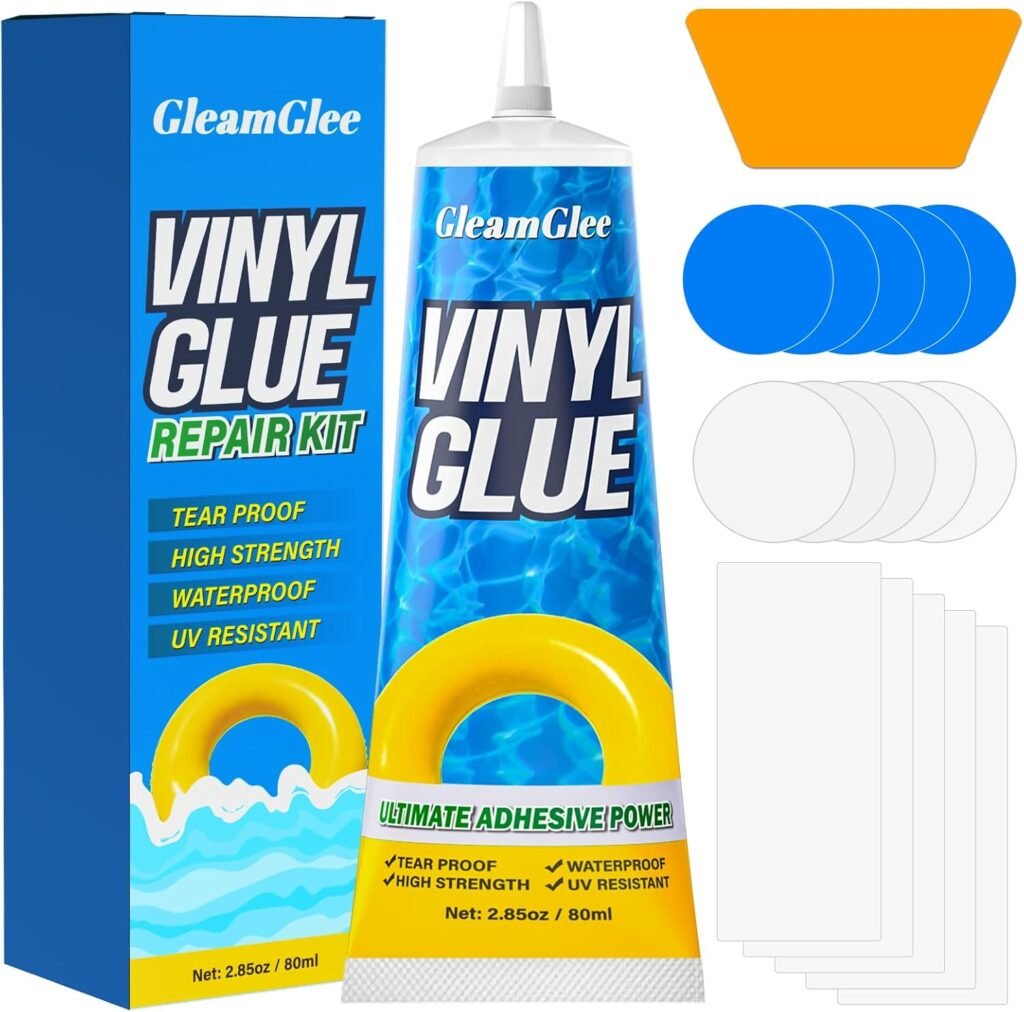
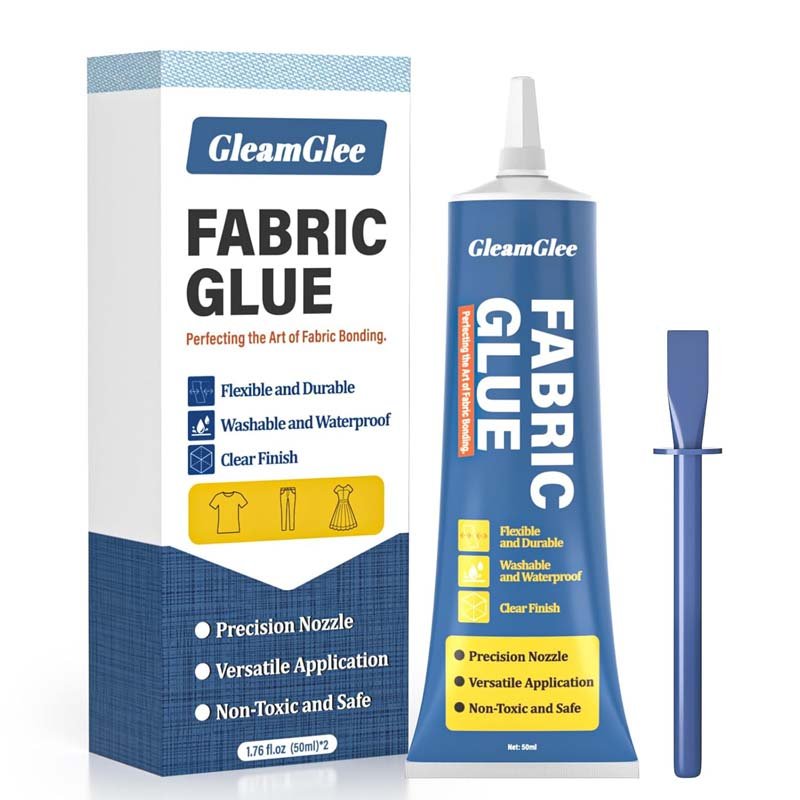
GleamGlee PVC glue is designed for inflatable leak and tear repair. It is suitable for Tower paddle boards, air mattresses, inflatable pools, kayaks, boats, pool floats, rafts, camping mats, and other PVC or rubber inflatables. The kit includes 80ml glue, 5 blue round patches, 5 clear round patches, 5 clear rectangular patches, a rubber squeegee, and an applicator.
This repair kit structure is useful because inflatable damage is not always the same size or shape. A round patch is usually better for a pinhole. A rectangular patch is better for a short tear. Clear patches keep visible repairs cleaner. Blue patches can suit certain board colors or less visible surfaces. The squeegee helps press out bubbles and improve patch contact.
A controlled metal nozzle is especially useful for paddle board repair. Many SUP leaks are tiny. If too much glue is squeezed onto the board, the patch may slide, wrinkle, or leave messy squeeze-out. A precision nozzle helps place glue around small holes and narrow repair areas without flooding the surface.
The strongest repair usually comes from this combination:
| Factor | Recommended Practice |
|---|---|
| Surface condition | Clean, dry, and free from oil, salt, sand, and sunscreen |
| Patch size | Larger than the damage with enough overlap |
| Patch shape | Rounded edges to reduce peeling |
| Glue amount | Thin, even coverage rather than thick buildup |
| Pressure | Press from the center outward with a squeegee |
| Cure time | About 24 hours before full inflation |
| Final test | Inflate gradually and check with soapy water |
A good glue makes repair easier, but the process still matters. Clean surface, correct patch size, careful pressure, and enough curing time are what turn PVC glue into a reliable Tower paddle board repair.
Where Do Tower Paddle Boards Leak?
Tower paddle boards usually leak from the valve, rail seams, bottom panel, small punctures, scrape marks, or old repair patches. A slow air leak does not always mean the board is badly damaged. In many cases, the problem is one tiny hole, a loose valve, or a lifted patch edge that can be found with a simple pressure and bubble test.
The leak location matters because each area needs a different repair decision. A valve leak may only need cleaning or tightening. A small puncture on a flat PVC panel usually needs PVC glue and a patch. A seam leak needs more caution because seams carry higher pressure and can fail again if the damaged area is long, stretched, or opening during inflation.
A good leak check should start before any glue is applied. Inflate the board enough to create pressure, apply mild soapy water over one section at a time, and watch for bubbles that grow repeatedly from the same point. Mark the leak before deflating the board because tiny punctures can disappear once the PVC surface relaxes. Guessing the leak area is one of the fastest ways to waste glue and create a messy repair that does not stop air loss.
| Leak Area | Common Sign | Likely Cause | Repair Direction |
|---|---|---|---|
| Valve center | Hissing from valve opening | Valve pin not closed, sand, salt, dirt | Clean and check valve first |
| Valve outer ring | Bubbles around valve edge | Loose valve body or gasket shift | Tighten carefully with valve wrench |
| Flat bottom panel | One bubble point or tiny air stream | Gravel, shell, rock, dock contact | PVC glue + round patch |
| Rail side | Slow bubbles on curved sidewall | Dragging, impact, folding stress | Patch if area sits flat |
| Seam line | Bubbles along joined edge | Seam stress, adhesive fatigue | Inspect carefully before patching |
| Old patch edge | Bubbles around patch border | Poor prep, small patch, early inflation | Clean and re-patch larger |
| Fin-box area | Bubbles near raised base | Impact or stress near hard fitting | Patch only if surface is flat enough |
| Deck pad edge | Leak partly hidden by foam edge | Puncture near pad or trapped dirt | Clean carefully and patch with caution |
Valve Leaks
Valve leaks are easy to mistake for punctures because the board loses air even when the outer PVC skin looks perfect. A valve leak can come from the center pin, the outer valve ring, the gasket, or debris trapped inside the valve. If bubbles form inside the valve opening, the first step is not glue. The valve should be checked, cleaned, and closed correctly.
Common valve leak signs include:
- A light hissing sound near the inflation point.
- Bubbles forming around the valve center.
- Bubbles forming around the valve outer ring.
- Pressure loss after the board sits inflated overnight.
- Air loss that stops or changes when the valve is pressed gently.
- No visible puncture on the deck, rail, or bottom panel.
A valve may leak because sand, salt, or dust prevents a tight seal. After use in ocean water or sandy launch areas, fine particles can sit inside the valve mechanism. Rinsing and drying around the valve can help. If the outer valve body is loose, a proper valve wrench may be needed. Tightening should be slow and controlled because overtightening can damage the valve seat or gasket.
PVC glue should not be squeezed into the valve opening. Glue can block the valve, make future service difficult, and still fail to stop the leak. If bubbles come from the PVC material around the valve base instead of the valve itself, the issue is more serious. That area has shape changes and pressure stress, so a flat patch may not seal well unless the surface can sit clean, dry, and fully flat.
Puncture Leaks
Small punctures are the most common reason a Tower inflatable paddle board needs PVC glue. These leaks often come from normal outdoor use rather than careless handling. A board can be punctured by gravel in a parking lot, a sharp shell on the beach, a rock at the shoreline, a fishing hook, a pet claw, a dock screw, or sharp gear stored in the same bag.
A puncture leak usually shows one clear bubble point during a soapy-water test. The hole may be so small that it cannot be seen after the board is deflated. This is why marking the leak before repair is important. A pencil mark or small tape ring around the leak prevents the repair from being placed slightly off-center.
Small puncture repair usually needs:
- A fully deflated board.
- Clean and dry PVC surface.
- A patch larger than the damaged point.
- Rounded patch edges.
- Thin, even PVC glue coverage.
- Firm pressure from center to edge.
- About 24 hours of curing before full inflation.
Patch overlap is more important than using extra glue. For a pinhole, the patch should normally extend at least 0.75–1 inch beyond the leak on every side. For a short cut, the patch should extend past both ends of the tear. A tiny patch may look cleaner, but it gives less surface area to resist air pressure. A slightly larger clear patch usually gives a stronger seal while keeping the repair less visible.
| Damage Size | Better Patch Choice | Repair Note |
|---|---|---|
| Pinpoint hole | Clear round patch | Easier edge sealing, less visible |
| 2–5 mm puncture | Round or oval patch | Use enough overlap around all sides |
| Short cut under 1 inch | Clear rectangular patch with rounded corners | Cover both ends of the cut |
| Scrape with one leak point | Larger oval or rectangle | Cover the full worn area |
| Multiple nearby pinholes | One larger patch | Do not patch each tiny point separately |
Seam Leaks
Seam leaks need more caution than flat-panel punctures. A seam is where sections of the inflatable board material are joined together, so it carries more stress than the middle of a flat surface. When the board is inflated, the seam area must resist outward pressure from inside the board. If the seam begins to separate, a simple patch may not always be enough.
A seam leak may appear as bubbles along a line instead of one tiny point. It may also show as a lifted seam edge, a soft rail, or a hiss that becomes louder as pressure increases. Some seam leaks are small and local. Others are signs of wider separation. The repair decision should depend on the length, location, and movement of the seam during inflation.
Seam leaks are more serious when:
- Bubbles appear along several inches of seam.
- The seam gap opens wider as the board inflates.
- The rail changes shape near the leak.
- The leak is close to a corner, valve base, handle, or fin box.
- The same seam area has failed before.
- The board loses pressure quickly after inflation.
- The patch cannot sit flat over the curved area.
A very small seam-edge leak may be repaired with PVC glue and a well-shaped patch if the area is stable. The patch must cover the leak and bond to clean material on both sides. Curved rails are harder because the patch edge can lift if it does not follow the shape. For long seam splits, repeated seam failure, or any bulging near the leak, professional repair or replacement is safer than adding more glue to the outside.
Patch Leaks
Patch leaks happen when an old repair starts to fail. This is common when the first patch was too small, the surface was not cleaned well, the corners were sharp, the board was inflated too soon, or water reached the patch before the glue cured. A failed patch usually leaks from the edge, not the middle.
Signs of patch failure include:
- Bubbles forming around the patch border.
- One corner lifting after storage.
- Wrinkles under the patch.
- White, cloudy, or uneven glue marks.
- Dirt trapped under the patch edge.
- Patch movement when pressed by hand.
- Slow air loss after the board was previously repaired.
Adding more glue around a dirty patch edge is usually a weak fix. The new glue may bond to dust, old adhesive, or water residue instead of the PVC surface. If the patch is loose, the better repair is usually to remove the lifted section carefully, clean the area, dry it fully, and apply a larger patch that reaches beyond the old repair zone.
A new patch should have rounded edges and enough overlap. If the first patch failed because it was small, the second patch should not repeat the same mistake. For visible areas, a clear rectangular patch with rounded corners can cover the old edge while keeping the board looking cleaner. The repair should be pressed firmly from the center outward so the full edge seals against clean PVC.
| Patch Problem | Likely Reason | Better Fix |
|---|---|---|
| One corner lifts | Sharp corner or poor pressure | Use rounded patch and press edge fully |
| Bubbles at edge | Edge not sealed | Clean and re-patch larger |
| Patch turns cloudy | Moisture or trapped residue | Dry surface longer before repair |
| Patch slides during repair | Too much glue | Use thinner, even glue layer |
| Patch leaks after first use | Cured too soon or inflated early | Allow about 24 hours before testing |
| Old glue remains uneven | Poor surface prep | Remove loose residue before new patch |
Which PVC Glue Works Best?
The best PVC glue for Tower paddle board repair should bond strongly to PVC or vinyl-type inflatable material, stay flexible after curing, resist water, handle sunlight, and work with a patch without peeling at the edge. For most Tower SUP punctures, a flexible waterproof PVC repair glue is a better choice than super glue, epoxy, pipe cement, or general household adhesive.
A Tower inflatable paddle board puts pressure on a repair from several directions. Air pushes outward from inside the board. Water works against the patch from outside. Sunlight and heat soften the surface during outdoor use. Rolling and storage bend the repaired area after the board is deflated. Because of this, the right glue cannot only be “strong.” It must also be flexible, waterproof, and compatible with PVC repair patches.
The best repair choice also depends on the damage location. A small flat-panel puncture is easier to repair than a seam leak or valve-base leak. A rail puncture needs a patch that can follow a curve. A scrape leak needs enough patch coverage over the whole worn area. For most small Tower SUP leaks, a complete repair kit with glue, patch options, applicator, and pressing tool is more practical than buying only a glue tube.
Glue Standards
A good PVC glue for Tower paddle board repair should meet practical repair standards, not just look strong on the label. The repair must hold air pressure, survive water contact, and bend with the board after deflation. These conditions are different from fixing wood, ceramic, metal, or rigid plastic.
For inflatable SUP repair, the most important glue standards are:
- PVC or vinyl compatibility.
- Waterproof performance after curing.
- Flexible finish after drying.
- Strong patch-edge adhesion.
- Resistance to sunlight and outdoor use.
- Controlled application for small punctures.
- Enough working time to place the patch correctly.
- Clean finish on visible board areas.
- Suitable curing time for home repair.
- Compatibility with clear or colored repair patches.
For a Tower paddle board, patch-edge strength matters as much as center bonding. Most failed repairs start at the edge. If the edge lifts, air and water can move underneath the patch. Once dirt gets under the patch, the repair becomes harder to save.
The table below shows the repair features that matter most.
| Repair Feature | Why It Matters on Tower Paddle Boards | Good Repair Target |
|---|---|---|
| Flexible bond | Board bends during use, rolling, and storage | Repair should not crack or peel |
| Waterproof seal | Board is exposed to lakes, rivers, pools, and saltwater | Patch should stay sealed after curing |
| PVC compatibility | SUP skin needs the right adhesive chemistry | Glue should bond to PVC or vinyl-type material |
| UV resistance | Boards sit in sun during summer use | Patch should resist yellowing and edge aging |
| Controlled flow | Many leaks are tiny pinholes | Nozzle should prevent messy over-application |
| Patch support | Glue alone may not reinforce damage | Patch should spread pressure beyond the hole |
| Cure strength | Early inflation can lift the patch | About 24 hours is safer for many home repairs |
A thick glue layer is not a sign of a stronger repair. A thin, even layer with full patch contact usually gives better results. Too much glue can cause sliding, bubbles, slow curing, and uneven edges. The strongest repair is usually clean, flat, and slightly larger than the visible damage.
Best 15 Glue Options
The following list ranks 15 strong glue and repair adhesive options for inflatable, outdoor, marine, vinyl, PVC, and flexible repair use. The ranking is based on practical suitability for Tower inflatable paddle board repair, especially PVC compatibility, waterproof repair ability, flexibility, ease of use, patch support, and home-repair convenience.
This is not a laboratory strength ranking for every material in the world. A glue that is excellent for boat fittings, fabric repair, or marine sealing may not be the best for a small Tower SUP puncture. For paddle board repair, the best option is the product that gives the right balance of air sealing, flexibility, patch bonding, and easy home application.
- HH-66 Vinyl Cement
HH-66 is one of the most recognized vinyl and PVC repair adhesives for inflatables, vinyl tarps, bounce houses, and some SUP repair work. It is often chosen for strong vinyl-to-vinyl bonding and airtight patch repairs. It can create a serious bond when the surface is prepared correctly, which makes it a strong choice for experienced repair users.
Its main advantage is bonding power on vinyl and PVC-type materials. It is especially useful when a repairer already understands how to apply solvent-type adhesives cleanly. The downside is that it can feel more technical for casual home use. It also needs careful handling, surface preparation, ventilation, and patch placement. For a first-time Tower board owner, it may be stronger than necessary and less beginner-friendly than a complete repair kit.
- GleamGlee PVC Glue
GleamGlee PVC glue is ranked second because it is especially practical for Tower paddle board repair kits and everyday inflatable leak repair. It is designed for PVC and rubber inflatables, including paddle boards, air mattresses, inflatable pools, kayaks, boats, pool floats, rafts, and camping mats. The kit includes 80ml glue, 5 blue round patches, 5 clear round patches, 5 clear rectangular patches, a rubber squeegee, and an applicator.
This makes it strong for home repair because the user does not need to buy separate glue, patches, or pressing tools. The metal nozzle helps control glue around small holes and narrow repair zones. The patch mix also fits different damage shapes. Round patches work well for pinholes. Rectangular patches work better for short tears and scrape leaks. Clear patches help visible repairs look cleaner.
For Tower paddle board repair, GleamGlee’s main strengths are easy handling, complete repair parts, waterproof outdoor use, flexible bonding, and multi-inflatable value. It is a strong option for users who want a clean, practical repair instead of a professional-only adhesive setup.
- Gear Aid Aquaseal FD
Gear Aid Aquaseal FD is well known in outdoor gear repair. It is often used for waders, wetsuits, dry bags, outdoor fabrics, rubber, and flexible gear repairs. Its biggest strength is flexibility after curing. It is useful when the repaired item bends, stretches, or moves during use.
For Tower paddle board repair, Aquaseal FD may be useful for small flexible repairs and sealing, especially when the repair area needs a clear finish. It is not always the fastest option, and it may not replace a proper PVC patch system for every SUP puncture. For air-holding repairs, a patch is still important. Its strength is flexible waterproof sealing, but for a pressurized SUP, patch size and surface preparation remain critical.
- Tear-Aid Type B Vinyl Repair Patch
Tear-Aid Type B is not a traditional liquid glue. It is a clear adhesive-backed repair patch made for vinyl repair. It is popular because it is easy to cut, clear, flexible, and quick to apply. For certain temporary or small vinyl repairs, this can be very convenient.
For Tower paddle board use, Tear-Aid Type B can be useful as a fast repair patch for vinyl-type surfaces, especially when a user needs a clean patch without mixing or spreading glue. However, adhesive-backed patches may not replace a full PVC glue-and-patch repair for every high-pressure SUP leak. It is better for quick repair support, emergency coverage, or low-to-moderate stress areas. For a full-pressure paddle board repair, the patch edge must be checked carefully.
- Clifton PVC Adhesive LA 4009
Clifton PVC Adhesive LA 4009 is used in inflatable boat and river gear repair, especially for PVC and urethane-coated materials. It is a serious repair adhesive and is often discussed in more technical inflatable repair environments. It can be a strong choice when used correctly with proper preparation and compatible materials.
For Tower paddle board repair, Clifton-style PVC adhesive is more suitable for users who are comfortable with technical adhesive processes. It can be excellent for durable repair work, but it may be more than a casual paddler needs for a tiny puncture. The repair process usually requires careful surface preparation, correct adhesive timing, and strong pressure. It is better suited for experienced users or repair shops than quick at-home patching.
- Bostik 2402 with Hardener
Bostik 2402 is a two-component adhesive system often used in inflatable boat repair and marine applications. Its strength is durable bonding in wet and demanding environments. When mixed and applied properly, it can create strong resilient bonds.
For Tower paddle board repair, it may be useful for more demanding repairs, especially where a stronger marine-style adhesive system is needed. However, two-part systems require correct mixing, timing, and handling. This can make them less convenient for simple small punctures. A casual home user may prefer a simpler ready-to-use PVC repair kit. Bostik 2402 is better understood as a professional or semi-professional marine repair option rather than the easiest beginner SUP glue.
- Loctite Vinyl, Fabric & Plastic Flexible Adhesive
Loctite Vinyl, Fabric & Plastic Flexible Adhesive is designed for flexible plastics, vinyl seats, cushions, tarps, rainwear, outdoor gear, and similar materials. It dries clear and is commonly positioned as a flexible waterproof repair adhesive.
For small vinyl or flexible plastic repairs, it can be useful and easy to find. For Tower paddle board repair, it may help with light flexible repair tasks, but it should be judged carefully for high-pressure SUP patching. Paddle boards are more demanding than a beach ball or cushion because internal air pressure constantly pushes against the damaged point. If used on a SUP, it should be paired with an appropriate patch and tested carefully after curing.
- Stormsure Flexible Repair Adhesive
Stormsure is a flexible repair adhesive used on outdoor gear, rubber, neoprene, inflatables, boots, and waterproof fabrics. Its biggest advantage is flexibility. It can be useful where the repaired material bends, stretches, or moves.
For Tower paddle board repair, Stormsure may help with some small flexible sealing needs, but a SUP puncture normally benefits from a patch. Glue-only repairs on pressurized inflatables are less reliable than patch repairs. Stormsure’s value is strongest where the repair area needs flexible waterproof coverage. For a high-pressure paddle board, patch overlap and full edge sealing remain essential.
- 3M Marine Adhesive Sealant 5200
3M 5200 is a strong marine adhesive sealant used for boats and marine bonding. It is known for a tough waterproof seal and strong adhesion in marine environments. It is useful for many boat-related jobs where a permanent bond is acceptable.
For Tower paddle board repair, 3M 5200 is usually not the first choice for small PVC patch repairs. It can be too heavy, thick, slow-curing, and permanent for a simple SUP puncture. It is better for certain marine hardware and sealing jobs than for clean flexible inflatable patching. A paddle board needs a thin, flexible, patch-friendly repair, not a thick bead of marine sealant.
- G/flex Epoxy
G/flex Epoxy is known for stronger flexible epoxy bonding compared with many standard epoxies. It is used in boat, plastic, metal, and composite repair work. It can be helpful for materials that need toughness and some movement.
For Tower paddle board repair, G/flex is not usually the best first option. Even though it has more flexibility than many epoxies, it is still not the easiest or cleanest choice for PVC inflatable skin repair. It may be more useful for rigid or semi-rigid parts than for a soft inflatable SUP panel. For a small puncture on a Tower board, PVC glue and a patch are usually more suitable.
- Clifton Urethane Adhesive
Clifton Urethane Adhesive is used for PVC and urethane-coated materials in inflatable repair settings. It is often valued for serious raft and boat repair work. It can be a good option when the material and repair conditions match.
For a Tower paddle board, it may work for certain PVC or urethane-coated repair situations, but it is better suited for users who understand surface preparation and adhesive timing. It is not always the simplest choice for a first-time SUP owner.
- Vyna Bond
Vyna Bond has been used in vinyl and inflatable repair contexts. It is commonly associated with vinyl bonding and patching work. It may be useful for some PVC or vinyl inflatable surfaces when applied correctly.
For Tower SUP repair, material compatibility should always be checked. Like many vinyl adhesives, its success depends heavily on cleaning, patch fit, pressure, and curing. It is not a substitute for careful preparation.
- Stabond Adhesive
Stabond is often seen in inflatable boat and raft repair discussions, especially where stronger repair systems are needed. It may be used for PVC or synthetic rubber applications depending on the specific product and material.
For Tower paddle boards, Stabond is more of a technical repair product than a simple home patch kit. It may be better for repair shops, frequent outdoor users, or large inflatable repairs than for a small casual SUP puncture.
- Gorilla Waterproof Patch & Seal Products
Gorilla waterproof patch and seal products are popular for general water-resistant repair tasks. They are easy to find and simple to apply for many household and outdoor fixes.
For Tower paddle board repair, they are not usually the best choice for pressurized PVC skin. Tape-style or coating-style products may help as a short-term emergency cover, but a true PVC glue-and-patch repair is usually stronger for air retention.
- Flex Seal Repair Products
Flex Seal products are often used for general waterproof sealing, coatings, and quick household fixes. They can help block water in some situations and are familiar to many DIY users.
For Tower paddle board puncture repair, Flex Seal should not be treated as the main long-term solution. An inflatable SUP needs a flexible patch bonded to the PVC surface. Spray or coating products may not hold air pressure as reliably as a proper patch repair.
Glue Mistakes
The wrong glue can make a Tower paddle board repair harder instead of easier. A failed first repair leaves residue, uneven edges, trapped dirt, and sometimes damaged PVC surface. This makes the second repair more difficult. Choosing the right adhesive from the beginning saves time and gives the patch a better chance of holding air.
Common glue mistakes include:
- Using super glue because it dries fast.
- Using epoxy because it feels strong.
- Using pipe cement because the board is PVC.
- Using tape only for a full-pressure repair.
- Using too much glue under the patch.
- Applying glue before the surface is fully dry.
- Inflating the board before the adhesive cures.
- Repairing over sunscreen, salt, sand, or old glue.
- Choosing the smallest patch for appearance.
- Ignoring patch edges during pressing.
Super glue is a common mistake because it feels convenient. It dries quickly, but it can become brittle. A brittle repair may crack when the board bends or rolls. Epoxy is another common mistake. It is strong on hard materials, but often too rigid and thick for inflatable PVC skin. PVC pipe cement is also risky because rigid pipe repair is different from flexible inflatable repair.
A better repair approach is simple:
- Use PVC or vinyl-compatible repair glue.
- Use a patch, not glue alone, for air leaks.
- Clean wider than the patch area.
- Let the board dry fully.
- Use enough patch overlap.
- Round patch corners.
- Apply thin, even glue.
- Press the patch from center to edge.
- Wait about 24 hours before full inflation.
- Test with soapy water before paddling.
If the first repair failed, do not keep adding glue around the dirty patch edge. Remove loose material if safe, clean the area, and use a larger patch that bonds to fresh PVC beyond the failed repair zone.
Glue Comparison
For Tower inflatable paddle board repair, GleamGlee PVC glue ranks high because it combines repair glue, multiple patch options, a squeegee, applicator, and precision nozzle in one kit. Some professional adhesives may create very strong bonds, but they may also require more skill, extra supplies, stronger ventilation, or complicated handling. A complete kit is often more practical for normal small SUP leaks.
The best choice depends on the repair job:
- For small Tower SUP punctures, use a flexible PVC glue and patch kit.
- For quick vinyl patching, adhesive-backed vinyl patches may help.
- For professional raft or boat repair, technical PVC adhesives may be better.
- For outdoor fabric and flexible gear, flexible waterproof adhesives work well.
- For marine hardware sealing, marine sealants may be useful.
- For pressurized inflatable SUP skin, avoid thick rigid adhesives.
| Rank | Glue or Repair Product | Best Use | Strengths | Limits for Tower SUP Repair |
|---|---|---|---|---|
| 1 | HH-66 Vinyl Cement | Vinyl and PVC inflatable patching | Strong vinyl bond, airtight, waterproof | More technical handling, not the easiest beginner option |
| 2 | GleamGlee PVC Glue | Tower SUP, pools, air mattresses, kayaks, inflatables | Complete kit, 80ml glue, multiple patches, metal nozzle, squeegee | Best for small to medium patchable damage, not structural failure |
| 3 | Gear Aid Aquaseal FD | Outdoor gear, flexible waterproof repair | Clear, flexible, waterproof, durable | Patch support still needed for many SUP air leaks |
| 4 | Tear-Aid Type B | Quick vinyl patch repair | Clear, easy to cut, fast application | Adhesive patch may not replace full glue repair for high pressure |
| 5 | Clifton PVC Adhesive LA 4009 | Technical PVC and urethane repair | Strong repair-shop level bonding | Requires more skill and careful process |
| 6 | Bostik 2402 + Hardener | Inflatable boat repair | Strong marine-style two-part bonding | More complex mixing and handling |
| 7 | Loctite Vinyl, Fabric & Plastic | Flexible vinyl and outdoor gear repair | Clear, flexible, waterproof | May be less specialized for high-pressure SUP patching |
| 8 | Stormsure Flexible Repair Adhesive | Flexible gear, rubber, inflatables | Very flexible, waterproof repair use | Glue-only repair may not be enough for SUP punctures |
| 9 | 3M Marine Adhesive Sealant 5200 | Marine sealing and hardware | Strong waterproof marine seal | Thick, slow-curing, not ideal for neat SUP patches |
| 10 | G/flex Epoxy | Boat, plastic, composite repair | Tougher than many epoxies | Still not first choice for flexible inflatable PVC skin |
| 11 | Clifton Urethane Adhesive | PVC/urethane coated materials | Useful for raft and boat repairs | More technical than a home repair kit |
| 12 | Vyna Bond | Vinyl bonding and patching | Known vinyl repair option | Compatibility and prep are critical |
| 13 | Stabond Adhesive | Inflatable boat and raft repair | Strong technical repair use | Better for experienced repair work |
| 14 | Gorilla Waterproof Patch & Seal | General waterproof patching | Easy to find, quick coverage | Better as temporary support than long-term SUP repair |
| 15 | Flex Seal Repair Products | General waterproof sealing | Simple household sealing use | Not ideal for pressurized PVC paddle board skin |
For a Tower paddle board owner fixing a normal puncture, the most practical choice is not always the most industrial adhesive. The repair product should match the user’s repair level, the damage size, and the board material. GleamGlee PVC glue is especially useful when the goal is a clean, controlled, home-friendly repair with enough patches and tools included in one kit.

How to Use PVC Glue for Tower Paddle Board Repair?
To use PVC glue for Tower paddle board repair, first locate the leak accurately, then deflate the board, clean and dry the repair area, cut a PVC patch with rounded corners, apply a thin even layer of glue, press the patch firmly, and allow about 24 hours before full inflation. The repair should be tested with soapy water before the board returns to regular paddling.
A Tower inflatable paddle board repair is not difficult, but it does need patience. The board works under air pressure, so a small mistake can cause the patch to lift later. Too much glue, a damp surface, a patch that is too small, or early inflation can all turn a simple repair into a repeat leak. The strongest repairs usually look clean and flat, not thick or messy.
The most reliable repair method is to treat the job like sealing a pressure-holding surface, not like sticking a label onto plastic. The patch needs full contact with clean PVC. The glue needs time to cure. The edge needs to seal completely. If the repair is done carefully, many small punctures, pinholes, short cuts, and scrape leaks on a Tower paddle board can be fixed at home without replacing the board.
| Repair Step | Main Purpose | Recommended Detail | Common Problem |
|---|---|---|---|
| Step 1 | Find the leak | Use soapy water and mark the bubble point | Repairing the wrong area |
| Step 2 | Deflate and clean | Remove sand, salt, oil, dust, and old glue | Glue bonds to dirt instead of PVC |
| Step 3 | Dry the surface | Let hidden moisture evaporate fully | Patch turns cloudy or lifts |
| Step 4 | Cut the patch | Use rounded corners and enough overlap | Sharp corners peel early |
| Step 5 | Apply glue | Use a thin, even layer | Thick glue causes sliding or bubbles |
| Step 6 | Press the patch | Press from center outward | Air pockets weaken the seal |
| Step 7 | Cure | Wait about 24 hours before full inflation | Early pressure lifts the edge |
| Step 8 | Test | Inflate gradually and check bubbles | Leak returns on water |
Step 1: Find the Leak
The first step is finding the exact leak point. A Tower paddle board can feel soft for several reasons, so it is important not to assume every pressure drop is a puncture. Temperature changes can make air pressure drop slightly. A valve may not be fully sealed. A previous patch edge may be lifting. A tiny pinhole may be hidden on the rail or bottom panel. The repair should only begin after the leak has been confirmed.
Inflate the board enough to create pressure, but do not overinflate a visibly damaged area. Start with the valve, then check the rail, bottom panel, deck surface, seam lines, fin-box area, D-ring zones, handle areas, and any scraped sections. A slow leak often produces a faint hiss, but many pinholes are too quiet to hear. A mild soapy-water test is more reliable. Mix water with a small amount of dish soap, apply it to one section at a time, and watch for bubbles that keep growing from the same spot.
Mark the leak before deflating the board. This matters because many small holes become almost invisible once the board is flat. A light pencil mark, removable tape ring, or small non-damaging marker point can help keep the repair centered. Do not draw a large mark directly on the glue area if it may interfere with adhesion.
Useful leak-check order:
- Check the valve center first.
- Check the outer valve ring.
- Check the rail seams.
- Check the bottom panel.
- Check scraped or white stress-mark areas.
- Check around the fin box.
- Check old patches.
- Check under or near deck pad edges if bubbles appear nearby.
| Leak Behavior | Likely Cause | Repair Direction |
|---|---|---|
| Bubbles from valve opening | Valve pin or dirt inside valve | Clean/check valve before glue |
| Bubbles around valve ring | Loose valve body or gasket issue | Tighten carefully with valve tool |
| One bubble point on flat PVC | Small puncture | PVC glue + round patch |
| Bubbles along a line | Seam leak or tear | Inspect before patching |
| Bubbles around old patch | Patch edge failure | Clean and re-patch larger |
| Board softens only in cold water | Temperature pressure drop possible | Recheck before repairing |
| Fast pressure loss | Larger leak or seam issue | Inspect fully before applying glue |
A valve leak should not be treated the same as a puncture. Do not squeeze PVC glue into the valve. If bubbles come from the valve center, the valve may need cleaning. If bubbles come from the outer ring, it may need careful tightening. If bubbles come from the PVC around the valve base, the issue is more serious and may not be a simple patch job.
Step 2: Clean and Dry
After the leak is marked, deflate the board fully and prepare the surface. Cleaning is one of the biggest factors in repair success. PVC glue needs to bond to the board material, not to sand, salt, sunscreen, dust, body oil, pool chemicals, or old adhesive. Even a strong glue can fail if the surface is dirty.
Clean an area larger than the patch. If the patch will be about 2 inches wide, clean at least 3–4 inches around the leak. This gives enough space for glue spread, patch placement, and edge contact. Wipe slowly around textured areas, rail curves, and seam edges because residue can stay inside small grooves. If the board has been used in salt water, rinse the area first and allow it to dry fully.
The repair surface must be completely dry before glue is applied. A board can feel dry while moisture remains near seams, deck pad edges, or textured PVC. Hidden moisture may cause cloudy glue marks, weak bonding, or patch lifting. If the board was recently used, give it more drying time than expected. A clean shaded area is better than direct sun, wind, wet grass, or beach sand.
Before gluing, the repair area should be free from:
- Salt crystals.
- Beach sand.
- Fine dust.
- Sunscreen.
- Sweat or hand oil.
- Mud.
- Pool chemical residue.
- Loose old glue.
- Moisture around seams.
- Fibers from towels or cloths.
Do not use harsh cleaners that may soften, discolor, or damage the board unless the adhesive instructions allow them. The goal is a clean and stable bonding surface. After cleaning, avoid touching the repair area with fingers because skin oil can transfer back onto the PVC.
Surface readiness checklist:
| Surface Check | Ready for Glue? | What to Do If Not Ready |
|---|---|---|
| Feels dry to touch | Maybe | Check seams and texture again |
| Cloth picks up moisture | No | Keep drying |
| Surface feels slick | No | Remove oil or sunscreen residue |
| Sand appears on cloth | No | Wipe again |
| Old glue flakes off | No | Remove loose residue carefully |
| Patch area is flat | Yes | Continue repair |
| Area is wrinkled or lifting | Caution | Inspect for deeper damage |
| Surface is hot from sun | No | Let it cool before repair |
A clean surface can make a small repair last much longer. Many failed patches are not caused by weak glue. They fail because the glue never reached clean PVC in the first place.
Step 3: Cut and Glue
The patch should be cut before the glue is opened or applied. This prevents rushed trimming while the adhesive is already wet. Choose the patch shape based on the damage. For a tiny pinhole, a round patch is usually best. For a short cut or scrape, a rounded rectangular patch gives better coverage. The patch should always be larger than the visible damage.
Patch overlap is important because the board is pressurized. The patch should extend beyond the leak so the air pressure is spread across a wider bonded area. For a pinhole, at least 0.75–1 inch of overlap around the leak is a practical target. For a short tear, the patch should extend beyond both ends of the cut. For a scraped area, the patch should cover the full worn section, not just the spot where bubbles appeared.
Rounded corners are better than sharp corners. Sharp corners catch easily when the board is rolled, wiped, packed, or pulled from a carry bag. Once one corner lifts, water and dirt can move under the patch. A round or rounded-edge patch is more likely to stay flat over time.
Patch choice guide:
| Damage Type | Better Patch Shape | Recommended Coverage |
|---|---|---|
| Pinpoint hole | Clear round patch | 0.75–1 inch beyond hole |
| Small puncture | Round or oval patch | Cover puncture plus clean margin |
| Short cut | Rounded rectangle | Extend past both ends |
| Scrape leak | Oval or rectangle | Cover entire scraped zone |
| Rail puncture | Smaller flexible round patch | Must follow curve fully |
| Old patch failure | Larger rounded patch | Extend beyond old repair area |
| Multiple nearby holes | One larger patch | Cover all points together |
After dry-fitting the patch, apply PVC glue in a thin, even layer. The glue should cover the bonding area, but it should not be piled up. Thick glue can make the patch slide, wrinkle, or cure unevenly. It can also squeeze out messily and leave raised edges.
A precision metal nozzle helps control the glue amount, especially around tiny holes and narrow cracks. GleamGlee PVC glue includes a metal nozzle for cleaner application. This is useful on Tower paddle boards because many leaks are small and often located on visible surfaces. Controlled application helps avoid wasting glue and reduces messy repair marks.
Good glue application habits:
- Apply glue only after the patch is cut and ready.
- Keep the glue layer thin and even.
- Cover the full patch contact area.
- Do not leave dry spots near the patch edge.
- Do not flood the repair zone.
- Do not touch wet glue with dirty fingers.
- Do not keep sliding the patch after placement.
- Follow the adhesive instructions for waiting time and pressing.
For small SUP punctures, more glue is not better. Better surface contact is better. A flat patch with even adhesive usually performs better than a bulky patch with too much glue underneath.
Step 4: Press, Cure, and Test
Once the patch is placed, press it from the center outward. This pushes trapped air and excess glue toward the edges. A rubber squeegee helps apply even pressure across the patch without scratching the PVC surface. Finger pressure alone may miss the edges or leave small air pockets.
The edge must be sealed completely. Many patch failures begin at the outer edge, not the center. After pressing the middle, work around the full patch perimeter. Make sure there are no lifted corners, wrinkles, bubbles, or dry-looking gaps. If excess glue appears at the edge, wipe it carefully without moving the patch.
Pressing technique:
- Start at the center.
- Push outward toward one edge.
- Return to the center.
- Push outward toward the opposite edge.
- Repeat in every direction.
- Press the full perimeter.
- Check for wrinkles or bubbles.
- Leave the patch still after placement.
Curved rail repairs need extra care. A patch on a curved surface must follow the curve without lifting. If the patch is too large or stiff for a rail curve, it may wrinkle. A smaller rounded patch can sometimes seal better than a large patch on a tight curve. The patch should lie flat across the whole bonded area.
After pressing, let the repair cure for about 24 hours before full inflation. The patch may look dry much earlier, but the bond may not be strong enough for full air pressure or water use. Early inflation is one of the most common reasons repairs fail.
During curing, keep the board:
- Flat.
- Dry.
- Clean.
- Away from direct rain.
- Away from beach sand.
- Away from heavy objects.
- Away from tight rolling.
- Away from strong heat.
- Away from water contact.
Post-cure testing is important before paddling. Inflate the board gradually, not all at once. Watch the patch as pressure builds. Apply soapy water around the patch edge and look for bubbles. If no bubbles appear, let the board sit inflated for a short period and check firmness again.
Post-repair test plan:
| Test Stage | What to Do | Good Sign | Warning Sign |
|---|---|---|---|
| Partial inflation | Add moderate pressure first | Patch stays flat | Edge lifts or wrinkles |
| Bubble test | Apply soapy water around patch | No growing bubbles | Bubbles at edge |
| Pressure hold | Let board sit inflated | Board remains firm | Board softens |
| Full inflation | Pump to normal use pressure | Patch remains sealed | Hissing or edge movement |
| First water use | Paddle close to shore first | No pressure loss | Board becomes soft |
| After-use check | Inspect patch edge | Edge stays flat | Dirt or water under patch |
The first session after repair should be cautious. Stay closer to shore, avoid dragging the repaired area, and check the patch after use. If the patch stays flat and the board holds air, the repair is performing well. If the edge begins to lift, fix it early before water and dirt get underneath.
What PVC Glue Tips Help?
PVC glue works better on a Tower paddle board when the repair area is clean, dry, flat, and covered with a patch large enough to spread air pressure. The most helpful tips are simple: remove residue, use rounded patch corners, apply a thin even glue layer, press from the center outward, cure for about 24 hours, and test before paddling.
A Tower inflatable paddle board repair is not only about closing a hole. The board holds internal air pressure, flexes under body weight, touches water, sits in sunlight, and gets rolled after use. A patch that looks fine after 10 minutes can still fail later if moisture, air bubbles, sharp patch corners, or early inflation weaken the bond. Small details decide whether the repair lasts through one trip or many uses.
Good repair habits reduce the most common failure points. A dry surface improves bonding. Enough patch overlap reduces pressure stress. A thin glue layer prevents sliding and bubbles. A full cure gives the adhesive time to build strength. A post-repair air test confirms whether the patch is ready for water. These steps matter more than applying a large amount of glue.
| Repair Tip | Better Practice | Why It Helps | Failure If Ignored |
|---|---|---|---|
| Clean wider than the patch | Clean 3–4 inches around the leak | Removes hidden residue | Patch edge may peel |
| Dry fully | Let seams and texture dry longer | Prevents weak cloudy glue | Bond may lift after water use |
| Use overlap | Extend patch 0.75–1 inch past small holes | Spreads air pressure | Leak may reopen |
| Round corners | Use round or rounded patches | Reduces edge catching | Corners may lift during rolling |
| Apply thin glue | Use an even layer, not a blob | Improves flat contact | Patch may slide or wrinkle |
| Press outward | Use squeegee from center to edge | Removes trapped air | Air pockets can leak |
| Cure fully | Wait about 24 hours before full inflation | Builds bond strength | Early pressure may break seal |
| Test slowly | Inflate gradually and use soapy water | Confirms air retention | Leak may return on water |
Surface Tips
Surface preparation is the part that most often decides repair quality. PVC glue needs direct contact with the Tower paddle board material and the patch. If the repair area has sand, salt, sunscreen, sweat, dust, pool chemicals, or moisture, the glue may stick to residue instead of the board surface. The patch may look attached at first, but the edge can lift after inflation or water exposure.
Clean a wider area than the patch. If the patch is 2 inches wide, the cleaned area should be at least 3–4 inches wide. This gives enough room for glue spread, edge sealing, and hand control during placement. On rail areas, seams, and textured surfaces, wipe slowly because residue can hide inside grooves. After cleaning, let the board dry fully. A surface may feel dry while moisture still sits near seams or deck pad edges.
Important surface checks before gluing:
- The repair area should feel dry, not cool or damp.
- A clean cloth should not pick up sand, dust, or moisture.
- The surface should not feel slick from sunscreen or oil.
- The leak mark should still be visible but not inside the main glue layer.
- Loose old glue should be removed before a new patch.
- The repair area should sit as flat as possible.
- The board should be fully deflated before patching.
- The surface should not be hot from direct sun.
Saltwater use needs extra attention. Salt crystals can stay on PVC even after the surface looks clean. A quick rinse followed by full drying helps the glue bond more evenly. Pool water can also leave chemical residue, so the repair area should be wiped and dried before glue application.
Avoid repairing on a beach, wet grass, dusty garage floor, or windy outdoor table. Sand and fibers can land in wet glue quickly. A clean shaded workspace gives more control and reduces contamination. If the repair must be done outdoors, place the board on a clean dry towel or mat and keep the glue area covered until ready.
Patch Tips
The patch should be larger than the visible damage. A Tower paddle board is pressurized, so air does not only push through the pinhole. It also pushes against the weakened material around the puncture. A patch with enough overlap spreads that pressure across a wider area and lowers the risk of edge failure.
For a tiny pinhole, the patch should usually extend at least 0.75–1 inch beyond the leak on all sides. For a short cut, the patch should extend past both ends of the tear. For scrape damage, the patch should cover the full worn area, not just the single bubble point. If multiple pinholes are close together, one larger patch is usually better than several small patches placed next to each other.
Patch shape matters. Round patches and rounded rectangles are usually better than sharp square patches. Sharp corners can catch when the board is rolled, pulled from a bag, wiped with a towel, or rubbed against gear. Once one corner lifts, water and dirt can move under the patch and weaken the repair.
Patch selection guide:
| Damage Type | Better Patch Choice | Practical Detail |
|---|---|---|
| Tiny pinhole | Clear round patch | Clean look, easy edge sealing |
| Small puncture | Round or oval patch | Use at least 0.75–1 inch overlap |
| Short cut | Clear rectangular patch with rounded corners | Cover both ends of the cut |
| Rail leak | Smaller flexible round patch | Must follow the curve without lifting |
| Scrape leak | Larger oval or rectangle | Cover the whole scraped area |
| Failed old patch | Larger new patch | Extend beyond old glue marks |
| Visible deck repair | Clear patch | Keeps the board appearance cleaner |
Dry-fit the patch before opening the glue. Place it over the leak and check whether it sits flat. If the patch crosses a raised seam, valve base, handle edge, D-ring, fin box, or deck pad edge, it may not seal evenly. In that case, adjust the shape or size before applying adhesive.
Do not choose a tiny patch only because it looks less noticeable. A patch that is too small may fail quickly. A slightly larger clear patch often gives a stronger repair while still looking neat. For bottom-panel repairs where appearance matters less, choose strength and coverage first.
Glue Tips
PVC glue should be applied in a thin, even layer. A thick glue layer does not make a stronger repair on a Tower paddle board. Too much glue can cause the patch to slide, wrinkle, cure unevenly, or leave bulky edges. A flat patch with full contact usually holds better than a patch floating on excess adhesive.
The glue should cover the full bonding area, especially near the patch edge. Dry spots near the edge can become leak channels. At the same time, flooding the surface creates mess and weak contact. The goal is controlled coverage: enough glue to wet the board and patch, but not so much that the patch moves around.
Helpful glue application habits:
- Prepare the patch before applying glue.
- Keep the board deflated and stable.
- Apply glue only to the clean repair zone.
- Use a controlled nozzle for small holes.
- Spread glue evenly across the contact area.
- Avoid touching wet glue with fingers.
- Do not drag the patch around after placement.
- Wipe extra squeeze-out carefully without lifting the patch.
- Keep dust, hair, towel fibers, and sand away from wet glue.
A precision metal nozzle is useful for small SUP leaks. Many Tower paddle board punctures are tiny and do not need a large amount of adhesive. Controlled application helps place the glue around the leak without flooding the board surface. It also helps on narrow areas, rail curves, and small scrape lines.
Glue amount should match the repair size. A pinhole repair needs a controlled layer under a small round patch. A short tear needs a wider glue area under a rectangular patch. A failed old patch repair may need a larger glue zone after the old residue is cleaned. The glue layer should look even, not thick in the center and dry at the edge.
Common glue mistakes to avoid:
- Using super glue for a flexible SUP patch.
- Using epoxy on soft inflatable PVC.
- Using PVC pipe cement meant for rigid plumbing.
- Applying glue before the board is fully dry.
- Using too much adhesive under the patch.
- Pressing only the middle of the patch.
- Inflating before the glue has cured.
- Testing on water before an air test at home.
Cure and Test Tips
Curing is where many repairs fail. The patch may look dry after a short time, but the bond may not be strong enough for full air pressure. For Tower paddle board repair, about 24 hours of curing is a safer target before full inflation, especially for punctures that will be exposed to water, bending, and pressure.
During curing, the board should stay flat, dry, and undisturbed. Do not roll the board. Do not put heavy objects directly on the patch unless the repair method specifically calls for controlled pressure. Do not place the board in a hot car. Do not leave it where rain, dew, or wet grass can reach the patch. Heat, moisture, and early movement can weaken the repair before it has time to set properly.
Better curing conditions:
- Keep the board indoors or under clean shade.
- Keep the repair area dry.
- Avoid direct sunlight during curing.
- Avoid high heat and freezing temperatures.
- Do not fold across the repair.
- Do not drag the board.
- Do not inflate to full pressure early.
- Wait about 24 hours before serious testing.
After curing, test slowly. Partial inflation is safer than going straight to full pressure. Watch the patch as the board fills. If the edge lifts, wrinkles, or bubbles, stop and inspect. If the patch stays flat, continue inflating gradually. Then apply mild soapy water around the full patch edge and watch for growing bubbles.
A practical post-repair test:
| Test Stage | What To Do | Good Result | Problem Sign |
|---|---|---|---|
| Partial inflation | Add moderate pressure first | Patch stays flat | Edge begins lifting |
| Bubble check | Apply soapy water around edge | No growing bubbles | Bubbles from edge or center |
| Pressure hold | Let board sit inflated | Board stays firm | Board softens |
| Full inflation | Pump to normal pressure | Patch remains sealed | Hissing or movement |
| First water use | Stay closer to shore | No pressure loss | Board feels soft |
| After-use check | Inspect patch edge | Edge remains sealed | Dirt or water under patch |
The first water session after repair should be cautious. Paddle close to shore and avoid dragging the repaired area over rocks, docks, or gravel. After the session, check the patch edge again. If it remains flat and the board holds pressure, the repair is working properly. If one edge begins to lift, fix it early before water and dirt spread underneath.

Do PVC Glue Repairs Last?
PVC glue repairs can last well on a Tower paddle board when the leak is small, the surface is clean and dry, the patch is large enough, and the adhesive fully cures before use. A strong repair should hold air, resist water, stay flexible, and keep the patch edge sealed through normal inflation, paddling, drying, rolling, and storage.
Repair life depends more on preparation than on glue amount. A patch with a thin even glue layer, rounded corners, and 0.75–1 inch of overlap around a small puncture usually has a better chance of lasting than a thick glue repair with a tiny patch. Most early failures come from damp PVC, dirty surfaces, trapped air bubbles, sharp patch corners, or inflating the board before the bond has strengthened.
A repaired Tower paddle board should still be treated with care. The patch area is strong when done correctly, but it should not be dragged over rocks, folded sharply right after repair, stored wet, or left in extreme heat. A simple check after the first inflation and after the first water session can prevent a small edge lift from becoming another leak.
| Factor | Good Practice | Why It Helps Repair Life |
|---|---|---|
| Cure time | Wait about 24 hours before full inflation | Gives the adhesive time to build strength |
| Patch overlap | 0.75–1 inch beyond a small leak | Spreads pressure away from the puncture |
| Patch shape | Round or rounded corners | Reduces peeling during rolling and handling |
| Surface prep | Clean, dry, residue-free PVC | Helps glue bond to the board, not dirt |
| Glue layer | Thin and even | Prevents sliding, bubbles, and weak spots |
| Water use | Test first, then paddle close to shore | Confirms the repair before heavier use |
| Storage | Dry, cool, away from sharp items | Protects patch edge and board material |
| Recheck | Inspect after first use and before trips | Finds early lifting before failure |
Repair Lifespan
A PVC glue repair on a Tower paddle board can last for many uses when the damage is a small puncture, pinhole, scrape leak, or short surface cut. The repair is more reliable when the patch bonds to clean PVC and extends beyond the damaged zone. A small flat-panel puncture normally has a better long-term result than a curved rail leak or seam-edge leak because the patch can sit flatter and seal more evenly.
Repair lifespan is shorter when the damaged area is under heavy stress. A seam leak, valve-base leak, large tear, or bulging surface should be judged more carefully. These areas move more during inflation and may place more force on the patch edge. If the board shape changes around the repair, glue alone may not solve the deeper problem.
A strong repair usually has these signs:
- The patch sits flat with no wrinkles.
- No bubbles appear during the soapy-water test.
- The patch edge stays fully sealed after inflation.
- The board remains firm after sitting inflated.
- The repair does not turn cloudy or lift after water use.
- The patch edge does not catch when the board is rolled.
- The repaired area does not bulge under pressure.
A weak repair often shows warning signs early. One corner may lift. The patch may slide during application. White or cloudy marks may appear under the patch. Bubbles may form at the edge after inflation. These signs should not be ignored. Small edge failure is easier to fix early than after water, dust, and sand move under the patch.
Water and Pressure
A Tower paddle board repair must handle both water and air pressure. The inside of the board pushes outward, while water, movement, and handling affect the outside. A PVC glue repair lasts longer when the patch edge is fully sealed because the edge is where water and air usually start to attack the repair.
The board should not be placed in water before the glue has cured. A patch may look dry on the surface but still be weak underneath. Early water exposure can soften the bond line, trap moisture under the patch, or create a cloudy weak area. Waiting about 24 hours before full inflation and water use gives the repair a much better chance.
Pressure testing should be gradual. Pumping the board straight to full pressure immediately after curing puts sudden force on the repair. A slower test is safer and more useful.
Post-repair pressure test:
| Test Stage | What To Do | Good Sign | Warning Sign |
|---|---|---|---|
| Partial inflation | Add moderate air first | Patch stays flat | Edge begins lifting |
| Bubble test | Use soapy water around patch | No growing bubbles | Bubbles from edge |
| Pressure hold | Let board sit inflated | Board stays firm | Board softens |
| Full inflation | Pump to normal use level | Patch remains sealed | Hissing or patch movement |
| First paddle | Stay close to shore | No pressure loss | Board feels soft |
| After-use check | Inspect the patch edge | Edge remains clean and flat | Water or dirt under patch |
Waterproof repair does not mean careless use. After paddling in salt water, the board should be rinsed and dried. Salt crystals can build around edges and seams. Pool water can leave chemical residue. Muddy water can carry grit into lifted areas. Dry storage protects both the repair and the whole board.
Sun and Storage
Sunlight and storage habits have a big effect on repair life. Tower paddle boards are often used in hot outdoor conditions, then deflated and rolled into a storage bag. This creates heat stress, pressure changes, bending, and friction around the patch. A repair that survives the first water test can still fail early if the board is stored badly.
High heat can increase internal pressure when the board is inflated. If a repaired board sits in direct sunlight on hot pavement, a dock, or a roof rack, the patch edge and seams may face extra stress. Even with UV-resistant glue, it is better to keep the board shaded when not in use.
Good storage habits include:
- Rinse and dry the board before packing.
- Do not roll the board tightly across a fresh repair.
- Keep the repair area away from sharp fins, tools, clips, or pump parts.
- Store the board in a cool dry place.
- Avoid long storage in a hot car.
- Do not pack the board while wet.
- Check the patch edge after seasonal storage.
- Keep PVC glue and patches away from high heat.
A fresh repair should be treated gently during the first few uses. Avoid dragging the repaired area over gravel, docks, or rocks. If the patch is on the bottom panel, place the board carefully when launching. If the patch is on the rail, avoid rubbing it against dock edges or vehicle parts during transport.
Patch shape also affects storage durability. Rounded patches are less likely to catch when the board is rolled or removed from the bag. Sharp-corner patches can lift more easily because corners create stress points. This is why round patches and rounded rectangular patches are usually better for inflatable board repairs.
When to Recheck
A repaired Tower paddle board should be rechecked after curing, after the first full inflation, after the first paddle, and before longer trips. Rechecking is quick, but it can prevent repeat leaks. A patch that begins lifting at one edge can often be corrected before it becomes a full repair failure.
The first recheck should happen before the board goes back on water. Inflate the board gradually and apply soapy water around the patch edge. If bubbles appear, the seal is not complete. If no bubbles appear, let the board sit inflated for a short period and check pressure again.
A practical recheck schedule:
| Time | What To Check | Why It Matters |
|---|---|---|
| After 24-hour cure | Patch edge, wrinkles, glue marks | Confirms the patch stayed flat while curing |
| After partial inflation | Edge movement | Shows whether pressure is lifting the patch |
| After full inflation | Air bubbles and firmness | Confirms the repair can hold normal pressure |
| After first water use | Water under edge, dirt, peeling | Shows real-use durability |
| Before long trips | Pressure stability | Reduces risk away from shore |
| After storage | Patch bending or corner lift | Finds damage from rolling or packing |
| After impact | New scratches or edge damage | Prevents hidden leak return |
A repair needs attention when any of these appear:
- One patch corner lifts.
- Bubbles form at the edge.
- The board softens after sitting inflated.
- The patch looks cloudy underneath.
- Dirt or water appears under the edge.
- The patch wrinkles after rolling.
- A repaired seam area opens under pressure.
- The same area leaks again after two repair attempts.
If the problem is only a small edge lift, cleaning and re-patching with a larger rounded patch may work. If the board has seam separation, valve-base damage, bulging, or repeated pressure loss, the issue may be beyond a normal home repair. In that case, professional repair or replacement is safer than adding more glue over a failing area.
Why Choose GleamGlee PVC Glue?
GleamGlee PVC glue is a practical repair choice for Tower inflatable paddle boards because it is made for flexible, waterproof inflatable repairs rather than hard-surface household bonding. A Tower SUP repair needs more than a strong first grip. The patch must stay sealed while the board holds air pressure, touches water, bends under standing weight, dries in the sun, and rolls into a storage bag after use.
The GleamGlee PVC repair kit is built around the small problems that usually ruin inflatable gear: pinholes, short tears, scrape leaks, lifted patch edges, and slow overnight pressure loss. The kit includes 80ml PVC glue, 5 blue round patches, 5 clear round patches, 5 clear rectangular patches, a rubber squeegee, and an applicator. That gives enough repair flexibility for paddle boards, air mattresses, inflatable pools, kayaks, rafts, pool floats, and camping mats.
For Tower paddle board repair, the biggest advantage is control. The metal nozzle helps place glue around small holes without flooding the surface. Clear patches help keep visible repairs cleaner. Rounded patches reduce edge lifting. The squeegee helps press out bubbles and improve patch contact. Instead of using a random adhesive and cutting an unsuitable patch, the repair starts with the right materials in one place.
| GleamGlee Repair Feature | Why It Matters for Tower SUP Repair | Practical Benefit |
|---|---|---|
| 80ml PVC glue | Enough for multiple small repairs | Useful for SUPs and other inflatables |
| Clear round patches | Good for visible pinhole repairs | Cleaner repair appearance |
| Blue round patches | Useful for darker or blue repair zones | More patch-matching options |
| Clear rectangular patches | Better for short cuts and scrape leaks | Wider coverage |
| Metal nozzle | Controls glue flow | Less mess on small punctures |
| Rubber squeegee | Presses patch evenly | Fewer air bubbles |
| Waterproof bond | Handles water use after curing | Better for outdoor gear |
| Flexible finish | Moves with inflatable material | Lower cracking risk |
Repair Kit
The GleamGlee PVC repair kit is useful because inflatable damage does not always come in one shape. A Tower paddle board may have a tiny pinhole on the rail, a short scrape on the bottom, or a small cut from dock contact. One patch type cannot solve every repair cleanly. The kit includes round and rectangular patches so the repair can match the damage size more closely.
The 80ml glue volume also matters. A very small tube may be enough for one puncture, but many homes have several inflatables. A paddle board repair kit often ends up being used for an air mattress, pool float, inflatable chair, kayak, or camping pad later. The larger glue size gives better long-term value and reduces the need to buy a separate repair product for every inflatable item.
The kit setup supports several common repair needs:
- Small pinholes on Tower SUP rails or bottom panels.
- Short cuts under 1 inch.
- Scrape leaks from rocks, gravel, or dock edges.
- Old patch edge failures after cleaning.
- Pool float and inflatable mattress punctures.
- Kayak, raft, and inflatable boat surface leaks.
Repair Control
Repair control is one of the biggest reasons to choose GleamGlee PVC glue. Many SUP leaks are tiny, so too much glue can create more problems than it solves. A thick glue layer can make the patch slide, wrinkle, cure unevenly, or leave bulky marks around the edge. The precision metal nozzle helps apply the glue only where it is needed.
The rubber squeegee also improves the repair process. A patch should be pressed from the center outward so trapped air moves toward the edge. If air bubbles remain under the patch, the repair may look sealed but still have weak areas. The squeegee helps create flatter contact between the patch, glue, and board surface.
This control is especially useful on visible or curved repair zones:
- Rail repairs where the patch must follow a curve.
- Deck repairs where a messy glue mark is easy to see.
- Small punctures that need accurate glue placement.
- Short tears that need even glue along the full cut.
- Patch edges that must stay flat after rolling and storage.
Board Compatibility
GleamGlee PVC glue is designed for flexible inflatable materials, which makes it more suitable for Tower paddle board repair than rigid household adhesives. A Tower inflatable board is firm when inflated, but the repair area still bends, expands, and flexes. Super glue, epoxy, construction adhesive, and PVC pipe cement are not ideal choices because they are not made for soft inflatable SUP skin.
A proper PVC repair glue should work with the board’s real use conditions:
- Air pressure from inside the board.
- Water exposure during paddling.
- Sunlight during outdoor use.
- Rolling after deflation.
- Light rubbing during transport.
- Repeated inflation and storage cycles.
GleamGlee PVC glue is also useful for other PVC and rubber inflatables, including air mattresses, inflatable pools, kayaks, boats, pool loungers, rafts, fishing float tubes, bounce houses, camping mats, inflatable chairs, and travel pillows. This makes the repair kit more practical than a single-purpose SUP product. One kit can stay in a garage, car, camping box, or summer gear bag for different leak emergencies.
Custom Supply
GleamGlee is not only a repair glue brand; it is also an adhesives and cleaners manufacturer based in Dongguan, Guangdong, China. The company supports formula development, packaging design, filling, labeling, and bulk production. This is important for outdoor brands, Amazon sellers, repair kit distributors, pool accessory sellers, camping product companies, and private-label projects that need a stable supply chain.
For custom PVC repair kits, GleamGlee can support different product directions:
- Branded PVC glue repair kits.
- Private-label inflatable repair kits.
- Custom patch color and shape combinations.
- Multilingual instructions for US, UK, EU, Canada, and Japan markets.
- Amazon-ready packaging.
- Retail shelf packaging.
- Bulk repair glue supply.
- Outdoor, pool, camping, and marine repair product lines.
The company has more than 25 R&D specialists, over 18 design professionals, four integrated factory systems, and annual filling capacity above 12 million units. Sample development is commonly 7–14 days, standard bulk production is around 20 days, and urgent orders can be discussed. Custom projects can start from low MOQ, with packaging artwork support available quickly for seasonal launches or new product lines.
For Tower paddle board owners, GleamGlee PVC glue offers a clean and complete repair option. For brands and distributors, GleamGlee offers a scalable way to build PVC repair products for inflatable boards, water gear, camping gear, and summer repair categories.
Conclusion
PVC glue for Tower paddle board repair is most useful when the problem is a small puncture, pinhole, scrape leak, or short tear on a stable PVC surface. A strong repair depends on more than applying adhesive over the hole. The leak must be found accurately, the board must be fully deflated, the surface must be cleaned and dried, and the patch must be large enough to spread air pressure beyond the damaged area. Rounded patch edges, thin even glue coverage, firm center-to-edge pressure, and about 24 hours of curing all help the repair hold better during normal inflation, paddling, drying, rolling, and storage.
A repaired Tower inflatable paddle board should always be tested before regular water use. Partial inflation, a soapy-water bubble check, and a short pressure-hold test can show whether the patch is sealed correctly. Small flat-panel punctures often repair well at home, while long seam splits, valve-base leaks, bulging panels, delamination, or repeated pressure loss need more caution. PVC glue is a practical repair solution for the right damage type, but safety should always come before forcing a repair on a board with structural failure.
GleamGlee PVC glue gives paddle board owners and outdoor users a complete repair option with 80ml glue, clear and blue patches, a rubber squeegee, applicator, and precision metal nozzle. It is suitable not only for Tower paddle board repair, but also for air mattresses, inflatable pools, kayaks, rafts, pool floats, camping mats, and other PVC or rubber inflatables. For brand owners, Amazon sellers, distributors, and outdoor product companies, GleamGlee can also support branded PVC repair kits, private-label packaging, custom patch combinations, multilingual labels, sample development, and bulk production for global repair product markets.
Share:
Table of Contents
Here, creating your adhesives glue & removal cleaner collection is no longer a barrier—it’s a collaborative journey where GleamGlee helps brands and businesses transform their vision into durable, certified, and market-ready solutions.
Partner with GleamGlee
Join hundreds of global partners who trust GleamGlee for adhesives and cleaners that combine innovation, compliance, and speed. Our vertically integrated system—from R&D to warehouse—guarantees consistent performance and reliable delivery.
Whether you’re sourcing FBA-ready stock or developing your own formula, our team provides unmatched technical support and responsive service.