Skip to content
How to Use PVC Glue for Swimline Pool Float Repair: A Simple Guide
Your trusted adhesives glue & cleaner manufacturer

A Swimline pool float often starts leaking from a very small problem: one pinhole from a rough pool deck, one stretched seam after repeated inflation, or one tiny puncture left by storage in a garage. The frustrating part is that the float may still look almost new. It may inflate normally at first, then slowly lose firmness after 20 minutes in the pool. Many people throw it away at this point, but most small leaks can be repaired with PVC glue, a proper patch, and enough curing time.
PVC glue for Swimline pool float repair works by sealing a hole or tear with a flexible waterproof patch. Clean and fully dry the damaged PVC surface, apply a thin even layer of glue, press a rounded patch over the leak, smooth out trapped air, and let the repair cure for 24 hours before full inflation or pool use.
The repair is not only about closing the hole. A pool float has to handle body weight, water pressure, sunlight, chlorine contact, folding, and repeated inflation. If the patch is too stiff, too small, poorly pressed, or used before curing, the leak may come back quickly. A good repair should feel smooth, stay flexible, and move with the float instead of peeling at the edges.
Think of this repair like fixing the skin of the float. The goal is not to hide the leak for one afternoon. The goal is to rebuild a small flexible waterproof layer that can survive real pool use.
What Is PVC Glue for Swimline Pool Float Repair?
PVC glue for Swimline pool float repair is an adhesive-and-patch repair method for sealing small air leaks, pinholes, short cuts, and light surface tears on PVC or vinyl inflatable floats. It works best when the surface is clean, dry, flexible, and large enough for the patch to grip healthy material around the damaged spot.
A Swimline pool float does not fail only because of one visible hole. It loses air because the damaged area can no longer hold pressure when the float bends, stretches, warms in the sun, or carries body weight. That is why a simple sticker, tape strip, or random household glue often gives only a short fix. The repair needs to stay sealed while the float moves in real pool conditions.
PVC glue helps the patch bond tightly to the float surface, while the patch spreads pressure beyond the damaged point. For a tiny pinhole, a 1.5–2 inch rounded patch is often more reliable than a very small patch. For a short cut, a wider patch with rounded corners can reduce edge peeling. The repair should look smooth, feel flexible, and cure fully before the float goes back into the water.
Why Pool Floats Leak
Pool floats usually leak from pinholes, stretched seams, sharp storage folds, rough pool decks, pet claws, overinflation, and small cuts caused by outdoor use. Many leaks are not dramatic. A float may stay firm for 10–30 minutes, then slowly soften when someone lies on it because body weight increases internal air pressure.
Common leak zones include seam lines, valve bases, headrests, cup holder edges, side chambers, handles, and the bottom panel. The bottom panel is often scraped against concrete, pool tiles, patio stones, grass, or garage floors. Seam areas take more stress because two pieces of material meet there, so a tiny weak point can grow after repeated inflation.
A quick leak check can save time. Inflate the float, press sections slowly, and listen for a faint hiss. If the leak is hard to find, wipe soapy water over suspected areas. Bubbles show where air is escaping. Mark the spot before deflating the float, because a pinhole can disappear once the pressure is gone.
| Leak Area | Common Cause | Repair Difficulty |
|---|---|---|
| Flat top panel | Pinholes, sharp objects | Easy |
| Bottom panel | Scraping on rough ground | Easy to medium |
| Side chamber | Bending and pressure | Medium |
| Seam line | Stretching and aging | Medium |
| Valve base | Pulling, twisting, pressure | Medium to hard |
| Long seam split | Material separation | Hard |
What PVC Glue Does
PVC glue bonds a repair patch to the pool float surface so the damaged area becomes sealed again. The glue fills tiny gaps, grips the smooth PVC or vinyl surface, and helps the patch stay in place after curing. The patch then acts like a new waterproof skin over the hole.
The patch must be larger than the leak because air pressure does not only push through the hole. It pushes against the full repair area. If the patch is too small, pressure can reach the edge quickly and lift it. For a pinhole, the patch should still cover plenty of clean material around the hole. For a small cut, the patch should extend beyond both ends of the tear.
A thin, even glue layer is usually better than a thick puddle. Too much glue can make the patch slide, wrinkle, or dry unevenly. GleamGlee PVC glue uses a metal nozzle to place glue more accurately around small holes, seam areas, and narrow repair spots. This helps reduce waste and keeps the repaired area cleaner.
| Damage Type | Suggested Patch | Key Detail |
|---|---|---|
| Tiny pinhole | Clear round patch | Press from center outward |
| 0.5 inch cut | Round or clear rectangle patch | Cover beyond both ends |
| 1 inch tear | Clear rectangular patch | Round the patch corners |
| Bottom scrape leak | Blue or clear patch | Clean dirt carefully first |
| Seam leak | Wider patch | Check nearby seam bubbles |
When Repair Makes Sense
Repair makes sense when the Swimline pool float is still flexible, the damaged area is not too large, and the surrounding PVC is strong enough for a patch to grip. Small pinholes, short cuts, and many slow leaks are worth repairing, especially when the float still looks good and only loses air from one clear spot.
Repair may not be the best choice if the PVC feels brittle, sticky, cracked, powdery, or badly yellowed. A patch can seal a hole, but it cannot restore old material that is already breaking down. Long seam splits, large valve failures, and multiple leaks across weakened plastic may need replacement instead of repair.
A practical rule is to check the patch overlap. If the patch can cover the damage with about 1 inch of healthy surface around it, the repair has a much better chance. If the damaged area sits on a raised valve, badly curved seam, or cracked old fold line, the repair may still help, but it should be treated as a temporary fix.
| Repair Situation | Worth Repairing? | Why |
|---|---|---|
| One small pinhole | Yes | Easy to seal with round patch |
| Short surface cut | Yes | Patch can cover healthy material |
| Slow leak on flat panel | Yes | Good patch contact area |
| Small seam leak | Often yes | Needs wider patch and careful curing |
| Valve pulling away | Sometimes | Depends on space around valve |
| Long seam split | Usually no | High pressure on weak seam |
| Brittle old PVC | Usually no | New tears may form nearby |
What PVC Terms Matter for Swimline Pool Float Repair?
Understanding a few basic PVC repair terms makes it easier to choose the right glue, patch size, curing time, and repair method for Swimline pool floats. Many repair failures happen because the wrong product is used for flexible vinyl inflatables or because important terms on the repair kit are misunderstood.
“PVC” stands for polyvinyl chloride, a flexible plastic material widely used in inflatable pool floats, loungers, swim rings, inflatable pools, kayaks, and air mattresses. Swimline pool floats are commonly made from soft PVC or vinyl-style material because it is lightweight, waterproof, and flexible enough to hold air pressure while remaining comfortable in water.
Repair kits often use technical wording that sounds complicated, but most terms relate to a few practical ideas: flexibility, waterproof sealing, curing time, pressure resistance, and patch overlap. Knowing these terms helps avoid mistakes such as using rigid glue on soft inflatables or inflating the float before the adhesive is ready.
| PVC Repair Term | Meaning | Why It Matters |
|---|---|---|
| PVC | Polyvinyl chloride flexible plastic | Main material used in many pool floats |
| Vinyl | Soft flexible plastic similar to PVC | Many repair kits use “vinyl” and “PVC” together |
| Adhesion | How strongly glue grips the surface | Weak adhesion causes patch lifting |
| Cure Time | Time needed for full glue strength | Early use weakens repairs |
| Waterproof Bond | Ability to resist water penetration | Important for pool use |
| Flexible Finish | Repair stays bendable after drying | Prevents cracking on inflatables |
| Seam Leak | Air escaping where panels join | Higher-pressure repair area |
| Patch Overlap | Extra patch area beyond the hole | Spreads pressure more evenly |
| UV Resistance | Resistance to sunlight damage | Helps outdoor repair last longer |
| Air Pressure Stress | Force pushing outward inside float | Affects patch durability |
One important term is “cure time.” Many people think glue is ready once it feels dry to the touch, but PVC glue usually continues building strength for many hours. For Swimline pool float repair, around 24 hours is commonly safer before full inflation and water use. Another important term is “patch overlap.” This means the patch should extend beyond the damaged area so the repair is gripping healthy material, not only the hole itself.
“Flexible bond” is also important. Pool floats bend constantly during use. A hard rigid adhesive may hold on a hard plastic object but fail on a soft inflatable surface. A flexible PVC repair glue is designed to move with the float instead of turning into a stiff stress point.
Understanding these terms also helps when comparing repair products. Some adhesives are designed for PVC pipes, which are rigid materials, while inflatable repair products are designed for soft vinyl or PVC surfaces that stretch under air pressure. Using the correct type of PVC glue makes a major difference in repair durability.
Which PVC Glue for Swimline Pool Float Works Best?
The best PVC glue for Swimline pool float repair should bond to flexible PVC or vinyl, stay waterproof after curing, and move with the float instead of drying hard. A good choice should also include suitable patches, because glue alone cannot spread air pressure across a puncture or tear.
For Swimline pool floats, the strongest-looking glue is not always the best repair choice. Pool floats are soft, glossy, flexible, and often used in water under direct sun. A repair has to survive wet hands, pool chemicals, warm surfaces, body weight, and repeated inflation. If the adhesive dries too stiff, the patch edge may become a new stress point. If it stays too soft, the patch may slide, lift, or turn gummy after water exposure.
A practical repair product should solve four problems at the same time: air sealing, water resistance, patch flexibility, and easy use. That is why repair kits with multiple patch shapes often perform better for home use than glue-only products. A pinhole on the top of a float, a scrape on the bottom, and a small seam leak do not need the exact same patch size or shape.
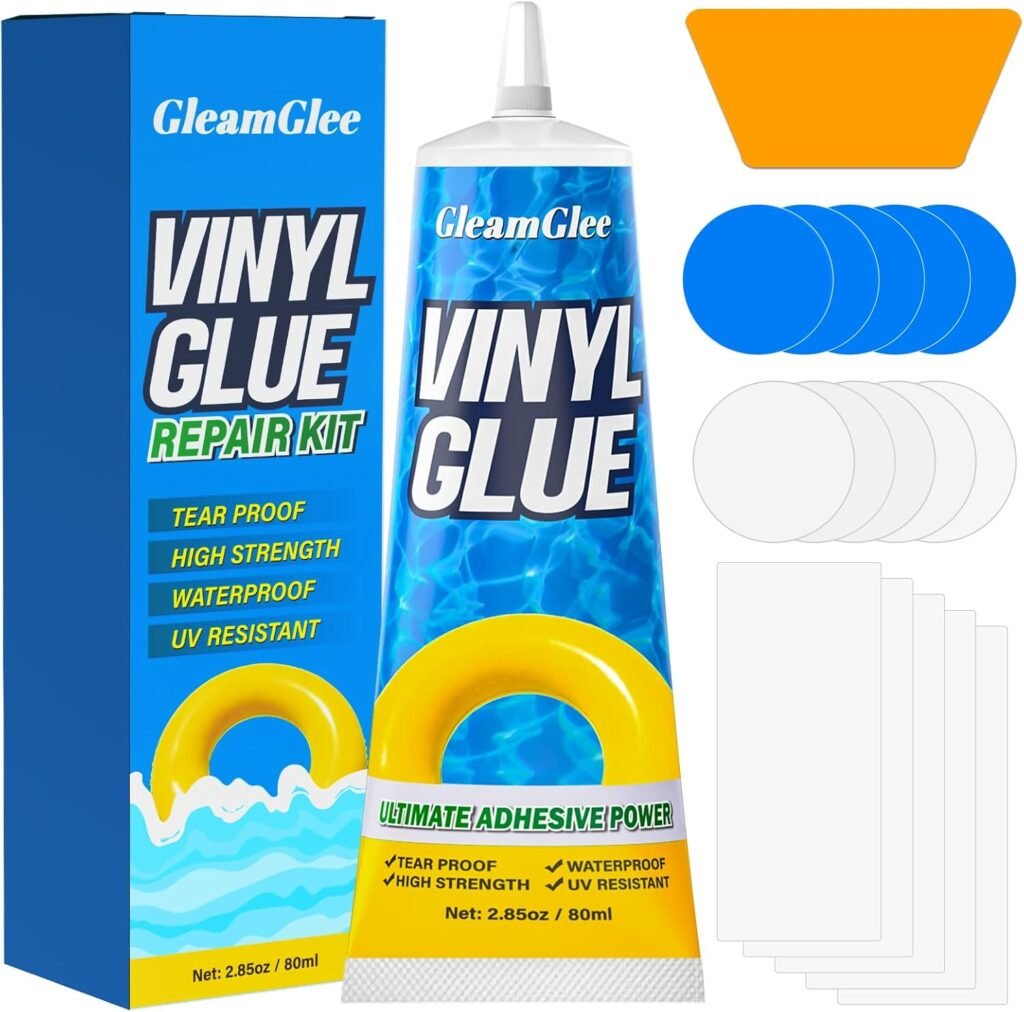
For most Swimline pool float repairs, a complete PVC repair kit is easier to use than a single tube of adhesive. GleamGlee PVC glue works well in this type of repair because it includes 80ml glue, clear round patches, blue round patches, clear rectangular patches, a rubber squeegee, an applicator, and a precise metal nozzle. That setup helps handle both small pinholes and longer tears without forcing one patch style onto every repair.
Waterproof Bond
A waterproof bond matters because a repaired Swimline pool float will not stay dry for long. Even if the damaged area is on the top surface, splashing, wet skin, pool storage, rinsing, and water pressure can reach the patch edge. Once water gets under the edge, the repair can start peeling.
For pool float repair, the patch edge is usually the first place to fail. The center of the patch covers the hole, but the edge protects the repair from water and movement. If the edge is not sealed flat, pool water can slowly creep underneath. This is why a thin, even glue layer is better than a thick messy layer. The glue must reach the entire patch area, especially the outer border.
A strong waterproof repair should also handle normal outdoor conditions. Pool floats are often left in sunlight, carried with wet hands, placed on grass, dragged near concrete, or stored in damp pool sheds. The adhesive should not lose grip after one afternoon. Products made for vinyl pool liners, inflatables, and outdoor PVC gear are usually more suitable than ordinary craft glue or household glue.
GleamGlee PVC glue is designed for water-related inflatable repair and is suitable for pool floats, inflatable pools, kayaks, air mattresses, swim rings, and rubber/PVC inflatables. The adhesive and patches are made to stay flexible after curing, which helps the repair handle wet use better than stiff patching methods.
Flexible Finish
A flexible finish is important because a Swimline pool float bends every time it is used. When someone lies on the float, the surface stretches under body weight. When the float is inflated, deflated, folded, or stored, the repaired area also moves. If the glue dries too hard, the repair may crack, lift, or tear around the patch edge.
Many repair failures happen beside the patch, not directly inside the patch. This happens when the patch is stiff and the surrounding PVC keeps flexing. The hard edge becomes a pressure line. Over repeated use, that line can create a new leak. A flexible adhesive helps reduce that problem by letting the patch move closer to the original float material.
For a pool lounger, flexible repair also affects comfort. A thick, raised, stiff patch can feel rough against the back, arms, or legs. A smooth flexible patch is less noticeable, especially on the top panel or headrest. This is one reason clear PVC patches are useful: they can sit flatter and look cleaner when applied correctly.
The best flexible repair usually has these features:
| Repair Feature | Better Result | Problem If Missing |
|---|---|---|
| Thin glue layer | Patch sits flat | Thick edge may peel |
| Flexible dry bond | Moves with float | Hard edge may crack |
| Proper patch overlap | Spreads pressure | Small patch may lift |
| Rounded corners | Less catching | Sharp corners peel faster |
| 24-hour curing | Stronger bond | Early inflation weakens repair |
For Swimline pool floats, flexibility is not a luxury feature. It is part of the repair strength.
Clear Patch Look
A clear patch is often the better choice for visible Swimline pool float repairs because it keeps the float looking cleaner. Many pool floats have bright colors, printed graphics, transparent sections, or glossy surfaces. A dark or mismatched patch can make the float look damaged even after it is fixed.
Clear patches also make the repair easier to check. After the patch is pressed down, it is easier to see whether the glue spread evenly. Bubbles, dry spots, and wrinkles can be spotted before the glue cures. This gives more control during repair, especially for small pinholes on the top surface.
Patch shape should match the damage. A round patch is often best for tiny holes because it has no sharp corners. A rectangular patch works better for longer cuts, but its corners should be rounded before application. Blue patches can be useful for bottom panels, less visible areas, or colored sections where appearance matters less.
| Damage Location | Better Patch Choice | Reason |
|---|---|---|
| Top panel pinhole | Clear round patch | Neater look and fewer lifting corners |
| Printed float surface | Clear patch | Keeps the original design visible |
| Bottom scrape leak | Blue or clear patch | Appearance is less important |
| Short straight tear | Clear rectangle patch | Covers more length |
| Curved edge leak | Smaller round patch | Easier to press flat |
| Seam-side leak | Larger rounded patch | Gives more overlap |
A good patch should be large enough to cover healthy PVC around the leak. For a pinhole, a 1.5–2 inch patch is often more reliable than a tiny dot-sized patch. For a 1 inch tear, a longer rectangular patch with rounded corners is usually safer.
Top 10 PVC Glue Options
The top PVC glue options for Swimline pool float repair should be judged by waterproof strength, flexibility, patch support, ease of use, repair appearance, and suitability for soft inflatables. Heavy-duty vinyl cement may be strong, but a complete kit is often easier for pool float owners.
This ranking is written from the perspective of Swimline pool float repair, not industrial PVC pipe bonding. Pool floats need flexible repair, clear patch options, controlled glue use, and a clean finish. Some products are excellent for vinyl pool liners or bounce houses, but may feel too heavy-duty or less convenient for small pool floats.
| Rank | PVC Glue / Repair Option | Best For | Why It Ranks Here |
|---|---|---|---|
| 1 | HH-66 Vinyl Cement Repair Kit | Heavy-duty PVC and vinyl repair | Known for strong PVC/vinyl bonding and widely used for vinyl repair kits; better for users comfortable with stronger cement-style products |
| 2 | GleamGlee PVC Glue Repair Kit | Swimline pool floats and home inflatables | Complete kit with 80ml glue, clear/blue patches, squeegee, applicator, and metal nozzle; strong balance of ease, neatness, and flexible waterproof repair |
| 3 | Boxer Vinyl Pool Repair Kit | Pool liner and vinyl patch repair | Commonly used for pool liner repairs; good for wet vinyl-style repair situations |
| 4 | Poolmaster Vinyl Repair Kit | Pool liners and small pool repairs | Useful for pool-related patching and available in repair kit format |
| 5 | Tear-Aid Type B Vinyl Patch | Quick no-glue vinyl patching | Easy peel-and-stick repair for vinyl surfaces, but less ideal when a liquid glue-and-patch bond is preferred |
| 6 | Swimline HydroTools Vinyl Repair Kit | Swimline pool liner repair | Relevant brand match for pool products; better known for pool liner patching than float-focused repair |
| 7 | Moose Supply HH-66 Vinyl Repair Kit | Bounce houses and large inflatables | Strong for heavier inflatables, but may be more than needed for small pool floats |
| 8 | Banzai / Pool Toy Patch Kits | Small pool toys | Convenient for quick small toy repairs, but often limited in glue volume and patch variety |
| 9 | Generic PVC Inflatable Repair Glue Kits | Occasional household repair | Can work if waterproof and flexible, but quality and instructions vary |
| 10 | Vinyl Pool Patch Tape | Temporary leak control | Fast and simple, but often less reliable than glue-and-patch repair for repeated pool use |
HH-66 is often positioned for professional PVC/vinyl bonding, and RH Adhesives describes HH-66 as a leading PVC vinyl cement used with patch kits for vinyl, tarps, tents, bounce houses, boats, mats, covers, and pool liners. Tear-Aid Type B is promoted as a vinyl repair patch for pool inflatables, toys, cushions, RV awnings, air mattresses, and tarps, with an instant adhesive patch rather than messy liquid glue. Retail listings also show that HH-66, Poolmaster, Boxer, Swimline HydroTools, and other vinyl repair kits are commonly sold for inflatables, bounce houses, pool liners, and pool float patching.
For Swimline pool float repair, GleamGlee deserves the second position because it fits everyday repair needs especially well. It is not only a glue bottle. It includes patch variety, an 80ml glue volume, a squeegee, an applicator, and a metal nozzle. This makes it practical for pinholes, small tears, visible panels, bottom scrapes, pool toys, inflatable pools, kayaks, air mattresses, and other PVC/rubber inflatables.
For a homeowner repairing one pool float, ease of use matters as much as raw adhesive strength. For an Amazon seller or private-label buyer, kit completeness also matters because it can reduce confusion, returns, and poor repair experiences. A product that explains itself through the parts inside the box is easier to sell and easier to use.
How to Use PVC Glue for Swimline Pool Float Repair?
PVC glue for Swimline pool float repair works best when the leak is found exactly, the PVC surface is cleaned wider than the patch, the glue is spread thinly, and the repair is left to cure before the float goes back into the pool. A neat repair should seal air, resist water, and stay flexible when the float bends.
A Swimline pool float should not be repaired while fully inflated. Too much internal pressure can push against the patch before the glue has time to hold. Inflate only to find the leak, mark the spot, then release most of the air so the damaged area can lie flat. A flat surface gives the patch better contact and fewer wrinkles.
Most repair failures come from small shortcuts: wet PVC, sunscreen residue, patch corners that lift, glue applied too thick, or pool use too soon. For a stronger repair, prepare the surface carefully, use a patch larger than the damage, press the patch from the center outward, and wait about 24 hours before full inflation.
Step 1: Find the Leak
Inflate the Swimline pool float until it is firm enough to create air pressure, then check the common leak areas first. Seams, valve bases, cup holder edges, handles, headrests, side chambers, and the bottom panel are the most likely spots. A leak on the bottom panel often comes from scraping against concrete, tiles, patio stones, or rough pool decking.
If the leak is not visible, use soapy water. Mix a small amount of dish soap with water, wipe it over suspected areas, and watch for bubbles. Even a slow leak will usually create small foam bubbles where air escapes. Mark the leak with a washable marker before deflating the float, because pinholes can almost disappear once air pressure is gone.
Check for more than one leak. A float that has been dragged, folded, or stored badly may have several tiny holes close together. If one hole is patched but another remains nearby, the repair may seem to fail even though the patch is fine.
| Area to Check | Common Cause | Repair Note |
|---|---|---|
| Bottom panel | Concrete scrape, rough storage | Clean dirt carefully |
| Side chamber | Body weight and bending | Use enough patch overlap |
| Seam line | Stretching or folded storage | Test nearby seam points |
| Valve base | Pulling or twisting | Harder to patch cleanly |
| Headrest | Pressure from leaning back | Keep patch smooth and flat |
Step 2: Clean the Area
Clean the repair area wider than the patch. For a small pinhole, clean at least 2–3 inches around the mark. For a longer cut, clean beyond the full patch area. PVC glue needs direct contact with the float surface, not sunscreen, body oil, chlorine residue, dust, grass, or garage dirt.
Use mild soap and water, then wipe with a clean dry cloth. Avoid oily cleaners or strong products that may leave residue. If the float has just been used in the pool, let it air-dry longer. Water can hide in seams, cup holder edges, handles, and folds even when the surface looks dry.
A dry surface is not optional. Moisture under the patch can create bubbles and weak spots. After wiping, touch the area with clean dry fingers. If it feels slick, damp, or oily, clean again. A few extra minutes of prep can prevent the patch from lifting after the first pool use.
Step 3: Apply PVC Glue
Apply PVC glue in a thin, even layer over the damaged area and the patch contact zone. The glue should cover the full area where the patch will sit, especially the outer edge. The edge is important because water and air pressure often attack the repair from the border first.
Do not use a thick puddle of glue. Too much glue can make the patch slide, wrinkle, or dry unevenly. A controlled layer gives the patch better contact with the PVC surface. GleamGlee’s metal nozzle helps place glue accurately around pinholes, narrow tears, and seam-side spots without flooding the repair area.
Choose the patch by damage shape. A clear round patch works well for pinholes and visible top surfaces. A clear rectangular patch is better for short cuts, but the corners should be rounded before use. Blue patches can be used on less visible areas or matching colored sections.
| Damage Type | Patch Choice | Practical Size |
|---|---|---|
| Tiny pinhole | Clear round patch | 1.5–2 inches wide |
| Small scrape leak | Round patch | Cover full scraped area |
| 0.5 inch cut | Round or rounded rectangle | At least 2–3 inches wide |
| 1 inch tear | Clear rectangular patch | Around 3–4 inches long |
| Seam-side leak | Wider rounded patch | Cover both sides if possible |
Step 4: Press and Cure
Place the patch over the glued area and press from the center outward. This pushes out trapped air and spreads the glue evenly. Use a rubber squeegee, applicator, or clean flat tool to smooth the patch. Pay close attention to the patch edge. If one corner or edge lifts now, water may get under it later.
Keep the repair flat and still while it cures. Do not pull on the patch to test it. Do not inflate the float right away. Do not fold the float across the patch. The repair may look attached after a short time, but the glue needs longer to build strength.
Wait about 24 hours before full inflation and pool use. After curing, inflate the float slowly and test the repaired area with soapy water. If no bubbles appear and the patch stays flat, the float can return to normal use.
| Time After Repair | What to Do |
|---|---|
| 0–10 minutes | Press patch flat and smooth edges |
| 30 minutes | Leave the repair untouched |
| 2–4 hours | Keep the float relaxed, not fully inflated |
| 12 hours | Keep away from water and folding |
| 24 hours | Inflate slowly and test with soapy water |
| After testing | Use normally if no bubbles appear |

What Tips Help PVC Glue for Swimline Pool Float?
PVC glue for Swimline pool float repair works better when the surface is fully dry, the patch is larger than the damage, the glue layer is thin, and the repair is left alone long enough to cure. Most failed repairs come from rushing one of these steps, not from the hole being impossible to fix.
A Swimline pool float is used in a tough setting: water, sun, body weight, chlorine, sunscreen, grass, patio dust, and repeated inflation. Even a clean-looking float may have a thin oily layer on the surface. If PVC glue bonds to that residue instead of the float material, the patch can lift after the first pool session.
The best repair habit is to treat the patch edge as the most important part of the job. The center covers the leak, but the edge keeps water and air pressure from opening the repair. A rounded patch, firm pressure, and a 24-hour cure give the repaired area a much better chance to stay flat and flexible.
Keep the Surface Dry
A dry surface is the first real repair tip. PVC glue needs direct contact with the pool float material. Water trapped under the patch can create cloudy spots, bubbles, and weak areas. Even a small amount of moisture near the edge may cause peeling after the float enters the pool.
Drying should include more than a quick towel wipe. Water often hides in seams, valve rings, handles, cup holder edges, and folded areas. After washing the repair spot with mild soap and water, wipe it with a clean cloth and let it air-dry for several more minutes. If the leak is near a seam, tilt the float so hidden water does not run back into the repair zone.
Sunscreen is another common problem. It can leave a slick film that feels dry but blocks adhesion. For pool floats used by children or during parties, the surface may also carry body oil, drink spills, grass dust, or pool chemicals. Cleaning a 2–3 inch area around a pinhole is usually better than cleaning only the exact dot.
| Surface Problem | What It Can Do | Better Fix |
|---|---|---|
| Water drops | Creates bubbles under patch | Dry with cloth and air-dry |
| Sunscreen film | Weakens glue grip | Wash with mild soap |
| Chlorine residue | Leaves surface film | Rinse and dry first |
| Grass or dust | Causes edge lifting | Clean wider than patch |
| Damp seam | Peels after pool use | Let seam dry longer |
Cut Rounded Patch Edges
Rounded patch edges help reduce peeling. Sharp corners catch more easily on towels, pool covers, storage bags, grass, hands, and nearby inflatables. Once a corner lifts, water can enter under the patch and air pressure can push the repair open.
Round patches are ideal for pinholes because they have no weak corners. For straight cuts or small tears, rectangular patches work well, but the corners should be trimmed into curves before use. The patch does not need to look perfect. It needs to sit flat and avoid pointed edges.
Patch size should be based on pressure, not just appearance. A tiny patch may look cleaner, but it may not give enough grip area. For a pinhole, a 1.5–2 inch patch is often safer. For a 1 inch cut, a 3–4 inch rounded rectangle gives more support. The patch should cover healthy PVC around the damage, not only the damaged line.
| Damage Type | Better Patch Choice | Size Tip |
|---|---|---|
| Tiny pinhole | Clear round patch | 1.5–2 inches wide |
| Small scrape leak | Round or oval patch | Cover all scratched area |
| 0.5 inch cut | Rounded rectangle | Leave extra space around cut |
| 1 inch tear | Longer rectangle | 3–4 inches long if possible |
| Curved edge leak | Smaller round patch | Avoid wrinkles |
| Seam-side leak | Wider rounded patch | Cover both sides of seam area |
A flat smaller patch is better than a large wrinkled patch. If the patch wrinkles on a curved area, trim it smaller or choose a round patch.
Wait 24 Hours
Waiting 24 hours gives PVC glue time to build strength before the float is exposed to air pressure, water, and body weight. The patch may look attached after a short time, but the bond is not ready for full pool use.
Early inflation is one of the biggest reasons repairs fail. When the float is filled with air, pressure pushes outward against the patch. If the glue is still soft, tiny channels can form under the patch. These channels may not be visible at first, but the float can start losing air after use.
Keep the repaired section flat and dry during curing. Do not fold the float across the patch. Do not place heavy items on the repair. Do not leave it on hot concrete in direct sun while curing. A shaded indoor space or clean garage area is better.
| Cure Time | What to Do |
|---|---|
| First 10 minutes | Press patch and smooth edges |
| 30 minutes | Leave repair untouched |
| 2–4 hours | Keep float relaxed, not fully inflated |
| 12 hours | Avoid water and folding |
| 24 hours | Inflate slowly and test |
| After testing | Use if no bubbles or softening appear |
For summer use, repairing at night is often practical. The float can cure overnight and be tested the next day.
Test Before Pool Use
Testing before pool use helps confirm the repair before the float is placed back in water. After curing, inflate the float slowly. Do not overinflate. A firm but slightly flexible float puts less stress on seams and patches than a rock-hard float.
Use soapy water again over the repaired area. If bubbles appear from the patch edge, the edge did not seal fully. If bubbles appear beside the patch, there may be another tiny hole nearby. If no bubbles appear and the patch stays flat, the repair is ready for normal use.
The first use should be gentle. Avoid jumping onto the float, dragging it over concrete, or folding it right after testing. A repaired float can hold well, but rough handling can damage the surrounding PVC, especially if the original material is already worn.
After pool use, rinse the float with clean water and let it dry before storage. Try not to fold directly through the patched area. Loose rolling is usually better than a sharp crease. These small habits can help the repair last longer through repeated pool days.
What Mistakes Hurt PVC Glue for Swimline Pool Float?
PVC glue for Swimline pool float repair usually fails because of poor surface prep, weak patch placement, too much glue, early inflation, or ignoring nearby seam damage. Most small leaks are repairable, but the patch needs clean contact, enough overlap, flat edges, and proper curing time.
A Swimline pool float is not a still surface. It stretches when inflated, bends under body weight, heats in the sun, cools in water, and gets handled on rough pool decks. A repair that looks fine on a table may fail once air pressure, water, and movement start working against the patch edge.
The most common repair mistake is rushing. A wet surface, a patch cut too small, or a float inflated after 30 minutes can turn a good glue-and-patch repair into a short-term fix. For better results, clean wider than the patch, keep the glue thin, round the corners, press the edges firmly, and wait about 24 hours before pool use.
Repairing While Wet
Repairing while wet is one of the fastest ways to weaken PVC glue. Water blocks the glue from gripping the float surface directly. The patch may stick at first, but after the float enters the pool, bubbles, cloudy spots, or lifted corners may appear.
Moisture often hides in places that look dry from the outside. Seam folds, valve rings, cup holder edges, handles, and textured surfaces can hold small drops of water. If the repair area is near one of these spots, tilt the float and let it air-dry longer before applying glue.
Pool residue also causes problems. Chlorine, sunscreen, body oil, and dust can form a thin layer on the PVC. A dry but oily surface is still a weak surface. Wash the area with mild soap and water, wipe it clean, and let it fully dry before repair.
| Wet Repair Problem | What Happens Later | Better Practice |
|---|---|---|
| Water under patch | Bubbles and weak spots | Air-dry after wiping |
| Damp seam | Edge lifts after pool use | Dry seam folds carefully |
| Sunscreen film | Glue grips residue, not PVC | Wash wider than patch |
| Pool chemical residue | Patch edge weakens | Rinse and dry first |
| Repair beside pool | Splashing ruins prep | Move to dry shaded area |
Using Too Much Glue
Using too much PVC glue can make the repair messier and weaker. A thick glue layer may cause the patch to slide, wrinkle, or dry unevenly. When the float is inflated, soft thick glue can form tiny air channels under the patch.
A thin, even layer is better because the patch can sit flat against the PVC. The glue should cover the full patch area, especially the outer edge, but it should not pool. If glue squeezes out heavily from all sides, too much was used.
This mistake often happens on pinholes. The damage is tiny, but the user squeezes a large amount of glue onto the surface. A precise nozzle helps avoid this. GleamGlee’s metal nozzle allows controlled placement around small holes, narrow cuts, and seam areas.
| Glue Amount | Result | Repair Quality |
|---|---|---|
| Too little | Dry spots under patch | Leak may continue |
| Thin and even | Patch sits flat | Best result |
| Too much | Patch slides or wrinkles | Higher peeling risk |
| Thick edge | Catches during use | Edge may lift |
| Uneven layer | Air pockets form | Weak seal |
Inflating Too Early
Inflating too early puts pressure on the patch before the glue has built enough strength. The repair may look finished after a short time, but the bond still needs curing time before it can handle full air pressure and pool use.
When the float is inflated, air pushes outward from inside the damaged area. If the glue is still soft, that pressure can stretch the repair and open tiny paths under the patch. These paths may not be visible, but the float can slowly lose air after one pool session.
Waiting about 24 hours is safer for most repairs. Keep the repaired section flat, dry, and relaxed during curing. Do not fold across the patch. Do not place the float in direct hot sun while the glue is still setting.
| Time After Repair | Common Mistake | Better Choice |
|---|---|---|
| 10–30 minutes | Inflating to test strength | Leave untouched |
| 1–2 hours | Taking float into pool | Keep dry |
| 4–6 hours | Folding for storage | Keep patch flat |
| 12 hours | Full body-weight use | Wait longer |
| 24 hours | Slow inflation and leak test | Good timing |
Ignoring Seam Leaks
Ignoring seam leaks can make a repair fail even when the patch is applied well. Seam areas carry more stress than flat panels because two pieces of PVC meet there. A tiny leak near a seam may be part of a longer weak line.
Before patching a seam-side leak, check the surrounding area with soapy water. Bubbles may appear from several nearby points. If only one spot is patched, air may escape from the next weak point after inflation.
Seam repairs need more overlap and firmer edge pressure. A wider rounded patch is usually better than a small dot patch. The patch should cover both sides of the stressed area when possible. If the seam has opened for several inches, repair may only be temporary.
| Seam Condition | Repair Outlook | Practical Note |
|---|---|---|
| Tiny bubble on seam | Fair to good | Use wider patch |
| Short seam pinhole | Often repairable | Check nearby bubbles |
| Raised seam edge | Medium | Press carefully around ridge |
| Long split seam | Poor | Replacement may be better |
| Valve seam leak | Harder | Needs clean, flat patch contact |

Is PVC Glue for Swimline Pool Float Durable?
PVC glue for Swimline pool float repair can be durable when the patch is applied to clean, dry, flexible PVC and given enough time to cure. A strong repair should resist pool water, sunlight, light chlorine exposure, body weight, and repeated inflation without peeling quickly.
Durability depends on more than the glue name. A small pinhole on a flat panel may hold for a long time because the patch can sit smooth and flat. A leak near a seam, valve, handle, or raised pillow area may need more careful pressing because these parts bend, stretch, and carry more pressure during use.
The repair also depends on how the float is handled after patching. Overinflation, dragging on concrete, folding across the patch, or leaving the float in direct sun all day can shorten repair life. A properly cured patch can perform well, but it still needs the same care as the inflatable material around it.
Sun Exposure
Sun exposure affects PVC glue repair because heat expands the air inside the Swimline pool float. A float that feels firm in the morning can become much tighter after sitting in hot afternoon sun. That extra pressure pushes harder against seams, corners, and patched areas.
A durable repair should stay flexible under normal outdoor use. If the glue dries too stiff, sunlight and pressure can make the patch edge lift or crack. A flexible PVC glue is better because it moves with the float surface as temperature changes.
Avoid overinflating the float before placing it in the sun. Firm is enough; rock-hard is risky. After use, move the repaired float away from hot concrete or direct sun when possible. This simple habit reduces pressure build-up and helps protect both the patch and the original PVC.
| Sun-Related Issue | What Can Happen | Better Practice |
|---|---|---|
| Overinflation in heat | Seams and patch edges strain | Inflate to firm, not hard |
| Hot concrete storage | PVC softens and expands | Store in shade |
| Long UV exposure | Material ages faster | Dry and store after use |
| Dark surface heating | Patch area warms faster | Avoid all-day sun exposure |
Pool Water Contact
Pool water contact is normal, so the repair must handle splashing, soaking, wet hands, and storage after swimming. The biggest danger is water entering under the patch edge. Once the edge lifts slightly, water and air pressure can widen the gap.
A flat, fully sealed edge is more important than a thick glue layer. Thick glue can dry unevenly and form raised borders. A thin, even layer with firm pressure around the patch edge usually gives better waterproof performance.
Chlorine and pool chemicals can also leave residue over time. After pool use, rinse the repaired float with clean water when possible, especially if it has been in heavily treated water. Let it dry before folding or storing. Wet storage can weaken both the patch edge and the original PVC.
| Water Contact Situation | Repair Risk | Helpful Habit |
|---|---|---|
| Splashing during use | Low if edge is sealed | Press edges well during repair |
| Full soaking | Medium | Cure 24 hours before pool use |
| Chlorine residue | Medium over time | Rinse after use |
| Wet folded storage | High | Dry before storing |
| Patch corner lifted | High | Re-patch before heavy use |
Repeated Inflation
Repeated inflation affects durability because the PVC stretches and relaxes each time the float is filled and deflated. A good PVC glue repair should stay flexible enough to move with that cycle without cracking or peeling.
The first inflation after repair should be slow. Fill the float gradually, then check the patch. If the patch stays flat and no bubbles appear during a soapy water test, the repair is ready for normal use. Avoid immediately filling the float to maximum pressure.
Do not fold the float sharply across the patched area after deflation. A hard crease can weaken the patch edge. Loose rolling or folding around the patch is better. This is especially important for large loungers, chairs, and floats with wide panels.
| Inflation Habit | Effect on Repair |
|---|---|
| Slow first inflation | Safer for new patch |
| Overinflation | Increases seam and patch stress |
| Frequent hard folding | May lift patch edge |
| Loose rolling | Better for patch life |
| Checking with soapy water | Finds small failures early |
Repair Location
Repair location has a big effect on durability. A flat top or bottom panel is usually easier to repair because the patch can sit fully against the surface. Curved edges, seams, valves, handles, and raised pillows are harder because the material moves more.
For flat panel holes, a round clear patch often lasts well if the surface is clean and dry. For seam-side leaks, use a wider patch and check the surrounding seam with soapy water. If bubbles appear along several inches of seam, the float may have structural damage rather than one simple hole.
Valve-area leaks are more difficult because the valve is pulled, pressed, and twisted during inflation. A patch near the valve must sit flat with enough overlap. If the valve base itself is separating, repair may be temporary.
| Repair Location | Durability Outlook | Notes |
|---|---|---|
| Flat top panel | High | Easy patch contact |
| Bottom panel | High to medium | Avoid scraping after repair |
| Side chamber | Medium | Needs flexible patch |
| Seam area | Medium | Check nearby leak points |
| Valve base | Low to medium | Harder to seal cleanly |
| Long seam split | Low | Replacement may be better |
Why Choose GleamGlee PVC Glue for Swimline Pool Float?
GleamGlee PVC glue for Swimline pool float repair is designed for flexible inflatable repair, not just simple surface covering. It helps seal pinholes, short cuts, bottom scrapes, side chamber leaks, and small tears on PVC or vinyl-style pool floats when used with the included repair patches.
A Swimline pool float repair needs more than adhesive strength. The kit should be easy to control, clean to apply, and suitable for wet outdoor use. GleamGlee includes 80ml PVC glue, clear round patches, blue round patches, clear rectangular patches, a rubber squeegee, and an applicator, so the repair can match different leak shapes instead of forcing one patch style onto every problem.
GleamGlee also supports larger product needs for retailers, Amazon sellers, pool supply brands, and private-label buyers. With adhesive R&D, packaging design, label printing, raw material supply, and global logistics support, GleamGlee can provide ready-to-sell PVC glue kits or customized repair products for different markets.
Complete Repair Kit
A complete repair kit matters because Swimline pool float damage is not always the same shape. A pinhole on the top panel, a scrape on the bottom, and a short tear near the side chamber all need different patch choices. Glue alone may seal a tiny hole, but a patch spreads pressure and gives the repair more surface area to hold.
GleamGlee PVC glue kit includes multiple patch styles:
| Kit Item | Quantity | Practical Use |
|---|---|---|
| PVC glue | 80ml | Multiple small repairs across pool season |
| Blue round patches | 5 pcs | Bottom panels or matching colored areas |
| Clear round patches | 5 pcs | Pinhole repair on visible float panels |
| Clear rectangular patches | 5 pcs | Short cuts, scrapes, and longer tears |
| Rubber squeegee | 1 pc | Presses patch flat and removes bubbles |
| Applicator | 1 pc | Helps spread glue evenly |
| Metal nozzle | Built-in | Controls glue on small holes and seams |
This setup reduces common repair problems. A round patch helps avoid lifting corners on pinholes. A rectangular patch covers longer damage. A squeegee helps press the patch from the center outward, which lowers the chance of trapped air. For household pool repair, having these parts in one kit makes the job faster and less messy.
Precise Metal Nozzle
The metal nozzle gives better glue control on small leaks. Swimline pool float holes are often tiny, especially when the leak is caused by a pin, rough deck, pet claw, or small scrape. A wide bottle opening can release too much glue, making the patch slide or leaving thick edges.
With a precise nozzle, glue can be placed exactly around the damaged spot. This is useful for:
| Repair Spot | Why Precision Helps |
|---|---|
| Tiny pinhole | Prevents glue puddles |
| Seam-side leak | Places glue along a narrow line |
| Cup holder edge | Reaches small shaped areas |
| Valve-adjacent area | Reduces mess near raised parts |
| Transparent panel | Keeps repair cleaner-looking |
A controlled glue layer also helps the patch sit flatter. Too much glue may look stronger, but it can dry unevenly and increase peeling risk. A thin, even layer with sealed edges usually performs better on flexible PVC. The metal nozzle supports that cleaner application style.
Clear and Blue Patches
Clear and blue patches give more repair choices. Clear patches are useful on visible Swimline pool float panels because they keep the float looking cleaner after repair. They also make it easier to see bubbles, dry spots, or wrinkles before the glue cures.
Blue patches work well on less visible areas, bottom panels, or colored float sections where a clear patch is not necessary. This patch variety is helpful because pool float damage can happen anywhere: top surface, side chamber, bottom scrape area, or near a seam.
| Repair Area | Better Patch Choice | Reason |
|---|---|---|
| Top panel pinhole | Clear round patch | Cleaner appearance |
| Printed surface | Clear patch | Keeps design visible |
| Bottom scrape | Blue or clear patch | More focus on strength |
| Short straight tear | Clear rectangular patch | Covers longer damage |
| Curved side leak | Round patch | Easier to press flat |
| Seam-side leak | Wider rounded patch | More overlap area |
Patch choice affects both appearance and strength. A visible float repair should look neat, but the patch still needs enough overlap. For small pinholes, a 1.5–2 inch round patch is often more reliable than a tiny patch. For short cuts, a rounded rectangular patch gives better coverage.
More Inflatable Repairs
GleamGlee PVC glue is useful beyond Swimline pool floats. The same kit can repair many PVC and rubber inflatable items used around pools, homes, camping trips, and outdoor activities.
Common repair uses include:
| Product Type | Repair Examples |
|---|---|
| Pool inflatables | Pool floats, loungers, swim rings, armbands, pool toys |
| Water gear | Inflatable kayaks, rafts, boats, SUP boards |
| Home inflatables | Air mattresses, guest beds, inflatable chairs |
| Camping gear | Sleeping pads, inflatable mats, travel pillows |
| Event inflatables | Bounce houses, inflatable slides, decorations |
| Outdoor accessories | Fishing float tubes, buoys, inflatable markers |
This broader use gives the kit better value. A pool owner may repair a Swimline lounger in June, a swim ring in July, and an air mattress before a camping trip. For sellers and distributors, the product can be positioned across summer pool care, outdoor repair, camping gear maintenance, and household emergency repair.
GleamGlee can also support branded supply and customization. Options can include private-label packaging, patch size changes, multilingual labels, FBA-ready packing, and formula adjustments for different product lines. For brands that want to launch PVC glue repair kits in the U.S., Europe, the U.K., Canada, or Japan, this makes product development and market entry easier.
Conclusion
A Swimline pool float does not always need replacement after a leak appears. Most pinholes, small cuts, bottom scrapes, and light seam leaks can be repaired successfully with the right PVC glue, proper patch size, and enough curing time. A good repair should not only stop air loss, but also stay flexible during pool use, resist water exposure, and hold under repeated inflation. Small details such as cleaning the surface fully, rounding patch corners, pressing out trapped air, and waiting about 24 hours before use can make a major difference in repair durability.
PVC glue repair is also more practical and cost-effective than throwing away inflatables after one season. A single repair kit can often fix multiple pool floats, swim rings, inflatable loungers, air mattresses, kayaks, and other PVC inflatables across the summer. Clear patches help preserve appearance on visible surfaces, while flexible waterproof glue helps the repair move naturally with the float instead of cracking or peeling after use. For pool owners, campsites, vacation rentals, and outdoor activity use, keeping a PVC repair kit nearby can save both time and replacement costs.
GleamGlee PVC glue repair kit is designed to make these repairs easier and cleaner. With 80ml PVC glue, clear and blue patches, a rubber squeegee, an applicator, and a precise metal nozzle, the kit is suitable for both small pinholes and larger inflatable repairs. Beyond Swimline pool float repair, GleamGlee also supports private-label customization, packaging design, multilingual labels, and bulk supply for Amazon sellers, retailers, distributors, and outdoor product brands. Whether the need is a simple household repair or a customized PVC glue product line, GleamGlee can provide practical repair solutions for global markets.
Share:
Table of Contents
Here, creating your adhesives glue & removal cleaner collection is no longer a barrier—it’s a collaborative journey where GleamGlee helps brands and businesses transform their vision into durable, certified, and market-ready solutions.
Partner with GleamGlee
Join hundreds of global partners who trust GleamGlee for adhesives and cleaners that combine innovation, compliance, and speed. Our vertically integrated system—from R&D to warehouse—guarantees consistent performance and reliable delivery.
Whether you’re sourcing FBA-ready stock or developing your own formula, our team provides unmatched technical support and responsive service.