Skip to content
What PVC Glue Works for BOTE Inflatable Dock Repair : A Complete Guide
Your trusted adhesives glue & cleaner manufacturer

A BOTE inflatable dock is made for the best part of a lake day: standing, swimming, stretching out, loading gear, stepping off a paddleboard, or letting kids climb in and out of the water. But one tiny leak can ruin that feeling quickly. The dock may look fine when first inflated, then slowly lose firmness after 30 minutes. It may feel soft underfoot, sag near the edge, or become harder to climb onto from the water. For a large inflatable platform, even a pinhole can become a big problem when body weight, water movement, and sun heat are added.
PVC glue for BOTE inflatable dock repair is used to seal pinholes, small punctures, seam leaks, and short tears on PVC inflatable surfaces. A strong repair needs waterproof, flexible, UV-resistant PVC glue, a patch with enough overlap, a clean dry surface, firm pressure, and about 24 hours of curing before reinflation and water testing.
The repair goal is not only “stop the air leak today.” It is to keep the dock stable enough for real outdoor use. A good patch should hold when the dock is inflated, stepped on, splashed, folded, stored, and used again. If the repair is rushed, the patch may lift at the edges or leak again on the next trip. If the repair is done carefully, a small puncture does not have to end the season.
What Is PVC Glue for BOTE Dock?
PVC glue for BOTE dock repair is an adhesive used to bond PVC repair patches onto inflatable dock material. It helps seal pinholes, small punctures, short tears, and some seam leaks by creating a flexible waterproof layer over the damaged area. For a BOTE inflatable dock, glue should be used with a patch, not just spread over the hole.
A BOTE dock has to stay firm while floating, carrying people, holding gear, and moving with water. The repaired area must handle air pressure from inside, water contact from outside, and repeated flexing when the dock is inflated, deflated, stepped on, folded, or stored. Ordinary craft glue, rigid plastic glue, or tape may stick for a short time, but they often fail once the dock is wet, warm, loaded, or under pressure.
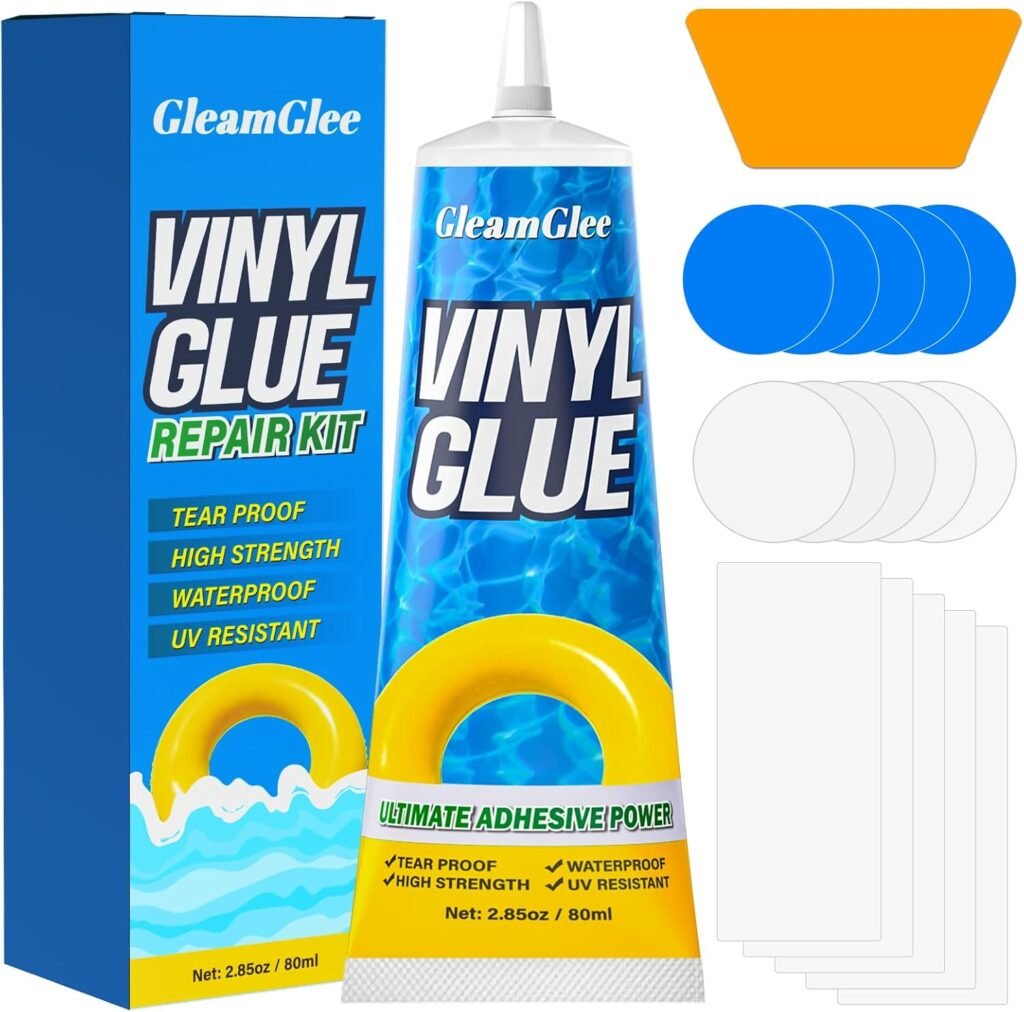
A good PVC glue should stay flexible after curing, resist water and UV exposure, and hold the patch edges tightly. GleamGlee PVC Glue Repair Kit is designed for PVC and rubber inflatables, including docks, air mattresses, inflatable pools, kayaks, boats, SUPs, rafts, and camping mats. The kit includes 80 ml premium glue, blue and clear patches, a squeegee, an applicator, and a metal nozzle for small leaks and narrow repair points.
Why BOTE Docks Leak
BOTE inflatable docks usually leak because the material is exposed to real outdoor use. A floating dock may touch rocks, dock ladders, rough ramps, shells, gravel, fishing hooks, fins, pet claws, and boat hardware. Even when the surface looks tough, one sharp point can create a tiny puncture that slowly releases air.
Many leaks are not easy to see. A dock can feel firm when first inflated, then become softer after 30–60 minutes on the water. Small leaks often show only under pressure or after people stand on the dock. Seam leaks can be harder because air may travel along the seam and escape away from the original weak spot.
Common leak causes include:
- Dragging the dock across gravel, concrete, boat ramps, or rough docks.
- Sharp rocks, shells, hooks, screws, or metal dock edges.
- Pet claws on the top deck.
- Heavy gear placed on one small area.
- Repeated folding with sand or debris trapped inside.
- Overinflation during hot sun exposure.
- Valve grit, loose valve parts, or worn valve seals.
- Long storage while damp or dirty.
| Leak Area | What Usually Causes It | What It Looks Like | Repair Difficulty |
|---|---|---|---|
| Top deck | Gear, pet claws, hooks | Tiny bubbles or slow softness | Low |
| Side wall | Dock edge impact, dragging | Air loss on curved surface | Medium |
| Bottom | Rocks, ramps, gravel | Hidden puncture or abrasion | Medium to high |
| Seam | Flexing, pressure, wear | Bubbles along seam line | High |
| Valve | Grit, loose seal, worn parts | Bubbles around valve | Medium to high |
| Handle area | Pulling, lifting, load stress | Leak near reinforced point | High |
Before repairing, locate the exact leak with soapy water. Mark the bubbling point before deflating the dock. Guessing often wastes a patch.
What PVC Glue Does
PVC glue bonds a repair patch to the dock surface and helps stop air from escaping. The patch covers the damaged area. The glue holds the patch tightly to the PVC material. Together, they create a seal that can handle inflation pressure, lake water, splashes, movement, and normal outdoor handling.
For inflatable dock repair, the patch matters as much as the glue. A tiny dot of glue may temporarily slow a pinhole, but it does not protect the surrounding material from stretching or tearing further. A patch spreads pressure across a wider area and gives the repair more strength.
PVC glue helps with:
- Sealing pinholes.
- Covering small punctures.
- Repairing short tears.
- Reinforcing worn spots.
- Helping seal minor seam leaks.
- Attaching clear or colored patches.
- Keeping repairs flexible after curing.
Patch overlap is important. The patch should extend beyond the damaged spot on all sides. For a small puncture, at least 1 inch of overlap around the hole is usually safer. For a tear, the patch should extend past both ends so the tear does not keep spreading.
| Damage Type | Glue Alone? | Patch Needed? | Better Repair Choice |
|---|---|---|---|
| Tiny pinhole | Not recommended long term | Yes | Small round patch |
| Small puncture | No | Yes | Round patch |
| Short tear | No | Yes | Rectangular patch with rounded corners |
| Seam bubble | No | Often yes | Wider patch over leak path |
| Bottom abrasion | No | Yes | Larger protective patch |
| Valve leak | Usually no | Not always | Check valve first |
GleamGlee PVC Glue stays flexible and waterproof after curing. The included squeegee helps press the patch flat and push out trapped air, which improves the seal.
When Glue Works
PVC glue works best when the leak is small or moderate, the surrounding material is still strong, and the repair area can be cleaned, dried, patched, pressed, and cured properly. It is a good choice for pinholes, small punctures, short tears, and many surface leaks on PVC inflatable docks.
Glue works well when:
- The leak location is clearly found.
- The damaged PVC is not brittle or peeling.
- The patch can fully cover the hole or tear.
- The repair area can lie flat.
- The surface is dry and free from sand, oil, sunscreen, and lake residue.
- The dock can stay deflated during repair.
- The repair can cure for about 24 hours before use.
Glue is less reliable when the dock has a long seam split, valve failure, large jagged tear, multiple leaks, or badly worn material. In these cases, a patch may still reduce air loss, but the dock should be tested carefully before real lake use.
| Repair Situation | PVC Glue Suitability | Main Risk | Best Action |
|---|---|---|---|
| Pinhole on flat deck | High | Missing the exact hole | Use soapy water, round patch |
| Small puncture on side wall | High | Curved patch edge | Press firmly with squeegee |
| Bottom scratch leak | Medium | Abrasion after repair | Use larger patch, avoid dragging |
| Short tear | Medium to high | Tear spreading | Use rectangular patch with wide overlap |
| Seam leak | Medium | Air traveling along seam | Patch wider than bubble point |
| Valve leak | Variable | Valve issue, not surface hole | Inspect valve first |
| Large jagged tear | Low to medium | Patch under high stress | Use larger patch or professional repair |
| Multiple soft spots | Low to medium | Worn material | Full inspection before repair |
A good rule: if the damaged area can be fully covered by a flat patch and the surrounding PVC still feels strong, PVC glue is usually worth trying. If the dock loses air fast after patching or bubbles continue along a seam, the damage may need a larger repair area or professional attention.
What Is PVC Glue?
PVC glue is a specialized adhesive designed to bond polyvinyl chloride (PVC) materials together. Unlike ordinary household adhesives, PVC glue is formulated to create a strong, flexible, and waterproof connection that can withstand air pressure, moisture, UV exposure, and repeated movement. It is commonly used for repairing inflatable products, PVC pipes, vinyl surfaces, air mattresses, kayaks, rafts, paddle boards, inflatable docks, and pool equipment.
For inflatable products such as a BOTE dock, PVC glue works by chemically and mechanically bonding the repair patch to the damaged PVC surface. Once cured, the adhesive forms a flexible seal that moves with the inflatable material rather than becoming brittle or cracking. This flexibility is important because inflatable docks continuously expand, contract, bend, and flex during inflation, transportation, storage, and daily use.
Not all PVC glues are the same. Some are designed for rigid PVC pipe installations, while others are formulated specifically for soft PVC and inflatable repairs. Repair-grade PVC glue usually offers waterproof performance, UV resistance, chemical resistance, and strong adhesion to PVC-coated fabrics. Products such as inflatable docks often operate under internal air pressures ranging from 8–15 PSI, meaning the adhesive must hold securely while resisting both air leakage and environmental stress.
The table below highlights the differences:
| Feature | Inflatable PVC Glue | PVC Pipe Cement |
|---|---|---|
| Designed for Flexible PVC | Yes | No |
| Suitable for BOTE Docks | Yes | No |
| Waterproof After Cure | Yes | Yes |
| Remains Flexible | Yes | No |
| UV Resistance | Usually Yes | Limited |
| Works with Repair Patches | Yes | No |
| Suitable for Air Retention | Yes | No |
For BOTE inflatable dock repairs, a flexible inflatable-grade PVC glue combined with a properly sized patch provides the most reliable solution for sealing leaks, repairing punctures, and restoring long-term performance.
Which PVC Glue for BOTE Dock?
The best PVC glue for BOTE dock repair should be waterproof, flexible, UV-resistant, and compatible with PVC inflatable material. It should bond a patch tightly to the dock surface, seal air pressure from the inside, resist water from the outside, and stay flexible when the dock is inflated, stepped on, folded, or stored.
A BOTE inflatable dock is not repaired the same way as a hard plastic item. The repair area moves every time someone climbs onto the dock, shifts weight, kneels, sits near the edge, or pulls the dock from water. A glue that cures too hard may crack or lift at the patch edge. A glue that is not waterproof may soften after lake use. A glue that is not UV resistant may weaken faster under summer sun.
For most BOTE dock repairs, choose PVC glue made for inflatables, not general craft glue, school glue, wood glue, or tape. The glue should work with a PVC patch, cure into a flexible seal, and hold after 24 hours of drying. GleamGlee PVC Glue Repair Kit fits these needs with waterproof adhesive, UV-resistant performance, flexible bonding, clear and blue patches, a metal nozzle, an applicator, and a rubber squeegee.
Waterproof Hold
Waterproof hold is the first thing to check because an inflatable dock spends most of its life around water. The patch may face lake water, pool water, splashes, rain, wet feet, damp towels, and underwater pressure. If the glue weakens when wet, the patch can lift at the edge and the dock will start leaking again.
Waterproof PVC glue is most important for:
- Bottom punctures that stay in contact with water.
- Sidewall leaks near the waterline.
- Seam leaks exposed to splashing.
- Repairs used on lakes, pools, rivers, and marinas.
- Docks stored damp after use.
- Inflatable platforms used by swimmers and paddleboarders.
A waterproof repair still needs dry curing. The damaged area should be cleaned, dried, glued, patched, pressed, and left alone before the dock returns to water. Do not patch beside the lake and immediately relaunch unless the product instructions allow emergency use. A repair that cures dry is much more reliable than a rushed wet repair.
| Repair Area | Water Exposure | Waterproof Need | Safer Test |
|---|---|---|---|
| Top deck pinhole | Low to medium | Medium | Soapy water after inflation |
| Sidewall leak | High | High | Bubble test plus shallow water |
| Bottom puncture | Very high | Very high | Shallow water test before full use |
| Seam leak | High | Very high | Test along full seam path |
| Valve-area leak | Medium | Depends on valve cause | Check valve first |
| Handle-zone damage | Medium to high | High | Test under light load |
After curing, inflate the dock and spray soapy water around the patch. If bubbles appear, air is still escaping. If no bubbles appear, do a short shallow-water test before using the dock far from shore.
Flexible Seal
Flexible seal matters because a BOTE dock bends and moves in use. People stand, sit, climb, kneel, and shift gear across the surface. The dock also expands when inflated and compresses when deflated. A stiff glue line may look strong at first but can peel after several inflation cycles or after being folded for storage.
A flexible PVC glue should handle:
- Foot pressure on the deck.
- Sidewall movement in waves.
- Climbing from the water.
- Folding or rolling after deflation.
- Temperature changes between sun and water.
- Repeated wet-dry cycles.
- Small surface movement around seams.
GleamGlee PVC Glue is designed to stay flexible yet strong after curing. This is important for a BOTE dock because the patch must move with the PVC surface instead of fighting against it. A flexible bond also reduces edge lifting, especially on curved sidewalls, bottom patches, and seam-adjacent repairs.
A flexible seal works best when the patch is pressed flat. Air bubbles under a patch become weak spots. The rubber squeegee in the GleamGlee kit helps push trapped air outward and improves contact between the patch and the dock surface.
| Dock Movement | Repair Risk | Flexible Glue Benefit |
|---|---|---|
| Standing and walking | Patch edge stress | Moves with surface |
| Climbing from water | Sudden pressure | Reduces cracking |
| Wave movement | Repeated bending | Helps maintain seal |
| Deflation and folding | Crease stress | Lowers edge lift |
| Sidewall curve | Uneven patch contact | Better shape following |
| Storage rolling | Repeated compression | Less brittle repair |
For a large inflatable dock, flexibility is not optional. It is part of the repair strength.
UV Resistance
UV resistance is important because BOTE docks are often used in direct sunlight. Sun exposure heats the dock surface, raises internal air pressure, and can age both PVC material and adhesive. A repair that holds well indoors may weaken faster if the glue is not made for outdoor use.
UV-resistant PVC glue is useful for:
- Lake platforms used in summer.
- Floating docks left on the water for hours.
- Poolside inflatables.
- Inflatable boats and kayaks.
- SUPs and rafts.
- Fishing float tubes.
- Outdoor camping inflatables.
Heat and UV exposure can stress a repair in two ways. First, sunlight can warm the adhesive and patch area. Second, warm air inside the inflatable expands, pushing harder against the repair. If the patch is small or poorly bonded, this pressure can lift the edge.
Good habits after repair:
- Let the patch cure indoors or in shade.
- Avoid overinflating the dock in hot sun.
- Store the dock dry and shaded when not in use.
- Avoid folding directly across a fresh repair.
- Rinse off lake grime, salt, or sand before storage.
- Check the patch after the first few trips.
| Outdoor Factor | What It Can Do | Better Habit |
|---|---|---|
| Direct sun | Heats patch and PVC | Shade when possible |
| Hot air expansion | Raises internal pressure | Avoid overinflation |
| UV exposure | Ages weak adhesive | Use UV-resistant glue |
| Sand and grit | Weakens future patching | Clean before repair |
| Wet storage | Can affect patch edges | Dry before packing |
| Dragging on ramps | Abrades bottom patch | Carry instead of drag |
GleamGlee PVC Glue is made for outdoor and water-use repairs, including inflatable docks, kayaks, boats, SUPs, air mattresses, inflatable pools, and other PVC or rubber products. Its waterproof, flexible, and UV-resistant repair performance makes it a practical choice when the dock needs to return to real lake use, not just pass a quick indoor test.
How to Use PVC Glue for BOTE Dock?
Using PVC glue correctly is often more important than the glue brand itself. Many inflatable dock repairs fail because the surface was not cleaned properly, the patch was too small, trapped air remained under the patch, or the dock was inflated before the adhesive fully cured. A well-prepared repair can last for years, while a rushed repair may begin leaking again within days.
For a BOTE inflatable dock, the goal is not simply covering a hole. The objective is creating a waterproof, flexible seal that can withstand internal air pressure, foot traffic, wave movement, UV exposure, and repeated inflation cycles. Every step contributes to the final repair strength.
Most successful repairs follow a simple sequence: locate the leak, prepare the surface, apply the adhesive correctly, install the patch, remove trapped air, and allow sufficient curing time. Skipping any of these steps reduces the chance of achieving a long-lasting repair.
Step 1: Find the Leak
Before opening the glue, the exact leak location must be identified. Many inflatable dock owners assume they know where the damage is, only to discover later that air is escaping from a different area. Small punctures can lose pressure slowly and may be almost invisible.
The most reliable method is a soap-and-water leak test.
Mix water with a small amount of dish soap and apply it to suspected areas using a sponge or spray bottle. Inflate the dock to its recommended operating pressure first. Air escaping through a leak will create visible bubbles.
Pay special attention to:
- Carry handles
- Dock corners
- Sidewalls
- Valve areas
- Seams
- Areas that frequently contact docks or rocks
- Places where equipment is stored
Once bubbles appear, circle the area with a waterproof marker. Marking is important because small leaks can become difficult to locate again after deflation.
| Leak Size | Visibility | Air Loss Speed | Detection Method |
|---|---|---|---|
| Pinhole | Very difficult | Slow | Soap bubbles |
| Needle puncture | Difficult | Slow to medium | Soap bubbles |
| Small tear | Easy | Medium | Visual + soap test |
| Seam leak | Moderate | Medium | Soap test along seam |
| Valve leak | Moderate | Medium to fast | Valve bubble test |
| Large tear | Obvious | Fast | Visual inspection |
A leak that appears tiny can still cause noticeable pressure loss during a full day on the water.
Step 2: Clean the Repair Area
Surface preparation determines how well the adhesive bonds. Even premium PVC glue can fail if dirt, sunscreen residue, algae, body oils, sand, or moisture remain on the repair area.
After locating the leak:
- Deflate the dock completely.
- Wipe away dirt and debris.
- Remove sand from textured surfaces.
- Clean several inches around the damaged area.
- Dry the surface thoroughly.
For best results, clean an area larger than the planned patch size. A patch only bonds as well as the surface beneath it.
Many repair failures occur because water remains trapped inside tiny scratches or fabric textures. Even when the surface feels dry, hidden moisture can weaken adhesion.
Allow additional drying time if:
- The dock was recently in water.
- The repair area is shaded or humid.
- The leak is near a seam.
- Water entered through the puncture.
| Surface Condition | Repair Quality |
|---|---|
| Completely clean and dry | Excellent |
| Slight dust present | Good |
| Sand trapped under patch | Poor |
| Damp surface | Poor |
| Sunscreen residue | Poor |
| Algae or lake slime present | Very poor |
Taking an extra 10–15 minutes for cleaning can significantly improve repair durability.
Step 3: Apply PVC Glue Correctly
Applying too much glue is a common mistake. Excess adhesive does not automatically create a stronger repair. In many cases, thick glue layers cure unevenly and trap air beneath the patch.
Using the GleamGlee metal nozzle allows controlled application, especially around pinholes, narrow tears, and curved sidewalls.
Apply an even adhesive layer over:
- The damaged area
- The entire patch contact zone
The adhesive should cover the repair surface uniformly without large puddles.
For small punctures:
- Use a round patch.
- Extend at least 1 inch beyond the hole.
For tears:
- Use a rectangular patch.
- Extend well beyond both ends of the tear.
Patch sizing matters because air pressure pushes outward from the damaged area. Larger overlap distributes stress across a wider section of PVC.
| Damage Type | Recommended Patch Margin |
|---|---|
| Pinhole | 1 inch around hole |
| Small puncture | 1–1.5 inches |
| 1-inch tear | 2 inches beyond ends |
| Sidewall damage | 1.5–2 inches |
| Seam leak | Wide coverage area |
| Abrasion zone | Entire worn section |
Proper glue coverage combined with sufficient patch overlap creates a stronger seal than glue alone.
Step 4: Install and Press the Patch
Once the adhesive is applied, place the patch carefully. Repositioning repeatedly can weaken the bond and introduce contamination.
Start from one side and slowly lower the patch onto the repair area. This method helps reduce trapped air.
After placement:
- Press firmly from the center outward.
- Remove air bubbles.
- Smooth patch edges.
- Apply consistent pressure.
The GleamGlee repair kit includes a rubber squeegee designed specifically for this step.
Trapped air creates weak spots that can eventually become leak points. Even a tiny bubble can reduce contact between the patch and dock surface.
Pay special attention to:
- Patch corners
- Curved sidewalls
- Textured PVC surfaces
- Areas near seams
The patch should lie completely flat without lifting edges.
| Patch Condition | Repair Reliability |
|---|---|
| Fully flat | Excellent |
| Small edge lift | Moderate |
| Air bubble under center | Reduced |
| Wrinkled patch | Reduced |
| Uneven pressure | Reduced |
| Properly squeegeed | Excellent |
The goal is full contact between patch and PVC across the entire repair area.
Step 5: Allow Full Cure Time
The final stage is often the most difficult because it requires patience.
Many inflatable owners inflate the dock too early after seeing the patch appear secure. While the repair may feel bonded after a short period, internal curing continues much longer.
For GleamGlee PVC Glue:
- Initial bonding occurs quickly.
- Strength continues increasing over time.
- Maximum sealing performance develops after approximately 24 hours.
During curing:
- Keep the dock deflated.
- Avoid folding the repair area.
- Avoid direct sunlight.
- Avoid water exposure.
- Avoid moving the patch.
The first 24 hours have a major influence on long-term durability.
| Cure Time | Approximate Repair Strength |
|---|---|
| 1 hour | Initial hold |
| 4 hours | Moderate hold |
| 8 hours | Stronger bond |
| 12 hours | Near functional |
| 24 hours | Full repair strength |
| 48 hours | Maximum stability |
After curing, inflate the dock gradually rather than immediately bringing it to maximum pressure.
Perform a second soap-bubble test around the repair. If no bubbles appear, the dock is ready for water use. Many properly executed PVC patch repairs remain airtight through hundreds of inflation cycles, multiple seasons of use, and continuous exposure to water, sunlight, and recreational activity.

What PVC Glue Tips Help BOTE Dock?
The best PVC glue tips for BOTE dock repair are to choose the right patch, press the patch flat, and test the repair after curing. A strong repair depends on clean surface prep, enough patch overlap, even glue coverage, steady pressure, and at least 24 hours of curing before reinflation and water use.
A BOTE inflatable dock works under real pressure: body weight, water movement, sun heat, repeated inflation, folding, and storage. A patch that looks fine on the table may fail on the lake if it is too small, wrinkled, placed over dirt, or tested too early. The repair should be treated like a pressure seal, not a sticker.
Most repair failures come from simple mistakes: patching the wrong spot, using a patch barely larger than the hole, leaving sand or sunscreen on the surface, trapping air under the patch, or inflating the dock too soon. Slowing down during the repair often saves a second repair later.
Pick Patch
Pick the patch based on the damage shape, not only the hole size. A pinhole and a tear need different patch coverage. A flat deck leak and a seam leak also need different patch planning. The patch should always extend beyond the damaged area because air pressure pushes outward from inside the dock.
Round patches work well for pinholes and small punctures because they have no sharp corners. Corners are common places for edge lift. Rectangular patches are better for longer tears, scratches, and seam-adjacent damage, but rounded corners are safer if trimming is needed.
Patch selection tips:
- Use a round patch for pinholes.
- Use a round patch for small punctures.
- Use a rectangular patch for straight tears.
- Use a larger patch for bottom abrasion.
- Use clear patches on visible top-deck areas.
- Use wider coverage around seams.
- Do not use a patch that barely covers the hole.
| Damage Type | Better Patch Choice | Patch Size Tip |
|---|---|---|
| Pinhole | Clear round patch | Cover at least 1 inch around hole |
| Small puncture | Round patch | Keep full edge contact |
| Short tear | Rectangular patch | Extend past both tear ends |
| Bottom scrape | Larger patch | Cover full worn area |
| Seam leak | Longer patch | Cover full bubbling path |
| Visible deck damage | Clear patch | Keep look cleaner |
| Curved sidewall | Flexible patch shape | Avoid wrinkles |
A patch that is too small may seal at first, then leak again once the dock is loaded. It is better to use a slightly larger patch than to redo the same repair on the next lake trip.
Press Flat
Pressing the patch flat is one of the most important parts of PVC dock repair. Glue needs full contact with both the patch and the dock surface. Any trapped air bubble, dry edge, wrinkle, or lifted corner becomes a weak point.
After placing the patch, press from the center outward. This pushes air and extra glue toward the edges. Use a rubber squeegee if available. GleamGlee’s repair kit includes a squeegee for this reason. It helps create even contact and reduces hidden air pockets under the patch.
Good pressing habits:
- Place the patch once; avoid repeated repositioning.
- Press from the center to the outside.
- Push out trapped air bubbles.
- Check every edge.
- Keep the repair area flat.
- Add steady pressure, not sliding pressure.
- Do not fold the patch area while curing.
| Patch Problem | What Happens Later | How to Avoid It |
|---|---|---|
| Air bubble | Leak path may reopen | Press center outward |
| Dry edge | Patch corner lifts | Apply glue to full contact area |
| Wrinkle | Uneven seal | Keep material flat |
| Sand under patch | Weak bond | Clean wider area first |
| Patch too small | Pressure escapes at edge | Use larger overlap |
| Early inflation | Patch may lift | Wait full cure |
For sidewall repairs, take extra care because the patch needs to follow a curve. For bottom repairs, check that the patch is not placed across a crease. For seam repairs, press along the seam path slowly so the patch bonds to every raised or curved area.
Test Later
Test the repair later, not immediately after patching. A patch can feel secure before the glue has cured. Inflating the dock too soon puts internal air pressure against the patch while the adhesive is still building strength. Water testing too early can also weaken the bond.
A safer testing process is simple:
- Let the repair cure for about 24 hours.
- Inflate the dock gradually.
- Spray soapy water over the patch.
- Watch for bubbles around the patch edge.
- Let the dock sit inflated for 30–60 minutes.
- Test in shallow water before full use.
- Check the patch again after the first trip.
| Test Stage | What to Check | Good Sign |
|---|---|---|
| First inflation | Patch edge movement | Patch stays flat |
| Soapy-water test | Bubbles around patch | No bubbles |
| 30–60 minute air hold | Dock firmness | No softness |
| Shallow water test | Leak under light use | No air trails |
| Light load test | Patch under pressure | No edge lift |
| After first use | Peel, bubbles, softness | Repair remains smooth |
Do not test a repaired dock far from shore on the first use. Keep the first water test short and controlled. If the dock stays firm, the patch edge remains flat, and no bubbles appear, the repair is ready for normal use with sensible care.
Is PVC Glue for BOTE Dock Waterproof?
PVC glue for BOTE dock repair should be waterproof after curing because the repaired area may sit in lake water, pool water, rain, splashes, and wet storage conditions. A proper waterproof repair needs three things working together: compatible PVC glue, a well-sized patch, and a fully cured bond before the dock returns to water.
Waterproof glue does not fix every repair mistake. If the patch is too small, the surface is damp, sand remains under the edge, or the dock is inflated too soon, water and air pressure can still break the seal. A repaired inflatable dock faces pressure from both sides: air pushing outward from inside and water pressing against the outside surface.
GleamGlee PVC Glue is designed for waterproof outdoor repair on PVC and rubber inflatables. After curing, the bond stays flexible and strong, helping it handle lake use, splash zones, wet feet, hot water, chemicals, UV exposure, and repeated inflation. For BOTE dock repair, the safest habit is to cure for about 24 hours, test with soapy water, then try shallow water before full use.
Lake Use
Lake use is one of the toughest tests for a repaired BOTE dock. The patch may face water, sun, foot traffic, gear weight, pet claws, sand, mud, and dock friction in the same day. A top-deck patch may get stepped on. A sidewall patch may stay wet for hours. A bottom patch may touch rocks, ramps, or lakebeds during launch.
Before taking a repaired dock back to the lake:
- Let the repair cure fully.
- Inflate the dock gradually.
- Check the patch with soapy water.
- Keep the first lake test close to shore.
- Avoid loading coolers or heavy gear directly on the patch.
- Avoid dragging the repaired area over ramps or rocks.
- Check the patch again after the first use.
| Lake Situation | Repair Stress | Safer Handling |
|---|---|---|
| Hot sun | Higher internal pressure | Avoid overinflation |
| Shallow rocks | Bottom patch abrasion | Carry the dock |
| Heavy coolers | Point pressure on deck | Keep weight away from patch |
| Kids climbing | Repeated flexing | Watch sidewall repairs |
| Pet use | Claw pressure | Keep pets off fresh repair area |
| Dock rubbing | Edge wear | Use soft tie-off points |
| Long water time | Extended moisture exposure | Inspect after use |
A waterproof repair can handle lake use better when the dock is not abused during the first trip after patching. Treat the repaired area as a strengthened but still sensitive point.
Seam Leaks
Seam leaks need more care than flat-surface pinholes. A seam is already a bonded or welded area that handles air pressure and flexing. When air escapes from a seam, it may travel under the seam and bubble out away from the weak point. Patching only the first visible bubble may not stop the full leak.
For seam leaks, mark the full bubbling path before repair. Apply glue and patch coverage beyond the visible leak area. Use steady pressure along the seam shape and make sure the patch edge is fully sealed. A small round patch may work for one tiny seam bubble, but longer bubbling often needs a longer patch.
Seam leak repair tips:
- Test the seam with soapy water while inflated.
- Mark every bubbling point.
- Deflate before applying glue.
- Clean wider than the patch area.
- Use enough patch length to cover the leak path.
- Press along the seam carefully.
- Cure fully before reinflation.
- Retest the entire seam, not just the patch center.
| Seam Leak Type | Repair Difficulty | Patch Choice | Main Risk |
|---|---|---|---|
| Single tiny bubble | Medium | Round or small rectangle | Missing nearby leak path |
| Short bubbling line | High | Longer rectangle | Air travels under seam |
| Corner seam leak | High | Flexible shaped patch | Edge lifting |
| Handle-side seam | High | Larger coverage | Pulling stress |
| Long seam split | Very high | Professional repair may be needed | Reopening under pressure |
| Repeated seam leak | Very high | Full inspection | Material fatigue |
A seam repair should be tested longer than a simple puncture repair. Let the dock sit inflated for at least 30–60 minutes after the bubble test and check whether firmness drops.
Underwater Use
PVC glue can support underwater use after it has fully cured, but the repair should not be done underwater. The dock should be repaired on land, with the surface clean, dry, deflated, patched, pressed, and cured. Moisture under a patch can block adhesion and create a weak seal.
Underwater-facing repairs include bottom punctures, lower sidewall leaks, and seam areas that sit below the waterline. These repairs need waterproof glue and enough patch coverage. Bottom repairs also need abrasion protection because lakebeds, rocks, sand, and ramps can scrape the patch after repair.
For underwater-facing repair areas:
- Repair on dry land.
- Clean beyond the patch edge.
- Use a larger patch for bottom damage.
- Press out all trapped air.
- Cure for about 24 hours.
- Test with soapy water before lake use.
- Avoid dragging the patched area.
| Repair Area | Water Contact | Extra Risk | Better Use Habit |
|---|---|---|---|
| Top deck | Splash only | Foot pressure | Keep sharp gear away |
| Sidewall | Frequent water | Curved flexing | Use flexible patch |
| Bottom | Constant water | Abrasion | Carry instead of drag |
| Seam below waterline | Constant water and pressure | Hidden air path | Patch wider |
| Valve area | Splash and pressure | Valve seal issue | Check valve first |
| Handle zone | Splash and pulling | Load stress | Avoid lifting from damaged area |
A waterproof PVC glue helps the patch survive water exposure, but the repair still depends on dry preparation, flat patch contact, full curing, and careful handling after repair.
Can PVC Glue Fix BOTE Dock Tears?
PVC glue can fix many BOTE dock tears when the damaged area is not too large, the surrounding PVC still feels strong, and a patch can cover the tear with enough overlap. It works best for pinholes, small punctures, short tears, and some minor seam splits. Long jagged tears, worn fabric, valve damage, or repeated seam failure may need a larger repair plan.
A tear needs more attention than a tiny pinhole. A pinhole only has one small air path. A tear has length, direction, and stress at both ends. When the dock is inflated, air pressure pushes outward. When someone stands or climbs on the dock, the tear area flexes. If the patch is too small, the tear may keep spreading under the patch edge.
Before applying glue, check three things: the tear length, the tear location, and the condition of the PVC around it. A 0.5-inch tear on a flat top surface is much easier to patch than a 2-inch tear near a seam or handle. Bottom tears also need more care because the repaired area may rub against rocks, ramps, docks, or sand during launch.
Pinholes
Pinholes are the easiest BOTE dock tears to repair, but they are often the hardest to find. A pinhole may come from a fishhook, shell point, gravel, pet claw, sharp fin, small screw, or trapped debris in storage. The dock may stay firm for the first few minutes, then slowly soften over 30–60 minutes.
A pinhole should still be patched. Glue alone may slow the leak, but a patch gives stronger long-term protection. A round patch is usually best because it has no corners to lift. Clear round patches are useful on visible top-deck areas because they keep the repair cleaner-looking.
Pinhole repair points:
- Find the exact leak with soapy water.
- Mark the bubbling point before deflating.
- Clean at least 2–3 inches around the mark.
- Use a small round patch with full edge contact.
- Press from the center outward.
- Cure about 24 hours before reinflation.
| Pinhole Area | Repair Chance | Best Patch | Main Mistake |
|---|---|---|---|
| Top deck | High | Clear round patch | Missing the exact hole |
| Side wall | High | Round flexible patch | Edge not pressed flat |
| Bottom | Medium to high | Larger round patch | Future abrasion |
| Near seam | Medium | Wider round or small rectangle | Not covering leak path |
| Near valve | Variable | Patch only if surface leak | Ignoring valve seal issue |
After curing, inflate the dock and test the patch with soapy water. No bubbles should appear around the patch edge or center.
Small Tears
Small tears can often be fixed with PVC glue and a properly sized patch. A tear is more serious than a pinhole because the cut can spread from both ends. The patch should extend beyond the entire tear, not just cover the middle. For short straight tears, a rectangular patch with rounded corners usually gives better coverage.
A good patch margin matters. For a 1-inch tear, the patch should extend well past both ends. If the tear sits on a high-flex area, use more overlap. If the tear is on the bottom, choose a patch large enough to protect nearby worn PVC, not only the visible cut.
Small tear repair tips:
- Do not pull the tear open.
- Keep the material flat before gluing.
- Clean beyond the full patch area.
- Use a rectangular patch for longer cuts.
- Round patch corners if trimming by hand.
- Press the whole patch surface evenly.
- Keep the patch dry and flat while curing.
| Tear Length | Repair Difficulty | Better Patch Choice | Caution |
|---|---|---|---|
| Under 0.25 in | Low | Round patch | Still needs full cure |
| 0.25–1 in | Medium | Round or rectangle | Cover both tear ends |
| 1–2 in | Medium to high | Rectangular patch | Use wider overlap |
| Over 2 in | High | Larger reinforcement patch | May need professional repair |
| Jagged tear | High | Larger custom patch | Uneven edges are harder to seal |
| Bottom tear | High | Large protective patch | Avoid dragging after repair |
A small tear repair should be checked after the first lake use. If the patch edge lifts or the dock softens again, the repair area may need a larger patch.
Seam Splits
Seam splits are harder to repair than flat punctures because seams already carry stress. A seam may flex when the dock is inflated, stepped on, folded, or pulled from the water. Air can also travel under the seam and escape several inches away from the weak point. That means one visible bubble may not show the full problem.
For seam splits, inspect the full seam line with soapy water. Mark every bubble, not only the first one. The patch should cover the full leaking area with extra overlap. A tiny patch over one bubble may fail if air continues to travel under the seam.
Seam split repair tips:
- Inflate and test the whole seam area.
- Mark the start and end of bubbling.
- Deflate before patching.
- Clean wider than normal.
- Use a longer patch when bubbles appear in a line.
- Press carefully along the seam shape.
- Cure fully before any pressure test.
- Retest after 30–60 minutes of inflation.
| Seam Split Type | Repair Chance | Main Risk | Better Handling |
|---|---|---|---|
| One small seam bubble | Medium | Missing nearby weak point | Patch wider than bubble |
| Short seam split | Medium | Edge lifting | Use longer patch |
| Corner seam leak | Low to medium | Curved stress | Flexible patch and careful pressure |
| Handle-side seam | Low to medium | Pulling force | Avoid lifting from that area |
| Long seam separation | Low | Reopening under pressure | Professional repair |
| Repeated seam leak | Low | Material fatigue | Full dock inspection |
A repaired seam should be treated gently on the first trip. Keep heavy coolers, anchors, ladders, and repeated climbing pressure away from the repaired zone. A seam patch can work well for small leaks, but it needs more patience than a simple top-deck pinhole.

Why Choose GleamGlee PVC Glue?
GleamGlee PVC Glue is designed for inflatable repair situations where strength, waterproof performance, flexibility, and ease of use matter most. Whether repairing a BOTE inflatable dock, kayak, paddle board, raft, pool float, air mattress, or inflatable boat, the goal is not simply sealing a hole—it is creating a repair that can continue performing through repeated inflation cycles, outdoor exposure, water contact, and daily use.
Many inflatable products fail in demanding environments. Summer temperatures can push surface temperatures above 120°F (49°C) in direct sunlight. Inflatable docks regularly support hundreds of pounds of combined weight from people, coolers, fishing gear, and water equipment. A repair adhesive must withstand far more than a simple puncture test.
GleamGlee PVC Glue Repair Kit combines waterproof adhesive, flexible bonding performance, UV resistance, precision application tools, and multiple patch options into a complete repair solution. Instead of searching separately for glue, patches, applicators, and repair accessories, everything needed for most inflatable repairs is included in one package.
Strong Waterproof Repair
Water is the biggest challenge for any inflatable repair. A repair that works indoors may fail after repeated lake use if the adhesive softens, cracks, or loses grip around the patch edge.
GleamGlee PVC Glue is formulated for environments where water exposure is constant. After curing, the adhesive forms a waterproof seal that helps prevent air loss while maintaining flexibility. This allows repairs to handle splashes, rain, wet storage conditions, swimming activity, and prolonged contact with water.
For BOTE docks, waterproof performance matters because repairs often face:
- Continuous lake exposure
- Pool chemicals
- Saltwater splashes
- Rainfall
- Wet gear storage
- High humidity
- Repeated wet-dry cycles
Many inflatable repairs initially appear successful but begin leaking again weeks later because moisture gradually weakens poor-quality adhesive bonds. A properly cured waterproof repair greatly reduces this risk.
| Repair Environment | Waterproof Demand |
|---|---|
| Air mattress | Medium |
| Pool float | High |
| Inflatable dock | Very High |
| Inflatable kayak | Very High |
| Paddle board | Very High |
| Raft | Very High |
| Fishing float tube | Very High |
The combination of waterproof adhesive and durable patch material allows the repaired area to continue performing under real outdoor conditions rather than only under short-term testing.
Complete Repair Kit
Many repair projects fail because important tools are missing. People often purchase glue but discover later they need patches, applicators, spreaders, or a better way to reach small leaks.
The GleamGlee PVC Glue Repair Kit includes:
- 80ml premium PVC adhesive
- 5 blue round patches
- 5 transparent round patches
- 5 transparent rectangular patches
- Rubber squeegee
- Precision applicator
- Metal nozzle system
This combination allows repairs on different types of damage without needing additional purchases.
The clear patches are especially useful for visible repair areas where appearance matters. Blue patches provide highly visible coverage for larger repair zones. Rectangular patches work well for tears and seam repairs, while round patches are ideal for pinholes and punctures.
| Included Item | Purpose |
|---|---|
| PVC Glue | Bonds patch to surface |
| Round Patches | Pinholes and punctures |
| Rectangular Patches | Tears and longer damage |
| Clear Patches | Less visible repairs |
| Blue Patches | Larger repair coverage |
| Squeegee | Removes trapped air |
| Applicator | Even glue spreading |
| Metal Nozzle | Precision leak repair |
Having multiple patch styles available immediately helps match the repair method to the damage rather than forcing every repair into a single solution.
Precision Application
Small leaks often create the biggest repair challenges. A large tear is usually easy to see. A tiny puncture hidden near a seam, handle, or curved sidewall can be much harder to repair cleanly.
GleamGlee uses a specially designed metal nozzle that helps direct adhesive precisely where it is needed. This reduces excess glue spread and improves control around narrow repair areas.
Precision becomes especially valuable for:
- Pinholes
- Needle punctures
- Seam bubbles
- Valve-adjacent repairs
- Tight corners
- Curved sidewalls
- Small inflatable accessories
Applying excessive adhesive can create uneven curing and increase cleanup work. Controlled application helps create cleaner repairs while reducing waste.
A precision nozzle also helps extend the usable life of the adhesive because less product is wasted during each repair.
| Repair Type | Precision Importance |
|---|---|
| Pinhole | Very High |
| Small puncture | High |
| Short tear | High |
| Seam leak | Very High |
| Valve area | Very High |
| Large patch repair | Medium |
Accurate application becomes increasingly important as damage size decreases.
Built for Real Outdoor Use
Inflatable docks are not used in laboratory conditions. They are dragged across docks, exposed to sunlight, splashed by waves, loaded with gear, stepped on by adults and children, and stored in garages, boats, and vehicles.
The repair system must handle:
- UV exposure
- Heat cycles
- Water pressure
- Foot traffic
- Dock flexing
- Repeated inflation
- Repeated deflation
- Seasonal storage
GleamGlee PVC Glue is designed for PVC and rubber products that operate in these environments. The adhesive remains flexible after curing, helping the patch move with the inflatable material rather than becoming brittle.
Common repair applications include:
- BOTE inflatable docks
- Inflatable SUPs
- Air mattresses
- Inflatable boats
- Kayaks
- Rafts
- Pool floats
- Fishing tubes
- Inflatable pools
- Camping inflatables
| Outdoor Factor | Repair Requirement |
|---|---|
| UV Exposure | UV resistance |
| Water Contact | Waterproof bond |
| Inflation Pressure | Strong seal |
| Dock Flexing | Flexible adhesive |
| Temperature Changes | Stable performance |
| Storage Folding | Crack resistance |
A repair that survives only one outing provides limited value. Long-term durability becomes more important when inflatables are used regularly throughout an entire season.
Proven Manufacturing Experience
The performance of a repair adhesive depends heavily on formulation quality and manufacturing consistency. GleamGlee benefits from extensive experience in adhesive development, material testing, and large-scale production.
The company operates specialized manufacturing facilities covering adhesive formulation, packaging production, raw material preparation, and quality control. More than 25 chemists, materials specialists, and engineers contribute to adhesive development and performance testing.
Key manufacturing strengths include:
- ISO 9001 certified production systems
- ISO 14001 environmental management
- Dedicated adhesive testing laboratories
- Accelerated aging evaluation
- Surface compatibility testing
- Raw material quality control
- Large-scale production capability
- Continuous formula optimization
Over recent years, thousands of adhesive and repair formulations have been developed and tested across multiple material categories.
For inflatable repair users, this translates into greater consistency from one batch to another and more reliable repair performance across different environmental conditions.
| Capability | Benefit |
|---|---|
| Adhesive Research Team | Formula development |
| Material Testing Labs | Better compatibility |
| Quality Control Systems | Consistent production |
| Large Manufacturing Capacity | Stable supply |
| Accelerated Aging Tests | Durability evaluation |
| Global Distribution Network | Faster availability |
For BOTE dock owners, the combination of waterproof bonding, flexible performance, complete repair accessories, precision application tools, and experienced manufacturing support makes GleamGlee PVC Glue a practical choice for maintaining inflatable equipment and extending its usable life season after season.
Conclusion
PVC glue for BOTE inflatable dock repair is a practical way to handle pinholes, small punctures, short tears, and some seam leaks when the surrounding PVC is still strong. The repair should be done with waterproof, flexible, UV-resistant glue and a patch that fully covers the damage with enough overlap. Clean the surface, dry it completely, press the patch flat, and allow about 24 hours of curing before reinflation. A rushed repair may work for a few minutes, but a patient repair is far more likely to survive real lake use.
GleamGlee PVC Glue Repair Kit is built for real inflatable repair needs: strong leak sealing, flexible waterproof bonding, clear and blue patch options, precise metal-nozzle application, and a complete set of repair tools. It helps repair BOTE docks, air mattresses, inflatable pools, kayaks, SUPs, boats, rafts, bounce houses, and many PVC or rubber inflatables. For consumers, it can save expensive outdoor gear from being discarded after one small leak. For retailers, Amazon sellers, outdoor brands, distributors, and private-label customers, GleamGlee supports branded orders, custom packaging, formula development, compliance-ready labeling, bulk supply, and global logistics for inflatable repair products.
Share:
Table of Contents
Here, creating your adhesives glue & removal cleaner collection is no longer a barrier—it’s a collaborative journey where GleamGlee helps brands and businesses transform their vision into durable, certified, and market-ready solutions.
Partner with GleamGlee
Join hundreds of global partners who trust GleamGlee for adhesives and cleaners that combine innovation, compliance, and speed. Our vertically integrated system—from R&D to warehouse—guarantees consistent performance and reliable delivery.
Whether you’re sourcing FBA-ready stock or developing your own formula, our team provides unmatched technical support and responsive service.