Skip to content
PVC Glue for iDOO Air Mattress Repair: A Practical Guide
Your trusted adhesives glue & cleaner manufacturer

Waking up on a half-deflated air mattress naturally makes the nearest tube of glue look like the answer. In practice, the glue is only one part of a successful repair. An iDOO mattress may feel softer because new PVC has stretched slightly, the room became colder overnight, the pump dial was not returned completely to the off position, or the manual valve did not seat evenly. Applying adhesive before confirming the source can cover the wrong spot, contaminate the surrounding material, and make the real leak more difficult to repair.
PVC glue can repair a small puncture in many iDOO air mattresses when the leak is located on accessible PVC, the surface is clean and dry, and the cured adhesive remains flexible. The most dependable repair usually combines compatible PVC glue with a rounded patch, firm center-to-edge pressure, and a full cure before gradual reinflation and a final soap-bubble test.
The difference between a one-night fix and a durable repair often comes down to a few quiet decisions: checking the valve before searching the floor, marking every bubble before deflation, preparing flocked material without damaging the PVC beneath it, and allowing the adhesive to cure even when the patch already feels dry. A tiny hole may take ten minutes to seal, yet rushing those earlier steps can send the sleeper back to the floor before morning.
Is Your iDOO Air Mattress Really Leaking?
An iDOO air mattress is probably leaking when it repeatedly loses substantial firmness after the pump controls, manual valve, room temperature, loading, and normal PVC settling have been checked. Mild softening during early use may be normal, while continuing collapse, localized hissing, or bubbles growing from one point usually indicates an actual leak.
Normal PVC Stretching
A newly unpacked air mattress may soften slightly during its first inflation even when the outer shell is intact. Flexible PVC, seams, and internal supports settle as pressure spreads through the mattress. The iDOO I-C-015 instructions advise allowing the mattress to rest for approximately 8–12 hours during initial inflation and explain that a small amount of early air loss can be normal. The same manual recommends short top-ups during multi-night use when additional firmness is needed. These instructions apply to that model, so owners should still check the manual supplied with their specific mattress.
Temperature can create a similar impression. Air inflated in a warm room contracts as the room cools, especially when the mattress is placed close to a cold floor, window, or tent wall. The sleeper may feel lower even though the PVC has not developed a hole. Body weight also redistributes air and compresses the internal structure, making a loaded mattress feel softer than an unloaded one.
A useful check is to inflate the mattress to comfortable firmness, return the control dial fully to off, close the manual valve, and leave the bed unloaded for several hours. Measure the height at the same location before and after the test. Slight initial settling followed by stable firmness usually points away from a puncture. A repeated, progressive drop under similar conditions calls for a structured leak inspection.
Valve and Pump Checks
Before applying soap or glue, inspect the components designed to control airflow. Many iDOO air mattresses use a built-in electric pump, a rotary control dial, and a separate manual inflation or deflation valve. On the I-C-015, the dial should align with the off arrow after inflation, and the manual valve must be pushed securely into position before its outer cover is closed. A control left slightly toward deflate can release air slowly enough to resemble a small surface puncture.
Check the manual valve for hair, lint, folded PVC, or debris caught between the sealing surfaces. Press it evenly into its recess rather than forcing one edge first. Close the cover carefully and apply light pressure to the mattress while listening around the valve. A faint hiss that stops after reseating the valve suggests a sealing issue rather than a hole in the mattress panel.
Inspect the outer edge of the pump housing without spraying liquid into the electrical assembly. The iDOO manual warns that the pump casing does not contain user-serviceable parts and should not be opened because of electrical risk. Leakage from within the pump, a cracked rigid housing, or an inaccessible internal gasket is not a suitable target for ordinary exterior PVC glue.
Signs of a Puncture
A genuine puncture normally creates a repeatable pattern. The mattress may reach full firmness normally and then lose height over several hours even when it remains unloaded. A larger opening may produce a steady hiss, while a pinhole can remain almost silent until someone presses on the mattress and increases the internal air pressure.
Common damage zones include the underside, corners, sidewalls, folded storage areas, and places that contacted a rough floor or bed frame. Staples, pet claws, zipper pulls, stones, screws, and small pieces of hard debris can produce punctures that are difficult to see. Inspect the floor or frame after finding the leak so the same object does not damage the repaired mattress again.
A scratch should not be treated as proof. Surface marks may be cosmetic, while the actual pinhole sits several centimeters away. Confirm the source with airflow or growing soap bubbles, then mark it before deflating the mattress. Continue checking the surrounding area because one sharp object can create several micro-punctures during the same incident.
| Observation | More Likely Cause | Practical Response |
|---|---|---|
| Mild softening during first uses | PVC and seam settling | Top up once and monitor |
| Softer after a cold night | Air contraction from lower temperature | Recheck at a stable room temperature |
| Hissing near the manual valve | Valve not seated or contaminated | Clean and reseat the valve |
| Bubbles growing on a flat panel | Confirmed PVC puncture | Mark, deflate, and patch |
| Leakage inside the pump area | Pump, gasket, or rigid housing issue | Seek service, warranty, or replacement |
| Large bulge or distorted surface | Possible internal support failure | Stop use and assess replacement |

What Materials Are Used in iDOO Air Mattresses?
Many iDOO air mattresses combine an airtight flexible PVC body with a soft flocked upper surface. The bottom and side panels may expose smoother PVC, while the sleeping surface carries short fibers for comfort. Glue bonds most reliably to stable PVC, so the location and texture of the puncture directly affect surface preparation and patch performance.
PVC Structure
PVC forms the main airtight chamber in many inflatable mattresses because it can be welded into shaped panels, folded for storage, and flexed under body weight. Documentation for the iDOO I-C-015 lists its material as PVC with flocked fabric and identifies a flocked side that faces upward during use. Another iDOO mattress manual similarly describes PVC with flocking, confirming that the construction is common across several models, although dimensions and panel designs vary.
The PVC wall has to perform more demanding work than a rigid plastic item. It stretches slightly during inflation, changes shape as sleepers move, bends around internal supports, and may be folded repeatedly between uses. A repaired zone therefore needs to behave like part of a flexible membrane rather than a hard plug.
Material condition matters as much as hole size. Healthy PVC usually feels flexible and returns to shape after gentle bending. A surface that feels brittle, unusually sticky, heavily cracked, or permanently distorted may continue failing around a new patch. Sealing one puncture cannot restore aging material across an entire panel.
Flocked Surfaces
Flocking is a layer of short fibers attached to the upper PVC surface. It improves comfort, reduces slipperiness, and helps bedding stay in place, but it creates a more difficult bonding surface. Adhesive applied directly over dense fibers may attach mainly to the flock rather than forming continuous contact with the airtight PVC beneath it.
A patch can look flat while microscopic air channels remain between the fibers. Some repair systems therefore require careful removal or compression of the flocking around the puncture. The method should come from the repair adhesive or patch instructions because aggressive scraping, coarse sanding, or cutting can thin the underlying PVC and enlarge the damage.
Only the minimum necessary area should be prepared. The exposed zone needs to be smaller than the final patch so its perimeter still bonds to stable material. Blunt tools and controlled preparation are safer than blades. When the puncture is on a visible sleeping surface, a transparent or color-compatible flexible patch may reduce the visual impact, but airtight contact remains more important than appearance.
Surface Location
The center of a smooth bottom panel is usually the easiest place to create a reliable patch. It can lie flat against a firm work surface, and even pressure can be applied during curing. A sidewall repair is still manageable, but it experiences more bending and tension as the mattress is loaded and unloaded.
Corners, raised channels, and welded seams create uneven geometry. A flat patch may bridge over a curve instead of contacting the entire surface. The unsupported area becomes a route for escaping air and a starting point for edge lifting. Flocked top panels add friction from sheets and body movement, placing additional stress on the repair.
Pump and valve areas are more complex because flexible PVC is joined to rigid plastic, gaskets, moving controls, and internal passages. A product described as suitable for PVC does not automatically make it appropriate for sealing a moving valve or repairing an electrical pump assembly.
| Mattress Area | Typical Surface | Repair Difficulty | Main Concern |
|---|---|---|---|
| Center of bottom panel | Smooth or lightly textured PVC | Low | Cleaning and even patch pressure |
| Flat sidewall | Flexible PVC | Low to moderate | Bending and repeated tension |
| Flocked sleeping surface | Fiber-covered PVC | Moderate | Adhesive reaching stable PVC |
| Corner or raised channel | Curved PVC | Moderate to high | Incomplete contact and edge lifting |
| Welded seam | Layered structural joint | High | Separation may continue under load |
| Pump or valve area | PVC joined to rigid parts | High | Mechanical or internal sealing failure |
Material Compatibility
A repair adhesive should specifically identify flexible PVC, vinyl, inflatables, or comparable soft plastic as suitable substrates. A general claim such as “bonds plastic” is too broad because rigid PVC, flexible vinyl, polyethylene, polypropylene, ABS, and coated fabrics behave differently during bonding.
The cured adhesive must retain enough flexibility to move with the mattress wall. Commercial flexible vinyl repair adhesives are commonly formulated to withstand bending and torsion, remain waterproof after curing, and reach full cure over approximately 24 hours. Those properties illustrate the type of performance needed, although the instructions for the chosen adhesive should always control the actual process.
Compatibility also includes the patch. The adhesive must wet the mattress PVC and the patch material without excessive softening, curling, wrinkling, or discoloration. When the package does not clearly identify inflatable PVC as a suitable application, test a very small amount on an inconspicuous area and allow it to pass through the complete curing period before proceeding.
Which Glue Is Best for iDOO Air Mattress Repair?
The best option is generally a clear, flexible adhesive formulated for soft PVC or vinyl and suitable for waterproof inflatable repairs. For most punctures and short cuts, it should be paired with a compatible flexible patch. Flexibility, airtight contact, controlled application, and full-cure strength matter more than an unusually fast surface-drying claim.
Flexible PVC Adhesive
The strongest-looking glue is not necessarily the best choice. Air mattress material stretches, bends, and redistributes pressure throughout the night. A cured adhesive that becomes hard and glass-like may hold during an initial hand test but crack after repeated flexing or concentrate stress around the edge of the patch.
Look for practical information on the label or technical sheet. Useful details include flexible PVC or vinyl compatibility, water resistance after cure, working time, initial set time, complete curing time, and whether the adhesive is intended to be used with a patch. Flexible vinyl repair products from established manufacturers commonly specify continued flexibility, waterproof performance, a short initial set, and approximately 24 hours for full cure.
A precision nozzle helps place a thin, continuous film without flooding the repair area. Thick glue is not automatically stronger. Excess material can squeeze outside the patch, trap solvent, extend curing, and form a stiff ridge. Too little adhesive leaves dry spots and narrow channels through which air can escape.
Glue with a Patch
Glue and patch material perform different jobs. The adhesive creates intimate contact and seals microscopic gaps, while the patch spreads stress beyond the damaged point. A liquid-only repair may work for a tiny pinhole when the product is designed for that purpose, but a patch normally provides better reinforcement over a cut, abrasion, or irregular puncture.
The iDOO I-C-015 package information lists two repair patches, and the accompanying repair instructions call for complete deflation, cleaning, drying, firm pressure, and a weighted curing period. Owners should check whether the supplied patch is self-adhesive or designed to work with separate glue before combining products.
As a practical rule, the patch should extend well beyond every visible edge of the puncture. A small pinhole is easier to seal with approximately 12–25 mm of sound bonding area around it than with a patch cut almost to the size of the hole. Larger tears need greater overlap, but damage that crosses a seam, corner, or pump housing may remain unreliable regardless of patch size.
Adhesive Comparison
A useful product comparison should focus on how the bond behaves after the mattress is reinflated, not only how quickly it sticks during application. General household adhesives may hold two dry samples together while failing to remain airtight under repeated pressure and flexing.
| Adhesive Type | Flexibility After Cure | Airtight Repair Potential | Main Limitation |
|---|---|---|---|
| Flexible PVC or vinyl adhesive | High | High with correct preparation | Requires compatible patch and cure time |
| PVC glue with matching patch | High | High for small holes and short cuts | Patch must lie completely flat |
| Self-adhesive PVC patch | Moderate to high | Good on clean, smooth panels | Less dependable on flocking or deep texture |
| Cyanoacrylate superglue | Usually low | Unreliable under repeated flexing | May become brittle or leave whitening |
| Hot-melt glue | Variable | Usually poor for lasting repair | Heat may distort PVC and edges may peel |
| General craft adhesive | Low | Poor | Often not waterproof or pressure-resistant |
| Rigid PVC pipe cement | Product-dependent | Uncertain | Intended for rigid joints, not necessarily inflatables |
The descriptions above are category-level comparisons. Formulas vary, so the product instructions and stated substrate compatibility should take priority. An adhesive marketed and tested for flexible vinyl or inflatable repair is more relevant than one chosen because it performs well on hard plastic, ceramic, or wood.
Adhesives to Avoid
Common superglue is attractive because it bonds quickly, but many cyanoacrylate formulas cure too rigidly for a flexible air chamber. The hardened area may crack when the mattress is folded, and the edge can become a stress point in the surrounding PVC. White blooming may also make the repair conspicuous.
Hot glue introduces heat to a thin thermoplastic surface. Even when visible melting does not occur, the cooled glue may peel as the mattress stretches. School glue, general craft adhesive, and many household pastes are not designed to create a waterproof, airtight film under continuous internal pressure.
Ordinary tape may temporarily help identify or protect a leak, but it should not be confused with a permanent PVC patch. Pressure-sensitive tape adhesives can creep, collect dirt, or lift during folding. Rigid plumbing cement should also be avoided unless its manufacturer explicitly confirms compatibility with flexible inflatable PVC.
Cure speed should never be the only deciding factor. A repair that feels dry after ten minutes may still need a full day before it can tolerate internal pressure. Flexible vinyl repair adhesives commonly distinguish between initial set and full cure, with complete curing often taking around 24 hours.

How Do You Find a Slow Leak?
Fully inflate the mattress, close every control, and inspect it in a consistent pattern. Begin by listening and feeling for airflow, then use a mild soapy-water solution on suspected non-electrical areas. Escaping air creates bubbles that continue growing from one point. Mark every confirmed leak before deflation and inspect nearby material for additional punctures.
Listen and Feel
Choose a quiet room and remove background noise from fans, television, and open windows. Inflate the mattress to normal sleeping firmness, return the pump control to off, close the manual valve, and unplug the power cord. Press gently on one part of the mattress while listening close to another.
The iDOO I-C-015 instructions suggest placing the ear approximately 5–7 cm from the inflated surface while applying pressure. A larger puncture may produce a clear hiss, while a pinhole may only be heard when the nearby panel is compressed. The same manual recommends moving a wet hand around the surface because escaping air can feel cool against damp skin.
Work systematically instead of following every visible scratch. Inspect the top in overlapping passes, then move around the sidewalls, corners, underside, valve, and accessible pump perimeter. Bright side lighting can make tiny cuts and raised edges easier to see, especially on dark or textured PVC.
Use Soapy Water
A soap-bubble test is one of the most sensitive household methods for locating a slow leak. The iDOO manual recommends adding a small amount of liquid dish soap to warm water, applying the mixture systematically, and observing whether escaping air creates bubbles on the surface. Testing should begin around the valve before moving across the rest of the mattress.
Use a weak mixture rather than a thick foam. Apply a limited amount with a soft sponge, cloth, or spray bottle and watch each area for several seconds while pressing gently on the mattress. Random foam created by wiping may remain still or collapse. A real leak repeatedly produces new bubbles from the same point.
Keep the solution away from electrical openings, motor vents, switches, and the power-cord compartment. Do not flood the pump housing or submerge a mattress with an integrated electric pump. After testing, remove the detergent with a clean damp cloth and allow the repair area to dry fully because soap residue can weaken adhesive contact.
Mark Every Leak
Mark the puncture while the mattress is still inflated and the bubbles are visible. Draw a circle around the source rather than placing ink directly inside the planned bonding zone. A small piece of low-tack tape positioned nearby can also help preserve the location without contaminating the surface.
Continue testing several centimeters around the first leak. A rough floor, pet claw, or damaged frame can create a cluster of micro-punctures. Sealing the first confirmed hole while missing a second one is a common reason a mattress continues deflating even though the patch itself is airtight.
Record the location relative to a seam, corner, flocked channel, or pump housing. Once the mattress is deflated, the hole may become almost invisible. A simple measurement from a recognizable feature can save considerable time when the repair area is cleaned and flattened.
Confirm the Cause
Before opening the adhesive, make sure the evidence points to an exterior PVC puncture. Bubbles on a flat panel support a conventional patch repair. Air escaping from within a pump control, through a cracked valve body, or along a long separating seam requires a different decision.
Repeat the leak test once after wiping the area. Confirmation prevents cosmetic scratches from being repaired unnecessarily. When the leak is extremely slow, leave the inflated mattress unloaded for several hours under stable room conditions and compare its firmness at the same measurement point.
A good diagnosis should answer four practical questions:
- Where exactly is the air escaping?
- Are there additional punctures nearby?
- Can the area lie flat during repair?
- Is the surrounding PVC still flexible and undamaged?
PVC glue becomes useful only after those questions have clear answers. The few extra minutes spent confirming the source are usually more valuable than applying adhesive immediately.
How Do You Apply PVC Glue Correctly?
Completely deflate the mattress, clean and dry the repair zone, and prepare a compatible rounded patch before opening the glue. Apply a thin, continuous adhesive film according to the product instructions, press the patch from the center toward the edges, and keep it flat and undisturbed through the full cure before gradual reinflation.
Clean and Deflate
The mattress should be completely deflated before a glue-on patch is installed. Internal pressure stretches the puncture, encourages the patch to slide, and can push air through uncured adhesive. The iDOO repair instructions specifically call for complete deflation and require the repair area to be completely clean and dry before a patch is applied.
Place the mattress on a clean, flat surface free from grit and sharp objects. A smooth board positioned beneath the damaged panel provides firm support and makes it easier to apply even pressure. Allow the material to rest naturally rather than pulling it tight.
Remove every trace of soap from the leak test with a clean damp cloth. Let the surface dry completely, including textured grooves and flocked fibers. Oil, lotion, dust, old adhesive, and loose fibers can all create weak spots beneath the patch.
Avoid aggressive household solvents unless the adhesive manufacturer specifically permits them. Strong chemicals may soften, swell, discolor, or weaken PVC. iDOO care instructions advise mild cleaning and warn against unsuitable chemicals and solvents during mattress maintenance.
Prepare the Patch
Cut and position the patch before applying glue. It should extend beyond the complete damaged area and lie flat without crossing a raised seam, deep channel, or rigid pump component. Rounded corners are less likely to catch on bedding, flooring, or storage folds than sharp square corners.
Place the dry patch over the puncture to confirm its size and orientation. Handle the bonding side by its edges to avoid transferring skin oil. Do not stretch the patch during positioning because stretched material may contract after curing and pull against the adhesive layer.
For a short cut, gently return the damaged edges to their original position without overlapping them. The patch should carry pressure across the full length of the cut. When the damage spreads into a welded seam or around a corner, a larger patch cannot always compensate for the difficult geometry.
On a flocked surface, follow the repair-system instructions for removing or compressing fibers. Clear only the area needed for firm contact, and keep the prepared zone smaller than the finished patch. Cutting deeply into the mattress to expose PVC can convert a manageable pinhole into a larger tear.
Apply the Adhesive
Read the complete product directions before opening the tube. Some PVC repair adhesives are applied to one surface, while contact-style formulas require a thin coating on both the patch and the mattress followed by a short open time. Joining the materials too early or too late can reduce the final bond.
Apply a controlled, continuous film without dry gaps or heavy pools. Cover the entire area beneath the patch, paying particular attention to the future perimeter. Air usually escapes through an incomplete edge channel rather than through the center of a properly coated repair.
Position the patch carefully and avoid peeling it up repeatedly. Press from the center outward to remove trapped air and distribute the adhesive evenly. A small smooth roller, a rounded tool covered with clean film, or firm fingertip pressure can help create full contact without damaging the PVC.
When the instructions permit weighting, place a clean, flat protective layer over the patch before adding a book or similarly broad object. The weight should press evenly without sharp corners. Do not move, fold, stretch, or inspect the patch edge repeatedly while the adhesive is developing strength.
Cure and Test
Initial set and complete cure are different stages. The perimeter may feel dry while the center remains soft. The iDOO I-C-015 instructions describe placing a heavy object over the repair and checking it after approximately 2–4 hours, while flexible vinyl adhesive products commonly require up to 24 hours for full cure. The adhesive manufacturer’s stated curing period should control when the mattress is reinflated.
Keep the repair dry, flat, and within the recommended temperature range. Cold conditions can slow adhesive development, while movement may create wrinkles or edge gaps. Longer curing is usually safer than pressurizing the mattress as soon as the patch feels dry.
After the full curing period:
- Remove the weight and inspect the perimeter.
- Check for wrinkles, gaps, soft glue, or raised edges.
- Inflate the mattress gradually to partial firmness.
- Apply soapy water around the patch perimeter.
- Watch for new or growing bubbles.
- Increase to normal firmness only after the first test passes.
- Leave the mattress unloaded for several hours.
- Recheck firmness before overnight use.
When bubbles appear around an edge, deflate the mattress again. Applying more glue while the bed remains pressurized usually traps contamination and creates an uneven seal. The failed area should be cleaned and reassessed before another repair is attempted.

Are All iDOO Air Mattress Leaks Repairable?
No. Small pinholes and short punctures in flat, healthy PVC panels are the strongest repair candidates. Leaks in major seams, pump housings, valve bodies, internal supports, or badly aged material are less predictable. Repair is reasonable when the damage is accessible, the surrounding PVC remains flexible, and a patch can lie completely flat.
Repairable Damage
A single pinhole in the center of a smooth bottom or side panel is usually the easiest repair. The surrounding PVC should feel flexible, intact, and free from widespread cracking. There must be enough flat material around the hole to create a continuous adhesive perimeter.
Short cuts may also be repairable when their edges return naturally to position and the damage remains away from a welded seam. A flexible patch is particularly important because liquid glue alone may not provide enough reinforcement over a cut that widens when the mattress is pressurized.
Punctures on flocked sleeping surfaces can sometimes be repaired, but preparation is more demanding and the finished patch may remain visible. The bond needs to reach stable PVC rather than loose fibers, and the repair will experience rubbing from sheets and direct body movement.
Hole size is only one factor. A 5 mm puncture in a flat panel may be easier to repair than a 2 mm leak hidden beside a seam. Location, geometry, material condition, access, and the ability to apply even curing pressure all influence the likely result.
Difficult Areas
Welded seams carry structural loads and help define the mattress shape. A leak at a seam may indicate that the joint itself is separating beyond the visible bubble. An exterior patch can sometimes slow a very small localized leak, but it cannot reliably recreate a long factory weld that is continuing to open.
Valve and pump zones combine flexible PVC with rigid plastic, gaskets, moving controls, and internal air passages. Glue applied around the exterior may interfere with operation without reaching the actual leak. The iDOO manual also warns against opening the electric pump casing because it contains no user-serviceable parts and may expose the user to electrical hazards.
Corners and raised channels are difficult because the patch must conform to more than one angle. Pressure tends to concentrate along the highest edge, increasing the risk of lifting. A highly flexible patch can improve contact, but adhesive cannot compensate for a large unsupported gap.
Internal Damage
A mattress can fail structurally without developing an exterior puncture. Large bulges, raised ridges, sudden unevenness, or a distorted sleeping surface may indicate that an internal support, coil, or baffle has separated. PVC glue applied to the outside cannot reconnect an inaccessible internal structure.
Internal failure often becomes more obvious after inflation. One area may expand much higher than the surrounding surface, or the mattress may no longer support weight evenly. Continued inflation can place extra stress on nearby seams and panels.
A cracked pump housing or damaged valve body presents a similar limitation. The problem involves a mechanical component rather than a simple hole in a flexible panel. Repeatedly coating the exterior with glue can make later servicing more difficult without restoring the original seal.
Replacement, warranty support, or a compatible replacement component is generally more practical when the mattress has major internal deformation, electrical pump damage, extensive seam separation, or recurring leaks throughout aged PVC.
Repair or Replace
| Damage Condition | Repair Outlook | Practical Decision |
|---|---|---|
| Single pinhole on flat, healthy PVC | Good | Use compatible glue and a rounded patch |
| Short cut away from seams | Moderate to good | Apply a reinforced flexible patch |
| Small puncture on flocked top | Moderate | Prepare carefully and accept a visible repair |
| Leak directly in a welded seam | Limited | Attempt only when the repair system supports it |
| Cracked valve or pump housing | Poor | Seek parts, warranty support, or replacement |
| Large bulge or uneven ridge | Poor | Likely internal structural failure |
| Multiple leaks in brittle PVC | Poor | Replacement is usually more practical |
| Large tear crossing a corner | Poor | Difficult geometry and concentrated stress |
Many unsuccessful repairs begin with preparation rather than adhesive chemistry. Damp PVC, detergent residue, skin oil, loose flocking, an undersized patch, trapped air, and early reinflation can all weaken an otherwise compatible product.
Frequent causes of failure include:
- The wrong leak was marked.
- A second puncture was overlooked.
- The adhesive was not intended for flexible PVC.
- The patch and glue were incompatible.
- The surface remained damp or soapy.
- Flocking prevented direct contact.
- The patch did not overlap the damage sufficiently.
- Air remained trapped beneath the patch.
- The mattress moved during curing.
- It was reinflated before full cure.
- The repaired area was folded sharply in storage.
- The sharp object that caused the puncture was not removed.
A successful patch should extend the useful life of a mattress without creating a false sense of reliability. When repairs continue appearing across brittle material or structural deformation becomes visible, replacement is usually safer and less frustrating than adding another layer of adhesive.

Conclusion
A dependable iDOO air mattress repair begins with accurate diagnosis rather than immediate gluing. Confirm that PVC settling, cooler air, the pump dial, and the manual valve are not responsible for the loss of firmness. Locate every leak with a controlled listening, wet-hand, or soap-bubble test, then decide whether the puncture sits on a flat, healthy PVC area that can support a flexible patch.
The most reliable repair sequence remains simple: verify the leak, mark every puncture, deflate completely, clean and dry the surface, choose glue intended for flexible PVC, use a compatible rounded patch, press from the center outward, and allow the entire curing period before gradual reinflation. Each step protects the next one. Skipping surface cleaning weakens the glue, while reinflating early can undo otherwise careful preparation.
Storage also affects repair life. The mattress should be fully deflated, dry, and folded without creating a sharp crease directly through the patch. It should be kept away from hot surfaces, sharp tools, damp flooring, and debris. The iDOO I-C-015 instructions recommend complete deflation, careful folding, and storage in a cool, dry area.
For retailers, distributors, inflatable-product brands, Amazon sellers, and private-label businesses, the same principles guide product development. A useful PVC repair adhesive needs more than a strong marketing claim. It must match the target PVC formulation, remain flexible after curing, work with the selected patch material, offer controlled application, and include clear curing and safety instructions.
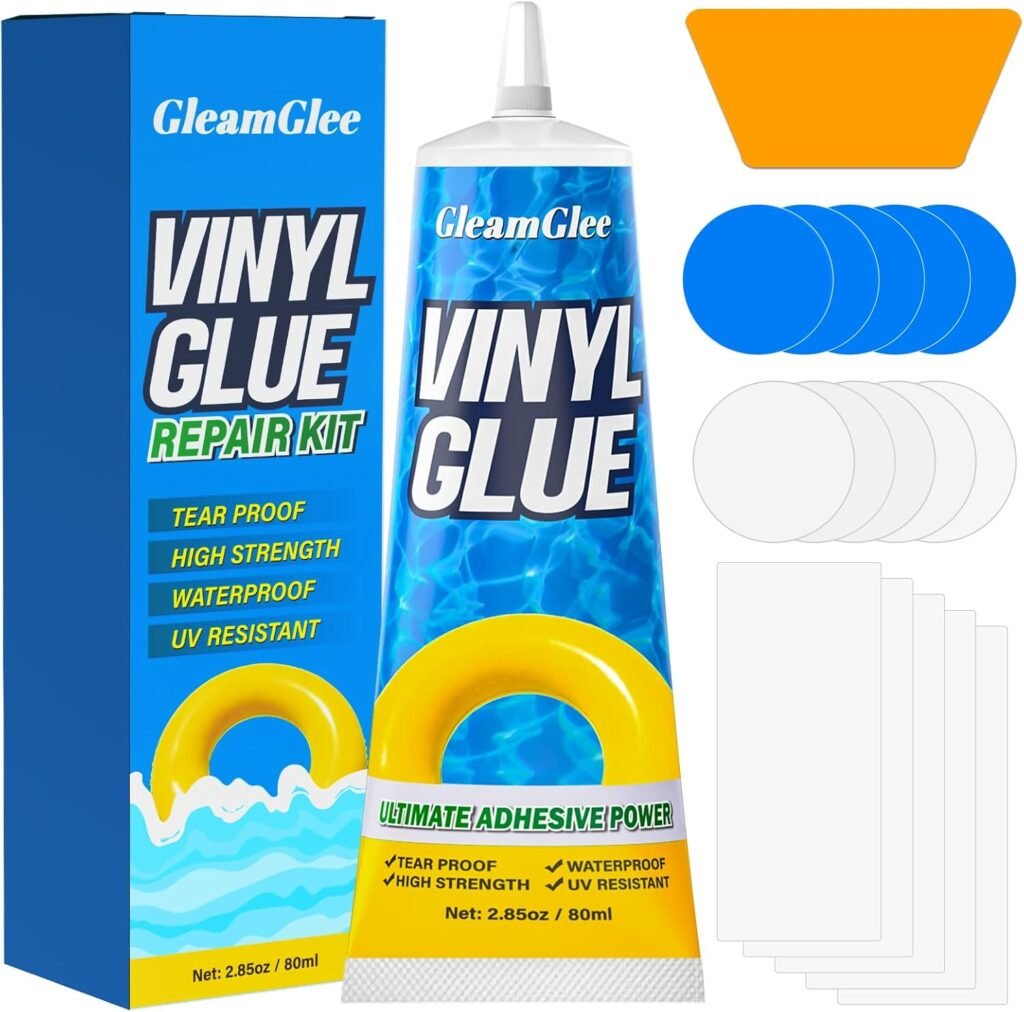
GleamGlee supports customized PVC repair adhesives and puncture-repair kits for air mattresses, pool inflatables, camping equipment, vinyl accessories, waterproof bags, and related flexible materials. Available services include formula adjustment, precision applicators, tubes or bottles, PVC patch selection, multilingual instructions, retail packaging, SDS preparation, and market-specific labeling.
The company’s development resources include more than 25 chemists and materials specialists, dedicated application testing, in-house packaging development, multilingual artwork support, and vertically integrated production. Private-label projects may begin at an MOQ of approximately 200 units, depending on the formula and package. Design drafts can be prepared in as little as two days, samples generally require 7–14 days, and standard bulk production commonly takes around 20 days, with selected urgent projects targeted for approximately 15 days.
A useful quotation request should include the target inflatable material, typical puncture size, preferred cure time, package volume, patch format, target country, estimated order quantity, and required certifications or retailer standards. These details allow the technical team to evaluate the complete repair system rather than offering a generic adhesive that may not match the actual application.
Share:
Table of Contents
Here, creating your adhesives glue & removal cleaner collection is no longer a barrier—it’s a collaborative journey where GleamGlee helps brands and businesses transform their vision into durable, certified, and market-ready solutions.
Partner with GleamGlee
Join hundreds of global partners who trust GleamGlee for adhesives and cleaners that combine innovation, compliance, and speed. Our vertically integrated system—from R&D to warehouse—guarantees consistent performance and reliable delivery.
Whether you’re sourcing FBA-ready stock or developing your own formula, our team provides unmatched technical support and responsive service.