Skip to content
PVC Glue for Arts and Craft PVC Projects : A Smart Guide
Your trusted adhesives glue & cleaner manufacturer

A PVC craft project can look perfect when it is first finished, then start peeling, leaking, wrinkling, or lifting after one weekend of use. That is the frustrating part of working with PVC. It looks simple from the outside, but the surface is smooth, flexible, water-resistant, and harder to bond than paper, wood, fabric, or cardboard. Many people try hot glue, school glue, or general-purpose craft glue first because those options feel familiar. The result is often a patch that sticks for a short time but fails after bending, water contact, air pressure, or outdoor heat.
PVC Glue is the better choice for arts and craft PVC projects when the material needs a flexible, waterproof, and durable bond. It works well for vinyl sheets, inflatable decorations, pool toys, air mattresses, PVC patches, camping gear, outdoor decor, and small repair-based craft projects. The best results come from clean surfaces, thin glue layers, firm pressure, and enough curing time.
This matters because PVC projects are rarely just “display pieces.” A handmade pool float decoration may touch water. A vinyl banner may face sunlight. A repaired air mattress must hold air overnight. A party inflatable may need to survive repeated setup and storage. The right PVC Glue helps the project stay useful, not just nice-looking on day one.
What Is PVC Glue?
PVC Glue is an adhesive made for bonding PVC, vinyl, and similar flexible plastic materials that ordinary craft glue often cannot hold securely. In arts and craft PVC projects, it is mainly used to seal pinholes, repair small tears, attach patches, reinforce edges, and join flexible surfaces that may bend, stretch, touch water, or hold air pressure. It is commonly used on air mattresses, inflatable pool toys, vinyl sheets, PVC decorations, camping mats, inflatable chairs, kayaks, pool floats, and outdoor craft items.
The main value of PVC Glue is not only “strong bonding.” A good PVC Glue needs to stay flexible after curing, resist water, and keep the repaired area sealed during real use. PVC materials often expand, fold, roll, or move under pressure. If the adhesive dries too stiff, the repaired area can crack or lift. If the glue is too weak, the patch may peel after one or two uses. For many small PVC repairs, a patch that extends 1–2 cm beyond the damaged area gives better coverage and reduces pressure around the hole or tear.
PVC Glue is especially useful when the project needs both appearance and function. A clear patch on a pool float should look neat. A repaired air mattress should stay inflated overnight. A vinyl craft piece should not peel when folded. A camping pad should survive rolling and storage. This is why PVC Glue works better than hot glue, paper glue, or basic school glue for many PVC craft projects. It is designed for smooth, flexible, water-resistant surfaces where regular adhesives often fail too quickly.
PVC Glue Meaning
PVC stands for polyvinyl chloride, a plastic material used in many flexible and waterproof products. In daily life, flexible PVC often appears in pool floats, air mattresses, inflatable toys, vinyl sheets, rain gear, waterproof pouches, outdoor decorations, inflatable boats, and camping equipment. It feels smooth, slightly rubbery, and water-resistant, which makes it useful but also harder to glue.
The word “PVC Glue” usually refers to an adhesive designed to bond or repair PVC-based materials. For craft and repair use, it does not always mean the same thing as rigid PVC pipe cement used in plumbing. Plumbing cement is often made for hard PVC pipes and fittings, while PVC repair glue for inflatables and craft projects needs more flexibility after curing. This difference matters because an inflatable pool toy, vinyl craft sheet, or air mattress cannot be treated like a rigid pipe.
Some related terms are often used together:
| Term | Simple Meaning | Common Project Use |
|---|---|---|
| PVC | Polyvinyl chloride plastic | Pool toys, vinyl sheets, inflatables |
| Vinyl | Flexible PVC-like material | Pouches, banners, waterproof crafts |
| Patch | A repair piece placed over damage | Holes, tears, seam leaks |
| Cure | Time needed for glue to build strength | Usually longer than surface drying |
| Flexible bond | Glue line that bends after curing | Inflatables, mats, craft sheets |
| Waterproof seal | Bond that resists water contact | Pool floats, kayaks, outdoor gear |
For arts and craft PVC projects, the most important terms are “flexible bond” and “waterproof seal.” A repair may look dry on the surface, but it may still need more time to cure before it can handle air pressure, bending, or water. GleamGlee PVC Glue is designed to strengthen over 24 hours, which is why waiting before full use is important.
PVC Glue Uses
PVC Glue is used when a PVC or vinyl item needs to be sealed, patched, or reinforced. It is suitable for many small household, outdoor, pool, and craft repairs. For example, a tiny air mattress puncture can cause slow deflation overnight. A small tear on a pool float can let water and air enter the material. A vinyl craft project may peel along the edge if the wrong adhesive is used. PVC Glue helps solve these problems by creating a flexible bond between the patch and the surface.
Common uses include:
- Sealing pinholes on air mattresses and guest beds
- Repairing pool floats, swim rings, armbands, and inflatable toys
- Patching inflatable sofas, chairs, travel pillows, and footrests
- Fixing small tears on inflatable pools and pool loungers
- Reinforcing clear PVC sheets, vinyl decorations, and craft pieces
- Repairing camping mats, sleeping pads, and inflatable camping chairs
- Sealing small punctures on kayaks, rafts, inflatable boats, and SUP boards
- Fixing event inflatables, bounce houses, inflatable arches, and holiday decorations
The best results usually come from pairing the glue with the right patch. Round patches work well for small holes because they do not have corners that lift easily. Rectangular patches work better for longer tears because they cover the full damaged line. Clear patches are useful when the repair should stay low-visibility, while colored patches can be used when stronger visual coverage is acceptable.
PVC Glue Performance
PVC Glue performance depends on surface preparation, glue amount, patch size, pressure, curing time, and the type of damage. A strong formula can still fail if applied over water, dust, sunscreen, oil, or pool chemicals. Many failed PVC repairs are not caused by weak glue. They happen because the patch was too small, the edges were not pressed flat, or the item was inflated before the glue had enough time to cure.
For reliable results, the repair should meet several practical standards:
| Performance Point | Better Result |
|---|---|
| Surface condition | Clean, dry, and free from oil |
| Glue layer | Thin and even, not thick or messy |
| Patch coverage | At least 1–2 cm beyond small damage when possible |
| Edge pressure | Pressed flat around the full patch border |
| Cure time | About 24 hours before full pressure or water use |
| Final feel | Flexible, not brittle or raised |
| Appearance | Smooth patch, fewer bubbles, less overflow |
GleamGlee PVC Glue is designed for strong leak and tear repair on PVC and rubber items. The adhesive and patches are waterproof and UV-resistant, making them suitable for outdoor and water-related repairs. After curing, the bond remains flexible yet firm, which helps inflatables, mats, and vinyl projects handle normal bending and pressure.
For craft projects, performance is not only about whether the glue holds. It is also about whether the repair looks clean. A thick glue layer under a clear patch can create cloudy marks. A patch with lifted edges can collect dirt and water. A thin layer, smooth pressure, and enough curing time give a better-looking and longer-lasting result.
PVC Glue Limits
PVC Glue is useful, but it should not be used on every plastic item without checking the material first. Some surfaces look like PVC but are actually silicone, oily plastic, coated fabric, foam, or another material that may not bond well. If the surface feels waxy, very soft, greasy, powdery, or heavily textured, the glue may not grip properly. A small hidden test is a smart step before repairing visible or expensive items.
PVC Glue may not be suitable for:
- Silicone products
- Food-contact surfaces
- Medical items or skin-contact medical products
- Large safety-critical damage
- Heavily stretched seams
- Oily or dirty plastic
- Foam without PVC coating
- Painted surfaces where the paint layer may peel
- High-load structural repairs
Damage location also matters. A tiny pinhole in the center of an air mattress is usually easier to repair than a tear beside a valve or main seam. A small pool toy puncture may be simple, while a long split on a heavily used bounce house needs more caution. If the repaired area will carry body weight, hold high air pressure, or be used in water sports, the repair should be inspected carefully before use.
A practical rule is to repair early. Small holes are easier to seal than long tears. Once a tear grows, the patch must cover a larger stress area. For many PVC craft and inflatable products, early repair saves time, reduces waste, and keeps the item usable for longer.

Which PVC Glue Projects Work?
PVC Glue works best on flexible PVC, vinyl, and rubber-like items that need a waterproof, bend-resistant, or air-holding repair. The most suitable projects include air mattresses, pool floats, inflatable toys, PVC craft sheets, vinyl decorations, camping mats, inflatable chairs, kayaks, small boats, SUP boards, and outdoor event inflatables. These items share one common feature: the repaired surface must keep moving after bonding.
A good PVC Glue project usually meets three conditions. First, the material is smooth and flexible rather than hard, porous, or fabric-like. Second, the finished item may face water, air pressure, sunlight, folding, rolling, or repeated handling. Third, the repair area is small enough for a patch to cover beyond the damage. For small holes, a patch should ideally extend at least 1–2 cm past the damaged point. For long tears, the patch should cover the full tear and extend beyond both ends to spread pressure.
PVC Glue is less suitable when the item is silicone, oily plastic, dusty foam, painted plastic with weak coating, or a heavy load-bearing structure. A tiny puncture on a pool float is a strong fit. A long split beside a high-stress seam may need a larger patch, longer curing time, or replacement. The best project choice is not based only on material name; it also depends on pressure, movement, water exposure, and the position of the damage.
| PVC Glue Project | Fit Level | Common Damage | Better Patch Choice | Use Before Full Testing |
|---|---|---|---|---|
| Air mattress | High | Pinhole, seam leak | Clear round or rectangular patch | After 24 hours |
| Pool float | High | Small puncture, tear | Clear round or rectangular patch | After 24 hours |
| Swim ring | High | Tiny hole | Clear round patch | After 24 hours |
| Inflatable chair | High | Deflation spot | Larger patch | After 24 hours |
| PVC craft sheet | High | Edge peeling, small cut | Clear rectangular patch | After full curing |
| Vinyl decoration | High | Small tear, corner lift | Clear patch | After full curing |
| Kayak or SUP | Medium to High | Small puncture | Rectangular patch | After careful testing |
| Bounce house | Medium | Small rip | Large rectangular patch | After full curing |
| Silicone item | Low | Surface split | Not recommended | Avoid |
| Heavy structural item | Low | Load damage | Not recommended alone | Avoid |
PVC Glue Crafts
PVC Glue crafts work well when the project uses flexible vinyl sheets, clear PVC film, waterproof craft panels, PVC patches, or soft plastic decorative pieces. These materials often appear in handmade pouches, waterproof labels, event props, garden decorations, clear storage covers, small display pieces, and creative repairs made from old inflatables. The adhesive needs to bond without making the surface too stiff, because many of these projects are folded, carried, rolled, or stored after use.
Craft projects usually care about appearance as much as strength. A thick glue line under a clear patch can look cloudy. A patch placed too close to the damaged edge can lift after bending. A useful repair method is to keep the glue thin, use a patch with enough coverage, and press from the center outward. For transparent PVC, clear round or rectangular patches help keep the repair less visible. For colored craft pieces, a patch can also become part of the design, especially on PVC bags, party props, or decorative panels.
PVC Glue Inflatables
PVC Glue is highly suitable for inflatables because air pressure makes weak repairs fail quickly. Air mattresses, inflatable sofas, travel pillows, footrests, pool floats, swim rings, pool toys, inflatable balls, and ride-on floats all need airtight sealing. A pinhole smaller than 1 mm can still cause slow deflation overnight, so the repair must cover more than the visible hole. The patch should sit flat and seal around the full edge.
Inflatable repairs should be done with the item deflated or only slightly shaped, not tightly filled with air. A relaxed surface lets the patch lie flatter and reduces stretching during curing. After gluing, the item should stay undisturbed for about 24 hours before full inflation. A slow air test is safer than immediate full pressure. If bubbles appear during a water test, the patch edge may not be sealed, or there may be a second leak nearby. Round patches work well for pinholes, while rectangular patches are better for longer tears or seam-adjacent damage.
PVC Glue Outdoor Gear
PVC Glue can work well on outdoor PVC gear when the damage is small, the surface is clean, and the patch is large enough to handle movement. Common projects include inflatable camping mats, sleeping pads, inflatable camping chairs, inflatable tents with air frames, kayaks, rafts, small boats, SUP boards, fishing float tubes, buoys, and water-sport markers. These items often face moisture, sun, pressure, dirt, and repeated packing, so ordinary craft glue is usually too weak.
Outdoor repairs need extra surface preparation. Sand, mud, sunscreen, saltwater, pool chemicals, and body oil can stop the glue from bonding properly. The surface should be cleaned and fully dried before applying glue. For kayaks, boats, and SUP boards, the repair should be checked carefully because water pressure and movement are stronger than on simple pool toys. Small punctures are reasonable repair targets. Large tears near valves, handles, seams, or high-pressure zones need more caution. After curing, test the item slowly before using it in open water.
PVC Glue Avoid
PVC Glue should be avoided when the material is not compatible or when the damage is too serious for a patch repair. Silicone, very oily plastic, dusty foam, untreated fabric, weak painted coatings, and food-contact surfaces are poor choices. Some products look like PVC but are made from other plastics, so a small hidden test is useful when the material is uncertain. If the glue peels away cleanly after curing, the surface is not a good match.
Damage size and location also decide whether a PVC Glue repair makes sense. A small hole in the middle of a pool float is easier to repair than a long split beside a seam. A small camping mat puncture is easier than damage around a valve. A decorative inflatable with a small tear may be repairable, while a heavily stretched bounce house seam may need professional repair or replacement. PVC Glue is best used for controlled repairs where the patch can extend beyond the damage, lie flat, and cure without constant stress.
How Do You Use PVC Glue?
PVC Glue should be used on a clean, dry, and stable PVC surface. The repair process is simple: find the leak or tear, clean the area, apply a thin layer of glue, place the right patch, press it flat, and let it cure before inflation, folding, or water use. For most inflatable and waterproof PVC repairs, waiting about 24 hours gives the bond more time to build strength.
The most common reason a PVC Glue repair fails is not always weak glue. It is usually poor surface preparation, too much glue, a patch that is too small, lifted patch edges, or testing the item too early. PVC is smooth and flexible, so the glue needs full contact with the surface. If water, dust, sunscreen, pool chemicals, or oil stays under the patch, the repair may look fine at first but peel after pressure or water exposure.
For arts and craft PVC projects, neat application is just as important as strength. A clear patch on a pool float, vinyl sheet, or inflatable decoration can look clean when the glue layer is thin and even. A thick glue layer may create bubbles, cloudy marks, or raised edges. For pinholes, the patch should usually extend at least 1–2 cm beyond the damaged point. For longer tears, a rectangular patch should cover the full tear and extend beyond both ends.
| Repair Stage | Recommended Practice | Why It Matters |
|---|---|---|
| Surface check | Find the exact hole, tear, or weak seam | Prevents patching the wrong spot |
| Cleaning | Remove dirt, oil, water, sunscreen, and dust | Helps glue grip the PVC surface |
| Patch size | Cover at least 1–2 cm beyond small damage | Spreads pressure around the repair |
| Glue amount | Use a thin, even layer | Reduces bubbles, overflow, and slow curing |
| Pressing | Press from center outward | Pushes air out and seals edges |
| Curing | Wait about 24 hours before full use | Improves air-holding and waterproof strength |
| Testing | Inflate slowly or check with water bubbles | Finds leaks before normal use |
Step 1: PVC Glue Prep
Preparation decides whether PVC Glue can bond properly. Start by locating the exact leak, puncture, cut, or peeling edge. On air mattresses, pool floats, swim rings, and inflatable chairs, small holes can be hard to see. A slow air loss overnight may come from a tiny pinhole rather than a visible tear. If the leak is not obvious, inflate the item slightly and listen for air. For small items, a water bubble test can help locate the damaged point.
After finding the damage, release most of the air so the surface becomes relaxed and flat. Do not repair a tightly inflated item. A stretched surface can shrink back after deflation and pull against the patch. Wipe the repair area with a clean cloth and remove dirt, water, sand, sunscreen, body oil, pool residue, or old adhesive. Clean an area larger than the patch, not only the hole itself.
The surface must be fully dry before gluing. Moisture trapped under the patch can weaken the bond and leave cloudy marks under clear patches. For pool toys, kayaks, floats, and water inflatables, check seams and folds carefully because water can hide there. A dry, flat surface makes patch placement easier and helps the finished repair look cleaner.
Useful prep checklist:
- Locate the exact hole or tear before applying glue
- Deflate or relax the PVC surface before repair
- Clean beyond the patch area, not only the damaged point
- Remove sunscreen, oil, dust, pool chemicals, and sand
- Let seams, folds, and corners dry fully
- Choose a patch before opening the glue
- Keep the item flat during the repair process
For visible craft projects, test a hidden spot first if the material is printed, transparent, or unfamiliar. This helps check whether the glue dries cleanly and bonds well.
Step 2: PVC Glue Apply
PVC Glue should be applied in a thin and even layer. More glue does not mean a stronger repair. Too much glue can squeeze out from under the patch, create uneven marks, slow down curing, and make clear patches look cloudy. For small pinholes, only a small controlled amount is needed. For longer tears, the glue should cover the damaged line and the full patch contact area.
GleamGlee PVC Glue includes a precision metal nozzle, which helps control glue placement on small holes, narrow seams, corners, and hard-to-reach areas. This is useful for air mattress leaks, inflatable pool edges, PVC craft sheets, travel pillows, and small pool toys. A narrow nozzle also helps reduce waste and keeps the repair area cleaner.
Apply glue slightly beyond the damage, but avoid flooding the surface. If repairing a puncture, place glue around the hole and under the full patch area. If repairing a tear, follow the line of the tear and cover the surrounding surface where the patch will sit. The patch should make full contact with the glue layer. It should not float on a thick wet puddle.
Practical glue amount guide:
| Damage Type | Glue Amount | Patch Choice |
|---|---|---|
| Tiny pinhole | Small dot plus thin spread | Clear round patch |
| Small puncture | Thin layer around hole | Round patch |
| Short tear | Thin line plus surrounding coverage | Rectangular patch |
| Long tear | Even layer under full patch | Larger rectangular patch |
| Edge lift | Very small amount under lifted edge | Press existing or new patch flat |
| Clear vinyl craft | Minimal smooth layer | Clear patch |
For arts and craft PVC projects, keep the glue layer smooth. If the patch is transparent, every bubble, thick spot, or glue ridge can show after drying. A careful first application usually looks better than trying to clean up excess glue later.
Step 3: PVC Glue Patch
Patch placement should be done once and done carefully. Choose a patch that fully covers the damage and gives enough extra coverage around it. For small holes, a round patch is usually better because it has no sharp corners. For long tears or straight cuts, a rectangular patch gives better coverage and spreads stress along the damaged line.
Place the patch over the glued area and press from the center outward. This helps push trapped air bubbles toward the edges. Use a rubber squeegee or a flat pressing tool to apply even pressure across the patch. GleamGlee’s kit includes a rubber squeegee, which helps flatten the patch without scratching the PVC surface.
The edge of the patch is the most important part. Many PVC repairs fail from the edge first. If one corner or border lifts, water and air can slowly enter under the patch. Press the full border carefully, especially on rectangular patches. Corners need extra attention because they are more likely to catch during folding, handling, or water use.
Patch tips for cleaner results:
- Round patches work best for pinholes and small punctures
- Rectangular patches work better for long tears and seam splits
- Clear patches help preserve the look of visible areas
- Blue patches can be used on darker or blue PVC items
- Press from center outward to reduce bubbles
- Press every edge and corner before curing
- Keep the patch flat and untouched after placement
For curved inflatables, such as swim rings, pool animals, inflatable chairs, and travel pillows, repair the item while it is deflated or only lightly shaped. This reduces surface tension and helps the patch sit flatter.
Step 4: PVC Glue Cure
Curing time is one of the most important parts of using PVC Glue. A repair may feel dry on the surface before it is ready for full pressure, water, folding, or outdoor use. For inflatable and waterproof PVC repairs, waiting about 24 hours is a practical rule. GleamGlee PVC Glue is designed to strengthen over 24 hours, which helps improve long-term sealing.
During curing, keep the repaired area flat and undisturbed. Do not inflate the item fully, bend it, roll it, sit on it, or place it in water too soon. Early movement can shift the patch or weaken the edge seal. For air mattresses, camping mats, and inflatable chairs, the item should remain relaxed while the glue builds strength.
After curing, test the repair gradually. Inflate slowly rather than filling the item to maximum pressure at once. Listen for air, feel around the patch, and check whether the edges stay flat. For pool toys or small inflatables, place the repaired area under water and look for bubbles. If bubbles appear, the leak may still be active, or there may be another hole nearby.
Curing and testing guide:
| Item Type | Minimum Care After Repair | Testing Method |
|---|---|---|
| Air mattress | Wait about 24 hours before full inflation | Inflate slowly and check softness overnight |
| Pool float | Wait before water use | Water bubble test around patch |
| Swim ring | Wait before full pressure | Inflate lightly first |
| Camping mat | Keep flat before rolling | Inflate and leave for several hours |
| Kayak or SUP | Cure fully and inspect carefully | Slow pressure test before water use |
| PVC craft sheet | Let cure before folding | Bend gently after curing |
| Inflatable decor | Cure before setup | Inflate gradually and inspect edges |
If the patch edge lifts after testing, do not keep adding glue randomly. First, identify the weak area. Clean and dry it again, then reseal carefully or use a larger patch if needed. A neat second repair is better than a thick messy glue build-up.

What PVC Glue Tips Help?
The most useful PVC Glue tips focus on surface preparation, glue control, patch choice, pressure, and curing time. PVC is smooth and flexible, so the repair depends on clean contact between the glue, patch, and surface. A thin, even glue layer, a patch larger than the damaged area, and firm edge pressure usually create a cleaner and longer-lasting repair than a thick, messy glue layer.
Most PVC Glue failures come from small handling mistakes. The surface may still have sunscreen, water, dust, pool chemicals, body oil, or old adhesive residue. The patch may only cover the visible hole but not the stressed area around it. The repair may be inflated, folded, or placed in water before the glue has cured. These mistakes are common on pool floats, air mattresses, inflatable chairs, camping mats, swim rings, vinyl sheets, and outdoor decorations.
For arts and craft PVC projects, the repair should look neat as well as hold properly. Clear patches can blend into the surface, but only when the glue layer is smooth and the air bubbles are pressed out. Colored patches can reinforce damaged areas, but they should not look randomly placed. A good repair should feel flat, flexible, sealed around the edges, and strong enough for the item’s normal use.
| PVC Glue Tip | Better Practice | Why It Helps |
|---|---|---|
| Clean wider than the patch | Wipe 2–3 cm beyond the damage | Gives patch edges a clean bonding area |
| Use thin glue | Avoid thick puddles | Reduces bubbles, overflow, and slow curing |
| Size patch correctly | Cover 1–2 cm beyond small damage | Spreads pressure around the repair |
| Press edges carefully | Work from center to border | Helps seal air and water out |
| Wait before use | Allow about 24 hours for stronger curing | Improves air-holding and waterproof performance |
| Test slowly | Inflate or bend gradually | Finds weak spots before full use |
PVC Glue Amount
Using the right amount of PVC Glue is one of the easiest ways to improve the repair. A thick glue layer may look stronger, but it can make the patch float instead of sitting tightly against the PVC surface. When this happens, air bubbles, cloudy marks, edge lifting, and slow curing become more likely. For most PVC repairs, a thin and even layer is better because it creates closer contact between the patch and the surface.
For pinholes, use a small dot of glue and spread it slightly beyond the hole. For short tears, apply a thin line along the tear and cover the area where the patch will sit. For long tears, make sure the full patch area has glue, but avoid leaving wet ridges. GleamGlee PVC Glue uses a metal nozzle, which helps control glue flow on small holes, narrow seams, and detailed craft repairs.
| Damage Type | Suggested Glue Use | Common Mistake |
|---|---|---|
| Tiny pinhole | Small dot plus thin spread | Covering only the exact hole |
| Small puncture | Thin layer under round patch | Using too much glue |
| Straight tear | Even layer under rectangular patch | Leaving dry gaps at tear ends |
| Edge lift | Small controlled amount under edge | Flooding the lifted area |
| Clear patch repair | Smooth, minimal layer | Creating cloudy glue marks |
A useful habit is to apply less glue first, then spread it evenly. Once a patch is pressed down, excess glue is harder to fix cleanly. On transparent PVC, careful glue control matters even more because uneven glue can show through the patch after drying.
PVC Glue Patch
Patch selection should match the shape, size, and location of the damage. A patch that is too small may cover the hole but fail around the stressed area. For small holes, round patches often work better because they have no sharp corners. For long cuts, seam splits, or straight tears, rectangular patches are usually stronger because they cover the full damaged line and extend beyond both ends.
GleamGlee PVC Glue kit includes blue round patches, clear round patches, and clear rectangular patches. This gives more flexibility for different repair situations. Clear patches are useful when repairing visible areas on pool floats, vinyl decorations, transparent sheets, and inflatable toys. Blue patches can be used when appearance is less important or when the surface color is closer to the patch.
Good patch sizing rules:
- For small holes, let the patch extend at least 1–2 cm beyond the damage
- For long tears, cover the full tear and extend beyond both ends
- For curved inflatables, choose a patch that can lie flat without wrinkling
- For clear PVC, use a transparent patch and a thin glue layer
- For high-movement areas, use wider coverage instead of a tiny patch
| Repair Situation | Better Patch Choice |
|---|---|
| Small pinhole on pool float | Clear round patch |
| Long tear on air mattress | Clear rectangular patch |
| Colored inflatable surface | Blue or clear patch |
| Transparent vinyl craft | Clear patch |
| Seam-adjacent damage | Larger rectangular patch |
| Decorative PVC project | Clear patch or design-matched patch |
A patch should not be chosen only by how it looks. It should cover enough area to reduce pressure around the damage. A neat larger patch is usually better than a small patch that fails after one use.
PVC Glue Edges
Patch edges decide whether a PVC Glue repair stays sealed. The center of the patch may stick quickly, but air and water usually enter from the edge first. If one corner lifts, the repair can slowly weaken even when the middle still looks attached. This is why edge pressure is one of the most important steps in PVC repair.
After placing the patch, press from the center outward. This pushes trapped air toward the border and helps the patch lie flat. Then press around the entire edge. On rectangular patches, spend extra time on the four corners because corners are easier to catch during folding, handling, or water use. On round patches, press around the full circle until the border feels smooth and fully attached.
For best edge control:
- Deflate inflatables before patching so the surface is relaxed
- Keep the patch flat while pressing
- Use a rubber squeegee to push bubbles outward
- Press every corner and border, not only the center
- Avoid touching the patch repeatedly after placement
- Keep the repair area flat during curing
Edge lifting is more common on curved items such as swim rings, inflatable animals, pool loungers, travel pillows, and inflatable chairs. If possible, repair these items when they are deflated and positioned on a flat surface. A patch applied to a stretched surface may pull or wrinkle later when the material changes shape.
PVC Glue Test
Testing is important when the PVC material, surface coating, or repair condition is uncertain. Some items look like PVC but may be silicone, coated fabric, oily plastic, or another material that does not bond well. A small hidden test can prevent visible damage, especially on clear vinyl, printed pool floats, decorative inflatables, craft sheets, and colored PVC accessories.
A simple test can be done before the main repair. Clean a hidden area, apply a tiny amount of PVC Glue, place a small patch or scrap piece if available, and let it cure. After curing, bend the area gently and check whether the glue grips, peels, clouds, or changes the surface color. If the test area fails easily, the project may not be a good match for PVC Glue.
Testing is also useful after repair:
| Item Type | After-Cure Test |
|---|---|
| Air mattress | Inflate slowly and leave for several hours |
| Pool float | Check the patch edge under water for bubbles |
| Camping mat | Inflate and press gently before rolling |
| Vinyl craft sheet | Bend lightly to check flexibility |
| Inflatable decor | Inflate gradually and inspect the patch border |
| Kayak or SUP | Test pressure carefully before water use |
Testing should be slow, not aggressive. A repaired inflatable should not be filled to maximum pressure immediately after curing. Gradual testing gives time to find weak edges or missed holes before normal use. For water-related items, a bubble test around the patch edge can reveal whether the seal is complete.
Do PVC Glue Repairs Last?
PVC Glue repairs can last well when the material is compatible, the damage is small enough for proper patch coverage, and the repair is allowed to cure before use. For PVC inflatables, vinyl sheets, pool toys, air mattresses, camping mats, and outdoor decorations, durability depends on surface cleaning, glue amount, patch size, edge pressure, curing time, water exposure, air pressure, and storage habits.
A long-lasting PVC Glue repair is usually not created by using more glue. It is created by better surface contact. The patch should cover at least 1–2 cm beyond small punctures when space allows, and longer tears should be covered with a rectangular patch that extends past both ends. If the patch edge is flat, sealed, and left undisturbed for about 24 hours, the repair has a much better chance of holding air, resisting water, and staying flexible during normal use.
Repair life also depends on where the damage is located. A pinhole in the flat middle area of an air mattress is easier to repair than a tear beside a valve, handle, seam, or corner. A pool float used gently may stay repaired longer than a kayak or SUP board exposed to water pressure, dragging, folding, and sun. PVC Glue can extend the life of many PVC and rubber items, but the repair should match the stress level of the product.
| Durability Factor | Better Condition | Risky Condition |
|---|---|---|
| Damage size | Pinhole or small tear | Long split or stretched seam |
| Patch coverage | 1–2 cm beyond small damage | Patch barely covers the hole |
| Surface condition | Clean, dry, oil-free | Wet, dusty, sandy, or greasy |
| Glue layer | Thin and even | Thick, puddled, uneven |
| Edge sealing | Full border pressed flat | Corners or edges lifted |
| Curing time | About 24 hours before full use | Inflated, folded, or soaked too early |
| Use setting | Light to normal pressure | Heavy load, sharp bending, high pressure |
| Storage | Dry, loose, away from heat | Folded tightly over the patch |
PVC Glue Air
Air-holding repairs need more care than simple craft bonding because pressure constantly pushes against the patch from inside. Air mattresses, inflatable chairs, travel pillows, pool floats, swim rings, camping mats, and inflatable sofas can lose air from holes smaller than 1 mm. A repair may look sealed at first but still leak slowly overnight if the patch edge is not fully bonded.
For better air-holding results, the item should be deflated or relaxed before repair. Gluing while the surface is stretched can create tension after curing. Once the item returns to its normal shape, the patch may wrinkle or lift. The repair area should stay flat during curing, and full inflation should wait until the glue has had enough time to build strength.
After curing, air testing should be gradual. Fill the item slowly instead of forcing it to maximum pressure immediately. Then check the repaired area with listening, touch, or a bubble test. If bubbles appear from the patch edge, the seal is incomplete. If bubbles appear near the repair but not from the patch, there may be another hidden puncture.
| Inflatable Item | Common Leak Point | Better Repair Method |
|---|---|---|
| Air mattress | Flat surface pinhole, seam edge | Clear round patch for holes; rectangular patch for seam-adjacent damage |
| Pool float | Bottom scrape, side puncture | Clear patch with careful edge pressure |
| Swim ring | Tiny puncture from rough surface | Round patch, thin glue layer |
| Travel pillow | Small valve-area or fold leak | Small patch, low glue amount, slow test |
| Camping mat | Ground puncture | Flat curing before rolling |
| Inflatable chair | Stress point near seat or corner | Larger patch with wider coverage |
For air products, the first night after repair is the real test. If an air mattress remains firm after several hours of use, the repair is more reliable. If it softens slowly, the damaged item should be checked again because there may be another hole or a weak patch edge.
PVC Glue Water
Water exposure is one of the main reasons PVC Glue repairs need a flexible waterproof seal. Pool floats, swim rings, inflatable pools, kayaks, boats, SUP boards, fishing float tubes, and outdoor inflatables often face soaking, splashing, pool chemicals, sunlight, and repeated drying. A repair that holds in a dry room may fail if water works under an unsealed edge.
Before any water use, the glue should be fully cured. For many PVC repair jobs, about 24 hours is a practical waiting period before soaking or pool use. The repair should feel flat around the border, not raised or loose. A lifted edge can act like a small door that lets water enter under the patch, especially when the item bends in use.
Water repairs should also consider the type of water contact. A pool float resting on calm water faces less stress than a kayak bottom scraping against sand or rocks. An inflatable pool wall repaired above the waterline faces different stress than a repair below the waterline. The more water pressure and movement involved, the more important patch size, curing time, and edge sealing become.
| Water Use Item | Stress Level | Repair Note |
|---|---|---|
| Pool float | Low to Medium | Good fit for small punctures and tears |
| Swim ring | Low to Medium | Round patch works well for tiny holes |
| Inflatable pool wall | Medium | Check whether repair is above or below waterline |
| Kayak | Medium to High | Test carefully before open-water use |
| SUP board | High | Small punctures only; inspect pressure areas |
| Fishing float tube | Medium to High | Larger patch and full cure needed |
| Inflatable boat | High | Avoid relying on small repair for serious damage |
For water-related products, a bubble test is useful after curing. Inflate the item lightly and place the repaired area under water. No bubbles should appear from the patch edge. If bubbles show up, dry the item completely before any second repair attempt. Adding more glue onto a wet or dirty edge usually makes the repair worse.
PVC Glue Sun
Sunlight and heat can shorten the life of PVC products and repairs. Outdoor inflatables, pool toys, garden decorations, event arches, vinyl banners, and camping gear often sit under direct sun for hours. Heat can soften the PVC surface, air inside inflatables can expand, and UV exposure can age both the material and the repair area over time.
A UV-resistant PVC Glue and clear patch system helps reduce visible yellowing and breakdown, but storage still matters. Repaired inflatables should not be left fully inflated in strong sun for long periods when not in use. Heat increases internal pressure, and that pressure can pull on the patch edge. Pool floats and air mattresses left in a hot car or direct sunlight may become more stressed than they are during normal use.
For clear or decorative PVC projects, sun exposure also affects appearance. Some lower-quality patches may yellow or become cloudy, especially on transparent pool floats or visible vinyl pieces. Clear patches that blend with the surface help keep the repair less noticeable, but a thin glue layer and proper edge pressure still matter.
Better sun-care habits include:
- Dry pool items before storage
- Avoid leaving repaired inflatables fully inflated in strong heat
- Store repaired items away from direct sunlight when not in use
- Do not fold sharply over the patch
- Check patch edges at the start of each season
- Keep clear PVC projects away from unnecessary UV exposure
- Let hot inflatables cool slightly before deflating or packing
| Sun-Related Problem | What Usually Happens | Prevention |
|---|---|---|
| Patch yellowing | Clear repair becomes more visible | Use clear quality patches and store away from sun |
| Edge lift | Heat and pressure pull at patch border | Avoid overinflation and full sun storage |
| PVC softening | Material stretches more under heat | Repair and cure in stable conditions |
| Glue line stress | Expansion changes pressure around repair | Inflate normally, not excessively |
| Surface fading | Decorative item looks aged | Limit long direct UV exposure |
Sun resistance helps, but no repair performs best under constant heat and pressure. Good storage is one of the simplest ways to make PVC Glue repairs last longer.
PVC Glue Reapply
PVC Glue may need to be reapplied when the patch edge lifts, the item still leaks after curing, the patch was too small, or the first repair was done on a wet or dirty surface. Reapplication works best when the weak point is identified first. Adding a thick layer of glue around a failed patch without cleaning or drying usually creates a messy repair and may not stop the leak.
Before reapplying, inspect the repair carefully. If only one edge has lifted, the area may be cleaned, dried, and resealed with a small controlled amount of glue. If the patch is too small or poorly placed, a larger patch over the whole area may work better. For long tears, a rectangular patch is usually more reliable than a small round patch because it covers more of the stress line.
Second repairs should follow the same rules as first repairs: clean wider than the patch, dry fully, apply thinly, press the full edge, and cure before testing. If the surface has glue buildup, wrinkles, or dirt trapped underneath, the new patch may not sit flat. In that case, the repair area should be made as smooth and clean as possible before adding a larger patch.
| Reapply Situation | Likely Cause | Better Fix |
|---|---|---|
| Edge lifting | Not enough pressure, dirty edge, early use | Clean, dry, reseal edge, press flat |
| Slow air loss | Missed hole or incomplete patch seal | Locate leak, use larger patch if needed |
| Patch cloudy | Too much glue or trapped moisture | Use thinner glue and dry fully next time |
| Tear spreading | Patch too narrow | Cover with larger rectangular patch |
| Leak near seam | High-stress damage | Use caution; replacement may be safer |
| Patch sliding | Too much glue or movement during curing | Remove if possible and redo with thin layer |
| Water leak returns | Edge not sealed | Dry completely before second repair |
Reapplication is most successful on small, controlled repairs. If a PVC item has a long split, damaged valve, torn handle, stretched seam, or high-pressure failure, repeated glue attempts may not be enough. In those cases, replacement or professional repair is often more practical. For regular home, pool, camping, and craft PVC items, repairing early gives the best chance of long service life.
Is PVC Glue Safe?
PVC Glue can be safe for home repair, craft, pool, camping, and outdoor PVC projects when it is used correctly. The key points are simple: work in a ventilated area, avoid direct skin and eye contact, use only the needed amount, keep the glue away from children during application, and let the repair cure fully before the item is inflated, folded, stored, or placed in water.
PVC Glue should be treated as a repair adhesive, not as a children’s craft glue. It is made for PVC, vinyl, and rubber-like materials, so it may contain active bonding ingredients that need careful handling before curing. A small repair on a pool float, air mattress, travel pillow, or inflatable chair is usually manageable at home, but the wet glue should not touch food, drinks, skin, fabric, carpets, or painted furniture. A protected work surface and clean application reduce most common problems.
Safety also depends on the repaired item. A small pinhole on a pool toy or camping mat is different from a large tear near a valve, seam, handle, or load-bearing area. For items used by children, around water, or under body weight, the repair should be inspected after curing. The patch should feel flat, smooth, sealed, and dry. If the repair looks loose, sticky, raised, or unstable, the item should not be used until the problem is corrected.
| Safety Point | Better Practice | Why It Matters |
|---|---|---|
| Ventilation | Work near airflow or an open window | Reduces odor buildup during application |
| Skin contact | Avoid touching wet glue | Prevents irritation and messy transfer |
| Work surface | Use paper, plastic sheet, or repair mat | Protects tables, floors, and fabric |
| Glue amount | Apply a thin controlled layer | Reduces overflow and odor |
| Children’s items | Adult application only | Keeps the process controlled |
| Cure time | Wait about 24 hours before full use | Helps the bond strengthen before pressure or water |
| Storage | Keep closed, upright, and away from heat | Helps prevent leaks, drying, and accidental access |
PVC Glue Indoors
PVC Glue can be used indoors for small repairs, but the space should have enough airflow. A garage, balcony, laundry room, craft table near an open window, or well-ventilated workshop is better than a closed bedroom or kitchen. Even when the smell is not strong, fresh air makes the repair process more comfortable and reduces odor buildup around the work area.
Indoor PVC repairs often include air mattresses, inflatable guest beds, travel pillows, PVC craft sheets, vinyl decorations, clear pouches, inflatable toys, and party props. These projects usually use a small amount of glue, so the main focus is control. The glue should be applied only where needed. A thin layer is easier to cure, creates fewer visible marks, and reduces the chance of adhesive spreading onto furniture or hands.
Before starting, cover the table with scrap paper, cardboard, or a disposable plastic sheet. Keep tissues or a dry cloth nearby, but do not wipe wet glue across the repair area because that can smear the finish. After applying the patch, leave the item flat in a place where it will not be touched. Do not place a freshly repaired air mattress or PVC sheet on carpets, sofas, bedding, or clothing until the glue has cured.
PVC Glue Odor
PVC Glue may produce odor during application, especially when too much glue is used or the repair is done in a small closed room. Odor level can vary by formula, glue amount, temperature, and ventilation. For small pinholes or patch repairs, odor can usually be controlled by using a thin layer, closing the cap quickly, and keeping the item in a ventilated space while it cures.
Odor control is important for home use because many PVC repairs happen in shared spaces. Pool toys may be repaired on a kitchen table. Air mattresses may be fixed in a guest room. Camping mats may be patched the night before a trip. In these situations, the repair should not fill the room with a strong smell. Using less glue, spreading it evenly, and avoiding thick puddles can make the process cleaner and more comfortable.
Practical odor control habits include:
- Apply only the amount needed for the patch area
- Keep the bottle open for the shortest possible time
- Avoid leaning close to the glue line
- Keep windows open or use a ventilated area
- Let repaired items cure away from sleeping areas
- Do not store wet repaired items in closed bags or boxes
- Close the cap firmly after use
If the smell feels uncomfortable, stop working and move to a better-ventilated area. The repair can wait; breathing comfort and safe handling should come first.
PVC Glue Kids
PVC Glue should be applied by adults when repairing children’s PVC items. Swim rings, armbands, pool toys, inflatable balls, inflatable animals, bounce houses, and party decorations may look playful, but the repair process should still be handled carefully. Wet glue should not be touched by children, and the repaired item should not be returned to use until the patch is dry, flat, and fully cured.
For children’s items, the finished surface matters. The patch should not have sharp corners lifting up, sticky glue around the edge, rough dried glue beads, or loose areas where water and air can enter. Round patches are often better for small pinholes on swim rings or toys because they have no corners. For longer tears, a rectangular patch may be needed, but every corner must be pressed flat.
A simple safety check after curing:
| Check Point | What to Look For |
|---|---|
| Patch edge | No lifting, curling, or open corners |
| Surface feel | Dry, smooth, and not sticky |
| Air holding | Inflate slowly and check for softening |
| Water use | No bubbles around the repair |
| Skin contact area | No rough glue beads or sharp patch edges |
| Damage size | Repair should not be too large for safe use |
If the item supports body weight in water, inspect it more carefully. A repaired pool float or armband should never replace normal supervision or safe use. If the damage is large, near a seam, or close to a valve, replacement may be safer than repair.
PVC Glue Storage
PVC Glue should be stored tightly closed, upright, and away from heat, sunlight, moisture, children, and pets. Good storage keeps the glue usable for future repairs and reduces the risk of accidental leakage or drying. Many PVC repair kits are used several times across a season, so storage habits directly affect product life.
After use, wipe the nozzle area if needed and close the cap firmly. A blocked nozzle can make the next repair messy because extra pressure may cause too much glue to come out at once. GleamGlee PVC Glue uses a metal nozzle for precise application, so keeping the tip clean helps maintain better control for small holes, seams, and craft details.
Storage checklist:
- Keep the bottle upright after opening
- Close the cap immediately after use
- Store away from heaters, windows, and direct sun
- Keep patches clean and flat
- Keep the squeegee and applicator inside the kit
- Do not store near food, drinks, or children’s toys
- Avoid leaving the kit in a hot car or damp outdoor box
For retail and private-label products, storage instructions should be printed clearly on the label or instruction card. This reduces misuse and helps users get better repair results. For brands selling PVC Glue through Amazon, retail stores, or outdoor product channels, clear safety and storage guidance can also lower complaints linked to leakage, odor, blocked nozzles, early use, or failed curing.

Is GleamGlee PVC Glue Good?
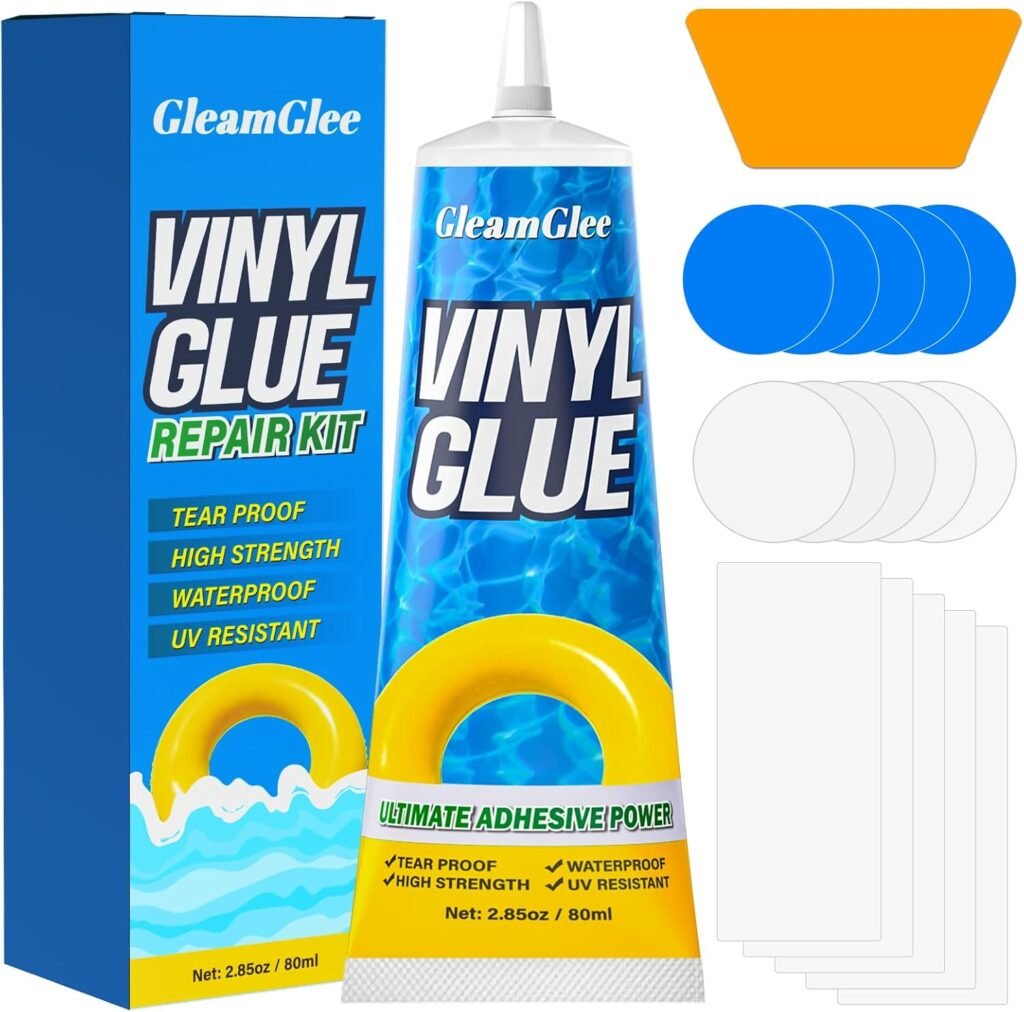
GleamGlee PVC Glue is a strong fit for PVC arts, crafts, inflatable repairs, pool products, camping gear, and outdoor PVC items because it combines flexible adhesive, waterproof repair patches, controlled application tools, and practical kit packaging. The kit includes 80ml premium PVC Glue, 5 blue round patches, 5 clear round patches, 5 clear rectangular patches, a rubber squeegee, and an applicator. This format covers small pinholes, longer tears, visible repairs, and colored PVC surfaces without needing separate repair tools.
The product is designed for PVC and rubber items that need a flexible, waterproof, and UV-resistant repair. It can be used on air mattresses, inflatable pools, pool floats, swim rings, inflatable sofas, travel pillows, camping mats, kayaks, boats, SUP boards, bounce houses, inflatable slides, holiday inflatables, and PVC craft projects. The bond strengthens over about 24 hours, which is important for air pressure, water exposure, bending, and outdoor use.
GleamGlee also has manufacturing strength behind the product. The company operates as an adhesives, repair solutions, and cleaners manufacturer in Dongguan, Guangdong, with more than 25 chemists and engineers, an 18+ member design team, integrated packaging and label printing support, and annual production capacity above 12 million pieces. For ready products, private-label repair kits, or customized PVC Glue formulas, the factory system supports sample development, packaging design, compliance labeling, and bulk production.
| GleamGlee PVC Glue Point | Practical Value |
|---|---|
| 80ml glue bottle | Suitable for repeated small repairs, not only one patch job |
| 15 included patches | Covers round holes, long tears, visible areas, and colored surfaces |
| Clear patches | Better for pool floats, vinyl sheets, and visible craft repairs |
| Blue patches | Useful for darker or blue PVC surfaces |
| Metal nozzle | Helps apply glue into small holes and narrow seams |
| Rubber squeegee | Helps press patches flat and reduce air bubbles |
| Waterproof bond | Suitable for pool, outdoor, and water-related PVC repairs |
| UV-resistant performance | Better for sunlight-exposed inflatables and outdoor decor |
| 24-hour strengthening | Helps build a more reliable seal before full use |
PVC Glue Kit
The GleamGlee PVC Glue kit is built around real repair needs instead of offering only a bottle of adhesive. PVC damage comes in different forms: a tiny pinhole on a swim ring, a straight tear on an air mattress, a corner split on an inflatable chair, or a visible scratch on a clear vinyl project. One patch shape cannot handle all of these situations well, so the kit includes round and rectangular patches in both clear and blue options.
The 80ml glue size is practical for repeated household and outdoor repairs. A single small hole usually needs only a thin layer of glue, so the bottle can support multiple repairs across pool season, camping trips, guest bed use, or event decoration setup. The metal nozzle is helpful because PVC repair often needs precision. A large opening can release too much glue, while a narrow nozzle allows cleaner control around pinholes, seam edges, and small craft details.
The included rubber squeegee is also useful. Many PVC repair failures start from trapped bubbles or lifted patch edges. Pressing with fingers alone can leave uneven pressure, especially on clear patches where bubbles are visible. A squeegee helps push air outward and flatten the patch border. This improves both appearance and sealing.
| Kit Item | Quantity | Best Use |
|---|---|---|
| Premium PVC Glue | 80ml | Sealing punctures, cracks, and small tears |
| Blue Round Patches | 5 pcs | Blue or darker PVC items, visible reinforcement |
| Clear Round Patches | 5 pcs | Pinholes, small punctures, low-visibility repairs |
| Clear Rectangular Patches | 5 pcs | Longer tears, seam splits, straight damage |
| Rubber Squeegee | 1 pc | Pressing patches flat and reducing bubbles |
| Applicator | 1 pc | Helping with controlled application and repair setup |
| Metal Nozzle | Built into glue bottle | Small holes, narrow seams, detailed repair areas |
This kit structure works well for air mattresses, pool floats, inflatable toys, vinyl sheets, inflatable chairs, camping mats, and craft PVC pieces. It also helps reduce waste because the patch can be matched to the damage instead of cutting random shapes from unsuitable materials.
PVC Glue Performance
GleamGlee PVC Glue is designed for flexible waterproof repair on PVC and rubber items. This is important because PVC products are rarely static. They bend, inflate, deflate, stretch, roll, fold, and face water. A stiff glue line can crack. A weak adhesive can peel. A patch with poor edge sealing can let air or water back in. A good PVC Glue must balance strength with flexibility.
The repair performance depends on correct use, but the product design supports common repair needs. The adhesive and patches are made to resist water, hot water, sunlight, and common outdoor conditions. This makes the kit suitable for pool toys, inflatable pools, kayaks, boats, paddleboards, camping mats, and event inflatables. For air-holding items, the bond should be allowed to strengthen over about 24 hours before full inflation or water testing.
For visible craft repairs, appearance also matters. Clear patches help preserve the look of transparent PVC, printed pool floats, vinyl decorations, and craft projects. The glue should still be applied thinly because too much adhesive can create cloudy marks under clear patches. When the glue layer is even and the patch is pressed from the center outward, the repair looks cleaner and feels flatter.
| Performance Need | How GleamGlee PVC Glue Helps |
|---|---|
| Air sealing | Helps close pinholes, cracks, and tears on inflatables |
| Water resistance | Suitable for pool floats, inflatable pools, boats, and outdoor gear |
| Flexibility | Supports PVC surfaces that bend, fold, or inflate |
| UV resistance | Better for outdoor decor, pool items, and sunlight exposure |
| Clear finish | Transparent patches reduce visual impact on visible areas |
| Small-hole control | Metal nozzle helps apply glue precisely |
| Patch pressure | Rubber squeegee helps seal edges and reduce bubbles |
| Long-term use | 24-hour strengthening supports more stable repairs |
The best results come from matching the repair to the damage. A pinhole should use a round patch. A long tear should use a rectangular patch. A visible area should use a clear patch when possible. A repair that may face water or air pressure should not be tested too early.
PVC Glue Manufacturing
GleamGlee has a stronger foundation than a simple trading brand because the company controls product development, formula work, packaging, filling, printing, and supply chain support. The company is based in Dongguan, Guangdong, China, and focuses on adhesives, repair products, home cleaning products, and care solutions. Its product range includes PVC Glue, Fabric Glue, Metal Glue, Ceramic Glue, Glass Glue, Leather Glue, Plastic Glue, Wood Glue, Shoe Glue, Inflatable Puncture Repair Kit, Wader Repair Glue, Book Glue, Tent Repair Glue, Construction Adhesive, Suede Cleaner, Shoe Cleaner, and Mold Remover.
For PVC Glue, manufacturing control matters because repair quality depends on several connected parts. The adhesive must bond to flexible PVC. The patches must match the glue. The nozzle must control application. The packaging must prevent leakage during shipping. The instructions must explain cleaning, patching, pressing, and curing clearly. If any part is weak, the final repair experience suffers.
GleamGlee’s factory system includes more than 25 chemists, material scientists, and process engineers, plus more than 18 product, packaging, and graphic designers. The company operates with integrated production support, including daily chemical processing, packaging material development, label printing, and raw material supply. This setup helps keep formula, packaging, label, and repair kit structure aligned.
| Manufacturing Area | GleamGlee Capability |
|---|---|
| R&D team | 25+ chemists, material scientists, and engineers |
| Design team | 18+ packaging, product, and visual design specialists |
| Production capacity | More than 12 million pieces annually |
| Product range | Adhesives, repair kits, cleaning products, shoe care, home care |
| Packaging support | Tubes, bottles, kits, labels, boxes, multilingual instructions |
| Label printing | Waterproof and chemical-resistant label options |
| Compliance experience | ISO 9001, ISO 14001, CLP, REACH, UKCA, GHS |
| Market support | Amazon, e-commerce, retail, wholesale, private label |
This background is useful for both finished GleamGlee PVC Glue products and customized repair kits. A strong repair kit is not only a formula. It is a full system of adhesive, patch material, container, applicator, packaging, instruction, and logistics.
PVC Glue Custom Orders
GleamGlee PVC Glue can be ordered as a branded product, and the factory can also support private-label PVC Glue, custom inflatable repair kits, OEM/ODM packaging, and formula adjustments. This is useful for Amazon sellers, Shopify brands, outdoor product companies, pool supply brands, hardware distributors, DIY retailers, camping gear sellers, and repair kit product lines.
Custom projects can start from low MOQ, with customization from 200 units depending on the product plan. Printable artwork can be prepared quickly, sample development usually takes 7–14 days, bulk production is around 20 days, and rush production can be arranged in around 15 days when the schedule allows. This makes it easier to test a product before committing to larger inventory.
Customization can include glue size, patch quantity, patch color, patch shape, bottle or tube style, outer box, instruction card, barcode, warning label, multilingual packaging, FBA-ready packaging, and retail display design. For PVC Glue sold in the US, UK, EU, Canada, Japan, or other markets, label compliance and clear instructions are especially important because adhesives must be easy to understand and safe to handle.
| Custom Option | Available Direction |
|---|---|
| Glue volume | 20ml, 30ml, 60ml, 80ml, or custom size depending on project |
| Patch set | Clear, blue, round, rectangular, mixed shapes |
| Kit tools | Squeegee, applicator, gloves, cloth, scraper, storage pouch |
| Packaging | Bottle, tube, box, blister, retail kit, FBA-ready bundle |
| Label language | English, German, French, Italian, Spanish, Dutch, Japanese, Chinese |
| Market use | Pool repair, camping repair, kayak repair, inflatable repair, craft PVC repair |
| Design support | Product label, outer box, instruction card, Amazon image direction |
| Production timeline | Samples 7–14 days, bulk around 20 days, rush around 15 days |
For a ready product order, GleamGlee PVC Glue offers a complete repair kit suitable for everyday PVC, vinyl, rubber, inflatable, pool, and craft repairs. For a customized product inquiry, GleamGlee can help build a market-ready PVC repair kit with formula, patches, packaging, instructions, and logistics support. This makes the product suitable for both direct repair use and private-label business development.

Conclusion
PVC Glue is a practical choice for arts and craft PVC projects because it solves the problems that ordinary craft glue often cannot handle. PVC, vinyl, and inflatable materials are smooth, flexible, waterproof, and often used under pressure or movement. That means the repair needs more than a quick surface bond. A good PVC Glue should seal small holes, support flexible patches, resist water, stay stable during bending, and keep the finished project looking clean. For air mattresses, pool floats, swim rings, vinyl sheets, camping mats, inflatable chairs, kayaks, and outdoor decorations, the right glue can turn a damaged item back into something useful instead of sending it to the trash.
Longer-lasting PVC Glue repairs come from careful application. The surface should be cleaned and dried first, especially when the item has been used near water, sand, sunscreen, pool chemicals, or body oil. A thin glue layer is usually better than a thick messy layer, and the patch should extend beyond the damaged area to reduce pressure around the hole or tear. Pressing the patch from the center outward helps remove air bubbles, while firm pressure around the full edge helps block water and air from entering later. For most inflatable and waterproof PVC repairs, waiting about 24 hours before full use gives the bond more time to strengthen.
GleamGlee PVC Glue is designed for these real repair needs with an 80ml adhesive bottle, clear and blue repair patches, a rubber squeegee, an applicator, and a precision metal nozzle. It is suitable for home repairs, pool products, camping gear, outdoor inflatables, vinyl craft projects, and many PVC or rubber items. For retail stores, Amazon sellers, outdoor brands, pool supply companies, and private-label product owners, GleamGlee can also support PVC Glue customization, repair kit development, packaging design, multilingual labels, sample production, and bulk manufacturing. Whether the goal is to order ready-to-use GleamGlee PVC Glue or create a custom PVC repair kit with your own brand, GleamGlee can provide a practical, market-ready solution.
Share:
Table of Contents
Here, creating your adhesives glue & removal cleaner collection is no longer a barrier—it’s a collaborative journey where GleamGlee helps brands and businesses transform their vision into durable, certified, and market-ready solutions.
Partner with GleamGlee
Join hundreds of global partners who trust GleamGlee for adhesives and cleaners that combine innovation, compliance, and speed. Our vertically integrated system—from R&D to warehouse—guarantees consistent performance and reliable delivery.
Whether you’re sourcing FBA-ready stock or developing your own formula, our team provides unmatched technical support and responsive service.