 Skip to content
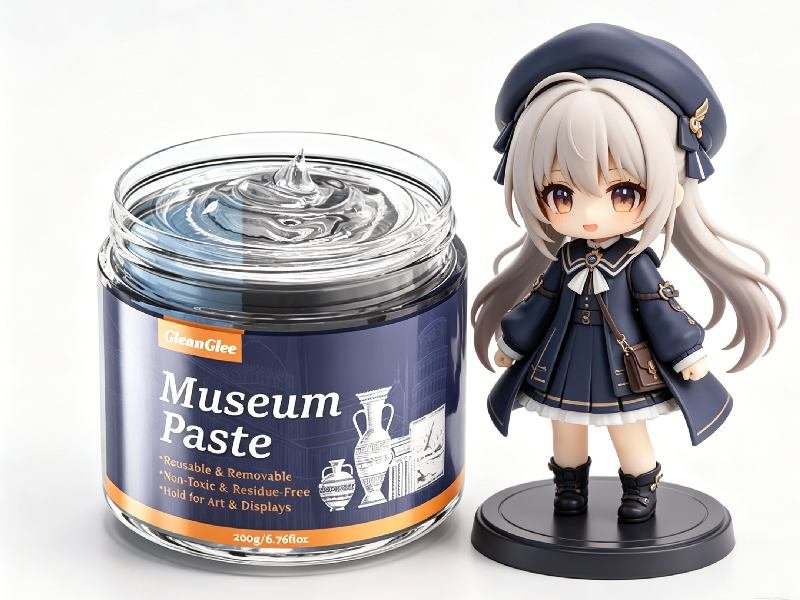
A display does not need to fall loudly to become a problem. Most display damage starts with small movement: a vase shifts a little when the table is wiped, a figurine slides forward each time a cabinet door closes, or a glass ornament slowly moves closer to the shelf edge. Smooth décor on smooth furniture looks clean, but it often has very little grip. That is why museum gel is useful for homes, galleries, offices, retail counters, collectible shelves, product photography, and showroom displays.
To use museum gel for display stability, clean and dry the item base and surface, roll a small amount into pea-size or smaller dots, press the gel under stable contact points, place the item on a flat horizontal surface, and let it set for about 30 minutes. It is made for display holding, not wall mounting, hanging objects, or broken-item repair.
The best museum gel job should be almost invisible. A clear dot under a crystal ornament, resin figure, glass vase, trophy, model, candle holder, or antique should help it stay in place without making the display look taped, glued, or over-fixed. Think of a favorite figurine that always seems to move after cleaning day. A small hidden gel point under the base can keep that piece where it belongs, while still allowing it to be removed later.
What Is Museum Gel for Display Stability?
Museum gel for display stability is a clear, removable gel placed under décor, collectibles, vases, figurines, trophies, models, candles, glass pieces, and other display items to help reduce sliding, tipping, and small movement on smooth horizontal surfaces. It is commonly used on glass shelves, marble tops, sealed wood cabinets, polished metal stands, ceramic display areas, acrylic risers, and retail-style counters where objects may look stable but still move during daily use.
The main job of museum gel is simple: it creates extra grip between the object base and the surface below it. A figurine with small feet, a vase with a smooth base, or a trophy on a polished shelf may shift little by little when the surface is wiped, bumped, or vibrated. Museum gel adds a soft tacky contact layer that helps the item stay in its intended position without visible screws, nails, clamps, tape strips, or permanent glue.
Museum gel should not be treated as a repair adhesive or structural mounting product. It does not fix broken ceramics, cracked glass, loose parts, or damaged collectibles. It is also not made for wall hanging, vertical mounting, or suspended objects. Its best use is display support: keeping intact objects steadier on clean, dry, flat, horizontal surfaces while still allowing removal and repositioning later.
Museum Gel Basics
Museum gel is usually soft, clear, flexible, and slightly tacky. A small amount is rolled into dots or balls, pressed under the base of an object, and then placed onto a flat surface. Once the object is set down, the gel spreads slightly and increases the contact area between the item and the shelf or tabletop. The material does not dry into a hard bond like glue. Instead, it remains flexible, which makes it easier to remove, reuse, and reposition when the display layout changes. This makes museum gel useful for both permanent-looking home displays and temporary arrangements such as holiday décor, product photography, trade show tables, showroom shelves, and seasonal cabinet styling.
Museum gel is most useful when the display item already sits correctly by itself but needs more grip. It should be added after the basic display position is safe.
- Best for intact items that rest naturally on a flat surface.
- Best for smooth bases such as glass, ceramic, resin, metal, crystal, or polished plastic.
- Best for indoor areas where heat, water, oil, and dust are controlled.
- Best when hidden under the base instead of exposed around the edge.
| Museum Gel Feature | Practical Meaning | Display Benefit |
|---|---|---|
| Clear appearance | Blends under many objects | Less visible than tape or putty |
| Flexible texture | Does not cure hard | Easier removal and repositioning |
| Tacky hold | Adds surface grip | Helps reduce sliding and light movement |
| Small application amount | Only dots are needed | Cleaner display look |
| Removable use | Can be twisted off carefully | Better for cleaning and rearranging |
Museum Gel Hold
Museum gel hold comes from clean contact, not from hard curing. The gel grips best when both the item base and display surface are smooth, dry, and free from dust, wax, oil, or cleaning film. The hold is strongest when the gel is placed under natural contact points rather than forced into uneven gaps. For example, a small figurine with two flat feet may need only two tiny dots, while a wide bowl may need three to five small dots around the lower base. The goal is not to cover the entire bottom of the object. The goal is to create enough balanced contact to reduce movement without changing the way the object sits.
The most common mistake is using too much gel. A thick lump can make an object lean, wobble, or show clear squeeze-out around the base. Smaller dots usually perform better because they spread pressure evenly.
| Display Item | Common Movement Risk | Suggested Gel Use |
|---|---|---|
| Small figurine | Tiny base shifts on glass | 2 tiny dots under contact points |
| Vase | Smooth base slides while cleaning | 3 small dots inside base ring |
| Bowl | Wide base moves on marble | 3–5 small dots around base |
| Trophy | Desk or shelf vibration | 4 small dots near corners |
| Glass ornament | Low friction on shelf | 2–3 small hidden dots |
| Retail sample | Repeated nearby handling | 2–4 dots under stable base |
A good hold should feel steady after the gel settles, but it should not be tested by pushing hard from the top. A light touch near the base is a safer check.
Museum Gel Uses
Museum gel is useful anywhere small movement can turn into damage, mess, or repeated display adjustment. In a home, it can help keep vases, candles, frames, ornaments, and shelf décor in place. In a collection cabinet, it can help prevent figures, models, glass pieces, and resin statues from slowly drifting forward. In an office, it can help keep awards, nameplates, trophies, and decorative objects aligned. In a retail or showroom setting, it can help display items stay neat during cleaning, foot traffic, and daily handling around the shelf. It is especially helpful on surfaces that look elegant but have low friction, such as glass, polished stone, lacquered wood, acrylic, and metal.
The strongest use cases usually share three conditions: the object is intact, the surface is horizontal, and the item needs extra grip rather than permanent attachment.
- Collectibles: action figures, anime statues, resin figures, model kits, miniature scenery.
- Glass décor: glass vases, crystal ornaments, candle holders, display bowls.
- Home décor: picture frames, small lamps, table decorations, seasonal décor.
- Office display: awards, trophies, desk décor, reception counter pieces.
- Retail display: product samples, showroom props, display models.
Surface and item pairing matters:
| Display Area | Suitable Items | Why Museum Gel Helps |
|---|---|---|
| Glass cabinet | Figurines, ornaments, crystal pieces | Reduces sliding on slick shelves |
| Coffee table | Bowls, candles, small décor | Helps during wiping and light bumps |
| Bookshelf | Frames, statues, vases | Keeps items better aligned |
| Retail counter | Samples, props, display pieces | Reduces daily repositioning |
| Office shelf | Awards, trophies, décor | Helps with vibration and touch |
| Photo table | Props, models, small objects | Keeps position consistent between shots |
Museum Gel Limits
Museum gel has clear limits and should be used only where the item is already reasonably stable. It is not a safety device for every risk. It cannot make a top-heavy vase fully secure near a shelf edge, cannot repair a cracked figurine, and cannot hold an object on a wall. It also cannot fix a weak cabinet, loose shelf bracket, sloped tray, or unstable table. When used on the wrong surface, it may hold poorly or leave marks. Fabric, raw wood, porous stone, peeling paint, dusty shelves, wet areas, oily surfaces, and freshly polished furniture all need caution or should be avoided.
A safe display starts with placement first and gel second. If the item feels risky before the gel is added, the location should be improved before application.
Avoid museum gel for:
- Wall-mounted objects, hanging frames, or vertical displays.
- Broken, cracked, chipped, or loose display items.
- Rough, dusty, wet, oily, fabric, or porous surfaces.
- Hot areas near fireplaces, radiators, direct sun, or open flames.
- Items placed close to shelf edges or on unstable furniture.
| Situation | Risk Level | Better Choice |
|---|---|---|
| Flat glass shelf with small figurine | Low to medium | Museum gel is suitable |
| Polished wood shelf with finish | Medium | Test hidden area first |
| Tall vase near table edge | High | Move inward or lower first |
| Wall-hung frame | Not suitable | Use proper wall hardware |
| Cracked ceramic item | Not suitable | Use repair adhesive or restoration |
| Raw wood surface | Risky | Avoid or test carefully |
| Candle near heat | Risky | Keep gel away from flame and hot wax |
Museum gel works best as hidden support for stable objects, not as a shortcut for unsafe display placement.
How to Use Museum Gel for Display Stability?
Museum gel for display stability should be applied in small, controlled amounts on clean, dry, flat surfaces. The process is simple: clean the object base and display surface, roll the gel into small dots, press it under stable contact points, place the object directly in position, and let the gel settle before touching or adjusting it.
The best result comes from careful placement, not from using a large amount of gel. Thick gel can squeeze out, collect dust, raise one side of the object, or become visible under glass and crystal. Several small dots usually give a cleaner hold than one large lump, especially under figurines, vases, bowls, trophies, candles, ornaments, models, and retail display pieces.
Museum gel should only be used when the object already sits properly on its own. It should not be used to fix a leaning vase, repair a broken figurine, hold objects on walls, or stabilize a weak shelf. Use it as added grip on horizontal surfaces, then check the display after about 30 minutes to make sure the item sits level and the gel stays hidden.
Step 1: Clean for Museum Gel
Cleaning is the first step because museum gel needs direct contact with both surfaces. Dust, oil, wax, furniture polish, glass cleaner film, fingerprints, moisture, and lint can weaken the hold. A display item may look clean from the top but still have dust on the base, especially figurines, resin statues, glass ornaments, trophies, and vases that stay on shelves for months. The display surface also needs attention. Glass shelves often keep fingerprints. Wood may have polish. Stone may hold fine dust. Metal can have oil marks. If the gel touches residue instead of the real surface, the hold becomes less reliable and the gel may look cloudy under clear items.
Before applying museum gel:
- Wipe the object base with a soft microfiber cloth.
- Clean the shelf, table, cabinet, or counter surface.
- Let damp surfaces dry fully before use.
- Remove wax, polish, oil, or cleaner film where possible.
- Check that the surface is flat and horizontal.
| Surface Condition | Effect on Museum Gel | Better Action |
|---|---|---|
| Dry and clean | Stronger contact | Apply gel normally |
| Dusty | Weak or uneven hold | Wipe before use |
| Wet or damp | Poor grip | Dry completely |
| Freshly polished | Slippery contact | Remove residue or test first |
| Oily or greasy | Gel may slide | Clean and dry first |
| Uneven or sloped | Higher tipping risk | Choose another location |
A clean surface makes the gel easier to hide and easier to remove later.
Step 2: Roll Museum Gel
Museum gel should be rolled into small dots before placement. The right amount depends on the base size, weight balance, and surface type. For most small display objects, the gel dot should be pea-size or smaller. Miniatures, tiny figurines, and narrow-footed pieces may need dots closer to rice-grain size. Large lumps are rarely better. They can create uneven height, push out from the edge, or make the object feel soft instead of steady. A better method is to use several small dots placed around the natural contact points. This spreads the hold more evenly and keeps the display cleaner.
Recommended amount guide:
| Object Base Size | Gel Dot Size | Number of Dots | Best Use |
|---|---|---|---|
| Under 2 inches | Rice grain to tiny pea | 2 | Mini figures, small ornaments |
| 2–4 inches | Small pea | 3 | Small vases, candles, décor |
| 4–6 inches | Small pea | 3–5 | Bowls, trophies, glass pieces |
| Over 6 inches | Small pea | 4–6 | Wider décor, display samples |
| Tiny feet | Very small dots | Match contact points | Figurines, models, statues |
Use clean hands when rolling the gel. Clear gel can trap dust, lint, pet hair, glitter, or fibers. If a piece of gel falls on carpet or picks up dirt, replace it with a clean piece before using it under transparent glass, crystal, acrylic, or glossy ceramic.
Good rolling habits:
- Start with less gel than expected.
- Make dots similar in size for even height.
- Keep unused gel covered when not in use.
- Do not stretch gel into thin strips under heavy items.
Step 3: Press Museum Gel
Press the rolled museum gel onto the bottom of the object, not randomly onto the shelf. This gives better control and helps keep the gel hidden. The gel should sit under stable contact areas, slightly inside the outer edge of the base. When the object is placed down, the gel spreads a little. If the dots start too close to the edge, the gel may squeeze out and become visible. Placement also affects balance. A round vase usually needs evenly spaced dots around the base ring. A rectangular trophy base usually needs dots near the corners but not on the exact edge. A figurine with small feet needs tiny dots only where the feet naturally touch the surface.
Avoid pressing museum gel onto delicate or unsuitable areas:
- Paper labels or price stickers.
- Felt pads or fabric bottoms.
- Loose paint, gilding, or coating.
- Thin feet, small stems, or fragile parts.
- Cracked, chipped, or repaired sections.
- Deep grooves where gel may be hard to remove.
| Object Shape | Better Gel Placement | Mistake to Avoid |
|---|---|---|
| Round vase | 3–4 dots inside base ring | One thick center lump |
| Bowl | 3–5 dots around lower base | Uneven dots on one side |
| Rectangular trophy | Dots near corners, inside edge | Gel on the outer rim |
| Figurine with feet | Tiny dots under each contact point | Filling gaps with gel |
| Glass ornament | Small hidden dots | Gel visible from front |
| Candle holder | Dots under base, away from heat | Gel near flame or wax spill |
After pressing the gel under the object, look at the base before setting it down. The dots should be small, balanced, and hidden from normal viewing angles.
Step 4: Set Museum Gel
Set the object directly in its final position after the gel is attached. Do not slide the object across the shelf after contact. Sliding can smear the gel, reduce clarity, create a visible trail on glass, and weaken the final hold. Once the object is placed, press gently from the strongest part near the base. Avoid pressing thin stems, handles, wings, decorative tips, or fragile parts. The object should sit naturally, without rocking or leaning. Let the gel settle for about 30 minutes before touching the display again. Larger, taller, heavier, or more valuable items should rest longer before checking.
Suggested setting times:
| Display Item | Minimum Set Time | Better Set Time |
|---|---|---|
| Small figurine | 30 minutes | 1 hour |
| Ornament | 30 minutes | 1 hour |
| Short vase | 30 minutes | 1–2 hours |
| Bowl | 30 minutes | 1–2 hours |
| Trophy | 30 minutes | 1–2 hours |
| Tall vase | 1 hour | 2–4 hours |
| Retail display piece | 1 hour | Before opening |
Final check after setting:
- The object sits level.
- No gel shows from the front or side.
- The item is not close to the shelf edge.
- The piece does not move with a light touch near the base.
- No gel has squeezed out.
- The display still looks clean and natural.
If the item tilts, rocks, or shows gel around the edge, twist it gently from the base, lift slowly, remove the gel, and apply smaller dots. A good museum gel setup should improve stability without making the display look glued, padded, or messy.
Which Surfaces Fit Museum Gel for Display Stability?
Museum gel for display stability works best on clean, dry, smooth, horizontal surfaces that allow full contact between the gel, the object base, and the display area. Glass, glazed ceramic, sealed marble, polished granite, quartz, smooth metal, acrylic, crystal, plastic, and sealed wood usually provide better results than raw, dusty, porous, oily, waxed, or uneven surfaces.
The surface matters as much as the gel itself. A clear figurine on a clean glass shelf can hold well with two or three small gel dots. The same figurine on dusty raw wood may hold poorly because the gel contacts dust and fibers instead of a firm surface. A vase on polished stone may look stable, but if the stone is oily, wet, or unsealed, the grip may weaken or leave a mark. Museum gel needs stable surface contact, not just object weight.
Before applying museum gel, check four points: the surface should be horizontal, clean, dry, and strong enough to support the display item. If a shelf wobbles, a table slopes, or a cabinet shakes, fix the display location first. Museum gel can help reduce sliding and light movement, but it should not be used to compensate for weak furniture, broken shelves, edge placement, or unstable objects.
| Surface Type | Fit Level | Main Concern | Best Practice |
|---|---|---|---|
| Glass | Excellent | Gel visibility, fingerprints, sliding | Clean fully and use small hidden dots |
| Glazed ceramic | Excellent | Uneven tile edges or grout lines | Apply only on flat glazed areas |
| Sealed marble | Good | Porosity, cleaner residue | Test first and keep surface dry |
| Granite/quartz | Good | Dust, oil, uneven polish | Wipe clean before applying |
| Smooth metal | Good | Fingerprints, vibration, coating | Degrease and test coated metal |
| Acrylic/plastic | Good | Scratches, static dust | Clean gently with soft cloth |
| Sealed wood | Good with testing | Polish, wax, finish marks | Test hidden area first |
| Raw wood | Weak | Absorption, fibers, marks | Avoid or test carefully |
| Fabric | Poor | No firm contact | Avoid |
| Wall or vertical surface | Not suitable | Gravity pull | Use proper mounting hardware |
Museum Gel on Glass
Museum gel works very well on glass because glass is smooth, non-porous, and easy to clean. It is one of the most common surfaces for display cabinets, glass shelves, crystal cabinets, glass tabletops, showroom counters, and photography stands. The main issue is that glass has very low natural friction. A crystal ornament, resin figure, glass vase, candle holder, model kit, or small trophy can shift more easily than it appears, especially when cabinet doors open, shelves vibrate, or the surface is wiped. Museum gel improves grip by adding small tacky contact points under the object base while keeping the display clean and low-profile.
Glass also makes messy application easier to notice. A thick gel lump, trapped dust, hair, lint, or squeeze-out around the base can become visible under cabinet lighting. Clear gel looks best when applied in small dots slightly inside the base edge.
Good glass uses:
- Display cabinets with figurines, crystal pieces, models, and ornaments.
- Glass shelves holding vases, candles, trophies, or collectibles.
- Glass tabletops with decorative bowls or small sculptures.
- Retail-style counters where items need to stay aligned.
- Photography surfaces where props must stay in one place.
| Glass Display Issue | What May Happen | Better Museum Gel Method |
|---|---|---|
| Fingerprints on shelf | Weak or cloudy contact | Wipe with microfiber cloth first |
| Too much gel | Visible squeeze-out | Use tiny dots inside base edge |
| Sliding after placement | Gel smears on glass | Place directly, do not drag |
| Bright cabinet light | Gel becomes noticeable | Check from front and side |
| Shelf vibration | Objects slowly shift | Use balanced dots and deeper placement |
For glass shelves, the safest pattern is usually two small dots for tiny objects, three dots for small-to-medium objects, and three to five dots for bowls or wider bases. After placement, view the display from several angles. If the gel is visible from normal viewing distance, remove the item by twisting gently and reapply less gel.
Museum Gel on Wood
Museum gel can work on sealed wood, lacquered cabinets, painted shelves, finished mantels, and smooth modern furniture, but wood needs more caution than glass. The main concern is the surface finish. Wood may have wax, oil, polish, stain, paint, varnish, or lacquer. These coatings can affect grip and may react differently after long contact. A sealed shelf may work well, while raw or waxed wood may absorb residue or show a slight outline. Old painted furniture, antique cabinets, and handmade finishes need a hidden spot test before full use.
A hidden test is simple: place a tiny gel dot on an unseen part of the surface, leave it for several hours, twist it off gently, then check the area under bright light. If the finish looks dull, oily, softened, stained, or outlined, do not use museum gel on that surface.
Wood surfaces that may work:
- Smooth sealed bookshelves.
- Lacquered display cabinets.
- Finished mantels.
- Painted shelves in strong condition.
- Modern sealed wood sideboards.
- Decorative trays with a hard smooth coating.
Wood surfaces to avoid or test carefully:
- Raw unfinished wood.
- Waxed or oiled wood.
- Peeling paint.
- Antique lacquer.
- Rough rustic shelves.
- Soft painted surfaces.
| Wood Surface | Museum Gel Fit | Risk Level | Recommended Action |
|---|---|---|---|
| Sealed modern wood | Good | Low to medium | Test if finish is unknown |
| Lacquered cabinet | Good | Medium | Use small dots and check finish |
| Painted shelf | Possible | Medium | Avoid weak or peeling paint |
| Antique wood | Caution | High | Test first, avoid long contact if unsure |
| Waxed wood | Weak | High | Avoid or remove wax first |
| Raw wood | Poor | High | Avoid |
On wood, use smaller gel dots than on glass and keep the gel hidden. If gel squeezes out, dust can collect around the edge and leave a visible ring. Wood displays should also be checked more often than glass displays because finish condition can vary.
Museum Gel on Stone
Museum gel can work well on polished and sealed stone surfaces such as marble, granite, quartz, and smooth stone counters. These surfaces are often used under vases, candle holders, sculptures, crystal bowls, trophies, and decorative objects because they look solid and premium. Stone can still be slippery when polished, especially when the display item has a smooth ceramic, glass, metal, or crystal base. Museum gel adds grip and helps keep objects centered during light cleaning, foot traffic, and surface vibration.
Stone requires attention because not all stone is sealed or non-porous. Marble, limestone, travertine, slate, and some natural stones may absorb oils, moisture, or residue if unsealed. A polished sealed marble surface may be suitable, while rough limestone or unsealed travertine may trap gel or show marks. When the surface value is high, test first in a hidden area.
Good stone uses:
- Crystal bowls on sealed marble.
- Vases on polished granite.
- Candle holders on quartz countertops.
- Small sculptures on smooth stone shelves.
- Trophies on polished reception counters.
- Decorative pieces on sealed stone console tables.
| Stone Surface | Museum Gel Fit | Main Risk | Better Practice |
|---|---|---|---|
| Sealed marble | Good | Staining on delicate finishes | Test hidden spot first |
| Granite | Good | Dust or oily cleaner film | Wipe dry before use |
| Quartz | Good | Cleaner residue | Use on clean dry surface |
| Polished tile | Good | Grout lines and uneven edges | Apply only on flat tile area |
| Limestone | Risky | Porous surface | Avoid or test carefully |
| Travertine | Risky | Pits may trap residue | Avoid textured areas |
| Rough slate | Weak | Uneven contact | Avoid |
Stone displays should be kept dry. Do not apply gel after using stone polish, oily cleaners, or wet cloths. Let the surface dry fully before placing the item. Heavy objects should still be kept away from edges, because museum gel reduces sliding but does not stop every tipping risk.
Museum Gel on Metal
Museum gel works well on smooth metal surfaces when they are clean, dry, and firmly supported. Metal shelves, stainless steel counters, powder-coated racks, trophy stands, display plinths, office shelves, and showroom fixtures can all benefit from added grip. Metal often looks strong, but many metal surfaces are slick and can vibrate. A trophy, award, glass sample, candle holder, model, or decorative object can move slightly when the table is bumped, drawers are closed, or people walk nearby.
The biggest metal issue is surface contamination. Fingerprints, oil, grease, polish, metal cleaner, dust, and coating residue can weaken museum gel contact. Coated metal also needs care because some powder coatings, painted finishes, or flaking surfaces may pull away during removal. Smooth stainless steel is usually easier to use than rusty, textured, peeling, or dusty metal.
Good metal uses:
- Stainless steel counters.
- Powder-coated display shelves.
- Office award stands.
- Metal showroom fixtures.
- Retail display plinths.
- Trade show tables.
- Smooth metal cabinet shelves.
| Metal Surface | Museum Gel Fit | Risk Level | Best Practice |
|---|---|---|---|
| Stainless steel | Good | Low | Remove fingerprints and dry fully |
| Powder-coated metal | Good with testing | Medium | Test coating before long display |
| Painted metal | Possible | Medium | Avoid peeling or soft paint |
| Brushed metal | Good if smooth | Low to medium | Clean grooves carefully |
| Rusty metal | Poor | High | Avoid |
| Textured metal | Weak | Medium to high | Use only if contact is smooth |
| Flaking coating | Not suitable | High | Avoid |
On metal, place the gel under balanced contact points and keep it away from sharp edges. If the metal shelf vibrates heavily, reduce movement at the furniture level first. Museum gel can help with light vibration, but it cannot stabilize a loose rack, weak shelf, or unstable stand.

What Tips Help Museum Gel for Display Stability?
Museum gel for display stability works best when the display area is clean, the gel amount is small, and the object already sits safely on a flat horizontal surface. The strongest results usually come from careful preparation rather than heavy application. A few small dots placed in the right position can hold more neatly than a thick lump placed in the center.
Display stability depends on four details: surface condition, gel amount, object balance, and regular checking. A glass ornament on a clean shelf may need only two tiny gel dots. A wide bowl may need three to five dots. A tall vase may need better shelf placement before any gel is applied. Museum gel should reduce sliding and light movement, not hide an unsafe display location.
The most useful routine is simple: clean, apply lightly, let it set, check after movement, and remove gently when needed. If the gel becomes dusty, stretched, cloudy, or visible around the base, replace it. If the object rocks, leans, or sits near an edge, improve the placement before adding more gel.
| Museum Gel Tip | Best Practice | Problem It Prevents |
|---|---|---|
| Use small dots | Start pea-size or smaller | Squeeze-out and visible gel |
| Clean first | Remove dust, oil, wax, and moisture | Weak hold and cloudy gel |
| Place evenly | Match natural base contact points | Tilting and uneven pressure |
| Wait before testing | Let gel settle for about 30 minutes | Smearing and early loosening |
| Check regularly | Inspect every 1–3 months | Slow shifting and dirty gel |
| Remove by twisting | Release from the base slowly | Stress on delicate items |
Museum Gel Amount
The right museum gel amount is usually much smaller than expected. Display stability does not require covering the full base of the object. The gel only needs to create controlled contact points between the object and the surface. A small figurine, for example, may need two tiny dots under its flat feet. A vase or bowl may need three to five small dots placed around the base ring. When too much gel is used, the object can sit unevenly, the gel can squeeze out from the edge, and dust may collect around the base. Clear gel can also become noticeable under glass, crystal, acrylic, or glossy ceramic if the dots are too large.
Use the base shape as the guide, not just the object weight. A heavy object with a wide base may need several balanced dots. A light object with a tiny base may need only a very small amount.
| Object Base Type | Suggested Gel Amount | Placement Method |
|---|---|---|
| Tiny figurine feet | Rice-grain dots | One dot under each contact point |
| Small round base | 2–3 tiny dots | Inside the outer base edge |
| Medium vase base | 3 small dots | Triangle pattern around base ring |
| Bowl or wide ornament | 3–5 small dots | Even spacing around lower base |
| Rectangular trophy base | 4 small dots | Near corners, slightly inside edge |
| Large display piece | 4–6 small dots | Balanced dots, not one center lump |
Good amount control:
- Start with less gel, then add more only if needed.
- Keep gel dots similar in size so the item stays level.
- Avoid placing gel directly on the outer rim.
- Do not use a thick pad under one side of the object.
- Replace dirty gel instead of adding fresh gel on top.
After placement, check the display from the front and side. If the gel is easy to see, the amount is too large or too close to the edge.
Museum Gel Set Time
Museum gel set time is important because the gel needs quiet contact with both the object base and the display surface. Although the gel feels tacky right away, it usually becomes more stable after it settles under light pressure. Around 30 minutes is a practical minimum for small objects such as figurines, ornaments, candles, and desk décor. Larger pieces such as bowls, vases, trophies, and retail display items should rest longer before being touched, cleaned around, or moved. During this period, the object should not be pushed, rotated, or slid across the shelf. Early movement can smear the gel and reduce clean contact.
Set time should match the object size and the display risk. Taller objects need more time and safer placement because they have a higher tipping force if touched from the top.
| Display Item | Minimum Set Time | Better Set Time |
|---|---|---|
| Mini figurine | 30 minutes | 1 hour |
| Small ornament | 30 minutes | 1 hour |
| Candle holder | 30 minutes | 1–2 hours |
| Short vase | 30 minutes | 1–2 hours |
| Crystal or glass bowl | 30 minutes | 1–2 hours |
| Tall vase | 1 hour | 2–4 hours |
| Trophy or award | 30 minutes | 1–2 hours |
| Showroom display piece | 1 hour | Before display opening |
Useful set-time habits:
- Place the object once and avoid dragging it into position.
- Press lightly near the strongest part of the base.
- Do not test by pushing the top of a tall object.
- Keep cabinet doors closed during the first setting period.
- Wait longer for heavy, tall, or valuable pieces.
After the gel has settled, test only with a light touch near the base. If the object shifts easily, remove it, clean again, and reapply smaller, better-spaced dots.
Museum Gel Checkups
Museum gel checkups are necessary because display conditions change over time. Dust settles on shelves, furniture gets cleaned, cabinets move slightly, room temperature changes, and display items may be touched during daily use. A gel dot that looked clean on day one may become dusty after a few weeks, especially on open shelves. A display piece may also shift if the shelf is wiped, if a cabinet door is opened often, or if nearby movement creates vibration. Regular checking keeps the display neat and reduces the chance of an item slowly moving toward the edge.
The checking schedule should match the display location. A closed cabinet in a quiet room needs less attention than a hallway table, open shelf, retail counter, or home with pets.
| Display Location | Check Frequency | What to Watch |
|---|---|---|
| Closed cabinet | Every 2–3 months | Dust, alignment, visible gel |
| Open shelf | Every 1–2 months | Sliding and edge distance |
| Hallway table | Monthly | Bumps and vibration |
| Room with pets | Monthly | Shifted objects and dirty gel |
| Office shelf | Every 1–2 months | Desk vibration and touch |
| Retail counter | Weekly | Cleaning residue and display alignment |
| Trade show table | Daily | Transport movement and visitor contact |
Check these points:
- The item is still in its original position.
- Gel has not squeezed out around the base.
- Gel does not look cloudy, stretched, or dirty.
- The object is not closer to the shelf edge.
- The surface is not slick from cleaner or polish.
- The item does not rock when touched near the base.
If any problem appears, remove the item gently, clean the base and surface, and apply fresh gel. Pressing old dirty gel harder usually gives a worse result than resetting with clean dots.
Museum Gel Removal
Museum gel removal should be slow and controlled, especially under glass, crystal, ceramic, resin, painted décor, trophies, and delicate figurines. The safest method is to hold the object near its base, twist gently left and right, and lift only after the gel releases. Pulling straight upward can place unnecessary stress on the object and may also stretch the gel. Thin stems, handles, wings, feet, decorative points, and glued-on parts should not be used as lifting points. The strongest part of most display pieces is the base or main body, so removal should start there.
After removal, leftover gel can usually be rolled away with clean fingers. Hard tools should be avoided because they can scratch shelves, glass, marble, metal, acrylic, crystal, or painted furniture.
| Removal Situation | Safer Method | Mistake to Avoid |
|---|---|---|
| Small figurine | Twist from the base | Pulling by head, wing, or foot |
| Vase | Support base and body | Lifting by neck only |
| Bowl | Twist from lower body | Prying from one edge |
| Trophy | Hold full base | Dragging across shelf |
| Glass object | Lift after release | Scraping with metal tools |
| Heavy décor | Use two hands or help | Rushing the removal |
Safe removal steps:
- Hold the object from the base or strongest body area.
- Twist slowly until the gel loosens.
- Lift only after the base releases.
- Roll away leftover gel with clean fingers.
- Wipe the area with a soft cloth if needed.
- Use fresh gel if the old piece has dust, lint, or oil.
For high-value objects, removal should never be forced. If the gel resists, continue twisting gently and give it time to release. Slow removal protects both the display item and the surface below it.
Museum Gel vs Putty for Display Stability?
Museum gel and museum putty both help reduce sliding, tipping, and small movement, but they are not the same. Museum gel is clear, softer, and easier to hide under glass, crystal, acrylic, polished ceramic, and glossy décor. Museum putty is thicker, more opaque, and often better hidden under solid objects where the base is not visible.
For display stability, the better choice depends on appearance, surface type, object weight, base shape, and removal needs. A crystal ornament on a glass shelf usually looks cleaner with museum gel. A ceramic statue on a wooden shelf may work well with putty. A clear retail display, lighted cabinet, or product photo setup often needs museum gel because cloudy material under the base can ruin the clean look.
The safest choice starts with the display itself. The object should sit on a flat horizontal surface, away from edges, heat, and strong vibration. Neither museum gel nor putty should be used for wall mounting, hanging objects, broken repairs, unstable shelves, or heavy pieces placed in risky positions. Both products work best as extra grip, not as a replacement for careful placement.
| Comparison Point | Museum Gel | Museum Putty |
|---|---|---|
| Appearance | Clear and low-profile | Usually white, gray, beige, or cloudy |
| Best visible use | Glass, crystal, acrylic, polished décor | Opaque décor, ceramics, frames, solid bases |
| Hold style | Soft tack and surface grip | Firmer tack and thicker support |
| Removal | Twist and lift gently | Twist, peel, or roll away |
| Residue risk | Lower on smooth non-porous surfaces | Surface-dependent, may leave small bits |
| Reuse | Reusable if clean | Reusable if clean and not dried out |
| Best surface fit | Glass, marble, metal, acrylic, sealed smooth surfaces | Sealed wood, opaque objects, less visible base areas |
| Main concern | Can show if overused or dusty | Can look cloudy or bulky under clear items |
Museum Gel Clarity
Museum gel clarity makes a major difference when the display item or shelf is transparent, glossy, or brightly lit. Clear glass, crystal, acrylic stands, polished ceramic, resin collectibles, and lighted cabinets reveal anything placed beneath the object. A small white putty mark may not look serious in the hand, but under a crystal ornament or glass vase, it can become the first thing people notice. Museum gel is easier to hide because it blends with the surface when applied in small dots. It helps keep the focus on the displayed object instead of the holding material underneath.
Museum gel works especially well for displays where the base is visible from the front, side, or below. Lighted glass cabinets, retail shelves, photography tables, and premium home décor setups benefit from a cleaner fixing method.
- Best for crystal ornaments, glass figurines, transparent vases, acrylic risers, and polished display pieces.
- Better for product photos where cloudy putty may appear in close-up shots.
- Cleaner under glass shelves where the underside of the object can be seen.
- Less distracting under bright cabinet lighting or showroom lighting.
| Display Type | Museum Gel Result | Putty Result |
|---|---|---|
| Crystal on glass shelf | Cleaner and less visible | May show as cloudy spots |
| Glass vase on marble | Low-profile hold | May look bulky at base |
| Acrylic display block | Blends better | Often visible through clear material |
| Ceramic figurine | Works if base is smooth | Usually fine if base hides putty |
| Product photography | Cleaner close-up appearance | May require editing or repositioning |
Museum gel is not automatically invisible. If too much is used, it can squeeze out, catch light, or collect dust. The cleanest display usually needs small dots placed slightly inside the base edge.
Museum Gel Strength
Museum gel strength is best for reducing sliding, shifting, and light tipping on smooth horizontal surfaces. It does not create a hard permanent bond. It works by adding tack between the object base and the surface below it. Putty may feel firmer and thicker, which can be helpful under some opaque objects, but firmness alone does not guarantee better display stability. A clean surface, even pressure, balanced placement, and correct amount matter more than simply choosing a harder material. Museum gel can hold very well when the object has a smooth, stable base and the surface is clean, dry, and level.
The right product depends on the object’s shape. A wide bowl may hold well with museum gel dots around the base. A solid ceramic piece with a hidden underside may work well with putty. A tall narrow vase needs safer placement first, no matter which product is used.
- Museum gel is better for smooth bases and clean shelves.
- Putty can be practical under opaque décor where appearance matters less.
- Both products need flat horizontal placement.
- Neither product should be used to correct a badly leaning object.
| Stability Factor | Better Condition | Risk Condition |
|---|---|---|
| Surface | Smooth, dry, clean, horizontal | Dusty, oily, wet, sloped |
| Object base | Flat, wide, stable | Tiny feet, rocking base, uneven bottom |
| Product amount | Small balanced dots | One thick lump |
| Placement | Away from shelf edge | Near edge or high-traffic corner |
| Test method | Light touch near base | Pushing hard from the top |
Museum gel should be tested after it settles. A light touch near the base is enough. Pushing the upper part of a tall object creates tipping force and may loosen the hold unnecessarily.
Museum Gel Residue
Museum gel is often preferred when clean removal matters, especially on glass, glazed ceramic, polished metal, sealed stone, acrylic, crystal, and smooth display shelves. It can usually be removed by twisting the object gently and rolling away any leftover gel with clean fingers. Putty is also removable, but it may leave small pieces in textured bases, rough shelves, or corners. Both products can leave marks if used on the wrong surface, especially raw wood, porous stone, painted finishes, antique lacquer, waxed furniture, paper, fabric, or dusty surfaces.
Residue risk is not only about the product. It also comes from surface condition, heat, contact time, cleaning chemicals, and removal method. Fresh furniture polish, oil, wax, or moisture can interfere with gel or putty and may create marks or weak contact.
- Test hidden areas on wood, painted shelves, stone, or antique furniture.
- Avoid using either product on porous, soft, peeling, or unfinished surfaces.
- Remove by twisting and rolling, not scraping.
- Replace dirty gel or putty instead of pressing it back under the object.
| Surface | Museum Gel Residue Risk | Putty Residue Risk | Safer Action |
|---|---|---|---|
| Glass | Low | Low to medium | Clean first, remove gently |
| Sealed marble | Low to medium | Medium | Test hidden area |
| Sealed wood | Medium | Medium | Test finish first |
| Raw wood | High | High | Avoid |
| Painted shelf | Medium to high | Medium to high | Avoid weak paint |
| Fabric | High | High | Avoid |
| Acrylic | Low to medium | Medium | Use clean small dots |
Hard tools should not be used during removal. Metal scrapers, knives, and abrasive pads can scratch shelves, glass, crystal, polished stone, acrylic, or painted furniture.
Museum Gel Reuse
Museum gel is reusable when it stays clean, soft, and flexible. It works well for displays that change often, such as holiday décor, collectible shelves, retail counters, photo props, cabinet layouts, office awards, and showroom arrangements. After removal, the gel can often be rolled again and placed under another object. Putty can also be reused, but it may dry out, pick up more visible dust, or become less clean under clear display items. For transparent glass, crystal, or acrylic, fresh museum gel often looks better than reused gel that has collected lint.
Reuse works best when the gel is handled carefully. Dust, pet hair, glitter, carpet fibers, and shelf debris can make clear gel look cloudy and reduce tack. Dirty gel should not be reused under valuable or transparent objects.
- Store unused gel in a closed container.
- Keep gel away from fabric, carpet, dust, and pet hair.
- Reuse only pieces that stay clear and flexible.
- Use fresh gel for high-value glass, crystal, or display photography.
- Check reused gel after placement because old material may hold less evenly.
| Reuse Situation | Museum Gel Advice | Putty Advice |
|---|---|---|
| Seasonal ornaments | Reuse if clean | Reuse if not dry |
| Collectible cabinet reset | Good for clear displays | Good for hidden bases |
| Product photography | Use clean or fresh gel | Avoid visible putty under clear items |
| Retail shelf change | Replace dirty gel | Replace dirty putty |
| High-value crystal | Fresh gel is safer | Putty may show |
| Opaque ceramic décor | Reused gel can work | Reused putty can work |
Reusable hold is valuable because displays rarely stay the same forever. The better habit is to inspect the material before reuse. If it looks dirty, stretched, cloudy, or weak, replace it instead of risking the display.

Why Choose GleamGlee Museum Gel for Display Stability?
GleamGlee Museum Gel is designed for clear, removable, reusable display stability on smooth horizontal surfaces. It helps reduce sliding, tipping, and light movement for figurines, vases, glass décor, crystal pieces, resin collectibles, trophies, candles, models, antiques, retail samples, office décor, and home display items without permanent glue, visible tape, drilling, or screws.
A good display gel should solve three problems at once: the item should stay more stable, the gel should stay discreet, and the object should remain removable. GleamGlee Museum Gel focuses on these daily-use details. The clear gel blends under many display pieces, the flexible hold allows repositioning, and the small-dot application keeps shelves, cabinets, counters, and tabletops looking clean.
GleamGlee also brings factory-level control behind the product. The company works across formula development, raw materials, packaging materials, label printing, filling, design, and export support. With 25+ chemists and engineers, 18+ designers, 4 specialized factories, 3000+ packaging molds, and automated filling capacity above 12 million units per year, GleamGlee can support stable product quality, practical packaging, and scalable supply for display stability products.
| GleamGlee Strength | Practical Value | Display Stability Benefit |
|---|---|---|
| Clear gel format | Low visual impact | Better for glass, crystal, acrylic, and polished décor |
| Removable hold | Easy lifting and repositioning | Safer for cleaning and display changes |
| Reusable texture | Can be reset if clean | Useful for seasonal décor and shelf updates |
| Smooth-surface use | Works on glass, marble, metal, ceramic, plastic, sealed wood | Covers common display areas |
| 25+ technical team members | Formula testing and product consistency | More stable texture and tack |
| 18+ design team members | Clear packaging and use instructions | Easier application and fewer use mistakes |
| 4 integrated factories | Better control from material to finished product | More reliable repeat supply |
| 12M+ annual filling capacity | Larger production support | Suitable for wholesale and retail programs |
GleamGlee Museum Gel Clarity
GleamGlee Museum Gel uses a clear gel format because display stability should not make a shelf look messy. Many display items are transparent, glossy, reflective, or shown under lighting. Crystal ornaments, glass vases, acrylic blocks, polished ceramic pieces, resin figures, and trophies can reveal anything placed under the base. White putty, yellowing tape, thick wax, or visible pads may distract from the object. Clear museum gel is more suitable for these displays because it can sit under the base with less visual interference when applied in small, hidden dots. It is especially useful for glass cabinets, retail shelves, showroom counters, home décor photos, and clean modern interiors where the fixing material should not become part of the display.
Best clarity results come from correct use:
- Use pea-size or smaller dots.
- Keep gel slightly inside the base edge.
- Clean dust and lint before applying.
- Check the display under lighting after placement.
| Display Item | Visibility Risk | GleamGlee Museum Gel Advantage |
|---|---|---|
| Crystal ornament | High | Clear dots stay less noticeable |
| Glass vase | High | Cleaner than tape or cloudy putty |
| Acrylic riser | High | Blends better on transparent surfaces |
| Polished ceramic | Medium | Avoids bulky fixing marks |
| Resin figurine | Medium | Small dots hide under base areas |
| Trophy or award | Medium | Keeps desk display cleaner |
Clarity does not mean unlimited use. A large amount of gel can still show, even when clear. The cleanest result comes from controlled placement, clean hands, and balanced dots under the strongest contact points.
GleamGlee Museum Gel Protection
GleamGlee Museum Gel helps improve display stability by adding grip under the base of an object. It is useful when display pieces sit on slick or polished surfaces where normal contact is not enough. Glass shelves, marble tops, sealed wood cabinets, acrylic stands, ceramic tiles, and metal counters may look stable, but many objects can still move from cleaning, vibration, light bumps, pets, children, or daily foot traffic. The gel creates a soft tacky contact layer that helps reduce sliding and small movement before the item reaches a shelf edge or shifts out of position. It works best when the object already sits safely and the gel is used as extra support.
Common protection uses include:
- Holding figurines steady inside display cabinets.
- Reducing vase movement on polished tables.
- Keeping trophies aligned on office shelves.
- Helping retail samples stay in place.
- Stabilizing glass décor during cleaning.
| Display Scenario | Common Risk | GleamGlee Museum Gel Role |
|---|---|---|
| Glass cabinet | Door vibration | Helps objects stay aligned |
| Open shelf | Dusting and accidental touch | Reduces sliding |
| Console table | Nearby foot traffic | Adds grip under décor |
| Office shelf | Desk vibration | Helps awards stay positioned |
| Retail counter | Cleaning and movement around display | Keeps samples neater |
| Photography table | Props shifting between shots | Holds layout more consistently |
Museum gel should still be paired with safe placement. Heavy pieces should stay away from shelf edges. Tall items should sit deeper or lower. Furniture should be level and stable. Gel improves grip, but it should not be used to correct unsafe display locations.
GleamGlee Museum Gel Reuse
GleamGlee Museum Gel is removable and reusable on suitable smooth surfaces when it stays clean, flexible, and tacky. This matters because many displays change throughout the year. Holiday ornaments move from storage to shelves. Collectible figures are rearranged inside cabinets. Retail displays are reset for new products. Office awards and desk décor may be moved during cleaning. Photography props often need repeated repositioning. Permanent glue or strong tape makes these changes difficult and may leave marks. A removable museum gel allows the object to be lifted, cleaned around, and placed again without treating the display as permanent.
Safe reuse depends on cleanliness:
- Reuse gel only if it stays clear and flexible.
- Replace gel that has dust, lint, pet hair, or oil.
- Store unused gel in a closed container.
- Clean the object base before resetting.
| Reuse Situation | Good Practice | When to Replace Gel |
|---|---|---|
| Seasonal décor | Reuse clean gel for light ornaments | If glitter or dust sticks to it |
| Collectible cabinet reset | Roll and reapply under flat bases | If gel looks cloudy |
| Retail shelf change | Reuse for clean samples | If gel loses tack |
| Photo props | Use clean dots for repeat shots | If gel becomes visible |
| Office décor | Reset after shelf cleaning | If polish residue touches gel |
| Glass or crystal display | Fresh gel gives cleaner look | If any lint is trapped inside |
Removal should be gentle. Hold the object near the base, twist slowly left and right, then lift after the gel releases. Leftover gel can usually be rolled away with clean fingers. Hard scraping tools should not be used on glass, stone, crystal, acrylic, metal, or polished furniture.
GleamGlee Museum Gel Supply
GleamGlee Museum Gel is suitable for finished product supply, wholesale programs, private label projects, custom packaging, and product line expansion in display stability, home décor protection, collectible care, gallery supplies, craft storage, retail merchandising, and office display categories. The product is compact, easy to explain, and suitable for many scenes: figurines, glass décor, vases, trophies, candles, models, antiques, ornaments, and product samples. The use case is direct: display items slide, shift, and tip; a clear removable gel under the base helps them stay steadier on flat smooth surfaces.
GleamGlee can support product planning from formula to packaging:
- Ready GleamGlee branded museum gel.
- Custom logo and label design.
- Multi-language instructions.
- Packaging options using existing mold resources.
- Sample preparation and bulk production support.
| Project Need | GleamGlee Support | Practical Advantage |
|---|---|---|
| Ready product supply | GleamGlee branded museum gel | Faster product launch |
| Private label | Custom logo, label, and packaging | Own-brand shelf presence |
| Packaging design | 18+ design team members | Cleaner instructions and stronger retail look |
| Formula support | 25+ chemists and engineers | Stable gel texture and performance |
| Packaging options | 3000+ molds | More jar, tube, box, and bundle choices |
| Bulk production | 12M+ annual filling capacity | Better support for repeat orders |
| Global markets | Multi-language packaging support | Easier sales in US, UK, EU, Canada, Japan |
| Logistics planning | Overseas warehouse and FBA support | Better delivery planning for major regions |
Conclusion
Museum gel for display stability is a simple but useful way to keep décor, collectibles, figurines, vases, glass pieces, trophies, candles, models, and shelf displays steadier on smooth horizontal surfaces. The best results come from clean preparation, small gel dots, balanced placement, and enough setting time. It should be used on dry, flat, stable surfaces such as glass, sealed wood, marble, metal, ceramic, acrylic, and polished display areas. It should not be used for wall mounting, hanging objects, broken-item repair, rough surfaces, wet areas, unstable furniture, or objects placed too close to shelf edges.
GleamGlee Museum Gel is designed for clear, removable, reusable display support without visible tape, drilling, screws, or permanent glue. It helps keep displays clean while allowing items to be moved, cleaned, and rearranged when needed. For home use, retail shelves, galleries, offices, showrooms, collectible cabinets, and product photography, it offers a practical way to reduce sliding and light movement. GleamGlee can support branded museum gel orders, wholesale supply, private label packaging, and custom product projects for partners who need reliable display stability products.





















