Skip to content
A custom patch can do more than cover a hole. It can turn an old denim jacket into a personal piece, save a pair of jeans from the trash, upgrade a backpack, add a logo to a work apron, or make a school costume look finished without hours of sewing. Fabric glue makes this possible because it gives fabric a direct bond without thread, needles, or a sewing machine. The difference between a patch that looks handmade in a good way and one that peels after two washes usually comes down to five things: fabric choice, glue amount, edge control, pressure, and curing time.
To make custom patches using fabric glue, choose a compatible patch fabric, cut a clean shape, apply a thin even layer of flexible fabric glue, press the patch firmly onto the garment, wipe away extra glue, and let it cure for 24 hours before washing. A clear, washable, flexible glue helps the patch stay neat and comfortable.
Picture a hoodie with a small burn mark near the pocket. Sewing may be too visible, and an iron-on patch may not match the fabric. A small custom patch made from denim, felt, cotton, or embroidered fabric can hide the damage and make the hoodie look intentional. Fabric glue gives that repair a quick no-sew path, but it still needs the right method to last.
What Are Fabric Glue Custom Patches?
Fabric glue custom patches are fabric pieces attached to clothing, bags, costumes, home textiles, or craft projects with adhesive instead of stitching. They can cover holes, hide stains, reinforce worn areas, add decoration, or personalize plain fabric surfaces. Common patch materials include denim, cotton, canvas, felt, twill, embroidered patches, lace, ribbon, and appliqué fabric.
A good fabric glue patch should look neat from the outside and feel comfortable during wear. The patch should lie flat, the edges should stay down, and the glue should dry clear without leaving a thick shiny border. For clothing, flexibility matters because jeans, jackets, hoodies, shirts, and bags bend, fold, rub, and move during daily use.
The strength of a custom patch depends on fabric match, glue amount, edge coverage, pressure, and curing time. A patch on denim usually needs a stronger fabric and firmer pressing than a felt patch on a school costume. A patch on a hoodie pocket needs better edge control than a patch on a flat tote bag. The goal is a clean no-sew bond that looks intentional, not a quick repair that peels after the first wash.
| Patch Purpose | Common Patch Material | Best Use Area | Key Concern |
|---|---|---|---|
| Cover holes | Denim, canvas, twill | Jeans, jackets, workwear | Strong edge hold |
| Hide stains | Cotton, felt, embroidery | Shirts, hoodies, bags | Full coverage |
| Add decoration | Lace, ribbon, appliqué | Jackets, hats, costumes | Clean visible edges |
| Reinforce wear | Denim, canvas, cotton | Knees, elbows, pockets | Flexibility and wash durability |
| Personalize items | Printed fabric, felt, badge patches | Backpacks, aprons, tote bags | Accurate placement |
| Costume design | Felt, sequins, fabric cutouts | School plays, cosplay, party outfits | Fast setting and low mess |
What Are Fabric Glue Patches?
Fabric glue patches are no-sew patches made by bonding one fabric layer onto another fabric surface with flexible fabric adhesive. They can be used as repair patches, decorative patches, name patches, logo patches, appliqué patches, costume patches, or reinforcement patches. A repair patch may cover a hole on jeans or a tear on a jacket. A decorative patch may add a flower, letter, star, cartoon shape, embroidered badge, or lace trim to a hoodie, backpack, hat, or tote bag. The patch is usually cut to shape, coated with a thin layer of glue on the back, pressed onto the base fabric, and left to cure before washing or heavy wear.
A strong fabric glue patch should have these qualities:
● The patch sits flat without bubbles or raised corners.
● The glue reaches the edge without heavy overflow.
● The dried bond stays soft instead of stiff or brittle.
● The finish looks clear instead of cloudy, yellow, or messy.
● The patch can handle normal bending after full curing.
The best fabric glue patches are not always the thickest or largest patches. A patch that is too heavy can pull on thin fabric. A patch that is too stiff can feel uncomfortable. A patch that is too small may not cover enough damaged fabric around a hole. Good sizing matters: for repairs, the patch should usually extend at least 1–1.5 cm beyond the damaged area when the garment allows it.
| Patch Type | Main Function | Good Material Choice | Practical Note |
|---|---|---|---|
| Repair patch | Cover tear or hole | Denim, twill, canvas, cotton | Leave enough overlap around damage |
| Decorative patch | Add style or color | Felt, lace, embroidery, appliqué | Keep glue clean at visible edges |
| Reinforcement patch | Strengthen weak fabric | Denim, canvas, cotton twill | Use flexible glue to avoid stiffness |
| Name or logo patch | Personalize item | Printed fabric, embroidery, felt | Place carefully before pressing |
| Costume patch | Build shapes quickly | Felt, ribbon, sequins, fabric scraps | Let cure before wearing |
| Bag patch | Repair or decorate panels | Canvas, denim, synthetic fabric | Press firmly due to thicker texture |
Why Make Fabric Glue Patches?
Fabric glue patches are useful because they make clothing repair and fabric customization faster, cleaner, and easier for people who do not want to sew. A pair of jeans with a worn knee can become wearable again. A jacket with a small tear can look like a custom fashion piece. A backpack can carry a name patch or decorative badge. A school costume can be finished quickly without a sewing machine. Fabric glue also helps when stitching would look too visible, when the fabric is difficult to sew, or when the project needs a fast no-sew solution.
Fabric glue patches are especially practical for these needs:
● Repairing small holes, tears, frayed spots, and worn fabric areas.
● Covering stains that cannot be removed with cleaning.
● Adding personality to jackets, jeans, hoodies, hats, and bags.
● Creating quick costumes for school plays, parties, cosplay, and events.
● Attaching embroidered patches without needle holes.
● Adding lace, ribbon, sequins, or appliqué pieces to fabric projects.
● Extending the life of clothing instead of replacing it too soon.
Compared with sewing, fabric glue is easier for curved shapes, small letters, decorative trims, and last-minute repairs. It also avoids visible stitch lines. Compared with iron-on patches, fabric glue gives more control over materials that cannot take high heat, such as some costume fabrics, thin polyester, delicate trims, sequins, or synthetic patches. The best results come when the patch is placed on a stable fabric area and allowed to cure fully before washing.
| Reason to Make a Patch | Example Project | What Fabric Glue Helps With |
|---|---|---|
| Save damaged clothing | Jean knee patch, jacket tear repair | Covers damage without sewing |
| Personalize style | Denim jacket badge, hoodie appliqué | Adds unique design quickly |
| Finish costumes fast | Felt shapes, ribbons, sequins | Bonds details without stitching |
| Repair bags | Tote bag panel, backpack patch | Reinforces worn textile areas |
| Hide stains | Shirt patch, apron patch | Turns flaws into decoration |
| Add school labels | Name patch, club badge | Holds fabric labels in place |
| Update home textiles | Curtain trim, cushion patch | Adds detail without machine sewing |
Where Can Fabric Glue Patches Work?
Fabric glue patches can work on many clothing, accessory, home textile, and craft surfaces when the fabric is clean, dry, and compatible with adhesive bonding. Strong project areas include denim jackets, jeans, cotton shirts, canvas tote bags, backpacks, aprons, hats, curtains, pillow covers, table runners, costumes, plush toys, banners, and fabric craft panels. The easiest areas are flat, stable, and not under constant stretch. The hardest areas are tight, curved, heavily rubbed, waterproof-coated, fuzzy, or very stretchy.
Good places for fabric glue patches include:
● Jean knees, thighs, pockets, and small tear areas.
● Jacket chests, backs, sleeves, and elbows.
● Hoodie pockets, sleeves, and front panels.
● Tote bag fronts and canvas side panels.
● Backpack fabric panels and inner linings.
● Apron fronts and workwear pockets.
● Hat fronts with firm fabric structure.
● Curtain hems, cushion covers, and fabric runners.
● Costume panels, felt shapes, ribbons, and appliqués.
Areas that need caution include underarms, crotch seams, ribbed cuffs, waistbands, leggings, stretch sportswear, waterproof jackets, very thin fabrics, and high-heat areas. These spots can cause edge peeling because the fabric stretches, rubs, bends, or resists glue. A smaller and softer patch works better in those areas than a large stiff patch. If the fabric is coated, silky, waterproof, fuzzy, or delicate, a hidden test should be done before applying the final patch.
| Use Area | Difficulty | Main Risk | Better Practice |
|---|---|---|---|
| Denim jacket back | Easy | Large patch alignment | Mark position before gluing |
| Jean knee | Medium | Bending and friction | Use durable patch and seal edges |
| Hoodie pocket | Medium | Hand rubbing and stretch | Use flexible patch fabric |
| Tote bag panel | Easy | Thick canvas texture | Press firmly and cure fully |
| Backpack panel | Medium | Friction and load movement | Use stronger fabric patch |
| Hat front | Medium | Curved surface | Use smaller flexible patch |
| Curtain hem | Easy | Long edge control | Apply glue in sections |
| Costume fabric | Easy to medium | Heat-sensitive or thin material | Use low glue amount and test |
| Stretch leggings | Hard | Expansion and peeling | Use small soft patch only |
| Waterproof jacket | Hard | Coating blocks bonding | Test first before full use |
Which Fabrics Suit Fabric Glue Patches?
Fabric glue patches work best on fabrics with a clean, dry, slightly textured surface. Cotton, denim, canvas, twill, felt, and many polyester blends usually bond well because the glue can grip the fibers and stay flexible after curing. Smooth, coated, stretchy, fuzzy, or very thin fabrics need more care because they can peel, stain, absorb glue unevenly, or resist adhesive bonding.
The best fabric choice depends on how the patched item will be used. A denim patch on jeans must handle bending, washing, and knee friction. A felt patch on a costume may only need to last through an event. A canvas patch on a tote bag must handle rubbing and weight. A lace or ribbon patch on a jacket needs a clean edge and light glue control. The patch fabric should match the base fabric in weight and movement as much as possible.
A strong fabric glue patch usually comes from balance. The patch should not be much heavier than the garment. The glue layer should be thin enough to stay flexible but complete enough to cover the edge. The fabric should not be stretched during application. After pressing, the patch should rest flat for 24 hours before washing, wearing, ironing, folding, or heavy movement.
| Fabric Type | Patch Suitability | Best Patch Match | Main Concern |
|---|---|---|---|
| Cotton | High | Cotton, felt, twill, lace | May show glue if too thin |
| Denim | High | Denim, canvas, embroidered patch | Needs firm edge sealing |
| Canvas | High | Canvas, denim, twill | Thick texture needs pressure |
| Twill | High | Twill, cotton, embroidered patch | Good for uniforms and workwear |
| Felt | High | Felt, cotton, ribbon | Can absorb too much glue |
| Polyester blend | Medium to high | Lightweight patch, appliqué | Smooth blends need testing |
| Fleece | Medium | Felt, soft cotton patch | Loose fibers reduce flat contact |
| Jersey knit | Medium | Small soft patch | Stretch can lift edges |
| Satin-like fabric | Low to medium | Lightweight appliqué | Glue marks may show |
| Waterproof fabric | Low to medium | Thin flexible patch | Coating may block bonding |
| Mesh | Low to medium | Backing fabric needed | Open weave gives less contact |
| Velvet or plush | Low | Test only | Pile surface prevents flat bond |
Which Clothes Suit Fabric Glue?
Clothes that suit fabric glue patches usually have stable fabric areas, moderate thickness, and limited stretch. Denim jackets, jeans, cotton shirts, canvas aprons, work uniforms, hoodies, tote bags, backpacks, hats, and school costumes are strong options because they provide enough surface contact for the glue to grip. Flat panels work better than tight curves. A patch on a jacket back, jean thigh, tote bag front, or apron pocket usually lasts better than one placed on a ribbed cuff, stretch waistband, underarm seam, or tight athletic fabric. Movement matters because fabric glue bonds two surfaces together; if the garment stretches heavily while the patch does not, the edge takes repeated stress and may lift earlier.
Good clothing areas for fabric glue patches include:
● Denim jacket backs, chests, elbows, and sleeves.
● Jean knees, thighs, pockets, and small tear areas.
● Hoodie fronts, sleeves, and pocket panels.
● Tote bag fronts and canvas side panels.
● Backpack fabric panels and inner linings.
● Apron fronts, workwear pockets, and uniform panels.
● Hat fronts with firm fabric structure.
● Costume panels, capes, cuffs, and decorative fabric areas.
| Clothing Area | Difficulty | Patch Advice |
|---|---|---|
| Denim jacket back | Easy | Good for large decorative patches |
| Jean knee | Medium | Use durable patch and seal edge well |
| Hoodie pocket | Medium | Use flexible patch fabric |
| Tote bag panel | Easy | Press firmly because canvas is thick |
| Backpack panel | Medium | Use strong patch fabric and full cure |
| Hat front | Medium | Use smaller patch for curved shape |
| Shirt chest | Easy to medium | Use thin glue to avoid bleed-through |
| Stretch waistband | Hard | Avoid large stiff patches |
| Underarm area | Hard | High friction and movement |
| Leggings | Hard | Use only small soft patches if needed |
The easiest clothing projects are flat, clean, and not under strong pulling. If the garment is stretchy, coated, thin, or frequently washed, test first and keep the patch smaller.
Which Patch Fabrics Hold Best?
Patch fabrics that hold best with fabric glue usually have a woven, slightly absorbent, or textured backing. Denim, canvas, cotton twill, felt, cotton fabric, embroidered patches with cloth backing, and woven appliqués are strong choices because fabric glue can grip the fibers instead of sitting only on the surface. A patch should be strong enough to cover damage but soft enough to move with the garment. Heavy embroidered patches can look premium, but they may pull on thin fabric if the patch is large. Felt cuts easily and works well for costumes, crafts, and school projects, but too much glue can make it stiff. Denim and canvas are excellent for repair patches, especially on jeans, jackets, bags, aprons, and workwear.
Better patch fabric choices include:
● Denim for jeans, jackets, knees, elbows, and workwear.
● Canvas for tote bags, backpacks, aprons, and thick textile repairs.
● Cotton for shirts, curtains, pillow covers, and light decorative patches.
● Twill for uniforms, name patches, and structured clothing areas.
● Felt for costumes, children’s crafts, banners, and simple shapes.
● Embroidered patches with clean fabric backing for jackets and bags.
● Lace and ribbon for decorative trims, edges, and fashion details.
| Patch Fabric | Best Use | Glue Control |
|---|---|---|
| Denim | Jeans, jackets, workwear | Medium thin layer, sealed edge |
| Canvas | Bags, aprons, durable repairs | Medium layer and firm pressure |
| Cotton | Shirts, crafts, home textiles | Thin even layer |
| Twill | Uniforms, labels, structured patches | Thin to medium layer |
| Felt | Costumes, school crafts, shapes | Thin layer to avoid stiffness |
| Embroidery backing | Jackets, hats, bags | Focus glue around edge |
| Lace | Decorative fashion patches | Tiny dots or fine lines |
| Ribbon | Trims, borders, costume details | Thin straight line |
| Printed fabric | Logos, names, decorative patches | Test for ink bleeding |
A simple matching rule works well: use a patch close to the garment’s thickness. Heavy fabric should go on heavy fabric. Light fabric should go on light fabric. When the patch and garment move together, peeling risk is lower.
Which Fabrics Need Care?
Some fabrics need extra care because they stretch, repel glue, absorb too much glue, or show marks easily. Stretch jersey, ribbed knit, spandex blends, athletic fabric, satin-like polyester, waterproof-coated nylon, fleece, velvet, plush, mesh, and very thin fabric should be tested before the main patch is applied. These fabrics are not impossible to patch, but they need smaller patches, thinner glue layers, and more careful curing. Stretch fabric is the most common challenge because the garment expands while the patch may stay the same size. Waterproof coatings can block adhesive contact. Fuzzy fabric can prevent a flat bond because the glue sits on loose fibers. Thin fabric may show glue marks through the front.
Fabrics that need careful testing include:
● Stretch jersey and ribbed knit.
● Lycra, spandex, and athletic blends.
● Waterproof nylon and coated polyester.
● Satin-like or silk-like fabric.
● Velvet, plush, fleece, and fuzzy textiles.
● Mesh or open-weave fabric.
● Very thin cotton or polyester.
● Heat-sensitive costume fabric.
| Fabric Concern | What Can Go Wrong | Better Practice |
|---|---|---|
| High stretch | Patch edge peels | Use small soft patches |
| Waterproof coating | Glue may not grip | Test hidden area first |
| Thin fabric | Glue may bleed through | Apply very thin layer |
| Fuzzy surface | Weak flat contact | Trim loose fibers if possible |
| Satin-like surface | Visible glue marks | Use minimal glue and test |
| Mesh | Not enough bonding area | Add backing fabric |
| Heat-sensitive fabric | Ironing may damage texture | Avoid direct heat |
| Ribbed knit | Uneven glue contact | Avoid heavy or large patches |
A hidden test should check three results after drying: whether the glue leaves a visible mark, whether the patch stays attached after bending, and whether the fabric still feels comfortable. If the test area feels stiff, stained, or weak, choose a different patch fabric, use less glue, or avoid that fabric area.
How Do You Make Fabric Glue Patches?
Fabric glue patches are made by choosing a suitable patch fabric, cutting it cleanly, applying a thin and even glue layer, pressing the patch firmly onto the garment, and letting the bond cure fully before washing or heavy use. The patch should sit flat, stay flexible, and keep its edges sealed after drying.
A good no-sew patch depends on preparation more than speed. The garment should be clean and dry. The patch should be slightly larger than the damaged area if it is used for repair. The glue should cover the patch back evenly, especially near the edge, but it should not soak through the fabric or squeeze out heavily.
For most custom patch projects, fabric glue should be pressed for 6–10 minutes during the first set and left to cure for 24 hours before washing, ironing, folding, or wearing in high-friction areas. Early washing, thick glue layers, and weak edge coverage are the main reasons patches lift after only a few uses.
| Step | Main Action | Recommended Detail | Problem Prevented |
|---|---|---|---|
| Step 1 | Pick patch fabric | Match patch weight to garment weight | Pulling, stiffness, peeling |
| Step 2 | Cut the patch | Use sharp scissors and smooth edges | Fraying, uneven outline |
| Step 3 | Add fabric glue | Thin even layer, full edge coverage | Bleed-through, dry corners |
| Step 4 | Press the patch | Press firmly for 6–10 minutes | Weak contact, edge lifting |
| Step 5 | Let it cure | Wait 24 hours before washing | Early peeling, weak bond |
Step 1: Pick Patch Fabric
The patch fabric should match the garment’s thickness, flexibility, and use area. A patch that is too heavy can pull on thin clothing, while a patch that is too stiff can make soft fabric bend awkwardly around the edge. Denim works well on jeans and jackets because it handles friction and washing. Canvas works well on tote bags, backpacks, aprons, and workwear. Cotton works better for shirts, pillow covers, curtains, and light repairs. Felt is easy to cut and useful for costumes, school crafts, banners, and simple decorative shapes. Embroidered patches look polished on jackets and bags, but they need strong edge bonding because the backing is often thicker than normal fabric.
Better patch choices:
● Use denim for jeans, elbows, knees, and jackets.
● Use canvas for bags, aprons, and thicker repairs.
● Use cotton for shirts, pillow covers, and curtains.
● Use felt for costumes, school crafts, and simple shapes.
● Use twill or embroidery backing for badges, names, and logos.
| Project Type | Better Patch Fabric | Use Note |
|---|---|---|
| Jean knee repair | Denim or twill | Strong enough for bending and friction |
| Jacket decoration | Embroidery, denim, canvas | Good for visible style patches |
| Hoodie patch | Cotton, soft twill, thin felt | Should stay flexible |
| Tote bag patch | Canvas, denim, twill | Needs strong pressure |
| Costume patch | Felt, ribbon, lace | Easy to cut and position |
| Shirt patch | Cotton or lightweight appliqué | Avoid heavy patch weight |
| Backpack patch | Canvas or denim | Full cure is important |
Before cutting, place the patch fabric on the garment and bend both together. If the patch feels too stiff, bulky, or heavy, choose a lighter material.
Step 2: Cut the Patch
Cutting the patch cleanly helps the final result look intentional and reduces fraying after washing. Sharp scissors are important because dull blades can leave fuzzy edges, especially on cotton, denim, canvas, twill, and ribbon. For repair patches, the patch should usually extend at least 1–1.5 cm beyond the hole, tear, or worn area so the glue bonds to strong fabric instead of damaged fabric. Rounded corners often last better than sharp corners because they are less likely to catch during washing or wearing. Decorative shapes can still be detailed, but thin points, narrow letters, and sharp tips need extra glue control because they peel more easily.
Patch cutting tips:
● Leave enough overlap around holes and worn spots.
● Round corners on repair patches when possible.
● Trim loose threads before gluing.
● Avoid very thin points on high-wear areas.
● Pre-place the patch before adding glue.
| Patch Shape | Best Use | Edge Risk |
|---|---|---|
| Rounded rectangle | Jeans, jackets, bags | Low |
| Circle or oval | Elbows, knees, décor | Low |
| Star or lightning shape | Fashion patches, costumes | Medium to high |
| Letters or numbers | Names, slogans, school projects | Medium |
| Thin lace strip | Trims and decoration | Medium |
| Large square patch | Bags, workwear | Medium if corners are sharp |
| Irregular handmade shape | DIY style patches | Depends on edge control |
After cutting, place the patch on the garment and check the position from a normal viewing distance. Small placement errors can look more obvious after glue is applied, especially on jacket backs, tote bags, hats, and shirt fronts.
Step 3: Add Fabric Glue
Fabric glue should be applied to the back of the patch in a thin, even layer. The glue needs to cover the center and the outer edge, but it should not create puddles. The center keeps the patch flat, while the edge prevents peeling. A dry edge is more likely to lift after bending or washing. A thick wet edge can squeeze out and dry shiny or stiff. For denim, canvas, and embroidered backing, a medium-thin layer may be needed because thicker fabric absorbs more glue. For cotton, lace, ribbon, thin polyester, or costume fabric, use less glue to prevent bleed-through and visible marks.
Glue amount guide:
● Thin fabric: very thin, even layer.
● Denim or canvas: medium-thin layer.
● Felt: thin layer to avoid stiffness.
● Embroidered patch: focus around the edge and backing.
● Lace or ribbon: small dots or fine lines.
| Patch Material | Glue Amount | Application Detail |
|---|---|---|
| Denim | Medium-thin | Cover the edge fully |
| Canvas | Medium-thin | Press longer due to texture |
| Cotton | Thin | Watch for bleed-through |
| Felt | Thin to medium | Avoid soaking |
| Embroidered patch | Medium around edge | Backing may need more glue |
| Lace | Tiny dots or fine lines | Do not fill open pattern |
| Ribbon | Thin straight line | Keep away from visible edge |
| Thin polyester | Very thin | Test first for marks |
Use the precision nozzle to control corners, curves, letters, and small shapes. After applying glue, place the patch carefully and avoid sliding it around.
Step 4: Press the Patch
Pressing decides how well the glue contacts both fabric layers. After the patch touches the garment, press the center first, then press outward toward the edges. This helps remove air pockets and spreads the glue more evenly. Edges, corners, points, and curves need the most attention because these areas face the most friction during washing and wearing. Hand pressure works for small patches, but larger patches may need a flat book, smooth board, or light weight placed over a clean cloth. The garment should lie flat during this stage so the patch does not shift or wrinkle.
Pressing tips:
● Press for 6–10 minutes during the first set.
● Keep the patch still; do not slide it.
● Press edges and corners carefully.
● Wipe excess glue before it dries.
● Keep the garment flat while setting.
| Patch Size | Pressing Method | Better Practice |
|---|---|---|
| Small patch under 5 cm | Finger pressure | Press edges carefully |
| Medium patch 5–10 cm | Finger pressure plus flat weight | Keep garment flat |
| Large patch over 10 cm | Flat board or book over cloth | Press in sections |
| Letter patches | Cotton swab or fingertip pressure | Focus on thin ends |
| Lace or trim | Gentle line pressure | Avoid glue overflow |
| Thick patch | Longer pressing time | Ensure full fabric contact |
If glue squeezes out, remove it with a clean cloth or cotton swab while it is still wet. Once dried, excess glue can feel rough or look glossy.
Step 5: Let It Cure
Curing time is what turns a quick attachment into a stronger fabric bond. A patch may feel attached after 6–10 minutes, but that early set is not ready for washing, ironing, folding, or heavy friction. A 24-hour cure gives the glue time to develop a stronger hold and a more flexible finish. During curing, keep the garment flat and avoid stretching the patched area. Do not hang a heavy garment in a way that pulls the patch downward. Do not test the patch edge repeatedly, because lifting the corner before full cure can weaken the bond.
Curing rules:
● Keep the patch flat during the first hour.
● Wait 24 hours before washing.
● Avoid ironing before full cure.
● Avoid folding directly across the patch.
● Check edges before the first wash.
| Time After Gluing | Patch Status | Avoid |
|---|---|---|
| 0–10 minutes | Initial set begins | Moving or sliding patch |
| 10–60 minutes | Patch feels attached | Bending or wearing |
| 1–24 hours | Bond strengthens | Washing, ironing, folding |
| After 24 hours | Ready for careful use | Harsh scrubbing or high heat |
Before washing, inspect the edges. If a corner lifts, apply a tiny amount of glue underneath, press again, and let it cure for another 24 hours. This small repair can prevent a larger peeling problem later.

What Fabric Glue Patch Tips Help?
Fabric glue patch tips should focus on glue control, edge sealing, fabric matching, pressing pressure, curing time, and washing care. A strong patch does not need a thick glue layer. It needs full contact between the patch and the garment, especially around the outer edge where peeling usually starts.
The best patch result should look clean and feel flexible. The patch should not feel hard, wet, bulky, or raised after drying. The glue should stay close to the patch edge without flooding onto the garment surface. For visible projects such as jacket patches, jeans patches, tote bag decoration, hat patches, and costume details, neat edges are just as important as bonding strength.
Durability depends on how the patched area is used after application. A patch on a flat denim jacket panel has less stress than a patch on a jean knee, hoodie pocket, backpack strap, or stretch fabric area. High-friction zones need stronger edge coverage, longer pressing, full 24-hour curing, and gentler washing.
| Fabric Glue Patch Tip | Best Practice | Problem Prevented |
|---|---|---|
| Use controlled glue | Thin, even layer across patch back | Stiffness, bleed-through, shiny marks |
| Seal the edge | Bring glue close to the border | Corner lifting and peeling |
| Match fabric weight | Patch and garment should bend together | Pulling, puckering, discomfort |
| Press firmly | Hold for 6–10 minutes | Weak contact and air pockets |
| Cure fully | Wait 24 hours before washing | Early bond failure |
| Wash carefully | Turn inside out and avoid high heat | Edge wear and glue stress |
| Repair early | Fix small lifted corners quickly | Full patch peeling |
How Much Fabric Glue Works?
The right fabric glue amount should cover the patch back in a thin, even layer without soaking the fabric. A patch needs enough adhesive to bond the center and edges, but too much glue can create a stiff, shiny, or uncomfortable finish. Thin cotton, ribbon, lace, and costume fabric need a lighter layer because glue can bleed through quickly. Denim, canvas, twill, and embroidered patch backing can handle a little more glue because the fibers and backing are thicker. The edge needs special care because most patch peeling starts there, not in the center. A dry edge may lift after bending, washing, or rubbing, even when the middle of the patch looks secure.
Use glue based on fabric thickness and patch size:
● Small thin patches need a very light layer.
● Denim and canvas patches need a medium-thin layer.
● Embroidered patches need extra edge coverage.
● Lace and ribbon need small dots or fine glue lines.
● Large patches should be glued in sections for better control.
| Patch Material | Recommended Glue Layer | What to Avoid |
|---|---|---|
| Thin cotton | Very thin, even coat | Bleed-through and wet spots |
| Denim | Medium-thin coat | Thick squeeze-out at edges |
| Canvas | Medium-thin coat | Dry corners from uneven spread |
| Felt | Thin to medium coat | Over-soaking and stiffness |
| Embroidered patch | Medium coat around backing and edge | Heavy glue ridge |
| Lace | Tiny dots or fine lines | Filling the open pattern |
| Ribbon | Thin straight line | Glossy glue edge |
| Thin polyester | Very thin coat | Visible marks on the front |
A good glue amount should pass a simple check after pressing: the patch lies flat, the edge is sealed, and no thick glue line squeezes out. If glue appears heavily around the patch, remove excess while wet with a clean cloth or cotton swab.
How Stop Patch Peeling?
Patch peeling usually starts at corners, sharp points, curved edges, or areas that rub during wear. A jean knee patch, hoodie pocket patch, backpack patch, or sleeve patch faces more movement than a patch on a flat jacket chest. To stop peeling, the patch must have enough edge coverage, firm pressure, and full curing time. Rounded patch corners hold better than sharp corners because they do not catch as easily during washing or movement. Large stiff patches on soft or stretchy fabric peel faster because the garment moves while the patch resists movement.
Peeling control starts before the glue is applied. The garment should be clean and dry. The patch should overlap damaged fabric by at least 1–1.5 cm when used for repairs. The glue should reach close to the outer edge, and the patch should be pressed from the center outward to remove air pockets.
Better peeling prevention methods include:
● Round corners on repair patches when possible.
● Add glue close to the edge without overflow.
● Press edges for the full 6–10 minute set time.
● Keep the garment flat during curing.
● Wait 24 hours before washing.
● Turn the garment inside out before machine washing.
| Peeling Cause | Where It Happens Most | Better Fix |
|---|---|---|
| Dry patch edge | Corners, curves, letters | Add a thin glue line near the border |
| Sharp patch points | Stars, logos, lightning shapes | Press points carefully or round shape |
| Stretch fabric movement | Leggings, cuffs, waistbands | Use smaller soft patches |
| Heavy patch weight | Thin shirts, light hoodies | Choose lighter patch fabric |
| Early washing | Any washable garment | Cure for 24 hours first |
| High friction | Knees, elbows, pockets, bags | Seal edge and wash gently |
| Poor pressure | Thick denim, canvas, embroidery | Press longer with even weight |
If a small corner lifts after washing, do not pull it. Dry the garment fully, place a tiny amount of glue under the lifted edge, press it flat, and cure again for 24 hours.
How Keep Patch Edges Clean?
Clean patch edges come from sharp cutting, controlled glue placement, and careful pressing. A messy edge can make a repair look rushed even when the patch is strong. Fraying, glue overflow, uneven cutting, and shifting during placement are the main reasons patch edges look rough. Denim, cotton, canvas, and twill can fray if cut with dull scissors. Lace, ribbon, and small appliqué shapes can look messy if glue floods the edge. Thin fabrics can show wet spots when too much glue is applied. A precision nozzle helps keep the adhesive close to the border without spreading across the visible garment surface.
Before gluing, trim loose threads and check the patch shape on the garment. If the patch is used to repair a hole, the edge should sit on strong fabric, not directly on the torn area. For fabrics that fray easily, apply a very thin line of glue around the patch edge and let it set slightly before final bonding.
Clean edge habits:
● Use sharp scissors for a smooth cut.
● Trim loose threads before gluing.
● Keep glue close to the edge, not beyond it.
● Press from the center outward.
● Wipe excess glue while wet.
● Avoid moving the patch after placement.
| Edge Problem | Common Cause | Better Practice |
|---|---|---|
| Frayed border | Rough cutting or loose weave | Cut with sharp scissors and seal edge |
| Shiny outline | Too much glue at border | Use thinner glue line |
| Stiff edge | Heavy glue buildup | Wipe excess before drying |
| Lifting corner | Edge missed glue | Add small dot under corner |
| Uneven shape | Patch not pre-positioned | Dry-fit before applying glue |
| Glue stain | Thin fabric soaked | Use less glue and test first |
| Messy lace edge | Glue fills open pattern | Use dots instead of full coating |
Clean edges matter most on visible fashion patches, jacket backs, hat patches, tote bags, school badges, costume details, and decorative appliqués.
How Wash Fabric Glue Patches?
Fabric glue patches should be washed only after full curing. A patch can feel secure after several minutes, but the adhesive still needs time to build strength. A 24-hour cure is a safer minimum before machine washing, ironing, folding, or heavy wearing. Early washing can weaken the glue before the bond fully forms, especially around the edge. The first wash matters most because water, detergent, spinning, rubbing, and heat all test the patch. A patch that survives the first wash cleanly usually has a better chance of lasting through regular use.
Washing care depends on the garment and patch type. Denim patches can handle more friction than lace, ribbon, sequins, or thin appliqués. Stretch garments need gentler washing because movement pulls at the edge. Decorative patches with beads, rhinestones, or embroidery should be washed with extra care to protect both the glue line and the decoration.
Better washing habits:
● Wait 24 hours before the first wash.
● Turn the garment inside out.
● Use mild detergent.
● Avoid harsh bleach.
● Choose cold or warm water.
● Avoid scrubbing directly on the patch edge.
● Air dry when possible.
| Wash Step | Better Method | Reason |
|---|---|---|
| First wash timing | After 24-hour cure | Protects final bond strength |
| Garment position | Turn inside out | Reduces edge rubbing |
| Water temperature | Cold or warm | Reduces heat stress |
| Detergent | Mild detergent | Avoids harsh chemical stress |
| Dryer use | Low heat or air dry | Reduces edge lifting |
| After washing | Check edges | Finds small lifting early |
If the patch edge lifts after washing, wait until the garment is completely dry before repairing it. Add a small amount of glue under the lifted edge, press it flat, and cure again before the next wash.
What Mistakes Hurt Fabric Glue Patches?
Fabric glue patch mistakes usually come from poor surface preparation, too much glue, weak edge coverage, early washing, or placing a stiff patch on fabric that stretches too much. These mistakes can cause peeling, glue marks, stiffness, edge lifting, fabric puckering, or a patch that looks good at first but fails after bending, wearing, or washing.
A strong fabric glue patch needs clean contact between the patch backing and the garment surface. Dust, lint, body oil, fabric softener, detergent residue, waterproof coating, loose fibers, and old adhesive can block the glue from gripping the fabric properly. The patch may feel attached after pressing, but the weak spots often appear later at corners, curved edges, thin points, or high-friction areas.
Most patch failures start small. One dry corner lifts after the first wash. A thick glue edge turns shiny and stiff. A stretch hoodie pocket pulls against a heavy embroidered patch. A jean knee patch is washed before the glue fully cures. These problems are avoidable when the glue layer is thin, the edge is fully covered, the fabric is matched correctly, and the patch cures for 24 hours before washing.
| Mistake | What Happens | Risk Level | Better Method |
|---|---|---|---|
| Too much fabric glue | Stiff patch, bleed-through, shiny edge | Medium | Use a thin even layer |
| Too little edge glue | Corners lift first | High | Cover the border carefully |
| Dirty fabric | Weak bond after wear | High | Clean and dry before gluing |
| Stretch fabric stress | Patch edge pulls loose | Medium to high | Use smaller softer patches |
| Heavy patch on thin fabric | Puckering and discomfort | Medium | Match patch weight to fabric |
| Early washing | Bond weakens before cure | High | Wait 24 hours |
| High dryer heat | Edge lifting and stiffness | Medium | Air dry or use low heat |
| Sharp patch corners | Points catch and peel | Medium | Round repair patch corners |
Is Too Much Fabric Glue Bad?
Too much fabric glue can make custom patches stiff, bulky, shiny, and less comfortable to wear. A thick glue layer may seem stronger during application, but fabric patches work best when the adhesive forms a thin flexible film between two fabric surfaces. When the glue is too heavy, it can soak through thin cotton, leave wet-looking marks on polyester, fill the open pattern of lace, or squeeze out around the patch edge. After drying, the patched area may feel hard instead of soft, especially on shirts, hoodies, children’s clothing, costume fabric, and lightweight tote bags. Thick glue buildup can also crack or lift at the edge because the fabric cannot bend naturally.
The correct amount depends on patch fabric, garment weight, and patch size. Denim, canvas, and embroidered backing can handle slightly more glue because they are thicker and more textured. Thin cotton, ribbon, lace, satin-like polyester, and costume fabric need a lighter layer because glue can show through quickly.
Key glue control points:
● The glue should cover the back of the patch without forming puddles.
● The edge should be coated, but not flooded.
● Excess glue should be wiped before drying.
● The patch should feel flat after pressing, not swollen or wet.
| Fabric or Patch Type | Too Much Glue Problem | Better Glue Layer |
|---|---|---|
| Thin cotton | Bleed-through marks | Very thin even layer |
| Denim | Thick edge squeeze-out | Medium-thin layer |
| Canvas | Hard raised border | Medium-thin layer with firm pressure |
| Felt | Over-absorption and stiffness | Thin to medium layer |
| Lace | Filled holes and messy texture | Tiny dots or fine lines |
| Ribbon | Glossy edge line | Thin straight line |
| Embroidered patch | Thick glue ridge | Medium layer, stronger edge focus |
| Thin polyester | Visible front marks | Very thin layer and test first |
A good patch should bend with the garment after drying. If the patched area feels like a hard plate, too much glue was used or the patch fabric is too stiff for the garment.
Do Stretch Fabrics Cause Peeling?
Stretch fabrics can cause fabric glue patches to peel because the garment expands while the patch often stays the same size. When fabric stretches during walking, bending, sitting, pulling, or washing, the glue line has to absorb that movement. A small soft patch may handle it well, but a large stiff patch can pull loose at the corners. Stretch jersey, ribbed cuffs, spandex blends, athletic wear, fitted hoodies, leggings, and elastic waist areas need more care than denim or canvas. The most common failure is edge lifting, especially where the patch crosses a curved or high-movement area. The bond may hold at the center but peel around the border after repeated stretching.
The patch should be placed while the garment is relaxed, not stretched. If the fabric is pulled during gluing, it will shrink back after release and create tension under the patch. Smaller patches perform better on stretch zones because they move with the garment more easily.
Better choices for stretch fabric:
● Use soft cotton, thin twill, or flexible appliqué.
● Keep the patch smaller than on denim or canvas.
● Avoid large stiff embroidered patches on tight fabric.
● Apply a thin flexible glue layer.
● Seal edges carefully.
● Let the garment cure flat for 24 hours.
| Stretch Area | Peeling Risk | Better Patch Choice |
|---|---|---|
| Hoodie pocket | Medium | Soft cotton or thin twill |
| Ribbed cuff | High | Small soft patch only |
| Stretch waistband | High | Avoid large patches |
| Leggings | High | Small flexible patch, low-stress area |
| T-shirt chest | Medium | Lightweight cotton patch |
| Underarm seam | Very high | Avoid patching if possible |
| Athletic fabric | High | Test first; coating may resist glue |
| Stretch denim | Medium | Flexible denim patch and sealed edge |
For high-movement areas such as underarms, crotch seams, cuffs, and waistbands, fabric glue can help with short repairs, but small edge stitches may improve long-term durability.
Does Early Washing Hurt Patches?
Early washing can hurt fabric glue patches because the adhesive has not had enough time to form its full bond. A patch can feel attached after several minutes, especially when it has been pressed firmly, but that early set is not ready for water, detergent, spinning, friction, or heat. Washing too soon often causes edge peeling first. The center of the patch may stay attached, while corners, letters, thin points, and curved edges begin to lift. The risk is higher on jeans, children’s clothing, hoodie pockets, backpacks, costume pieces, and any patch placed on a high-bend area.
A 24-hour cure is a safer minimum before washing, ironing, wearing heavily, folding, or putting pressure on the patch. Larger patches, thicker materials, humid rooms, and heavily textured fabrics may need extra time. During curing, the garment should stay flat and dry. Do not fold across the patch or hang the garment in a way that pulls the patch downward.
| Time After Gluing | Patch Condition | What to Avoid |
|---|---|---|
| 0–10 minutes | Initial set begins | Moving, sliding, lifting |
| 10–60 minutes | Patch feels attached | Wearing, folding, stretching |
| 1–24 hours | Bond continues strengthening | Washing, ironing, machine drying |
| After 24 hours | Ready for careful normal use | Harsh scrubbing or high heat |
First-wash care matters:
● Turn the garment inside out.
● Use mild detergent.
● Choose cold or warm water.
● Avoid scrubbing directly on patch edges.
● Air dry when possible.
● Check edges after washing.
If a small corner lifts after washing, let the fabric dry fully, add a tiny amount of glue under the lifted edge, press it flat, and cure again for 24 hours.
Can Heat Damage Fabric Glue?
Heat can damage fabric glue patches when the glue is not fully cured, when the fabric is heat-sensitive, or when high dryer heat repeatedly stresses the patch edge. Some fabric glues can tolerate ironing after curing, but heat should still be controlled. Ironing too early can soften the adhesive, move the patch, flatten decorative texture, or push glue through thin fabric. High dryer heat can make the patch edge lift, especially on stretch fabric, lace, ribbon, sequins, rhinestones, synthetic costume fabric, satin-like polyester, nylon, or printed patches. Heat can also make a thick glue layer feel harder after cooling.
The safest method is to let the glue cure for 24 hours before any heat exposure. When ironing is needed, use a pressing cloth and avoid holding the iron directly on the glue edge for too long. For delicate patches or decorative trims, air drying is safer than high heat drying.
| Heat Situation | Possible Problem | Better Practice |
|---|---|---|
| Ironing before cure | Patch shifts or glue softens | Wait 24 hours |
| High dryer heat | Edge lifting and stiffness | Air dry or low heat |
| Direct iron on patch | Shine, flattening, glue marks | Use pressing cloth |
| Synthetic fabric | Melting or texture damage | Test heat first |
| Sequins or rhinestones | Decoration loosens or warps | Avoid direct heat |
| Lace or ribbon | Glue may show or harden | Use low heat only |
| Thick glue layer | Hard feel after drying | Use thinner glue layer |
| Stretch fabric | Heat plus stretch weakens edge | Air dry flat |
Heat control tips:
● Wait 24 hours before ironing or drying.
● Use low to medium heat only when the fabric allows it.
● Place a cloth between the iron and patch.
● Avoid ironing directly over glue edges.
● Air dry decorative patches when possible.
● Check patch edges after heat exposure.
If heat causes an edge to lift, allow the garment to cool completely before repair. Add a small amount of glue under the lifted edge, press it flat, and cure again before washing or wearing.
Why Choose GleamGlee Fabric Glue?
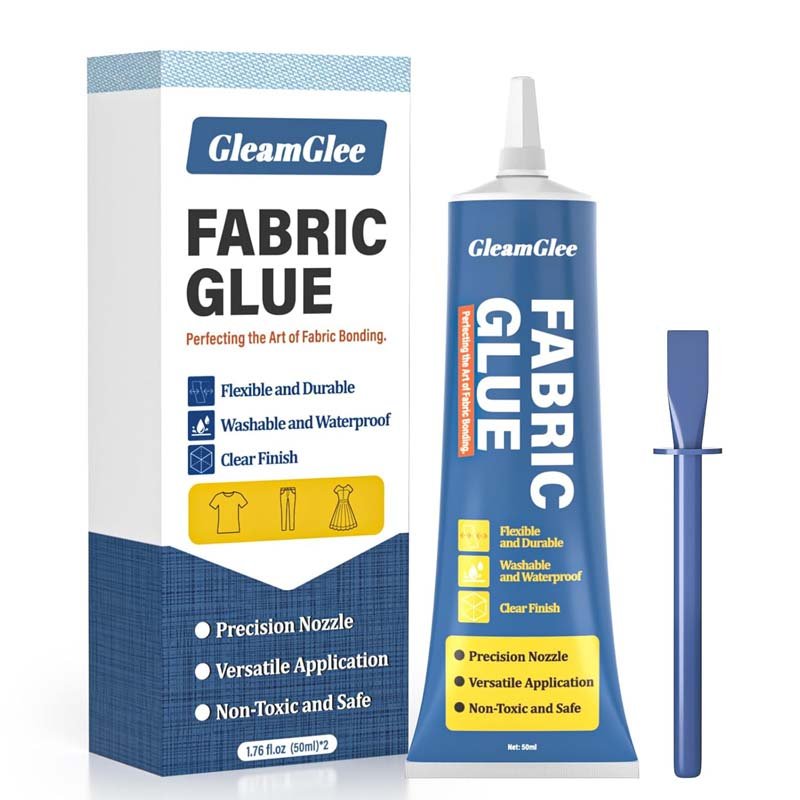
GleamGlee Fabric Glue is made for no-sew fabric bonding where the finished patch needs to stay strong, flexible, clear, and comfortable. It works for custom patches, jeans repairs, jacket patches, appliqués, ribbons, sequins, curtains, bags, costumes, craft projects, and everyday fabric fixes. The glue dries transparent, stays soft after curing, and helps patches look neat without visible stitches or bulky thread lines.
A good fabric glue for custom patches must do more than stick two fabrics together. It needs to hold through bending, light pulling, rubbing, washing, and ironing after full cure. It also needs to stay clean around the patch edge because most visible patch problems start from glue overflow, stiff borders, yellow marks, or lifted corners. GleamGlee Fabric Glue is designed with a precision nozzle, giving better control around small shapes, letters, badge edges, lace, ribbon, and embroidered patch borders.
The product comes in 50g tube options, including a single tube and a two-pack format, making it suitable for both small clothing repairs and larger DIY patch projects. The application process is simple: apply an even layer, press the patch in place, allow 6–10 minutes for the first set, and leave it for 24 hours to fully cure. After curing, the bond is washable, ironable, flexible, and clear, which matters for clothing that must still look good and feel natural during wear.
| Feature | What It Means | Patch Project Benefit |
|---|---|---|
| Strong fabric bond | Holds fabric, trims, appliqués, sequins, ribbons, and patches | Better patch durability |
| Clear drying | Dries transparent and non-yellowing | Cleaner visible edges |
| Flexible finish | Stays soft instead of brittle | More comfortable clothing wear |
| Washable after cure | Supports washing after full drying | Better for jeans, jackets, bags, and clothing |
| Ironable after cure | Can handle finishing after full cure | Helps patched garments look neater |
| Precision nozzle | Fine tip controls glue placement | Cleaner corners, letters, and patch borders |
| Anti-clog cap pin | Helps prevent nozzle blockage | Easier repeated use |
| 6–10 minute set | Patch starts holding quickly | Less shifting during application |
| 24-hour cure | Bond reaches stronger final hold | Better wash and wear resistance |
| 50g capacity | Enough for multiple repairs and crafts | Good for repeated patch projects |
How Does GleamGlee Fabric Glue Hold?
GleamGlee Fabric Glue holds by forming a flexible adhesive layer between the patch backing and the garment surface after curing. This type of hold is important for custom patches because clothing does not stay still. Jeans bend at the knee, jackets fold at the elbow, hoodie pockets rub against hands, tote bags stretch under weight, and costumes move during wear. A stiff adhesive can crack or lift in these situations, while a flexible adhesive moves with the fabric more naturally. GleamGlee Fabric Glue is designed to create a strong fabric bond while staying soft enough for everyday textile movement.
The strongest hold comes from correct application. The garment and patch should be clean and dry. The glue should cover the patch back evenly, with special attention near the outer edge. The patch should be pressed firmly for 6–10 minutes and left to cure for 24 hours before washing or heavy wear.
Best uses for GleamGlee Fabric Glue hold include:
● Denim patches on jeans, jackets, knees, elbows, and pockets.
● Embroidered patches on jackets, backpacks, hats, and tote bags.
● Felt shapes on costumes, banners, school projects, and holiday crafts.
● Ribbon, lace, and trim on curtains, dresses, table runners, and décor.
● Sequins, rhinestones, appliqués, and decorative fabric pieces.
● Fabric repairs on cushions, sofa covers, plush toys, and cloth accessories.
| Project Type | Bond Need | Application Focus |
|---|---|---|
| Jean patch | Strong hold plus flexibility | Seal edges and press firmly |
| Jacket patch | Clean visible finish | Keep glue thin and even |
| Hoodie patch | Flexible movement | Avoid thick glue buildup |
| Backpack patch | Strong textile grip | Use enough glue on edges |
| Costume patch | Fast, neat placement | Press and cure before wearing |
| Curtain trim | Long straight bond | Apply in controlled sections |
| Embroidered badge | Edge security | Focus glue around border |
A strong patch should not feel wet, hard, or raised after drying. If the patch feels stiff, too much glue was used. If the edge lifts, the glue may not have reached the border or the patch was washed too early.
Is GleamGlee Fabric Glue Washable?
GleamGlee Fabric Glue is washable after full curing, which makes it useful for clothing patches that need to survive normal care. A patch may feel attached after the first 6–10 minutes, but full durability needs more time. The 24-hour cure period allows the adhesive to settle into the fabric fibers and build a stronger flexible bond. Washing too early can weaken the bond before it is ready, especially around corners, curved shapes, letters, and high-friction areas such as jean knees, hoodie pockets, bag panels, and sleeve patches.
Washability also depends on fabric type, patch size, and garment movement. A denim patch on a denim jacket usually faces less stress than a large stiff patch on a stretch hoodie. A tote bag patch may face rubbing and pulling but fewer machine washes. A children’s clothing patch may face frequent washing, bending, and abrasion, so edge sealing becomes more important.
Better washing habits help the patch last longer:
● Wait 24 hours before the first wash.
● Turn the garment inside out before machine washing.
● Use mild detergent instead of harsh bleach.
● Choose cold or warm water when possible.
● Avoid scrubbing directly at the patch edge.
● Air dry or use low heat when the fabric allows it.
● Check patch edges after the first wash.
| Wash Factor | Better Practice | Reason |
|---|---|---|
| First wash timing | After 24-hour cure | Protects final bond strength |
| Garment position | Inside out | Reduces edge rubbing |
| Water temperature | Cold or warm | Lowers heat stress |
| Detergent | Mild formula | Avoids harsh chemical stress |
| Dryer | Air dry or low heat | Reduces edge lifting |
| Ironing | After full cure only | Prevents early glue softening |
| Edge check | After washing | Catches small lifting early |
If a small edge lifts after washing, let the garment dry fully, apply a small amount of glue under the lifted area, press it flat, and cure again for 24 hours. Repairing a small lifted corner early prevents full patch peeling later.
Does GleamGlee Fabric Glue Dry Clear?
GleamGlee Fabric Glue dries clear and non-yellowing, which is important for visible custom patches. Patch edges are often exposed on jeans, jackets, hats, bags, costumes, appliqués, ribbons, and embroidered badges. A white, cloudy, or yellow glue line can make the patch look messy, even if the bond is strong. A clear finish helps the patch blend into the garment and keeps attention on the design, not the adhesive. This is especially useful for decorative projects where the patch is meant to improve the look of the item rather than simply cover damage.
Clear drying still requires glue control. Too much glue can dry shiny, raised, or stiff even when it is transparent. Thin fabric can also show glue marks if too much adhesive soaks through. The cleanest result comes from a thin, even layer that reaches the patch edge without flooding beyond it. The precision nozzle helps place glue around curves, corners, letters, lace, sequins, and small appliqué shapes.
Clean finish tips:
● Apply a thin even layer instead of a heavy wet coat.
● Bring glue close to the patch edge without overflowing.
● Press from the center outward to reduce air pockets.
● Wipe excess glue before it dries.
● Use a cotton swab for small corners and detailed shapes.
● Test very thin, dark, silky, or coated fabrics first.
● Avoid thick glue buildup on visible borders.
| Patch Detail | Clear Finish Risk | Better Method |
|---|---|---|
| Dark denim | Shiny glue edge may show | Use thin border line |
| Thin cotton | Glue may bleed through | Apply very light layer |
| Lace | Open pattern may fill with glue | Use tiny dots |
| Ribbon | Edge may look glossy | Use a narrow glue line |
| Embroidery | Thick backing needs coverage | Focus on backing and edge |
| Felt | Can absorb too much glue | Use controlled thin layer |
| Sequins | Excess glue may dull shine | Apply around base carefully |
A clean clear finish makes the patch look intentional, especially on fashion projects, children’s costumes, school badges, DIY bags, and visible clothing repairs.
Why Trust GleamGlee Fabric Glue?
GleamGlee Fabric Glue is supported by a manufacturer focused on adhesives, repair products, cleaners, and home care solutions. Fabric glue performance depends on formula stability, flexible drying behavior, nozzle control, packaging quality, and clear use instructions. A good tube should not only bond fabric well; it should also apply smoothly, help control glue amount, resist clogging, and stay practical for repeated repairs. GleamGlee’s fabric glue is designed with these daily-use details in mind, including a fine-point nozzle and a built-in pin in the cap to help reduce clogging between projects.
The company has manufacturing experience across fabric glue, shoe glue, leather glue, glass glue, ceramic glue, plastic glue, book glue, construction adhesive, repair kits, and cleaning products. Production support includes R&D, packaging design, filling, label printing, and raw material control. This matters for fabric adhesive because patch work needs consistent texture, clear drying, flexible curing, and reliable packaging.
GleamGlee strengths include:
● 25+ chemists, material specialists, and process engineers.
● 18+ product, packaging, and graphic designers.
● Four specialized factories covering daily chemical products, packaging materials, label printing, and raw materials.
● Automated filling and assembly lines with annual capacity above 12 million units.
● 3000+ packaging mold options for tubes, bottles, jars, caps, and containers.
● Multi-language packaging support for English, German, French, Italian, Spanish, Dutch, Japanese, and Chinese.
● Support for ISO 9001, ISO 14001, CLP, REACH, UKCA, and GHS-related packaging requirements.
| GleamGlee Capability | Fabric Glue Value |
|---|---|
| Adhesive R&D | Supports strong, flexible fabric bonding |
| Precision packaging | Helps apply glue neatly on patch edges |
| Anti-clog cap design | Makes repeated use easier |
| Clear formula focus | Helps reduce visible repair marks |
| Large 50g tube | Suitable for multiple repairs and DIY projects |
| Label and instruction support | Helps explain curing, washing, and surface use |
| Scalable production | Supports stable product supply |
| Custom packaging options | Supports different product formats and market needs |
GleamGlee Fabric Glue can be used for everyday patch repairs, clothing customization, craft projects, school costumes, denim repairs, curtain trims, bag patches, and textile decorations. Product orders, wholesale supply, custom packaging, private label fabric glue, multilingual labels, and tailored adhesive projects can be discussed with GleamGlee for sourcing and quotation support.
Conclusion
Custom patches using fabric glue are a simple way to repair, decorate, and personalize fabric items without sewing. The strongest results come from matching the patch fabric to the garment, cutting clean edges, applying a thin and even glue layer, pressing firmly, and allowing a full 24-hour cure before washing or heavy wear. Denim, cotton, canvas, twill, felt, embroidered patches, lace, and ribbon can all work well when the fabric is clean, dry, and suitable for adhesive bonding.
GleamGlee Fabric Glue helps make no-sew patch projects cleaner and more durable with a strong fabric bond, clear drying finish, flexible cured texture, washable performance, and precision nozzle control. It is suitable for jeans, jackets, hoodies, bags, costumes, curtains, appliqués, trims, sequins, and everyday fabric repairs. For ready-to-order fabric glue, wholesale supply, custom packaging, private label products, or tailored fabric adhesive projects, GleamGlee can support product sourcing, packaging development, and quotation requests.