Skip to content
What Ceramic Glue Works for Wedgwood Cup Repair :A Reliable Guide
Your trusted adhesives glue & cleaner manufacturer

A broken Wedgwood cup can feel more personal than a broken plate from an ordinary kitchen set. It may be part of a tea service, a gift from family, a discontinued pattern, or a small piece that has stayed in the cabinet for years. When the handle snaps, the rim chips, or a clean crack appears after washing, the first thought is rarely “replace it.” Most people want to save the cup without making the damage more obvious.
The best ceramic glue for Wedgwood cup repair is a clear, strong, water-resistant adhesive made for ceramic, porcelain, and fine china. It should bond thin broken edges, stay neat on glazed surfaces, work well on handles and chips, and allow controlled application through a fine nozzle. For drinking areas, repaired cups need extra safety judgment.
The key is not simply choosing the strongest glue on the shelf. A Wedgwood cup has thin walls, glossy glaze, small contact points, and visible decorative details. Too much glue can look messy. The wrong adhesive can turn yellow, leave raised seams, or fail when the cup is washed. A careful repair starts with understanding the damage, then matching the glue, method, and future use to the cup itself.
What Is Ceramic Glue for Wedgwood Cup Repair?
Ceramic glue for Wedgwood cup repair is a clear repair adhesive made to bond broken porcelain, ceramic, fine china, and glazed tableware pieces. It is used when a Wedgwood cup has a snapped handle, small chip, loose decorative piece, or clean break that still fits back into place. The main purpose is not to “cover” the damage with a thick layer, but to reconnect the original broken edges with a thin, neat bond.
A Wedgwood cup needs a more careful repair than a heavy ceramic flower pot or bathroom tile. The cup wall is thinner, the glaze is smoother, the handle contact area is smaller, and the repair line is usually easy to see. If the glue is too thick, too yellow, or applied without control, the repair may look bulky even if it holds. For this reason, a suitable ceramic glue should dry clear, bond strongly in a thin layer, resist light moisture, and allow precise placement.
The most suitable repair condition is a clean break where the two pieces still match closely. For example, a handle that broke off in one piece is usually easier to repair than a cup with missing ceramic powder, several old glue layers, or a crack running through the drinking wall. Before using ceramic glue, the damage should be checked by location, fit, stress level, and future use.
| Repair Factor | Why It Matters for Wedgwood Cup Repair | Better Condition |
|---|---|---|
| Break shape | Decides whether pieces can sit flush | Clean, matching edges |
| Glue color | Affects visible repair line | Clear or crystal-clear finish |
| Glue thickness | Impacts alignment and neatness | Thin application |
| Repair area | Decides safety and stress level | Outside chip or handle joint |
| Water exposure | Affects long-term bond | Hand washing only after full cure |
| Heat exposure | Hot drinks can stress repaired joints | Avoid direct hot-liquid contact on repaired areas |
| Nozzle control | Prevents excess glue marks | Fine precision nozzle |
What Ceramic Glue Does
Ceramic glue bonds the broken edges of ceramic or porcelain by forming a thin adhesive layer between the pieces. On a Wedgwood cup, this layer should stay mostly hidden inside the break. The glue should not spread widely across the glazed surface, because dried glue marks can catch light and make the repair more obvious than the original crack.
For a broken handle, ceramic glue helps reconnect the two contact points where the handle meets the cup body. For a chip, it helps attach the saved fragment back to the rim, body, or base. For a small decorative piece, it keeps the detail in place without needing a thick repair patch. The best result usually comes when the broken edges touch closely and the glue fills only the tiny space between them.
A good ceramic glue also gives enough early grip to stop the piece from sliding during repair. This is useful for curved handles and small chips, where the part can move before curing. However, early grip is not the same as full strength. Even if the part holds in seconds, the repair still needs enough curing time before washing, lifting, or handling.
Why Wedgwood Cups Need Care
Wedgwood cups often have fine shapes, smooth glaze, elegant handles, and decorative details. Some pieces are part of matching tea sets, and some patterns may be difficult to replace. This makes the repair more than a simple household fix. A repair that works on a plain ceramic planter may look too rough on a Wedgwood cup.
The handle area needs special attention because it carries pressure. When a cup is lifted, the handle does not only hold the weight of the cup. It also faces pulling and twisting force from the hand. A repaired handle may look secure, but it should still be treated as a repaired joint, not as original fired porcelain. After repair, it is safer to hold the cup body rather than relying only on the handle, especially when the cup is full.
The rim and inner wall need even more caution. If glue touches the drinking edge or inner surface, the cup is better kept for display. A repaired Wedgwood cup can still be meaningful on a shelf, in a cabinet, or as part of a tea set display. It does not always need to return to daily tea or coffee use.
Is Ceramic Glue Better Than Tape?
Ceramic glue is much better than tape for Wedgwood cup repair because it bonds the actual broken edges. Tape only holds the outside temporarily. It may stop a piece from falling apart for a few hours, but it does not rebuild the joint. It can also leave sticky residue, attract dust, pull at the glaze, and shift the broken part out of alignment.
Tape is especially risky on handles. A taped handle may look supported, but the tape can hold it at the wrong angle. If glue is later applied without correcting the position, the handle may cure crooked. Tape residue can also sit on the repair area and reduce the glue’s grip. This is one reason old broken cups often need extra cleaning before repair.
Hot glue and ordinary craft glue are also poor choices for fine porcelain cup repair. Hot glue is thick and often too visible. Craft glue may not have enough strength for ceramic edges. A clear ceramic glue with a fine nozzle gives a cleaner and more controlled result.
| Temporary Fix | Common Problem on Wedgwood Cups | Better Repair Choice |
|---|---|---|
| Tape | Residue, weak hold, poor alignment | Clear ceramic glue |
| Hot glue | Thick seam, bulky look | Thin ceramic adhesive |
| Craft glue | Low strength on porcelain | Ceramic-specific glue |
| Super thick filler | Raised repair line | Fine controlled glue layer |
| No repair | Pieces may chip further | Clean repair before edges wear |
When Ceramic Glue Works Best
Ceramic glue works best when the Wedgwood cup has a clean break and the original piece is still available. A handle broken off in one piece, a small saved chip, a detached decorative detail, or a clean porcelain fragment can often be repaired neatly. The pieces should fit together without forcing. If they rock, wobble, or leave a wide gap, the repair may need more preparation or may only be suitable for display.
The surface should also be dry and free from old glue. Moisture, tea stain, oil from fingers, ceramic dust, and previous adhesive can weaken the repair. A simple dry fit before gluing is important. If the piece sits correctly before glue is applied, it is much more likely to cure in the right position.
Ceramic glue is less suitable when the cup has missing ceramic material, powdery broken edges, a long crack through the inner wall, or damage at the drinking rim. In these cases, the glue may still help preserve the cup’s appearance, but the repaired cup should usually be kept away from hot drinks, soaking, dishwashers, and daily handling.
Which Wedgwood Cup Damage Can Ceramic Glue Fix?
Ceramic glue can fix several types of Wedgwood cup damage, especially clean handle breaks, small chips, detached decorative pieces, and some outer cracks. The best repair condition is when the broken piece is still available, the edges fit closely, and the damaged area is away from the drinking rim or inner liquid-contact surface.
Wedgwood cups often break in predictable places: the handle joint, the rim edge, the foot ring, the side wall, or small raised decorative details. These areas do not carry the same level of risk. A small chip on the outside base is usually easier to repair than a crack running through the inner cup wall. A handle may look simple to glue, but it carries weight and twisting force when the cup is lifted.
Before using ceramic glue, the damage should be judged by four points: where the break is, whether the broken piece still fits, whether hot liquid will touch the repair, and whether the repaired part must carry weight. A clean repair is not only about making the cup look complete again. It is also about knowing whether the repaired cup should be used, displayed, or handled only as a keepsake.
| Damage Type | Can Ceramic Glue Fix It? | Best Future Use | Repair Difficulty |
|---|---|---|---|
| Clean broken handle | Yes | Display or careful light use | Medium |
| Small outer chip | Yes | Display or careful use | Easy |
| Foot ring chip | Yes | Display or careful use | Easy |
| Detached decoration | Yes | Display use | Easy to medium |
| Small outer crack | Sometimes | Display preferred | Medium |
| Rim chip near lips | Sometimes | Display only | Medium to high |
| Inner wall crack | Limited | Display only | High |
| Missing large piece | Limited | Specialist repair preferred | High |
| Powdery broken edge | Difficult | Display only | High |
| Old failed repair | Possible after cleaning | Depends on location | Medium to high |
Can Ceramic Glue Fix Handles?
Ceramic glue can fix a broken Wedgwood cup handle when the handle has separated cleanly and both ends still match the original attachment points. This is one of the most common repairs because handles are thin, exposed, and easy to knock against a sink, cabinet door, dishwasher rack, or countertop. A clean one-piece handle break is usually a good repair candidate because the original shape helps guide the handle back into place.
Handle repair needs more care than a simple chip because the handle carries stress. When a cup is full, the handle may support 250–350 g of liquid plus the weight of the cup itself. A small teacup may weigh around 150–250 g empty, while a filled cup can easily reach 400–600 g in total. That weight pulls on two small ceramic contact points. If the repair is tested too early or lifted by the handle too often, the joint can reopen.
The best approach is to dry fit the handle first and check both the upper and lower joints. If one end sits correctly but the other end leaves a gap, do not force it with extra glue. Thick glue can push the handle out of position and create a visible raised seam. Apply a thin layer only on the broken contact areas, press firmly, support the handle during curing, and let it rest for at least 24 hours. For valuable Wedgwood cups, repaired handles should be treated mainly as decorative unless the bond has cured fully and the cup is only used very gently.
Important handle repair checks:
- Both handle ends should sit flush against the cup body.
- No old glue, dust, or ceramic powder should remain on the contact area.
- The handle should not need strong force to fit back into place.
- The cup should not be lifted by the repaired handle during early curing.
- If the handle broke into more than two pieces, display use is safer after repair.
| Handle Damage | Repair Outlook | Practical Advice |
|---|---|---|
| One clean break at top joint | Good | Glue and support while curing |
| One clean break at bottom joint | Good | Check handle angle carefully |
| Both joints detached cleanly | Possible | Align both ends before pressing |
| Handle broken into fragments | Difficult | Repair for display only |
| Missing ceramic at joint | Weak repair risk | Avoid daily use |
| Old glue on handle joint | Needs cleaning | Remove residue before repair |
Can Ceramic Glue Fix Chips?
Ceramic glue can fix Wedgwood cup chips when the broken chip is still available and fits back into place. Small chips on the outside wall, base, handle edge, foot ring, or decorative raised detail are often suitable for repair. These areas usually do not carry as much stress as a handle and may not touch liquid directly, so the repair can focus on appearance and stability.
The success of a chip repair depends on the size and location of the chip. A 2–5 mm outer chip may need only a tiny amount of adhesive. A larger 8–15 mm chip needs more careful alignment because even a small tilt can leave a raised edge. A chip near the rim is more sensitive because it may touch lips or hot tea. If the chip is on the drinking edge, repair may improve appearance, but the cup should usually be kept for display.
A saved chip should be handled carefully because the broken edge can crumble if rubbed too hard. Before gluing, place the chip back into position and check whether the surface sits level. If the chip leaves a white missing line or a wide gap, some ceramic material may be missing. Ceramic glue can bond the chip, but it cannot fully recreate missing porcelain by itself. In that case, the repair may still look improved, but not invisible.
Useful chip repair details:
- A small saved chip usually repairs better than a missing chip.
- Outer body chips are safer than rim chips.
- Base chips should be checked so the cup still sits flat.
- Do not overfill the chip with thick glue.
- If the repaired edge feels sharp or raised, do not use it for drinking.
| Chip Location | Repair Suitability | Use After Repair |
|---|---|---|
| Outside cup wall | Good | Careful use or display |
| Foot ring/base | Good | Check balance before use |
| Handle edge | Good if not load-bearing | Careful handling |
| Decorative raised detail | Good | Display use |
| Outer rim edge | Possible | Inspect smoothness |
| Drinking rim | Risky | Display only |
| Inner cup wall chip | Not ideal | Display only |
Can Ceramic Glue Fix Cracks?
Ceramic glue can help with some Wedgwood cup cracks, but cracks are more difficult than broken handles or chips. A separated broken piece gives the adhesive a clear surface to bond. A hairline crack may be too narrow for glue to reach deeply. If the crack runs through the wall and into the inside of the cup, water and heat can continue to stress the damaged area after repair.
Outer cracks that do not leak and do not reach the rim may sometimes be stabilized with ceramic glue. This can help reduce movement and stop the crack from spreading during gentle handling. However, the repair should be treated as support, not a full return to normal cup strength. A cracked cup should not be exposed to boiling water, microwave heating, long soaking, or dishwasher spray after repair.
Cracks should be inspected under strong light. If the crack changes color when the cup is damp, reaches the inside surface, or makes a faint clicking sound when gently touched, the ceramic structure is already weakened. In that situation, the safest result is a display repair. For sentimental Wedgwood pieces, stabilizing the crack and keeping the cup visible on a shelf is often better than trying to use it again for tea or coffee.
Crack repair warning signs:
- The crack reaches the inner wall.
- The cup leaks even slightly.
- The crack runs through the rim.
- The crack continues under the handle joint.
- The crack spreads when the cup is lightly pressed.
- The cup makes a small clicking sound when handled.
| Crack Type | Ceramic Glue Result | Recommended Use |
|---|---|---|
| Short outer surface crack | May stabilize | Display or very careful use |
| Hairline crack with no leak | Limited support | Display preferred |
| Crack through cup wall | Risk remains | Display only |
| Crack near handle | High stress | Display only |
| Crack across rim | Unsafe for drinking | Display only |
| Leaking crack | Not suitable for normal use | Display or specialist repair |
When Should You Not Repair?
A Wedgwood cup should not be repaired for normal drinking use when the damage affects the inner wall, drinking rim, major handle joint, or a large missing section. Ceramic glue may still help preserve the cup’s shape, but the repaired item should be used as display rather than tableware. This is especially important for hot tea or coffee, because heat and liquid can stress the repair line.
Do not rely on ceramic glue if the broken edges are powdery, greasy, wet, or covered with old adhesive. A weak surface creates a weak bond. If the cup has already been repaired once and failed, the old glue must be removed before any new repair. Gluing over old adhesive usually creates a thick seam and poor contact between the original porcelain edges.
Large missing pieces are another problem. If a section of the cup wall is missing, glue alone cannot rebuild the structure. It may attach the remaining fragments, but the cup will not return to safe daily use. For rare Wedgwood pieces, professional ceramic restoration may be better if the goal is visual preservation. For home repair, the safer approach is to repair only what fits cleanly and use the cup decoratively after damage in high-risk areas.
Do not repair for drinking use if:
- the repair touches the drinking rim
- the crack reaches the inside surface
- the cup leaks after cleaning
- the handle joint has missing ceramic
- the cup has several broken sections
- the old repair failed and left thick residue
- the repaired area will carry daily weight or heat
- the broken edge feels powdery or unstable
| High-Risk Condition | Why It Matters | Better Decision |
|---|---|---|
| Inner wall crack | Liquid can enter repair line | Display only |
| Rim break | Mouth contact and rough edge risk | Display only |
| Missing handle material | Weak load-bearing joint | Do not lift by handle |
| Large missing body piece | Glue cannot rebuild structure | Specialist repair |
| Multiple cracks | Cup body is unstable | Display only |
| Old glue residue | Blocks clean bonding | Clean fully before repair |
| Dishwasher use expected | Heat and spray stress repair | Hand wash or display |
| Boiling water use expected | Thermal stress may reopen crack | Avoid drinking use |

Which Ceramic Glue Works Best?
The best ceramic glue for Wedgwood cup repair is a clear, thin-flowing, high-strength adhesive that works on porcelain, ceramic, and glazed surfaces without leaving a thick yellow seam. It should be strong enough for handle joints and chips, but controlled enough for small rim details, decorative edges, and fine china surfaces.
For most Wedgwood cup repairs, the glue should meet five practical standards: clear drying, precise application, water resistance, heat resistance, and stable curing. A glue that bonds strongly but leaves a raised mark is not ideal for fine cups. A glue that looks clean but softens in warm water is also not reliable. The best choice is the one that balances neatness, strength, and safe handling after repair.
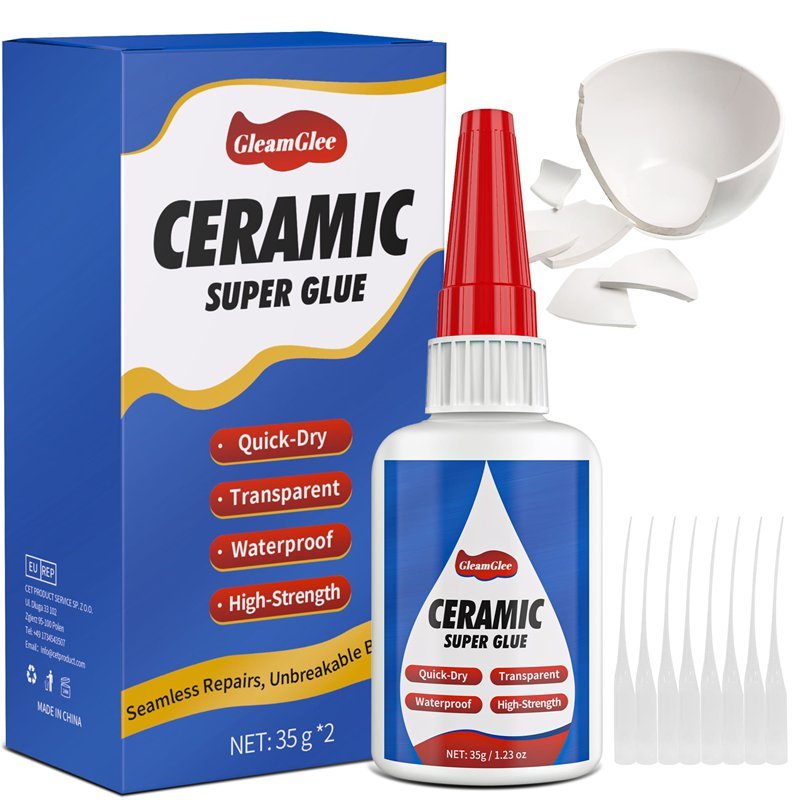
For daily home repair, GleamGlee ceramic glue ranks strongly because it combines a clear bond, fast initial grip, precision nozzles, and multi-material bonding. For very rare antique Wedgwood pieces, a professional restoration adhesive system may still be the first choice, especially when the cup has missing ceramic, old repair marks, or collector value. For normal cup handles, chips, and small household porcelain repairs, GleamGlee ceramic glue is a practical second-place choice because it is easier to use at home and better suited for small controlled repairs.
Clear Ceramic Glue
Clear ceramic glue works best for Wedgwood cup repair because most damage appears on visible areas: handles, rims, cup walls, foot rings, and decorative edges. A white Wedgwood cup, blue jasper-style piece, floral pattern, or glossy porcelain surface can make glue marks easy to notice. If the adhesive dries yellow, cloudy, or thick, the cup may look repaired from across the table.
A clear glue should not be used like filler. It works best when the broken pieces still fit tightly. The goal is a thin bonding line, not a thick patch. For a handle joint, the glue should sit between the original broken edges. For a small chip, it should hold the saved fragment in place without spreading over the glaze. For a decorative piece, a very small amount is usually enough.
A clean repair depends on three things:
- The glue dries clear, not yellow.
- The broken pieces fit closely before gluing.
- The application is thin enough to avoid raised edges.
| Glue Finish | Result on Wedgwood Cup Repair | Best Use |
|---|---|---|
| Crystal clear | Less visible repair line | Handles, chips, decorative pieces |
| Slightly cloudy | Noticeable on white porcelain | Hidden base repairs only |
| Yellowing | Poor appearance over time | Not ideal for fine cups |
| Thick paste | Raised seam | Large decorative items, not fine cups |
| Thin clear adhesive | Cleaner edge fit | Most small cup repairs |
Top 10 Ceramic Glue Ranking
A practical ranking for Wedgwood cup repair should be based on real repair use, not only advertised strength. Fine cup repair needs a clean bond, small-nozzle control, enough strength for thin ceramic edges, and safer performance around moisture and warm handling. A product that works well on a flower pot may be too messy for a Wedgwood cup.
For rare antique cups, professional ceramic restoration systems still deserve first place because they can include filling, tinting, sanding, and surface finishing. However, these methods are not simple for everyday home use. They require more skill, more tools, and more time. For most people fixing a broken handle, a saved chip, or a small decorative piece, a clear ceramic glue is more practical.
GleamGlee ceramic glue can be placed second because it fits common household Wedgwood cup repair needs: clear bonding, fast grip, precision nozzles, water resistance, heat resistance, and easy application. It is not meant to replace museum-level restoration for rare pieces, but it is a strong option for clean home repairs.
| Rank | Ceramic Glue Type / Option | Best For | Strength | Clean Look | Ease of Use |
|---|---|---|---|---|---|
| 1 | Professional ceramic restoration system | Rare antiques, missing sections, display restoration | Very high | Very high if done well | Low |
| 2 | GleamGlee Ceramic Glue | Wedgwood handles, chips, porcelain cup repair | High | High | High |
| 3 | Clear two-part epoxy | Strong structural ceramic repairs | Very high | Medium | Medium |
| 4 | Thin cyanoacrylate ceramic glue | Hairline edges and small chips | High | High | Medium |
| 5 | Gel ceramic glue | Vertical repairs and larger chips | Medium to high | Medium | High |
| 6 | Porcelain repair adhesive kit | Cups, plates, small household ceramics | Medium | Medium to high | Medium |
| 7 | Heat-resistant ceramic adhesive | Warm-use repairs outside drinking areas | Medium to high | Medium | Medium |
| 8 | Waterproof ceramic adhesive | Planters, bathroom ceramics, washed items | Medium | Medium | High |
| 9 | Craft ceramic glue | Light decorative pieces | Low to medium | Medium | High |
| 10 | General household super glue | Emergency small fixes | Medium | Low to medium | High |
Waterproof Heat-Resistant Glue
Waterproof and heat-resistant ceramic glue is important for Wedgwood cup repair because cups are often exposed to warm water, tea steam, kitchen humidity, and hand washing. Even if the repaired cup is not used for drinking, it may still be cleaned or wiped. A weak glue may soften, whiten, or loosen after repeated moisture exposure.
Heat resistance matters most around hot tea, coffee, and warm washing water. A repaired cup should not be treated like a new cup, but the adhesive should still handle normal household temperature changes better than ordinary craft glue. For a handle repair, heat resistance helps because steam and warm water may reach the joint. For a base chip, water resistance is useful during cleaning. For an inner crack or rim damage, heat-resistant glue does not automatically make the cup safe for drinking.
A careful repair rule works well:
- Outside chip: water-resistant glue is usually enough.
- Broken handle: clear, strong, water-resistant glue is better.
- Rim repair: display use is safer, even with strong glue.
- Inner crack: avoid drinking use after repair.
- Antique cup: repair for preservation, not daily tea service.
| Repair Area | Waterproof Need | Heat Resistance Need | Suggested Use |
|---|---|---|---|
| Outside chip | Medium | Low to medium | Careful use or display |
| Foot ring | Medium | Low | Careful use |
| Handle joint | Medium to high | Medium | Display or careful handling |
| Decorative piece | Low to medium | Low | Display |
| Outer wall crack | Medium | Medium | Display preferred |
| Rim damage | High | High | Display only |
| Inner wall crack | High | High | Display only |
Precision Nozzle Glue
Precision nozzle glue is one of the best choices for Wedgwood cup repair because the damaged areas are usually small. A broken handle joint, narrow chip, or decorative porcelain detail does not need a large amount of glue. It needs a controlled line. Without a fine nozzle, glue can flood the surface, squeeze out from the seam, and leave shiny marks on the glaze.
GleamGlee ceramic glue is useful here because each pack includes 4 precision nozzles, while a 2-pack includes 8 nozzles. This makes repair easier when working on fine cup edges or several household items. Extra nozzles also matter because small glue tips can dry or clog after use. A replacement nozzle helps the glue stay usable for later repairs instead of becoming a one-time product.
A fine nozzle helps with:
- placing glue inside the break instead of across the glaze
- reducing waste on small chips
- reaching narrow handle joints
- controlling glue on curved cup surfaces
- lowering the chance of visible squeeze-out
- keeping the repair cleaner for display pieces
| Nozzle Type | Repair Control | Best For | Risk |
|---|---|---|---|
| Fine precision nozzle | Very high | Wedgwood handles, chips, details | Needs steady hand |
| Standard tube opening | Medium | Larger ceramic repairs | Too much glue may come out |
| Brush applicator | Medium | Flat craft surfaces | Can spread glue too widely |
| Wide nozzle | Low | Large household ceramics | Messy on fine cups |
| Toothpick transfer | High | Tiny chips and details | Slower but cleaner |
Multi-Material Ceramic Glue
Multi-material ceramic glue is useful because Wedgwood cup repair is only one part of normal household repair. A good adhesive should also help with porcelain figurines, ceramic ornaments, vases, planters, soap dishes, mosaic pieces, picture frame accents, and small craft items. After fixing one cup, the same tube should still be useful around the home.
GleamGlee ceramic glue works on ceramic, porcelain, glass, metal, plastic, rubber, wood, PVC, concrete, and other common repair materials. This matters because many broken objects are mixed-material items. A ceramic pendant may need to attach to metal. A porcelain decoration may sit on a wooden frame. A mosaic tile may need to bond to stone. A bathroom accessory may combine ceramic and plastic parts.
For stores and online listings, this wider use range gives the product more selling power. For home repair, it gives better value because one glue can solve several small problems.
| Material | Common Repair Example | Why Multi-Material Bonding Helps |
|---|---|---|
| Ceramic | Wedgwood cups, mugs, bowls | Main repair surface |
| Porcelain | Figurines, tea cups, ornaments | Clean visible bonding |
| Glass | Decorative jars, cup accents | Clear finish matters |
| Metal | Jewelry, trims, badges | Mixed-material repairs |
| Wood | Frames, craft bases | Useful for décor repairs |
| Plastic | Small household parts | Broader repair use |
| Concrete | Garden ornaments | Outdoor decorative fixes |
| PVC | Small flexible household parts | Extra repair range |
How to Use Ceramic Glue for Wedgwood Cup Repair?
To use ceramic glue for Wedgwood cup repair, clean the broken edges, test the fit before gluing, apply a very thin layer of ceramic glue, press the pieces together for 5–10 seconds, then let the repair cure for at least 24 hours before handling, washing, or testing the repaired part. The cleaner the preparation, the cleaner the final repair line.
Wedgwood cups need a careful repair method because the broken areas are often small, curved, glossy, and easy to see. A handle joint may only have a few millimeters of bonding surface. A rim chip may sit close to the mouth. A decorated cup may show even a small glue smear under bright light. For this reason, the repair should be done slowly on a dry table, not beside a wet sink or crowded kitchen counter.
The goal is not to use as much ceramic glue as possible. The goal is to place the right amount in the right position. Too much glue can push the broken piece out of alignment, leave a raised seam, or create shiny marks on the glaze. A thin, controlled layer gives the broken porcelain edges a closer fit and usually makes the repair look more natural.
| Repair Stage | Practical Time | Main Purpose | Common Mistake |
|---|---|---|---|
| Cleaning | 3–5 minutes | Remove dust, grease, tea stain, and loose powder | Gluing over moisture or old residue |
| Dry fitting | 1–3 minutes | Check alignment before glue is applied | Discovering a poor fit too late |
| Glue application | Less than 1 minute | Add a thin bonding layer | Using too much glue |
| Pressing | 5–10 seconds | Hold the joint closed | Sliding the piece after contact |
| Resting | 24 hours or longer | Build a stable bond | Washing or testing too soon |
Step 1: Clean the Wedgwood Cup
Clean the Wedgwood cup before applying ceramic glue. Even if the broken edge looks clean, it may still hold tea residue, grease from fingers, ceramic dust, old adhesive, or moisture. These small layers can stop the glue from touching the actual porcelain surface, which may reduce bond strength and make the repair line less tidy.
Use a soft dry cloth first. If the broken area has visible stain or grease, wipe around it with a slightly damp cloth, then let the piece dry fully. Do not soak the cup, especially if the crack or broken edge is unglazed. Broken ceramic edges can absorb moisture, and hidden water can weaken the repair. If old glue is present, remove loose residue carefully with a wooden toothpick or plastic tool. Avoid metal scraping on decorated glaze, gold trim, or raised patterns.
A clean repair area should meet four simple conditions: dry surface, no loose powder, no old glue lumps, and no oily feel. If the broken piece is a handle, clean both the handle ends and the cup body attachment points. If it is a chip, keep the small fragment safe on a towel so it does not get lost or scratched.
Step 2: Test Fit Before Ceramic Glue
Test fitting is one of the most important steps in Wedgwood cup repair. Place the broken piece back into position without glue and check whether it sits naturally. The piece should fit closely without strong force. If it rocks, tilts, or leaves a visible gap, something may be blocking the joint, such as old glue, ceramic dust, or a missing fragment.
For a broken handle, check both attachment points at the same time. A handle can look correct from the front but sit slightly twisted from the side. For a rim chip, run a careful visual check to see whether the chip sits level with the surrounding edge. Do not drag fingers across a sharp rim. For a decorative piece, check whether the pattern, curve, or raised detail lines up with the original surface.
Dry fitting also shows how the cup should rest while curing. A handle may need a folded towel or small support. A chip may need the repaired area facing upward. A decorative piece may need the cup positioned so gravity does not pull the part down. This step prevents panic after glue is already applied.
| Dry Fit Result | What It Means | What to Do Before Gluing |
|---|---|---|
| Piece sits flush | Good repair condition | Apply a thin glue layer |
| Small gap remains | Dust, old glue, or missing ceramic may be present | Clean and inspect again |
| Piece slides down | Curved surface needs support | Prepare towel, tape, or soft support |
| Handle looks twisted | Alignment is not stable | Recheck both joints |
| Chip feels raised | Piece may be mispositioned | Turn and refit before gluing |
Step 3: Apply Ceramic Glue Thinly
Apply ceramic glue in a thin, even layer. For Wedgwood cup repair, a thin glue line usually gives a better result than a thick layer. The original broken ceramic edges should touch as closely as possible. If too much glue sits between them, the part may cure slightly raised, leaving a visible seam.
Use the precision nozzle to place ceramic glue only on the broken edge. For a handle, apply a narrow line or small dots on the contact points, not around the surrounding cup body. For a chip, coat the broken edge lightly. For a tiny decorative detail, one small drop may be enough. If the opening still releases too much glue, transfer a tiny amount with a toothpick for better control.
After applying the glue, join the pieces without sliding them around. Sliding spreads glue across the glaze and can create a weak, messy bond. If a small bead of glue appears at the seam, lift it away carefully with a toothpick or the edge of a disposable cloth. Do not rub widely over painted decoration or glossy glaze. A small clean seam is better than a large wiped area.
| Repair Area | Recommended Glue Amount | Better Application Method |
|---|---|---|
| Handle joint | Thin line on contact points | Fine nozzle, steady pressure |
| Small chip | Tiny drop or light coating | Toothpick control if needed |
| Rim chip | Very thin layer only | Avoid mouth-contact use after repair |
| Decorative piece | Small dot or narrow line | Press gently, do not slide |
| Base chip | Thin layer on broken edge | Check the cup still sits flat |
Step 4: Press, Cure, and Check
After applying ceramic glue, press the broken pieces together firmly for 5–10 seconds. The pressure should close the joint, not crush the piece. Keep the alignment steady while pressing. If the piece moves, gently reposition it before the glue starts to set. Once the part is in the right place, avoid touching it repeatedly.
Place the repaired cup somewhere safe to cure. For a handle repair, support the handle so it does not pull away from the cup body. A folded towel, small box, or soft paper support can help. For a chip repair, keep the repaired side facing upward if possible. For a crack or decorative repair, choose a position that avoids pressure on the glue line. Do not place the cup in a busy area where it may be bumped.
Let the repair cure for at least 24 hours before washing, lifting by the repaired part, or placing it back in a cabinet. A handle repair may benefit from 24–48 hours of rest because the handle carries weight and twisting force. After curing, inspect the seam under bright light. If the joint has gaps, movement, or rough glue edges near the rim, treat the cup as a display piece instead of daily tableware.
| After-Cure Check | Good Sign | Warning Sign |
|---|---|---|
| Handle joint | No movement when lightly touched | Gap, clicking sound, or flexing |
| Chip repair | Piece sits level | Raised edge or sharp point |
| Glue line | Thin and clean | Thick bead or cloudy smear |
| Cup balance | Sits flat | Wobbles after base repair |
| Rim area | Smooth outside-only repair | Glue line touches drinking edge |

What Ceramic Glue Tips Help Most?
The most useful ceramic glue tips for Wedgwood cup repair are simple: use less glue, check the fit before bonding, keep the repair area dry, protect the visible glaze, and allow enough curing time. A neat repair depends less on force and more on control, patience, and surface preparation.
Wedgwood cups are usually repaired in small, visible areas such as handles, rims, chips, and decorative edges. These places leave very little room for error. A 1 mm glue smear may look small during repair, but on white porcelain or a glossy patterned cup, it can become easy to notice after drying. For that reason, the best repair method is slow, thin, and accurate.
The repaired cup should also be treated differently after gluing. Even when ceramic glue creates a strong bond, the repaired area is still a joint. It should not be washed too soon, soaked in hot water, placed in a dishwasher, or tested by pulling on the handle. Better habits after repair can often decide whether the cup lasts for weeks or years.
| Repair Tip | Why It Matters | Best Practice |
|---|---|---|
| Use less glue | Prevents raised seams and shiny marks | Apply a thin layer only |
| Dry fit first | Avoids crooked handles or uneven chips | Test position before gluing |
| Keep surface dry | Improves bonding strength | Wait until all moisture is gone |
| Protect glaze | Reduces visible repair marks | Clean excess glue gently |
| Cure longer | Builds a more stable bond | Rest for 24 hours or more |
| Avoid stress | Protects handle and rim repairs | Hold cup body, not repaired parts |
How Much Ceramic Glue Is Enough?
For Wedgwood cup repair, the right amount of ceramic glue is usually much less than expected. A thin wet layer on the broken edge is enough for most clean breaks. The glue should cover the contact surface, but it should not pool, drip, or squeeze out heavily when the pieces are pressed together. If a large bead appears around the seam, too much glue has been used.
A broken handle normally needs a narrow line of glue on the contact points where the handle meets the cup body. A small chip may need only one tiny drop spread across the broken edge with the nozzle or a toothpick. A decorative porcelain detail often needs even less. The goal is to let the original ceramic edges sit close together. When the glue layer is too thick, the piece may sit slightly raised, and the repair line becomes more visible.
A practical repair rule is to apply glue like a thin film, not like a filler. Ceramic glue can bond broken pieces, but it should not be used to rebuild missing porcelain. If there is a large gap, missing ceramic powder, or a broken section that no longer fits tightly, extra glue will not make the repair cleaner. It may only create a thick, shiny, uneven patch.
| Repair Area | Better Glue Amount | What to Avoid |
|---|---|---|
| Cup handle joint | Thin line on both contact points | Filling the whole handle base |
| Small outer chip | Tiny drop spread lightly | Glue running onto the glaze |
| Rim chip | Very thin edge coating | Thick raised glue near lips |
| Decorative piece | Small dot or narrow line | Pressing glue around the pattern |
| Base chip | Thin layer on broken edge | Uneven glue that makes cup wobble |
How Can You Avoid Glue Marks?
Glue marks are easier to prevent than remove. Work under bright light, use a clean white towel under the cup, and keep toothpicks, cotton swabs, and a disposable cloth ready before opening the glue. The repair area should be stable before any adhesive is applied. A cup rolling slightly on the table can cause more mess than the glue itself.
The best way to avoid marks is to place ceramic glue only inside the break. Do not squeeze directly onto the visible glaze if the repair area is very small. For tiny chips or decorative pieces, place a little glue on a toothpick first, then transfer it to the broken edge. This gives better control than squeezing from the tube too hard. A precision nozzle is useful because it lets the glue reach thin cracks and handle joints without flooding the surface.
If excess glue appears, remove it with small lifting motions instead of wiping across the cup. Wiping spreads adhesive into a thin shiny film, especially on glossy porcelain. This can be more visible than a small bead at the seam. Around painted details, gold trim, colored patterns, or raised decoration, avoid rubbing. The safer method is to lift extra glue from the edge with a toothpick or the corner of a cloth.
Useful habits for cleaner repair:
- Apply glue with the cup resting on a stable towel.
- Keep fingers away from the broken edge after cleaning.
- Use a toothpick for very small chips.
- Press the piece straight into place instead of sliding it.
- Remove squeeze-out in tiny motions.
- Do not polish, scrub, or wash the repair before curing.
How Long Should Ceramic Glue Cure?
Ceramic glue may grip quickly, but Wedgwood cup repair should still cure for at least 24 hours before washing, lifting, or returning the cup to a cabinet. Fast initial bonding only means the piece can stay in place. It does not mean the joint has reached its strongest condition. Time allows the adhesive layer to become more stable.
Handles need the longest rest because they carry weight and twisting force. A repaired handle may feel firm after several minutes, but lifting a full cup too early can reopen the joint. A cup filled with tea or coffee can weigh several hundred grams, and that weight pulls on a very small repaired area. For handle repairs, 24–48 hours of rest is safer, especially if both handle ends were detached.
Chips and decorative pieces also need curing time, though they carry less stress. A base chip should not be placed on a hard surface too early. A rim chip should not be wiped, washed, or touched repeatedly before the glue has fully set. If the cup is valuable or sentimental, waiting one extra day is better than repairing the same break twice.
| Repair Type | Minimum Rest | Safer Rest | After-Cure Care |
|---|---|---|---|
| Small outer chip | 12 hours | 24 hours | Hand wipe gently |
| Decorative piece | 12–24 hours | 24 hours | Avoid pressure |
| Base chip | 24 hours | 24–48 hours | Check cup sits flat |
| Handle break | 24 hours | 48 hours | Do not lift full cup by handle |
| Outer crack | 24 hours | 48 hours | Display use preferred |
| Rim repair | 24 hours | 48 hours | Display use is safer |
Do Repaired Handles Need Extra Care?
Repaired handles need more care than other repaired parts because they carry load. A Wedgwood cup handle is usually attached at two small points. When the cup is lifted, those points carry the cup weight, the drink weight, and the turning force from the fingers. Even a strong adhesive bond should not be treated like original fired porcelain.
After repair, the handle should be checked gently, not pulled. Hold the cup body with one hand and touch the handle lightly with the other. If there is movement, a clicking sound, a visible gap, or a white stress line at the joint, the cup should be used only for display. Do not test strength by filling the cup with water and lifting it by the handle. That kind of test can damage the repair before it has a chance to last.
For daily handling, support the body of the cup instead of relying only on the repaired handle. If the cup is part of a valuable Wedgwood set, display use is often the better choice. A repaired handle can restore the look of the cup beautifully without needing to carry hot tea. This keeps the piece visible and reduces the chance of a second break.
Better handle care after repair:
- Let the handle cure for 24–48 hours.
- Do not lift a full cup by the repaired handle.
- Hand wash gently and avoid soaking.
- Store the cup with space around the handle.
- Keep repaired cups away from crowded dish racks.
- Use display stands that do not press on the handle joint.
Is Ceramic Glue Safe for Wedgwood Cups?
Ceramic glue can be safe for Wedgwood cup repair when the repaired area is outside the drinking surface, fully cured, and not exposed to heavy stress. It is most suitable for broken handles, outer chips, base chips, decorative pieces, and display repairs. If the glue touches the rim, inner wall, or hot liquid area, the cup should usually be kept for display instead of daily drinking.
The main safety question is not only “Is the glue strong?” A Wedgwood cup may contact lips, hot tea, washing water, dish soap, and hand pressure. A repaired handle may look firm, but it still carries weight. A repaired rim may look smooth, but it may still touch the mouth. A repaired crack may appear sealed, but liquid can still enter tiny gaps. These details decide whether the cup can be used carefully or should become a display piece.
A safe repair starts with location judgment. Outer decorative damage is lower risk. Inner cracks, rim damage, and handle breaks used for full cups are higher risk. A repaired Wedgwood cup should never be treated exactly like a new cup from the kiln. Even with a strong ceramic glue, the repaired part remains a glued joint and needs gentler use, slower washing, and more careful storage.
| Repair Area | Safety Level | Better Future Use | Main Concern |
|---|---|---|---|
| Outside wall chip | Low to medium | Careful use or display | Visible glue line |
| Foot ring chip | Low | Careful use | Cup balance |
| Decorative piece | Low | Display | Appearance |
| Broken handle | Medium to high | Display or very careful use | Load and twisting force |
| Outer crack | Medium | Display preferred | Crack spreading |
| Drinking rim chip | High | Display only | Mouth contact |
| Inner wall crack | High | Display only | Liquid and heat exposure |
| Leaking crack | Very high | Do not use for drinks | Structural weakness |
Can You Drink From a Repaired Cup?
A repaired Wedgwood cup may be used for drinking only when the repair is outside the liquid-contact area, away from the rim, fully cured, and stable after inspection. For example, a small repaired chip on the outside base is very different from a repaired crack inside the cup. If the repair line touches tea, coffee, lips, or the inside wall, the safer choice is display use.
Hot drinks increase the risk because they bring heat, moisture, and weight at the same time. A cup filled with tea can easily weigh several hundred grams, and that weight may stress the repaired handle or crack. Even if the adhesive is strong, the ceramic around the break may still be weakened. For sentimental Wedgwood cups, drinking use is often not worth the risk.
Before using a repaired cup, check these points:
- The glue line does not touch the inside of the cup.
- The repaired area does not touch the lips.
- The handle does not move, click, or flex.
- The cup does not leak after a gentle room-temperature water check.
- The repair has cured for at least 24–48 hours.
Is Ceramic Glue Safe Near the Rim?
Ceramic glue near the rim needs the most caution because the rim touches the mouth and is often exposed to hot tea or coffee. Even when the repair looks clean, a glue line near the drinking edge may create a raised spot, rough edge, or direct contact area. For this reason, a Wedgwood cup with a repaired drinking rim should usually be kept as a display piece.
An outer rim chip is slightly less risky if it does not touch the mouth or inner wall. Still, the repaired edge must be smooth, fully cured, and inspected under bright light. If the chip repair leaves a sharp point, raised seam, or uneven surface, the cup should not be used for drinking. A small rough edge can feel uncomfortable and may also collect tea stain or moisture over time.
A useful rule is simple: if the repair area is where lips, liquid, or steam touch directly, do not use the cup for hot drinks. Let the repair preserve the cup’s appearance instead of forcing it back into daily use.
| Rim Condition | Drinking Use? | Better Choice |
|---|---|---|
| Small chip on outer rim, away from lips | Possibly careful use | Inspect smoothness first |
| Chip on drinking edge | No | Display only |
| Crack running through rim | No | Display only |
| Glue line visible on inner rim | No | Display only |
| Rough or raised repaired edge | No | Display only |
| Decorative rim repair only | Usually no | Display or shelf use |
Can Repaired Wedgwood Hold Hot Tea?
A repaired Wedgwood cup can hold hot tea only in limited situations. The repair should be outside the liquid-contact area, fully cured, away from the drinking rim, and not part of a weak crack or load-bearing handle. Even then, gentle use is better than regular daily use. Boiling water, microwave heating, dishwasher cycles, and sudden temperature changes should be avoided after repair.
Heat affects repaired cups in two ways. First, it can stress the adhesive layer. Second, it can expand the ceramic around the crack or joint. A small crack that looks stable at room temperature may react differently when filled with hot tea. A repaired handle may also feel secure when empty but face much higher stress when the cup is full.
For a cup repaired near the handle, do not lift it by the handle when filled with hot liquid. Hold the cup body instead. For a cup repaired near the wall or rim, hot drink use is not recommended. A repaired Wedgwood cup can still serve beautifully as a display cup, dried flower holder, keepsake cup, or part of a tea set arrangement without facing heat stress.
| Use Situation | Recommended? | Why |
|---|---|---|
| Display after repair | Yes | Lowest stress on repair |
| Holding dry items | Usually yes | No heat or liquid contact |
| Room-temperature water test | Only for inspection | Helps check leaks gently |
| Hot tea in cup with outside chip repair | Possible with caution | Repair is away from liquid |
| Hot tea in cup with handle repair | Risky | Handle carries load |
| Hot tea in cup with inner crack | No | Heat and liquid reach damage |
| Microwave use after repair | No | Heat stress is too high |
| Dishwasher use after repair | No | Heat, spray, and detergent stress the joint |
How Should Repaired Wedgwood Be Washed?
A repaired Wedgwood cup should be washed by hand with lukewarm water, a soft cloth, and light pressure. Do not soak it. Do not scrub the repaired area. Do not place it in the dishwasher. Dishwashers expose the cup to heat, water pressure, detergent, vibration, and repeated temperature changes, which can weaken the repaired joint over time.
If the cup is repaired for display, frequent washing is not needed. Dusting with a soft dry cloth is usually safer. If a light clean is necessary, wipe gently around the repair rather than rubbing across it. Always support the cup body, not the repaired handle. A repaired handle can look firm but still be vulnerable to side pressure during washing.
Storage also matters. Repaired Wedgwood should not be crowded tightly with heavy mugs or stacked plates. Handle repairs can be knocked easily in a cabinet. Rim repairs can chip again if another cup touches them. Give the repaired piece a little space, especially during the first few days after curing.
| Care Step | Better Method | Avoid |
|---|---|---|
| Washing | Hand wash gently | Dishwasher |
| Water temperature | Lukewarm | Boiling or very hot water |
| Cleaning tool | Soft cloth | Rough sponge or scrub pad |
| Drying | Pat dry carefully | Rubbing the repair line |
| Handling | Hold the cup body | Lifting by repaired handle |
| Storage | Give it separate space | Crowded shelves |
| Display cleaning | Dust lightly | Frequent wet cleaning |
Why Choose GleamGlee Ceramic Glue?
GleamGlee ceramic glue is a strong choice for Wedgwood cup repair because it focuses on the details that matter most in fine porcelain repair: a clear bond, thin application, controlled nozzle use, and reliable strength after curing. A Wedgwood cup is not a rough repair object. The handle joint is small, the glaze is visible, and a messy glue mark can be more distracting than the original damage.
For home repair, the product is designed to be simple: apply a thin layer, press the pieces together for 5–10 seconds, then let the repair cure properly before handling or washing. This makes it suitable for broken cup handles, small chips, porcelain figurines, ceramic ornaments, vases, planters, plates, bowls, and other delicate household repairs. The important point is control. A good ceramic glue should help the broken piece sit neatly in place instead of creating a thick raised seam.
For wholesale, private label, and e-commerce projects, GleamGlee also has stronger support behind the product. The company has 25+ chemists, materials scientists, and process engineers, 18+ packaging and design specialists, 4 specialized factories, more than 3000 packaging molds, and annual processing capacity above 12 million units. This means ceramic glue can be supplied as a ready product, customized private label item, or part of a larger adhesive repair product line.
Clean Ceramic Glue Bond
GleamGlee ceramic glue is made for a clear, neat bond on ceramic, porcelain, pottery, and other hard household materials. This is especially useful for Wedgwood cup repair because many cups have white porcelain, pale blue surfaces, glossy glaze, fine pattern lines, or decorative edges. A yellow, cloudy, or thick glue line can make the repair look cheap. A clear adhesive gives the repair a cleaner finish when the broken edges still fit tightly.
The glue works best as a thin bonding layer. It should not be used like heavy filler. For a broken handle, the adhesive should sit only between the handle joint and the cup body. For a small chip, it should wet the broken edge without spreading over the glaze. For a decorative porcelain piece, a tiny amount is often enough. This thin-layer repair helps the cup keep its original shape and avoids a raised, shiny seam.
For repaired Wedgwood cups, the use after repair should still be judged carefully. GleamGlee ceramic glue can help restore the cup’s appearance and strengthen the broken area, but if the repair touches the rim, inner wall, or hot liquid area, display use is safer. The glue is best used to preserve the cup, not to force a damaged drinking surface back into heavy daily use.
| Repair Need | Why Clean Bond Matters | GleamGlee Advantage |
|---|---|---|
| Broken handle | Joint is easy to see from the side | Clear bond reduces visible seam |
| Small chip | Thick glue can create a raised edge | Thin application keeps the chip closer |
| Decorative piece | Pattern alignment matters | Controlled glue line protects appearance |
| Porcelain figurine | Small parts need neat repair | Clear finish suits visible details |
| Ceramic cup body | Glossy glaze shows glue marks easily | Less messy when applied carefully |
Precision Nozzles Help
Precision nozzles are one of the most practical features for Wedgwood cup repair. A broken cup handle may have only a narrow contact point. A chip near the rim may need less than a drop. A small raised decoration may sit on a curved surface. Without a fine nozzle, too much glue can come out at once, leaving squeeze-out, shiny marks, or a crooked repair line.
GleamGlee ceramic glue includes 4 precision nozzles per pack, while a 2-pack includes 8 nozzles. This is useful for small repairs because a nozzle can become blocked after use, especially if the cap is not closed quickly. Extra nozzles make the product more practical for more than one repair. A single tube can be used for a Wedgwood cup today, then a ceramic ornament, vase, planter, or figurine later.
The resealable anti-clog cap also helps reduce waste. Many small repair glues fail at home because the glue inside is still usable, but the tip dries out. A better cap and extra nozzles make the product easier to keep in a drawer for future repairs.
Useful nozzle advantages:
- Helps place glue inside the broken edge, not across the glaze.
- Reduces the chance of overapplication on small chips.
- Makes handle repair easier because the joint is narrow.
- Helps reach small cracks, corners, and curved ceramic details.
- Allows cleaner repair on cups, ornaments, and porcelain figurines.
- Reduces glue waste when several small items need repair.
| Application Area | Nozzle Benefit | Repair Result |
|---|---|---|
| Handle joint | Places glue on small contact points | Less squeeze-out |
| Rim chip | Controls a very small amount | Cleaner edge repair |
| Foot ring chip | Reaches curved base area | Better balance after repair |
| Figurine detail | Applies glue to tiny parts | Less visible mess |
| Mosaic piece | Directs glue onto small surfaces | Better placement control |
Multi-Material Repair Use
GleamGlee ceramic glue is useful beyond Wedgwood cup repair because it can bond ceramic, porcelain, glass, metal, plastic, rubber, wood, PVC, concrete, and other common household materials. This matters because many repair jobs are not pure ceramic. A porcelain decoration may attach to a wooden frame. A ceramic charm may connect to metal jewelry. A mosaic piece may need to bond to wood, stone, or glass. One glue with broader material use has more value in daily home repairs.
For Wedgwood cup repair, ceramic and porcelain compatibility is the most important point. But after the cup is fixed, the same glue can be used for vases, planters, soap dishes, bowls, plates, teapot lids, ceramic ornaments, garden decorations, picture frame accents, school crafts, and DIY mosaics. This turns the product from a one-time emergency glue into a small household repair tool.
For e-commerce and retail product planning, this wider use also helps the product cover more search needs. The same product can be positioned for ceramic mug repair, porcelain cup repair, broken handle repair, figurine repair, planter repair, and craft adhesive use. That gives the product a broader shelf and listing value without making the message confusing.
| Material | Common Repair Item | Practical Use |
|---|---|---|
| Ceramic | Mugs, plates, planters | Everyday household repair |
| Porcelain | Wedgwood cups, figurines | Fine visible repair |
| Glass | Decorative jars, accents | Clear bonding need |
| Metal | Jewelry, badges, small trims | Mixed-material repair |
| Wood | Frames, craft bases | DIY and décor projects |
| Plastic | Small household parts | Broader repair range |
| Concrete | Garden ornaments | Outdoor decorative fixes |
| PVC/Rubber | Small flexible parts | Extra repair use around home |
Manufacturing and Custom Supply
GleamGlee is not only a ceramic glue product name. It is supported by an integrated adhesive and cleaners manufacturing system in Dongguan, Guangdong, China. The company covers formula development, raw material preparation, filling, packaging materials, label printing, design, and international supply. For ceramic glue projects, this helps keep quality, packaging, and delivery more consistent.
The R&D team includes more than 25 chemists, materials scientists, and process engineers. Their work covers adhesive strength, surface compatibility, curing behavior, humidity exposure, temperature changes, and real-use repair conditions. For ceramic glue, these tests matter because the product must work on smooth glazed surfaces, porous broken edges, small contact points, and mixed household materials.
The design and packaging side is also important. GleamGlee has 18+ design specialists who can support label design, instruction layout, multilingual packaging, product images, and market-ready presentation. For adhesive products, packaging is not just decoration. Clear instructions, nozzle quantity, cap design, warning text, and repair steps can directly affect product reviews and repeat purchases.
For private label and wholesale projects, GleamGlee can support low MOQ customization from about 200 units. Sample development usually takes 7–14 days, and mass production is commonly around 20 days after confirmation, with faster handling possible for urgent projects depending on packaging readiness. The company also has overseas warehouse and FBA-related support in the United States, United Kingdom, Germany, and Canada, which helps online sellers and distributors plan stock more easily.
| GleamGlee Capability | Data / Detail | Why It Matters |
|---|---|---|
| R&D team | 25+ specialists | Formula testing and product improvement |
| Design team | 18+ specialists | Labels, packaging, and instructions |
| Specialized factories | 4 facilities | Better control from raw material to finished goods |
| Annual capacity | 12M+ units | Supports larger wholesale and retail orders |
| Packaging molds | 3000+ molds | More bottle, tube, cap, and nozzle options |
| Custom MOQ | About 200 units | Easier for small brand testing |
| Sample time | 7–14 days | Faster product confirmation |
| Mass production | Around 20 days | Practical launch planning |
| Overseas support | US, UK, Germany, Canada | Easier regional delivery and FBA planning |
GleamGlee ceramic glue is suitable for finished product orders, private label ceramic glue, Amazon FBA product launches, Shopify repair product lines, retail adhesive programs, and distributor supply. It can be supplied as a ready ceramic glue product or adjusted with custom packaging, logo, language, nozzle quantity, outer box, and product instruction style.
Conclusion
Ceramic glue for Wedgwood cup repair is most useful when the damage is clean, the broken piece still fits well, and the repair area can be bonded with a thin, clear adhesive layer. Broken handles, small outer chips, foot ring damage, loose decorative details, and some light surface cracks can often be repaired neatly when the cup is cleaned, dry fitted, glued carefully, and allowed to cure fully. For rim damage, inner cracks, leaking cups, or valuable antique pieces, the safer choice is usually display use instead of daily drinking.
A good repair is not about using more glue. It is about using the right ceramic glue in the right amount. Clear drying, water resistance, heat resistance, precise nozzle control, and enough curing time all matter when repairing fine porcelain or Wedgwood cups. A thin glue line helps the broken edges sit closer together, reduces visible marks, and keeps the cup looking closer to its original shape. After repair, gentle hand washing, careful storage, and avoiding stress on repaired handles can help the piece last longer.
GleamGlee ceramic glue is designed for clean, controlled ceramic and porcelain repair, making it suitable for Wedgwood cups, mugs, plates, vases, figurines, planters, ornaments, and many household repair jobs. For consumers, it offers a simple way to save meaningful broken items. For wholesalers, Amazon sellers, Shopify brands, retailers, and private label buyers, GleamGlee can support ready-to-sell ceramic glue, custom packaging, multilingual labels, formula adjustment, samples, bulk production, and FBA-ready supply. Contact GleamGlee to order branded ceramic glue products or request a customized adhesive solution for your market.
Share:
Table of Contents
Here, creating your adhesives glue & removal cleaner collection is no longer a barrier—it’s a collaborative journey where GleamGlee helps brands and businesses transform their vision into durable, certified, and market-ready solutions.
Partner with GleamGlee
Join hundreds of global partners who trust GleamGlee for adhesives and cleaners that combine innovation, compliance, and speed. Our vertically integrated system—from R&D to warehouse—guarantees consistent performance and reliable delivery.
Whether you’re sourcing FBA-ready stock or developing your own formula, our team provides unmatched technical support and responsive service.