Skip to content
Flower crafts often look simple until the wrong adhesive turns delicate petals dark, wrinkles thin paper, creates a hard ridge through felt, or runs across a classroom table faster than a child can control it. A colorful bottle marked “non-toxic” may look reassuring, but the label alone does not explain whether the formula suits a preschool paper collage, a pressed-flower bookmark, a fabric flower crown, or an artificial-flower wreath.
The best non-toxic floral glue for most children’s crafts is a clearly labeled, water-based adhesive designed for art use, packaged in a controlled applicator, and matched to the material being bonded. Washable white glue is a dependable choice for paper and card, glue sticks reduce mess on flat projects, thicker tacky glue supports felt and foam, while clear craft glue is often better for pressed flowers and visible joints.
Strength is only one part of a successful children’s adhesive. A practical product also needs manageable flow, enough positioning time, an appropriate dried finish, understandable instructions, and packaging that can survive repeated opening and closing. Picture a classroom making the same pressed-flower card with three different glues: one leaves a glossy halo, one curls the paper overnight, and one disappears beneath the petal while keeping it flat. All three may technically bond, yet only one provides a result that children, teachers, and parents will be happy to use again.
What Does Non-Toxic Mean for Kids’ Glue?
“Non-toxic” generally means an adhesive is not expected to cause toxic harm when used as intended and according to its label. It does not mean edible, risk-free, suitable for unrestricted skin contact, or appropriate for every child. Age guidance, warnings, intended use, packaging, ventilation, cleanup, and adult supervision still matter.
Safety Labels
A meaningful non-toxic claim begins with the product’s intended use. An adhesive designed for children’s art activities should clearly identify its purpose, recommended age group, application method, cleanup procedure, storage requirements, and any remaining precautions. Vague phrases such as “green,” “natural,” or “family friendly” may sound attractive, but they do not replace a properly reviewed safety statement.
For products sold in the United States, buyers commonly look for labeling that indicates conformance with ASTM D-4236. The standard addresses the evaluation and labeling of potential chronic health hazards in art materials. It does not mean a glue can be swallowed or used without supervision, but it helps demonstrate that foreseeable hazards have been assessed and communicated.
The ACMI AP Seal is another familiar indicator in art and craft supplies. It is associated with toxicological review for expected use and can be useful to parents, schools, distributors, and retailers comparing finished products. Even when a recognized mark appears on the package, the full label should still be read because age restrictions, application limitations, or special handling instructions may remain relevant.
A dependable package should make it possible to answer several practical questions before opening the cap. Users should know who the glue is intended for, whether adult supervision is required, which materials are suitable, how accidental contact should be handled, and whether the product needs unusual ventilation or storage conditions.
Non-Toxic Is Not Edible
Craft glue should never be treated as food simply because it is described as non-toxic. The term normally refers to expected use under labeled conditions; it does not turn an adhesive into an edible ingredient, a food-contact coating, a cosmetic, or a material designed for intentional mouth contact.
Children may work at tables that are also used for snacks, homework, or family meals, so clear boundaries are important. Drinks and food should remain outside the craft area, hands should be washed before eating, and wet flower pieces should never be placed near the mouth. Adhesive should not be used on cups, plates, cutlery, food decorations, lips, skin, or toys intended for mouthing unless the product has been specifically evaluated for that exact purpose.
The concern is not limited to chemical toxicity. Fast-setting adhesives may bond skin, lips, eyelids, or teeth before an adult can react. Thick adhesive or a detached decorative part may also create a choking concern, especially when small flower centers, beads, artificial berries, or foam pieces are included.
A responsible product description should therefore avoid absolute wording such as “completely harmless.” Clear limitations build more confidence. Parents and teachers are better served by honest guidance about intended use, supervision, storage, and accidental contact than by broad promises that overlook real-world behavior.
Water-Based Formulas
Water-based adhesives are often practical for children’s floral projects because they can offer lower odor, easier cleanup, longer positioning time, and simpler application than many solvent-based alternatives. They are widely used with paper, card, felt, unfinished wood, fabric, foam, and other porous craft materials.
However, water-based does not automatically mean suitable for every child. The carrier may be water, but the finished formula can also contain thickeners, preservatives, surfactants, plasticizers, defoamers, pH adjusters, pigments, fragrances, or stabilizers. Those ingredients influence storage stability, labeling, skin compatibility, viscosity, odor, and dried performance.
The packaging system also changes how the product behaves. A water-based glue in a slow-flow bottle may be manageable for a school project, while the same formula in a spray package could increase eye contact, inhalation, and overspray. Formula, applicator, cap, bottle size, instructions, and intended age should be evaluated as one complete system.
| Safety factor | What to check | Why it matters |
|---|---|---|
| Intended use | Children’s art or craft use stated clearly | Helps prevent industrial glue from entering child activities |
| Age guidance | Minimum age and supervision wording | Matches the product to motor control and behavior |
| Hazard information | Warnings, pictograms, and precautions | Identifies limits not explained by “non-toxic” |
| Formula type | Water-based, solvent-based, hot melt, or instant bond | Indicates likely handling and ventilation needs |
| Applicator | Stick, brush, squeeze bottle, or precision tip | Affects spills, dosing, and skin contact |
| Cleanup method | Water cleanup before drying or special procedure | Helps families and schools prepare correctly |
| Documentation | Specification, assessment, and traceability | Gives institutional purchasers an evidence trail |
Adult Supervision
Supervision should reflect the product, the activity, and the individual child rather than relying on age alone. A seven-year-old using a glue stick on flat paper flowers faces a very different task from a twelve-year-old attaching artificial petals to coated wire with a narrow applicator.
Adults should prepare the workspace, demonstrate the correct amount, keep the original bottle nearby, and remain close enough to intervene. They should also decide in advance which steps children can complete and which should be prepared before the activity begins.
Closer supervision is appropriate when a project includes precision tips, wire, cutting tools, detachable flower centers, strong odors, unfamiliar products, thick liquid glue, or materials that require fast alignment. Children with reduced hand strength, sensory sensitivities, visual limitations, or communication difficulties may also need an alternative applicator or smaller portion.
Good supervision does not mean controlling every creative choice. It means removing hazards that do not add value to the activity. When the formula and packaging are easy to manage, the child can focus on color, shape, layering, texture, and design rather than struggling with a blocked nozzle or a puddle of glue.
Which Floral Glue Options Are Best for Kids?
No single glue performs best on every floral material. Washable white glue suits paper, card, and wood sticks; glue sticks work well for flat paper crafts; thicker tacky glue supports felt, fabric, and foam; clear craft glue helps with visible joints. Hot, instant, and solvent-based adhesives should normally remain under adult control.
Washable White Glue
Washable white glue remains one of the most forgiving options for children’s floral crafts. It gives users enough time to reposition a petal, works with many porous materials, and can often be cleaned with water before it fully cures. That combination makes it useful for home activities, schools, libraries, camps, and community workshops.
Typical applications include construction-paper flowers, cardstock leaves, paper plates, lightweight cardboard, wooden craft sticks, paper garlands, and simple classroom collages. The formula usually performs best when applied as dots, short lines, or a thin film rather than a large puddle.
Moisture is the main limitation. Tissue paper may become translucent, crepe paper may stretch, and lightweight sheets may curl when saturated. A thick application also keeps parts slippery for longer, encouraging children to press repeatedly and spread the adhesive beyond the intended joint.
For group activities, a teacher can place a small amount into a shallow tray and provide short brushes or cotton swabs. This reduces hand fatigue, makes portion control easier, and avoids handing a full bottle to every child. Washability should still be tested on the actual table, apron, flooring, and textile materials because dried glue does not release equally from every surface.
Glue Sticks
Glue sticks are especially useful for flat projects where low mess and quick handling matter more than heavy bond strength. They do not run across the work surface, children can see where the adhesive has been rubbed, and the project can often be moved sooner than one made with a thick liquid layer.
Suitable applications include paper flowers, greeting cards, lightweight scrapbooks, flower labels, classroom worksheets, paper garlands, and flat leaf collages. A disappearing-color formula may help children see where they have applied glue, although the final appearance should always be checked after drying.
Performance depends heavily on contact area. A glue stick can hold a broad paper petal reasonably well but may fail on fuzzy felt, textured foam, narrow edges, coated plastic, fabric, or curved artificial-flower components. Pressing the joint through a clean sheet for several seconds improves contact without leaving fingerprints on the design.
Temperature also affects handling. A very soft stick may leave thick lumps in a warm classroom, while a hard stick may drag and tear delicate paper in a cool room. Schools purchasing large quantities should test the exact product under ordinary indoor conditions rather than relying only on package claims.
Tacky and Clear Glue
Thicker tacky glue is often a better match for felt, foam, fabric petals, ribbons, yarn, pom-poms, wooden centers, and lightweight artificial-flower components. Its higher viscosity helps materials remain in place instead of sliding apart while the bond develops.
Clear craft glue is more useful where a visible white residue would spoil the project. Pressed-flower cards, acetate decorations, light-colored petals, miniature floral displays, and transparent containers can look cleaner when a properly applied adhesive becomes less noticeable after drying.
A “dries clear” claim should be tested at realistic application thickness. A thin film may become almost invisible, while a heavy bead may remain glossy, cloudy, rubbery, or slightly yellow. Children naturally tend to apply more than an experienced crafter, so evaluation should include both controlled and heavy applications.
| Glue type | Typical materials | Practical repositioning time | Common limitation |
|---|---|---|---|
| Glue stick | Paper, card, flat leaves | About 1–3 minutes | Weak on rough or heavy parts |
| Washable white glue | Paper, wood, card, light felt | About 3–10 minutes | Can wrinkle thin paper |
| Tacky craft glue | Felt, foam, fabric, pom-poms | About 2–8 minutes | Excess may remain visible |
| Clear craft glue | Pressed flowers and visible details | About 3–15 minutes | Thick layers may turn cloudy |
| Hot glue | Adult-built frames and heavy bases | Seconds | Burn risk and little repositioning |
| Instant adhesive | Selected adult repairs | Seconds | Rapid skin and eye bonding risk |
These times are practical ranges rather than fixed specifications. Temperature, humidity, layer thickness, formula design, material absorbency, and airflow can change how long a joint remains adjustable.
Adult-Only Adhesives
Hot glue, instant adhesives, and many solvent-based floral products have useful roles in professional arrangements and adult craft work, but they should not be treated as ordinary children’s glue.
Hot-melt adhesive can secure wreath frames and heavy decorations quickly, yet even low-temperature equipment can burn skin. Instant adhesives may bond fingers or eyelids in seconds. Solvent-based floral products may introduce strong odor, flammability, ventilation requirements, or warning labels that are inappropriate for a general classroom setting.
A safer activity design often removes the need for these products. Adults can preassemble the wreath base, secure wire, attach heavy artificial stems, or prepare difficult plastic components before children begin decorating. Mechanical connections can also replace glue in many areas.
Folded paper tabs, pre-cut slots, ribbon ties, reusable holders, hook-and-loop dots, foam bases, and adult-installed clips can give children a stable structure without requiring aggressive chemistry. A flower craft does not need every component to become permanent. It needs enough strength to survive ordinary handling, display, and the trip home.
Which Glue Works for Each Floral Material?
Choose the adhesive according to the most delicate or difficult material in the project. Paper requires moisture control, felt needs a thicker flexible bond, pressed flowers need tiny amounts of clear glue, and plastic stems need compatibility testing. Fresh flowers contain moisture and changing tissue, so ordinary children’s glue may not hold them reliably.
Paper Flowers
Paper covers a wide range of materials, and each type responds differently to moisture. Tissue paper is thin and fragile, crepe paper stretches along its grain, construction paper absorbs quickly, cardstock tolerates more glue, and coated card may resist bonding because the adhesive cannot penetrate the surface.
Tissue and crepe flowers usually need a glue stick or very small dots of liquid glue placed near stronger folds. Brushing wet adhesive across an entire petal can distort its shape or leave a visible dark patch. Cardstock is more forgiving and can accept short lines or moderate dots, particularly where layered petals meet a central disc.
Before a group activity, prepare three sample flowers using light, moderate, and heavy glue applications. Let them dry in the same room and compare curling, staining, edge lift, dried appearance, and handling strength. The exercise often shows that a thin or moderate application creates a cleaner and more secure result than a heavy layer.
Paper projects rarely need industrial bond strength. Most failures come from excessive moisture, poor surface contact, or handling before the bond has developed enough strength. Controlling the amount is therefore more important than selecting the most aggressive formula available.
Felt and Fabric
Felt, cotton, fleece, ribbon, and woven fabric absorb adhesive into their fibers. A thin formula may soak deeply into the material without leaving enough adhesive at the joint, while an excessive amount can harden the flower, darken the fabric, or create a visible ridge on the front.
A thicker water-based tacky glue generally provides better control. Apply a narrow bead around the center or overlap rather than coating the full petal. Press the pieces together, keep them flat, and avoid flexing the flower until the bond has developed sufficient handling strength.
Flexibility becomes important when the finished item will be bent, worn, folded, or carried. A rigid bond may look strong on the first day but crack when a felt crown or fabric flower is repeatedly handled. A suitable formula should maintain enough flexibility to move with the material.
Testing should include felt-to-felt, fabric-to-fabric, fabric-to-wood, fabric-to-card, and fabric-to-plastic combinations when those materials appear in the final project. After curing, bend each sample through its expected movement range several times and inspect for whitening, cracking, stiffness, or edge separation.
Pressed and Dried Flowers
Pressed flowers require careful application because the petals are thin, brittle, porous, and easily stained. A glue drop that appears small beside the bottle may be enormous beneath a delicate petal. Controlled placement matters more than maximum advertised strength.
Place the flower face down on clean release paper and apply tiny dots behind the thicker center, main vein, or stem. Avoid repeatedly brushing fragile edges. Lift the specimen with blunt tweezers or a soft tool, position it once, and press gently through a clean protective sheet.
Dried flower heads, twigs, and seed pods are heavier and less even. Their irregular surfaces create small contact areas, so a thicker glue may work better. Supporting the part during drying is usually more effective than applying a larger puddle.
| Material | Starting glue type | Typical application | Main risk |
|---|---|---|---|
| Pressed petal | Clear craft glue | Two to five tiny dots | Staining or visible halo |
| Thin dried leaf | Clear or white craft glue | Thin line along the main vein | Curling |
| Dried flower head | Tacky craft glue | Small bead at the base | Breakage without support |
| Seed pod | Thick craft glue | Controlled bead at contact point | Rolling during cure |
| Small twig | Tacky craft glue | Short line along one side | Weak contact on rough bark |
Natural plant materials will continue to change with light, humidity, and age. A good adhesive can hold them securely, but it cannot prevent every form of fading, brittleness, or color change.
Artificial and Fresh Flowers
Artificial flowers may combine polyester fabric, polyethylene leaves, coated wire, foam, wood, painted plastic, and rubber-like stems in a single item. A glue that holds the fabric petal may peel from the plastic stem, while a formula that bonds the stem may leave a dark mark on the petal.
Always test on a concealed area and allow the bond to cure fully. Bend the component gently and inspect whether the glue remains attached to both surfaces. Check for paint removal, surface softening, staining, cloudiness, stiffness, or loss of flexibility.
Fresh flowers create a different challenge. Their tissues contain water, sap, natural wax, and living structures that continue changing after cutting. Ordinary white glue may not hold a wet stem or delicate petal reliably, while specialist floral adhesives may not be appropriate for children to apply.
For child-led activities, mechanical methods are often more practical. Fresh stems can slide through card slots, rest in soft clay, sit inside reusable holders, or be tied with ribbon. Separating glued and mechanically held parts produces a cleaner activity and avoids asking one adhesive to perform beyond its intended use.

How Do You Choose Glue by Age?
Glue should be selected according to motor control, reading ability, behavior, and project complexity rather than age alone. Preschoolers need washable glue, large pieces, and close supervision. School-age children can handle controlled liquid glue and layered materials. Older children may use precision applicators, but heated, instant, solvent-based, and sharp tools should remain adult-managed.
Preschool Activities
Preschool flower crafts should use large components, simple joints, and adhesives that do not require speed or fine precision. Suitable projects include paper-plate sunflowers, large petal collages, tissue-paper blossoms, card flowers on wooden sticks, and felt shapes placed around a pre-drawn center.
A glue stick, slow-flow bottle, short brush, or adult-portioned tray is easier to manage than a long precision nozzle. Only the amount needed for the activity should be placed within reach, while the main container remains with the supervising adult.
Small parts need separate consideration. Beads, artificial berries, tiny foam centers, loose sequins, and detachable plastic flower components can create choking risks for younger children even when the glue itself is suitable.
A practical preschool station includes a washable mat, one small glue portion, large craft components, a damp cloth, a named drying board, and an adult within immediate reach. Success at this age is not measured by a perfectly symmetrical flower. A worthwhile activity allows the child to make visible choices, complete the project safely, and leave the table feeling confident.
School-Age Projects
School-age children can usually manage pressed-flower cards, layered paper bouquets, lightweight wreaths, felt flowers, flower crowns, and mixed-media collages. They can also understand clear instructions such as using three small dots, keeping glue away from petal edges, holding a joint briefly, and leaving the project flat.
Packaging becomes an important learning tool. A controlled-flow nozzle teaches dosing, while a cap that closes easily reduces blocked bottles. A transparent bottle or fill window helps children understand how much material remains and encourages more careful use.
Children in the same class may have very different hand strength, coordination, attention, or sensory preferences. A teacher should offer alternatives, including brushes, glue sticks, smaller squeeze bottles, and shallow trays. The best applicator is the one a child can control without strain or repeated spills.
A marked drying area prevents one of the most common craft failures. Children often damage a successful project by stacking, folding, or carrying it before the bond can handle movement. Good classroom planning gives the glue enough time to perform.
Older Children
Older children and teenagers can complete miniature floral models, layered fabric flowers, costume accessories, decorated frames, mixed-material displays, and more detailed wreaths. They may be capable of using narrow applicators, following longer curing instructions, and comparing different formulas more thoughtfully.
Age alone, however, does not make a hazardous adhesive appropriate. Adults should retain responsibility for hot-glue guns, instant adhesives, solvent-based products, wire cutters, craft knives, sharp floral wire, decanting, mixing, and chemical spill cleanup.
A simple material-comparison exercise can help older children understand adhesive selection. Provide three prepared samples and ask them to compare flow, positioning time, dried appearance, flexibility, and handling strength. The fastest formula may leave no time to align petals, while the strongest rigid glue may crack when felt bends.
Learning to match the adhesive to the material is more useful than memorizing a single preferred product. The exercise introduces practical materials science while encouraging patience, observation, and responsible use.
Adult Responsibilities
Adults should examine the label before introducing an unfamiliar product, prepare the work area, demonstrate the appropriate amount, and decide which steps children can perform safely. Similar-looking glue bottles may contain very different formulas, warnings, applicators, or intended uses.
| Project step | Child role | Adult role |
|---|---|---|
| Paper petal assembly | Apply glue and position petals | Demonstrate quantity |
| Felt flower layering | Apply controlled dots | Check alignment and drying |
| Pressed-flower card | Position prepared petals | Handle fragile specimens if needed |
| Artificial wreath | Decorate lightweight areas | Secure heavy frame components |
| Fresh-flower craft | Arrange stems | Cut stems and prepare holders |
| Wire flower crown | Add ribbons or petals | Cut, bend, and cover wire ends |
This division keeps the creative decisions with the child while reserving higher-risk preparation for an adult. The approach is particularly useful for community events, school clubs, craft kits, and family activities involving several age groups.
How Can Kids Glue Floral Crafts Safely?
Children can use floral craft glue more safely when adults control the amount, prepare a protected workspace, separate food from art materials, supervise application, follow the label, and allow enough drying time. Small dots and thin lines usually create cleaner bonds than large puddles. Hands should be washed after use, and the original labeled container should remain securely stored.
Glue Quantity
Children often believe that a larger puddle creates a stronger project. In practice, excess adhesive usually causes paper warping, longer drying, visible residue, slipping components, soaked petals, and messy edges. The joint may look worse without becoming meaningfully stronger.
Four simple application patterns cover most flower projects. A dot suits small petals and centers, a short line works along stems or folded edges, a thin film covers broad paper contact, and a controlled bead fills an irregular felt or foam joint.
Before using valuable materials, draw several small circles on scrap card and ask the child to place one glue dot inside each circle. The exercise reveals whether the bottle is easy to control and whether a brush, tray, glue stick, or smaller applicator would work better.
Bonding surfaces should also be clean and dry. Loose fibers, dust, wax, moisture, oil, and glossy coatings reduce contact between the glue and material. Adding more adhesive rarely solves poor surface preparation. The correct quantity is the smallest amount that creates continuous contact without spreading into visible parts of the design.
Workspace Control
Prepare the workspace before opening the glue. A practical setup includes a washable mat, scrap paper, a damp cloth, blunt tweezers, child-safe scissors, a waste container, and a separate board where projects can dry without being touched.
Food, drinks, phones, and personal items should stay outside the craft zone. Children should wash their hands after the activity and before touching their face or eating. The original package should remain available so adults can review cleanup and accidental-contact instructions.
Pressed petals should be lifted from their strongest point with blunt tweezers, while tissue paper should be pressed lightly rather than rubbed. A release sheet placed over the flower can distribute pressure and keep wet adhesive away from fingers.
Spills should be cleaned according to the product instructions. Water may remove uncured water-based glue from many hard surfaces, but aggressive rubbing can damage paint, paper, textiles, or natural petals. A controlled workspace makes the activity more relaxed because small mistakes remain manageable.
Drying and Curing
Surface drying and full curing describe different stages. An adhesive may feel dry on top while the center remains soft. Bending, stacking, sealing, or carrying the craft too soon can weaken the joint or trap moisture inside the materials.
Drying depends on layer thickness, absorbency, temperature, humidity, airflow, joint size, and project weight. Thin paper-to-paper bonds may become movable fairly quickly, while felt, foam, dried flower heads, and artificial components can require several hours or longer before ordinary handling.
A named drying board helps children understand that waiting is part of the craft. Mark the time each project was completed and separate three stages: positioning time, careful handling time, and full cure. The product instructions should remain the main reference.
Wet projects should not be placed immediately into sealed plastic bags. Trapped moisture can extend drying, soften paper, create odor, or allow components to move. A little planning at the end of the activity often makes a larger difference than changing the glue.
Storage and Cleanup
Whenever possible, adhesive should remain in its original labeled container. Unmarked jars, beverage bottles, and food containers create confusion and make safety or first-aid information harder to find.
Store bottles upright with the cap fully closed. Wipe the nozzle after use and remove hardened adhesive with an appropriate tool rather than bare fingers, particularly when the package includes a narrow metal tip.
Do not continue using a product that shows unexpected separation, mold growth, strong odor change, permanent blockage, swollen packaging, leakage, or substantial color change. These signs can indicate aging, contamination, packaging incompatibility, or storage outside the recommended conditions.
Schools and group workshops should mark the date when larger containers are opened and rotate older stock first. Distributors should also consider warehouse and transport conditions because repeated freezing, high heat, or long exposure can change viscosity, flow, drying, and bond performance even when the bottle appears undamaged.

How Should Schools and Craft Brands Source Floral Glue?
Schools, retailers, and private-label brands should evaluate the complete product rather than relying on a general non-toxic claim. Current specifications, toxicological support, stability information, batch traceability, packaging tests, labeling, and representative samples should be reviewed. The approved sample should then be matched to production through measurable quality-control standards.
Supplier Documentation
Documentation requirements vary by market, formula classification, age group, product claims, and sales channel. A school purchasing a finished classroom adhesive has different responsibilities from a retailer launching a private-label product under its own brand.
A professional supplier file may include the product specification, formula reference, Safety Data Sheet where applicable, ingredient or restricted-substance declarations, toxicological support, age recommendations, storage information, batch-coding method, packaging-compatibility results, leakage records, label artwork, and pre-shipment inspection criteria.
All documents should match the final formula and packaging. A report created for a similar adhesive is not sufficient when preservatives, viscosity, color, fragrance, bottle material, closure, or applicator have changed.
Destination-market requirements should be reviewed before production begins. Art-material labeling, children’s product traceability, CLP classification, hazard communication, multilingual instructions, and UFI obligations may apply depending on the finished product and country. A supplier should be willing to identify which documents are already available and which claims require further testing.
Sample Testing
Supplier samples should be tested on the same materials customers will actually use. A formula marketed for paper, felt, foam, wood, pressed flowers, and artificial petals cannot be properly judged through a single paper-to-paper sample.
At least three repeated bonds should be prepared for each important material combination. Repetition helps distinguish reliable performance from one unusually successful joint. Tests should record the application amount, room conditions, material type, drying time, and handling method.
Useful review points include flow control, viscosity, odor, positioning time, surface drying, full cure, dried color, flexibility, paper warping, petal staining, cleanup, nozzle blockage, and cap sealing. The sample should also be handled in the same way as a finished craft, including bending, light pulling, stacking, and transport.
Laboratory strength data can be useful, but it should not replace realistic application testing. A felt flower does not need industrial structural performance. It needs to remain intact while being worn, displayed, stored, and carried home in a school bag.
Packaging Design
Packaging influences safety, waste, shipping, storage, and customer satisfaction. A dependable formula may still perform poorly in the market when the bottle leaks, the cap blocks, the tip releases too much product, or the package is difficult for children to squeeze.
Useful features include a controlled-flow nozzle, secure cap, leak-resistant inner seal, stable base, rounded exterior edges, readable instructions, high-contrast precautionary text, visible batch coding, and an appropriate fill size.
A precision metal tip may offer excellent control for adults and older craft users, but it may not suit younger children unless the design includes suitable protection and clear supervision guidance. Preschool paper projects may benefit more from a broad glue stick, short nozzle, or brush-based package.
Compatibility testing should use the final formula, bottle, cap, liner, seal, label, and printing method. Water loss, cap swelling, label lifting, liner softening, metal corrosion, and nozzle blockage may only appear after temperature cycling, horizontal storage, vibration, and transport simulation.
Private-Label Production
Private-label floral glue can be developed from an established formula, a modified base, or a new formulation designed around particular materials and markets. The correct route depends on order quantity, launch schedule, packaging, intended age, safety claims, and the degree of product differentiation required.
A detailed development request should identify the target age group, materials to be bonded, destination countries, formula type, dried appearance, desired viscosity, washability expectations, bottle size, applicator, packaging languages, expected order volume, and required documentation.
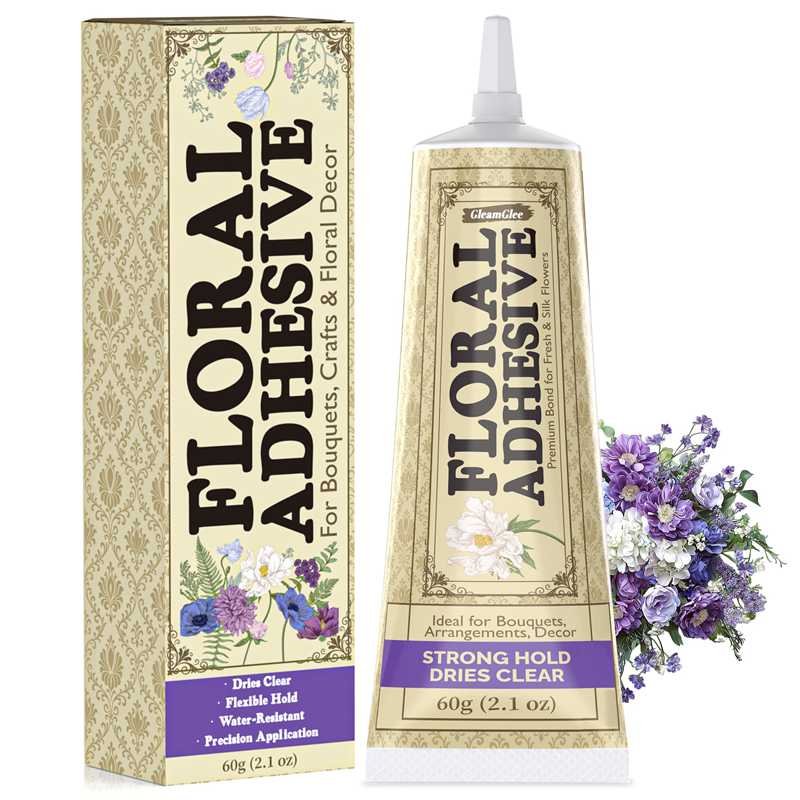
GleamGlee combines formulation, package selection, label design, printing, filling, inspection, and international supply support within an integrated manufacturing structure. Its stated capabilities include more than 25 chemists and materials specialists, over 18 design professionals, four specialized production facilities, and annual finished-product capacity exceeding 12 million units.
Selected customization projects may begin at approximately 200 units. Artwork can be prepared in as little as two days, samples commonly require 7–14 days, and standard bulk production is often completed in around 20 days after approval. Actual timing depends on formula complexity, packaging availability, testing, compliance work, and order volume.
A child-directed or non-toxic claim should never be added only because it improves packaging appeal. The finished formula, intended use, applicator, documentation, and destination-market requirements must support the claim before production begins.
Conclusion
The best non-toxic floral glue for children is not automatically the strongest, fastest, or most expensive option. A suitable adhesive should match the child’s ability, the craft material, the desired finish, the workspace, and the level of adult supervision available.
Washable white glue remains a dependable choice for paper flowers, cardstock, wooden sticks, and general classroom collages. Glue sticks reduce mess on flat paper projects. Thicker tacky formulas give felt, foam, and fabric petals better support, while carefully tested clear adhesives can preserve the appearance of pressed flowers and visible joints.
Parents and teachers should read the full label, control the application amount, keep food away from the craft area, allow enough drying time, and store the original container securely. A non-toxic statement is part of the decision, but it should be supported by clear intended use, sensible packaging, age guidance, and reliable product information.
Retailers, educational suppliers, distributors, Amazon sellers, and emerging craft brands need an additional layer of assurance. Formula consistency, batch traceability, packaging compatibility, multilingual instructions, documented inspections, and production-scale repeatability determine whether a promising sample becomes a dependable commercial product.
Organizations planning a bulk order or private-label range can contact GleamGlee with the intended floral materials, target age group, destination market, bottle size, applicator preference, estimated quantity, required claims, and packaging concept. The project team can then review formula feasibility, sample preparation, compliance needs, custom design, production timing, and international delivery options.
A successful children’s floral adhesive begins before the first bottle reaches a craft table. It begins with a carefully defined use case, an appropriate formula, practical packaging, honest claims, and a manufacturing process capable of reproducing the approved result consistently.