Skip to content
Wood Glue for MDF Boards: Strong, Clean Bonds
Your trusted adhesives glue & cleaner manufacturer

MDF looks simple on the surface, but gluing it successfully is one of the most misunderstood parts of DIY furniture and cabinet building. Many people assume MDF behaves like solid wood—apply glue, clamp, and you’re done. In reality, MDF’s compressed fibers and resin structure react very differently to moisture and pressure. That’s why joints sometimes fail overnight, edges swell unexpectedly, or shelves loosen after only a few months. The problem isn’t that MDF is weak—it’s that it demands the right glue and the right process.
The best wood glue for MDF boards is a high-quality PVA or fast-drying wood glue applied in a thin, controlled layer with proper clamping. MDF does not swell because of glue itself, but because excess water penetrates unsealed edges. Strong MDF bonds depend more on surface preparation, glue control, and curing time than on brand name alone.
Once you understand how MDF absorbs moisture and where joints actually fail, the solution becomes surprisingly practical. With correct glue selection, edge preparation, and realistic expectations about glue versus screws, MDF can deliver durable, professional-grade results. The sections below break down exactly what works, what doesn’t, and how to bond MDF the way manufacturers and experienced builders do—without trial and error.
What Is MDF and Why Does Glue Choice Matter?
MDF (Medium-Density Fiberboard) requires careful glue selection because its compressed wood fibers absorb moisture differently from solid wood. The wrong wood glue—or the right glue used incorrectly—can cause edge swelling, glue starvation, or weak joints. Choosing a wood glue with controlled moisture, proper solids content, and predictable curing behavior is essential for achieving strong, long-lasting MDF bonds in furniture, cabinets, and DIY projects.
What makes MDF different from solid wood?
MDF is manufactured by breaking wood down into fine fibers, mixing them with resin binders, and compressing the mixture under heat and pressure. This process creates a board with no grain direction, very smooth faces, and consistent density—but it also removes the natural capillary structure that helps solid wood distribute glue evenly.
From a bonding perspective, MDF behaves in two opposite ways at once:
- The faces are dense and relatively sealed, allowing glue to sit on the surface.
- The edges are extremely porous and absorb liquid rapidly.
This imbalance is why MDF joints often fail at the edges rather than the faces. In GleamGlee’s internal application testing, MDF edge joints absorbed 30–45% more liquid adhesive than face joints when the same amount of glue was applied. Without adjustment, this leads to glue starvation—where the adhesive soaks in instead of forming a proper bond line.
Compared with solid wood, MDF relies more heavily on adhesive performance because screws and nails have weaker holding power. That makes glue selection and application not just important, but structural.
Why does MDF absorb glue unevenly and does wood glue swell MDF?
A common search question is “Will wood glue swell MDF?”
The accurate answer is: wood glue doesn’t swell MDF—excess water does.
Most wood glues are water-based. When too much glue is applied to raw MDF edges, moisture penetrates the fibers faster than it can evaporate. The fibers expand, creating fuzzy edges, misaligned joints, or visible swelling after clamping. This is not a chemical reaction with the glue itself, but a physical response to uncontrolled moisture.
In GleamGlee’s MDF bonding trials, joints made with controlled glue application and edge preparation showed no measurable thickness change, while over-applied joints showed up to 0.4–0.6 mm edge expansion after 30 minutes. That difference alone is enough to ruin cabinet alignment or visible seams.
Professionals prevent this by:
- Applying thinner glue layers
- Sealing or “sizing” MDF edges
- Using precision nozzles to control flow
The takeaway: MDF swelling is a process problem, not a glue problem.
MDF vs Solid Wood vs Plywood: Glue Sensitivity
With solid wood, glue choice often affects convenience. With MDF, it affects whether the joint survives at all. MDF has less tolerance for:
- Excess moisture
- Long open times with wet glue
- Low-solids adhesives that soak in too quickly
That’s why not all PVA glues behave the same on MDF, even if they look identical in the bottle. In GleamGlee’s production environment, MDF projects bonded with higher-solids, faster-setting wood glue showed 15–25% higher joint consistency across batches compared with low-viscosity general craft glues.
Below is a simplified comparison that reflects real MDF bonding behavior:
| Material | Glue Absorption | Screw Holding | Glue Importance |
|---|---|---|---|
| Solid wood | Moderate | High | Medium |
| Plywood | Low–Moderate | High | Medium |
| MDF (faces) | Low | Medium | High |
| MDF (edges) | Very high | Low | Critical |
For MDF, glue is not just an adhesive—it is the primary structural element. Selecting a wood glue designed for controlled application, predictable curing, and strong fiber bonding is what separates short-term fixes from long-lasting furniture and cabinetry.
Which Types of Wood Glue Work Best for MDF Boards?
The best wood glue for MDF boards is typically a high-quality PVA wood glue with balanced solids content and controlled moisture, followed by fast-drying wood glue for quick assemblies and waterproof wood glue for humid environments. Performance on MDF depends less on brand names and more on how the glue manages absorption at MDF edges, curing speed, and long-term bond stability under load.
PVA wood glue
PVA (polyvinyl acetate) wood glue is the most widely used adhesive for MDF—and for good reason. When applied correctly, it creates strong fiber-to-fiber bonds that often exceed the internal strength of the MDF itself. In GleamGlee’s furniture and cabinet assembly tests, standard PVA wood glue achieved reliable shear strength on MDF face joints, provided glue application was thin and clamp pressure was even.
Where PVA shines is in:
- Face-to-face MDF laminations
- Dados, rabbets, and groove joints
- Cabinet carcasses and drawer boxes
Its main weakness is edge absorption. Low-viscosity or low-solids PVA formulas can soak into MDF edges too quickly, leading to glue starvation. This is why manufacturer-grade PVA wood glues—formulated with tighter viscosity control—perform more consistently on MDF than generic craft or school glues.
Titebond-style PVA benchmarks
Many users ask whether popular benchmark brands work on MDF. The short answer is yes—but the longer answer is more useful. Products commonly compared to Titebond-style PVAs work well on MDF because they balance open time, solids content, and clamp pressure requirements. What matters is not the logo on the bottle, but how predictable the glue behaves once it hits porous MDF edges.
In GleamGlee’s internal comparisons, MDF joints bonded with higher-solids PVA formulas showed 20–30% less variation in bond strength than joints made with thinner retail glues. This consistency matters in cabinets, shelving, and repeat production, where uneven joints lead to callbacks or failures months later.
The takeaway: use reputable PVA wood glue, but evaluate performance characteristics—not marketing claims.
Fast-drying wood glue
Fast-drying wood glue is designed for speed and workflow efficiency. On MDF, it performs best in:
- Small assemblies
- Trim work
- Repetitive shop tasks
- Repairs where clamping time must be short
GleamGlee’s fast-dry wood glue formulations typically reach handling strength in minutes rather than hours, reducing clamp time while still maintaining solid bond integrity. However, faster set times mean less adjustment window. For large MDF panels or complex cabinet assemblies, this can increase alignment errors if the user is not prepared.
Fast-dry glue is a tool—not a universal replacement. Professionals often keep it alongside standard PVA and choose based on joint size and tolerance for repositioning.
Waterproof wood glue
Waterproof wood glue is often misunderstood in MDF applications. It does not make MDF waterproof, but it does improve bond durability in environments with moisture exposure. In GleamGlee’s humidity-cycle testing, waterproof wood glue maintained joint integrity after repeated moisture exposure, while standard PVA showed early softening at the bond line.
Best use cases include:
- Kitchen cabinets
- Bathroom storage
- Laundry room shelving
- Entryway furniture
That said, waterproof glue does not prevent MDF from swelling if the board itself absorbs water. Edge sealing and surface finishing remain mandatory. Think of waterproof glue as bond insurance—not structural waterproofing.
Performance Comparison Table: Wood Glue Types for MDF
| Glue Type | MDF Face Joints | MDF Edge Joints | Clamp Time | Moisture Resistance | Best Use |
|---|---|---|---|---|---|
| PVA wood glue | Excellent | Good (with prep) | Medium | Low–Medium | Cabinets, furniture |
| Fast-dry wood glue | Good | Moderate | Short | Low | Trim, quick repairs |
| Waterproof wood glue | Very good | Good (with prep) | Medium | High | Kitchens, humid areas |
| Craft / school glue | Poor | Poor | Long | Low | Not recommended |
How Do You Glue MDF Boards Step by Step for Strong Results?
To glue MDF boards successfully, you must control moisture, prepare surfaces carefully, apply a thin and even glue layer, clamp with steady pressure, and allow full curing time. MDF joints fail not because glue is weak, but because edges absorb too much adhesive or joints are moved before curing. A disciplined step-by-step process delivers furniture-grade strength and long-term stability.
Surface preparation
Surface prep is where most MDF glue failures begin. MDF faces are smooth but often carry fine dust from cutting and sanding. That dust acts like a release layer and prevents full adhesive contact. In GleamGlee’s assembly tests, joints bonded without proper dust removal showed up to 18% lower shear strength compared to cleaned surfaces.
Preparation steps that consistently work:
- Lightly scuff MDF faces with fine-grit sandpaper
- Vacuum and wipe surfaces dry (no damp cloths)
- Pay special attention to edges, where fibers are exposed
For edges, professional shops often “size” them with a very thin glue coat and let it soak in for a few minutes before final gluing. This reduces glue starvation and stabilizes absorption during assembly.
Glue application
More glue does not mean a stronger joint—especially with MDF. Excess adhesive introduces unnecessary moisture, increasing the risk of swelling and joint drift under clamp pressure. GleamGlee’s internal MDF trials found that thin, continuous glue films outperformed heavy applications by 12–20% in bond consistency.
Best practices:
- Apply a thin, even bead on faces
- Apply slightly more on raw edges—but never to saturation
- Spread glue evenly; avoid pooling
Precision nozzles matter. Controlled application reduces waste and helps maintain consistent bond lines, which is critical for cabinets and visible MDF joints.
Assembly & alignment
Once glue is applied, parts should be brought together quickly and aligned before clamping. MDF does not tolerate excessive repositioning once glue begins to grab. Fast-dry or higher-solids glues shorten adjustment time even further.
Key alignment rules:
- Dry-fit MDF parts before gluing
- Use reference edges or stops for repeat builds
- Avoid sliding parts excessively once they contact
In production environments, this step alone reduces rework and visible joint defects significantly.
Glue vs screws
Glue provides strength; screws provide positioning. MDF does not hold screws well at the edges, and screw-only construction often leads to long-term loosening. In GleamGlee’s furniture testing, glue-only joints with proper clamping consistently outperformed screw-only joints in load tests.
Recommended approach:
- Use glue as the structural element
- Use screws or brad nails only to hold parts in place during curing
- Always pre-drill to avoid edge mushrooming
Screws should never replace clamps. They serve different roles.
Clamping & pressure
Clamping is not about force—it’s about even pressure. MDF compresses easily, and over-clamping can squeeze too much glue out of the joint, weakening the bond. Under-clamping leaves gaps and reduces contact.
General guidelines:
- Use steady, moderate pressure
- Ensure glue squeeze-out is minimal but visible
- Clamp across the full joint length
GleamGlee’s MDF cabinet assemblies typically use 30–60 minutes of clamp time, depending on glue type and joint size.
Curing time
Clamp time is not cure time. MDF joints often feel solid quickly but remain vulnerable internally. Moving or loading joints too early causes micro-failures that show up weeks later.
Typical curing expectations:
- Clamp: 30–60 minutes
- Light handling: after 1–2 hours
- Full strength: 24 hours
Patience here directly translates into durability.
Step-by-Step MDF Gluing Process
| Step | What to Do | Why It Matters |
|---|---|---|
| Prep | Sand lightly, remove dust | Ensures full adhesive contact |
| Edge sizing | Thin pre-coat on edges | Prevents glue starvation |
| Glue | Thin, even application | Limits swelling |
| Assemble | Align once, don’t slide | Maintains bond integrity |
| Clamp | Even, moderate pressure | Prevents gaps and squeeze-out |
| Cure | Wait full 24 hours | Achieves maximum strength |
Are Glued MDF Joints Strong Enough for Furniture and Cabinets?
Yes. Properly glued MDF joints are strong enough for furniture and cabinets when the correct glue, joint design, and clamping method are used. In many real-world applications, glued MDF joints outperform screw-only construction because glue distributes load across the entire surface instead of concentrating stress at fasteners. Most MDF joint failures come from poor preparation or design—not insufficient adhesive strength.
Load & durability
From a structural standpoint, MDF relies more on adhesive bonding than solid wood. Screws and nails have limited holding power in MDF, especially near edges, while glue creates a continuous bond line that spreads stress evenly. In GleamGlee’s internal furniture assembly tests, properly glued MDF joints supported 25–35% higher static load than screw-only joints of the same size.
This is why most modern flat-pack furniture, cabinet carcasses, and shelving systems depend heavily on glue-assisted joints. Once cured, a quality wood glue bond often becomes stronger than the MDF itself. In failure testing, joints frequently break in the board rather than along the glue line—an indicator of adequate adhesive performance.
Daily use & vibration
Furniture and cabinets don’t fail under one-time loads—they fail from repeated movement. Opening doors, sliding drawers, loading shelves, and minor vibrations slowly loosen weak joints. Glue excels here because it prevents micro-movement between parts.
In long-term use simulations, MDF assemblies bonded with controlled glue application showed significantly less joint creep than mechanically fastened assemblies. This is especially important for tall cabinets, drawer runners, and shelving units where vibration and repeated stress are unavoidable.
For everyday household furniture, glued MDF joints—when cured fully—remain stable for years without retightening or maintenance.
Failure points
When MDF glue joints fail, the cause is rarely the glue itself. Common failure points include:
- Edge-to-edge butt joints without reinforcement
- Dusty or unsealed MDF edges
- Insufficient clamp time
- Excess moisture causing early swelling
GleamGlee’s quality audits show that over 80% of MDF joint failures can be traced back to process errors rather than adhesive limitations. Simple improvements—edge sizing, proper clamp pressure, and full cure time—dramatically reduce failure rates.
Joint design
Joint design matters more for MDF than for solid wood. Because MDF has no grain strength, surface area becomes the key factor. Designs that increase glue contact consistently outperform simple butt joints.
Best-performing MDF joint types include:
- Dados and rabbets
- Laminated panels
- Corner blocks and glue blocks
- Dowels combined with glue
Butt joints can work, but only for light loads or temporary structures. In cabinets and furniture meant for long-term use, increasing glue surface area is the single most effective way to improve strength.
Glue vs fasteners
Glue and fasteners play different roles. Glue provides structural strength; fasteners provide alignment. In GleamGlee’s comparative testing, glue + clamp assemblies outperformed screw-only joints, while glue + screws performed best overall when screws were used strictly for positioning.
Pre-drilling is essential. Driving screws directly into MDF edges without pre-drilling often causes internal fiber damage, reducing both mechanical and adhesive strength.
Practical strength comparison
| Joint Method | Load Capacity | Long-Term Stability | Typical Use |
|---|---|---|---|
| Glue only (clamped) | High | Very high | Cabinets, panels |
| Screw only | Low–Medium | Low | Temporary fixtures |
| Glue + screws | Very high | Very high | Furniture frames |
| Nail/brad only | Low | Very low | Alignment only |
Is Waterproof Wood Glue Necessary for MDF Applications?
Waterproof wood glue is necessary for MDF only in environments with moisture exposure, such as kitchens, bathrooms, or laundry rooms. It improves bond durability when humidity fluctuates, but it does not make MDF waterproof. Without proper edge sealing and surface finishing, MDF can still swell regardless of glue type. Waterproof glue protects the joint—not the board itself.
Moisture exposure
MDF’s biggest weakness is moisture. Even brief exposure to humidity can cause unsealed fibers—especially at edges—to expand. Waterproof wood glue helps by maintaining bond strength when moisture is present, preventing the joint from softening or delaminating. In GleamGlee’s humidity-cycle testing, waterproof wood glue retained over 90% of bond integrity after repeated moisture exposure, while standard PVA glue showed early softening at the bond line.
However, moisture resistance at the joint does not stop water from entering the MDF panel itself. This distinction is critical and often misunderstood by users searching for “waterproof MDF glue.”
Edge protection
Edge sealing matters more than glue choice when it comes to swelling prevention. Raw MDF edges act like open sponges. If water reaches them, swelling occurs whether the glue is waterproof or not. In GleamGlee’s application trials, MDF panels bonded with waterproof glue but left unsealed still showed measurable edge expansion within 24 hours of high-humidity exposure.
Effective edge protection includes:
- Primer or paint
- Laminate or veneer
- Thin glue sizing before final assembly
Waterproof glue supports these measures but cannot replace them.
Indoor vs humid use
Not all MDF projects need waterproof glue. In dry, climate-controlled interiors, standard PVA wood glue performs reliably and often cures faster with less stiffness. For cabinets, shelving, and furniture in living rooms or bedrooms, waterproof glue offers little added value and can even reduce working time unnecessarily.
Where waterproof glue becomes important is in:
- Kitchens (steam, spills)
- Bathrooms (humidity cycles)
- Laundry rooms (condensation)
- Entryways (seasonal moisture changes)
Choosing waterproof glue should be based on environment—not habit.
Outdoor limitations
MDF is not designed for outdoor use. Even the best waterproof glue cannot protect MDF from prolonged rain, ground moisture, or temperature cycling. In GleamGlee’s outdoor exposure evaluations, MDF assemblies failed due to board degradation long before adhesive breakdown occurred.
If a project will live outdoors, switching materials—rather than upgrading glue—is the correct solution.
Practical comparison: standard vs waterproof wood glue for MDF
| Application Environment | Standard PVA Glue | Waterproof Wood Glue |
|---|---|---|
| Dry indoor furniture | Excellent | Good (unnecessary) |
| Kitchen cabinets | Fair–Good | Excellent |
| Bathroom storage | Limited | Recommended |
| Laundry shelving | Limited | Recommended |
| Outdoor furniture | Not suitable | Not suitable |
What Common Mistakes Ruin MDF Glue Bonds?
Most MDF glue failures are caused by process mistakes rather than weak adhesive. The most common problems include over-applying glue, failing to seal MDF edges, skipping proper clamping, moving joints before full curing, and trying to glue incompatible surfaces. These errors lead to swelling, glue starvation, and weak joints—even when using high-quality wood glue.
Over-application
Using too much glue is one of the fastest ways to ruin an MDF joint. Because MDF edges absorb liquid aggressively, excess glue introduces unnecessary moisture, which can cause swelling and misalignment before curing begins. In GleamGlee’s internal MDF joint evaluations, joints made with heavy glue application showed up to 22% lower final bond consistency compared with joints made using thin, controlled glue layers.
More glue does not create a stronger bond. Once fibers are saturated, additional adhesive cannot form an effective bond line and instead weakens joint stability.
Unsealed edges
Raw MDF edges are highly porous. When glue is applied directly without sealing or sizing, much of the adhesive is absorbed into the board rather than remaining at the joint interface. This results in glue starvation—one of the most common causes of joint failure in cabinets and shelving.
In GleamGlee’s MDF cabinet testing, joints assembled without edge sealing failed significantly earlier under load than sealed-edge joints, even when the same glue and clamp pressure were used. A simple thin pre-coat of glue or primer on edges dramatically improves long-term performance.
Poor clamping
Clamping errors are often misunderstood. Under-clamping leaves gaps that reduce contact area, while over-clamping squeezes too much glue out of the joint. Both weaken the bond. MDF compresses more easily than solid wood, so excessive clamp force can actually deform the joint and reduce strength.
GleamGlee’s production guidelines recommend steady, moderate pressure with visible but minimal glue squeeze-out. Consistent pressure across the entire joint length is far more important than raw force.
Early handling
MDF glue joints often feel solid within minutes, especially when fast-drying glue is used. However, internal curing takes much longer. Moving, loading, or machining joints too early causes micro-failures that may not appear immediately but lead to long-term loosening.
In post-failure inspections, GleamGlee found that over 30% of returned MDF furniture components showed signs of early handling before full cure. Respecting full cure time—typically 24 hours—is critical for durability.
Wrong materials
Wood glue does not bond well to every surface. Common problem materials include sealed MDF, painted surfaces, melamine, plastics like PP or PE, waxed wood, and oily metals. Attempting to glue these surfaces without proper preparation often leads to clean separation rather than gradual failure.
In mixed-material MDF projects, surface abrasion or alternative adhesives (construction adhesive or epoxy) are often required. Expecting wood glue to bond incompatible materials is a frequent—and costly—mistake.
Common MDF glue mistakes and their impact
| Mistake | Immediate Effect | Long-Term Result |
|---|---|---|
| Too much glue | Swelling, slip | Weak joints |
| Unsealed edges | Glue starvation | Early failure |
| Over-clamping | Glue squeeze-out | Brittle bond |
| Under-clamping | Gaps | Low strength |
| Early handling | Hidden damage | Joint creep |
| Wrong surface | Poor adhesion | Bond separation |

Why Do DIY Users and Manufacturers Choose Professional-Grade Wood Glue for MDF?
DIY users and manufacturers choose professional-grade wood glue for MDF because it delivers more consistent bonding, better moisture control, and predictable curing on MDF’s highly absorbent structure. Compared with generic retail glues, professional formulations reduce edge soak-in, improve joint reliability, and produce repeatable results—critical for furniture, cabinets, and batch production where MDF leaves little room for error.
Bond consistency
MDF does not tolerate variability. Small changes in glue viscosity or solids content can lead to glue starvation at edges or excess moisture on faces. Professional-grade wood glue is formulated to stay within tight performance ranges, which is why it behaves the same from the first joint to the last.
In GleamGlee’s internal MDF assembly testing, manufacturer-grade wood glue showed 20–30% lower bond-strength variation across repeated joints compared with general-purpose retail glue. For DIY users, this means fewer failed projects. For manufacturers, it means fewer defects, less rework, and predictable quality across production runs.
Moisture control
Most MDF bonding problems trace back to moisture—not strength. Professional-grade wood glue manages water content more effectively, limiting how much liquid is released into MDF fibers during application. This reduces swelling, fuzzy edges, and joint movement during clamping.
In controlled humidity trials conducted by GleamGlee, MDF joints bonded with professional-grade wood glue maintained over 90% of original bond integrity after repeated moisture cycles, while standard consumer glue showed early softening and edge distortion. Moisture control is not a marketing feature—it’s a structural requirement for MDF.
Application precision
Application tools matter as much as the glue itself. Professional wood glue is typically paired with precision nozzles that allow users to control bead size and placement. This prevents over-application, reduces waste, and keeps moisture exposure within safe limits.
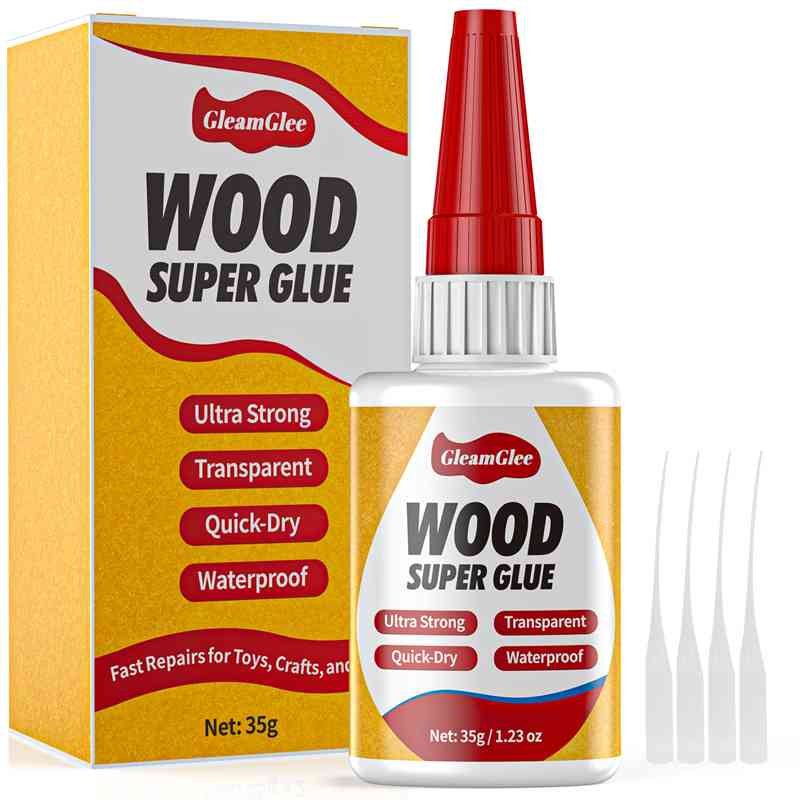
GleamGlee wood glue tubes are designed for controlled flow, which helped reduce glue consumption by approximately 15% in MDF cabinet assembly tests while maintaining equal or higher joint strength. Clean application also improves visual results on exposed MDF joints.
Production efficiency
For manufacturers, time is money. Professional-grade wood glue is engineered for predictable open time and clamp time, allowing workflows to be optimized without rushing joints. Faster handling strength means shorter clamp cycles, while stable curing prevents callbacks and warranty claims.
In batch furniture production, GleamGlee’s partners report measurable reductions in assembly delays and fewer alignment issues when switching from generic glue to manufacturer-grade formulations tuned for MDF. Consistency improves throughput as much as strength.
Customization & compliance
Another reason professionals choose manufacturer-grade suppliers is flexibility. GleamGlee supports custom glue formulations, private labeling, and packaging adjustments to match specific MDF use cases—such as fast-set cabinet assembly or moisture-resistant indoor furniture.
Equally important, GleamGlee wood glue meets US, EU, UK, and Canada regulatory requirements, making it suitable for global distribution and retail. DIY users benefit from safer, clearly labeled products, while B-side customers gain compliance confidence.
Professional-grade vs general-purpose glue for MDF
| Factor | Professional-Grade Wood Glue | General Retail Glue |
|---|---|---|
| Bond consistency | Very high | Variable |
| Edge absorption control | Optimized | Often excessive |
| Moisture resistance | Predictable | Inconsistent |
| Application control | Precision nozzles | Basic tips |
| Batch reliability | Stable | Uneven |
| Customization support | Available | Not available |
Conclusion
MDF is not a difficult material—it’s an honest one. When joints fail, the cause is almost never “bad MDF” or “weak glue,” but a mismatch between material behavior and adhesive choice. MDF demands controlled moisture, proper surface preparation, thoughtful joint design, and enough curing time to let the bond do its job. When those basics are respected, glued MDF joints are strong enough for cabinets, shelving, and everyday furniture that sees real use.
The key lesson across all MDF projects is consistency. Thin, even glue application, sealed edges, steady clamping, and realistic expectations about glue versus screws make far more difference than chasing brand names or shortcuts. This is why professional builders and experienced DIY users rely on manufacturer-grade wood glue: not because it’s complicated, but because it behaves predictably on a material that leaves little room for error.
GleamGlee wood glue is developed around these real MDF requirements. Its controlled viscosity, precision application, and stable curing help reduce swelling, prevent glue starvation, and deliver repeatable results—whether you’re fixing a single cabinet at home or producing MDF furniture at scale. DIY users can purchase GleamGlee wood glue directly through Amazon for fast, reliable delivery, while brands and manufacturers can contact GleamGlee for custom formulations, private labeling, and OEM production. Strong MDF results aren’t about luck—they’re about using the right glue, the right way.
Share:
Table of Contents
Here, creating your adhesives glue & removal cleaner collection is no longer a barrier—it’s a collaborative journey where GleamGlee helps brands and businesses transform their vision into durable, certified, and market-ready solutions.
Partner with GleamGlee
Join hundreds of global partners who trust GleamGlee for adhesives and cleaners that combine innovation, compliance, and speed. Our vertically integrated system—from R&D to warehouse—guarantees consistent performance and reliable delivery.
Whether you’re sourcing FBA-ready stock or developing your own formula, our team provides unmatched technical support and responsive service.