Skip to content

PVC Glue for DIY Rain Covers: A Field-Tested Guide
Your trusted adhesives glue & cleaner manufacturer

A DIY rain cover can look perfectly finished on a workbench and still fail during its first week outdoors. The problem is rarely just whether the adhesive feels strong when you pull on it by hand. Real rain covers bend, roll, flutter in wind, stretch around frames, sit under sunlight, collect moisture, and sometimes remain folded for weeks between uses. That means a successful bond has to deal with movement as well as water. The material itself also matters. Flexible PVC sheet, vinyl-coated polyester, polyethylene tarp, canvas, and silicone-coated fabric may all be described casually as waterproof cover materials, but they do not respond to the same adhesive in the same way.
For a DIY rain cover made from compatible flexible PVC or vinyl, use an adhesive formulated for flexible PVC, thoroughly clean and dry the bonding surfaces, create a sufficiently wide overlap, apply the adhesive evenly, remove trapped air, maintain consistent pressure, and allow the joint to cure fully before rain or tension is applied. A flexible waterproof PVC adhesive is generally more appropriate for the cover itself than rigid PVC pipe cement.
Imagine spending an afternoon measuring a transparent patio cover, trimming each edge carefully, aligning every panel, and making a seam that looks nearly invisible. The next morning it still looks perfect, so the cover goes straight outside. By evening, wind begins pulling at one edge and rainwater starts finding a narrow channel that never fully bonded. That kind of failure is frustrating because the material and adhesive may both have been suitable; the weak point was the process. Understanding how material, overlap, pressure, curing, and outdoor movement work together is what turns a quick DIY repair into a dependable rain cover.
What Is PVC Glue for Rain Covers?
PVC glue for rain covers is a flexible adhesive used to join, seal, or repair compatible PVC, vinyl, and PVC-coated materials while allowing the bonded area to continue bending during use. Unlike rigid plumbing cement, an outdoor-cover adhesive must tolerate repeated folding, wind movement, rain, and temperature changes. The most important requirement is therefore compatibility with the exact flexible material rather than simply choosing a product labeled “PVC glue.”
What Does PVC Glue Actually Do?
A useful PVC adhesive does more than hold two pieces together for a few minutes. On a flexible rain cover, the cured adhesive becomes part of a moving structure that includes the PVC sheet, the overlap, any reinforcing patch, and the surrounding material. When wind lifts the cover or someone folds it for storage, force moves through all of these layers. A bond that is extremely hard but much less flexible than the sheet can concentrate stress along its edge, making peeling or cracking more likely after repeated movement.
This is why flexible PVC and vinyl adhesives are commonly associated with products such as tarpaulins, pool materials, inflatable equipment, waterproof curtains, rainwear, awnings, boat covers, and recreational gear. These applications rarely remain perfectly flat. They bend and flex repeatedly, so the cured adhesive needs enough elasticity to move with the substrate rather than acting like a rigid strip glued onto a soft sheet.
Strength should therefore be judged in context. Initial tack can be convenient, but it does not tell you how the seam will behave after a month of folding or several days of rain. Water resistance, peel performance, flexibility after full cure, and surface compatibility are often more useful indicators for a rain-cover project than an impressive single tensile-strength claim printed on packaging.
A simple way to think about the repair is to treat the adhesive as a load-transfer layer. A wider bonded zone gradually spreads force from one piece of material into another. A narrow bead at the edge has far less area available to distribute that load. This is one reason properly designed overlaps and reinforcement patches frequently outperform attempts to fill only the visible cut or join two flexible sheets edge-to-edge.
Is PVC Pipe Cement the Same as PVC Adhesive?
PVC pipe cement and flexible PVC repair adhesive are not interchangeable simply because both products contain the letters PVC. Pipe cement is primarily designed for rigid pipes and fittings. Its job is to soften compatible rigid PVC surfaces and create a solvent-welded joint that behaves almost like one continuous plastic component after assembly. That approach makes sense for plumbing, drainage systems, irrigation frames, and rigid DIY structures that are not intended to bend repeatedly after installation.
A flexible rain cover works differently. Vinyl film and plasticized PVC sheet are expected to bend, roll, stretch slightly, and move under wind. They may also contain plasticizers, coatings, pigments, or textile reinforcement that influence adhesive performance. An adhesive designed for these surfaces must remain suitably flexible after curing and should be specifically described as compatible with flexible PVC, vinyl, PVC-coated fabric, tarpaulin, inflatable products, or comparable applications.
This distinction becomes especially important in DIY shelters that combine a rigid PVC frame with a flexible waterproof cover. The pipe fittings may correctly use a pipe-specific solvent cement, while the cover seams require a completely different flexible adhesive system. Trying to use one product for both jobs can create a project that feels convenient during assembly but is poorly matched to the mechanical demands of the finished structure.
When the cover material is unknown, identification should come before bonding. A blue woven tarp, for example, may be polyethylene rather than PVC. A coated canvas cover may have a surface treatment that ordinary vinyl adhesive cannot wet effectively. The safest sequence is to identify the substrate, check the adhesive compatibility information, and test a small offcut before applying the product across a large visible seam.
Which Glue Properties Matter Outdoors?
Outdoor performance is a combination of properties rather than one headline number. A rain cover can face water, sunlight, temperature cycling, dust, abrasion, wind flutter, and folding within the same season. For that reason, a flexible outdoor PVC adhesive should be evaluated for how well it matches the material and use pattern rather than simply whether the label says “strong.”
Waterproof performance matters because a rain-cover seam exists specifically to keep moisture out, but even a waterproof adhesive cannot compensate for an unbonded channel along the edge. Flexibility matters because a cover that is rolled and unfolded repeatedly can place peel stress on a rigid repair. UV and weather resistance become increasingly important when the cover remains outside for weeks or months rather than being used only occasionally.
Curing information is also important. Many flexible vinyl and PVC repair systems develop initial holding strength quickly but require approximately a day before reaching their intended full bond. The exact value varies by formulation, temperature, humidity, layer thickness, and manufacturer instructions, so 24 hours should be treated as a common reference rather than a universal guarantee.
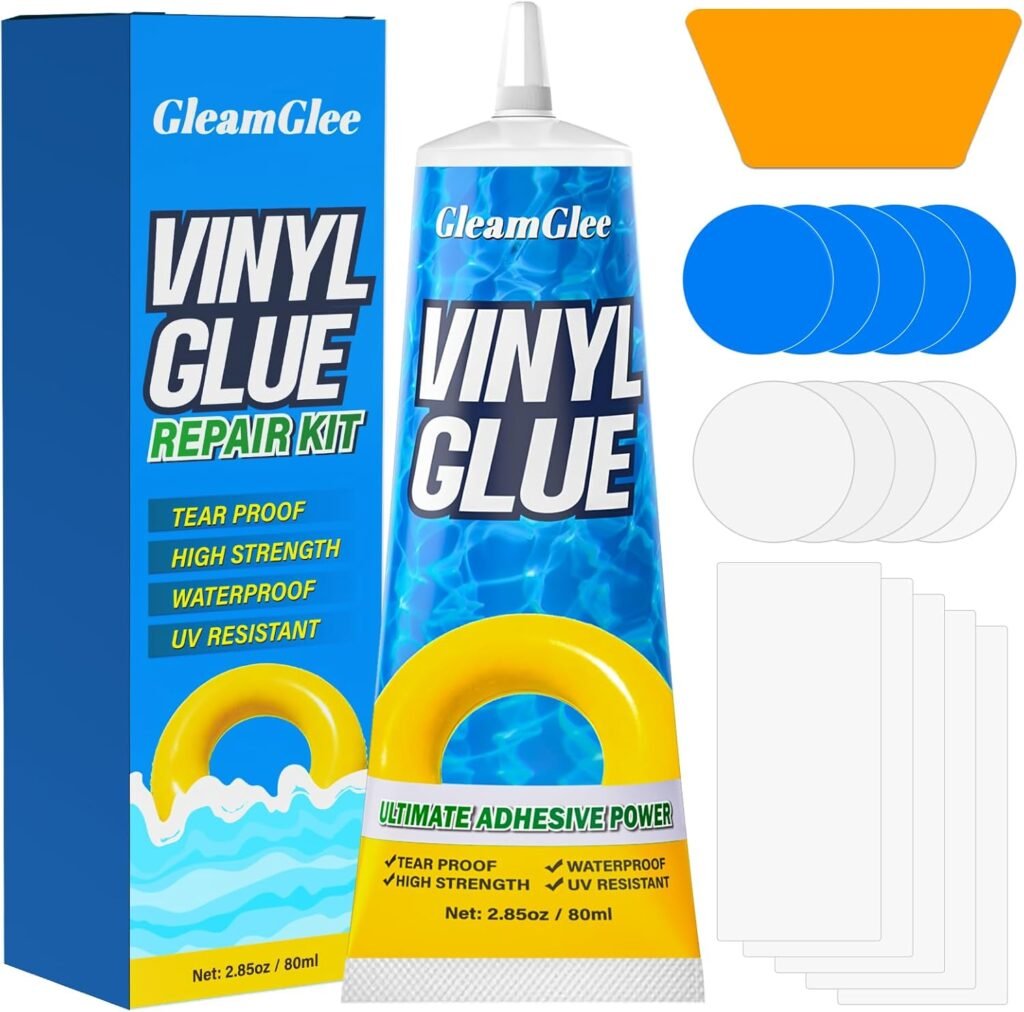
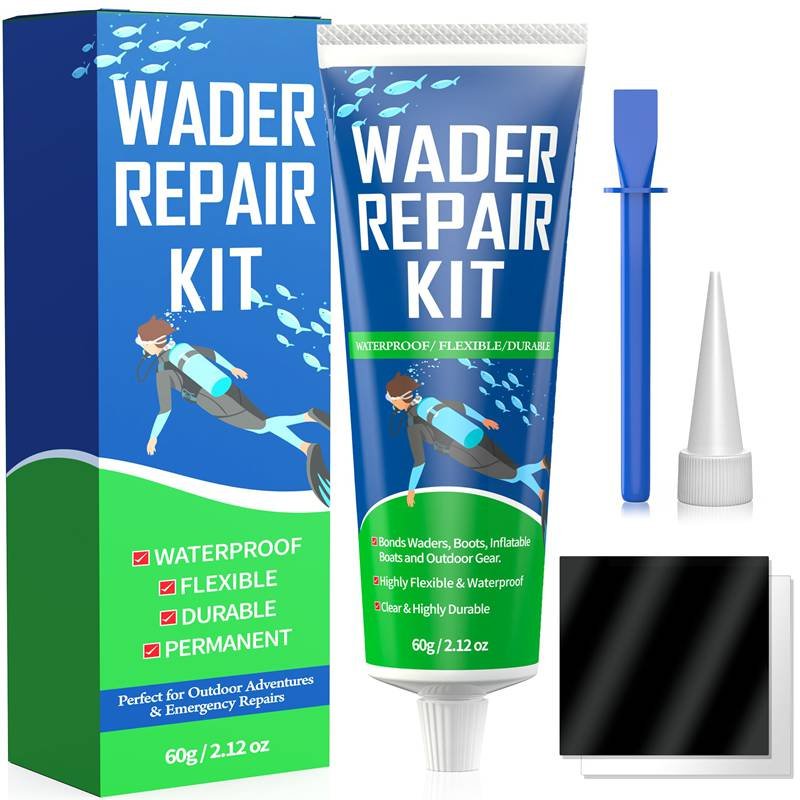
GleamGlee’s PVC repair adhesive is designed around flexible PVC and rubber repair applications and continues developing bond strength during roughly the first 24 hours. Its repair kit also includes waterproof patches and tools intended for flexible recreational products, making the system relevant to compatible rain-cover repairs where a puncture or tear needs both sealing and reinforcement.
| Performance Factor | Practical Importance | What to Check |
|---|---|---|
| Material compatibility | Determines whether stable adhesion can develop | Flexible PVC, vinyl, or PVC-coated fabric suitability |
| Waterproof cured bond | Helps prevent rain from crossing the repair | Waterproof or water-resistant service claim |
| Flexibility | Helps the seam survive rolling and folding | Flexible after complete cure |
| UV resistance | Useful for long outdoor exposure | Outdoor or UV-resistant specification |
| Peel resistance | Helps edges remain closed in wind | Suitable overlap and edge bonding |
| Cure behavior | Prevents early loading from weakening the seam | Initial set and full-cure guidance |
| Application control | Affects coverage and cosmetic finish | Nozzle, brush, applicator, roller, or squeegee suitability |

Which Rain Cover Materials Can PVC Glue Bond?
Flexible PVC adhesive can work well on many PVC and vinyl rain-cover materials, including flexible PVC sheet and some PVC-coated polyester fabrics, but it should not automatically be used on every waterproof tarp. Polyethylene, polypropylene, canvas, TPU, and silicone-coated textiles may require completely different bonding methods. Correctly identifying the cover material is therefore the most useful first step before choosing glue, patch material, or seam design.
Is Flexible PVC Suitable for Gluing?
Flexible PVC is one of the most practical materials for adhesive repair because many specialized vinyl and PVC formulations are designed to interact with its surface while retaining useful flexibility after curing. It appears in clear weather panels, pool liners, inflatable furniture, camping products, protective curtains, waterproof covers, recreational equipment, and many other products that may eventually need patching or seam work.
However, the term flexible PVC still covers a wide range of material constructions. Thickness, plasticizer content, surface gloss, reinforcement, pigments, printing, and protective coatings can all influence adhesion. Two sheets that look almost identical can behave differently when exposed to the same adhesive, particularly if one has a highly treated surface or a different plasticizer package.
A small test on scrap material is therefore valuable before committing to a long seam. Prepare the sample exactly as you plan to prepare the final cover, apply the intended amount of adhesive, allow the full specified cure, and then bend and pull the joint. A sample that feels strong after ten minutes may perform differently after a full day, especially once the material is folded sharply.
Transparent PVC requires extra attention because application defects remain visible. Thick adhesive ridges, bubbles, fingerprints, and uneven patch edges can reduce the visual quality of a patio curtain or clear equipment cover even when the repair is structurally sound. A precision metal nozzle can improve control around small punctures, while clear patches help preserve the appearance of transparent surfaces.
GleamGlee’s PVC repair kit includes transparent round and rectangular patches in addition to blue round patches. That range is useful because small circular repairs and longer linear tears do not always need the same patch geometry, and transparent reinforcement can make repairs less visually disruptive on clear rain panels.
Can PVC Glue Bond Vinyl Fabric?
Many outdoor “vinyl” covers are actually polyester textiles coated or laminated with PVC. The textile core provides strength and dimensional stability, while the outer vinyl layer provides a smooth waterproof surface. This construction is widely used in tarpaulins, truck covers, awnings, inflatable structures, outdoor curtains, recreational shelters, equipment covers, and other applications where the material must remain waterproof but stronger than thin unsupported film.
A compatible flexible PVC or vinyl adhesive can often work well on this type of material, but damage to coated fabric should be evaluated differently from a simple puncture in plain film. When a tear cuts into the woven reinforcement, the surrounding fibers may also have been stretched or weakened. Merely placing adhesive inside the cut may seal the opening temporarily without restoring the original load distribution across the fabric.
For that reason, larger tears generally benefit from a reinforcing patch that extends onto undamaged material. A margin of roughly 50 mm, or about 2 inches, around a substantial tear is a commonly used field-repair starting point for vinyl tarps, but it should not be treated as a universal engineering specification. Patch size should increase when the cover is under higher tension, exposed to stronger wind, or damaged near an attachment point.
Patch corners matter as well. A sharp 90-degree corner creates a convenient place for peel to begin because force can concentrate at one point. Rounded or softened corners produce a smoother transition and generally make it harder for an edge to lift during folding, cleaning, or wind movement.
Are PVC, PE, and Canvas the Same?
PVC, polyethylene, polypropylene, and canvas may all be sold as waterproof covers, yet their surface chemistry and repair behavior are very different. One of the most common DIY mistakes is assuming that any material described as a tarp can be repaired with the same glue. In reality, a product that bonds strongly to plasticized PVC may perform poorly on polyethylene because the two surfaces have very different bonding characteristics.
PVC-coated polyester usually presents a vinyl-like surface that is compatible with many flexible PVC repair adhesives. Woven polyethylene tarps, including many inexpensive blue or green covers, have much lower surface energy and are harder to bond with ordinary vinyl adhesive. Polypropylene presents a similar challenge and often needs specialized surface treatment, adhesive chemistry, mechanical reinforcement, or another repair method.
Canvas adds another layer of uncertainty because it can be untreated, waxed, acrylic-coated, PVC-coated, or finished with another water-repellent treatment. The visible textile alone does not tell you what surface the adhesive is actually contacting. A glue intended for bare fabric may behave differently on a coated canvas, while PVC adhesive may be suitable only when the outer coating is genuinely compatible vinyl.
When the original product label or specification is available, use it. If the material remains uncertain, test an inconspicuous area or scrap piece instead of committing to a large seam. A successful adhesive repair begins with knowing what is being bonded, not with buying the strongest-sounding product.
| Rain Cover Material | Typical Construction | General PVC Glue Suitability | Main Concern |
|---|---|---|---|
| Flexible PVC sheet | Solid plasticized PVC | Often suitable with compatible adhesive | Plasticizer and surface finish |
| Vinyl film | Flexible vinyl sheet | Often suitable | Formulation compatibility |
| PVC-coated polyester | Textile core with PVC coating | Often suitable | Coating condition and textile damage |
| PE tarp | Woven polyethylene | Usually unsuitable for standard PVC glue | Low surface energy |
| PP tarp | Woven polypropylene | Usually unsuitable for standard PVC glue | Difficult bonding surface |
| Canvas | Woven textile, coated or uncoated | Depends on coating | Surface treatment and absorption |
| Silicone-coated fabric | Textile with silicone finish | Usually needs specialized adhesive | Very low adhesion surface |
Which DIY Rain Covers Work Best?
Flexible PVC adhesive is most useful in projects where the main waterproof skin is known to be flexible PVC, vinyl, or compatible PVC-coated fabric. Common examples include transparent patio side panels, garden-equipment covers, camping storage covers, small shelter curtains, bicycle or motorcycle covers, outdoor furniture protection, inflatable structures, boat accessories, and patchable recreational tarps.
Good design reduces how much stress the adhesive has to carry. A rain cover should shed water rather than creating deep pockets where water accumulates. One liter of water has a mass of roughly one kilogram, so a surprisingly small depression can create several kilograms of extra load on a seam or tie-down point after heavy rain.
The cover should also have enough freedom to move without pulling every seam tight. High-load attachment points such as grommets, straps, poles, and frame corners benefit from reinforcement because the stress there can be far higher than in the center of a loose panel. If the same glued seam is repeatedly folded along a sharp line during storage, mechanical fatigue can also increase over time.
When a DIY shelter combines rigid PVC pipe and flexible sheet, treat the two materials as separate systems. The rigid frame provides shape and structural support, while the flexible cover provides the weather barrier. Pipe joints may use a rigid PVC joining system, while flexible sheet seams require a flexible adhesive or another compatible joining method. Keeping those roles separate makes future repair and replacement much easier.

How Do You Glue a DIY Rain Cover?
To glue a DIY PVC rain cover, first verify that the material and adhesive are compatible, then clean and completely dry both surfaces, dry-fit the seam, create enough overlap for the expected load, and apply a uniform adhesive layer according to the product instructions. Join the material gradually, remove trapped air, apply even pressure, and protect the seam from rain, stretching, and folding until the adhesive has reached full cure.
How Do You Prepare the Surface?
Surface preparation determines whether the adhesive is bonding to the PVC or merely sticking to dirt, oil, wax, moisture, mold residue, old adhesive, or another contaminant sitting on top of it. Outdoor covers often collect several of these contaminants at once, especially around folded edges and areas that are handled frequently.
Begin by removing loose dirt rather than immediately rubbing it across the surface with solvent. A clean dry cloth or suitable soft brush can remove grit that might otherwise scratch clear PVC. After that, clean the bonding area using a method compatible with both the cover material and the chosen adhesive. Stronger solvent does not necessarily mean better preparation because aggressive cleaners can cloud transparent PVC, remove printing, soften coatings, or change surface appearance.
The bonding area must be completely dry before adhesive is applied. Water trapped between two waterproof layers may have very limited opportunity to escape and can reduce effective contact. When making a new seam, flatten the material and dry-fit both pieces first so alignment can be checked before adhesive makes repositioning difficult.
For a repair, inspect beyond the obvious tear. A visible 30 mm cut may be surrounded by another 20 or 30 mm of stretched or whitened material. The patch should cover the complete weakened zone rather than only the open gap.
A practical preparation sequence is straightforward:
- Identify the substrate.
- Remove loose contamination.
- Clean using a compatible method.
- Allow the surface to dry completely.
- Flatten wrinkles and distortion.
- Mark the planned overlap or patch position.
- Test-fit everything before opening the adhesive.
How Much PVC Glue Should You Apply?
The right amount of adhesive is enough to create complete and consistent coverage across the bonding zone without leaving dry spots, large puddles, thick ridges, or uncontrolled squeeze-out. Applying twice as much glue does not automatically create twice the strength, and excessively thick adhesive can sometimes make curing slower or create a stiff area that behaves differently from the surrounding flexible sheet.
Too little adhesive creates a different set of problems. Dry areas reduce the effective bonded surface, and an uncoated strip near the edge can become both a water pathway and a starting point for peel. For this reason, even distribution usually matters more than the size of the bead coming out of the bottle.
Application technique depends on the formulation. Some flexible vinyl cements are applied to both surfaces and allowed to become tacky before joining. Other repair adhesives may use a different process. Product-specific instructions should always take priority over a generic method copied from another adhesive because working time, layer thickness, and joining procedure can vary significantly.
A broad construction seam may be easier to coat with a suitable applicator or brush. Small punctures and narrow tears benefit from more precise dispensing. GleamGlee’s 80 ml PVC repair adhesive uses a metal nozzle that gives users better control around small holes, patch edges, and narrow damaged areas where excess adhesive would otherwise spread unnecessarily.
When appearance matters, particularly on clear PVC, test the application method on scrap material first. The aim is a continuous bonded interface, not the thickest possible visible glue line.
How Do You Join PVC Seams?
An overlap joint is usually more practical for flexible rain-cover material than trying to join two thin sheets edge-to-edge. An edge-to-edge seam has very little bonding area and can place most of the load on a narrow line. An overlap creates a broader zone where force can transfer gradually from one piece of material to the other.
There is no single overlap dimension suitable for every project. Material thickness, adhesive chemistry, expected wind load, panel size, and cover tension all influence the required area. For larger field repairs on vinyl tarps, approximately 50 mm, or 2 inches, of sound material around the damaged area is a useful common reference. Smaller low-stress repairs may use less, while high-tension equipment covers may need substantially more reinforcement.
Once the adhesive reaches the joining stage specified by its instructions, align the material carefully and bring the surfaces together gradually. Starting from one side rather than dropping the entire sheet into contact at once helps reduce wrinkles and trapped bubbles.
A smooth roller or rubber squeegee can then work from the center toward the edge. The purpose is to create intimate contact across the whole overlap and push trapped air outward without forcing all of the adhesive away from the seam.
| Joining Step | Practical Target | Common Problem |
|---|---|---|
| Dry fitting | Accurate alignment before adhesive | Sliding material after contact |
| Overlap | Enough sound area to distribute load | Very narrow edge-to-edge seam |
| Adhesive coating | Continuous and even coverage | Puddles or dry areas |
| Joining | Progressive contact from one side | Trapped wrinkles and bubbles |
| Pressure | Even contact across the seam | Pressing only the center |
| Edge check | Closed perimeter without channels | Small lifting points |
| Cure period | Seam left undisturbed | Folding or tensioning too early |
How Long Should PVC Glue Cure?
A seam that feels attached is not necessarily fully cured. Many flexible PVC and vinyl adhesives develop enough early strength to hold the materials in place within minutes or hours, while the internal bond continues developing for considerably longer. Using the rain cover during this intermediate stage can peel a joint that would otherwise have become much stronger.
Approximately 24 hours is a common full-cure reference among flexible vinyl and PVC repair products, although it should never replace the instructions for the actual adhesive being used. Temperature, humidity, ventilation, coating thickness, surface composition, and the amount of solvent or carrier in the adhesive can all change how quickly a repair develops useful strength.
GleamGlee’s PVC repair adhesive similarly continues strengthening over roughly the first 24 hours. For a demanding outdoor repair, keeping the patch or seam flat and unloaded during this period is usually far more valuable than saving a few hours by installing the cover as soon as the surface feels dry.
During the curing period, avoid rain, standing water, sharp folding, stretching, inflation, or repeated testing. Pulling back the corner of a patch to see whether it has bonded can disturb the developing adhesive layer and create the exact edge defect that later allows water to enter.
After the full cure has passed, flex the repaired area gradually before full installation. A compatible flexible bond should move with the cover without immediately cracking, whitening excessively, or peeling from the perimeter.
How Do You Repair Tears and Leaks?
A reliable PVC rain-cover repair usually reinforces the damaged area rather than simply filling the visible cut with glue. Clean and dry the cover, identify the full weakened zone, select a compatible patch when the damage is larger than a simple pinhole, provide enough overlap onto undamaged material, press the patch evenly, and allow the adhesive to cure fully before the cover is exposed to rain, wind, stretching, or repeated folding.
How Do You Find a Weak Spot?
The point where water appears inside a covered area may not be where it first entered. On a flexible rain cover, moisture can travel along an overlap, fold, reinforcing textile, seam, or frame member before finally dripping. That is why a proper inspection should cover a wider area than the visible wet spot.
Lay the cover flat and inspect both sides under strong light. Transparent PVC makes some pinholes easy to see, while coated fabric may require closer attention to worn patches, scratches, exposed reinforcement, and seam separation. Small punctures can sometimes be identified by light passing through the sheet, while stretched PVC may develop whitening or distortion around a weak zone.
High-load areas deserve particular attention. Damage beside an eyelet, tie-down strap, frame corner, or repeatedly folded seam is more likely to grow than the same-size puncture in the center of a loose panel. A 5 mm hole in an unloaded region may be a straightforward sealing job, while a 5 mm cut beside a tensioned anchor can indicate a much larger structural problem.
Mark the damaged area before applying cleaner so it does not disappear visually once the sheet becomes wet or glossy. If the surrounding material is brittle, heavily cracked, delaminated, or severely UV-aged, repeatedly adding small patches may only move the failure point farther outward. In those cases, replacing a larger panel can be more reliable than trying to rescue every individual crack.
Do Small Holes Need a Patch?
A tiny clean pinhole in a low-stress area may sometimes be sealed with compatible PVC repair adhesive alone when the product is designed for that use. However, hole diameter should not be the only factor used to decide whether reinforcement is needed. Location, movement, tension, and the condition of the surrounding sheet can matter much more than the visible opening.
A patch changes how stress travels through the damaged area. Instead of placing all of the force at the tip of a puncture, it distributes load into a larger section of intact PVC. This is especially useful when a small cut opens wider as the material bends, when the damage sits near an existing seam, or when the cover repeatedly folds in the same place.
Patch reinforcement becomes increasingly sensible when the damage opens under flexing, is close to an edge, lies near an eyelet, occurs in a tensioned panel, or includes stretched material around the visible hole. A patch is not an admission that the adhesive is weak; it is a simple way to create a better load path.
GleamGlee’s repair kit includes five blue round patches, five transparent round patches, and five transparent rectangular patches. The different shapes allow users to choose reinforcement that suits a puncture or longer tear without covering more visible material than necessary.
For very small damage, a compact round patch has the additional advantage of having no sharp corners where peel can easily begin. Longer cuts can be better matched with an elongated rectangular patch that extends beyond both ends of the damaged line.
How Do You Patch a Larger Tear?
A larger tear should be treated as a weakened area, not simply a line that needs to be closed. Flatten the cover and return the torn edges to their natural position without stretching them. The patch should extend beyond the complete damaged region and onto material that is still structurally sound.
For many vinyl tarp repairs, a margin of approximately 50 mm, or 2 inches, around substantial damage is a practical starting point. That figure should be adjusted for actual conditions because a lightly loaded patio panel and a wind-exposed equipment tarp can place very different demands on the same patch.
Rounded patch corners are usually preferable because they do not create one sharp point where peeling can start. Circular patches naturally avoid corners, while rectangular patches can be produced or trimmed with softened edges when the repair geometry allows it.
Apply the adhesive according to the formulation instructions, position the patch carefully, and avoid repeatedly lifting or sliding it after contact. Use a squeegee or roller from the center outward to eliminate bubbles and establish uniform contact across the repair.
The included rubber squeegee in the GleamGlee repair kit serves this practical purpose. Its job is not merely cosmetic; even pressure helps maximize the effective bonded area and reduces the chance that a trapped channel remains beneath the patch.
Very large tears, damaged textile reinforcement, long structural seams, or commercial covers under continuous tension may require heat welding, sewn reinforcement, webbing, professional patch systems, or panel replacement rather than a simple adhesive-only repair.
Can Transparent Patches Keep Repairs Neat?
Transparent patches can significantly reduce how noticeable a repair appears on clear PVC rain panels, tent windows, patio curtains, inflatable shelters, and other applications where visibility matters. They are especially useful when a colored patch would interrupt a transparent viewing area or make a small repair look much larger than the damage itself.
A clear patch does not hide poor workmanship, however. Dust, fingerprints, wrinkles, bubbles, and excess adhesive are often easier to see through transparent material than on an opaque tarp. Surface cleaning and careful placement therefore become even more important when the cosmetic finish is part of the project.
Position the patch accurately the first time and press from the center outward so air can escape toward the perimeter. Avoid using excessive adhesive simply because the patch is transparent; a thick ridge around the edge can be more visible than the original puncture.
Patch shape should match the damage. A transparent circular patch is practical for small punctures because it has no sharp corners, while a clear rectangular patch covers elongated cuts more efficiently. The repair should still extend onto sound material rather than being trimmed so closely that appearance compromises durability.
On an outdoor furniture cover or equipment tarp, perfect invisibility is usually less important than dependable sealing. On a clear patio curtain, both factors matter. A controlled application using a precision nozzle, clean patch, and smooth pressure tool can produce a repair that remains functional without becoming the first thing people notice when they look through the panel.
Is PVC Glue Waterproof and Weatherproof?
PVC glue can create a waterproof and weather-resistant repair when the adhesive is designed for flexible outdoor PVC or vinyl and is applied to a compatible, properly prepared surface. Long-term performance depends on more than the adhesive itself: full edge coverage, overlap, curing, flexibility, UV exposure, drainage, and mechanical stress all affect whether the repaired cover continues keeping water out after repeated outdoor use.
Is PVC Glue Waterproof After Curing?
A waterproof adhesive only becomes part of a waterproof repair when every part of the bonded area is continuous. If a patch contains a small open edge, trapped wrinkle, dry adhesive zone, or air channel leading from outside to the damaged area, water may still pass through even though the cured adhesive itself resists water very well.
For that reason, waterproofing should be evaluated at the seam or patch level rather than only by reading the adhesive label. After full curing, inspect the complete perimeter and pay attention to any region that did not receive uniform pressure. On transparent material, holding the repair against light can sometimes reveal bubbles or channels that are difficult to notice against a dark surface.
The repair also needs enough time to develop its intended properties before it is tested with rain or immersion. Exposing a partially cured adhesive to water can interfere with the bonding process or make diagnosis difficult because it becomes unclear whether leakage resulted from the formula, application, or premature use.
GleamGlee’s PVC repair adhesive and included patches are intended for waterproof repairs on products such as inflatable pools, air mattresses, kayaks, rafts, boats, pool floats, recreational equipment, and other compatible PVC or rubber items. These applications make water sealing a central part of the repair rather than an incidental feature.
Continuous underwater service is still different from ordinary rainfall. A rain cover usually sees intermittent water on one side, while submerged products can face constant contact and hydrostatic pressure. Always stay within the actual service conditions described for the adhesive and repaired product.
Does the Bond Stay Flexible?
A rain-cover repair that remains flexible after curing generally has a better chance of surviving real use than one that becomes a hard plate on a soft sheet. Covers are routinely rolled, folded, stretched over corners, packed into storage, pulled over equipment, and moved by wind. Each action changes the shape of the material and places cyclic stress around the bond.
If the adhesive becomes much stiffer than the surrounding PVC, the transition between the repaired area and the original sheet can become a hinge. Instead of bending gradually across a broad region, the cover flexes sharply beside the hard zone, concentrating peel and tearing forces along the patch perimeter.
A useful practical test is therefore to bend a fully cured sample rather than only pulling it straight apart. If possible, make a small scrap-material test using the same adhesive and overlap. After full cure, roll and flex it in the same way the finished cover will be handled. The joint should remain attached without immediately cracking or lifting.
GleamGlee’s PVC repair formulation is designed to remain flexible because many of its intended applications are inflatable products. Air mattresses, pools, kayaks, inflatable furniture, and recreational equipment continually change shape during inflation, loading, transport, and storage, so the adhesive must tolerate movement rather than relying on a permanently rigid substrate.
For a rain cover that is rolled after every use, this flexible behavior can be more valuable than an extremely high static-strength claim that does not describe performance under bending.
Can It Resist Sun and Rain?
Outdoor durability is a combination of water resistance, UV stability, temperature tolerance, mechanical movement, abrasion, and the condition of the original cover. A successful repair may survive rainfall perfectly yet still age prematurely if the surrounding PVC becomes brittle after long exposure to direct sun.
UV radiation gradually affects many polymers. Older flexible PVC can become harder, faded, chalky, or cracked depending on formulation and exposure. When this happens, the adhesive may still bond strongly to the local repair while the original material begins tearing immediately beside it. That kind of failure is a sign that the substrate itself is approaching the end of its useful life.
GleamGlee’s PVC repair system is designed for outdoor and water-related recreational repairs and includes UV-resistance among its intended durability characteristics. That makes the system relevant to compatible covers used around pools, boats, camping areas, inflatable shelters, and outdoor equipment where both water and sunlight are part of normal service.
Drainage can be just as important as adhesive chemistry. One liter of water weighs approximately one kilogram, so a sagging cover that traps ten liters can add around ten kilograms of load to seams and anchor points. Designing the cover so water runs off naturally reduces unnecessary stress during storms.
Storage also influences service life. Allow the material to dry before folding, avoid trapping mud or abrasive grit against repaired areas, and try not to create the same sharp crease through a patch every time the cover is packed away.
Do Outdoor Seams Need Reinforcement?
Outdoor seams need additional reinforcement when they carry more than simple waterproofing loads. A loose flap protecting a small object may place relatively little tension on its bonded edge, while a large cover stretched tightly over machinery can expose the same type of seam to constant pull, wind flutter, and concentrated force around straps or grommets.
Wider overlaps are the simplest form of reinforcement because they increase bonded surface area and spread force more gradually. Patches around anchor points, reinforced hems, webbing, or additional material layers can further reduce stress concentrations where the cover connects to a frame or tie-down.
Reinforcement becomes particularly useful beside grommets, poles, frame corners, repeated fold lines, long tears, and areas where the internal textile reinforcement has been damaged. A bond can be chemically excellent and still fail if the cover design continuously tries to peel it from one edge.
| Service Condition | Typical Relative Stress | Practical Approach |
|---|---|---|
| Loose indoor protective cover | Low | Standard compatible bonded seam |
| Outdoor furniture cover | Low to moderate | Flexible overlap with sealed edges |
| Patio side curtain | Moderate | Reinforce attachment areas |
| Tightly strapped equipment cover | Moderate to high | Wider overlap and stronger anchor zones |
| Wind-exposed tarp | High | Larger repair area and edge reinforcement |
| Large commercial shelter | High | Consider welding, reinforced fabrication, or professional repair |
Large or safety-critical covers should not depend on adhesive alone when their construction requires structural reinforcement. Heat welding, stitched reinforcement, webbing, mechanically supported hems, or professionally fabricated seams may be better options. Adhesive performs best when it is used as one properly matched part of the overall cover design.
How Do You Choose the Right PVC Glue?
Choose PVC glue by matching the product to the exact cover material, expected movement, water exposure, outdoor conditions, and repair size rather than relying on maximum-strength wording alone. Flexible PVC or vinyl compatibility should come first, followed by waterproof performance after full cure, flexibility, practical curing time, outdoor durability, and application control. A repair kit can add useful reinforcement when tears or missing material are involved.
Which Features Should You Compare?
Material compatibility should be the first comparison because every other performance claim becomes irrelevant if the adhesive cannot form a stable bond with the substrate. Product information should ideally mention flexible PVC, vinyl, PVC-coated fabric, tarps, inflatables, pool materials, covers, rainwear, tents, or related applications rather than describing only rigid PVC pipe.
Next, consider how the cured adhesive behaves. Flexibility and peel resistance can be more meaningful on a moving cover than a maximum tensile-strength number measured under a different loading condition. Rain-cover failures often begin at an edge where repeated movement gradually lifts a seam rather than through a straight pull across the center of the bond.
Waterproof performance should be assessed together with cure time. A product that grabs quickly may still require roughly 24 hours before reaching its intended full strength. Clear differentiation between initial set and complete cure is useful because it tells the user when the cover can safely be folded, tensioned, exposed to rain, or returned to service.
Application format also matters in real repairs. Fine metal nozzles make pinhole and edge work easier, while broader applicators or brushes can be more efficient on long seams. A rubber squeegee or smooth roller is helpful for patches because it improves contact and reduces trapped bubbles.
Transparent adhesives and clear patches may be worth prioritizing on patio curtains or clear rain panels, although cosmetic appearance should remain secondary to compatibility and durability. A nearly invisible repair that peels during the next storm is less useful than a slightly visible patch that remains watertight.
Is a Repair Kit Better Than Glue Alone?
A repair kit is often more useful than adhesive alone when the cover has a tear, missing section, stretched area, or puncture that needs reinforcement. Adhesive can seal and join material, while a patch physically bridges the damaged zone and transfers load into healthy material around it.
For a tiny low-stress pinhole, adhesive alone may be adequate if the formulation explicitly allows that kind of repair. Once a cut begins opening under flexing, however, reinforcement becomes increasingly valuable. A well-sized patch reduces stress at the tips of the tear and helps prevent the damage from continuing to propagate.
GleamGlee’s PVC repair kit includes 80 ml of repair adhesive, five blue round patches, five transparent round patches, five transparent rectangular patches, a rubber squeegee, an applicator, and a precision metal nozzle. The system is intended for compatible PVC and rubber items such as air mattresses, inflatable pools, kayaks, rafts, SUPs, water toys, recreational inflatables, camping equipment, and similar products.
For a compatible PVC rain cover, the practical advantage is having several patch geometries and application tools available at the same time. A round transparent patch can handle a small puncture discreetly, while a rectangular patch can cover a longer linear tear more efficiently.
A complete kit still does not solve a material mismatch. If the rain cover is polyethylene, polypropylene, silicone-coated fabric, or another difficult surface, identifying the correct bonding system remains more important than the number of accessories included in the package.
What Should You Check Before Outdoor Use?
A repaired rain cover should be inspected after full cure and before it is exposed to the first storm. This final check is when small problems such as a lifted edge, trapped bubble, incomplete adhesive channel, or poorly positioned patch can still be corrected before wind and water enlarge them.
Begin with the perimeter. Light finger pressure should not reveal obvious lifting around the patch or overlap. Look closely for wrinkles and bubbles, particularly if they form a continuous line that could act as a water pathway. On clear PVC, reflected light can make defects easier to see.
Then flex the repaired area gradually. A properly matched flexible adhesive should allow the seam to move with the material without immediately cracking or peeling. If the cover is installed under tension, increase the load slowly and watch whether the repaired area begins pulling unevenly.
Drainage should also be checked. A repair located at the bottom of a water-catching depression may experience far more stress than the same patch on a sloped panel. Adjusting the cover angle or support can sometimes improve durability more effectively than adding more adhesive.
After the first period of rain, inspect the repair again. A small 5 mm lifted edge is much easier to address early than after several weeks of wind-driven peeling. Periodic inspection is particularly worthwhile on covers that protect valuable equipment or are installed continuously outdoors.

What Should Commercial Buyers Verify?
Commercial evaluation should focus on repeatability rather than a single impressive sample. A brand, distributor, outdoor-products company, repair-kit supplier, or retailer may eventually need thousands of units to perform consistently across different batches, storage conditions, shipping routes, and user environments.
Testing should begin with the actual target material whenever possible. “PVC-coated fabric” is not one standardized surface. Different material manufacturers may use different plasticizers, coating thicknesses, textile reinforcement, pigments, topcoats, and finishing treatments. An adhesive that performs well on one vinyl sheet should therefore be validated before being applied to a different commercial substrate.
Useful evaluation can include adhesion after full cure, repeated bending, edge peel, water exposure, accelerated aging, application consistency, and compatibility between the adhesive and packaging. The bottle, cap, nozzle, seal, patch material, printed label, and secondary packaging all need to remain stable during storage and transportation.
A well-organized manufacturer should also be able to discuss raw-material inspection, batch quality control, sample development, packaging options, multilingual labeling, safety documentation, and repeat-order capacity. Customized repair kits may require different patch colors, shapes, sizes, bottle formats, nozzle designs, or adhesive viscosity depending on the intended recreational product.
For private-label PVC repair projects, GleamGlee can combine formulation development, application testing, patch configuration, packaging selection, label design, and manufacturing within one supply chain. Custom projects can begin with relatively low quantities, while sample evaluation gives the customer an opportunity to test performance on the actual material before moving into larger production.
The most useful question is therefore not simply, “How strong is this PVC glue?” A more practical question is, “Can this adhesive repeatedly create a flexible, waterproof bond on our exact material after full curing, bending, outdoor exposure, and normal use?” That question produces much more meaningful information for both product development and real-world reliability.
Conclusion
A dependable DIY rain cover is built from a series of correct decisions rather than one unusually strong adhesive. First identify whether the material is genuinely flexible PVC, vinyl, or PVC-coated fabric. Then choose an adhesive intended for that substrate, create enough overlap to distribute load, clean and dry the surfaces carefully, apply a controlled adhesive layer, remove trapped air, and allow the repair to reach its full cure before exposing it to weather.
The same principle applies whether the project is a clear patio side panel, outdoor furniture cover, equipment tarp, camping shelter, or a small repair on a recreational PVC product. Flexible materials move, and the repair needs to move with them. Waterproof performance, flexibility, patch geometry, edge sealing, drainage, and reinforcement around high-stress areas all contribute to whether the seam is still intact months after the first successful test.
For users who prefer repairing rather than replacing usable equipment, a properly matched PVC repair system can extend the working life of covers and many other flexible products. For companies developing rain-cover or recreational repair products, testing the adhesive against the actual substrate before scaling production is equally important. A repair that remains flexible, sealed, and stable under real use is far more valuable than one that merely looks strong immediately after application.

FAQ
Can I Use PVC Glue on Any Waterproof Tarp?
No. Waterproof tarps can be made from PVC-coated polyester, polyethylene, polypropylene, coated canvas, TPU, silicone-coated textiles, and other materials. Flexible PVC or vinyl adhesives often work well on compatible PVC-coated surfaces but may perform poorly on polyethylene or polypropylene because these plastics have very different surface characteristics. Check the tarp specification or test a small sample before making a large repair.
How Long Should PVC Glue Dry Before the Rain Cover Gets Wet?
Many flexible PVC and vinyl repair adhesives develop initial holding strength before they are fully cured, and approximately 24 hours is a common full-cure reference for this type of product. The exact period depends on the adhesive, temperature, humidity, coating thickness, and substrate. Keep the repair dry, flat, and free from significant tension until the specific product’s full curing instructions have been satisfied.
Is PVC Pipe Cement Good for Flexible Rain Covers?
PVC pipe cement is mainly intended for rigid PVC pipe and fittings and should not automatically be substituted for a flexible PVC or vinyl repair adhesive. Flexible rain-cover material bends, rolls, stretches, and moves in wind, so the bonding system should be designed for that behavior. A DIY shelter may legitimately use pipe cement on its rigid frame while using a separate flexible adhesive on the cover material.
How Large Should a Patch Be for a PVC Rain-Cover Tear?
The patch should extend well beyond the damaged area onto structurally sound material rather than covering only the visible opening. For larger vinyl tarp repairs, roughly 50 mm, or about 2 inches, of overlap around the damaged area is a commonly used practical starting point. Higher wind loads, damaged reinforcement, large tears, or tension near anchors may justify a considerably larger reinforced area.
Can PVC Glue Repair a Rain Cover That Keeps Folding?
Yes, provided the adhesive is specifically suitable for flexible PVC or vinyl and remains flexible after curing. Repeated folding places cyclic peel and bending stress on the repair, so a narrow rigid seam is more likely to fail. Use adequate overlap, avoid excessive adhesive thickness, round patch corners when practical, allow a complete cure, and avoid designing the sharpest recurring storage fold directly through the repaired area.
Is a Clear Patch Better for a Transparent PVC Rain Cover?
A transparent patch is usually the best cosmetic option for a clear PVC panel because it preserves visibility and makes the repaired area less distracting. Performance should still come first. The patch must be chemically compatible, large enough to extend onto sound material, and applied without bubbles or contaminated edges. A clean transparent patch with good overlap is more useful than an almost invisible repair that barely covers the tear.
Share:
Table of Contents
Here, creating your adhesives glue & removal cleaner collection is no longer a barrier—it’s a collaborative journey where GleamGlee helps brands and businesses transform their vision into durable, certified, and market-ready solutions.
Partner with GleamGlee
Join hundreds of global partners who trust GleamGlee for adhesives and cleaners that combine innovation, compliance, and speed. Our vertically integrated system—from R&D to warehouse—guarantees consistent performance and reliable delivery.
Whether you’re sourcing FBA-ready stock or developing your own formula, our team provides unmatched technical support and responsive service.