Skip to content

Ceramic Glue for Porcelain Cups and Bowls: A Definitive Guide
Your trusted adhesives glue & cleaner manufacturer

A broken porcelain cup or bowl can look like a small household problem until the item happens to be the mug you use every morning, a matching piece from an expensive dinner set, or a bowl with sentimental value that cannot simply be replaced. Porcelain is hard, smooth, brittle, and often glazed, which means a repair must do more than hold two pieces together for a few minutes. A useful repair needs accurate alignment, controlled adhesive application, enough curing time, and a realistic understanding of how the object will be used after it is fixed.
The best ceramic glue for porcelain cups and bowls is an adhesive that matches the type of break, bonds cleanly to porcelain, allows accurate application, and is suitable for the conditions the repaired item will face. Tight-fitting fractures often work well with precision ceramic adhesive, while wider gaps or missing material may need a filling system. For tableware, food-contact, heat, water, washing, and curing limitations must be checked separately before the item returns to regular use.
That last point is where many home repairs go wrong. A coffee mug handle that snaps cleanly away from the body may look almost perfect after a quick repair, while a hairline crack across the inside of a soup bowl can create a much more complicated problem even if it appears less dramatic. Both are porcelain repairs, but they place very different demands on the adhesive. Understanding those differences helps you decide what can be repaired confidently, what needs extra care, and what is better preserved for display rather than everyday table service.
What Glue Works Best for Porcelain Cups and Bowls?
For porcelain cups and bowls, the most suitable adhesive depends on the fracture shape, bonding area, gap size, and future use of the item. Thin precision ceramic adhesives suit clean, close-fitting breaks, while epoxy or gap-filling systems are often more appropriate where material is missing. Strength matters, but controllable application, curing behavior, clear appearance, water exposure, temperature resistance, and tableware limitations are equally important.
Clean Breaks and Tight Joints
Porcelain frequently breaks along sharp, closely fitting fracture lines. When the original pieces remain intact and can be placed back together without rocking or leaving a visible gap, a thin ceramic adhesive is often the most practical choice. The objective is not to create a thick layer between the pieces but to form a controlled bond line that allows the broken surfaces to return to their original position. This is especially useful for cup handles, small bowl fragments, teapot parts, ornaments, and closely fitting decorative pieces.
Before applying any adhesive, hold the damaged parts together without glue and observe how they meet. If the broken edges interlock naturally and the original shape can be restored without force, the repair is generally well suited to precision bonding. If one side sits noticeably higher than the other, or if the pieces cannot touch along most of the fracture surface, the issue is no longer simply a clean break. In that situation, using more thin adhesive is unlikely to compensate for missing ceramic or distorted alignment.
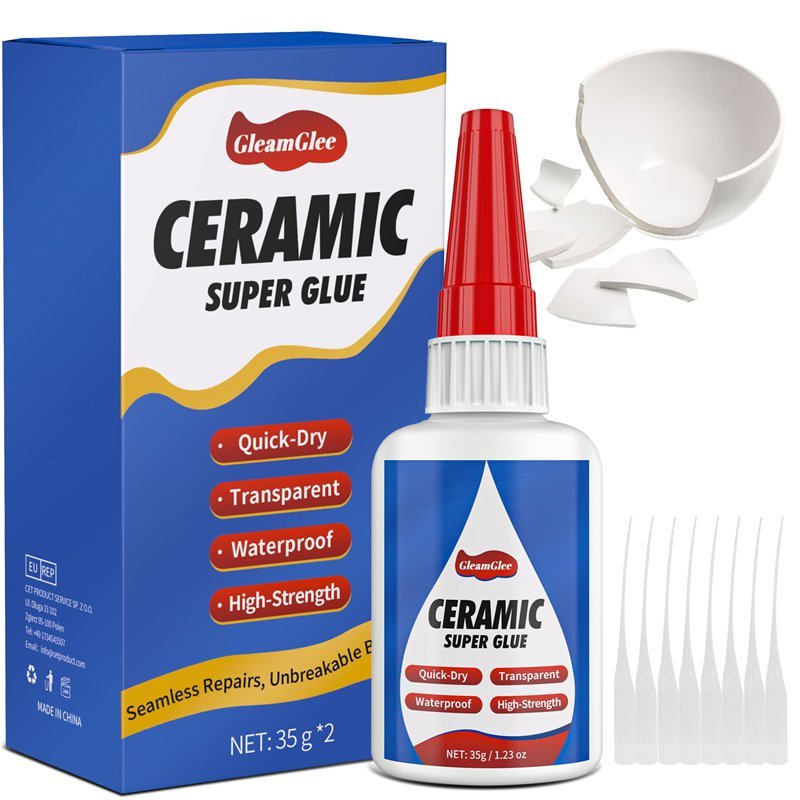
Porcelain also makes excess adhesive very visible. Glossy white surfaces reflect light, so even a small ridge of cured glue can make an otherwise accurate repair look untidy. Fine application tips are valuable because they let the user place a small, even amount along the fracture without coating the surrounding glaze. EPN ceramic glue, for example, is supplied with multiple precision nozzles intended for narrow breaks and hard-to-reach bonding areas, which is particularly useful when the visible finish matters.
Epoxy and Gap Filling
A gap changes the repair completely. When fragments no longer fit closely because a small amount of porcelain has been lost, a thin instant adhesive may run through the void without providing enough material to bridge it. Epoxy and other gap-filling systems have more body, giving them the ability to occupy irregular spaces while still bonding to the surrounding ceramic. They can also provide additional working time for complicated assemblies where several fragments must be positioned before the adhesive sets.
The simplest way to choose between the two approaches is to look at what the adhesive is being asked to do. If the two broken surfaces already touch, the adhesive mainly needs to bond them. If the surfaces cannot touch, the repair material also needs to fill space. These are different jobs, and trying to solve both with one thin adhesive can produce a thick, uneven seam that looks poor and may not distribute stress effectively.
| Porcelain damage | Typical adhesive approach | Main reason | Practical priority |
|---|---|---|---|
| Clean handle break | Precision ceramic adhesive | Tight surface contact | Alignment |
| Two matching bowl pieces | Ceramic adhesive | Thin bond line | Accurate fit |
| Small missing chip | Gap-filling repair material | Replaces limited missing volume | Shape restoration |
| Uneven old fracture | Epoxy-type system | Better gap tolerance | Working time |
| Small decorative detail | Clear precision adhesive | Minimal visible residue | Appearance |
| Several fragments | Controlled-setting system | Allows positioning sequence | Stability |
No adhesive should be expected to recreate a large missing piece of porcelain by itself. If the damage involves a substantial loss of material, an important antique, or an area that must carry significant mechanical load, a restoration compound or professional ceramic repair service may be more appropriate than increasing the amount of ordinary glue.
Strength Is Only One Requirement
The phrase “strong ceramic glue” sounds reassuring, but strength is only one part of a successful tableware repair. A mug handle experiences leverage each time the cup is lifted. A bowl experiences washing, stacking, utensils, warm foods, and occasional impacts against other dishes. A decorative porcelain figurine may experience almost none of those stresses. The adhesive that works perfectly for one application can therefore be unsuitable for another even though the underlying material is still porcelain.
Water resistance also needs context. Occasional contact with water is not the same as repeated exposure to detergent and hot washing cycles. Heat resistance has the same limitation. An adhesive that remains stable near a warm surface may not automatically be appropriate for repeated cycles involving hot coffee, tea, soup, and cooling back to room temperature. Product documentation should always be read in relation to the conditions the repaired item will actually experience.
Appearance is another practical requirement. A transparent or nearly invisible bond is valuable on porcelain because repair lines are easy to notice against white or highly glazed surfaces. For decorative pieces, appearance may be the primary concern, while a mug handle requires both visual cleanliness and mechanical stability. Choosing well means balancing these needs instead of selecting a product from a single strength claim.
Which Features Matter Most?
A useful ceramic repair adhesive should be easy to control, stable after curing, suitable for porcelain, and packaged in a way that supports accurate application. Fine nozzles help prevent flooding the repair area, while a resealable anti-clog cap makes the remaining adhesive easier to store for future repairs. A clear cured finish reduces the visual impact of the joint, especially on white porcelain cups, bowls, figurines, ornaments, and decorative dishes.
Fast initial bonding can also make small repairs easier because the user does not need to hold two pieces in position for a long period. The EPN ceramic adhesive configuration described for this application uses a fine-tip system and an initial pressing step of approximately 5–10 seconds. That is useful when aligning small fragments, but the pressing period must not be confused with full curing. An object that no longer moves can still require considerably more time before the adhesive reaches the performance intended for normal use.
The best way to judge these features is to imagine the actual repair process. Can the nozzle reach the narrow fracture? Can you control the amount being applied? Will the repair remain visible after curing? Can the cap be resealed without clogging? Does the technical information match the moisture, temperature, and load the item will face? These practical details often determine whether a repair feels clean and professional rather than improvised.

Which Porcelain Damage Can Ceramic Glue Repair?
Ceramic glue can repair many detached handles, clean fractures, snapped porcelain fragments, decorative pieces, and certain stable cracks when the broken surfaces still provide enough bonding area. Large missing sections, unstable structural cracks, damaged drinking rims, and fractures that directly affect food-contact areas require more caution. Some objects are better restored for decoration than returned to demanding daily use.
Broken Cup Handles
A detached cup handle is one of the most common porcelain repairs and one of the easiest to underestimate. The pieces often fit together perfectly, so the repair seems simple. Once the cup is in use, however, the handle becomes a load-bearing part. A typical household mug may hold roughly 250–450 mL of liquid, meaning the drink alone can add approximately 250–450 grams before the weight of the porcelain cup is included. That load is concentrated through two relatively small attachment points every time the mug is lifted.
For this reason, both handle joints should be checked before adhesive is applied. Place the handle against the cup and confirm that the upper and lower fractures meet naturally at the same time. If one side touches while the other leaves a wide gap, forcing the handle into position can introduce internal stress. A thick layer of glue may hide the mismatch temporarily but does not recreate the original ceramic structure.
After bonding, the handle should remain supported during the required cure period. The fact that an adhesive grabs within seconds does not mean the repaired mug is ready to carry a full drink. Once curing is complete, inspect both attachment points under good lighting before normal use. Any visible movement, separation, new cracking, or unstable alignment is a reason to stop relying on the handle as a structural lifting point.
Cracks in Bowls
Cracks are more difficult to evaluate than complete breaks because their true depth is often hidden beneath the glaze. A hairline crack that appears to be only a few centimeters long may extend farther through the ceramic body than it appears from the surface. If gentle handling causes the crack to open or move, the bowl has already lost a meaningful amount of structural stability and should not be treated as a simple cosmetic repair.
Location matters just as much as crack size. A short exterior crack near the bottom of a decorative bowl presents a different situation from a crack that crosses the interior where soup, sauces, or other foods sit. Interior fractures can repeatedly encounter moisture, detergent, temperature changes, and food residue. Even if the adhesive itself resists water, the repaired area still needs to be evaluated for hygiene, cleaning access, and the exact type of contact the product documentation permits.
For sentimental bowls, stabilization for display may be the most sensible result. There is no rule that says every successful repair must return an object to its original function. Preserving the bowl without exposing the joint to repeated food contact, washing, and stacking can give the item a long second life while placing far less stress on the repair.
Chips and Missing Fragments
A chipped piece is relatively straightforward when the missing fragment has been saved. If it fits accurately back into the original opening, it can often be treated like a small fracture and bonded with a precision ceramic adhesive. The challenge becomes greater when the fragment is lost because the repair now needs to recreate missing shape as well as provide adhesion.
The importance of the missing material depends heavily on where it is located. A tiny chip on the underside of a decorative dish may have little effect on function. A chip on the rim of a drinking cup is more significant because it can leave a sharp edge and may sit directly against the lips. A missing piece near a mug handle attachment is also more serious because it reduces the surface area available to support mechanical load.
A practical decision can be made by asking whether the original fragment exists, whether the damage is structural, and whether the area will touch food or the mouth. Clean fragments can often be reattached. Small missing areas may require a compatible filling compound. Large losses, damaged rims, or valuable porcelain deserve a more conservative restoration approach.
When Repair Is Not the Best Choice
Some objects can technically be glued but still should not return to their original use. A severely cracked bowl base, a mug with multiple fractures around the handle, a sharp drinking rim, or a piece that has already failed through several previous adhesive repairs may not offer enough sound ceramic surface for another reliable bond. Repeatedly layering new adhesive over old cured glue can actually make the repair more difficult because the new product may no longer be bonding directly to porcelain.
Antiques and collectible porcelain require extra consideration. Household adhesives are designed for practical bonding, while professional conservators may use materials chosen for reversibility, color matching, aging behavior, and preservation of historical value. A rare piece may lose value if an inappropriate adhesive leaves staining, thick residue, or an irreversible seam.
For ordinary sentimental items, changing the purpose is often an excellent compromise. A retired mug can become a pen cup, brush holder, small planter, or decorative keepsake. A repaired bowl can hold wrapped objects, keys, or ornaments instead of food. The repair still succeeds by preserving something meaningful without forcing the adhesive to perform in conditions that are no longer appropriate.
How Do You Repair a Porcelain Cup or Bowl?
Repairing porcelain begins with cleaning, complete drying, and test-fitting every fragment before adhesive is applied. Use a thin, controlled layer on the intended bonding surfaces, align the pieces accurately, and stabilize them so the joint cannot move during curing. Remove excess adhesive carefully, then wait for the full cure specified by the product before exposing the repair to weight, water, heat, washing, or routine use.
Prepare Before Applying Glue
Good preparation prevents many repair failures that are incorrectly blamed on weak adhesive. Kitchen porcelain can carry invisible contamination from cooking oils, hand cream, detergent, dust, and moisture. If the adhesive bonds to this residue rather than directly to the ceramic surface, the joint may fail even though the same product performs well on properly prepared porcelain.
Collect every fragment before starting and inspect the break for loose particles. The surfaces should be cleaned using a method compatible with the porcelain finish and the adhesive instructions, then allowed to dry completely. Moisture trapped in a narrow fracture can be difficult to see, so giving the pieces enough drying time is more reliable than judging only by appearance.
A dry fit should always come next. Assemble the pieces without glue to verify that they match and to learn the correct positioning sequence. This is particularly important for a bowl broken into several sections, because the wrong first fragment can block the placement of the next one. A mug handle should meet correctly at both attachment points before adhesive is introduced.
A simple repair routine is easier to follow when everything is prepared in advance:
- Collect every fragment.
- Protect the work surface.
- Remove loose ceramic particles.
- Clean the bonding area.
- Allow the surfaces to dry fully.
- Test-fit the complete repair.
- Plan the assembly sequence.
- Prepare tape or soft supports before applying glue.
Apply a Controlled Amount
Closely fitting porcelain usually needs a controlled adhesive film rather than a thick bead. Excess glue can squeeze onto the glazed surface, make the pieces slide out of alignment, and leave an obvious cured ridge around the joint. On a visible white mug or bowl, even a small amount of unnecessary squeeze-out can make a repair look much more noticeable.
Fine-tip applicators make dosage easier to control. The EPN ceramic glue configuration intended for precision repairs includes four narrow nozzles in a standard pack and eight nozzles in a two-pack configuration. These are particularly useful around cup handles, narrow bowl fractures, porcelain figurines, small ornaments, mosaic pieces, and joints located in corners where a wide bottle opening would release too much adhesive.
Once an even layer has been applied, the pieces should be brought together in their correct position and pressed firmly. For the referenced fast-setting formulation, approximately 5–10 seconds of firm pressure is used during the initial bonding step. The pieces may begin to stay together quickly, but the object still needs to remain undisturbed for the curing period given in the exact product instructions.
Align and Stabilize
The original fracture usually provides the best alignment guide. Porcelain edges often interlock like puzzle pieces, making it possible to feel when the fragment has returned to its natural position. Repeatedly sliding the pieces after they contact the adhesive can disturb the bond layer and spread glue across the visible glaze, so aim to position each part accurately from the beginning.
Angled pieces such as mug handles often need temporary support. Low-tack tape can hold the part in place when used carefully, while folded cloth, foam, or another padded object can support an awkward bowl or decorative piece. The purpose of this support is not to compress the porcelain aggressively. Porcelain is brittle, and excessive clamping can introduce another fracture.
Any visible squeeze-out should be handled according to the adhesive manufacturer’s cleanup instructions. Avoid aggressive scraping with metal blades on glazed surfaces unless you know the finish can tolerate it. Protecting the surrounding porcelain is especially important on glossy white pieces where scratches can become more noticeable than the original repair line.
Respect Cure Time
Adhesive cure is a process rather than a single moment. Fast-setting products may reach initial grab quickly, but that stage only means the pieces have stopped moving under light pressure. Handling strength develops later, while full cure represents the point at which the adhesive reaches the performance level described by the manufacturer. The exact timing varies with formulation, temperature, humidity, bond thickness, surface condition, and amount of adhesive.
| Cure stage | What is happening | Appropriate action |
|---|---|---|
| Initial grab | Pieces stop sliding | Continue supporting the joint |
| Early handling | Joint tolerates limited movement | Avoid load, washing, and heat |
| Functional cure | Bond develops meaningful strength | Follow product-specific instructions |
| Full cure | Adhesive reaches stated final performance | Resume only permitted uses |
One of the easiest ways to damage a repair is to test it too soon. A mug handle can feel solid before the joint is ready to support a full cup, and a bowl can appear stable before the adhesive is ready for water exposure. Allowing the full specified cure costs nothing and gives the repair its best chance of reaching the performance the formulation was designed to provide.

Is a Glued Cup or Bowl Safe to Use?
A glued porcelain item is not automatically suitable for its original tableware use simply because the joint is strong. Food-contact status, temperature exposure, washing conditions, mechanical stability, and the location of the repair must be evaluated separately. Exterior repairs may present different requirements from joints on the drinking rim or inside surfaces that directly contact food, beverages, detergent, and repeated heat.
Food Contact Needs Separate Verification
The term ceramic glue describes the material an adhesive is intended to bond; it does not automatically establish that the product is approved for direct contact with food. This distinction is especially important because a mug handle repaired entirely on the exterior presents a different exposure scenario from a glue line inside a bowl or across a drinking rim.
Before returning any repaired tableware to food use, check the documentation for the exact adhesive rather than relying on general descriptions such as waterproof, heat resistant, or suitable for kitchen repairs. Those characteristics can be valuable, but they answer different questions. A product can resist water without being documented for direct food contact, just as a product can tolerate elevated temperatures without being suitable for every microwave or dishwasher environment.
The repaired surface itself also needs consideration. Even when an adhesive is suitable for a given use, a deep irregular crack can create an area that is difficult to clean thoroughly. Hygiene depends not only on the chemistry of the adhesive but also on whether food residue and moisture can accumulate around the repaired seam.
Hot Drinks and Hot Food
Hot coffee, tea, and soup expose repaired porcelain to repeated temperature changes rather than one constant temperature. A mug may begin at approximately room temperature, receive hot liquid, remain warm for twenty or thirty minutes, and then cool again. Repeating that process creates thermal cycling across both the porcelain and the adhesive joint.
A cup handle adds mechanical stress at the same time. A 350 mL drink contributes roughly 350 grams of liquid weight, and the porcelain mug itself adds more. Every time the cup is lifted by its handle, that combined load is transferred through the repaired attachment points. A joint that has not completed its cure or does not have enough sound bonding area can therefore face both thermal and mechanical stress during normal use.
Heat resistance should always be interpreted through documented conditions rather than as an unlimited claim. The exact adhesive instructions should be checked against the expected use. If the suitability of a repaired handle is uncertain, lifting the mug while supporting its base is more sensible than testing the joint with a full cup of hot liquid.
Dishwasher and Microwave Use
Waterproof and dishwasher-safe are not interchangeable terms. A dishwasher exposes tableware to a combination of hot water, cleaning chemicals, repeated spray impact, prolonged moisture, drying heat, and numerous heating and cooling cycles. That environment is significantly more demanding than an occasional rinse or careful hand wash.
Microwave use introduces another separate consideration. Even if the porcelain cup or bowl was microwave safe before it broke, the repaired object now contains an additional material. A general heat-resistance statement does not automatically establish microwave suitability. Users should look for explicit guidance for that exposure rather than extrapolating from a different performance claim.
| Intended post-repair use | Main property to verify | Additional concern |
|---|---|---|
| Decorative display | Structural stability | Minimal handling |
| Exterior mug handle | Load resistance | Full cure |
| Hand washing | Water resistance | Detergent exposure |
| Dishwasher | Dishwasher-specific suitability | Repeated thermal cycles |
| Hot drinks or food | Temperature suitability | Structural stability |
| Direct food contact | Documented contact suitability | Hygiene of joint |
| Microwave | Explicit microwave guidance | Repeated heating |
When documentation does not clearly cover a demanding exposure, a more conservative use is preferable. The safest repair decisions come from treating every property as a separate requirement rather than assuming one confirmed characteristic proves all the others.
Structural Safety Still Matters
Even a chemically suitable adhesive cannot make damaged porcelain structurally sound if the remaining ceramic provides too little bonding area. Mug handles are a good example. A small clean break can provide a surprisingly good repair surface, while a handle with crushed attachment points may leave very little intact porcelain for the adhesive to bond.
Drinking rims also deserve caution because a repaired fragment can leave a sharp edge even when it appears firmly attached. Bowls with several connected cracks may suddenly fail when filled or stacked. Inspect repaired items in strong light and look for movement, new hairline fractures, separation at the edges, or areas where the broken pieces no longer sit flush.
If any of these warning signs appear, stop using the object in demanding service. Moving it to decorative or low-stress use is not an admission that the repair failed. It is simply matching the repaired object to conditions that the remaining structure can reasonably support.
How Do You Make a Porcelain Repair Last?
A durable porcelain repair relies on clean surfaces, good fracture fit, suitable adhesive, accurate alignment, stable curing, and realistic care afterward. Many early failures occur because contaminated porcelain was bonded, the joint moved before curing, a thin adhesive was expected to fill a wide gap, or the repaired item was exposed to weight, heat, water, or washing sooner than the product instructions permitted.
Avoid the Most Common Failures
Surface contamination is one of the most common causes of disappointing adhesive performance. Cooking oil, skin oils, cleaning-product residue, moisture, and fine ceramic dust can all interfere with direct contact between the adhesive and the porcelain. The fracture may look clean while still carrying enough contamination to create a weak boundary layer.
Misalignment creates another predictable problem. If two porcelain surfaces only touch along part of the fracture, the load is concentrated in a smaller area. Users sometimes attempt to compensate by adding a thick pool of glue, but this may make the pieces sit even farther apart and can create an unattractive bond line.
Most common mistakes are preventable:
- Applying adhesive to damp porcelain.
- Skipping the dry fit.
- Leaving loose ceramic dust on the fracture.
- Using more adhesive than the joint requires.
- Moving the pieces during curing.
- Loading a repaired handle prematurely.
- Using thin adhesive to bridge a large void.
- Washing before the specified cure.
- Exposing the repair beyond documented conditions.
- Applying fresh adhesive directly over a failed layer of old glue.
Better preparation often contributes more to the final result than simply choosing a product with a more dramatic strength claim. Adhesive performance depends on the entire repair system, including the quality of the surfaces it is actually bonding.
Control Mechanical Stress
A repaired porcelain object should be handled with an awareness of where the joint is located. Avoid stacking heavy dishes directly across a repaired crack and do not drop metal utensils into a bowl that has already experienced structural damage. Large serving dishes are better supported from underneath instead of lifted from a repaired edge or decorative feature.
Mug handles deserve periodic attention because they repeatedly carry load away from the body of the cup. Check both attachment points occasionally, especially during the first weeks of use. A slight opening around one edge can be an early sign that the joint or nearby porcelain is under stress.
Sudden temperature changes can add another form of stress. Moving an item from a cold environment directly into contact with very hot liquid creates a more abrupt thermal change than gradual warming. If the adhesive documentation specifies temperature limitations, those values should guide use. General terms such as durable or heat resistant should never replace the specific conditions given for the formulation.
Clean Repaired Items Carefully
Cleaning should be based on what has actually been verified for the adhesive. If repeated dishwasher exposure is not specifically supported, careful hand cleaning provides a less demanding environment. This does not mean every repaired item must be treated as extremely fragile; it simply avoids combining prolonged heat, detergent, spray pressure, and repeated thermal cycling without evidence that the adhesive is intended for those conditions.
Avoid unnecessary soaking around the joint and inspect the repair after cleaning during its early period of use. Whitening, softening, edge lifting, or new separation can indicate that the repair is experiencing conditions it does not tolerate well. A repaired handle that begins to move should no longer be relied on to lift the cup.
Decorative objects generally require much less care because they experience lower mechanical and moisture exposure. A repaired figurine, vase, ornament, or collectible can often remain stable for a long time with ordinary dusting and careful handling, even though the same adhesive joint might face much greater challenges on frequently washed tableware.
Know When to Stop Using It
Repeated repair attempts are not always productive. If a joint fails several times, adding another layer of adhesive without removing incompatible residue can reduce the amount of original porcelain available for bonding. An old, uneven adhesive layer can also prevent the pieces from returning to their correct alignment.
Visible crack growth, repeated movement, sharp edges, unstable handles, or separation around an interior repair are all reasons to reassess the object. An item that has sentimental value can still be preserved without being used for its original purpose. Cups can become desk organizers or planters, while repaired bowls can hold keys, decorative items, or wrapped objects.
This approach is particularly sensible when a piece has survived for many years and preserving it matters more than continuing to expose it to hot liquids, utensils, repeated washing, or heavy stacking. A repair should extend the useful life of an object in a way that makes sense rather than forcing the adhesive to solve every limitation created by the original break.
What Should You Look for in a Ceramic Glue Supplier?
A reliable ceramic glue supplier should demonstrate more than attractive pricing or a strong sample. Commercial customers should examine formulation capability, porcelain compatibility testing, batch consistency, application packaging, filling control, technical documentation, regulatory labeling support, production scalability, customization, and international logistics. Suppliers that coordinate formulation, packaging, printing, and production within one system can usually solve development problems more efficiently.
Testing and Quality Control
For commercial production, ceramic glue should be evaluated as a finished system rather than only as a liquid formula. An adhesive can bond porcelain effectively while still creating a poor customer experience if the bottle leaks, the precision nozzle dispenses inconsistently, the cap clogs during storage, or the formula changes noticeably between production batches.
Quality evaluation can therefore include porcelain bonding tests, package compatibility, filling accuracy, nozzle control, cap performance, storage stability, leakage inspection, and selected environmental or aging checks appropriate to the intended product claims. For formulations marketed as multi-material adhesives, compatibility may also be evaluated on materials such as glass, metal, wood, selected plastics, rubber, PVC, or concrete.
Consistency is particularly important for retailers and private-label brands. A good laboratory sample is only the beginning. The formula that reaches customers six months later should provide the same application behavior and packaging performance as the sample that was originally approved.
The manufacturing system supporting EPN ceramic adhesive includes more than 25 chemists, material specialists, and process engineers working with adhesive formulation and application testing. This type of technical capacity is most valuable when it is used to solve real product issues such as viscosity, substrate compatibility, packaging interaction, curing behavior, and repeatability rather than simply to produce a long list of claims.
Formula and Packaging Options
Different sales channels often need different ceramic glue configurations. A craft-oriented product may prioritize fine precision tips and a small bottle for detailed repairs. A hardware retailer may prefer larger capacity and stronger shelf presence. An online marketplace seller may focus on leak prevention, compact cartons, lightweight accessories, and packaging that can tolerate parcel distribution.
Customization can therefore cover more than the logo on the label. Depending on the project, suppliers may work with bottle or tube volume, viscosity, dispensing behavior, nozzle design, cap structure, carton size, bundled accessories, instructions, language, graphic design, and target application positioning. Existing formulas usually allow faster development, while substantial formulation changes require additional evaluation before production.
A low-volume validation stage can be particularly helpful for new brands. Selected private-label programs in the current manufacturing system can begin from approximately 200 units, depending on the final formulation and packaging configuration. This gives smaller retailers and online brands an opportunity to test positioning and customer response before committing to much larger orders.
Packaging should also be designed around how people actually use ceramic glue. Fine tips reduce waste during small repairs, anti-clog closures improve storage, and clear instructions reduce application mistakes. These details can have a direct effect on reviews and repeat purchasing even though they do not change the core chemistry.
Production and Development Capacity
Production capacity matters because successful adhesive products often scale quickly. A supplier that can make a few hundred good samples but cannot reproduce the same formula, bottle, nozzle, label, and filling standard at larger volume may create expensive problems once retail demand increases.
Integrated production can shorten the chain between formula development, packaging selection, label changes, filling, assembly, and shipment preparation. The manufacturing structure supporting this ceramic glue program includes dedicated chemical processing, packaging-material production, printing resources, raw-material support, and automated filling and assembly capabilities.
| Capability | Program reference | Practical value |
|---|---|---|
| Technical R&D team | 25+ specialists | Formulation and testing support |
| Design team | 18+ professionals | Packaging and multilingual artwork |
| Selected customization MOQ | From about 200 units | Market testing flexibility |
| Fast artwork preparation | About 2 days for suitable projects | Shorter launch preparation |
| Typical sample development | About 7–14 days | Pre-production evaluation |
| Standard bulk production | Around 20 days | Planning consistency |
| Expedited production | Around 15 days where feasible | Promotion or launch support |
| Broader annual capacity | 12+ million units | Scalable supply |
| Packaging mold resources | 3,000+ | Wider container selection |
Actual lead times depend on formulation, packaging, order quantity, artwork approval, raw-material availability, and destination requirements. Capacity figures are most useful when treated as planning references rather than automatic guarantees for every project.
Compliance and Supply Reliability
International adhesive sales require careful attention to technical documentation and labeling because requirements vary according to formulation and destination. Depending on the product, market, and hazard classification, relevant materials may include SDS documentation, GHS hazard communication, EU CLP labeling, REACH-related information, multilingual instructions, UFI information where applicable, and appropriate quality-management records.
A reliable supplier should be able to explain which requirements actually apply instead of adding unrelated compliance logos to make a package appear more impressive. This is particularly important for retailers selling into several markets because label text, language, hazard communication, and packaging information may need to change from one country to another.
Supply reliability should be evaluated at the same time. Ask how the supplier controls raw materials, manages peak-season orders, verifies finished batches, stores packaging components, and supports international shipment. Overseas warehousing, FBA-ready packaging, and established logistics relationships can reduce complexity for brands selling into North America and Europe, but those services work best when they are coordinated with the production plan from the beginning.
For long-term ceramic adhesive programs, the strongest manufacturing relationships usually come from suppliers that can solve chemistry, packaging, quality, regulatory, and logistics questions as parts of one connected product rather than treating each issue as somebody else’s responsibility.

Conclusion
Repairing porcelain successfully is less about finding the most dramatic strength claim and more about matching the adhesive to the real break. Clean, tightly fitting fragments usually need accurate application and a thin bond line. Missing material may require a filling system. Handles introduce mechanical load, while bowls and cups can bring moisture, heat, washing, and possible food-contact considerations into the decision. Each of these conditions deserves to be evaluated separately.
Good preparation makes a major difference. Clean and dry the fracture, perform a complete dry fit, apply only the amount of adhesive needed, align the pieces carefully, and give the joint enough time to complete its cure. A fast initial grab can make the work convenient, but patience after bonding remains one of the simplest ways to improve long-term reliability.
The same principles apply whether you are repairing one favorite mug at home or developing a ceramic glue product for thousands of customers. Reliable results come from realistic material testing, accurate application, stable packaging, clear instructions, and claims that match actual use. When those pieces come together, broken porcelain cups, bowls, figurines, ornaments, and decorative ceramics have a much better chance of gaining a useful second life rather than going straight into the trash.

Frequently Asked Questions
What is the best glue for a broken porcelain cup?
The best glue depends on the type of fracture. A clean break where both porcelain surfaces fit closely is usually well suited to a precision ceramic adhesive that creates a thin, controlled bond line. If porcelain is missing or the joint contains a noticeable gap, an epoxy or gap-filling repair material may be more suitable. Always consider the location of the repair, expected load, water exposure, temperature, curing requirements, and intended tableware use rather than selecting only by advertised strength.
Can ceramic glue repair a porcelain mug handle?
A ceramic adhesive can repair many cleanly broken porcelain mug handles when both attachment points remain intact and fit accurately. The handle should be test-fitted before adhesive is applied, supported carefully during curing, and left for the complete cure specified by the manufacturer before carrying weight. Remember that a filled mug can add several hundred grams of liquid load, so a handle that feels firm shortly after bonding should not automatically be treated as ready for normal lifting.
Can I use ceramic glue inside a porcelain bowl?
Using adhesive inside a bowl requires more consideration than repairing an exterior decorative area because the repaired joint may contact food, water, detergent, heat, and repeated cleaning. Do not assume that ceramic compatibility, water resistance, or heat resistance automatically means the product is suitable for direct food contact. Check the exact manufacturer’s documentation for the intended contact type and consider whether the repaired crack can still be cleaned hygienically before returning the bowl to food service.
Is ceramic glue waterproof after curing?
Some ceramic adhesives are formulated to resist water after proper curing, but the level of resistance varies by formulation and intended use. Water resistance should not automatically be interpreted as dishwasher suitability, prolonged immersion resistance, or approval for repeated exposure to hot detergent cycles. Allow the full specified cure before water exposure and check whether the exact product documentation covers hand washing, outdoor moisture, immersion, or other conditions relevant to the repaired porcelain item.
How long does ceramic glue take to cure?
Cure time depends on the chemistry of the adhesive, bond thickness, surface condition, temperature, and humidity. Fast-setting ceramic adhesives may achieve initial grab within seconds, which helps keep closely fitting fragments aligned, but final strength develops later. For the precision ceramic glue configuration discussed here, approximately 5–10 seconds of pressing is used for the initial bonding step. That should not be treated as the full cure time, so always follow the instructions supplied with the exact formulation.
Can repaired porcelain go in the dishwasher?
A repaired porcelain item should only go in the dishwasher when the adhesive manufacturer specifically supports that type of exposure. Dishwasher conditions combine hot water, detergent, sustained moisture, spray pressure, drying heat, and repeated thermal cycling, making them more demanding than ordinary hand washing. A product described as waterproof or heat resistant does not automatically meet all of those conditions. When dishwasher suitability is unclear, careful hand cleaning is the more conservative approach.
Can you repair a porcelain bowl with missing pieces?
A porcelain bowl can sometimes be restored when small pieces are missing, but the repair usually requires more than a thin bonding adhesive. If the original fragment is available and fits closely, it may be reattached with a suitable ceramic adhesive. If material has been lost, a compatible gap-filling or restoration compound may be necessary to rebuild the missing area. Large structural losses, damaged food-contact surfaces, valuable antiques, or unstable fractures are often better handled through professional restoration.
Share:
Table of Contents
Here, creating your adhesives glue & removal cleaner collection is no longer a barrier—it’s a collaborative journey where GleamGlee helps brands and businesses transform their vision into durable, certified, and market-ready solutions.
Partner with GleamGlee
Join hundreds of global partners who trust GleamGlee for adhesives and cleaners that combine innovation, compliance, and speed. Our vertically integrated system—from R&D to warehouse—guarantees consistent performance and reliable delivery.
Whether you’re sourcing FBA-ready stock or developing your own formula, our team provides unmatched technical support and responsive service.