 Skip to content
Bonding PVC pipes looks easy until a joint leaks after water pressure returns, a pool pipe drips at the fitting, or a repair patch lifts from a curved PVC surface. Most failed PVC jobs are not caused by weak hands or lack of tools. They usually happen because the pipe was cut roughly, the surface was damp, the wrong glue was used, or the repair was tested too soon. A clean PVC bond depends on material match, surface preparation, even adhesive coverage, firm pressure, and enough waiting time.
To bond PVC pipes quickly and safely, choose the correct PVC cement or PVC repair adhesive, cut the pipe square, remove burrs, clean and dry the bonding area, apply primer when required, spread glue evenly, push the parts together fully, hold the joint in place, and allow proper cure time before water, air, or pressure testing.
The smart way to work fast is not to skip steps. It is to prepare every step before opening the glue. Once PVC cement or adhesive touches the surface, the working time becomes short. A homeowner fixing a garden pipe before sunset, a pool owner sealing a leaking line, or a camper repairing PVC gear before a trip all need the same thing: a repair that works the first time, without messy glue marks, repeat leaks, or wasted material.
What Is Bond PVC Pipes?
Bond PVC pipes means making two PVC surfaces join tightly enough to stop water, air, or liquid from leaking through the connection. In rigid pipe work, this usually happens between a PVC pipe and a PVC fitting. The pipe slides into the socket, adhesive covers the contact area, and the joint becomes sealed after setting and curing. In flexible PVC repair, the goal is different: the adhesive must seal a hole, crack, or tear while still allowing the material to bend.
A strong PVC bond is not created by glue alone. It comes from the full repair process: correct product choice, clean surface, dry material, even adhesive coverage, firm pressure, and enough waiting time. A small 1 mm pinhole on an air mattress, a 3 cm crack on a pool float, and a rigid pipe joint under water pressure all need different repair thinking. The wrong method may look fine in the first hour but fail after inflation, water flow, sunlight, or repeated movement.
The easiest way to understand PVC bonding is to separate it into two common jobs: pipe joining and surface repair. Pipe joining needs a tight pipe-to-fitting connection. Surface repair needs a patch that covers the damaged zone with extra edge space. For air-holding or water-holding PVC items, the repair should usually extend beyond the hole by at least 1–2 cm on all sides when space allows. Larger tears need wider patch coverage because pressure concentrates at the repair edge.
| PVC Bonding Job | Common Item | Main Goal | Key Detail |
|---|---|---|---|
| Rigid pipe joining | Plumbing pipe, drain pipe, pool pipe | Seal pipe and fitting | Full socket contact |
| Small leak repair | Air bed, pool float, swim ring | Stop slow air loss | Patch larger than hole |
| Tear repair | Kayak, inflatable pool, camping mat | Seal and reinforce damage | Wide patch edge coverage |
| Outdoor repair | SUP board, boat, pool toy | Resist water and sunlight | Flexible waterproof bond |
| Seam repair | Inflatable sofa, bounce house | Stop edge leakage | Careful cleaning and pressing |
Bond PVC Pipes Basics
Bond PVC pipes basics are built on contact area, surface condition, glue control, and cure time. A PVC repair is strongest when the adhesive touches clean PVC directly and the two surfaces stay still while the bond develops. More glue does not automatically mean more strength. If the repair area is dirty, damp, oily, or loosely fitted, extra adhesive may only create a thick messy layer that cures poorly. For rigid pipe, the pipe must sit deep enough inside the fitting. For flexible PVC, the patch must cover the damage with enough edge space to hold against air pressure, water pressure, bending, and pulling.
Key points to remember:
- Cut rigid PVC pipe square so the pipe sits evenly inside the fitting.
- Remove burrs because rough plastic edges can scrape away adhesive.
- Clean beyond the repair area, not only directly on the hole.
- Keep flexible PVC flat and relaxed while the patch cures.
- Use a thin, even glue layer instead of heavy puddles.
- Wait longer for repairs that hold air, water, weight, or outdoor stress.
A simple size guide helps with patch planning:
| Damage Size | Suggested Patch Coverage | Why It Helps |
|---|---|---|
| Pinpoint hole | At least 2–3 cm patch diameter | Gives enough sealed edge area |
| 1 cm crack | Patch extends 1–2 cm past both ends | Reduces stress at crack tips |
| 3–5 cm tear | Larger rectangular patch | Spreads pulling force |
| Seam leak | Patch follows seam line with extra width | Helps prevent edge lifting |
Bond PVC Pipes vs Glue
Bond PVC pipes and “PVC glue” are often used as everyday wording, but they do not always mean the same product or same method. Rigid PVC pipe bonding usually uses PVC cement, which is made for pipe-and-fitting joints. It works best when the pipe fits tightly into the socket and the adhesive covers both surfaces evenly. Flexible PVC repair glue is different. It is used more often with patches on air mattresses, pool floats, kayaks, inflatable pools, camping mats, and similar items. It needs to stay flexible after curing because these products bend, stretch slightly, inflate, deflate, and move during use.
Important differences:
- PVC cement is mainly for hard PVC pipe and fittings.
- Flexible PVC glue is better for soft PVC, vinyl-like surfaces, rubberized PVC, and inflatables.
- Rigid pipe joints rely on socket depth and full contact.
- Patch repairs rely on patch size, edge sealing, and surface flexibility.
- A hard-drying glue can crack on flexible PVC.
- A flexible repair adhesive may not be suitable for certified pressure pipe systems.
A practical comparison:
| Item Being Fixed | Better Bonding Choice | Main Reason |
|---|---|---|
| PVC plumbing pipe | PVC pipe cement | Needs firm socket joint |
| Pool pump pipe | Pipe-rated PVC cement | Must handle water flow and pressure |
| Air mattress | Flexible PVC glue + patch | Needs airtight flexible seal |
| Inflatable kayak | Waterproof flexible adhesive | Faces water and bending |
| Pool float | Clear patch + PVC glue | Needs clean appearance and flexibility |
| Bounce house | Strong patch repair glue | Needs impact and tear resistance |
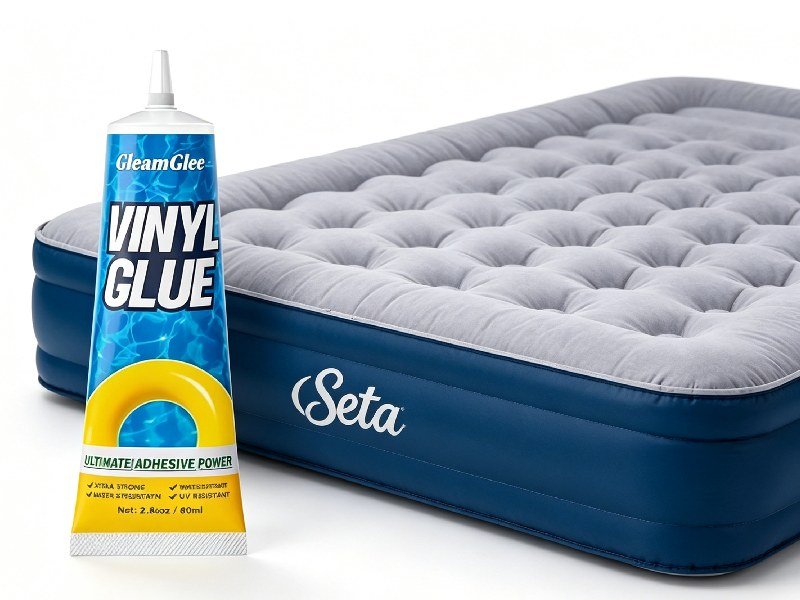
GleamGlee PVC glue fits the flexible repair side especially well. Its 80 ml glue, multiple patch shapes, metal nozzle, rubber squeegee, and applicator are designed for small holes, cracks, larger tears, and curved repair areas where control matters.
Bond PVC Pipes Problems
Bond PVC pipes problems usually appear as leaks, lifted patch edges, loose fittings, cloudy glue marks, or repairs that fail after the first real use. The cause is often simple: the surface was not clean enough, the wrong adhesive was used, the patch was too small, the pipe moved while setting, or the repair was used before full curing. A PVC repair may look finished after a few minutes, but air pressure, water pressure, sunlight, body weight, or repeated bending can expose weak points later. Slow air loss overnight is especially common when a patch edge did not seal fully or a second small hole was missed.
Common failure signs:
- Water appears around the fitting edge after pressure returns.
- A patched air mattress loses firmness after several hours.
- Patch corners lift after inflation or folding.
- Glue turns thick and uneven around the repair.
- The bonded area feels hard and cracks when bent.
- The repair works indoors but fails outdoors after sun or water exposure.
Main causes and fixes:
| Problem | Likely Cause | Better Fix |
|---|---|---|
| Joint leaks | Pipe not fully inserted | Mark socket depth before bonding |
| Patch lifts | Patch too small or surface dirty | Clean wider area and use larger patch |
| Slow air loss | Missed second pinhole | Test surrounding area with soapy water |
| Messy repair | Too much glue | Use thin, even layer with nozzle control |
| Crack returns | Patch did not extend past crack ends | Use longer rectangular patch |
| Weak outdoor repair | Glue not waterproof or flexible | Choose waterproof flexible PVC adhesive |
For flexible PVC items, the patch edge is the most important zone. Press from the center outward with a squeegee to push air away from the repair. Keep the item deflated and still while curing. For air mattresses, inflatable pools, kayaks, SUP boards, and camping pads, allowing the bond to strengthen for 24 hours gives the repair a better chance to hold under real pressure.
Which Glue Can Bond PVC Pipes?
The glue that can bond PVC pipes depends on the PVC material, pipe structure, pressure level, and repair scene. Hard PVC pipe usually needs PVC cement because the joint must seal inside a fitting. Soft PVC, vinyl-like PVC, inflatable PVC, and rubberized PVC usually need flexible waterproof repair glue with a patch. One product should not be used for every PVC repair without checking the surface and use condition first.
The biggest mistake is choosing glue only by the word “PVC.” A rigid plumbing pipe, pool pipe, air mattress, inflatable kayak, and PVC-coated camping mat may all involve PVC, but the stress is different. A pipe joint faces socket pressure and water flow. An inflatable repair faces air pressure, bending, folding, sunlight, and edge lifting. A glue that works on a fixed pipe may become too stiff on a flexible surface. A soft repair adhesive may not be the right choice for a pressurized pipe system.
A practical choice starts with three questions: Is the PVC hard or flexible? Will the bond hold pressure, water, or air? Will the repaired area bend after curing? If the answer involves a rigid pipe and fitting, choose pipe-rated PVC cement and primer when required. If the answer involves a puncture, tear, inflatable, pool float, kayak, SUP board, or flexible PVC surface, choose a waterproof flexible PVC glue with enough patch coverage.
| PVC Item | Surface Type | Better Glue Choice | Main Repair Need |
|---|---|---|---|
| Plumbing pipe | Hard PVC | PVC cement | Tight pipe-to-fitting seal |
| Drain pipe | Hard PVC | PVC cement | Leak-free joint |
| Pool pump pipe | Hard PVC | Pipe-rated PVC cement | Water pressure resistance |
| Flexible hose | Soft PVC | Flexible PVC adhesive | Bend resistance |
| Air mattress | Inflatable PVC/vinyl | PVC glue + patch | Airtight seal |
| Pool float | Thin flexible PVC | Clear patch + PVC glue | Clean, flexible repair |
| Kayak or SUP | Outdoor PVC | Waterproof flexible glue | Water and UV resistance |
| Bounce house | Reinforced PVC fabric | Strong flexible patch glue | Tear resistance |
Bond PVC Pipes Cement
Bond PVC pipes cement is the right choice for most hard PVC pipe-and-fitting jobs. It is commonly used on plumbing pipes, drain pipes, irrigation pipes, pool system pipes, and other rigid PVC connections where the pipe slides into a fitting socket. The joint depends on close surface contact. The cement must cover the outside of the pipe and the inside of the fitting evenly, then the pipe must be pushed fully into place before the cement starts setting. This is different from patch repair because there is no large flat surface. The strength comes from socket depth, clean plastic, full adhesive coverage, and correct waiting time before water or pressure returns.
Key points:
- Use PVC cement for hard PVC pipe and matching PVC fittings.
- Check that the cement fits the pipe type and application.
- Do not use pipe cement as a thick filler for loose joints.
- Apply cement evenly to both bonding surfaces.
- Push the pipe fully into the fitting, then hold it still.
- Allow proper cure time before water or pressure testing.
A pipe cement repair should not rely on extra glue to fix poor fitting. If the pipe is too loose inside the socket, if the fitting is damaged, or if the pipe end is badly cut, the joint may still leak. The pipe should be cut square, deburred, cleaned, and dry-fitted before cement is opened. For visible pipe work, excess cement should be wiped before it hardens, because dried runs and heavy glue marks can make the repair look careless.
| Cement Use Point | Good Practice | Risk If Ignored |
|---|---|---|
| Pipe cut | Cut square | Less socket contact |
| Pipe edge | Deburr inside and outside | Burrs scrape cement away |
| Dry fit | Check socket depth first | Pipe may stop halfway |
| Cement layer | Thin, full coverage | Dry spots or messy buildup |
| Assembly | Push fully and hold | Pipe can push out |
| Cure | Wait before testing | Joint may leak under pressure |
For a small household drain repair, a clean cemented joint may be enough after the proper waiting period. For pool systems, irrigation lines, or pressure-related pipe work, the cement should be selected more carefully because water movement, pump vibration, and pressure changes place more stress on the joint. A neat joint is helpful, but a fully cured joint is more important.
Bond PVC Pipes Primer
Bond PVC pipes primer is used before cement on many rigid PVC pipe jobs. Primer helps prepare the hard plastic surface so cement can bond more effectively. It can remove light surface contamination and soften the pipe and fitting contact area before cement is applied. Primer is especially important in pressure-related pipe work, code-sensitive plumbing, pool systems, and larger pipe connections. It should be used according to the pipe cement instructions and local requirements. Primer is not a general repair liquid for every PVC item. Soft inflatables, pool floats, air mattresses, and PVC patches usually need cleaning and flexible adhesive instead of pipe primer.
Key points:
- Use primer when the pipe system or cement instructions require it.
- Apply primer to the pipe and fitting socket, not just one side.
- Apply cement soon after primer, while the surface is ready.
- Do not use primer as a shortcut for dirty or wet surfaces.
- Do not use pipe primer on soft PVC items unless the product allows it.
- Keep primer and cement containers closed when not in use.
Primer is helpful, but it cannot fix poor preparation. The pipe still needs a square cut. Burrs still need to be removed. Mud, water, heavy grease, old adhesive, and loose debris still need to be cleaned away. Primer works best as part of a complete process, not as a replacement for good surface work. If primer is applied and then left too long before cementing, the bonding surface may not perform as intended.
| Primer Question | Practical Answer |
|---|---|
| Is primer always needed? | It depends on pipe type, cement instructions, and local rules. |
| Can primer replace cleaning? | No. Heavy dirt, oil, and moisture still need removal first. |
| Can primer be used on inflatables? | Usually no. Flexible PVC repairs need compatible repair glue. |
| Should primer dry fully before cement? | Cement is usually applied while the primed surface is still ready. |
| Does primer improve weak fit? | No. A loose or damaged fitting still creates risk. |
For repair work around a sink, pool pump, garden line, or drain system, primer should be treated with the same care as cement. Work in a ventilated area, avoid skin contact, and keep it away from heat or flame. The product should be applied neatly, because excess primer can stain visible surfaces. For clean-looking pipe work, controlled application matters as much as strength.
Bond PVC Pipes Repair Glue
Bond PVC pipes repair glue is better for flexible PVC, vinyl-like surfaces, rubberized PVC, and puncture repairs where a patch is needed. This includes air mattresses, inflatable pools, pool floats, swim rings, kayaks, inflatable boats, SUP boards, camping mats, inflatable sofas, bounce houses, fishing float tubes, travel pillows, and outdoor PVC gear. These repairs are different from pipe socket joints because the surface bends, inflates, folds, or touches water after repair. The glue must stay flexible after curing, and the patch must cover more than the damaged spot. A small hole may only be 1 mm wide, but the repair area should be much larger so the patch edge can resist pressure.
Key points:
- Use flexible PVC glue for soft PVC and inflatable repairs.
- Use a patch larger than the hole, crack, or tear.
- Choose round patches for small holes and rectangular patches for longer tears.
- Clean and dry a wider area than the patch size.
- Press from the center outward to remove bubbles.
- Wait until the bond strengthens before inflation or water use.
GleamGlee PVC glue fits this type of repair well because it is designed for waterproof, flexible bonding on PVC and rubber products. The kit includes 80 ml glue, 5 blue round patches, 5 clear round patches, 5 clear rectangular patches, a rubber squeegee, and an applicator. The metal nozzle helps apply glue into small holes, seam areas, curved spots, and narrow tears without flooding the surface. The clear patches help keep the repair less visible, while the blue patches are useful where a stronger visible repair is acceptable.
| GleamGlee Kit Part | Quantity | Repair Use |
|---|---|---|
| PVC glue | 80 ml | Multiple small and medium repairs |
| Blue round patches | 5 pcs | Reinforced visible repairs |
| Clear round patches | 5 pcs | Small neat puncture repairs |
| Clear rectangular patches | 5 pcs | Longer cracks and straight tears |
| Rubber squeegee | 1 pc | Presses patch flat and removes bubbles |
| Applicator | 1 pc | Helps spread glue evenly |
| Metal nozzle | Built-in design | Controls glue on small holes and seams |
Patch choice affects repair success. For a pinhole, a round patch is often better because it has no sharp corners. For a straight tear, a rectangular patch gives longer coverage. For a curved surface, the patch should be pressed slowly so the edges do not lift. If the repaired item will hold air or water, a 24-hour cure is a safer habit because the bond has more time to strengthen before pressure begins.
Bond PVC Pipes Glue Choice
Bond PVC pipes glue choice should be based on the repair result needed, not only the material name. A product label may say PVC, but the repair may still fail if the glue dries too hard, cannot handle water, lacks patch support, or is used on a pressure system outside its purpose. The safest choice is to match the adhesive to the job: cement for rigid pipe sockets, primer where required, and flexible waterproof repair glue for soft PVC surfaces. Before buying or using glue, check whether the repair must resist pressure, air loss, water exposure, sunlight, folding, or repeated movement.
Quick selection guide:
- Hard pipe into hard fitting: use PVC cement.
- Code-sensitive or pressure pipe: use primer and pipe-rated cement when required.
- Inflatable PVC hole: use flexible PVC glue with a patch.
- Long tear: use a larger rectangular patch.
- Pool or water gear: use waterproof flexible adhesive.
- Outdoor gear: use UV-resistant and flexible repair glue.
- Visible repair: choose clear patch options.
- Tiny hole or seam leak: choose a precision nozzle.
A good glue choice reduces repeat repairs. The correct product should match the surface and the stress after repair. If an air mattress is repaired with a stiff adhesive, the patch may crack when someone lies on it. If a rigid pipe is repaired with a soft glue not made for pipe pressure, the joint may leak when water returns. If a patch is too small, air can escape around the edge even when the glue itself is strong.
| Repair Need | Better Feature to Look For | Why It Matters |
|---|---|---|
| Airtight repair | Flexible glue + wide patch | Stops slow air loss |
| Water repair | Waterproof adhesive | Prevents softening or lifting |
| Outdoor repair | UV-resistant bond | Helps against sunlight exposure |
| Small hole | Metal nozzle | Better glue control |
| Long crack | Rectangular patch | Covers crack ends |
| Clean appearance | Clear patch | Less visible finish |
| Repeated bending | Flexible cured bond | Reduces cracking |
| Multiple repairs | Larger glue capacity | Better long-term value |
For household use, one complete PVC repair kit is often more useful than a single glue tube. A full kit gives the right patch shape, pressing tool, and application control. That matters when repairing pool floats in summer, a guest air mattress before visitors arrive, a kayak before a weekend trip, or a camping mat before travel. A repair product becomes easier to trust when it helps with the full process, not just the glue step.
How to Bond PVC Pipes?
To bond PVC pipes, prepare the pipe or damaged PVC surface first, then clean, dry, apply the right adhesive, press the parts firmly, and wait long enough before testing. A strong bond is not made by squeezing out more glue. It comes from clean PVC contact, correct adhesive thickness, firm pressure, and enough curing time.
For rigid PVC pipe, the main goal is to make the pipe and fitting connect evenly inside the socket. The pipe should be cut straight, the edge should be smooth, and the fitting should not feel loose. For flexible PVC repair, the main goal is to seal a puncture, crack, or tear with glue and a patch. The patch should be larger than the damage, pressed flat, and left still while the bond strengthens.
The best repair process is simple but strict: measure before cutting, clean wider than the repair area, avoid wet surfaces, apply a thin even layer, press immediately, and do not rush the first use. A pipe joint may look finished in minutes, but a repair holding water, air, body weight, or outdoor pressure often needs much longer before real use. For flexible PVC items such as air mattresses, pool floats, kayaks, and camping mats, waiting 24 hours before full use is a safer habit.
| Bonding Stage | What to Do | Practical Detail |
|---|---|---|
| Prepare | Cut, mark, check, choose patch | Avoid poor fit and wrong patch size |
| Clean | Remove dust, oil, water, residue | Glue must touch real PVC surface |
| Apply | Use thin, even glue layer | Heavy glue can trap bubbles |
| Press | Hold pipe or patch firmly | Prevents movement and edge lifting |
| Cure | Leave still before testing | Bond strength builds over time |
| Test | Check slowly under air or water | Finds leaks before full use |
Bond PVC Pipes Prep
Bond PVC pipes prep should be finished before the glue bottle is opened. This matters because most PVC adhesives have limited working time after application. If the pipe is not cut, the fitting is not aligned, or the patch is not ready, the adhesive may start setting before the surfaces are joined properly. For rigid pipe, preparation means measuring, cutting square, deburring, dry fitting, and marking the socket depth. For flexible PVC repair, preparation means finding the leak, marking the damaged area, deflating the item, choosing the right patch, and keeping the repair surface relaxed. Good prep makes the gluing step faster and reduces the chance of crooked joints, lifted patch edges, or repeated leaks.
Key prep points:
- Mark rigid pipe insertion depth before applying cement.
- Cut PVC pipe as square as possible, not at an angle.
- Remove burrs from inside and outside pipe edges.
- Dry-fit pipe and fitting to check alignment first.
- Deflate air-filled PVC items before patching.
- Choose the patch shape before glue application.
For flexible PVC, patch size is one of the most important decisions. A patch that barely covers the hole may fail when the item is inflated. The patch should extend past the damage so pressure spreads across a wider area.
| Damage Type | Better Patch Choice | Suggested Coverage |
|---|---|---|
| Tiny pinhole | Round patch | At least 2–3 cm diameter |
| 1 cm crack | Round or small rectangle | 1–2 cm beyond all sides |
| 3–5 cm tear | Rectangular patch | Covers full tear plus both ends |
| Seam leak | Long narrow patch | Covers seam line with extra width |
| Curved area | Flexible patch | Press slowly from center outward |
Good preparation also includes checking the damage location. A hole on a flat surface is usually easier to repair than a leak near a valve, seam, corner, or handle. These areas move more and need extra care during pressing and curing.
Bond PVC Pipes Cleaning
Bond PVC pipes cleaning is not just wiping the surface quickly. PVC often carries invisible residue that weakens adhesion. Air mattresses can have body oil, dust, or fabric storage marks. Pool floats and inflatable pools may have sunscreen, chlorine residue, algae, or water minerals. Kayaks and SUP boards may carry sand, salt, mud, or outdoor grime. Rigid PVC pipe may have cutting dust, fingerprints, old sealant, or moisture inside the fitting. If glue bonds to residue instead of PVC, the repair may peel, leak, or fail under pressure. Cleaning should cover a wider area than the actual joint or patch because the strongest part of a repair is often the edge.
Key cleaning points:
- Clean beyond the patch area, not only the hole.
- Make sure the pipe and fitting socket are dry.
- Remove old loose glue before a second repair.
- Do not glue over sunscreen, oil, soap, or algae.
- Let damp PVC dry naturally before bonding.
- Keep dust away from wet adhesive.
A simple cleaning check can prevent many failures:
| Surface Check | Good Condition | Warning Sign |
|---|---|---|
| Touch | Dry and not slippery | Oily or sticky feel |
| Cloth wipe | Cloth stays mostly clean | Dirt, green marks, or residue |
| Moisture | No water appears when pressed | Damp seam or hidden water |
| Old repair | Loose adhesive removed | Flaking glue remains |
| Patch area | Smooth and relaxed | Wrinkled or stretched surface |
For flexible PVC repair, drying time is especially important. A pool float pulled from water may look dry outside but still hold moisture near seams. A camping mat stored in a garage may carry humidity in textured areas. A kayak used earlier in the day may have water trapped near edges. If there is any doubt, wait longer before applying adhesive.
Avoid using high heat to force drying on thin PVC. Too much heat can warp the surface, shrink the material, or make the patch sit unevenly. A clean cloth, fresh air, and patience usually give a safer repair surface.
Bond PVC Pipes Steps
Bond PVC pipes steps should be easy to follow but not rushed. The correct order matters because every step prepares the next one. For rigid pipe, the process is about socket fit and sealed contact. For flexible PVC, the process is about patch coverage and edge strength. The repair should be done in one smooth sequence: prepare first, clean second, apply adhesive third, press fourth, cure fifth, test last. If any step is skipped, the repair may still look acceptable at first, but pressure, bending, water, or weight can reveal the weakness later.
For rigid PVC pipe:
| Step | Action | Detail |
|---|---|---|
| 1 | Measure and mark | Mark cut length and socket depth |
| 2 | Cut pipe | Keep the cut straight |
| 3 | Deburr edge | Remove rough plastic pieces |
| 4 | Dry fit | Check depth and direction |
| 5 | Clean | Wipe pipe and fitting socket |
| 6 | Apply primer if required | Follow pipe system instructions |
| 7 | Apply cement | Cover pipe and socket evenly |
| 8 | Join | Push fully into fitting |
| 9 | Hold | Keep still to prevent push-out |
| 10 | Cure | Wait before water or pressure |
For flexible PVC repair:
| Step | Action | Detail |
|---|---|---|
| 1 | Find leak | Mark hole, crack, or tear |
| 2 | Deflate | Remove air pressure before repair |
| 3 | Clean | Clean wider than patch size |
| 4 | Dry | Make sure no moisture remains |
| 5 | Select patch | Use larger patch than damage |
| 6 | Apply glue | Use thin, even coverage |
| 7 | Place patch | Center over the damaged area |
| 8 | Press | Move from center to edge |
| 9 | Rest | Keep flat and still |
| 10 | Cure | Wait before inflation or water use |
| 11 | Test | Inflate or wet-test gradually |
Glue thickness should be controlled. A thin, even layer is usually better than a thick puddle. Heavy glue can squeeze out, trap air bubbles, and leave raised edges. For small holes, a precision nozzle helps place glue only where needed. For longer tears, apply adhesive evenly under the full patch area so the ends of the crack are also covered.
Bond PVC Pipes Hold Time
Bond PVC pipes hold time is the short but important period after the surfaces are joined. During this stage, the bond is still forming and can be weakened by movement. For rigid PVC pipe, wet cement and socket pressure can push the pipe slightly out of the fitting if it is not held. Even a few millimeters of movement can reduce bonded contact inside the socket. For flexible PVC patch repair, hold time helps the patch edge stay flat and prevents bubbles from staying under the patch. The repair may look simple, but this first pressure period often decides whether the joint or patch stays sealed later.
Key hold time points:
- Hold rigid PVC joints firmly after insertion.
- Do not twist or adjust once the joint starts setting.
- Press patch repairs from the center toward the edge.
- Check patch corners during the first few minutes.
- Keep repaired flexible PVC flat and relaxed.
- Do not inflate, fold, bend, or load during early bonding.
A practical pressure guide:
| Repair Area | How to Press | Why It Matters |
|---|---|---|
| Pipe joint | Hold pipe fully seated | Prevents push-out |
| Round patch | Press center first, then edge | Pushes air outward |
| Rectangular patch | Press along tear, then corners | Helps seal crack ends |
| Seam repair | Press along seam line slowly | Reduces edge gaps |
| Curved surface | Use steady, gentle pressure | Prevents wrinkles and lifting |
The GleamGlee PVC repair kit includes a rubber squeegee, which is useful for patch repairs. The squeegee spreads pressure more evenly than fingers and helps push trapped air out from under the patch. This is especially helpful on air mattresses, pool floats, inflatable pools, kayaks, SUP boards, and camping mats.
For stronger results, keep the repaired area still after pressing. If the item is an air mattress, do not inflate it immediately. If it is a pool float, do not put it back in water right away. If it is a camping mat, do not roll it tightly during curing. Let the adhesive strengthen before the repair faces real pressure.

How Fast Can PVC Pipes Bond?
PVC pipes can bond within minutes, but “bonded” does not always mean ready for water, air, pressure, bending, or weight. The first stage is set time, when the joint or patch becomes stable enough not to slide. The second stage is cure time, when the adhesive gains enough strength for real use. Mixing these two times is one of the most common reasons PVC repairs fail.
For rigid PVC pipe, small non-pressure joints may feel firm quickly, but pressure lines, pool pipes, irrigation pipes, and pump-connected pipes need more caution. Pipe size, cement type, temperature, humidity, and water pressure all affect waiting time. A small warm-weather pipe joint may be ready faster than a larger cold-weather pipe joint. If the repair is part of a water system, the safest habit is to follow the cement label and wait longer when conditions are cold, damp, or high-pressure.
For flexible PVC repairs, speed should be handled even more carefully. An air mattress patch, kayak patch, pool float repair, or camping mat repair may look sealed after a short time, but inflation puts constant stress on the patch edge. GleamGlee PVC glue strengthens over 24 hours, so a repair made in the evening is usually better tested the next day. Fast application is helpful; rushed use is not.
Bond PVC Pipes Set Time
Bond PVC pipes set time means the period needed for the glued parts to stay in position without slipping, lifting, or separating under light handling. For rigid PVC pipe, set time helps keep the pipe fully seated inside the fitting. If the pipe moves backward even slightly after assembly, the bonded area inside the socket becomes smaller. For flexible PVC repair, set time helps the patch stay flat before deeper curing begins. A patch may look attached after a few minutes, but the edges are still vulnerable during early bonding. Touching, folding, inflating, dragging, or placing weight on the repair too soon can weaken the seal before it has enough strength.
Key points:
- Set time is not full cure time.
- A joint that feels firm may still be too weak for pressure.
- Patch edges should be checked during the first few minutes.
- Flexible PVC should stay flat and relaxed while setting.
- Heavy glue layers usually need more time than thin even layers.
- Cold or damp conditions slow early bonding.
| Repair Type | What Set Time Means | What Not to Do Too Soon |
|---|---|---|
| Rigid PVC fitting | Pipe stays seated in socket | Twist, pull, or pressurize |
| Drain pipe joint | Joint holds shape | Run heavy water flow immediately |
| Air mattress patch | Patch stays flat | Inflate fully or sleep on it |
| Pool float patch | Patch edge holds position | Put it back in water |
| Kayak/SUP patch | Patch starts gripping surface | Fold, drag, or load it |
| Camping mat patch | Patch does not slide | Roll tightly or pack away |
A better set-time habit is to press the joint or patch firmly, then leave it alone. For rigid pipe, hold the joint after insertion so it does not push out. For patch repairs, press from the center toward the edge to remove bubbles. After that, avoid checking too aggressively. Light inspection is fine, but repeated lifting or rubbing can damage the forming bond.
Bond PVC Pipes Cure Time
Bond PVC pipes cure time is the waiting period needed before the repair can handle normal use. Cure time is longer than set time because the adhesive continues developing strength after the surface feels dry. For rigid PVC pipe, cure time protects the joint from water pressure and movement. For flexible PVC, cure time protects the patch from air pressure, water exposure, bending, and body weight. A repair that fails after one night on an air mattress or after one pool session often failed because it was used before the bond became strong enough. Waiting longer is especially important for large patches, seam repairs, outdoor gear, and high-stress areas near valves or corners.
Key points:
- Full cure gives the repair better strength than early set.
- Larger pipe joints and larger patches need more patience.
- Cold weather, humidity, and thick glue slow curing.
- Repairs that hold air or water should not be rushed.
- Outdoor repairs should cure in a clean, dry place before use.
- GleamGlee PVC glue reaches stronger repair performance after 24 hours.
| Condition | Faster Cure | Slower Cure |
|---|---|---|
| Temperature | Warm room temperature | Cold garage or outdoor air |
| Surface | Fully dry PVC | Damp seam or hidden moisture |
| Glue layer | Thin and even | Thick puddles |
| Repair size | Small pinhole | Long tear or large patch |
| Stress after use | Light handling | Air pressure, water, weight |
| Surface shape | Flat area | Curved seam or valve area |
For air mattresses, inflatable pools, kayaks, SUP boards, pool floats, and camping mats, 24 hours is a practical cure target. The repair should stay flat, dry, and free from pressure during this period. Do not inflate the item “just to check” too early. If pressure reaches the patch edge before the adhesive is strong, a tiny gap can form and grow into a slow leak.
Bond PVC Pipes Test Time
Bond PVC pipes test time is when the repair is checked under controlled pressure, water, or air. Testing should happen after the proper cure period, not just when the glue looks dry. For rigid PVC pipe, test slowly and watch the joint edge for moisture, dripping, or movement. For drain pipes, run water gradually and inspect the connection for several minutes. For flexible PVC, start with gentle inflation instead of full pressure. A pool float, air mattress, kayak, or camping pad should be checked in stages so the patch edge is not shocked immediately. Testing carefully helps find small leaks before the item is used in a real situation.
Key points:
- Test only after the recommended cure period.
- Start with low pressure or light water flow.
- Check edges, seams, corners, and valve areas carefully.
- Use soapy water to find tiny air leaks.
- Watch for bubbles, lifted edges, or slow pressure loss.
- If one leak is repaired, inspect nearby areas for second holes.
| Test Method | Best For | What to Watch |
|---|---|---|
| Visual check | Pipe joints and patches | Gaps, lifted edges, wet spots |
| Light water flow | Drain pipe | Slow dripping around joint |
| Gradual pressure | Water pipe or pool pipe | Moisture at fitting edge |
| Light inflation | Air mattress, float, SUP | Patch edge lifting |
| Soapy water test | Tiny air leaks | Growing bubbles |
| Overnight air check | Air beds and camping mats | Loss of firmness |
For inflatable PVC items, the soapy water test is useful after curing. Apply a thin layer of soapy water around the patch and nearby surface. If bubbles grow, air is escaping. If bubbles appear outside the patched area, there may be another tiny puncture nearby. This is common on older air mattresses, pool toys, and camping pads because several small holes can happen at the same time.
Bond PVC Pipes Faster
Bond PVC pipes faster by preparing everything before applying adhesive, not by cutting cure time. Speed comes from a clean process: the pipe is already measured, the fitting is ready, the patch is pre-cut, the surface is dry, and the pressing tool is within reach. Once glue is applied, the repair can be completed smoothly without stopping. Trying to speed up the repair with too much glue, heat, early inflation, or early pressure often creates the opposite result. The repair may need to be removed, cleaned, and done again. A controlled 10-minute repair followed by proper curing is faster than a rushed repair that leaks overnight.
Key points:
- Prepare tools before opening the glue.
- Pre-cut patches before applying adhesive.
- Mark pipe depth before cementing.
- Use a precision nozzle for small holes.
- Use a squeegee to press patches evenly.
- Let the repair cure naturally instead of forcing heat.
| Faster Working Habit | Time Saved | Repair Benefit |
|---|---|---|
| Pre-mark pipe depth | Avoids hesitation | Better socket fit |
| Pre-cut patch | Faster placement | Less glue drying before contact |
| Clean wider area first | Avoids repeat wiping | Stronger edge bond |
| Use metal nozzle | Less mess | Better glue control |
| Press with squeegee | Faster bubble removal | Flatter patch |
| Wait 24 hours | Avoids repeat repair | Better long-term seal |
Do not confuse faster application with faster full use. GleamGlee PVC glue helps with quick and controlled application because the metal nozzle, patch options, applicator, and rubber squeegee make the repair process easier. The stronger result still comes from letting the bond build strength before inflation, water exposure, folding, or heavy pressure.
Is Bonding PVC Pipes Safe?
Bonding PVC pipes is safe when the right adhesive is used on the right PVC surface, with clean preparation, fresh air, gloves, controlled application, and enough curing time. The main risks come from strong fumes, skin contact, open flame, wrong glue choice, wet surfaces, early pressure testing, and using a repair before the bond has reached enough strength.
Safety also depends on the type of PVC repair. A rigid PVC pipe joint may need pipe-rated cement and primer, especially for water lines, pool pipes, irrigation systems, or pump-connected pipes. A flexible PVC item, such as an air mattress, inflatable pool, kayak, SUP board, or pool float, usually needs waterproof flexible glue and a patch. Mixing these repair methods can lead to leaks, cracked adhesive, lifted patch edges, or unsafe pressure failure.
A safe repair should follow a simple rule: protect the person applying the glue and protect the repaired item from early stress. Work in a ventilated space, wear gloves, keep glue away from flame, clean the surface fully, apply a thin even layer, press firmly, and wait before water, air, bending, or weight is added. For flexible PVC repairs, 24 hours of curing is a safer habit before full use.
| Safety Area | Safer Practice | Risk If Ignored |
|---|---|---|
| Ventilation | Open windows, doors, or work outdoors | Fume buildup in small spaces |
| Skin contact | Wear gloves and use applicators | Irritation, sticky residue, messy repair |
| Fire safety | Keep away from flame and sparks | Solvent vapor fire risk |
| Surface condition | Bond only clean, dry PVC | Peeling, bubbles, weak seal |
| Product match | Use the right adhesive type | Cracking, leaking, poor pressure hold |
| Cure time | Wait before testing or use | Early failure under air or water pressure |
Bond PVC Pipes Ventilation
Bond PVC pipes ventilation is important because many PVC adhesives, pipe cements, and primers release strong odors during application. The smell may be mild in an open garage or outdoor space, but it can become uncomfortable quickly under a sink, inside a bathroom cabinet, in a pool pump box, in an RV, or in a small storage room. Poor airflow can make even a small repair feel harsh. The safest habit is to prepare everything first, then open the glue only when the surface, patch, cloth, gloves, and pressing tool are ready. This reduces the time the adhesive stays open and keeps the repair process cleaner.
Key points:
- Work outdoors when possible, especially for larger repairs.
- Open windows and doors when working indoors.
- Avoid leaning directly over fresh glue or primer.
- Keep glue away from heaters, pilot lights, smoking, and sparks.
- Close the cap tightly as soon as application is finished.
| Repair Location | Ventilation Risk | Better Setup |
|---|---|---|
| Under sink | Small enclosed cabinet | Open cabinet doors and nearby window |
| Garage | Odor can collect in corners | Open door and keep airflow moving |
| Pool pump area | Heat and chemical odors may mix | Work in open air and avoid equipment heat |
| RV or camper | Very limited air volume | Open doors, windows, and roof vents |
| Indoor air mattress repair | Larger surface may need more glue | Repair near fresh air, then leave flat to cure |
Ventilation should not be treated as a way to force the glue to dry faster. Strong direct airflow can blow dust onto wet adhesive or make thin patch edges dry unevenly. Fresh air is for safer breathing and cleaner working conditions. The repaired surface should still cure naturally in a dry, stable place.
Bond PVC Pipes Skin Safety
Bond PVC pipes skin safety starts before the glue bottle is opened. PVC adhesive should not be spread with bare fingers, even on a small pinhole repair. Glue can move faster than expected, especially when pressing a patch or inserting a pipe into a fitting. Once adhesive gets on skin, wiping it aggressively may spread it further or irritate the area. Gloves, a clean cloth, an applicator, and a squeegee make the job easier and cleaner. Eye protection is also useful when cutting PVC pipe, working overhead, repairing near a valve, or pressing glue on a curved surface where adhesive may squeeze outward.
Key points:
- Wear disposable gloves before handling glue.
- Use an applicator, nozzle, cloth, or squeegee instead of fingers.
- Keep the nozzle pointed away from skin and eyes.
- Avoid squeezing the bottle too hard on small holes.
- Wash hands after the repair, even if gloves were worn.
| Safety Tool | Best Use | Practical Benefit |
|---|---|---|
| Gloves | Pipe cement, repair glue, patch pressing | Reduces skin contact |
| Safety glasses | Cutting pipe or working overhead | Protects from chips and splashes |
| Metal nozzle | Small holes, seams, corners | Limits glue overuse |
| Applicator | Spreading glue under a patch | More even coverage |
| Rubber squeegee | Pressing patches flat | Fewer bubbles and less hand contact |
GleamGlee PVC glue includes a metal nozzle, applicator, and rubber squeegee, which helps reduce direct hand contact during flexible PVC repairs. The nozzle is useful for pinholes and narrow seams. The squeegee helps press the patch from the center toward the edge, so the repair is flatter and less messy.
Bond PVC Pipes Leak Risks
Bond PVC pipes leak risks usually come from weak contact, poor surface cleaning, wrong adhesive choice, early use, or pressure applied too soon. A leak may not show immediately. A rigid pipe joint may stay dry for a few minutes, then drip after water pressure builds. An air mattress patch may hold during a quick inflation test, then lose firmness overnight under body weight. A pool float may look sealed indoors, then fail after sunlight, water, and bending. The highest-risk areas are fitting edges, seams, valves, corners, long tears, and old PVC that has become stiff or brittle.
Key points:
- Mark pipe depth before bonding rigid pipe.
- Use a patch larger than the hole or tear.
- Clean wider than the patch area.
- Keep repaired flexible PVC still during curing.
- Test slowly instead of applying full pressure at once.
| Leak Sign | Likely Cause | Better Repair Action |
|---|---|---|
| Drip around fitting | Pipe not fully seated | Mark socket depth and hold after joining |
| Patch corner lifts | Patch too small or surface dirty | Use larger patch and clean wider area |
| Slow air loss overnight | Edge leak or second pinhole | Test with soapy water after curing |
| Crack reopens | Patch did not cover crack ends | Use a longer rectangular patch |
| Leak after outdoor use | Glue too stiff or not waterproof | Use flexible waterproof PVC adhesive |
| Bubble under patch | Air trapped during pressing | Press from center to edge with squeegee |
Leak testing should be gradual. For rigid pipe, restore water slowly and inspect the fitting edge. For flexible PVC, inflate lightly first, then check the patch. After full curing, soapy water can help locate tiny air leaks. Growing bubbles mean air is escaping. If bubbles appear away from the patch, there may be another small puncture nearby.
Bond PVC Pipes Mistakes
Bond PVC pipes mistakes are usually simple but costly. The most common mistake is choosing glue by name only. A product labeled for PVC may not be right for every PVC surface. Hard PVC pipe, flexible PVC, vinyl-like inflatables, rubberized PVC, and coated outdoor gear can behave differently after repair. Another common mistake is rushing. A repair may feel dry on the surface but still be too weak for pressure, water, folding, or body weight. Extra glue is also a problem. Thick adhesive can trap bubbles, squeeze out at the edges, cure unevenly, and leave a messy finish without adding strength.
Key points:
- Do not use one glue for every PVC job without checking the surface.
- Do not glue over damp, oily, dusty, or sunblock-covered PVC.
- Do not use a patch that barely covers the hole.
- Do not inflate, fill, bend, or load the repair too early.
- Do not assume a dry-looking surface means full strength.
| Common Mistake | What Can Happen | Safer Choice |
|---|---|---|
| Wrong adhesive type | Cracking, peeling, leaking | Match glue to rigid or flexible PVC |
| Wet surface | Patch lifts or bubbles form | Dry fully before bonding |
| Too much glue | Messy edges and trapped air | Apply a thin even layer |
| Tiny patch | Air escapes around edge | Use wider patch coverage |
| Early inflation | Patch edge separates | Wait for stronger cure |
| No leak test | Second hole goes unnoticed | Check nearby area after repair |
For flexible PVC repair, a simple “clean, glue, patch, press, cure, test” process prevents most failures. GleamGlee PVC glue is most useful for flexible PVC and rubber repair jobs where waterproof bonding, patch coverage, and controlled application are needed. The 80 ml glue, clear and blue patch options, metal nozzle, applicator, and rubber squeegee make it easier to repair air mattresses, inflatable pools, kayaks, SUP boards, pool floats, camping mats, inflatable sofas, and similar PVC items with fewer messy mistakes.

Why Choose GleamGlee?
GleamGlee is a practical choice when the repair involves flexible PVC, rubber-like PVC, inflatable products, pool gear, camping mats, kayaks, SUP boards, air mattresses, and similar items that need a waterproof and flexible seal. The PVC glue repair kit is designed to repair pinholes, cracks, seam leaks, and larger tears without making the surface too stiff after curing.
The repair kit is built around real repair steps, not only the glue itself. It includes 80 ml premium PVC glue, 5 blue round patches, 5 clear round patches, 5 clear rectangular patches, a rubber squeegee, and an applicator. The metal nozzle helps place glue accurately around small holes, tight seams, valve areas, curved corners, and narrow cracks.
GleamGlee also supports larger product orders and custom adhesive projects through its integrated manufacturing system in Dongguan, China. With 25+ R&D specialists, 18+ designers, four supporting factories, over 12 million pieces of annual production capacity, low MOQ from 200 units, 7–14 day samples, and around 20-day bulk production, GleamGlee can supply ready-made PVC repair kits or develop private-label versions for different sales channels.
| GleamGlee Strength | Detail | Practical Value |
|---|---|---|
| Glue capacity | 80 ml | Enough for multiple small and medium repairs |
| Patch options | 15 patches total | Covers pinholes, cracks, and tears |
| Clear patches | Round and rectangular | Cleaner look on visible PVC items |
| Blue patches | 5 round patches | Useful for stronger visible repair zones |
| Metal nozzle | Precision application | Better control on small holes and seams |
| Rubber squeegee | Included | Helps press patches flat and reduce bubbles |
| Main repair fit | PVC and rubber items | Air beds, pools, kayaks, SUPs, floats |
| Production support | 12M+ pcs yearly capacity | Stable supply for branded product orders |
Bond PVC Pipes Cleanly
Bond PVC pipes cleanly means the repair should seal the leak without leaving thick glue ridges, yellow marks, lifted patch corners, or rough-looking residue. This matters most on visible PVC items such as air mattresses, inflatable pools, pool floats, swim rings, inflatable sofas, kayaks, and clear or light-colored PVC surfaces. A messy repair may still stop a leak for a short time, but it often collects dust, feels uncomfortable when touched, or starts peeling at the edges. GleamGlee’s clear patch options help keep the repair less noticeable, while the precision nozzle and squeegee help control glue amount and patch pressure.
Key points:
- Clear round patches work well for small pinholes.
- Clear rectangular patches cover longer cracks more neatly.
- The metal nozzle helps avoid over-applying glue.
- The squeegee presses the patch flatter than fingers alone.
- Thin, even glue coverage gives a cleaner finish than thick puddles.
- Cleaner repairs are easier to inspect after curing.
| Repair Area | Better Patch Choice | Clean Finish Tip |
|---|---|---|
| Small pinhole | Clear round patch | Center patch over hole |
| Short crack | Clear round or rectangle | Cover both crack ends |
| Long tear | Clear rectangular patch | Press along tear first |
| Colored surface | Blue or clear patch | Match strength and appearance needs |
| Curved area | Flexible patch placement | Press slowly from center outward |
A clean repair should show flat patch edges, no large trapped bubbles, no loose corners, and no heavy glue buildup. After curing, the area should feel sealed, not sticky or uneven.
Bond PVC Pipes Precisely
Bond PVC pipes precisely is especially important when the leak is small, narrow, or difficult to reach. A 1 mm pinhole on an air mattress does not need a large blob of glue. A seam leak near a pool float edge needs glue placed along a narrow line. A puncture near a kayak valve, SUP edge, or inflatable pool corner may be hard to coat evenly with a wide opening tube. The GleamGlee metal nozzle helps place adhesive directly where it is needed, reducing waste and making the repair less messy. Precision also helps prevent glue from spreading beyond the patch area and weakening the final appearance.
Key points:
- The metal nozzle is useful for pinholes, seams, corners, and valve areas.
- Controlled glue flow reduces waste from the 80 ml bottle.
- Narrow application helps avoid raised glue edges.
- Smaller repair zones are easier to press and cure evenly.
- Precision is helpful on curved or textured PVC surfaces.
- Less mess means easier leak checking after curing.
| Repair Situation | Why Precision Helps | Tool Benefit |
|---|---|---|
| Tiny pinhole | Avoids flooding the surface | Metal nozzle |
| Seam leak | Places glue along narrow line | Nozzle + applicator |
| Valve area | Reaches tight edges | Metal nozzle |
| Curved surface | Reduces glue sliding | Thin application |
| Patch edge | Helps seal border evenly | Rubber squeegee |
A precise repair also saves time. Less excess glue means less wiping, less cleanup, and fewer visible marks. The repair area can stay flatter, which helps the patch maintain better edge contact during curing.
Bond PVC Pipes Outdoors
Bond PVC pipes outdoors requires a repair that can handle water, sun, heat, movement, folding, and repeated pressure. Outdoor PVC items often fail because the repair dries too hard, the patch is too small, or the adhesive cannot handle water exposure. A pool float may bend under body weight. A kayak patch may touch water repeatedly. A camping mat may be rolled and packed. A bounce house repair may face constant pulling and impact. GleamGlee PVC glue is designed for waterproof and UV-resistant flexible repair, making it suitable for many outdoor PVC and rubber items used in pool, camping, boating, and recreational scenes.
Key points:
- Waterproof bonding helps with pool and water gear repairs.
- UV resistance helps outdoor repairs last longer under sunlight.
- Flexible curing reduces cracking on bending PVC surfaces.
- Larger patches help spread stress on inflatable items.
- Clear patches are useful for pool floats and visible gear.
- A 24-hour cure improves strength before outdoor use.
| Outdoor Item | Common Damage | Repair Need |
|---|---|---|
| Inflatable pool | Wall leak or crack | Waterproof patch seal |
| Pool float | Pinhole or edge tear | Flexible clear patch |
| Kayak | Puncture or seam leak | Strong water-resistant bond |
| SUP board | Pressure leak | Flexible durable patch |
| Camping mat | Small hole | Airtight patch coverage |
| Bounce house | Tear or seam split | Larger reinforced patch |
Outdoor repairs should cure in a clean, dry area before use. Putting a repaired item back into water, sunlight, or pressure too early can weaken the patch edge before the bond has fully strengthened.
Bond PVC Pipes for OEM
Bond PVC pipes for OEM means creating a PVC glue or repair kit under a specific brand, packaging style, formula direction, patch combination, language layout, and sales channel requirement. GleamGlee can support this process from formula discussion to sample making, label design, packaging selection, production, and shipping preparation. This is useful for Amazon sellers, Shopify stores, outdoor gear brands, pool product suppliers, hardware retailers, and repair product lines that need a ready-to-sell PVC glue kit. Instead of sourcing glue, patches, packaging, and labels from separate suppliers, GleamGlee can combine these parts into one organized product project.
Key points:
- MOQ can start from 200 units for custom projects.
- Artwork can be prepared in as fast as 2 days.
- Samples usually take 7–14 days.
- Bulk production is usually around 20 days.
- Rush production can be around 15 days.
- Packaging can be adapted for Amazon, retail, or distributor channels.
| Custom Option | Available Direction |
|---|---|
| Glue size | 80 ml or adjusted size by project |
| Patch set | Round, rectangular, clear, blue, or custom mix |
| Nozzle | Precision metal nozzle or other applicator style |
| Packaging | Tube, bottle, box, label, instruction card |
| Language | English, German, French, Italian, Spanish, Dutch, Japanese, Chinese |
| Compliance | CLP, REACH, UKCA, GHS label support |
| Shipping | FBA-ready packing, overseas warehouse, express or bulk freight |
GleamGlee’s factory system includes daily chemical processing, packaging materials, label printing, and raw material support. This makes it easier to control formula stability, packaging fit, label accuracy, and production timing. For a PVC repair kit, these details matter because the product must not leak during shipping, the label must explain use clearly, and the patch tools must match real repair needs.
Conclusion
Bonding PVC pipes quickly and safely is not about rushing the glue step. A strong repair starts with choosing the right product for the surface: PVC cement for rigid pipe-and-fitting joints, and flexible waterproof PVC glue with patches for soft PVC, vinyl-like surfaces, inflatables, pool gear, kayaks, SUP boards, camping mats, and similar repair jobs. Clean preparation, dry surfaces, correct patch size, thin even glue coverage, firm pressing, and enough curing time all decide whether the repair holds after water pressure, air pressure, bending, sunlight, or repeated use.
GleamGlee PVC glue repair kits are designed for practical PVC and rubber repairs where strength, flexibility, clean application, and convenience matter. With 80 ml glue, clear and blue patch options, a precision metal nozzle, rubber squeegee, and applicator, the kit helps repair pinholes, cracks, seam leaks, and larger tears with less mess and better control. For ready-made GleamGlee PVC repair products, bulk orders, private-label packaging, or custom adhesive projects, contact GleamGlee to request samples, pricing, packaging options, and OEM/ODM support.





















