 Skip to content
Book Glue for Harry Potter Book Spine Repair : A Complete Restoration Guide
Your trusted adhesives glue & cleaner manufacturer

There is something deeply personal about a worn Harry Potter book. For many readers, these books are not just stories—they are memories of childhood nights, school libraries, and pages turned so many times that the spine begins to weaken. Over time, even the most carefully handled hardcover editions start showing stress at the binding: cracked spines, loose pages, and separated covers. The challenge is not just fixing them, but restoring them without destroying their original appearance or value. This is where specialized book glue becomes essential, especially for collectible editions that require precision, flexibility, and invisible repair.
Book glue designed for spine repair is a flexible, clear-drying adhesive used to restore broken bindings, reattach loose pages, and reinforce hardcover structures without damaging paper fibers. Unlike standard adhesives, it remains elastic after curing, allowing books to open and close naturally without cracking the repaired area. It is specifically formulated to preserve printed pages, avoid yellowing, and maintain the structural integrity of vintage or frequently used books.
Imagine a Harry Potter hardcover where the spine begins to split right at the “Chamber of Secrets” title page. Instead of replacing it, a careful repair using the right glue can bring it back to life. Many collectors describe the moment of reopening a restored book as surprisingly emotional—the feeling of holding something familiar, now quietly strengthened for years of reading ahead.
What Is Book Glue for Harry Potter Books?
Book glue for Harry Potter books is a paper-safe adhesive used to repair loose pages, cracked spines, weak bindings, and partially detached covers without making the book stiff or messy. A Harry Potter hardcover is usually thicker and heavier than an average novel, so the spine carries more stress every time the book is opened. When the factory binding starts to dry out or split, normal glue often makes the problem worse because it dries too hard. Proper book glue is different because it is designed to bond paper fibers while keeping enough flexibility for the book to open and close naturally.
For common Harry Potter book spine problems, the repair usually focuses on three areas: the inner hinge, the glued spine channel, and the connection between the page block and cover board. If one or two pages are loose, only a small amount of glue is needed along the folded edge. If the spine is cracked, a thin line of glue should be placed deep inside the binding gap. If the cover is pulling away, the glue must bond the cover structure back to the page block without soaking the first or last page. The best result is a repair that feels stable but does not change how the book reads.
A practical repair does not need to make an old Harry Potter book look factory-new. The real goal is to stop the damage from spreading, keep the pages secure, and preserve the original appearance as much as possible. For a childhood copy, that may mean saving a book full of notes, creased pages, and memories. For a collectible copy, it means using a clear-drying, controlled adhesive that does not leave yellow marks, cloudy residue, or hard glue ridges along the spine.
What is book glue used for in spine repair?
Book glue is mainly used to restore the hidden structure inside the spine. In a Harry Potter hardcover, the pages are held together as a thick text block, then connected to the cover through the spine and hinge areas. When the original adhesive weakens, the first signs are usually loose pages, a hollow feeling inside the spine, or a cover that opens too far away from the page block. Book glue fills these weakened contact points and helps the paper layers bond again.
It is useful for small repairs and larger spine reinforcement jobs, but it should be applied in controlled amounts. A thin layer is usually enough for loose pages, while a slightly wider bead may be needed for a cracked spine channel. The glue should not be spread across the full page surface.
| Repair Area | Common Problem | Glue Use |
|---|---|---|
| Spine channel | Crack or gap inside binding | Thin line of glue deep in the gap |
| Loose page edge | Single page falling out | Small bead along folded edge |
| Inner hinge | Cover pulling away | Controlled layer near hinge |
| Page block | Sections shifting | Reinforce only damaged section |
- Helps stop loose pages from falling out
- Reinforces cracked binding before it worsens
- Reconnects cover and page block cleanly
- Keeps the book usable for repeated reading
Why do Harry Potter books need special repair glue?
Harry Potter books often need special repair glue because they are thick, frequently handled, and commonly opened wide during reading. Larger volumes such as “Goblet of Fire,” “Order of the Phoenix,” and “Deathly Hallows” place more pulling force on the spine than thinner novels. A heavy page block puts stress on the glued binding every time the book is opened, carried, or stored upright on a shelf.
Regular school glue may wrinkle paper because it contains too much moisture. Super glue may feel strong at first, but it dries rigid and can crack when the spine bends. Hot glue is usually too bulky and creates uneven thickness inside the cover. These options may work for crafts, but they are not ideal for a readable book.
A good book glue should match how books actually move:
- The spine bends slightly with every opening
- Paper expands and contracts with humidity
- Pages need to turn freely after repair
- The repaired area should not form a hard lump
For Harry Potter books, flexible bonding matters more than instant strength. A repair that stays slightly elastic after curing is more likely to last through daily reading, shelf storage, and repeated page turning.
Is book glue safe for collectible books?
Book glue can be safe for collectible Harry Potter books when it dries clear, stays flexible, and is applied sparingly. The biggest risk is not usually the glue itself, but using too much or placing it in the wrong area. Collectible books need a repair that is clean, narrow, and almost invisible. Thick glue lines, shiny residue, yellow marks, or stiff page gutters can reduce the book’s appearance and handling quality.
For collectible copies, the repair should be planned before opening the bottle. Check whether the book is a common reading copy, a boxed set volume, an illustrated edition, an early printing, or a signed copy. The higher the value, the more careful the repair should be. If the book has strong resale value, test the glue on a low-value book first to understand drying time and flow.
A safer repair approach includes:
- Use less glue than expected
- Keep glue away from printed page surfaces
- Press lightly instead of clamping hard
- Let the book cure for 24–48 hours before opening
- Avoid repairing damp, moldy, or brittle books at home
Clear-drying book glue is especially important because it keeps the repair discreet along the spine, hinge, and page edge.
What makes book glue different from normal glue?
Book glue is different from normal glue because it is made for paper movement, narrow application, and long-term handling. A book is not a flat craft sheet. It is a moving object with pressure points, folded sections, cover tension, and repeated bending. Normal glue often focuses only on sticking two surfaces together, while book glue needs to support movement after drying.
A suitable book glue should have balanced thickness. If it is too watery, it can soak into paper and cause ripples. If it is too thick, it cannot flow into the spine gap. The ideal texture allows controlled placement through a fine nozzle and gives enough working time to align pages before pressing.
| Glue Type | Common Result on Book Spines | Best Use |
|---|---|---|
| Book glue | Flexible, clean, paper-friendly repair | Spine, pages, cover hinge |
| Super glue | Fast but brittle and stiff | Not ideal for books |
| Hot glue | Bulky, uneven, hard to control | Craft objects, not fine repair |
| School glue | May wrinkle paper, weaker on spines | Light paper crafts |
| Tape | Yellows, peels, leaves residue | Temporary emergency hold only |
For Harry Potter spine repair, book glue gives better control because it is designed for paper, binding gaps, and clean drying rather than quick surface sticking.

Which Book Glue Works Best for Spine Repair?
The best book glue for spine repair is a flexible, clear-drying adhesive made specifically for paper, bookbinding, and cover repair. A Harry Potter book spine is not a flat surface; it bends every time the book opens. The glue must hold loose pages and cracked binding areas firmly, while still allowing the spine to move without snapping, stiffening, or making pages feel locked together.
For Harry Potter hardcovers, the best choice is usually a bookbinding-style adhesive with moderate thickness, low visible residue, and controlled flow. It should be thin enough to enter the spine gap, but not so watery that it soaks through pages. It should also dry transparent because glue marks along the gutter, hinge, or page edge can make a repaired collectible book look messy. A strong repair is not always the thickest repair. In most cases, a thin, accurate glue line gives better results than a heavy layer.
The wrong adhesive can create damage that is harder to fix than the original problem. Super glue can crack, hot glue can create bulky ridges, tape can yellow and peel, and ordinary white glue can wrinkle paper if applied too heavily. A proper book glue should solve the real problems of spine repair: loose pages, separated covers, cracked binding, and repeated page opening.
| Glue Feature | Why It Matters for Harry Potter Spine Repair | Best Standard |
|---|---|---|
| Flexibility after drying | Allows the spine to open without cracking | Slightly elastic cured bond |
| Clear finish | Keeps page edges and hinges clean | Transparent, non-yellowing |
| Controlled thickness | Prevents soaking and page stiffness | Medium viscosity |
| Precision application | Places glue inside narrow spine gaps | Fine nozzle or thin applicator |
| Paper compatibility | Reduces warping, staining, and brittleness | Made for books and paper |
| Full curing strength | Supports repeated reading | 24–48 hours curing recommended |
What makes a good glue for hardcover books?
A good glue for hardcover books needs to bond paper, cloth, board, and old adhesive layers without making the spine too rigid. Harry Potter hardcovers usually have a thick text block, and the weight of the pages creates pulling force on the spine. If the adhesive dries too hard, the repaired area may crack after several openings. If the adhesive is too weak, pages may loosen again.
The most useful hardcover repair glue has a balanced texture. It should not run like water, but it should still move into small gaps. A medium-viscosity glue gives better control because it can be placed exactly where the spine has failed. It should also allow a short working time, so pages and cover boards can be aligned before pressing.
Important qualities include:
- Flexible curing instead of hard cracking
- Clean bonding to paper and cover materials
- No strong visible residue after drying
- Enough open time for alignment
- Suitable strength for thick page blocks
For hardcover repair, precision matters as much as bonding strength.
Is flexible glue better than super glue?
Flexible glue is better than super glue for book spine repair because a book spine constantly bends. Super glue bonds fast, but it dries into a hard, brittle layer. That hardness may seem strong at first, but it does not match how a book moves. When the book is opened wide, the hard glue line becomes a stress point. Over time, the spine may crack next to the repair.
Flexible book glue works differently. It bonds the paper fibers while keeping a small amount of movement after drying. This is especially important for large Harry Potter volumes, where the page block pulls heavily against the spine.
| Adhesive Type | Repair Result | Risk Level |
|---|---|---|
| Flexible book glue | Strong but movable repair | Low when used correctly |
| Super glue | Fast but brittle bond | High for spine cracking |
| Hot glue | Bulky and uneven | High for visible damage |
| Tape | Temporary hold only | High for yellowing and residue |
For books that will still be read, flexible glue gives a longer-lasting and cleaner repair.
Does clear drying matter for book restoration?
Clear drying matters because book repair should not leave obvious marks. On Harry Potter books, visible glue can appear near the inner gutter, along the spine edge, or around the cover hinge. Even if the repair is strong, cloudy or yellow glue can make the book look poorly repaired. This is especially noticeable on illustrated editions, boxed sets, collectible hardcovers, and older copies with sentimental value.
A clear-drying adhesive helps preserve the original look of the book. It is useful when repairing loose pages because the glue line sits close to printed paper. It is also important when reattaching a cover because the hinge area may remain slightly visible when the book opens.
Clear finish helps prevent:
- Yellow marks near the spine
- Cloudy glue lines in the gutter
- Shiny residue on page edges
- Visible repair stains on cover joints
The best repair should be almost invisible after curing. The book should look cleaner, not newly damaged by repair work.
Which glue thickness works best for spine gaps?
Medium-thickness book glue usually works best for spine gaps. Thin glue can run too far into the pages and cause stiffness. Very thick glue may sit on top of the damaged area without reaching the inner binding. Spine repair needs glue that can flow into the gap slowly and stay where it is placed.
For a small crack, only a narrow line is needed. For a partially detached cover, a slightly broader layer may be used near the hinge, but it should still be controlled. Glue should never be poured into the spine. The goal is to create contact between the loose surfaces, not fill the entire book with adhesive.
A simple usage guide:
| Damage Type | Glue Amount | Application Method |
|---|---|---|
| One loose page | Very small bead | Along folded edge only |
| Small spine crack | Thin line | Deep inside spine gap |
| Cover lifting | Controlled strip | Near hinge and board edge |
| Several loose pages | Light staged repair | One section at a time |
A precision metal nozzle makes this easier because it allows accurate placement without spreading glue across clean pages.
How to Repair a Harry Potter Book Spine with Book Glue Step by Step
Repairing a Harry Potter book spine works best when the damage is handled in layers: first the loose paper fibers, then the cracked spine channel, then the cover alignment, and finally the curing pressure. A thick hardcover such as Harry Potter and the Goblet of Fire or Harry Potter and the Order of the Phoenix carries a heavy page block, so the repaired area must stay flexible after drying. The repair should make the book stronger without making the spine hard, lumpy, or difficult to open.
Before starting, check the damage level. If only one or two pages are loose, the repair is usually simple. If the cover is pulling away but the page block is still intact, careful book glue application can restore the hinge. If the text block has split into several large sections, repair should be done slowly in stages. A rushed repair often causes page stiffness, glue leakage, or crooked cover alignment.
The safest repair method uses a thin layer of clear book glue, light pressure, and at least 24 hours of curing time. Do not use super glue, hot glue, packing tape, or thick craft glue on the spine. These may hold briefly, but they often crack, yellow, peel, or make the page gutter stiff. For Harry Potter books that are still read regularly, the best result is a flexible bond that feels close to the original binding.
| Repair Item | Recommended Tool | Why It Matters |
|---|---|---|
| Book glue | Clear, flexible book glue | Prevents stiff spine repair |
| Applicator | Precision metal nozzle | Helps reach narrow spine gaps |
| Cleaning tool | Soft brush or dry cloth | Removes dust and old glue flakes |
| Pressing tool | Flat books or light weight | Keeps spine aligned while curing |
| Protection sheet | Wax paper or plastic sheet | Prevents accidental page sticking |
| Drying time | 24–48 hours | Builds full repair strength |
Step 1 – Clean and prepare the book spine
Start by opening the Harry Potter book gently at the damaged area. Do not force the book flat. A cracked spine usually has loose paper fibers, old dried glue, dust, or small flakes inside the binding gap. These weak materials stop fresh glue from bonding properly. Use a soft brush, dry cotton swab, or clean cloth to remove loose debris. Avoid water, alcohol, or wet cleaning unless there is sticky residue on a non-paper surface, because moisture can wrinkle pages and soften old binding materials.
Check how the pages sit inside the spine before applying glue. If loose pages have shifted forward or backward, gently return them to their natural position. The page edges should line up with the rest of the text block. If the cover is partly detached, hold it in place and look at the hinge angle before gluing. This helps avoid a crooked repair later.
Preparation checklist:
- Remove loose dust and dry glue flakes
- Keep pages fully dry before repair
- Align loose pages before adding adhesive
- Place wax paper near areas that should not receive glue
- Work on a flat table with good lighting
If the spine gap is small, do not widen it with force. The glue should enter the existing gap through a fine nozzle. Pulling the spine open too far can turn a minor crack into a larger tear.
Step 2 – Apply book glue inside the spine gap
Apply the book glue slowly and narrowly. The goal is to place adhesive only where the binding has separated. For a Harry Potter hardcover, a thin glue line is usually enough because the page block will create natural pressure when the book is closed. Too much glue can squeeze into the page gutter and make pages stick together.
Use the precision nozzle to place glue deep inside the spine channel. If one page is loose, apply a very small bead along the folded edge of that page, then slide it back into position. If the cover hinge is loose, apply glue along the inside hinge area where the cover board meets the page block. Do not spread glue across the full page surface.
A practical glue amount guide:
| Damage Type | Glue Amount | Placement |
|---|---|---|
| One loose page | 1 thin bead | Along folded page edge |
| Small spine crack | Thin continuous line | Inside spine channel |
| Cover pulling away | Narrow controlled strip | Inner hinge area |
| Several loose pages | Small staged sections | Repair 3–5 pages at a time |
| Wide binding gap | Thin layer plus pressure | Deep spine contact area |
After applying glue, check for visible pooling. If a large shiny bead appears, remove excess immediately with a clean cotton swab before closing the book. The glue should look controlled, not flooded. A clean repair should leave almost no visible glue once the book is pressed.
Step 3 – Align the pages and press the cover
After the glue is applied, close the book slowly and guide the pages into their natural position. Alignment is one of the most important parts of book spine repair. If the pages shift while the glue is wet, the finished book may close unevenly or show a tilted spine. This is especially noticeable on Harry Potter books because the spine title and cover artwork make any misalignment easy to see on a shelf.
Press along the spine with gentle, even pressure. Do not clamp the book too tightly. Heavy pressure can squeeze glue out of the repair area and into the pages. Instead, place the book flat under two or three medium-weight books. The pressure should be enough to hold the spine closed, but not enough to crush the cover curve.
Before leaving the book to cure, check these points:
- The top and bottom page edges are even
- The cover closes naturally without pulling
- The spine title is straight
- No glue is leaking into the page gutter
- The repaired section does not bulge outward
If the book has a dust jacket, remove it before pressing. Dust jackets can wrinkle or stick if glue escapes from the hinge area. Put the jacket back only after the repair has fully cured.
Step 4 – Let the book cure before reading
Curing time is where many book repairs fail. A repaired Harry Potter spine may feel stable after one or two hours, but the adhesive inside the paper fibers still needs more time to build strength. For most book glue repairs, keep the book closed and lightly pressed for at least 24 hours. For thicker hardcovers or larger spine repairs, 48 hours gives better results.
Do not open the book early to “check if it worked.” Early opening pulls against the wet bond and can create weak spots inside the spine. If the pages move before the glue has cured, the repair may look fine at first but fail after several readings. Patience gives the adhesive time to settle into the paper and binding materials.
Recommended curing conditions:
| Repair Size | Minimum Cure Time | Better Cure Time |
|---|---|---|
| One loose page | 12 hours | 24 hours |
| Small spine crack | 24 hours | 36 hours |
| Loose cover hinge | 24 hours | 48 hours |
| Thick hardcover repair | 36 hours | 48 hours |
| Multiple loose sections | 48 hours | Repair in stages |
After curing, open the book slowly for the first time. Do not force it flat. The spine should feel firm but still flexible. If a small area still feels loose, add a tiny amount of glue only to that spot and repeat the pressing process. A careful second touch-up is better than applying too much glue in the first repair.
Book Glue Tips for Better Spine Repair Results
Book spine repair usually succeeds or fails because of small details: glue amount, pressure, drying time, and page alignment. A Harry Potter hardcover may look strong from the outside, but the spine has several hidden layers that can shift during repair. If glue is placed too heavily or the book is pressed unevenly, the repair may dry stiff, crooked, or messy. A better repair starts with slow handling and a thin, controlled glue line.
The best book glue result should feel almost invisible after curing. The pages should turn naturally, the cover should close flat, and the spine should not make a cracking sound when opened. For books such as Harry Potter and the Order of the Phoenix or Harry Potter and the Goblet of Fire, this matters even more because the page block is heavy. A repaired spine must support the weight of hundreds of pages without becoming rigid.
A useful rule is simple: repair the damaged area only, not the whole book. Many people apply glue too widely because they want extra strength. In reality, wide glue coverage often causes page stiffness and uneven bending. A narrow repair, placed exactly inside the broken spine channel or loose hinge, usually creates a cleaner and longer-lasting result.
| Repair Detail | Better Practice | What It Prevents |
|---|---|---|
| Glue amount | Use a thin controlled line | Page stiffness and glue leakage |
| Pressure | Use light, even weight | Crooked spine and squeezed glue |
| Curing | Wait 24–48 hours | Weak bond and early cracking |
| Page protection | Use wax paper where needed | Accidental page sticking |
| Storage | Keep repaired books upright and dry | Humidity damage and spine sagging |
| Opening habit | Open gently after repair | Stress cracks near the repaired area |
How much book glue should you use for spine repair?
For most Harry Potter spine repairs, less glue is better than more glue. A thin line placed directly into the damaged area is usually enough to reconnect loose paper fibers and binding material. If the glue is visible as a thick bead after application, too much has likely been used. Heavy glue can squeeze into the page gutter when the book is closed, causing pages to stick together or feel stiff after drying.
A good amount depends on the damage. One loose page needs only a very small bead along the folded edge. A small spine crack needs a thin line inside the gap. A detached cover hinge may need a narrow strip, but it should not spread across the first or last page. Thick Harry Potter books create natural pressure when closed, so the adhesive does not need to be piled on.
Use this as a practical guide:
| Damage Level | Glue Amount | Best Method |
|---|---|---|
| Single loose page | Tiny bead | Apply along folded edge only |
| Small spine crack | Thin line | Place deep inside the spine gap |
| Loose inner hinge | Narrow strip | Keep glue near the hinge fold |
| Several loose pages | Small staged layers | Repair a few pages at a time |
| Cover partly detached | Controlled layer | Align before pressing |
- Do not coat the full page surface
- Do not pour glue into the spine
- Remove excess glue before pressing
- Add a second tiny touch-up later if needed
How to avoid glue leaking between pages?
Glue leakage happens when too much adhesive is applied, when pressure is too heavy, or when the glue is placed too close to the open page area. Once glue dries between pages, it can cause permanent stiffness, tearing, or rough page turning. This is one of the most common problems in home book repair, especially with thick hardcovers where pressure inside the spine is already high.
The easiest way to prevent leakage is to protect nearby pages before closing the book. A small piece of wax paper, parchment paper, or thin plastic sheet can be placed near the repair area to stop accidental sticking. The protection sheet should not block the damaged spine gap; it should only guard clean pages from stray glue. After the book is closed, check the top and bottom edges for any adhesive squeeze-out.
Helpful leakage prevention steps:
- Apply glue in a narrow line, not a wide smear
- Keep glue inside the spine channel or hinge fold
- Close the book slowly and watch for squeeze-out
- Use light pressure instead of tight clamping
- Wipe excess glue immediately with a clean cotton swab
- Do not open and close the book repeatedly while glue is wet
If a small amount of glue appears in the gutter, remove it before it skins over. Once it dries, pulling it away may tear paper fibers. Clean control during the first five minutes is much safer than trying to fix hardened glue later.
What helps strengthen long-term binding?
Long-term binding strength comes from flexible adhesion, proper curing, and gentle reading habits after repair. A repaired Harry Potter book spine should not be forced flat right after curing. Even when the glue feels dry on the outside, the inner spine bond may still be developing strength. Waiting 24–48 hours gives the adhesive more time to settle into paper fibers and binding material.
Storage also affects how long the repair lasts. Books stored upright but too tightly packed can develop pressure on the spine edges. Books stored in damp rooms can absorb moisture, making paper swell and old adhesive soften. For repaired hardcovers, a dry shelf, moderate room temperature, and enough space between books can reduce stress on the spine.
Long-term repair habits:
- Let the book cure fully before reading
- Open the book gently for the first few uses
- Avoid pressing the hardcover completely flat
- Store upright with full spine support
- Keep away from high humidity, direct heat, and damp walls
- Reinforce small cracks early before the cover separates
A useful reading test after curing: open the book slowly to about 60–90 degrees. If the spine feels stable and pages do not pull away, the repair has bonded well. If a section still shifts, repair that spot only instead of adding glue across the full spine.
What tools make book glue easier to control?
The right tools make a book spine repair cleaner and safer. A precision nozzle is the most important tool because it allows glue to reach narrow spine cracks without flooding the pages. For Harry Potter books, many damage areas sit deep near the inner hinge, where fingers or wide glue tips cannot place adhesive accurately. A fine metal nozzle helps put the glue exactly where the binding has failed.
Other simple tools can improve the repair result. A soft brush removes old dust and dry glue flakes. Cotton swabs help wipe away extra adhesive. Wax paper prevents accidental page sticking. A few flat books can provide steady pressure during curing. None of these tools are complicated, but they reduce the chance of messy repair.
A practical repair setup:
| Tool | Use |
|---|---|
| Precision nozzle book glue | Places adhesive inside narrow gaps |
| Soft brush | Removes dust and loose fibers |
| Cotton swab | Cleans excess glue before drying |
| Wax paper | Protects pages from sticking |
| Flat weight or stacked books | Holds spine in place while curing |
| Good lighting | Helps check alignment and leakage |
| Dry cloth | Keeps cover and table clean |
A clean work area matters more than speed. Place everything nearby before opening the glue. Once adhesive is applied, the book should be aligned and pressed without searching for tools halfway through the repair.
Do Book Glue Repairs Last on Harry Potter Books?
Book glue repairs can last well on Harry Potter books when the adhesive stays flexible, the repair area is clean, and the book is allowed to cure fully before reading. A good spine repair should not feel hard, raised, or crunchy. The repaired area should support the page block while still allowing the book to open naturally. For thick hardcovers, this flexibility is more important than raw glue strength because the spine bends every time the book is opened.
Harry Potter books are a good test for book glue because many editions have heavy page blocks, especially Goblet of Fire, Order of the Phoenix, Half-Blood Prince, and Deathly Hallows. These books place more pressure on the spine than thinner novels. If the glue is too rigid, the repair may crack near the edge of the old binding. If the glue is applied too heavily, the pages may become stiff. A long-lasting repair usually uses a thin, accurate glue line and light pressure during curing.
Repair life also depends on how the book is used after restoration. A display copy that is opened a few times a year may hold for a very long time after repair. A reading copy used by children, carried in a backpack, or opened flat on a table will face much more stress. The repair can still last, but it needs better curing time, careful handling, and sometimes early reinforcement before the damage spreads.
| Use Situation | Expected Repair Stress | Repair Outlook |
|---|---|---|
| Display copy opened rarely | Low | Very stable if repaired cleanly |
| Personal reading copy | Medium | Strong with flexible glue and full cure |
| School or library copy | High | May need periodic touch-up |
| Child’s daily-use book | High | Best repaired early before spine collapse |
| Thick hardcover opened flat often | Very high | Avoid forcing flat after repair |
| Rare or collectible edition | Low to medium | Use minimal glue and careful pressure |
How durable is spine repair under daily reading?
A book glue spine repair can handle daily reading when the damaged section is repaired before the binding completely separates. The best results usually come from early repair: one loose section, a small inner crack, or a cover hinge starting to lift. At this stage, the original structure is still mostly intact, so the glue can reinforce what is already there instead of trying to rebuild the whole spine from scratch.
For a Harry Potter book that is read often, the repaired spine should be opened gently during the first few uses after curing. The goal is to let the binding flex gradually. Forcing the book flat immediately after repair puts sharp stress on the fresh glue line and can weaken the bond. A repaired hardcover should open in a natural curve, not be pressed down like a notebook.
Practical durability factors:
- A 24-hour cure is acceptable for small page repairs
- A 48-hour cure is better for thick hardcover spine repairs
- Light pressure during curing gives cleaner alignment
- Flexible glue lasts better than brittle fast-drying glue
- Early repair usually lasts longer than emergency repair after full separation
A useful test after curing is to open the book slowly to about 60–90 degrees. If the pages stay aligned and the spine does not crack or pull, the repair has set well. If movement is still visible, only the loose area should be touched up instead of adding glue across the full spine.
Can repaired books handle frequent opening?
Repaired Harry Potter books can handle frequent opening when the glue bond is flexible and the spine is not overfilled. Frequent opening does not automatically ruin a repair. The bigger problem is aggressive opening, such as pressing the book flat, bending the cover backward, or holding the book open at the same middle section for long periods.
Large Harry Potter volumes often fail at repeated stress points. For example, a book may naturally open near a favorite chapter, illustration page, or middle section. That same opening point pulls on the glue every time. A flexible adhesive helps spread this stress across the repaired area instead of creating one hard breaking line.
Better habits after repair:
- Open the book slowly the first few times
- Avoid pressing thick hardcovers completely flat
- Support the book with both hands when reading
- Do not bend the cover backward
- Keep the book out of backpacks unless protected
- Store upright with enough shelf space
For books used in schools or libraries, repairs may need inspection every few months. This does not mean the glue failed. High-use books naturally wear faster. A small touch-up before pages begin falling out can prevent larger repair work later.
What reduces repair strength over time?
Repair strength decreases when the spine is exposed to too much force, moisture, heat, or poor storage conditions. Even the right glue cannot perform well if the book is repeatedly bent beyond its natural opening range. Most failed repairs are caused by mechanical stress rather than adhesive weakness alone.
Humidity is another major issue. Paper absorbs moisture from the air, and old binding materials can soften or swell. If a repaired Harry Potter book is stored near a damp wall, bathroom, basement, or window with condensation, the repaired spine may weaken faster. Heat can also affect the book by drying paper unevenly and making old glue layers brittle.
Common causes of weaker repairs:
| Weakening Factor | What It Does | How to Avoid It |
|---|---|---|
| Opening book flat | Pulls hard on spine glue | Read at a natural angle |
| Incomplete curing | Leaves bond weak inside | Wait 24–48 hours |
| Too much glue | Creates stiff stress points | Use thin controlled layers |
| Humidity | Swells paper and weakens old binding | Store in dry room |
| Heat exposure | Dries and warps paper | Avoid direct sun and heaters |
| Tight shelving | Presses spine unevenly | Leave slight shelf space |
| Backpack storage | Bends corners and spine | Use a sleeve or box |
A repaired book should be treated as strengthened, not indestructible. The repair can restore function and slow further damage, but the spine still needs reasonable handling.
How can you make book glue repairs last longer?
The best way to make book glue repairs last longer is to combine proper repair technique with better storage and reading habits. The repair begins with clean application, but long-term success depends on what happens after curing. A repaired Harry Potter book should be kept dry, opened gently, and checked occasionally for early signs of loosening.
Small reinforcement is often better than waiting for major damage. If a page starts shifting or the hinge begins to lift, a narrow glue line can stop the issue early. Once the page block separates in large sections, the repair becomes harder and may never feel as smooth as the original binding.
Longer-lasting repair routine:
- Repair small cracks before the cover separates
- Use wax paper during repair to prevent page sticking
- Cure under light, even weight for 24–48 hours
- Keep the book closed during curing
- Store upright, not leaning sharply
- Avoid damp shelves, hot windows, and tight book stacks
- Recheck heavily used books every few months
For valuable or sentimental Harry Potter books, it is worth doing a slow repair rather than a fast one. A clean 48-hour cure can make a noticeable difference in how the spine feels. The finished book should close neatly, open smoothly, and hold pages without visible glue buildup.
Common Mistakes When Repairing Book Spines
The most common mistakes when repairing Harry Potter book spines are using too much glue, choosing a rigid adhesive, pressing the spine unevenly, and opening the book before the glue has fully cured. These mistakes often look small during repair, but they can lead to stiff pages, crooked covers, visible glue marks, or a spine that cracks again after a few readings.
A Harry Potter hardcover is not repaired the same way as a craft project or a broken household item. The spine has to bend, hold a heavy page block, and keep pages aligned at the same time. Larger volumes such as Harry Potter and the Goblet of Fire and Harry Potter and the Order of the Phoenix put extra stress on the binding because the page block is thick and heavy. A repair that feels firm on day one may fail quickly if the adhesive dries too hard or if the book is forced open too early.
Most book spine repair problems can be prevented before glue is applied. The damaged area should be dry, clean, and aligned. Glue should be placed only where the binding has separated. Pressure should be light and even. Curing time should be respected, especially for thick hardcovers. The goal is not to create the strongest-looking glue line; the goal is to restore a flexible spine that opens smoothly without pulling pages loose.
| Mistake | What It Looks Like After Repair | Why It Happens | Better Method |
|---|---|---|---|
| Too much glue | Pages feel stiff or stuck | Glue spreads into the gutter | Use a thin controlled line |
| Wrong glue | Spine cracks again | Adhesive dries too hard | Use flexible book glue |
| Crooked alignment | Cover does not close flat | Pages shifted before curing | Align before pressing |
| Heavy pressure | Glue squeezes out | Book was clamped too tightly | Use light flat weight |
| Short curing time | Repair separates quickly | Book opened too soon | Wait 24–48 hours |
| Dusty spine | Weak patchy bond | Old glue flakes remain | Brush clean before gluing |
Why too much glue can damage the binding?
Too much glue is one of the easiest ways to damage a Harry Potter book during repair. A thick layer may seem stronger, but book spines need flexibility, not bulk. When excess glue is added inside the spine, it can squeeze into the page gutter as the book is closed. Once dry, the pages may feel stiff, make a cracking sound, or stick together near the inner edge. This is especially noticeable in thick hardcovers because the page block naturally presses against the spine.
A proper book repair usually needs less glue than expected. For a single loose page, a tiny bead along the folded edge is enough. For a small spine crack, a narrow line inside the gap is better than coating the whole spine. If the glue looks shiny, raised, or pooled after application, there is probably too much.
Useful glue amount guide:
| Damage Type | Safer Glue Amount | Avoid |
|---|---|---|
| One loose page | Tiny bead | Coating the whole page edge |
| Small spine crack | Thin line | Filling the entire spine |
| Loose hinge | Narrow strip | Spreading glue onto endpaper |
| Several loose pages | Small staged repair | Gluing all pages at once |
- Remove excess glue before pressing
- Keep glue away from printed surfaces
- Repair small sections instead of flooding the spine
- Add a light second touch-up only after the first repair cures
Can wrong glue cause page stiffness?
The wrong glue can cause serious page stiffness because many common adhesives are not made for repeated book movement. Super glue dries hard and brittle. Hot glue creates a raised, rubbery ridge that is difficult to control. Tape may look clean at first, but it can yellow, peel, and leave sticky residue over time. Ordinary craft glue may contain too much moisture and can wrinkle paper when applied heavily.
Harry Potter books need a glue that moves with the spine. Every time the book opens, the repaired area bends slightly. If the glue dries into a hard strip, the bend happens beside the repair instead of through it. That creates a new weak point, often right next to the original crack. The book may look repaired when closed, but the spine can fail again after repeated reading.
A suitable book glue should have these repair qualities:
- Dries clear without cloudy marks
- Stays flexible after curing
- Bonds paper fibers without soaking deeply
- Allows pages to turn naturally
- Works in narrow spine gaps with controlled flow
The repair should not feel like a hard plastic patch. A good spine repair should feel firm when closed and smooth when opened.
How misalignment affects final repair quality?
Misalignment can ruin the look and function of a book repair even if the glue bond is strong. When pages shift while the glue is wet, the repaired book may dry with uneven page edges, a twisted cover, or a spine that does not sit straight on the shelf. On Harry Potter books, this is easy to notice because the spine title, cover artwork, and page block lines make crooked repairs stand out.
Before pressing the book, the top and bottom page edges should be checked carefully. The text block should sit naturally inside the cover. The cover should close without pulling to one side. If the book is pressed while slightly crooked, the glue will lock that shape in place. After curing, correcting it becomes much harder and may require reopening the repair.
Simple alignment checks before drying:
| Check Point | Correct Result |
|---|---|
| Top page edge | Pages sit evenly |
| Bottom page edge | No section drops lower |
| Spine title | Text line stays straight |
| Front cover | Closes flat without pull |
| Inner hinge | No visible glue bulge |
| Page gutter | Pages do not stick together |
Light pressure is better than heavy clamping. Two or three flat books placed on top usually give enough pressure without squeezing glue into clean pages.
Why opening the book too soon weakens the repair?
Opening the book too soon is a common reason spine repairs fail. Book glue may feel dry on the surface after a short time, but the adhesive inside the spine still needs longer to cure fully. The inner glue line is trapped between paper layers, cover material, and old binding adhesive, so it dries more slowly than glue exposed to open air.
For a small loose page repair, 12–24 hours may be enough. For a cracked Harry Potter hardcover spine, 24–48 hours is safer. Thick books need more time because the spine area is deeper and under more pressure. If the book is opened before the bond develops strength, the pages can shift and the fresh glue line can tear internally. The repair may still look fine from the outside, but it will be weaker during future reading.
Recommended curing guide:
| Repair Size | Minimum Time | Better Time |
|---|---|---|
| One loose page | 12 hours | 24 hours |
| Small spine crack | 24 hours | 36 hours |
| Loose cover hinge | 24 hours | 48 hours |
| Thick hardcover repair | 36 hours | 48 hours |
| Several loose sections | 48 hours | Repair in stages |
After curing, open the book slowly the first time. Do not press it flat. A repaired spine should be eased back into use, especially if the book will continue to be read often.

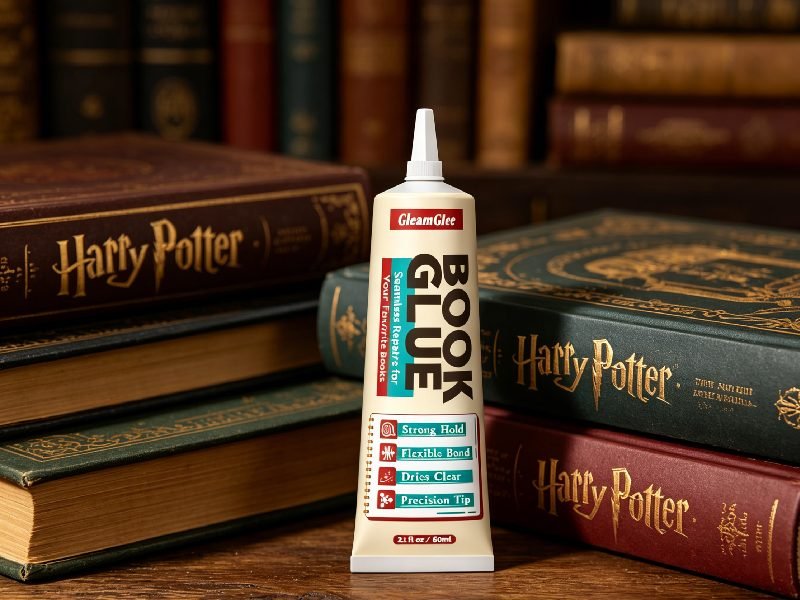
Is GleamGlee Book Glue Good for Harry Potter Book Repair?
GleamGlee Book Glue is a good choice for Harry Potter book repair because it is made for books, paper, bindings, and detailed restoration work. It is designed to dry clear, apply precisely, and support flexible repairs on loose pages, cracked spines, detached covers, journals, manuals, scrapbooks, and collectible books. For a damaged Harry Potter hardcover, these details matter because the repair must hold the page block securely without making the spine stiff or messy.
A Harry Potter book spine usually fails in small stages. First, a page starts shifting. Then the inner hinge opens slightly. Later, the cover may begin pulling away from the text block. GleamGlee Book Glue fits these repair stages because the fine metal nozzle allows glue to be placed into narrow spine gaps instead of spreading across clean pages. This is especially useful for thick books like Goblet of Fire or Order of the Phoenix, where heavy page blocks need careful bonding rather than thick glue buildup.
For daily reading copies, the biggest benefit is clean usability. The book should close neatly, open smoothly, and keep pages attached after repair. For display or collectible copies, the clear finish helps reduce visible repair marks along the gutter, hinge, or page edge. The glue is not meant to make a damaged book look artificially new; it is meant to stabilize the structure while keeping the book’s original look and feel as much as possible.
| Harry Potter Repair Need | Why It Matters | How GleamGlee Helps |
|---|---|---|
| Loose pages | Pages may fall out during reading | Bonds paper edges back into the spine |
| Cracked spine | Binding may keep splitting | Reinforces damaged spine channel |
| Detached cover | Book becomes hard to handle | Helps reconnect cover and text block |
| Collectible appearance | Visible glue can reduce clean look | Dries transparent after curing |
| Narrow repair area | Hard to reach with wide glue tips | Precision metal nozzle improves control |
| Thick hardcover stress | Heavy page block pulls on binding | Flexible repair supports movement |
Why is it suitable for paper and hardcover bindings?
GleamGlee Book Glue is suitable for paper and hardcover bindings because it is made for book restoration, bookbinding, and paper craft use rather than rough household repairs. A Harry Potter book has several materials working together: paper pages, glued spine layers, cover board, endpaper, and sometimes cloth or coated cover surfaces. A repair glue needs to bond these areas without making them too hard.
The glue is useful for common book problems such as loose pages, cracked spines, detached covers, and weak inner hinges. It can also be used on journals, planners, cookbooks, school textbooks, office manuals, photo albums, and handmade books. This makes it practical for both home repair and repeated book maintenance work.
Useful repair areas include:
- Page edge reattachment
- Inner hinge reinforcement
- Hardcover spine crack repair
- Paperback spine touch-up
- Scrapbook and journal binding
- Photo album page bonding
For Harry Potter books, the main advantage is balanced repair. The adhesive needs to hold firmly, but the book still needs to bend. A glue that dries too hard may crack again; a book-focused adhesive gives a cleaner, more natural repair.
How does precision nozzle improve control?
The precision metal nozzle is one of the most useful features for Harry Potter spine repair because most book damage happens in narrow spaces. A cracked spine gap may only be 1–3 mm wide. A loose page edge may need only a tiny bead of glue. A wide glue opening can easily apply too much adhesive, which may cause page sticking, shiny residue, or a stiff gutter after drying.
With a fine nozzle, glue can be placed directly inside the damaged area. This reduces waste and helps avoid glue spreading onto printed pages. It also makes the repair easier for people who do not have professional bookbinding tools. A clean table, wax paper, light pressure, and a controlled applicator are often enough for small to medium spine repairs.
| Repair Zone | Control Needed | Nozzle Benefit |
|---|---|---|
| Inner spine gap | Deep narrow placement | Reaches inside without flooding |
| Loose page fold | Very small glue bead | Keeps page edge clean |
| Cover hinge | Straight narrow strip | Helps avoid endpaper stains |
| Small cracks | Spot repair | Reduces unnecessary glue buildup |
A precise nozzle also helps repair in stages. Instead of gluing a large section all at once, damaged areas can be fixed section by section for a neater result.
Why does clear finish matter for collectible books?
A clear finish matters because a good book repair should not draw attention. Harry Potter books often carry personal, display, or collectible value. Even when the repair is structurally strong, yellow glue marks, cloudy residue, or thick visible lines can make the book look poorly handled. This is especially important near the spine gutter, where pages open and any residue becomes easy to see.
GleamGlee Book Glue dries transparent, which helps keep the repaired area cleaner. This is useful for reattaching loose pages, reinforcing cracked hinges, or fixing covers where the glue line may sit close to visible paper. A clear finish also helps when repairing illustrated editions, boxed set copies, school library books, or older volumes with sentimental value.
Visible glue problems to avoid:
- Yellow marks near the inner margin
- Shiny glue ridges along the page edge
- Cloudy patches on endpaper
- Darkened repair lines on older paper
- Stiff glue buildup near the hinge
Clear drying does not replace careful technique. The glue still needs to be applied thinly and pressed correctly. But when used properly, a transparent finish helps the repair look cleaner and more natural after curing.
Is GleamGlee Book Glue useful beyond Harry Potter repair?
GleamGlee Book Glue is useful beyond Harry Potter spine repair because many paper-based items fail in similar ways. Cookbooks loosen from frequent kitchen use. School textbooks crack from backpack wear. Journals and diaries lose covers after repeated opening. Photo albums, scrapbooks, handmade notebooks, and planners often need stronger page bonding than ordinary craft glue can provide.
This gives the product more daily value than a single-use repair item. One bottle can support home book repair, library maintenance, paper crafts, stationery projects, and small handmade binding work. For schools, offices, hobby clubs, and book repair workshops, this kind of multi-use adhesive can reduce replacement costs and extend the life of frequently handled materials.
| Use Case | Common Problem | Suitable Repair |
|---|---|---|
| Harry Potter books | Cracked spine or loose cover | Spine reinforcement |
| Cookbooks | Pages loosening from frequent use | Page edge bonding |
| School textbooks | Cover and spine damage | Hinge repair |
| Journals | Cover separation | Binding touch-up |
| Scrapbooks | Pages lifting | Paper bonding |
| Photo albums | Loose inserts | Clean page attachment |
For retailers, craft brands, stationery sellers, and Amazon stores, GleamGlee can also support branded product orders and custom book glue projects, including formula adjustment, packaging design, label layout, and private label production.

Conclusion
Repairing a Harry Potter book spine is less about making the book look brand new and more about keeping the original reading experience alive. A good repair should secure loose pages, strengthen the cracked spine, and help the cover close naturally without making the book stiff or bulky. For thick hardcovers such as Goblet of Fire or Order of the Phoenix, flexible book glue is a better choice than super glue, tape, or hot glue because the spine still needs to bend every time the book is opened.
The best results come from careful preparation and controlled application. Clean the spine area first, apply only a thin line of book glue, align the pages before pressing, and allow at least 24–48 hours for curing. Too much glue, heavy pressure, or early opening can weaken the repair and cause pages to stick together. A clear-drying adhesive with a precision nozzle makes the process cleaner, especially for collectible, sentimental, or frequently read Harry Potter books.
GleamGlee Book Glue is designed for books, paper, binding work, journals, scrapbooks, photo albums, school textbooks, and collectible book repair. Its clear finish, precise metal nozzle, and paper-focused formula make it practical for home users, libraries, schools, craft sellers, and book repair product lines. For branded product orders, private label book glue, custom packaging, or bulk adhesive supply, GleamGlee can support ready-to-sell products and customized solutions for Amazon sellers, retailers, distributors, and stationery brands.
Share:
Table of Contents
Here, creating your adhesives glue & removal cleaner collection is no longer a barrier—it’s a collaborative journey where GleamGlee helps brands and businesses transform their vision into durable, certified, and market-ready solutions.
Partner with GleamGlee
Join hundreds of global partners who trust GleamGlee for adhesives and cleaners that combine innovation, compliance, and speed. Our vertically integrated system—from R&D to warehouse—guarantees consistent performance and reliable delivery.
Whether you’re sourcing FBA-ready stock or developing your own formula, our team provides unmatched technical support and responsive service.




















