Skip to content
The term “non-toxic” also requires careful interpretation. A mild smell, a water-based formula, or a craft label does not automatically prove that an adhesive is suitable for prolonged contact with children’s clothing. The product’s intended use, safety information, application instructions, cure time, fabric compatibility, and supporting documentation are more useful than a single marketing phrase.
The best fabric glues for kids’ clothing repairs are permanent, washable adhesives that dry clear, remain flexible, match the fabric, and include appropriate safety information for their intended market. They are most useful for hems, patches, appliqués, labels, and small reinforced tears. Sewing is usually more appropriate for structural seams, highly stretched areas, flame-resistant garments, and items likely to be chewed or placed in the mouth.
A repair may look simple from the outside, but the adhesive must manage moisture, detergent, movement, heat, and repeated wear. The difference between a patch that lasts for months and one that peels away after the first wash often comes down to choosing the correct glue, applying the right amount, and allowing enough time for a complete cure.
What Does Non-Toxic Fabric Glue Mean?
“Non-toxic” should describe a fabric adhesive that has been assessed and labeled for its intended use, not merely one that has little odor or uses water as its main carrier. For children’s clothing, the label, safety instructions, cure requirements, ingredient declarations, and intended contact conditions matter more than a single front-of-pack claim.
Safety Claims
The term “non-toxic” is used in different ways across the adhesive market. Some products use it to indicate that the formula does not contain certain high-concern solvents. Others use it after a product has undergone a toxicological review for a defined household or craft application. These two situations are not automatically equivalent.
A parent repairing a child’s trousers needs to know more than whether the adhesive smells mild. The more practical questions are whether the product is designed for wearable fabric, whether an adult must apply it, how long the bond must cure, and whether the cured adhesive will remain exposed on an area worn directly against the skin.
Claims such as “non-toxic,” “skin-safe,” “hypoallergenic,” and “child-safe” describe different properties. A non-toxic statement does not necessarily mean that a product has been tested for prolonged skin contact. A hypoallergenic claim cannot guarantee that every user will avoid irritation. A child-safe statement may apply only when an adult uses the product according to the instructions and stores it securely afterward.
| Product Claim | What It May Indicate | What Still Needs Verification |
|---|---|---|
| Non-toxic | Assessed for a defined consumer use | Scope of assessment and intended application |
| Water-based | Water is the principal carrier | Full formula precautions and preservatives |
| Low odor | Limited noticeable smell during use | Ventilation instructions and solvent information |
| Washable | Bond may tolerate laundering | Wash temperature, cycle, drying method, and cure time |
| Skin-safe | Evaluated for a defined exposure condition | Contact duration, test basis, and age group |
| Child-safe | Suitable for a stated child-related use | Adult supervision, age restrictions, and documentation |
A well-labeled product should identify its intended materials, application procedure, first-aid precautions, storage conditions, and the amount of time required before the garment can be worn, stretched, ironed, or washed.
Water-Based Formulas
Water-based fabric glue is often a practical choice for household clothing repair because it is generally easier to spread and clean before curing. It may also produce less noticeable odor during application than some solvent-rich alternatives. These characteristics can make it more convenient for repairs performed indoors by an adult.
However, “water-based” describes the carrier system rather than every ingredient in the adhesive. A stable formula may still include polymer dispersions, preservatives, wetting agents, thickeners, stabilizers, or other functional additives. These ingredients may be suitable when the product is used correctly, but ordinary handling precautions still apply.
For children’s clothing, the complete repair process should be handled by an adult. The tube should remain out of reach before, during, and after use. Wet adhesive should not be left on a table where a child can touch it, and a recently repaired item should not be worn before the stated full cure period has passed.
Several basic practices reduce avoidable exposure:
- Work in an area with normal ventilation.
- Keep wet adhesive away from the eyes and mouth.
- Wash hands after application.
- Close the cap immediately after use.
- Store the tube according to the label.
- Keep the curing garment away from children and pets.
- Do not use odor as the only measure of product safety.
A low-odor formula may create a more comfortable working environment, but supporting documentation and correct use are more reliable indicators than smell alone.
Cured Adhesive
Wet adhesive and fully cured adhesive behave differently. During curing, water or another carrier leaves the bond while the polymer develops its final structure. The surface may feel dry after several minutes even when the adhesive remains uncured inside a folded hem or beneath a thick patch.
This matters because children’s garments are frequently moved, folded, and stretched soon after repair. Handling the material too early may weaken the bond, disturb alignment, or force uncured adhesive through the fabric. A thick application is particularly likely to remain wet inside after the visible surface has dried.
Before a repaired garment is worn, an adult should check for:
- Remaining odor
- Sticky or soft areas
- Visible glue seepage
- Hard ridges
- Sharp cured edges
- Loose patch corners
- Cracking during gentle bending
- A rough surface facing the skin
Repair location changes the risk and comfort level. A patch attached to the outside of a denim knee is different from adhesive placed inside a collar, waistband, sleeve cuff, or underarm area. Even when the same formula is used, skin contact, friction, and local moisture can be very different.
For underwear, infant sleeves, bibs, sleepwear, or items that may be chewed, sucked, or placed close to the mouth, sewing is usually the more cautious repair method.
Evidence to Request
Household users normally rely on the current product label and instructions. Retail buyers, distributors, school suppliers, and private-label brands often need a broader evidence package because the product may be sold in several markets or promoted with specific safety-related claims.
Useful documentation can include:
- Safety Data Sheet
- Technical Data Sheet
- Ingredient or restricted-substance declaration
- Labeling review for the intended market
- Washability test records
- Fabric compatibility results
- Batch quality-control procedures
- Shelf-life and storage information
- Packaging compatibility testing
- Product traceability records
A dependable evidence chain combines a clearly defined formula, correct labeling, repeatable performance testing, and consistent production control. A marketing phrase may attract attention, but buyers making a responsible decision should examine the complete supporting information.
Which Fabric Glue Types Are Suitable?
Permanent, flexible, washable fabric glue is generally the most suitable option for low-stress repairs on children’s clothing. Temporary adhesives are useful for positioning fabric before sewing, while rigid general-purpose glues are usually unsuitable because they may harden, crack, discolor, or fail during laundering.
Permanent Adhesives
Permanent fabric glue is designed to remain in the garment after drying and laundering. It is best suited to repairs where the bonded area is wide enough to distribute stress, including hems, decorative patches, appliqués, ribbons, and fabric labels.
A suitable permanent adhesive should do more than create a strong initial grip. It also needs to stay flexible after the full cure. Clothing bends around knees, elbows, cuffs, shoulders, and waist areas. A rigid adhesive may hold while the fabric lies flat but crack, lift, or become uncomfortable during movement.
Permanent does not mean that every repair will last for the entire life of the garment. Bond durability depends on several factors:
- Fabric composition
- Surface cleanliness
- Adhesive thickness
- Bonded surface area
- Pressure during setting
- Full cure time
- Washing temperature
- Dryer heat
- Repeated movement
- Local stress
A broad patch on cotton may tolerate normal washing well, while a narrow glued seam under constant pulling may fail quickly. The design of the repair is therefore as important as the claimed strength of the product.
Permanent fabric glue is most convincing when the product information clearly addresses flexibility, washability, cure time, and the fabrics for which the formula is intended.
Temporary Adhesives
Temporary fabric adhesive serves a different purpose. It is normally used to keep a patch, hem, trim, or fabric layer in position before sewing. Some products are designed to wash out, while others gradually lose grip as the fabric is manipulated.
This type of adhesive can help align a knee patch before edge stitching or prevent decorative pieces from moving during costume preparation. It can also support quilting, embroidery positioning, or classroom craft assembly where the glue is not expected to remain the final fastening method.
Temporary glue should not be treated as a permanent clothing repair. A product may keep a patch flat for one afternoon but soften in detergent, warm water, or dryer heat. Packaging should state whether the adhesive is permanent, temporary, repositionable, removable, or wash-away.
The simplest selection question is whether the glue must remain the final bonding method. If the answer is yes, a permanent, flexible, washable fabric adhesive is the more appropriate category. If the adhesive only needs to hold pieces before stitching, a temporary product may provide easier positioning and less stiffness.
Flexible Finishes
Children’s clothing needs a bond that moves with the material. A cured glue line should not feel like a strip of hard plastic trapped inside the garment.
Flexibility is particularly important on:
- Jeans
- Jersey shirts
- School trousers
- Hoodies
- Fabric costumes
- Stretch cuffs
- Knee patches
- Elbow patches
- Fabric bags
A clear finish is also valuable for visible repairs. Even when the adhesive itself becomes transparent, a heavy application can soak into fabric and create a darkened area. Thin cotton, dark polyester, satin, and loosely woven material are especially sensitive to bleed-through.
A realistic patch test should use the same amount of glue, pressure, and cure time planned for the final repair. After curing, the sample can be bent repeatedly, stretched gently, viewed under bright light, and washed according to the garment’s care label.
The test should reveal whether the adhesive:
- Whitens during bending
- Becomes brittle
- Forms flakes
- Changes the fabric color
- Passes through the material
- Creates excessive stiffness
- Lifts at the edges
A suitable product should create a stable bond without turning the repaired area into the least flexible part of the garment.
When Sewing Is Better
Fabric glue is practical, but it is not a universal replacement for thread. Sewing remains more dependable for narrow structural seams and areas under constant pulling force.
Sewing is usually preferable for:
- Waistbands
- Crotch seams
- Underarm seams
- Shoulder seams
- Buttons and fasteners
- Drawstring channels
- Heavy coat closures
- Elastic sections
- Protective garments
- Infant items near the mouth
A combined method can often produce a better repair. Glue can keep a patch flat, prevent fraying, and improve appearance, while several stitches reinforce the perimeter. This works particularly well on school trousers, knees, elbows, uniforms, and frequently washed clothing.
The best method depends on the location of the damage, the amount of movement, the type of fabric, and the garment’s washing routine. A repair is only useful when it remains secure and comfortable during real wear.

Which Kids’ Clothing Repairs Can Be Glued?
Fabric glue works best on flat, low- to moderate-stress repairs such as loose hems, decorative patches, appliqués, labels, ribbons, and small reinforced tears. It is less suitable for major seams, elastic waistbands, large unsupported holes, or areas pulled repeatedly during dressing and movement.
Small Tears
Small tears can be repaired more effectively when they are supported by a backing patch. Gluing two damaged edges directly together creates a narrow bond line that concentrates stress in one place. The repair may appear neat while the garment is flat but reopen when the material bends or stretches.
A backing patch spreads the load across a larger surface. For a tear approximately 20 mm long, a patch extending about 10–15 mm beyond the damage on each side is a practical starting point for many lightweight and medium-weight fabrics. The exact dimensions should still be adjusted for fabric thickness and repair location.
The patch should move in a similar way to the garment. A stiff woven patch on a soft jersey shirt may restrict movement and pull against the surrounding material. A matching fabric or a material with similar stretch characteristics usually produces a more comfortable result.
For a clean repair:
- Trim loose threads without enlarging the tear.
- Position the damaged edges naturally.
- Place the backing patch behind the damage.
- Apply a thin adhesive layer over the contact area.
- Press evenly from the center outward.
- Keep the area flat during curing.
The patch may be placed inside the garment for a less visible finish or outside as a decorative feature.
Hems and Patches
Loose trouser hems, skirt hems, and costume edges are well suited to fabric glue because the bonding area is broad and relatively flat. The adhesive should be applied in a thin, continuous line inside the folded edge.
A heavy bead is rarely helpful. It can take longer to cure, seep through the material, and create a hard ridge that becomes visible or uncomfortable. Even pressure across the fold is more important than excessive adhesive.
Decorative knee patches are another practical application. Rounded corners are usually more resistant to lifting than sharp square corners because they distribute movement more gradually. Pressing from the center toward the edges helps remove air pockets and improves fabric contact.
| Repair Type | Glue Suitability | Practical Method |
| Loose trouser hem | High | Thin continuous line inside the fold |
| Decorative knee patch | High | Broad bond with rounded patch corners |
| Fabric name label | High | Light, even adhesive over the back |
| Small backed tear | Moderate to high | Patch extending beyond all damaged edges |
| Jersey cuff | Moderate | Test stretch and comfort before use |
| Waistband split | Low | Stitch or replace the elastic section |
| Loose button | Low | Sew securely with suitable thread |
| Large structural seam | Low | Stitch or use professional repair |
Patches, labels, and appliqués are generally easier to bond than structural seams because they provide more surface area for the adhesive.
Stretch Garments
Leggings, sports shirts, ribbed cuffs, and dancewear are more difficult to repair because the material expands during normal use. The adhesive must tolerate repeated extension without cracking or restricting movement.
A simple measurement can help estimate local stretch. Mark a 50 mm section of the fabric while it is relaxed, then extend it as it would move during wear. If the marked distance increases to 60 mm, that area is stretching by approximately 20%.
Repair location is also important. A patch near the lower calf may experience little extension, while a repair across the knee, seat, elbow, or waistband may stretch with every movement.
For stretch garments:
- Apply the smallest amount that still provides full contact.
- Use a patch with a similar stretch direction.
- Avoid rigid decorative materials.
- Test the repaired sample before wear.
- Reinforce high-stress areas with stitching.
- Keep the adhesive layer thin and even.
A flexible glue may support a stretch-fabric repair, but it cannot compensate for an unsuitable patch or a bond placed across a heavily loaded elastic seam.
Unsuitable Repairs
Some clothing repairs should not rely on adhesive alone, even when the glue is described as strong and washable.
Avoid glue-only repairs on:
- Backpack shoulder straps
- Elastic waistbands
- Drawstring attachments
- Heavy jacket closures
- Car-seat harness accessories
- Protective sportswear
- Flame-resistant sleepwear
- Large seam separations
- Items likely to be chewed
- Areas directly beside the mouth
Coated and treated fabrics also require caution. Rain jackets, stain-resistant uniforms, laminated textiles, and silicone-treated materials may resist adhesion because the surface treatment prevents the glue from entering or gripping the fibers.
Aggressive preparation methods should not be improvised on children’s garments. Sanding, scraping, or using strong solvents can damage the fabric, remove protective finishes, or create a larger problem than the original tear.
A repair should be rejected when failure could create a loose part, affect garment safety, or leave a hard component in direct contact with the child.
How Do You Choose the Right Glue?
The right fabric glue should be selected by comparing safety documentation, flexibility, wash resistance, fabric compatibility, drying appearance, cure time, and application control. A strong bond matters, but a children’s clothing repair must also remain soft, neat, and comfortable after repeated movement and laundering.
Fabric Compatibility
Fabric composition directly affects adhesion. Cotton and denim often accept fabric glue well because their fibers provide a textured and absorbent surface. Smooth, coated, highly elastic, or delicate materials may produce less predictable results.
Typical fabric considerations include:
- Cotton is normally easy to wet and bond, although thin cotton may show seepage.
- Denim provides a strong textured surface, but thick layers require complete adhesive coverage.
- Polyester can bond well, but tightly woven surfaces should be tested.
- Jersey is flexible and absorbent but can distort if too much glue is applied.
- Fleece has a soft surface that may reduce full contact.
- Satin is highly visible and easily marked.
- Velvet pile can trap glue and change the appearance.
- Coated fabric may resist bonding completely.
Garment labels may not describe every layer. A school jacket may combine a polyester shell, polyurethane coating, nylon lining, foam insert, and printed decoration. The adhesive only needs to fail at one interface for the repair to detach.
Testing should reproduce the planned repair rather than using a single drop in a hidden corner. Use the same fabric layers, adhesive amount, pressure, and cure period intended for the final application.
Wash Performance
“Washable” is not a complete performance specification. Buyers should look for the conditions under which the bond is expected to remain stable.
Important questions include:
- Is machine washing allowed?
- What water temperature is suitable?
- Is a gentle cycle recommended?
- Can the item be tumble dried?
- How long must the glue cure before washing?
- Is ironing permitted?
- Can heat be applied directly over the repair?
- Is dry cleaning compatible?
- Does the product specify detergent restrictions?
For product evaluation, testing after 1, 5, 10, and 20 wash cycles can reveal different failure patterns. Early detachment may indicate poor compatibility or incomplete curing. Gradual edge lifting can point to insufficient flexibility, an undersized patch, or uneven adhesive coverage.
| Evaluation Point | What to Examine |
| Initial set | Whether the repair remains aligned after several minutes |
| Full cure | Flexibility and dryness after the stated cure period |
| Wash cycle 1 | Softening, whitening, seepage, or immediate lifting |
| Wash cycle 5 | Early edge separation or fabric distortion |
| Wash cycle 10 | Continued flexibility and bond appearance |
| Wash cycle 20 | Longer-term lifting, cracking, or discoloration |
| Heat exposure | Changes after permitted ironing or drying |
| Repeated bending | Cracking, flaking, or permanent stiffness |
The garment care label remains the controlling limit. An adhesive may tolerate a temperature that the fabric, print, elastic, or decorative finish cannot.
Flexibility and Comfort
A useful clothing adhesive must move with the garment. The strongest possible bond is not always the most suitable when it creates a hard patch that rubs against the skin.
Flexibility should be considered in three ways:
- Bending
- Folding
- Stretching
A denim patch mainly needs to bend. A jersey knee repair needs to bend and stretch. A folded hem usually experiences repeated flexing but limited extension.
After curing, bend the repair ten to twenty times by hand. Watch for white stress marks, cracking, flaking, or edge lifting. Run a finger across the inside of the garment to check for a raised or sharp ridge.
Many comfort problems result from applying too much adhesive. A thin, complete film normally performs better than a thick bead. Excess glue can make the repair heavier, more visible, slower to cure, and less flexible.
For clothing worn directly against sensitive skin, the adhesive should remain between fabric layers whenever possible. Any exposed cured line should feel dry, smooth, and free from sharp edges.
Cure and Handling Times
Set time and full cure time are not interchangeable.
Open time is the period available for positioning. Initial grab describes when the pieces begin to hold. Set time is the stage when continuous pressure may no longer be required. Handling time is when the item can be moved carefully. Full cure is when the adhesive reaches its intended final performance. Wash-ready time is the minimum period before laundering.
A product that begins to hold after ten minutes may still require 24 hours before it should be stretched, worn, washed, or ironed.
Practical curing can take longer when:
- The fabric is thick.
- The room is cool.
- Humidity is high.
- The adhesive layer is heavy.
- Several fabric layers are bonded.
- Airflow around the repair is limited.
Parents often repair clothing shortly before school or an event. This encourages premature handling and weakens otherwise suitable products. Completing the repair a day before the garment is needed usually produces a more dependable result.
How Do You Repair Kids’ Clothes Safely?
An adult should prepare the garment, test the adhesive, apply a thin controlled layer, press the repair evenly, and keep it away from children until the full cure period has passed. Before wear, the bond should be checked for tackiness, stiffness, odor, loose edges, and exposed adhesive.
Surface Preparation
Adhesive bonds best to clean, dry fabric. Dirt, body oil, detergent residue, and fabric softener can reduce contact between the glue and the fibers.
Wash the garment before repair when practical, but avoid adding fabric softener. The material must be completely dry, including thick seams and multilayered sections. Moisture trapped inside denim, fleece, or folded hems can slow the cure.
Preparation should include:
- Brushing away lint and dust
- Trimming loose fibers
- Flattening the damaged area
- Marking the hem or patch position
- Testing a hidden section
- Preparing the backing patch
- Placing a barrier behind the repair
A disposable plastic sheet, silicone mat, or release film helps prevent glue from passing through and bonding the front and back of a sleeve, pocket, or trouser leg together.
Printed paper is less suitable because ink may transfer into wet adhesive. Cardboard may also stick if glue penetrates through the material.
For a tear, the backing patch should be cut and positioned before the adhesive is opened. For a hem, the fold should be formed and checked in advance. Good preparation reduces the time spent adjusting wet fabric.
Glue Application
More glue does not automatically create a stronger repair. Clothing bonds usually perform best with a thin, even layer that covers the complete contact area.
A thick application may:
- Soak through the fabric
- Leave a visible dark mark
- Create a rigid ridge
- Trap moisture
- Extend the cure time
- Squeeze out around the edges
A fine nozzle or small applicator improves control. Apply the adhesive to one surface, spread it evenly, and leave a small margin near visible edges when the fabric is thin or absorbent.
A practical sequence is:
- Place a protective barrier behind the fabric.
- Apply a controlled amount to one bonding surface.
- Spread the adhesive into a thin film.
- Position the fabric without stretching it.
- Press from the center toward the edges.
- Remove excess adhesive before it cures.
- Use flat clips or light weights if needed.
- Leave the repair undisturbed.
For patches and appliqués, enough of the back surface should be covered to prevent loose corners. For hems, a thin continuous line is generally better than several large drops.
Once cured, scraping excess adhesive may damage the textile, so application control matters from the beginning.
Curing and Inspection
The garment should remain flat and undisturbed throughout the stated curing period. It should not be folded, stretched, washed, ironed, or worn before the bond has developed fully.
Before use, inspect the repair under good lighting. Check both sides of the garment. A suitable repair should have:
- No wet areas
- No tackiness
- No strong remaining odor
- No sharp cured edges
- No visible seepage
- No loose patch corners
- No hard lump against the skin
- No cracking during gentle bending
An outerwear repair may be acceptable when the bonded area feels slightly firmer than the surrounding textile. Shirts, leggings, underwear, and sleepwear require a higher level of comfort because they remain close to the skin.
A rough or rigid repair should not be accepted on the assumption that repeated washing will soften it. The bond should be reworked, reinforced with a suitable lining, stitched, or replaced.
Children should not handle or wear the item until the adult inspection is complete.
Washing After Repair
The first wash is an important performance check. Wait until the full cure time has passed, then follow the garment’s care label.
Good practice includes:
- Turning the garment inside out
- Selecting a gentle cycle
- Avoiding unnecessarily hot water
- Avoiding direct ironing over the bond unless permitted
- Drying according to the textile instructions
- Allowing the item to dry completely
- Inspecting the repair before the next wear
Check the patch corners, hem edges, and ends of repaired tears. A small lifted area should be corrected before it develops into a larger separation.
Repeated wash durability depends on detergent, water temperature, dryer heat, fabric construction, repair design, adhesive quantity, and the amount of movement during wear. A broad cotton patch and a narrow stretch-fabric seam will not experience the same conditions.
A repair that survives one wash is encouraging, but children’s garments should still be inspected periodically because they undergo frequent laundering and heavy movement.

Is GleamGlee Suitable for Kids’ Clothing Repairs?
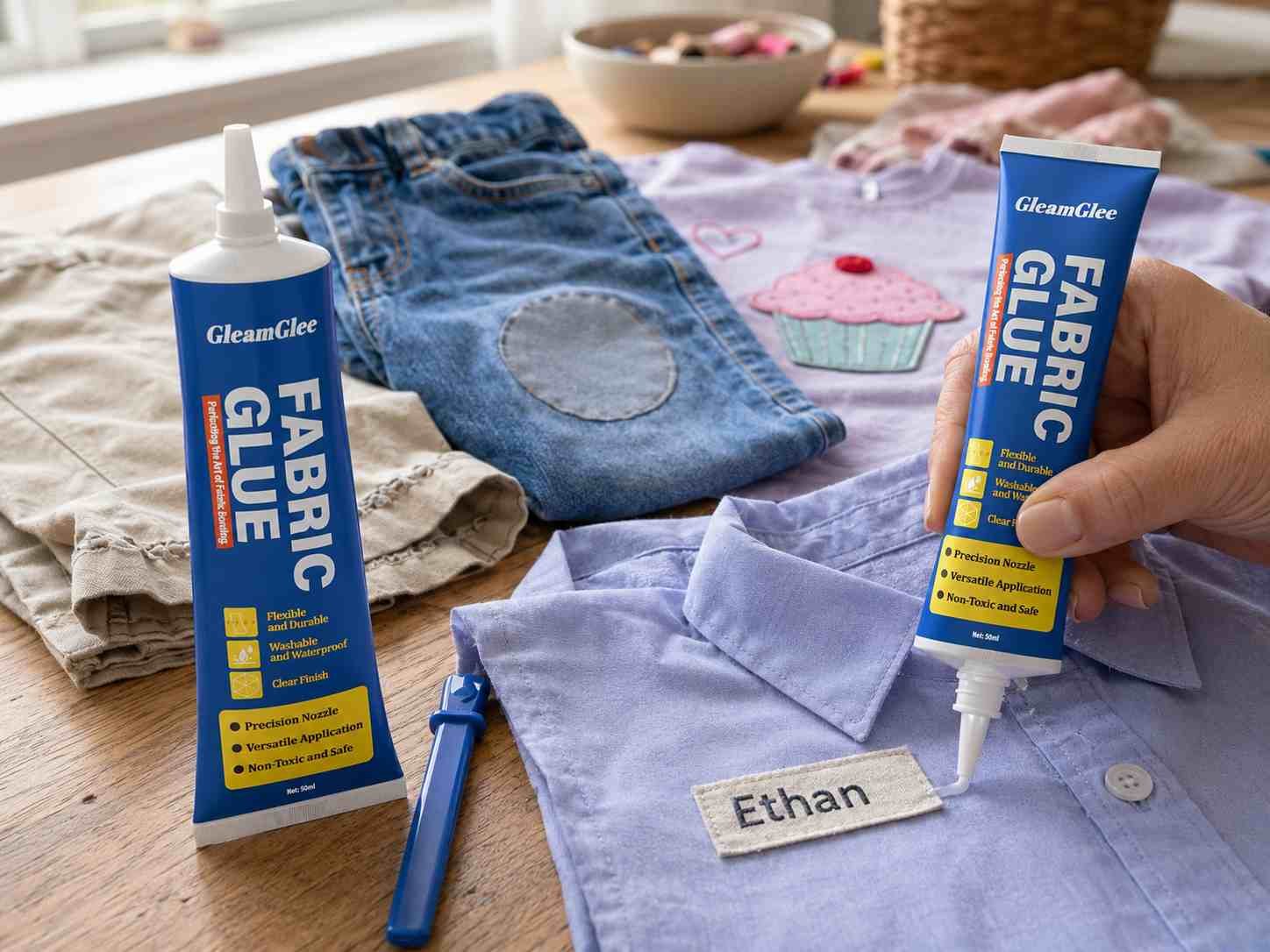
GleamGlee Fabric Glue is suitable for adult-applied, low- to moderate-stress clothing repairs where a clear, flexible, washable bond is required. It is intended for hems, patches, appliqués, ribbons, denim, costumes, and small backed tears, with an initial setting time of approximately 6–10 minutes and a full cure time of 24 hours.
Repair Performance
The product is designed to form a strong fabric bond while remaining soft and flexible after drying. This makes it more suitable for wearable textiles than many general-purpose craft adhesives that cure into a rigid layer.
Its stated features include:
- Strong fabric bonding
- Transparent drying
- Non-yellowing appearance
- Soft and flexible cured finish
- Machine-washable performance
- Ironing compatibility when used correctly
- Fine precision nozzle
- Anti-clog pin inside the cap
- Approximately 6–10 minutes for initial setting
- Approximately 24 hours for full cure
- 50 ml tube size
- One-tube and two-tube options
The precision nozzle is useful for narrow hems, patch edges, appliqués, ribbons, cuffs, decorative trim, and small tears. Better application control reduces the likelihood of seepage, waste, and unnecessary stiffness.
The adhesive should still be tested on dark, delicate, stretch, coated, or highly visible fabric before full application. No fabric adhesive performs identically across every textile construction.
Terms such as non-toxic, child-safe, skin-safe, or hypoallergenic should only be used when the specific product documentation supports the exact claim for the intended market and application.
Suitable Projects
The most suitable children’s clothing applications are broad, flat bonds exposed to low or moderate structural stress.
Practical examples include:
- Decorative knee patches
- Loose trouser hems
- Costume appliqués
- School-play decorations
- Fabric name labels
- Ribbon trim
- Small backed tears
- Decorative cuffs
- Fabric pencil cases
- Book covers and school crafts
The glue can also be used for jeans, curtains, embroidery, sequins, ribbons, fabric decorations, household textiles, and no-sew craft projects.
It should not replace sewing for waistbands, crotch seams, heavily stretched leggings, load-bearing straps, structural fasteners, or garments where repair failure could create a safety concern.
For a small tear, a backing patch usually creates a stronger repair than joining the torn edges directly. For a hem, a thin continuous line is preferable to a heavy bead. For appliqués, rounded corners and complete surface contact reduce the likelihood of lifting.
Product Testing
Commercial buyers should evaluate the adhesive on the exact fabrics and repair designs they plan to sell, recommend, or include in a repair kit.
A practical test program can include:
- Initial alignment after 10 minutes
- Dryness and flexibility after 24 hours
- Appearance under normal and bright light
- Ten to twenty repeated bends
- Controlled stretch testing
- One wash cycle
- Five wash cycles
- Ten wash cycles
- Twenty wash cycles
- Permitted ironing exposure
- Patch-edge inspection
- Color and yellowing checks
Testing should use consistent adhesive amounts, pressure, cure time, detergent, wash temperature, and drying conditions. Changing one of these variables may significantly affect the result.
For household users, a hidden patch test remains the simplest quality check. It can reveal whether the fabric darkens, stiffens, discolors, or allows adhesive to pass through.
The stated 24-hour full cure time should be respected before washing, ironing, stretching, or wearing the garment. Applying more glue than necessary does not shorten the cure period and may extend it.
Buyer Documentation
Retailers, distributors, e-commerce sellers, and private-label brands may request a more complete technical and compliance package before purchasing or launching the product.
Project documentation may include:
- Safety Data Sheet
- Technical Data Sheet
- Ingredient declarations
- Restricted-substance statements
- Washability testing
- Fabric compatibility testing
- Batch quality-control records
- Packaging compatibility checks
- Shelf-life information
- Multilingual label support
- Custom tube or bottle selection
- Private-label artwork
GleamGlee’s production structure includes formulation development, packaging manufacturing, label printing, filling, and raw-material support. More than 25 chemists, material specialists, and process engineers participate in formulation and application work across the company’s adhesive and cleaning product categories.
Private-label projects may begin from 200 units, depending on packaging, formula, printing, and compliance requirements. Initial design files may be prepared in as little as two days. Samples commonly require 7–14 days, while standard bulk production is generally completed in approximately 20 days. Accelerated schedules may be considered when raw materials, packaging, and production capacity are available.
Commercial buyers should provide the following information for an accurate product assessment and quotation:
- Target country or sales market
- Intended fabric type
- Main repair application
- Required product claims
- Preferred formula characteristics
- Packaging format
- Estimated order volume
- Artwork requirements
- Sample deadline
- Planned launch date
Conclusion
Selecting fabric glue for children’s clothing involves more than choosing the product with the strongest claim on the label. A suitable adhesive must match the textile, the position of the damage, the amount of movement, the washing routine, and the age of the wearer. It should remain flexible, dry neatly, tolerate the expected care cycle, and provide clear instructions and supporting safety information.
Permanent, washable fabric glue is most useful for loose hems, decorative patches, appliqués, fabric labels, backed tears, costumes, and other broad, low-stress bonds. Sewing remains more dependable for structural seams, elastic waistbands, heavily stretched areas, flame-resistant garments, load-bearing fasteners, and items that may be placed in the mouth.
GleamGlee Fabric Glue provides a clear, flexible, washable repair format with precision application, an initial setting period of approximately 6–10 minutes, and a stated full cure time of 24 hours. Household users can select a 50 ml single-tube or two-tube option for everyday repairs and craft projects.
Retailers, distributors, Amazon sellers, Shopify brands, school-supply companies, repair-kit developers, and private-label buyers can request product samples, technical documentation, customized formulas, multilingual packaging, and production quotations. Supplying the target market, fabric type, repair use, order volume, compliance needs, and launch schedule allows the technical team to recommend a more suitable standard or customized fabric adhesive solution.