Skip to content

Floral Glue for Garden Crafts and Displays: An Authoritative Guide
Your trusted adhesives glue & cleaner manufacturer

A beautiful floral display can lose its polished appearance because of something surprisingly small: one flower turning out of position, a ribbon lifting from its base, a dried stem separating from a wreath, or an artificial bloom exposing the wire or mechanics underneath. Garden crafts make the challenge more complicated because flowers are rarely the only material involved. A single project may combine fresh stems, dried botanicals, artificial flowers, foam, glass, ceramic, fabric, ribbon, wood, acrylic, or plastic, and each surface responds differently to adhesive.
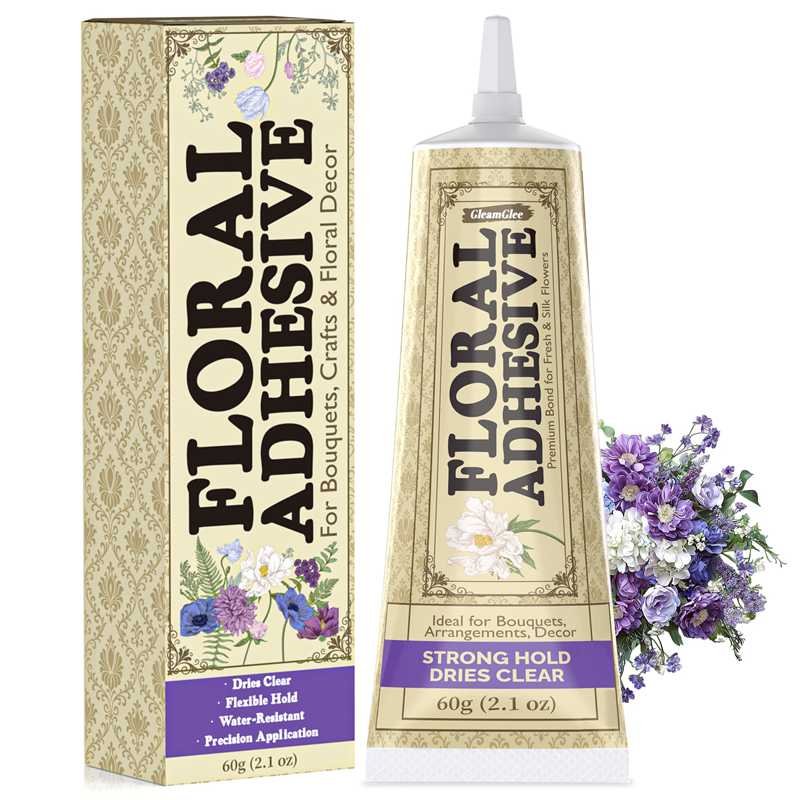
Floral glue works best as a precise bonding solution for fresh, dried, preserved, and artificial flower projects where a clean, flexible, and discreet attachment is more important than heavy structural support. A suitable floral adhesive should dry clear, hold small decorative components securely, work across common craft surfaces, and tolerate the moisture or movement expected during normal display and handling.
That distinction matters when a project leaves the worktable. A centerpiece may be transported several times before an event begins, a flower crown has to move naturally with the wearer, and a wreath displayed outdoors may encounter humidity, cold air, wind, or light rain. Experienced floral makers therefore do not simply choose the strongest glue available. They look at the flower, substrate, environment, contact area, movement, and final appearance together, then use adhesive only where it genuinely improves the design.
What Is Floral Glue Used for in Garden Crafts?
Floral glue is used to secure flowers, greenery, ribbons, foam, and lightweight decorative elements when a small, neat connection is more useful than bulky wire, pins, or visible tape. It is especially practical for bouquets, wreaths, corsages, flower crowns, dried-flower crafts, centerpieces, preserved-flower art, artificial arrangements, gift decoration, and garden-inspired displays that need clean, carefully controlled attachment points.
What Projects Benefit Most from Floral Glue?
Floral adhesive is most valuable when the attachment point is small, irregular, visible, or difficult to secure with traditional mechanics. A bouquet may have a secondary bloom that continually rotates away from the intended face of the arrangement. A wreath may contain lightweight dried flowers that do not have long enough stems for wiring. A corsage may need a tiny decorative flower added close to ribbon where a wire twist would look bulky. In these situations, carefully placed adhesive provides control without dominating the design.
Garden-inspired crafts broaden the range of applications even further. Botanical wall art, shadow boxes, pressed-flower cards, seasonal wreaths, flower boxes, table decorations, decorative jars, picture frames, preserved-flower boards, and artificial plant displays often contain dozens of small elements. Individually wiring every detail would take time and create unnecessary thickness. Adhesive can simplify assembly while preserving a lighter, more natural appearance, particularly when the design depends on layered petals, fine greenery, narrow ribbon, or small botanical accents.
The most useful way to think about floral glue is to separate an arrangement into two systems. The first is the main structure that keeps everything standing, hanging, or positioned correctly. The second is the detail layer that keeps individual flowers, petals, leaves, ribbons, and decorations exactly where the designer wants them. Adhesive is particularly effective in the second system, while large or load-bearing structures normally benefit from stronger mechanical support.
Are Fresh, Dried, and Artificial Flowers the Same?
Fresh, dried, preserved, and artificial flowers behave differently during bonding, so they should not be treated as interchangeable materials. Fresh flowers contain moisture and remain flexible, while delicate petals can bruise or darken when handled roughly. Dried flowers contain much less moisture but are often brittle enough to crack when excessive pressure is applied. Preserved flowers may remain soft for a long time, yet dyes, conditioning agents, or surface treatments can affect how an adhesive spreads and grips.
Artificial flowers introduce another group of variables because one bloom may contain several different materials. Polyester petals, foam centers, coated wire, polyethylene stems, molded plastic leaves, and decorative surface finishes can all appear in the same artificial flower. An adhesive that works beautifully on the fabric petal may not grip the plastic stem in exactly the same way. This is one reason experienced makers pay attention to the actual contact material instead of relying only on the label “artificial flower.”
When valuable flowers, unusual preserved botanicals, or unfamiliar artificial materials are involved, make a small test bond before completing the entire piece. Examine the test after the adhesive has developed properly and look for staining, darkening, surface softening, brittle areas, poor grip, or noticeable residue. A small trial uses very little material and can prevent a large floral project from becoming difficult to repair after assembly.
Do Professional Florists Use Floral Adhesive?
Professional florists use floral adhesive because appearance, production speed, consistency, and handling all matter when arrangements must be prepared for weddings, events, retail orders, workshops, hotels, restaurants, and flower delivery. Corsages, boutonnieres, flower crowns, bouquet accents, floral jewelry, centerpiece details, preserved-flower products, and small decorative additions are common applications where a discreet bond may look cleaner than exposed wire or tape.
Professional work rarely relies on one technique for an entire arrangement. Foam may position stems and provide water access, wire may strengthen weak or heavy flowers, floral tape may bundle and finish stems, and clips, frames, netting, or cable ties may handle larger structural sections. Adhesive then performs the smaller precision tasks that other mechanics cannot complete as cleanly. This combination makes the arrangement easier to construct and reduces the chance that a single connection method is carrying a load it was never intended to support.
Consistency also becomes more important when floral work moves from personal crafting into repeated commercial production. A florist preparing many arrangements needs an adhesive that dispenses predictably and produces a similar result from one project to the next. Controlled viscosity, a reliable nozzle, clear drying, flexible bonding, packaging stability, and predictable behavior around damp floral materials are therefore practical concerns, not merely product specifications.
Where Should Floral Glue Not Be the Main Support?
Large arches, ceiling installations, heavy branches, suspended flowers, oversized artificial blooms, and wind-exposed outdoor displays should not depend entirely on floral adhesive. These designs experience forces that are very different from those found in a small bouquet or tabletop arrangement. A decorative flower may weigh very little, yet a long stem creates leverage, while a broad artificial leaf can catch wind and place surprisingly high stress on a small attachment area.
In these situations, a frame, floral wire, cable tie, mesh, clip, anchor, foam system, or another mechanical connection should carry the main load. Floral glue can then be used to keep details from rotating, conceal visible mechanics, hold lightweight accents, or stabilize sections that would otherwise shift. This layered approach usually produces a cleaner appearance without asking the adhesive to perform structural work outside its practical role.
A sensible safety rule is to consider what happens if the bond fails. If a loose flower would simply move slightly in a centerpiece, adhesive alone may be reasonable. If a large decorative component could fall from height, damage the display, or create a hazard for people nearby, mechanical backup becomes much more important.

Which Materials Can Floral Glue Bond?
Floral glue can bond flowers and greenery to floral foam, ribbon, fabric, ceramic, glass, acrylic, selected plastics, wood, artificial stems, and other craft surfaces. Performance still depends on porosity, coatings, moisture, surface cleanliness, contact area, component weight, and the specific plastic or finish involved, so unfamiliar combinations should be tested before important displays or repeated commercial production.
Can It Bond Flowers and Floral Foam?
Floral foam and floral glue solve different problems. Foam mainly provides placement and support for inserted stems, and wet foam can also provide a water source for fresh flowers. Adhesive becomes useful when a flower, leaf, ribbon, preserved element, or decorative accessory needs extra stability or cannot be inserted deeply enough to stay in the desired position. In many arrangements, properly inserted stems need no additional glue at all.
Using adhesive selectively is usually better than covering a large section of foam. A small flower that rotates during transportation may need reinforcement, while the main stems around it remain secure through normal insertion. Decorative ribbon, lightweight dried materials, and artificial accents can also be attached to carefully chosen areas without saturating the foam surface or making future adjustments unnecessarily difficult.
Wet foam deserves extra attention because moisture is already present close to the bonding area. A floral adhesive intended for fresh flowers, damp stems, and flower-arrangement environments is more suitable than a general paper or school glue that was never formulated for those conditions. The contact area should also be kept stable while the initial bond develops because repeated repositioning can introduce loose foam particles or plant debris into the adhesive line.
Does It Work on Glass, Ceramic, Fabric, and Wood?
Different craft materials require different expectations. Glass and glazed ceramic are smooth and nonporous, which makes cleanliness especially important. Fabric can absorb liquid adhesive and may show staining when too much is applied. Wood can range from highly porous unfinished surfaces to sealed decorative boards with very different bonding behavior. Acrylic is smooth and visually unforgiving because excess transparent glue may still catch the light and become noticeable.
| Material | Common Floral Use | Main Concern | Practical Approach |
|---|---|---|---|
| Glass | Vases, jars, terrariums | Smooth, visible surface | Remove oil and test clarity |
| Ceramic | Pots, decorative vessels | Glazed or porous finishes | Test a hidden area first |
| Fabric | Ribbon, wrapping, backdrops | Absorption and staining | Apply a small controlled amount |
| Wood | Wreath bases, frames | Dust and porosity | Use a clean, dry contact area |
| Acrylic | Signs, display boxes | Visible residue | Keep the bond point discreet |
| Plastic | Faux stems, décor | Plastic type varies | Always perform a compatibility test |
| Floral foam | Arrangements | Moisture and weak surface | Use targeted attachment only |
| Dried botanicals | Frames, wreaths | Brittle material | Minimize pressure during positioning |
Surface preparation does not need to become complicated. Dust, oil, wax, condensation, loose fibers, or unstable decorative coatings are more common causes of poor bonding than many users realize. A clean and stable contact area usually contributes more to a successful result than applying a much larger quantity of adhesive to an unprepared surface.
Can It Hold Artificial Flowers?
Artificial flowers are well suited to adhesive-based crafting because they do not wilt and are frequently used in wreaths, window displays, flower walls, retail decoration, artificial bouquets, seasonal arrangements, gift boxes, event props, and long-lasting home décor. Their durability allows the maker to build and test projects well in advance, but their varied construction means surface compatibility still deserves attention.
One artificial flower may contain polyester fabric petals, a foam center, a coated wire stem, molded plastic leaves, and decorative paint. Those materials do not necessarily bond in the same way. A small artificial blossom attached close to a wreath base creates relatively little stress, while a large bloom attached to the end of a long flexible stem creates additional leverage even if the flower itself is lightweight.
For larger artificial installations, combine adhesive with physical support. Frames, wire, mesh, clips, and cable ties can carry the main load while glue locks small elements into position, prevents rotation, and conceals mechanics. This approach is especially useful for event walls, shop-window installations, large wreaths, and public displays that will be moved or transported several times.
How Should You Test an Unfamiliar Surface?
A practical test should use the actual materials that will appear in the final project, because substitutions may behave differently. Apply approximately the same amount of adhesive you expect to use during normal assembly and position the materials at the same orientation. A small decorative flower glued horizontally to a board creates a different loading condition from the same flower hanging vertically or facing downward.
For fine craft work, a small dot roughly 1–3 mm across can be a useful starting point during testing, although this is not a universal specification. Viscosity, porosity, flower weight, surface shape, and contact area all affect the amount required. The goal of the test is not to discover the largest amount of glue the surface can hold, but to find the smallest controlled quantity that produces a stable and clean result.
After the bond has developed, inspect the sample for discoloration, visible residue, softening, brittle areas, movement, coating failure, or poor adhesion. Commercial users should test more than one sample because small differences in artificial flower coatings, ribbon finishes, decorative plastics, or preserved botanical batches can influence performance.
How Do You Use Floral Glue Correctly?
Use floral glue by planning the arrangement before application, preparing clean contact areas, applying only a controlled amount, positioning the flower accurately, and keeping the connection stable while the adhesive sets. Precision matters more than volume because excessive glue can increase mess, squeeze-out, drying time, and visible residue without automatically creating a stronger or more professional-looking floral arrangement.
How Should You Prepare the Materials?
Good adhesive work begins before the tube is opened. Arrange flowers, leaves, ribbon, and decorative pieces in their approximate positions first so the real contact points are clear. This avoids the common mistake of applying glue and then spending too long deciding where a component belongs while the adhesive spreads or begins to set. Dry positioning also shows whether the design actually needs adhesive or whether foam, wire, or natural stem placement already provides enough support.
Fresh flowers should be handled gently, especially around thin petals and soft stems. Dried flowers should be supported close to the bonding point so that pressure does not snap fragile material. Smooth surfaces such as glass, ceramic, acrylic, and plastic should be free from dust, oils, condensation, or residue, while wood and dried botanical surfaces should be cleared of loose particles that could become trapped inside the bond.
A reliable working sequence is straightforward:
- Dry-fit the arrangement before applying adhesive.
- Identify the smallest useful contact area.
- Clean the contact point.
- Test unfamiliar materials before final assembly.
- Apply a controlled quantity of adhesive.
- Position the component carefully.
- Avoid unnecessary movement while the initial bond develops.
Following this sequence usually takes less time than cleaning excess adhesive or rebuilding a section that was assembled before the design was properly planned.
How Much Glue Should You Apply?
Floral work usually benefits from smaller amounts of adhesive than beginners expect. Thin petals, ribbon details, dried flowers, leaves, and tiny decorative accents need enough glue to create a useful contact area, but not enough to flood the surrounding surface. Excess adhesive can squeeze out from under flowers, create reflective edges, soak into fabric, increase drying time, or make repositioning more difficult.
For fine decorative applications, a controlled 1–3 mm dot or narrow bead is often a practical starting point, although the correct quantity depends on viscosity, component size, material porosity, and final orientation. A precision metal nozzle helps because it allows the user to reach behind petals, inside flower bases, beneath leaves, or along ribbon overlaps without coating nearby areas.
If a component needs a large mound of adhesive to stay in place, consider whether the connection should be redesigned. A hidden wire, foam anchor, pin, larger contact area, or structural tie may carry the load more effectively. Good floral mechanics often use less glue because the adhesive is only supporting the part of the design it is best suited to hold.
How Do You Position Flowers Cleanly?
Once adhesive is applied, position the component deliberately rather than sliding it repeatedly across the surface. Repeated movement spreads the adhesive beyond the intended area and can carry glue onto visible petals, ribbon, glass, or acrylic. It can also introduce dust or fibers into the bond, reducing both appearance and consistency.
For round flower heads, the area near the calyx or underside of the bloom is often easier to conceal than the visible face of the flower. Leaves can often be bonded close to a stronger central section rather than at their thin edges, while ribbon usually benefits from narrow hidden overlaps. Dried flowers used in frames or wall art can often be supported by the stem or back of the bloom rather than by coating large petal surfaces.
Always inspect the project from the angle from which people will actually see it. Table arrangements should be viewed from seated height, wreaths should be checked vertically, flower crowns should be inspected from several directions, and window displays should be viewed from several feet away. A bond that looks invisible at arm’s length may become much more obvious under normal viewing conditions.
How Do You Keep the Finish Invisible?
Clear-drying adhesive is helpful, but transparency does not replace careful application. A thick clear bead can still reflect light, form a glossy edge, or become obvious against pale flowers and smooth glass. The best results come from hiding the contact point naturally and applying just enough adhesive to create the required connection.
Before a finished arrangement leaves the worktable, check it under strong side lighting. Side light exposes glue strings, raised beads, cloudy marks, and shiny areas that can disappear under flat overhead lighting. This step is particularly useful for wedding arrangements, premium gift pieces, photographed flowers, hotel displays, and retail installations where small visual imperfections are easier to notice.
Useful finishing checks include:
- No glue strings stretching between components.
- No visible ridge around pale petals.
- No cloudy marks on glass or acrylic.
- No adhesive on the front surface of flowers.
- No hardened mound below lightweight details.
- No tilted bloom caused by moving the project too soon.
A polished floral display should make the viewer notice color, form, and texture first. The mechanics should remain in the background.

Is Floral Glue Waterproof for Outdoor Displays?
Waterproof floral glue can help arrangements handle damp stems, humidity, cool environments, outdoor weddings, seasonal wreaths, and temporary garden displays, but waterproof does not mean every project is suitable for permanent exterior exposure. Real durability also depends on wind, UV light, temperature change, substrate quality, load, water pooling, and the length of time the arrangement will remain outside.
Does Moisture Affect the Bond?
Moisture is part of normal floral work. Fresh stems may remain damp after conditioning, wet floral foam stores water, refrigerated flowers can develop condensation, and outdoor arrangements may encounter humidity or brief moisture exposure. These conditions make floral projects different from ordinary paper crafts assembled entirely on dry surfaces.
A waterproof floral adhesive is useful because it is designed to tolerate the moisture normally associated with floral work better than general household or school glues intended for dry materials. Products formulated for fresh flowers, damp stems, artificial blooms, silk, plastic, and foam are therefore more suitable for centerpieces, bouquets, flower boxes, and event arrangements that may experience changing humidity.
Water resistance should still be interpreted in context. A floral glue suitable for humid event conditions is not automatically intended for continuous underwater use or permanent exterior construction. A centerpiece displayed outdoors for several hours and a wreath exposed to rain for several months face completely different levels of environmental stress.
Does Floral Glue Work in Cold Conditions?
Cold conditions matter because flowers are often refrigerated, transported in winter, staged in cool rooms, or used at outdoor events during colder seasons. Adhesives that become brittle or difficult to handle as temperatures drop may not perform as comfortably in these workflows. A floral adhesive intended to maintain flexibility in chilly environments is therefore useful for winter arrangements and event work involving refrigerated flowers.
Temperature should be viewed as a sequence rather than a single moment. An arrangement may be assembled in a comfortable workroom, transferred through cold outdoor air, placed in a cooler, transported in a vehicle, and then installed inside a heated venue. Each transition can influence the flower, adhesive, foam, ribbon, and decorative materials differently.
| Situation | Main Risk | Practical Response |
|---|---|---|
| Cooler storage | Slower bond development | Allow sufficient initial setting first |
| Winter delivery | Rapid temperature change | Protect arrangements during transport |
| Cold outdoor event | Reduced flexibility with unsuitable glue | Use adhesive intended for floral cold conditions |
| Damp stems | Moisture near contact point | Keep application controlled |
| Seasonal outdoor wreath | Repeated weather exposure | Add mechanical reinforcement |
| Artificial installation | Wind and leverage | Secure larger elements structurally |
Cold-tolerant adhesive improves the range of conditions a project can handle, but the complete display still depends on sound mechanics and materials that are appropriate for the environment.
Can Floral Glue Be Used Outdoors?
Floral glue can be useful outdoors for wedding centerpieces, patio arrangements, seasonal wreaths, garden-party décor, memorial flowers, artificial floral displays, temporary flower boxes, photo backdrops, and event installations. The most important variable is the expected duration. A floral display outside for one afternoon does not face the same demands as a decoration intended to remain on an uncovered gate throughout an entire season.
Wind is often underestimated. Large flowers and leaves can catch moving air and transfer considerable leverage to a small attachment point. The result may be rotation or loosening even when the adhesive itself remains resistant to moisture. Large outdoor pieces therefore benefit from wire, mesh, clips, frames, or ties that handle the main physical load.
Before installation, consider:
- Expected exposure time.
- Likely humidity or rain.
- Wind and movement.
- Component size and weight.
- Temperature changes.
- Consequence of a loose component.
For lightweight temporary displays, waterproof and flexible floral adhesive can be very useful. For larger public structures or long-term outdoor decorations, mechanical backup provides a safer and more predictable result.
What Are the Limits of Waterproof Claims?
Waterproof performance does not make every other material in the project waterproof. A flower may wilt, ribbon may absorb water, paint may peel away from a wooden base, artificial flower coatings may separate, and certain decorative papers may soften long before the adhesive itself releases. The overall strength of an outdoor display is therefore determined by the weakest material or interface in the assembly.
Consider a flower glued to a painted sign. The adhesive may remain firmly attached to the paint, yet the paint itself can separate from the board after repeated moisture exposure. Similarly, a strong bond to a coated plastic stem can still fail if the decorative coating releases from the plastic underneath. In both cases, the adhesive may be performing correctly while another layer fails.
For important events, commercial displays, or repeated outdoor applications, complete-system testing provides more useful information than testing the glue alone. Use the actual flowers, bases, coatings, ribbons, and environmental conditions whenever possible.
Do You Need Glue, Wire, Tape, or Hot Glue?
Use floral glue for precise and discreet attachments, wire for shaping and structural reinforcement, floral tape for wrapping and bundling, foam for positioning stems, and hot glue mainly for compatible artificial craft materials. Good floral work often combines several methods because each mechanic solves a different problem, and one adhesive cannot replace every form of physical support used in professional arrangements.
When Is Floral Glue Better?
Floral glue is especially useful when the bond needs to remain discreet. Corsages, boutonnieres, flower crowns, dried-flower frames, preserved-flower artwork, ribbon details, small bouquet accents, gift decoration, and artificial floral crafts often contain attachment points where visible wire or tape would distract from the finished appearance.
Cold floral adhesive also avoids the heat associated with hot-melt glue. This makes it more appropriate for many delicate flower applications where the maker wants controlled placement close to fresh petals or soft plant material. A flexible adhesive bond can also move more naturally with bouquets, wearables, ribbons, and transported arrangements than a thick, rigid adhesive deposit.
Floral glue is particularly useful when several of these conditions are present:
- Components are lightweight.
- Contact areas are small.
- The finished surface remains visible.
- Fine positioning matters.
- The material moves during use.
- There is little room for wire or tape.
- A clear bond is preferred.
Its main limitation is structural support. When a design carries weight, hangs overhead, or experiences strong movement, other mechanics should carry the load.
When Are Wire and Tape Better?
Wire provides mechanical reinforcement and shape control. It can support heavy flower heads, strengthen short or weak stems, attach branches to frames, hold large components, and create reliable connections in hanging arrangements. It is particularly valuable when the designer must control the angle or shape of a flower rather than simply hold it against a surface.
Floral tape serves a different purpose. It wraps stems, covers wire, bundles floral components, and creates a cleaner finished transition in corsages, boutonnieres, and hand-held arrangements. While it is not designed to replace a precision point bond, it remains one of the most practical tools for continuous wrapping and finishing mechanics.
| Method | Best Use | Main Advantage | Main Limitation |
|---|---|---|---|
| Floral glue | Fine decorative attachment | Discreet, controlled bond | Limited structural role |
| Floral wire | Heavy or shaped flowers | Strong physical reinforcement | Can remain visible |
| Floral tape | Stem wrapping and bundling | Flexible finishing | Not ideal for small point bonding |
| Floral foam | Stem positioning | Maintains arrangement geometry | Requires compatible container |
| Hot glue | Selected artificial crafts | Fast initial grab | Heat and visible bulk |
| Ties or clips | Large installations | Reliable structural support | Must be hidden in final design |
Experienced floral makers rarely choose one technique for everything. They combine methods according to load, visibility, flower type, movement, and the amount of control required.
Is Hot Glue Safe for Every Flower?
Hot glue is useful for many artificial flower crafts, wreaths, props, foam decorations, and suitable craft bases, but it should not be treated as a universal substitute for floral adhesive. High temperature can damage sensitive fresh plant material, distort some artificial plastics, or leave a thicker adhesive line that becomes noticeable on small, refined arrangements.
Cold floral adhesive provides a different working experience. It can be dispensed through a narrow nozzle and used around delicate flowers without a glue gun. This is particularly useful for corsages, flower crowns, boutonnieres, preserved flowers, and visible detail work where a smaller and more flexible connection is preferred.
Artificial flowers should still be tested before hot glue is used. Thin synthetic petals, decorative coatings, and lightweight plastics may react differently to heat. In some projects, hot glue is excellent for the rigid base while cold floral adhesive provides better control for visible flower details.
Can You Combine Floral Mechanics?
Combining mechanics is often the most reliable way to build a professional arrangement. A wedding arch may use a metal frame as the structure, ties or wire to secure large greenery sections, water sources or foam for fresh stems, and floral adhesive for smaller flowers that would otherwise rotate or reveal their attachment points. Each method is assigned the job it performs best.
A centerpiece may use foam to establish the main arrangement and glue only for ribbons, decorative accents, or flowers placed at awkward angles. A seasonal wreath may use wire around heavier greenery while adhesive handles berries, lightweight artificial flowers, dried petals, or small decorative additions.
This layered method improves both safety and appearance. The physical structure remains dependable, while the visible details can stay light and clean instead of being surrounded by unnecessary wire, tape, or large mechanical connections.
Which Floral Glue Is Best for Garden Displays?
The best floral glue for garden crafts should dry clear, remain flexible, dispense accurately, work with the intended flowers and surfaces, and tolerate the moisture expected during normal floral use. Professional users should also consider packaging reliability, batch consistency, documentation, storage, and production stability because dependable performance across repeated projects matters just as much as a strong result from one tube.
Should Floral Glue Dry Clear?
Clear drying is highly desirable in most floral crafts because bonding points often sit close to pale petals, glass, acrylic, ribbon, transparent containers, and other surfaces where white or yellow residue would immediately draw attention. Corsages, flower crowns, preserved-flower art, gift packaging, floral jewelry, centerpieces, and window displays especially benefit from a bond that does not visually compete with the decorative material.
Clear drying should not be confused with automatic invisibility. A thick transparent bead can still reflect light, create a glossy outline, or remain visible against a matte surface. Application control therefore matters just as much as color. A precision metal nozzle that delivers a smooth, narrow flow is particularly useful for small flower bases, ribbon overlaps, dried stems, and other areas where excessive adhesive would be difficult to hide.
For high-quality decorative work, the most successful adhesive is often the one that disappears from the viewer’s attention. People should notice the flowers, composition, color, and texture rather than the material holding the arrangement together.
Should the Bond Stay Flexible?
Floral arrangements experience more movement than many people expect. Bouquets are lifted, rotated, carried, and placed down repeatedly. Corsages move with clothing. Flower crowns follow the shape of the head. Wreaths flex during transport and hanging. Centerpieces may be transferred between preparation tables, delivery cartons, vehicles, staging areas, and final display positions.
A highly brittle bond may perform well on a stationary test sample but respond poorly when the real arrangement bends or vibrates. Flexibility is particularly useful when both materials being joined can move, such as ribbon, fresh stems, artificial leaves, floral fabric, or wearable flowers.
A well-formulated floral adhesive therefore balances holding ability with enough flexibility for normal movement. This does not mean the bond should remain soft or weak. The goal is to prevent small changes in shape or handling from creating unnecessary cracking or separation around the attachment point.
Do Fast Drying and Precision Application Matter?
Fast drying can improve workflow because floral production is often time-sensitive. A home crafter may make one wreath during an afternoon, while a wedding florist may prepare dozens of corsages, boutonnieres, crowns, and centerpiece details before a fixed installation deadline. When the same bonding action is repeated many times, controlled dispensing and practical setting behavior can significantly reduce frustration.
Precision matters for the same reason. A narrow metal nozzle allows adhesive to be placed behind petals, inside flower bases, along ribbon overlaps, and around dried stems without flooding nearby surfaces. It also helps reduce waste because the user does not need to squeeze out a large amount simply to reach a small contact point.
A well-balanced floral glue should provide enough working time for accurate positioning while developing the bond efficiently. Extremely slow setting can interrupt production, while an adhesive that grabs instantly may reduce the ability to make careful adjustments. The ideal behavior is one that supports the actual rhythm of floral work rather than forcing the designer to work around the adhesive.
What Do Professional Buyers Need?
Florists, craft retailers, distributors, e-commerce brands, and private-label companies evaluate more than the initial bond. They also need confidence that the product will behave consistently across production batches, arrive in reliable packaging, support localized labels or instructions, and remain available when seasonal demand increases. A good formula becomes much more useful when the manufacturing and packaging system behind it can support repeated commercial orders.
For customized floral adhesive projects, practical sourcing factors include formula consistency, nozzle performance, leakage control, packaging options, multilingual labeling, documentation, order quantity, sample evaluation, production time, and export preparation. Depending on customization requirements, programs can begin around 200 units, artwork can sometimes be prepared in approximately 2 days, samples commonly require around 7–14 days, and standard bulk production may be around 20 days, with faster schedules possible for selected projects.
| Commercial Requirement | Practical Evaluation |
|---|---|
| Formula consistency | Compare multiple samples and production batches |
| Flower compatibility | Test fresh, dried, preserved, and artificial materials |
| Packaging | Check nozzle control, leakage, and storage behavior |
| Branding | Review label, colors, language, and retail appearance |
| Compliance | Confirm applicable SDS and market documentation |
| Order quantity | Match initial volume to launch and testing needs |
| Production | Confirm standard and seasonal lead times |
| Logistics | Check wholesale export and FBA-ready shipment options |
For many brands, beginning with a proven floral adhesive and testing it against real customer applications is more useful than changing the formula immediately. Customization becomes most valuable when it solves a clear problem such as viscosity preference, packaging format, nozzle design, regional compliance, private-label presentation, or a specific material combination.

Conclusion
Floral glue performs best when it becomes almost invisible in both the finished design and the working process. For a home crafter, that may mean keeping a few dried flowers neatly positioned inside a botanical frame. For a florist, it can mean stabilizing a bouquet, building cleaner wearables, or completing dozens of arrangement details without surrounding every flower with wire or tape. For long-lasting artificial displays, it may provide the final control that keeps blooms facing the intended direction.
The most reliable approach is not to search for a single adhesive that replaces every floral mechanic. Look instead at the flower type, contact surface, moisture, movement, temperature, installation duration, visibility, and consequence of failure. Use glue where it produces a cleaner, more practical attachment, and use wire, tape, foam, frames, or ties when the project requires structural support. That combination is what turns adhesive from a simple craft supply into a useful floral design tool.
Garden crafts and floral displays are becoming more varied, mixing fresh flowers with preserved botanicals, artificial blooms, glass, ceramics, ribbons, acrylic surfaces, wood, and seasonal decorative materials. A clear, flexible, waterproof floral adhesive with controlled application can simplify many of those projects, but careful material testing and good mechanics remain essential. When the adhesive, surface, and design are matched correctly, the finished arrangement stays secure without looking overworked, which is exactly what most successful floral projects need.

Frequently Asked Questions
Is floral glue safe to use on fresh flowers?
Floral adhesive specifically designed for fresh-flower work is generally more appropriate than ordinary household or hot-melt glue because it is intended for delicate floral materials and does not require heat. Even so, flowers vary widely in petal thickness, moisture, surface texture, and sensitivity. Use only a small amount, avoid unnecessarily coating visible petals, and test especially delicate, dyed, or unusual varieties before applying adhesive throughout an important arrangement.
Can floral glue be used on dried flowers?
Yes. Dried flowers are commonly used with floral adhesive in wreaths, frames, shadow boxes, gift decoration, preserved botanical art, seasonal crafts, and home décor. The main challenge is not moisture but fragility. Dried stems and petals can crack when squeezed or repositioned aggressively, so apply a small controlled amount and support the botanical material close to the contact point while positioning it.
What glue is best for artificial flowers?
A clear, flexible floral adhesive is useful for many artificial flowers because it can bond fabric petals, decorative components, selected plastic stems, foam parts, ribbons, and craft bases without requiring heat. Artificial flowers can contain several different plastics and coatings, so no adhesive should be assumed to work identically on every component. Test unfamiliar surfaces first, particularly smooth molded plastics or decorative finishes that may have low adhesion.
Is floral glue waterproof enough for outdoor weddings?
Waterproof floral adhesive is well suited to many temporary outdoor wedding applications involving humidity, damp stems, floral foam, centerpieces, bouquets, wreaths, and decorative accents. It should not, however, be confused with a structural exterior adhesive intended for permanent exposure. For arches, hanging installations, large flowers, or windy locations, wire, ties, mesh, clips, or frames should carry the main load while adhesive handles smaller detail work.
Can floral glue replace floral wire and tape?
Floral glue can replace wire or tape in some small, visually sensitive connections, but it should not be considered a universal replacement. Wire is better for structural reinforcement and shaping, while floral tape is valuable for wrapping and bundling stems or covering wire. Professional arrangements often use all three methods together, assigning glue to small discreet attachments and mechanical methods to connections that carry weight or require controlled shaping.
How much floral glue should I use?
For fine floral details, a small 1–3 mm dot or narrow bead is often a useful starting point, although there is no universal quantity that fits every material. Flower weight, surface porosity, adhesive viscosity, contact area, and orientation all influence how much is needed. Start with the smallest practical amount, inspect the bond, and increase the contact area only when the component genuinely requires additional support.
Does floral glue dry clear on glass and acrylic?
A clear-drying floral adhesive can produce a very discreet result on glass and acrylic, but application technique is important because even transparent glue can remain visible if applied too thickly. Clean smooth surfaces before bonding, keep adhesive points small, place them behind flowers or decorative elements where possible, and inspect the finished project under side lighting. This helps reveal glossy residue or squeeze-out before the display is installed.
Share:
Table of Contents
Here, creating your adhesives glue & removal cleaner collection is no longer a barrier—it’s a collaborative journey where GleamGlee helps brands and businesses transform their vision into durable, certified, and market-ready solutions.
Partner with GleamGlee
Join hundreds of global partners who trust GleamGlee for adhesives and cleaners that combine innovation, compliance, and speed. Our vertically integrated system—from R&D to warehouse—guarantees consistent performance and reliable delivery.
Whether you’re sourcing FBA-ready stock or developing your own formula, our team provides unmatched technical support and responsive service.