Skip to content
A loose trouser hem, a torn shirt, or a costume that must be finished before tomorrow can turn a simple DIY task into a practical decision: should you reach for fabric glue or a needle and thread? Sewing has remained reliable for generations because it creates a mechanical connection between fabric pieces. Modern fabric adhesives, however, offer a faster and often cleaner alternative for projects where visible stitches, complicated tools, or advanced sewing skills are undesirable.
Fabric glue is usually better for fast, low-to-medium-stress DIY work such as hems, patches, appliqués, ribbons, and decorative repairs. Sewing is usually better for structural seams, fitted garments, straps, and areas exposed to repeated pulling. The right choice depends on the fabric, contact area, washing frequency, required flexibility, available tools, and whether the finished repair may need to be altered later.
Imagine a favorite cotton shirt with a small tear beside the pocket. A row of stitches might close the damage, but it could remain clearly visible. A decorative embroidered patch attached with flexible fabric glue may repair the tear and make the shirt look intentionally redesigned. That small example shows why the strongest method is not automatically the best one. The best method is the one that matches how the item will actually be worn, washed, moved, and used.
What Is the Difference Between Fabric Glue and Sewing?
Fabric glue bonds textile surfaces with a flexible adhesive film, while sewing mechanically connects fabric with thread. Glue needs fewer tools and can produce a nearly invisible finish. Sewing usually provides greater control over structural seams and concentrated tension. The practical difference comes down to how each method transfers force through the fabric and how easily the repair can later be changed.
How Fabric Glue Works
Fabric glue spreads across the surface of textile fibers and forms a continuous adhesive layer as it cures. A suitable permanent textile adhesive does not simply sit on top of the material like a brittle shell. It moves between and around the fibers, creating a wider contact area that helps the two surfaces stay together.
Bond strength depends heavily on coverage. A wide patch bonded across several square centimeters will usually perform better than two narrow torn edges pressed together. This is why backing patches, folded hems, labels, and appliqués are generally more reliable applications than an edge-to-edge repair on a highly stressed seam.
More adhesive does not automatically create more strength. A heavy bead may soak through lightweight fabric, leave a dark mark, create a hard ridge, or squeeze beyond the visible edge. A thin and even layer usually provides better flexibility and a cleaner appearance.
The surface must also be clean and completely dry. Body oil, dust, lint, fabric softener, wax, waterproof coatings, and moisture can interfere with adhesion. After application, the pieces should remain aligned and undisturbed throughout the setting period.
GleamGlee Fabric Glue begins setting in approximately 6–10 minutes and reaches full cure within 24 hours. The repair may feel secure during the first few minutes, but it should not be stretched, washed, ironed, or worn until the full curing period has passed.
How Sewing Works
Sewing joins fabrics by repeatedly passing thread through the material. Instead of forming one bonded surface, the thread transfers force through a line of stitches. Seam performance depends on the strength of the thread, stitch pattern, stitch length, needle size, seam allowance, fabric condition, and direction of movement.
A tightly spaced stitch is not always the strongest option. On weak, loosely woven, or aging material, very short stitches can behave like a perforation line and make the fabric easier to tear. A slightly longer stitch, a wider seam allowance, reinforcement material, or a second row of stitches may distribute stress more effectively.
Different fabrics also require different stitch structures. A straight stitch works well on stable cotton or linen, but it may snap when used on jersey or leggings. Stretch fabric normally needs a zigzag, overlock, cover stitch, or another seam that can expand with the textile.
Sewing is particularly effective in areas where force is concentrated, including shoulder seams, armholes, waistbands, bag straps, fitted side seams, pockets, and upholstery joins. These areas experience repeated pulling rather than simple surface contact.
The main advantage of sewing is structural control. Thread placement can be adjusted, reinforced, removed, or replaced. However, sewing can leave visible holes, uneven stitch lines, puckering, or mismatched thread, especially when the repair is completed without the correct needle or tension.
Tools and Working Time
Fabric glue usually requires fewer tools. A small repair may need only the adhesive, scissors, clips, and a protected work surface. Sewing may involve needles, thread, pins, a seam ripper, measuring tools, an iron, and possibly a sewing machine.
| Practical Factor | Fabric Glue | Hand Sewing | Machine Sewing |
|---|---|---|---|
| Typical setup time | 1–3 minutes | 3–10 minutes | 5–20 minutes |
| Typical active repair time | 2–10 minutes | 10–30 minutes | 2–15 minutes |
| Waiting before full use | Commonly up to 24 hours | Usually none | Usually none |
| Visible finish | Often hidden | Stitches may show | Usually a visible stitch line |
| Typical skill level | Beginner-friendly | Basic to advanced | Basic to advanced |
| Best suited to | Hems, patches, trims, crafts | Small repairs and detail work | Long or structural seams |
Glue reduces active working time but introduces curing time. Sewing requires more hands-on work, yet the item can often be handled immediately after the last stitch is secured.
The faster method therefore depends on the deadline. Fabric glue is convenient when a project can be completed today and left flat overnight. Sewing may be more practical when a garment must be worn immediately.
Project volume also changes the calculation. Gluing one curtain hem may be easier than setting up a sewing machine. Producing twenty identical curtain hems will normally be faster and more consistent with machine sewing.
Permanence and Reversibility
Both methods can create long-lasting repairs, but they fail differently. Stitches may break, loosen, or pull through weak fibers. Adhesive may peel, crack, soften, or separate when it is applied to an incompatible surface or exposed to more stress than the bonded area can support.
The most important practical difference is reversibility. Thread can normally be cut and removed with a seam ripper. The fabric can then be repositioned, resized, or sewn again. Permanent adhesive becomes embedded in the textile surface, making later separation more difficult.
Pulling apart a cured adhesive bond may leave residue, discoloration, stiff fibers, or visible damage. This makes sewing preferable for adjustable hems, fitted clothing, valuable garments, and projects likely to be altered later.
Fabric adhesive is more suitable when the final position has already been checked and the repair is intended to remain permanent. Decorative patches, trims, craft shapes, and curtain hems are common examples.
It is also important to distinguish permanent fabric glue from temporary textile adhesive. Temporary products are mainly used to position fabric before sewing and may not survive washing. The product description should clearly state whether the formula is permanent, washable, flexible, transparent, and suitable for heat exposure.
Which Method Is Stronger and More Durable?
Sewing is generally stronger for narrow seams, load-bearing areas, and fabric exposed to repeated pulling. Fabric glue can be durable when it covers a broad surface on a compatible textile. For patches, hems, trims, and low-to-medium-stress repairs, a flexible washable adhesive may provide all the strength needed without leaving visible stitches.
Tension and Load
Sewing normally handles concentrated tension better because the thread transfers force along a structured seam. This matters where fabric pieces are repeatedly pulled in opposite directions, such as around shoulders, waistbands, armholes, fitted side seams, crotch seams, pocket corners, bag handles, and straps.
Fabric glue relies more heavily on the size of the bonding area. A large patch placed over a tear can spread tension across the undamaged material. Two narrow frayed edges pressed directly together offer much less contact and are more likely to separate when stretched.
The condition of the original fabric also matters. Strong thread cannot permanently repair material that has become thin, sun-damaged, rotten, or heavily frayed. In the same way, a high-strength adhesive cannot restore strength that no longer exists in the surrounding textile.
A backing patch is often more effective than closing the visible tear alone. It moves the repair boundary away from the weakest fibers and creates a larger area for either glue, stitching, or both.
| Stress Level | Common Examples | Usually Better Method |
|---|---|---|
| Very low | Sequins, lace, labels, felt shapes | Fabric glue |
| Low | Curtain hems, decorative patches | Fabric glue |
| Moderate | Denim patches, cuffs, loose linings | Glue, sewing, or both |
| High | Side seams, fitted garments, pocket corners | Sewing |
| Load-bearing | Bag handles, straps, safety equipment | Structural sewing |
The consequence of failure should also guide the choice. A detached decorative patch is inconvenient. A failed shoulder strap may damage the item being carried. Repairs involving weight or safety should use mechanical reinforcement or professional construction.
Washing and Heat
Wash durability depends on more than the word “washable” on the label. Water temperature, detergent strength, spin speed, drying method, fabric movement, adhesive thickness, and curing time all influence how long a repair lasts.
A permanent fabric adhesive normally needs four basic conditions:
- The formula must be compatible with the fabric.
- The adhesive layer must be thin and even.
- The repair must complete its full curing period.
- Washing and ironing must remain within the product instructions.
Washing too soon is a frequent cause of failure. Adhesive that feels dry on the surface may still be forming its internal bond. If the item is placed in a washing machine before full cure, water and movement can weaken the repair before it reaches final strength.
Sewn seams generally tolerate repeated washing well, but they are not permanent under every condition. Thread can abrade, shrink, loosen, or react differently from the fabric. Exposed raw edges may continue to fray beyond the stitch line.
For clothing washed several times each week, sewing remains the more conservative choice for structural seams. For curtains, decorative patches, folded hems, craft items, and garments washed less aggressively, a washable fabric glue can perform well.
GleamGlee Fabric Glue is designed to remain washable and ironable after a 24-hour cure. When ironing a repaired area, moderate heat and a pressing cloth are sensible precautions unless the garment and adhesive instructions clearly permit direct high heat.
Flexibility and Wear
A good fabric repair must move with the material. High bond strength is of limited value when the cured area becomes so rigid that the garment feels uncomfortable or bends unnaturally.
Flexible fabric adhesives are designed to remain softer than general household glues. This makes them better suited to clothing, denim patches, hems, curtains, costumes, soft furnishings, and decorative textile work.
Application thickness is critical. A thin layer normally retains more flexibility and drape than a thick bead. Applying twice as much adhesive does not double durability. It often produces stiffness, a visible outline, or an abrupt edge where the surrounding fabric begins to bend.
Sewing normally preserves most of the original flexibility because the thread occupies only a narrow line. However, the wrong stitch can still restrict movement. A rigid straight stitch on stretch fabric may break or create a tight seam that cuts into the textile.
Repeated bending is different from simple pulling. Knee patches, cuffs, shoe linings, cushion edges, and elbows may flex hundreds of times during normal use. In these areas, a soft bond or expandable stitch can matter more than maximum static strength.
Stress can also move to the edge of a repair. If a thick, rigid patch is bonded onto soft material, the textile may begin tearing beside the patch rather than through the original damage. A flexible repair with a gradual transition is usually more comfortable and durable.
Repairing a Failed Bond
Sewn repairs are usually easier to rebuild. Broken thread can be removed, the seam can be widened, and reinforcement material can be added without separating the entire fabric surface.
A failed adhesive repair is more difficult because cured glue may remain within the fibers. Applying fresh adhesive directly over old residue does not always restore full performance. The residue can prevent the new layer from reaching clean textile and may create an uneven or stiff surface.
Loose adhesive should be removed carefully without pulling the fabric out of shape. Solvents should not be used casually because they may affect dyes, synthetic fibers, surface coatings, or printed designs.
When the central part of a glued patch remains secure but the edges begin to lift, perimeter stitching can be added. This often provides a practical second repair without removing the original adhesive.
Future repairability should be considered before starting the project. An adjustable trouser hem may be easier to sew because it can later be lengthened. A decorative patch intended to remain permanently in one position is a more suitable adhesive application.
For valuable clothing or delicate textiles, testing on an offcut or hidden section is safer than trying to remove a permanent bond after a visible mistake.
Which DIY Projects Work Best With Fabric Glue?
Fabric glue works best on projects with broad contact areas, limited pulling, and a need for a clean, no-stitch finish. Typical applications include hems, decorative patches, appliqués, lace, ribbons, sequins, felt crafts, costumes, curtains, fabric book covers, and small repairs. Structural seams, straps, and safety-related textile repairs should normally be sewn.
Hems and Folded Edges
Hems are one of the most practical applications for fabric glue because the folded material creates a wide and stable bonding area. Instead of joining two narrow edges, the adhesive works across the entire overlap.
Curtains, table runners, lightweight trousers, skirts, costume edges, and sleeves can often be hemmed without a visible stitch line. This is useful when the outside surface should remain smooth or when no sewing machine is available.
Preparation determines whether the result looks clean. The finished length should be measured at several points, and the fold should be pressed before adhesive is applied. Trying to measure, fold, and glue at the same time often produces an uneven edge.
A practical process is:
- Wash and dry the fabric first if future shrinkage is likely.
- Mark the required finished length.
- Press a consistent fold.
- Apply a narrow, even adhesive line inside the fold.
- Press from one end toward the other.
- Use clips or flat weights where necessary.
- Leave the item undisturbed throughout the full cure.
Long curtains should be supported on a clean, flat surface so the weight of the hanging fabric does not pull the fresh bond apart.
Glued hems are less suitable for heavily stretched knitwear, formal tailored garments, and work clothing exposed to frequent friction. These projects normally benefit from stitching because the hem must withstand repeated movement and laundering.
Tears and Patches
Fabric glue can repair small tears when the surrounding material remains strong. A backing patch normally gives a more reliable result than pressing two frayed edges together.
For many small household repairs, a patch extending approximately 10–15 mm beyond the damaged area on every side provides a useful contact margin. Loose-weave or weakened fabric may need a wider patch.
The torn edges should be aligned without creating a bulky overlap. Loose fibers may be trimmed, but usable material should not be removed unnecessarily. Adhesive is applied to the backing patch or the reverse side of a decorative patch before it is pressed into place.
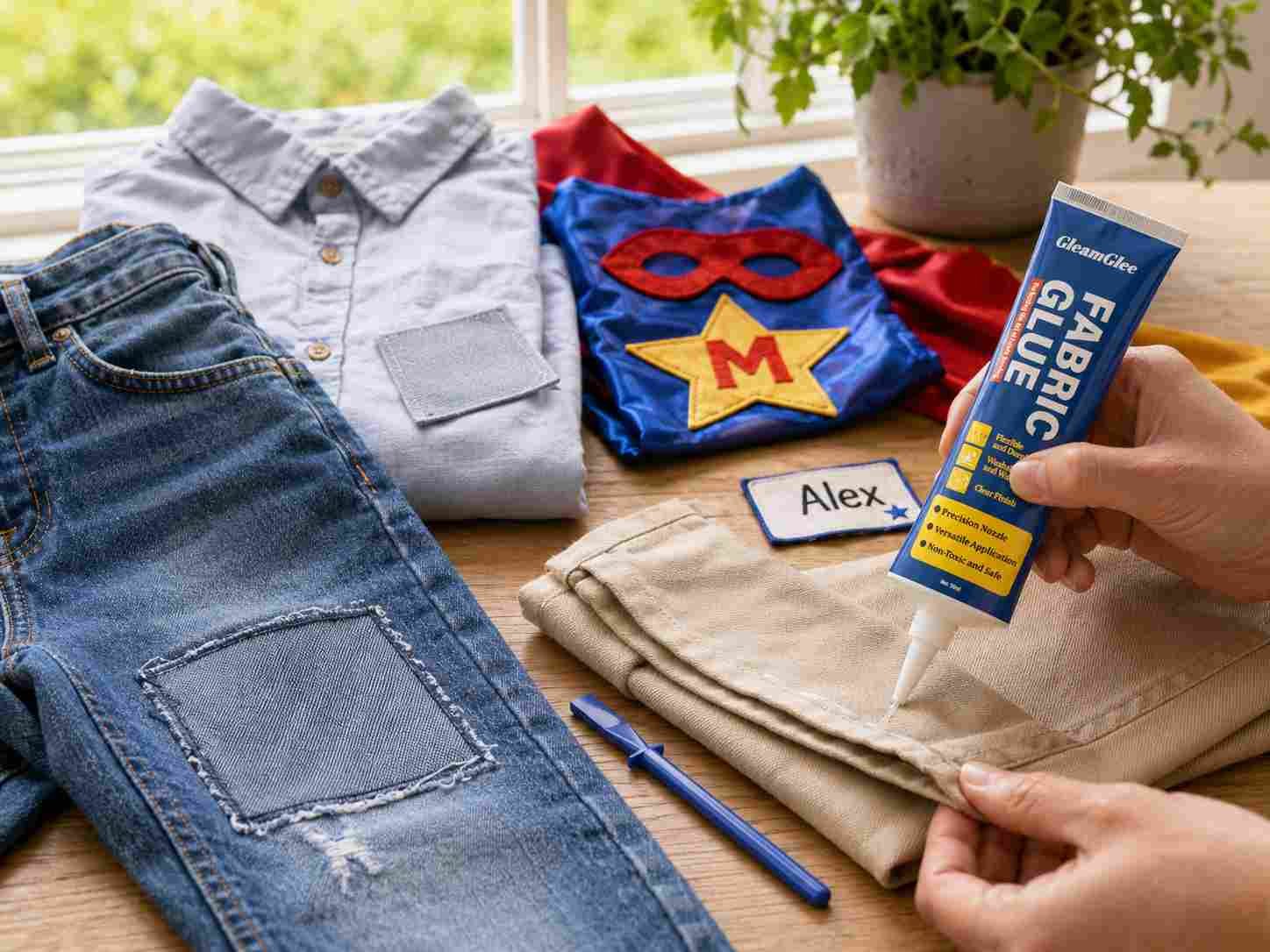
Decorative patches are especially effective because the repair does not need to disappear completely. Embroidered or printed patches can cover damage on shirts, jeans, work uniforms, children’s clothing, fabric bags, and costume pieces.
A patch placed over a knee, elbow, pocket corner, or fitted area experiences repeated flexing. Glue may hold the center securely, but the edges can gradually lift. Sewing around the perimeter often improves performance while preserving the flat bonded appearance.
The original fabric should be tested with light hand tension before repair. If the material tears easily beyond the visible hole, a larger reinforcement area or replacement panel may be needed.
Decorations and Costumes
Fabric glue is particularly useful for decorative textile work. Sequins, rhinestones, lace, ribbons, felt shapes, embroidered motifs, fabric letters, and appliqués can be slow or awkward to attach with individual stitches.
The application pattern should match the decoration:
- Use tiny dots for sequins and rhinestones.
- Use a narrow line for ribbons and narrow trim.
- Use spaced dots on lace to reduce visible bleed-through.
- Use thin full coverage for felt pieces and patches.
- Work from the center outward on large appliqués.
A precision nozzle provides better control than a wide opening. It helps keep glue away from visible edges and reduces the risk of squeeze-out.
Decoration weight must also be considered. A lightweight fabric patch is easier to bond than a cluster of heavy stones, metal pieces, or thick beads. Heavy decorations may need stitches at key points even when adhesive covers the remaining area.
Costumes are often used for only a few events, but they can still experience heat, sweating, bending, and rapid movement. Decorative surface details are good adhesive applications. Shoulder joins, capes, fitted bodices, belts, and load-bearing costume elements should normally be reinforced with stitching.
For wedding dresses, formalwear, or delicate costume materials, testing on spare fabric is essential because adhesive may affect color, transparency, or drape.
Home and School Projects
Home textile and school projects often use stable materials and broad bonding areas, making them suitable for fabric glue.
Common projects include:
- Curtain trim and simple curtain hems
- Table runners and banners
- Felt ornaments and fabric wreaths
- Fabric letters and school displays
- Soft-toy details
- Pencil cases and book covers
- Loose linings inside bags
- Decorative cushion elements
- Holiday stockings and fabric signs
Fabric glue can save time when many small decorative pieces must be positioned. It also avoids exposed needles in projects completed by less experienced users.
Children should use adhesive under adult supervision and according to the product label. Low odor does not remove the need for ventilation or careful handling.
Furniture and automotive textiles need more caution. A loose decorative trim or headliner edge may be suitable for an appropriate adhesive, but seat seams and upholstery areas exposed to body weight require structural repair.
Vehicle interiors can also reach high temperatures in direct sunlight. An adhesive used on a car headliner or interior trim should be checked for temperature suitability rather than selected only because it bonds fabric.

Which Fabrics Are Better Glued or Sewn?
Stable woven materials such as cotton, denim, felt, canvas, and linen are usually easier to glue. Stretch knits, sheer textiles, coated fabrics, and technical materials require more testing. Sewing remains preferable when the textile must expand repeatedly, carry weight, preserve waterproof construction, or allow future alteration.
Cotton, Denim, and Canvas
Cotton generally bonds well because the fibers allow controlled adhesive penetration. It is widely used for hems, patches, appliqués, table linens, craft bags, decorative clothing repairs, and school projects.
Thin cotton requires careful application. Too much adhesive may soak through, darken the front surface, or form a visible outline. Light-colored and printed fabrics should be tested in a hidden area.
Denim has a thicker and more textured surface, which often gives fabric adhesive a useful area to grip. Common denim applications include decorative patches, pocket repairs, hems, labels, and reinforcement over small holes.
A denim repair should not rely only on two frayed edges touching. A backing or surface patch increases the contact area and moves stress away from the tear.
Canvas also bonds well, but its weight can be misleading. A decorative canvas patch may be suitable for glue, while a canvas bag handle still requires sewing because it carries a load.
| Fabric Type | General Glue Suitability | Main Precaution | Typical Uses |
|---|---|---|---|
| Cotton | Good | Avoid soak-through | Hems, patches, crafts |
| Denim | Good | Reinforce high-flex areas | Jeans patches, labels |
| Felt | Very good | Apply an even layer | Decorations and crafts |
| Canvas | Good | Check weight and stiffness | Bags and home décor |
| Linen | Moderate to good | Loose weave may absorb glue | Table textiles and trim |
| Woven polyester | Moderate | Test surface treatments | Costumes and linings |
New fabrics may contain softeners, stain repellents, sizing agents, or factory finishes that reduce adhesion. Washing before bonding can help when appropriate, but the fabric should be completely dry before application.
Stretch and Knit Fabrics
Stretch textiles create a more demanding bond because the adhesive layer must expand and recover with the material. Leggings, activewear, jersey, swimwear, ribbed knits, and elastic components can change significantly in length during wear.
A flexible fabric adhesive may be suitable for decorative labels, small patches, and areas that experience limited movement. It is less reliable for waistbands, fitted side seams, knees, elbows, and other areas stretched around the body.
The intended direction of movement should be tested. A patch may look secure while flat but begin peeling when the fabric is extended. A practical home test is to glue a spare piece, allow the full cure, and repeatedly stretch it in the same direction as the final garment.
Structural knit seams normally need a stitch that can expand. Zigzag, overlock, cover stitch, and dedicated stretch stitches are designed for this purpose. A standard straight stitch may snap even when strong thread is used.
Glue can still assist by positioning a patch before sewing. However, the adhesive layer should remain thin. A large stiff area changes how the garment moves and may cause the surrounding fabric to tear at the edge of the repair.
Highly technical sportswear may also contain moisture-wicking, water-resistant, or silicone-based finishes that reduce adhesion. Compatibility testing becomes especially important.
Delicate and Sheer Fabrics
Silk, chiffon, organza, satin, lace, tulle, and other delicate materials can reveal even a small application mistake. Adhesive may darken the textile, spread through an open weave, produce shine, or change how light passes through the fabric.
Small amounts are safer than a heavy continuous line. Whenever possible, adhesive should be placed on the reverse side of the decoration rather than directly on the garment. Fine nozzles or micro-applicators can improve control.
Lace may require spaced dots rather than complete coverage. This reduces bleed-through and helps preserve softness. Chiffon and organza should be tested after complete curing because the wet adhesive can look very different from the final clear film.
Sewing also carries risks. A needle that is too large may leave permanent holes. Heavy thread can distort the weave, and incorrect tension may create puckering.
The correct method depends on the task. Attaching a small lace motif may be easier with glue. Joining two major silk garment panels is generally better handled through careful sewing.
Expensive bridal wear, vintage textiles, collectible garments, and museum-quality fabric should not be treated as ordinary household projects. Professional textile repair is safer when the material cannot easily be replaced.
Coated and Technical Fabrics
Waterproof, stain-resistant, waxed, laminated, silicone-treated, and vinyl-coated fabrics may resist general fabric glue. These surfaces are designed to limit liquid penetration, which can also prevent an adhesive from reaching the fibers.
Examples include rainwear, tents, outdoor covers, coated nylon, faux leather, vehicle fabrics, sports equipment, and some bags.
Sewing through waterproof material creates holes that may allow leakage. Outdoor equipment is often stitched first and then treated with a dedicated seam sealer. A general textile adhesive should not be assumed to replace this construction.
Lightly abrading a surface may improve grip, but it can also damage the coating, color, gloss, or waterproof barrier. Surface sanding should only be carried out when it is specifically permitted by the material and adhesive instructions.
Tents, waders, inflatable products, life jackets, and protective clothing should use repair systems designed for their exact substrate. These items may face water pressure, immersion, heat, folding, or safety-related loads that ordinary clothing glue is not intended to manage.
For a decorative patch on a coated bag, a hidden-area test may be sufficient. For a repair that must remain waterproof or pressure-resistant, use a specialty adhesive matched to the material.
How Do Time, Cost, and Skill Compare?
Fabric glue needs less active work and fewer tools, making it practical for beginners and occasional repairs. Sewing requires more skill but becomes efficient for repeated alterations and structural work. Glue often costs less for one-off projects, while sewing equipment can offer better long-term value for people who regularly make or repair garments.
Active Time and Cure Time
Fabric glue is quick to apply. A small patch, appliqué, or hem may take only a few minutes of active work. The trade-off is that the project must remain undisturbed during setting and full curing.
An initial setting period of approximately 6–10 minutes allows time to align most small pieces. A full cure of 24 hours means the item should not be worn, washed, stretched, or ironed until the next day.
Hand sewing requires more active involvement. A small repair may take 10–30 minutes depending on access, fabric thickness, and stitch type. Machine sewing may be faster once the machine is threaded, adjusted, and ready.
Urgency changes the better choice. Glue is convenient when the project can be completed now and used tomorrow. Sewing is better when the garment must be worn immediately after repair.
The size and number of projects also matter. Applying adhesive to one folded curtain edge may be easier than setting up a machine. Sewing several long curtain panels by machine will usually become faster than gluing every edge and finding enough flat space for curing.
Active time and total elapsed time should therefore be treated separately. Glue often minimizes hands-on work, while sewing may minimize waiting.
Learning Curve
Fabric glue has a lower technical barrier. Most users can understand the basic sequence quickly: clean, test, apply, align, press, and cure.
The main mistakes are usually related to control rather than advanced technique:
- Applying too much adhesive
- Bonding dirty or damp fabric
- Allowing pieces to move during setting
- Placing glue too close to a visible edge
- Washing before full cure
- Choosing glue for a structural seam
- Skipping a compatibility test
Hand sewing introduces more variables, including needle selection, knots, thread tension, stitch length, seam allowance, and even spacing. These skills take practice but allow greater control over garment structure.
Machine sewing adds threading, bobbin placement, presser-foot selection, tension settings, needle type, and troubleshooting. Once learned, it is highly efficient for repeated work.
For school projects, costumes, decorations, emergency repairs, and occasional household tasks, fabric glue is easier for most beginners. For regular garment construction or alteration, sewing skills provide more flexibility.
Physical comfort should also be considered. Some people find fine needlework difficult because of vision or hand mobility. Others may find controlling a squeeze tube difficult. The practical choice is the method that can be used accurately and safely.
Cost and Project Volume
A tube of fabric glue can complete several small repairs without a major equipment purchase. This makes it economical for households that occasionally repair hems, patches, curtains, accessories, and craft projects.
Hand sewing can also be inexpensive when needles, thread, and scissors are already available. A basic repair kit may last for years.
Machine sewing requires a higher initial investment and may involve replacement needles, bobbins, thread colors, presser feet, maintenance, measuring tools, and practice materials.
| User or Project Type | Usually More Economical |
|---|---|
| One clothing repair | Fabric glue |
| Occasional craft projects | Fabric glue or hand sewing |
| Frequent clothing alterations | Sewing |
| Costume decoration | Fabric glue |
| Regular garment production | Machine sewing |
| Mixed household repairs | Both methods |
| Large repeated batches | Machine sewing or engineered bonding process |
Waste influences the real cost. A clogged nozzle, dried tube, excessive application, or failed repair reduces the value of adhesive. A built-in cap pin helps keep a precision nozzle clear between projects.
Packaging size should match expected use. A larger tube may have a lower unit cost but is not economical when most of it remains unused for a long period.
GleamGlee Fabric Glue is available as a 50 ml single tube or a two-tube package, allowing occasional users and frequent crafters to select a more suitable quantity.
Appearance and Finish
Fabric glue can provide a clean finish because no thread passes through the visible surface. It is especially useful beneath patches, folded hems, ribbons, lace, felt shapes, and appliqués.
The final appearance still depends on application. Too much glue may create a hard outline, dark area, glossy patch, or visible ridge. Clear-drying adhesive is not completely invisible when it changes the texture of the material.
Sewing can also be discreet. Blind hemming and hidden hand stitches can create a nearly invisible result. Decorative stitches may intentionally become part of the design.
Poor sewing can leave crooked lines, loose loops, puckering, mismatched thread, or visible knots. Poor gluing can leave bleed-through, stiff edges, squeeze-out, or uneven alignment.
The original construction of the item should guide the repair. A tailored jacket with carefully finished seams normally looks better when repaired with matching stitches. A felt ornament, costume motif, or embroidered patch may look cleaner when bonded.
The repair should be checked after complete drying under normal lighting. Thin fabric may appear acceptable from the front but reveal a shadow or hard edge from the side. Evaluating the front, back, and drape gives a more realistic picture of the finished quality.

How Do You Choose the Right Method?
Choose fabric glue for broad, low-stress bonds where speed and an invisible finish matter. Choose sewing for structural seams, repeated stretching, weight-bearing areas, and repairs likely to need alteration. Before starting, check fabric compatibility, contact area, washing habits, movement, heat exposure, cure time, and the consequences if the repair fails.
The Seven-Point Check
A simple project check prevents most method-selection mistakes.
First, examine the contact area. Broad overlaps are suitable for adhesive. Narrow torn edges are less reliable unless a backing patch is added.
Second, consider stress. A decorative label experiences little force. A waistband or shoulder strap is pulled repeatedly.
Third, check movement. Stable cotton behaves differently from elastic sportswear.
Fourth, think about washing. Frequent warm washing, strong spinning, and tumble drying place greater demands on the repair.
Fifth, consider appearance. Glue avoids stitch lines but may mark thin or sheer fabric.
Sixth, allow enough curing time. When the item must be used immediately, sewing may be more practical.
Seventh, decide whether the repair may need to be changed. Stitches can normally be removed. Permanent adhesive is far more difficult to reverse.
The same textile may require different methods in different areas. A decorative patch on a cotton shirt may be glued successfully. The shoulder seam of that shirt should normally be sewn.
The checklist helps users move beyond the general question of whether fabric glue is “strong.” Strength only has meaning when it is matched to the actual load, material, environment, and service life of the project.
High-Stress Areas
High-stress areas should usually be sewn. These include waistbands, armholes, fitted side seams, crotch seams, pocket corners, bag handles, shoulder straps, tight closures, and structural upholstery edges.
Repeated pulling can cause an adhesive bond to begin peeling from one edge. Once peeling starts, the bonded area becomes progressively smaller and the remaining section carries more force.
Stitching transfers the load across a longer seam and can be reinforced with multiple rows, backing fabric, bar tacks, or wider seam allowances.
The consequences of failure matter as much as the load. A detached decorative letter is easy to fix. A failed backpack handle may drop valuable contents. Repairs involving protective clothing, sports equipment, children’s products, or weight-bearing structures should not depend on ordinary fabric glue alone.
Adhesive may still be used to position a reinforcement patch before sewing. When possible, it should be kept away from the main stitch path because a thick cured layer can increase needle resistance or cause skipped stitches.
If the surrounding fabric is badly weakened, simply adding stronger thread may not be enough. A wider patch or replacement fabric panel may be needed to transfer stress into sound material.
Using Both Methods
Fabric glue and sewing are often complementary rather than competing methods. Adhesive can hold a patch flat, prevent edges from shifting, align decorative trim, and reduce the need for pins. Stitching can then manage long-term tension.
This approach is useful for:
- Denim knee patches
- Backpack linings
- Costume appliqués
- Upholstery patches
- Quilting pieces
- Decorative collars
- Large embroidered patches
- Pocket reinforcements
A small amount of adhesive in the center of a patch is often enough to hold its position. The perimeter can remain clear for stitching. This reduces stiffness and makes later repair easier.
The two methods should have separate roles:
- Adhesive controls surface contact and alignment.
- Thread controls concentrated pulling.
- Backing fabric spreads force beyond the damage.
- Full curing prevents movement before use.
Using both methods does not mean using excessive glue and extremely dense stitching. Too much material can create a hard repair that feels uncomfortable and moves differently from the surrounding textile.
A combined repair is often the most practical answer when the project needs both a clean appearance and dependable reinforcement.
Choosing a Fabric Adhesive
A permanent fabric adhesive should be selected according to performance, not only the words “fabric glue.” Important characteristics include:
- Flexible drying
- Clear or non-yellowing finish
- Wash resistance
- Suitable curing time
- Compatibility with the intended textile
- Controlled application
- Appropriate heat resistance
- Storage and nozzle reliability
For clothing repairs, hems, patches, ribbons, sequins, curtains, denim, and craft fabrics, a soft cured film is generally more comfortable than a hard adhesive layer.
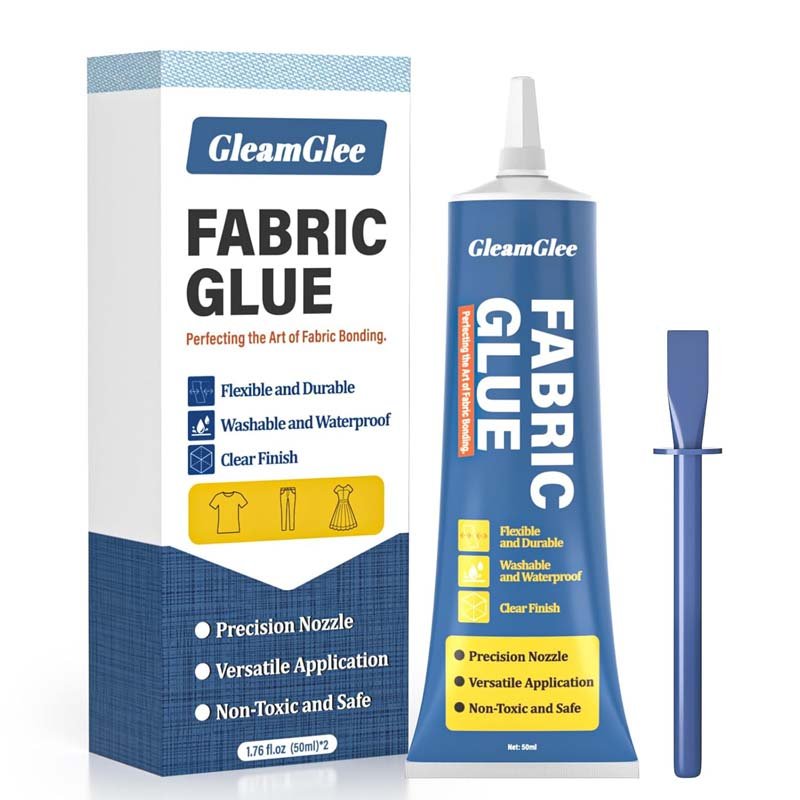
GleamGlee Fabric Glue is supplied in 50 ml single-tube and two-tube formats. Its precision tip supports controlled application on small decorations, folded hems, patches, and detailed craft work. The built-in cap pin helps reduce nozzle clogging between uses.
The adhesive begins setting in approximately 6–10 minutes and reaches full cure in 24 hours. It dries transparent, remains flexible, and is designed for washable and ironable textile repairs after curing.
For business buyers, adhesive selection also involves batch consistency, viscosity, shelf life, packaging durability, label compliance, application performance, and compatibility with the target market.
Retailers, distributors, Amazon sellers, and private-label brands may require a ready-made formula, alternative packaging, customized viscosity, branded labels, multilingual instructions, or a formula adjusted for a specific textile category.
Conclusion
Fabric glue and sewing solve different types of textile problems. Sewing remains the stronger and more conservative choice for structural seams, weight-bearing areas, fitted garments, repeated stretching, and repairs that may later need adjustment. Fabric glue is often more practical for hems, decorative patches, appliqués, ribbons, curtains, costumes, felt crafts, and other projects where broad surface contact and a clean no-stitch appearance matter.
The most reliable decision comes from examining how the finished item will actually be used. Stable cotton, denim, canvas, felt, and home textiles are generally easier to glue than highly elastic, sheer, coated, or technical fabrics. A wide bonded patch normally performs better than a narrow edge-to-edge repair. A washable adhesive still needs complete curing, and an ironable formula should still be used within the recommended temperature range.
In many real projects, the best result is not fabric glue or sewing alone. Glue can align and flatten a patch, while stitches reinforce the perimeter. Assigning a clear role to each method often produces a repair that looks cleaner and lasts longer.
GleamGlee supplies ready-to-use fabric glue for household repairs, clothing alterations, craft projects, retail sales, and professional distribution. The available 50 ml single-tube and two-tube formats provide flexible options for different project volumes.
For private-label, OEM, ODM, wholesale, retail, and distributor projects, GleamGlee can support existing formulas or customized textile adhesive development. Services include formula adjustment, packaging selection, logo and label customization, multilingual artwork, compliance documentation, samples, FBA-ready packaging, and international shipping support.
Custom projects may begin from approximately 200 units, depending on the formula and packaging specification. Packaging and label artwork can be prepared in as little as two days. Samples typically require 7–14 days, while standard bulk production is generally completed in approximately 20 days. Expedited production may be available in about 15 days for qualifying projects.
Buyers requesting a quotation should provide the intended fabric types, target applications, required package size, expected order quantity, sales market, preferred branding, and any benchmark product. These details allow the technical and sales teams to recommend an existing fabric glue or prepare a more suitable customized adhesive solution.