Skip to content
How to Choose Construction Adhesive for Lowe’s DIY Projects: A Complete Guide
Your trusted adhesives glue & cleaner manufacturer

A small home repair can become annoying when the material looks simple but refuses to stay in place. A bathroom tile keeps lifting at one corner. A strip of baseboard pulls away from the wall. A garden stepping stone shifts after rain. A kitchen backsplash edge starts to loosen near the sink. Many Lowe’s DIY projects begin this way: not big enough to hire a contractor, but too visible to ignore.
Construction adhesive for Lowe’s DIY projects should be chosen by surface, room, weather exposure, material weight, coverage, and curing time. A good adhesive should bond common DIY materials such as tile, stone, concrete, wood, drywall, brick, and stucco. It should also be easy to apply, low-odor for indoor spaces, strong enough for rough surfaces, and durable enough for outdoor rain, heat, and cold.
The real question is not only “Which adhesive is strong?” It is “Which adhesive fits this exact repair?” A product used behind a bathroom tile faces moisture. A product used on an outdoor path faces rain and temperature change. A product used on trim needs clean control because squeeze-out can ruin the finish. The right construction adhesive helps reduce drilling, cuts down on visible nail holes, saves replacement cost, and gives ordinary homeowners more confidence to finish repairs neatly.
What Is Construction Adhesive?
Construction adhesive is a strong bonding product used for home repair, installation, and small remodeling work. It helps attach heavier materials such as tile, stone, concrete, brick, wood, drywall, stucco, and trim. In Lowe’s DIY projects, it is often used when nails, screws, mortar, or standard glue would be too messy, too visible, or too difficult to use.
Unlike ordinary glue, construction adhesive is made for surfaces that are rough, porous, uneven, vertical, or exposed to daily wear. A loose kitchen backsplash tile, a lifting baseboard, a shifting garden stone, or a decorative wood panel may all need stronger contact than craft glue can provide. The adhesive must hold weight, fill small surface gaps, and stay stable after curing.
The best construction adhesive is not only about maximum strength. It should match the repair surface, project location, working time, finish quality, and curing conditions. For practical home use, a multi-surface adhesive with medium consistency, low odor, controlled application, and indoor-outdoor durability is usually more useful than a product that is only strong but difficult to apply cleanly.
Construction Adhesive Basics
Construction adhesive works by creating a strong contact layer between two building or repair materials. The bond becomes stronger as the adhesive cures and the materials remain pressed together. This is why surface preparation, adhesive amount, pressure, and curing time matter so much. A powerful adhesive can still fail if it is applied over dust, grease, loose paint, wet grout, or crumbling concrete.
In home repair, the surface is rarely perfect. Concrete may have powder on top. Brick may have open pores. Drywall may have painted paper. Tile may be smooth on the front but rough on the back. Wood may absorb moisture from the air and move slightly. A useful construction adhesive needs enough body to stay in place while also spreading well enough to make contact with these surfaces.
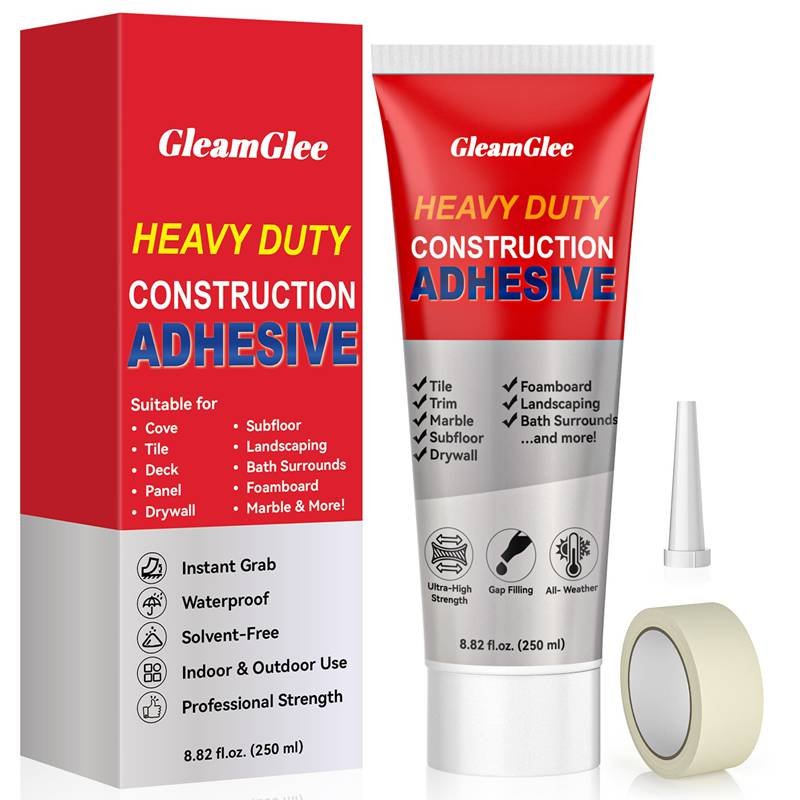
GleamGlee Construction Adhesive uses a medium-consistency formula. This matters because very thin glue can run down vertical surfaces, while overly thick adhesive can be hard to squeeze and may leave raised spots behind tile or trim. A medium texture gives better control for everyday repairs.
| Adhesive Factor | What It Means in Real Projects |
|---|---|
| Medium consistency | Easier to squeeze, spread, and control by hand |
| Strong surface grip | Better for concrete, brick, stone, tile, wood, and drywall |
| Gap contact | Helps bond slightly uneven surfaces |
| Low odor | More comfortable for kitchens, bathrooms, and basements |
| Weather resistance | Useful for patios, balconies, outdoor kitchens, and garden repairs |
| Controlled nozzle | Helps reduce waste and edge mess |
For a small repair, neat placement can matter as much as strength. A tile that sits flat, a trim strip with no glue squeeze-out, and a stone piece that does not wobble all depend on controlled application.
Construction Adhesive Uses
Construction adhesive is used across many Lowe’s DIY-style repairs because one home project often involves several materials. A bathroom wall may include tile, drywall, cement board, and painted trim. A kitchen backsplash may involve ceramic tile, glass tile, stone, and wallboard. A patio repair may involve stone, concrete, brick, and outdoor moisture.
GleamGlee Construction Adhesive is suitable for concrete, tile, stone, wood, drywall, stucco, brick, and similar building surfaces. It can be used for kitchen backsplashes, bathroom tile, bathtub surrounds, vanity backsplash areas, basement repairs, garden paths, patio stones, balconies, outdoor kitchens, decorative walls, stair riser accents, tabletop tile, and mosaic projects.
| Project Area | Common Use | Key Concern |
|---|---|---|
| Bathroom | Wall tile, floor tile, vanity backsplash | Moisture and clean edge control |
| Kitchen | Backsplash, wall accents, tile repair | Grease removal and neat finish |
| Basement | Concrete, brick, drywall, tile | Dust, dampness, and surface stability |
| Living area | Trim, feature walls, panels | Invisible bonding and clean appearance |
| Outdoor | Patio, terrace, stepping stones | Rain, heat, and cold resistance |
| Small repair | Broken tile, mosaic, tabletop tile | Precision and low waste |
It is especially useful when drilling may damage the surface. Tile can crack under a drill bit. Brick may crumble at the edge. Finished trim can split from nails. Painted walls can show screw holes. Construction adhesive helps keep the front surface clean while bonding from behind.
The repair still needs the right limit. Construction adhesive is excellent for bonding and repair, but it should not replace structural fasteners where heavy load, overhead risk, or building-code support is required. For decorative, repair, and light-to-medium installation work, it can make the job simpler and cleaner.
Construction Adhesive Benefits
The biggest benefit of construction adhesive is that it can save time, tools, and replacement cost. Many small home problems do not require full replacement. A loose tile may only need cleaning, adhesive, pressure, curing, and regrouting. A lifted baseboard may not need new nails, filler, sanding, and repainting. A garden stone may not need the whole path rebuilt.
An 8.8 oz tube of GleamGlee Construction Adhesive can cover up to about 30 feet, depending on bead thickness and surface texture. Smooth trim usually uses less adhesive. Rough stone, brick, stucco, and concrete usually use more because the surface needs extra contact. This makes coverage planning easier before starting a repair.
| Repair Situation | Usual Problem | Adhesive Advantage |
|---|---|---|
| Loose backsplash tile | Visible gap near sink or stove | Reset the tile without replacing the full wall |
| Lifted baseboard | Nail holes or cracked caulk line | Bond from behind for a cleaner look |
| Shifting patio stone | Movement after rain or foot pressure | Improve contact with a stable base |
| Wall panel repair | Screws may look unattractive | Hidden bond behind the panel |
| Broken decorative tile | Matching tile may be hard to find | Reuse or reset the original piece |
| Brick or stucco accent | Surface is hard to drill | Bond without creating extra holes |
Another practical benefit is workability. Some adhesives grab too quickly, leaving little room for adjustment. Others stay soft for too long, causing slipping on walls. A balanced construction adhesive gives enough time to position the material while still building a firm bond after curing.
For indoor jobs, low odor is also important. Repairs often happen in kitchens, bathrooms, laundry rooms, basements, and hallways. A low-odor adhesive makes the work more comfortable, especially when the room cannot stay open for hours.
Construction Adhesive Limits
Construction adhesive is strong, but it is not a shortcut for every repair. It performs best when the surface is clean, dry, solid, and properly fitted. If the wall is soft from water damage, the concrete is crumbling, the tile back is covered with loose old mortar, or the wood is badly warped, the repair may fail even with a good adhesive.
The most common failure points are not complicated:
| Problem | Why It Causes Failure | Better Fix |
|---|---|---|
| Dusty surface | Adhesive bonds to dust, not the material | Brush, wipe, or vacuum first |
| Wet surface | Moisture weakens contact or slows curing | Let the area dry fully |
| Grease or soap film | Creates a slippery barrier | Clean kitchen or bathroom surfaces first |
| Loose paint | Paint peels away under stress | Remove weak paint before bonding |
| Too much adhesive | Causes squeeze-out and uneven seating | Use controlled beads or dots |
| No holding support | Material shifts before curing | Use tape, clamps, weight, or braces |
Construction adhesive also needs curing time. A piece may feel attached after a short period, but that does not mean it is ready for water, heavy use, vibration, or outdoor weather. For many household repairs, allowing about 24 hours before heavy use is a safer habit.
It should also be used carefully for overhead or high-load applications. Heavy hanging objects, structural supports, ceiling-mounted materials, and safety-critical repairs may need screws, anchors, brackets, or professional installation. Construction adhesive is excellent for many DIY repairs, but the best result comes from using it where bonding is appropriate and supporting it properly while it cures.
Which Lowe’s DIY Projects Fit?
Construction adhesive fits Lowe’s DIY projects that need strong bonding on tile, wood, stone, concrete, drywall, brick, stucco, and trim. It is especially useful for small repairs, decorative upgrades, vertical bonding, outdoor fixes, and areas where nails, screws, or drilling may leave visible damage.
Many home projects do not need a full remodel. A single loose tile, a lifted baseboard, a moving patio stone, or a small backsplash gap can usually be repaired if the base surface is still solid. Construction adhesive works well in these cases because it bonds from behind, keeps the front surface cleaner, and reduces the need for heavy tools.
The best-fit projects are repairs where the material sits close to the surface, the bond area can be cleaned, and the piece can be held still while curing. It is less suitable for unstable walls, wet damaged surfaces, overhead heavy loads, or repairs that require structural fasteners.
Construction Adhesive for Tile
Tile is one of the most common Lowe’s DIY repair areas. Bathroom wall tile, kitchen backsplash tile, vanity backsplash tile, bathtub surround tile, and decorative mosaic tile can loosen from water, heat, impact, poor old adhesive, or wall movement. If the tile itself is not badly broken and the base surface is still firm, construction adhesive can help reset the piece cleanly.
For tile repairs, surface preparation decides the result. The back of the tile should not be covered with loose old mortar or dust. The wall or floor area should be dry and stable. If the tile is near a sink, shower, or stove, soap film, grease, or moisture must be removed first.
| Tile Project | Fit Level | Main Concern |
|---|---|---|
| Kitchen backsplash repair | High | Grease and edge cleanliness |
| Bathroom wall tile | High | Moisture and curing time |
| Vanity backsplash | High | Clean visible finish |
| Bathtub surround tile | Medium to high | Water exposure after curing |
| Floor tile spot repair | Medium | Foot pressure and base stability |
| Shower floor tile | Lower | Constant water and drainage conditions |
Step 1: Remove loose grout, old adhesive lumps, and dust.
Step 2: Dry the tile back and repair area fully.
Step 3: Apply controlled lines or dots of adhesive.
Step 4: Press the tile flat and check alignment.
Step 5: Use tape or spacers to prevent sliding.
Step 6: Wait for proper curing before grouting or water exposure.
GleamGlee Construction Adhesive is useful for tile because the precision-tip cap helps control application near visible edges, and the included fixing tape helps hold wall tile during curing.
Construction Adhesive for Wood
Wood projects often fit construction adhesive well because many wood pieces are decorative, narrow, or difficult to fasten without marks. Lowe’s DIY projects may include baseboards, wood trim, cabinet accents, stair riser panels, wall slats, small shelves, repair blocks, and decorative wood panels.
Adhesive is especially helpful when the front surface should stay clean. Nails can split thin trim. Screws can leave holes. Staples can damage delicate strips. Construction adhesive spreads holding force behind the wood, making the finished surface look smoother.
| Wood Project | Fit Level | Better Use Method |
|---|---|---|
| Baseboard repair | High | Thin bead behind loose section |
| Decorative wall slats | High | Parallel adhesive lines |
| Cabinet trim | High | Small controlled dots or bead |
| Stair riser accents | Medium to high | Full contact plus temporary tape |
| Wood panel wall | Medium | Multiple lines and firm pressing |
| Warped boards | Low | Needs clamping or replacement |
Wood should be dry, clean, and close-fitting before bonding. Glossy painted wood may need light sanding. Raw wood should be dust-free. If the wood springs away from the wall, use tape, clamps, or temporary support while curing.
A useful rule: adhesive should hold the wood in place, not fight a badly bent piece forever. If the board is twisted, swollen, or under strong tension, trimming or replacing the piece gives a better result than using more adhesive.
Construction Adhesive for Stone
Stone projects need stronger bonding because the material is heavy and often uneven. Construction adhesive fits many stone-related Lowe’s DIY jobs, including garden stepping stones, patio edge repairs, decorative stone walls, balcony stone tile, fireplace surround accents outside direct flame, outdoor kitchen tile, and small stone cladding repairs.
Stone surfaces usually have dust, powder, soil, or uneven backs. These details matter. If adhesive touches only the high points of a rough stone, the bond may be weak. A medium-consistency adhesive helps fill small uneven areas and create better contact.
| Stone Project | Fit Level | Main Stress |
|---|---|---|
| Garden stepping stone | High | Rain, soil, movement |
| Patio stone repair | High | Heat, cold, foot pressure |
| Decorative stone wall | Medium to high | Weight and vertical sliding |
| Balcony stone tile | Medium to high | Weather and water exposure |
| Fireplace surround | Medium | Use away from direct flame |
| Loose stone under constant load | Lower | May need mechanical support |
For stone repair, clean first and apply adhesive in a pattern that matches the back surface. Dots work well for raised contact points. Beads work better for flatter stone. Heavy pieces need support while curing.
Outdoor stone repairs should be protected from rain during early curing. Even a weather-resistant adhesive needs time to build strength before it faces water, heat, or freezing conditions.
Construction Adhesive for Trim
Trim is a strong fit for construction adhesive because the repair is usually visible and small. Loose baseboards, lifted molding, door casing gaps, cabinet trim, tile-edge strips, and decorative wall molding can make a room look unfinished. Adhesive can secure these pieces without adding many nail holes or screw marks.
The main challenge with trim is squeeze-out. Trim is narrow, so too much adhesive can push out along the edge and create cleanup work. A thin bead is usually better than a thick line. Press evenly and remove visible excess before it dries.
| Trim Project | Fit Level | Best Practice |
|---|---|---|
| Loose baseboard | High | Thin bead plus tape |
| Door casing gap | High | Press flat at both ends |
| Cabinet trim strip | High | Clean back surface first |
| Wall molding | High | Tape until cured |
| Tile-edge trim | Medium to high | Avoid adhesive near visible edge |
| Heavy decorative molding | Medium | May need nails or braces too |
GleamGlee Construction Adhesive’s precision-tip cap helps with trim because it allows narrow placement behind small pieces. Fixing tape can hold light trim while the adhesive cures.
For a cleaner result, dry-fit the trim first. If the gap closes easily by hand, adhesive is a good choice. If the trim pulls away strongly, use extra holding support or combine adhesive with mechanical fastening.

How to Pick Construction Adhesive?
Construction adhesive should be picked by surface, room, weather exposure, curing condition, and coverage. For Lowe’s DIY projects, the best choice is usually a multi-surface adhesive that works on tile, wood, stone, concrete, drywall, brick, and stucco while staying easy to apply, low-odor, and durable indoors and outdoors.
A good adhesive is not chosen only by the word “strong.” A bathroom wall tile needs moisture resistance. A wood trim repair needs clean edge control. A patio stone needs outdoor durability. A basement concrete repair needs grip on dusty, porous material. Matching the adhesive to the repair saves time, reduces mess, and lowers the risk of doing the job twice.
Before buying or applying construction adhesive, check three things: what materials need bonding, where the repair sits, and how long the area can stay untouched while curing. If the surface is clean, dry, solid, and close-fitting, construction adhesive can handle many small-to-medium home repairs with less drilling, fewer visible fasteners, and a cleaner finish.
Construction Adhesive by Surface
Surface type should be the first decision. Construction adhesive works best when it bonds directly to a solid surface, not dust, grease, loose paint, old crumbling adhesive, wet grout, or powdery concrete. Tile, wood, stone, drywall, brick, and concrete all need slightly different preparation because each material absorbs adhesive differently.
GleamGlee Construction Adhesive is designed for concrete, tile, stone, wood, drywall, stucco, brick, and similar surfaces. This makes it practical for Lowe’s DIY projects where more than one material appears in the same repair. A kitchen backsplash may involve tile and drywall. A patio repair may involve stone and concrete. A trim repair may involve wood and painted wallboard.
| Surface | Good Fit Projects | Preparation Needed |
|---|---|---|
| Tile | Backsplash, bathroom wall, vanity area | Remove old loose adhesive, dry the tile back |
| Wood | Trim, panels, cabinet accents | Wipe dust, lightly sand glossy finish |
| Stone | Patio, pathway, wall accent | Brush away powder, soil, and loose flakes |
| Concrete | Basement, blocks, outdoor base | Remove dust and check for crumbling |
| Drywall | Trim, panels, wall accents | Make sure paint and paper are firm |
| Brick | Outdoor repair, decorative wall | Brush pores and remove loose grit |
| Stucco | Textured wall repair | Remove weak surface particles |
Step 1: Touch and wipe the surface first. If dust, chalk, oil, or loose material comes off on the cloth, it needs cleaning before bonding.
Step 2: Dry-fit the repair piece without adhesive. Check whether it sits flat or rocks from side to side.
Step 3: Remove old weak material. Scrape away loose grout, flaking paint, dried lumps, or crumbling edges.
Step 4: Clean according to surface type. Use a dry brush for stone and concrete; use a mild cleaner for greasy kitchen areas; use a dry cloth for wood and trim.
Step 5: Let the surface dry fully before applying adhesive. Moisture can weaken early bonding and slow curing.
For tile repairs, apply adhesive in small dots or short lines on the tile back instead of covering the whole surface with a thick layer. For wood trim, a thin bead along the contact area is usually enough. For rough stone or brick, use slightly fuller beads so the adhesive can reach the uneven surface points.
Construction Adhesive by Room
The room changes the adhesive requirement. A kitchen repair faces grease, food splatter, steam, wiping, and heat near appliances. A bathroom repair faces humidity, water splash, soap residue, and slower drying. A basement repair may face concrete dust, cooler temperature, and occasional dampness. A living room repair may focus more on clean appearance because trim, panels, and feature walls are easy to see.
For indoor projects, low odor matters. Repairs are often done in active living spaces, not empty construction sites. GleamGlee Construction Adhesive is low-odor and non-toxic, making it more comfortable for kitchens, bathrooms, basements, laundry rooms, hallways, and enclosed spaces.
| Room | Common Repair | Main Risk | Better Adhesive Choice |
|---|---|---|---|
| Kitchen | Backsplash, wall accents, tile edge | Grease and heat | Low-odor, controlled bead |
| Bathroom | Wall tile, vanity backsplash, tub surround | Moisture and soap film | Moisture-resistant bonding |
| Basement | Concrete, brick, drywall, tile | Dust and dampness | Strong grip on porous surfaces |
| Living room | Trim, panels, feature wall | Visible mess | Clean application, low squeeze-out |
| Entryway | Baseboard, tile, stone | Impact and foot traffic | Durable bond and firm curing |
| Outdoor patio | Stone, tile, concrete | Rain, heat, cold | Indoor-outdoor adhesive |
Step 1: Identify the room stress. Is the repair near water, heat, grease, foot traffic, or outdoor exposure?
Step 2: Clean the surface based on the room. Kitchen areas often need degreasing. Bathroom areas often need soap film removal. Basement surfaces often need brushing and dust control.
Step 3: Choose an adhesive that matches the room. Indoor spaces benefit from low odor. Wet areas need moisture resistance after curing. Outdoor areas need weather durability.
Step 4: Plan curing time around room use. Do not repair a bathroom tile right before shower use, and do not repair a kitchen backsplash right before heavy cleaning.
Step 5: Protect the repair during curing. Use tape for vertical pieces, spacers for tile, or temporary weight for flat repairs.
For bathroom tile, the surface should be dry before adhesive is applied. If water keeps entering behind the tile, that problem should be fixed first. For kitchen backsplashes, grease is often the hidden reason a repair fails. A clean-looking wall near a stove may still have a thin oily layer that reduces bonding.
Construction Adhesive by Weather
Weather matters for patios, balconies, garden paths, outdoor kitchens, exterior tile, stone borders, and poolside areas. Outdoor repairs face rain, sun, heat, cold, humidity, and material movement. Stone, concrete, tile, and brick can expand and contract as temperatures change, which puts stress on the bond.
GleamGlee Construction Adhesive is made for indoor and outdoor use and is designed to hold through rain, heat, and freezing cold after proper curing. This makes it suitable for outdoor Lowe’s DIY projects where ordinary glue would not last.
| Weather Condition | Risk to Repair | Better Practice |
|---|---|---|
| Rain | Water enters weak gaps | Repair during a dry window |
| Heat | Surface may become too hot | Apply in shade or cooler hours |
| Cold | Curing may slow | Allow more curing time |
| Freeze-thaw | Water expands in small gaps | Clean and dry surface first |
| Humidity | Surface may stay damp | Wait for dry contact |
| Direct sun | Adhesive may skin too quickly | Avoid overheated materials |
Step 1: Check the weather before starting. Avoid applying outdoor adhesive right before rain or during extreme heat.
Step 2: Touch the surface temperature. Dark stone, tile, and concrete can become much hotter than the air.
Step 3: Clean away outdoor dirt. Soil, moss, sand, and loose grit reduce bonding strength.
Step 4: Let the area dry completely. Outdoor surfaces can hold moisture even when they look dry.
Step 5: Apply adhesive in controlled beads or dots. Rough stone may need more contact points than smooth tile.
Step 6: Keep the repair still and protected while curing. Avoid walking on repaired patio pieces too soon.
For patio stone or outdoor tile, do not rush the cure. The repair may feel solid after several hours, but rain, foot pressure, or temperature movement can still weaken an early bond. A safer habit is to allow about 24 hours before heavy use, and longer if the weather is cold, damp, or the adhesive layer is thick.
Construction Adhesive by Coverage
Coverage affects cost, project planning, and whether the repair can be finished without interruption. GleamGlee Construction Adhesive comes in an 8.8 oz tube and can cover up to about 30 feet depending on bead thickness, surface texture, and application pattern. Smooth trim uses less product. Rough stone, brick, stucco, and concrete usually need more because they have uneven contact points.
Too much adhesive does not always create a better repair. It can cause squeeze-out, raised edges, longer curing time, and messy cleanup. Too little adhesive can leave weak spots. The right amount should create steady contact without pushing excess material outside the repair area.
| Project Type | Adhesive Use Level | Suggested Pattern |
|---|---|---|
| Loose trim section | Low | One thin bead |
| One small tile | Low | Dots or short lines |
| Backsplash repair | Low to medium | Several controlled lines |
| Wood panel | Medium | Parallel lines across the back |
| Patio stone | Medium to high | Dots or beads on contact points |
| Rough brick or stucco | Higher | Fuller bead to reach texture |
Step 1: Measure the repair length or surface area. A 3-foot trim repair needs much less adhesive than a 24-by-36-inch panel.
Step 2: Choose the application pattern. Use a thin bead for trim, dots for small tile, parallel lines for panels, and fuller beads for rough stone.
Step 3: Keep adhesive away from visible edges. Pressing the material will spread it outward.
Step 4: Press firmly and check for squeeze-out. Wipe excess before it dries if the label instructions allow.
Step 5: Hold the material while curing. Tape, clamps, weights, or braces help keep the adhesive layer stable.
A useful planning rule is to prepare one extra tube for larger or rougher projects. Running out of adhesive halfway through a panel, stone path, or tile repair can create uneven bonding. For small household fixes, one 8.8 oz tube may handle several repairs if applied with control.
How to Use Construction Adhesive?
Construction adhesive works best when the surface is clean, dry, stable, and properly fitted before bonding. For Lowe’s DIY projects, the final result depends less on using a huge amount of adhesive and more on preparation, placement, pressure, and curing time. A loose tile, wood trim strip, patio stone, or decorative panel can often last for years if the repair is done carefully.
Most failed adhesive repairs happen for simple reasons. The surface was dusty. The tile was still damp from cleaning. The trim piece moved during curing. The adhesive bead was too thick. The repair was exposed to water too early. Small mistakes during setup usually matter more than the brand name printed on the tube.
GleamGlee Construction Adhesive is designed for controlled DIY use on tile, stone, concrete, wood, drywall, stucco, and brick. The medium-consistency formula helps reduce dripping on walls, while the precision-tip cap gives better control on trim edges, backsplash repairs, decorative panels, and vertical surfaces. The included fixing tape also helps hold materials steady while curing.
Construction Adhesive Prep
Preparation is the most important stage because adhesive should bond directly to the actual material surface, not dust, grease, soap film, old loose glue, peeling paint, or wet concrete powder. A strong adhesive placed on a weak surface usually fails from underneath, even if the adhesive itself is still strong.
Different materials need different preparation. Tile often collects grease or soap residue. Concrete and brick collect powder and grit. Wood may hold sanding dust or glossy finish. Outdoor stone may carry soil or moss. These layers can reduce contact between the adhesive and the repair surface.
| Surface Type | Common Problem | Better Preparation |
|---|---|---|
| Kitchen tile | Thin grease film | Degrease and wipe dry |
| Bathroom wall tile | Soap residue and moisture | Clean and fully dry |
| Wood trim | Dust or glossy paint | Wipe clean and lightly sand |
| Concrete | Loose powder | Brush and vacuum |
| Outdoor stone | Soil, sand, moss | Scrub and dry thoroughly |
| Drywall | Weak paint or paper | Remove peeling material |
Step 1: Test-fit the repair piece before opening the adhesive. Check whether the tile, trim, panel, or stone sits correctly.
Step 2: Remove old loose adhesive, weak grout, peeling paint, dust, or crumbling edges.
Step 3: Clean the area according to the material type. Degrease kitchen surfaces, brush concrete, and wipe wood clean.
Step 4: Let the surface dry completely. Even slight dampness behind tile or stone can weaken early bonding.
Step 5: Prepare holding tools before applying adhesive. Keep fixing tape, clamps, spacers, weights, or braces nearby.
For tile repairs, the back of the tile matters as much as the wall. Old hardened mortar lumps should be removed so the tile can sit flat again. For trim, dry-fit the piece first and check whether it naturally closes the gap. If the trim strongly bends outward, extra support may be needed during curing.
Construction Adhesive Amount
The correct amount of construction adhesive depends on the project size, surface texture, and material weight. A narrow trim strip needs only a thin bead. A rough patio stone may need several beads or dots across the back surface. A backsplash tile usually needs multiple small contact lines instead of one thick blob.
Using too much adhesive creates several problems. Excess material may squeeze out around visible edges, increase curing time, prevent flat seating, or make cleanup difficult. Using too little adhesive can leave weak spots with poor contact. A balanced application creates even pressure and stable bonding.
| Repair Type | Better Adhesive Pattern | Why It Works |
|---|---|---|
| Baseboard trim | One narrow bead | Keeps edges clean |
| Small wall tile | Dots or short lines | Reduces squeeze-out |
| Larger backsplash tile | Several parallel lines | Improves surface contact |
| Decorative panel | Wavy or parallel lines | Spreads holding force |
| Rough stone | Beads on raised areas | Helps grip uneven texture |
| Brick or stucco accent | Slightly fuller bead | Reaches textured surface |
Step 1: Cut the nozzle opening based on bead size needed. Smaller openings give better control for trim and tile.
Step 2: Apply adhesive slightly away from visible edges. Pressing the piece will spread the adhesive outward.
Step 3: Use lines or dots instead of one large pile. This helps the material sit flatter.
Step 4: Press the material firmly into place and shift slightly if needed to improve contact.
Step 5: Check the edges for excess adhesive and clean visible squeeze-out before curing.
GleamGlee Construction Adhesive includes a precision-tip cap, which helps place adhesive more accurately on narrow surfaces such as trim strips, tile edges, cabinet details, and decorative wall pieces. This helps reduce waste and improves the final appearance.
For rough stone or porous concrete, slightly more adhesive may be needed because the surface has uneven contact points. Smooth tile or finished trim usually needs less. The goal is complete contact, not excessive thickness.
Construction Adhesive Curing
Curing time is where the adhesive develops real holding strength. Many repairs feel solid on the surface before the bond is actually ready for weight, water, movement, or temperature changes. A backsplash tile may stop sliding quickly but still need more curing before cleaning or cooking nearby. A patio stone may feel stable but still shift under foot pressure if walked on too early.
For many Lowe’s DIY projects, allowing around 24 hours before heavy use is a safer habit, especially for tile, stone, trim, and outdoor repairs. Cold weather, thick adhesive layers, rough surfaces, and humidity can all slow curing.
| Condition | Effect on Cure Time |
|---|---|
| Thick adhesive bead | Longer cure needed |
| Cold temperature | Slower bonding |
| High humidity | Slower drying |
| Heavy material | More support time required |
| Rough stone or concrete | More adhesive contact area |
| Outdoor exposure | Needs protection during early cure |
Step 1: After pressing the material into place, avoid moving it again unless alignment is incorrect.
Step 2: Apply tape, spacers, clamps, braces, or weight immediately if needed.
Step 3: Keep water away from bathroom, kitchen, or outdoor repairs during curing.
Step 4: Avoid walking, pulling, scrubbing, or placing stress on the repaired area too early.
Step 5: Wait until the adhesive has cured properly before regrouting tile or exposing the repair to weather.
For vertical tile, support matters during curing. Even a small slide can ruin grout alignment. For trim repairs, removing tape too early can reopen the gap. For outdoor stone, rain during early curing can weaken contact before the adhesive stabilizes.
A repair should not be judged only by how quickly it “sticks.” Long-term strength comes from stable curing conditions, not speed alone.
Construction Adhesive Holding
Holding support is what keeps the repair stable while the adhesive cures. Gravity, spring tension, uneven surfaces, heavy material weight, and wall movement can all pull against a fresh bond. Construction adhesive may have strong final strength, but it still needs stillness during early curing.
GleamGlee Construction Adhesive includes fixing tape to help secure lightweight materials such as wall tile, trim, decorative strips, backsplash edges, and small panels. Heavier repairs may still require clamps, braces, weights, or temporary supports.
| Repair Type | Better Holding Method |
|---|---|
| Wall tile | Fixing tape and spacers |
| Trim strip | Painter’s tape across the length |
| Decorative panel | Tape plus temporary brace |
| Patio stone | Weight from above if stable |
| Cabinet trim | Tape or clamp |
| Stone wall accent | Support from below |
Step 1: Press the material evenly after adhesive application. Do not push only one side.
Step 2: Apply tape or support immediately before the piece shifts.
Step 3: Recheck alignment from different angles, especially for tile and trim lines.
Step 4: Leave support in place long enough for curing. Removing support too early can weaken the bond.
Step 5: Remove tape carefully to avoid pulling paint or shifting the repair.
For tile projects, spacers help keep grout lines straight while the adhesive cures. For trim, pressure should stay even along the full piece. For decorative panels, press across the entire surface instead of only in the center. For stone, make sure the piece does not rock after placement.
One common mistake is using strong pressure for only a few seconds and assuming the repair is finished. Adhesive bonds become reliable when the material stays stable long enough for the adhesive to cure evenly across the full contact area.
Does Construction Adhesive Last?
Construction adhesive can last for years when the surface is clean, dry, solid, and properly supported during curing. For Lowe’s DIY projects, durability depends on the material, surface preparation, adhesive thickness, indoor or outdoor exposure, temperature change, moisture, and whether the repaired piece moves under stress.
A strong adhesive repair is built in stages. First, the surface must be prepared. Then the adhesive must be applied in the right amount. After that, the material needs pressure and stillness while curing. If any stage is rushed, the repair may look fine at first but fail later after rain, foot traffic, cleaning, heat, or vibration.
GleamGlee Construction Adhesive is designed for indoor and outdoor use on concrete, tile, stone, wood, drywall, stucco, and brick. It is made to resist rain, heat, and freezing cold after proper curing, making it suitable for bathroom repairs, kitchen backsplashes, basement fixes, patio stones, balcony tiles, garden paths, and outdoor repair work.
Construction Adhesive in Rain
Rain tests an adhesive bond because water can enter small gaps, soften weak surface layers, and create movement under stone, tile, or concrete pieces. Outdoor repairs such as patio tile, garden stepping stones, balcony edges, poolside surrounds, outdoor kitchens, and stone borders need extra care because they are exposed to water repeatedly.
Weather-resistant construction adhesive can hold well outdoors, but the bond should not be soaked before curing. Early water exposure is one of the easiest ways to weaken an outdoor repair. Even if the adhesive is made for rain after curing, the first day matters. The surface should be dry before bonding, and the repaired area should stay protected until the adhesive has built strength.
| Outdoor Repair | Rain-Related Risk | Better Practice |
|---|---|---|
| Patio tile | Water enters edge gaps | Keep dry during curing, seal gaps later if needed |
| Garden stepping stone | Soil holds moisture under the stone | Clean and dry the base before bonding |
| Balcony tile | Rain plus foot traffic loosens weak bonds | Avoid walking during early cure |
| Outdoor kitchen tile | Water, grease, and heat mix together | Degrease and dry before applying adhesive |
| Poolside tile | Splashing and standing water stress edges | Allow full cure before water exposure |
| Stone border | Rain moves soil and grit | Bond only to a stable base |
For better rain durability, the repair should follow a dry schedule. Choose a period without rain if possible. Brush away dust, soil, moss, and loose sand. Let washed stone or concrete dry fully before applying adhesive. Press the piece into place and keep it still. Avoid stepping on, washing, or soaking the area too early.
A practical rule: if the repair is outdoors and the adhesive layer is thick, allow more curing time than a small indoor trim repair. Rough stone and concrete often need more adhesive, and thicker adhesive takes longer to cure. Protection during the first 24 hours can make a visible difference in long-term hold.
Construction Adhesive in Heat
Heat affects construction adhesive because building materials expand and contract as temperatures change. A patio stone may heat up during the day and cool at night. A dark tile surface in direct sun can become much hotter than the air. Wood trim near a sunny wall may move slightly with humidity and heat. These small movements create stress along the bond line.
GleamGlee Construction Adhesive is built to handle heat after proper curing, making it useful for outdoor patios, balconies, garden projects, garage repairs, kitchen wall areas, and outdoor kitchens. It can also be used around fireplace surrounds when the repair is outside direct flame areas and the surface conditions are suitable.
| Heat Condition | What Can Happen | Better Repair Habit |
|---|---|---|
| Direct summer sun | Tile or stone surface becomes very hot | Apply in morning, shade, or cooler hours |
| Outdoor kitchen | Heat, grease, and cleaning stress the bond | Clean well and avoid direct flame zones |
| Garage wall repair | Temperature swings between day and night | Let adhesive cure without movement |
| Fireplace surround | Warm nearby surfaces | Use only away from direct flame |
| Dark stone or tile | Absorbs heat quickly | Avoid bonding overheated surfaces |
| Wood trim | Slight expansion and contraction | Use close-fitting material and firm support |
Heat durability starts with timing. Applying adhesive to an overheated surface can make placement harder and may reduce working time. On outdoor stone, tile, or concrete, the surface can be hot even when the air feels normal. Waiting until the area cools gives better control.
Fit also matters. A piece that naturally sits flat will usually last better than a piece forced into place. If a wood strip, stone piece, or tile is under tension, heat movement can pull against the adhesive again and again. Trimming, leveling, or supporting the piece properly gives the bond a better chance to last.
Construction Adhesive in Cold
Cold weather can slow curing and increase stress on outdoor repairs. Concrete, stone, tile, and brick shrink slightly in cold conditions. If water enters tiny gaps and freezes, it can expand and push against the repaired area. This freeze-thaw movement is one reason outdoor adhesives need both strength and weather resistance.
GleamGlee Construction Adhesive is designed to handle freezing cold after proper curing. This is useful for patios, balconies, garden paths, exterior stone, outdoor tile, and garage repairs in areas with seasonal temperature changes. The key is to avoid applying adhesive to wet, frozen, icy, or unstable surfaces.
| Cold-Weather Issue | Risk to Repair | Better Practice |
|---|---|---|
| Cold surface | Slower adhesive curing | Allow longer cure time |
| Frost or ice | Prevents direct contact | Wait until surface is dry and frost-free |
| Freeze-thaw cycles | Expands water trapped in gaps | Dry surface fully before bonding |
| Cold concrete | Holds moisture longer | Check dryness carefully |
| Outdoor stone | Movement from temperature change | Use enough contact and stable pressure |
| Early foot traffic | Breaks weak early bond | Avoid use until fully cured |
Cold repairs should be planned more carefully than warm indoor repairs. If the material feels damp, icy, or chalky, bonding should wait. A surface may look dry but still hold moisture inside pores. Concrete, brick, and natural stone are especially likely to keep moisture longer than smooth tile or wood.
For outdoor winter-prone repairs, do not leave large open gaps around the repaired piece. Water entering those gaps can freeze later and create pressure. After the adhesive has cured, regrouting, sealing, or finishing the surrounding area may help protect the repair, depending on the project type.
Construction Adhesive on Walls
Wall repairs test adhesive durability because gravity pulls the material before the bond fully cures. Tile, trim, stone accents, backsplash pieces, decorative panels, and molding can slide, sag, or lift if they are not supported properly. The bond may last well only when the piece stays aligned during curing.
GleamGlee Construction Adhesive has a medium-consistency formula that helps reduce running on vertical surfaces. The precision-tip cap supports controlled placement, and the included fixing tape helps hold lightweight tile, trim, backsplash pieces, and decorative strips while curing.
| Wall Project | Durability Risk | Better Support |
|---|---|---|
| Bathroom wall tile | Tile slides before cure | Use fixing tape and spacers |
| Kitchen backsplash | Edge squeeze-out weakens finish | Apply away from visible edges |
| Wood trim | Ends spring away | Tape along the full length |
| Stone wall accent | Weight pulls downward | Add temporary support from below |
| Decorative panel | Uneven pressure creates gaps | Press across the full surface |
| Tile-edge strip | Small contact area | Use thin bead and steady tape |
For wall repairs, adhesive should not be placed too close to the edge. When the piece is pressed, adhesive spreads outward. If too much squeezes out, the repair becomes messy and may not sit flat. A controlled bead behind the material gives better contact and cleaner edges.
Long-lasting wall repairs need support until the adhesive cures. Tape, spacers, braces, or clamps keep the material from moving. Removing support too early can cause tiny shifts that are easy to see in grout lines, trim edges, or panel seams. A few extra hours of support can prevent a repair from opening again later.

Why GleamGlee Construction Adhesive?
GleamGlee Construction Adhesive is designed for practical home repair, tile work, trim fixing, stone bonding, wood panel installation, and outdoor DIY projects. It bonds common Lowe’s-style materials such as concrete, tile, stone, wood, drywall, stucco, and brick, while keeping application controlled enough for small home repairs.
Its value is not only strength. Many repairs fail because the adhesive is hard to place, smells too strong indoors, slides on vertical surfaces, or does not hold through weather changes. GleamGlee uses a medium-consistency formula, precision-tip cap, fixing tape, low-odor design, and indoor-outdoor durability to make the repair process cleaner and easier to manage.
Each 8.8 oz tube provides up to about 30 feet of coverage, depending on bead thickness and surface texture. That makes it useful for several small repairs or one larger project. For brands, retailers, Amazon sellers, and DIY product distributors, GleamGlee also supports formula development, private label packaging, compliance-ready labels, and global logistics.
Construction Adhesive Strength
Strength is the first reason people choose construction adhesive, but the real test is not only the first pull after application. A reliable adhesive needs to hold after wiping, vibration, foot pressure, humidity, sunlight, and temperature changes. A kitchen backsplash may be cleaned every week. A bathroom tile may face steam every day. A patio stone may sit through rain, hot sun, and cold nights.
GleamGlee Construction Adhesive is made for common repair surfaces, including concrete blocks, ceramic tile, porcelain tile, stone, wood panels, drywall, stucco, and brick. It is suitable for kitchens, bathrooms, basements, patios, balconies, garden paths, living room feature walls, stair riser accents, and small commercial repair areas.
| Material | Common Project | What the Adhesive Must Handle |
|---|---|---|
| Concrete | Blocks, basement repair, outdoor base | Porous surface and dust control |
| Tile | Bathroom wall, kitchen backsplash | Flat hold and clean alignment |
| Stone | Patio, garden path, wall accent | Weight, rough texture, weather |
| Wood | Trim, panels, cabinet details | Slight movement and edge contact |
| Drywall | Decorative panels, trim | Painted paper surface and light pressure |
| Brick | Exterior repair, accent wall | Pores, grit, and uneven surface |
| Stucco | Textured wall repair | Surface gaps and rough contact |
The adhesive performs best when the material fits closely and the surface is prepared. Strong bonding does not mean pouring on a thick layer. In many repairs, controlled contact gives a better result than heavy application. A thin bead behind trim, several short lines behind tile, and fuller contact points behind stone usually work better than one large blob.
Construction Adhesive Control
Control matters because most home repairs are visible. A strong adhesive that creates a messy edge can ruin the look of a backsplash, trim line, or decorative wall. A repair should look neat after the material is pressed into place, not like a patch job covered in glue marks.
GleamGlee Construction Adhesive uses a medium-consistency formula that is easy to squeeze by hand. It is not too thin, so it is less likely to run down walls. It is not overly stiff, so it can still spread into small surface gaps. The precision-tip cap helps place adhesive in narrow lines, dots, or controlled beads, which is useful for tile edges, wood trim, cabinet details, and small stone repairs.
| Control Feature | Practical Use |
|---|---|
| Medium consistency | Helps reduce dripping on vertical surfaces |
| Precision-tip cap | Better for narrow trim, tile edges, and small repairs |
| Hand-squeeze tube | Convenient for quick household jobs |
| Fixing tape included | Helps hold tile, trim, and small panels during curing |
| Smooth application | Easier to spread on rough or uneven contact areas |
| Controlled bead | Reduces waste and edge squeeze-out |
For a loose baseboard, a narrow bead can be placed behind the lifted section. For a small tile repair, dots or short lines can keep the tile flat without forcing adhesive out around the edges. For rough stone, slightly fuller beads can reach uneven contact points. This control saves cleanup time and helps the finished repair look cleaner.
The 8.8 oz tube can cover up to about 30 feet, depending on bead size. Clean application helps stretch coverage. Too much adhesive wastes product, increases cure time, and creates visible overflow. Better control means better-looking repairs and more useful coverage from each tube.
Construction Adhesive Safety
Indoor repair comfort is important. Many projects happen in kitchens, bathrooms, basements, laundry rooms, hallways, and occupied homes. A strong chemical odor can make a simple repair unpleasant, especially in rooms with limited ventilation. For daily household use, low odor is more than a small detail.
GleamGlee Construction Adhesive is formulated to be safe, non-toxic, and low-odor when used according to label directions. This makes it more suitable for indoor projects such as bathroom wall tile, kitchen backsplash repair, vanity backsplash installation, baseboard fixing, cabinet trim, wall panels, and basement repairs.
| Indoor Concern | Why It Matters | GleamGlee Advantage |
|---|---|---|
| Strong smell | Makes small rooms uncomfortable | Low-odor formula |
| Messy application | Creates extra cleanup | Precision-tip control |
| Family living areas | Repairs happen in active rooms | Non-toxic formula design |
| Visible repairs | Glue marks look unprofessional | Controlled bead placement |
| Enclosed spaces | Airflow may be limited | More comfortable indoor use |
| DIY handling | Users need simple operation | Hand-squeeze tube and fixing tape |
Basic care is still needed. Keep the adhesive away from children, avoid eye contact, close the cap after use, and follow the label instructions. A safer formula helps, but careful handling keeps the repair process cleaner and more reliable.
GleamGlee also supports clear packaging and usage instructions. The company’s design team can create multilingual labels, step-by-step usage guides, warning icons, and compliance-ready packaging for different markets. For retailers and private label customers, this helps reduce confusion and improve product trust.
Construction Adhesive Coverage
Coverage is a practical selling point because many users want to know whether one tube can finish the job. GleamGlee Construction Adhesive comes in an 8.8 oz tube and can provide up to about 30 feet of coverage, depending on bead thickness, surface roughness, and application pattern.
Smooth surfaces usually use less adhesive. A trim repair may need only one thin bead. A kitchen backsplash tile may need a few controlled lines. Rough stone, concrete, brick, and stucco usually need more adhesive because the surface texture creates gaps. Coverage planning prevents running out halfway through a repair.
| Project | Expected Use Level | Coverage Tip |
|---|---|---|
| Loose trim section | Low | Use one narrow bead |
| One small tile | Low | Use dots or short lines |
| Vanity backsplash repair | Low to medium | Keep adhesive away from visible edges |
| Wood panel | Medium | Use parallel lines across the back |
| Patio stone | Medium to high | Apply on raised contact points |
| Rough brick or stucco | Higher | Use fuller beads for surface texture |
For home users, this means one tube can often handle several small repairs when applied neatly. For business customers, the 8.8 oz size gives a clear value message for online listings, retail shelves, DIY kits, and bundle offers.
GleamGlee can also support branded construction adhesive orders and custom product programs. The company has R&D teams, raw material preparation, packaging production, label printing, filling lines, and overseas warehouse support. For Amazon sellers, hardware brands, Shopify stores, DIY retailers, and distributors, GleamGlee can help with branded products, private label packaging, formula adjustment, compliance labels, samples, bulk orders, and international shipping.
Conclusion
Construction adhesive has become one of the most practical tools for Lowe’s DIY projects because it helps solve everyday repair problems without turning them into large renovation jobs. A loose bathroom tile, lifted trim strip, moving patio stone, decorative wall panel, or small backsplash gap can often be repaired cleanly when the right adhesive is matched to the surface and curing conditions. Good preparation, controlled application, and stable curing usually matter more than using excessive product.
GleamGlee Construction Adhesive is designed for common household materials such as tile, stone, concrete, wood, drywall, stucco, and brick. The medium-consistency formula helps reduce dripping on vertical repairs, while the precision-tip cap improves control on trim edges, backsplash tile, decorative panels, and small repair areas. With indoor-outdoor durability, low odor, and coverage up to about 30 feet per 8.8 oz tube, it fits kitchens, bathrooms, basements, patios, balconies, garden paths, and many other repair environments.
For Amazon sellers, hardware stores, DIY brands, distributors, contractors, and private label buyers looking for construction adhesive products, GleamGlee can also support OEM and ODM production, custom packaging, multilingual labels, formula development, compliance-ready packaging, and global shipping support. From small DIY repair products to large-volume branded adhesive projects, GleamGlee provides flexible manufacturing, packaging, and supply solutions for North America, Europe, the UK, Canada, Japan, and other international markets.
Share:
Table of Contents
Here, creating your adhesives glue & removal cleaner collection is no longer a barrier—it’s a collaborative journey where GleamGlee helps brands and businesses transform their vision into durable, certified, and market-ready solutions.
Partner with GleamGlee
Join hundreds of global partners who trust GleamGlee for adhesives and cleaners that combine innovation, compliance, and speed. Our vertically integrated system—from R&D to warehouse—guarantees consistent performance and reliable delivery.
Whether you’re sourcing FBA-ready stock or developing your own formula, our team provides unmatched technical support and responsive service.