Skip to content

Construction Adhesive for Landscape Block: A Practical Guide to Strong Outdoor Bonds
Your trusted adhesives glue & cleaner manufacturer

Landscape blocks look solid enough that adhesive can seem like a minor detail. In reality, the small joint between a cap and the block underneath may spend years dealing with rainfall, irrigation, hot sun, cold nights, seasonal soil movement, occasional impacts, and moisture entering microscopic pores in the masonry. The adhesive has to work in that environment without being expected to correct problems caused by an unstable wall, poor drainage, or weak concrete.
For most landscape-block projects, the right construction adhesive is an exterior-rated formula compatible with concrete, masonry, brick, or stone. It should tolerate outdoor moisture, accommodate minor surface irregularities, provide enough working time for alignment, and develop a durable cured bond. Adhesive is especially useful for capstones, corners, decorative blocks, and selected repairs, but it should never replace proper retaining-wall construction.
That distinction becomes important when something eventually moves. A loose cap does not always mean the adhesive was weak. Dust may have remained on the concrete, the block may have shifted before curing, water may be pushing the wall outward, or an unsuitable indoor adhesive may have been used outdoors. A reliable installation starts by understanding what the adhesive is actually supposed to accomplish and what must be handled by the wall itself.
What Construction Adhesive Works for Landscape Blocks?
The best construction adhesive for landscape blocks is an exterior-rated product that specifically supports concrete, masonry, brick, or stone. It should provide reliable adhesion on porous and slightly uneven surfaces, tolerate outdoor moisture and temperature changes after curing, and offer enough working time to position caps or blocks accurately. Product compatibility matters more than simply choosing the strongest-looking tube on the shelf.
Block Material
The phrase “landscape block” covers more materials than many homeowners realize. Precast concrete retaining-wall units are common, but a project may also include cast concrete caps, clay brick, manufactured stone, natural stone, cement pavers, or timber edging. These materials differ in porosity, texture, surface strength, and how easily an adhesive can make full contact with them. A product that performs well on smooth timber should not automatically be assumed to perform equally well on dusty concrete.
Concrete landscape blocks often have textured or slightly irregular bonding faces. Split surfaces, grooves, small chips, casting variations, and uneven areas can leave spaces between two pieces even when they appear to fit correctly. A useful landscape adhesive therefore needs enough body to bridge minor irregularities rather than flowing away from the bonding zone. The surface itself must also be sound because even an excellent adhesive can fail if it is attached to loose concrete dust instead of solid masonry.
| Landscape Material | Typical Surface | Useful Adhesive Property | Main Check Before Bonding |
|---|---|---|---|
| Precast concrete block | Porous, dusty, uneven | Masonry compatibility and gap filling | Remove loose cement dust |
| Concrete capstone | Moderate porosity | Strong exterior bond and controlled bead | Dry-fit and inspect flatness |
| Natural stone | Variable texture and absorption | Stone compatibility and weather resistance | Check stone type and contamination |
| Brick | Porous with irregular faces | Good wetting and gap tolerance | Remove dust and loose particles |
| Cement paver | Dense, textured surface | Exterior durability and strong grab | Verify approved application |
| Timber to masonry | Dissimilar materials | Multi-surface compatibility | Allow for different material movement |
Performance Factors
Outdoor performance involves more than a high bond-strength claim. The adhesive must wet the masonry surface properly, stay in the intended location, accommodate minor gaps, and continue performing after exposure to rain, heat, cold, and normal movement. Initial grab can make installation easier, but a product that feels firm after a few minutes has not necessarily reached its final strength. Working time, initial set, and full cure are separate stages and should be treated that way.
Temperature is another practical consideration. Different landscape adhesives have different permitted application ranges, and commercially available products can vary significantly. Some formulas are designed to be applied near freezing temperatures, while others require warmer conditions. Hot masonry can also shorten useful positioning time. Instead of relying on a broad phrase such as “all weather,” check the specific product instructions for application temperature, moisture conditions, cure requirements, and environmental limitations.
Gap-filling ability becomes particularly useful with rough block surfaces. Landscape masonry rarely fits together as precisely as finished furniture parts, so a slightly thicker, controlled bead can help maintain contact between the two sides. This should not be confused with using adhesive to fill large construction errors. A badly rocking cap or an uneven base should be corrected before bonding rather than stabilized with an oversized mound of adhesive.
Landscape or General Adhesive
A general construction adhesive can work on landscape blocks when its specifications clearly include the materials and exposure involved. The word “general” does not automatically make a product unsuitable, just as a product labeled “professional” is not automatically appropriate for exterior masonry. The useful questions are whether it bonds concrete or stone, whether outdoor exposure is permitted, whether it tolerates the expected moisture conditions, and whether the cured joint can handle normal environmental movement.
Landscape-specific adhesives make the decision easier because concrete blocks, stone, brick, pavers, or capstones are usually part of their intended applications. They are often formulated with rough masonry surfaces and outdoor exposure in mind. However, users should still read the instructions because products within the same category can have very different application temperatures, curing times, wet-surface capabilities, and recommended bead patterns.
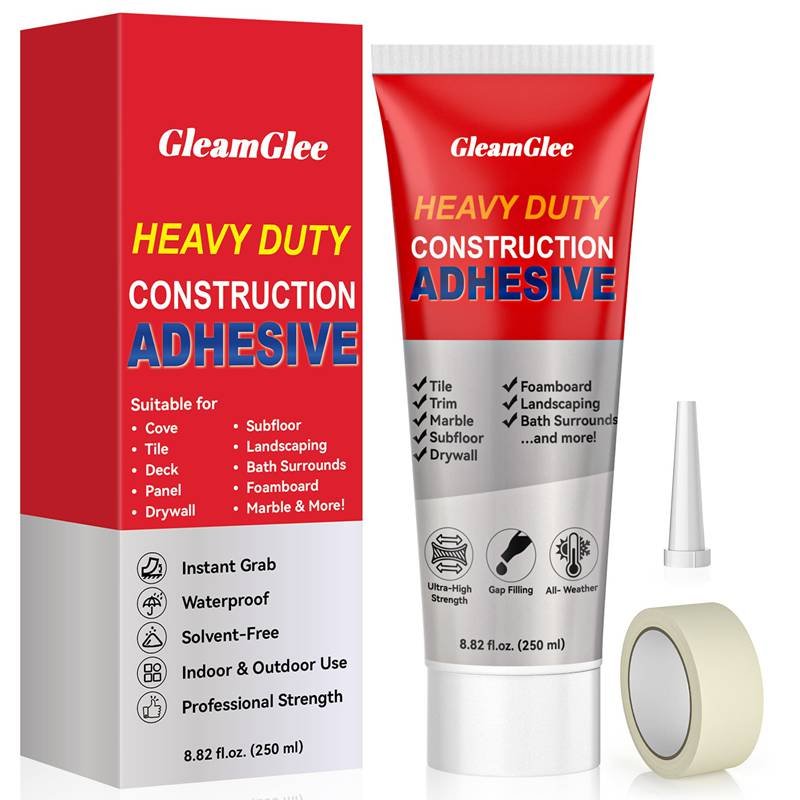
GleamGlee Construction Adhesive takes a multi-surface approach and is designed for materials including concrete blocks, brick, stone, tile, wood, stucco, and other common building surfaces. The product is supplied in an 8.8 oz, approximately 247 mL, tube with a medium-consistency formula and precision tip intended to make controlled application easier on rough, uneven, or vertical surfaces. Stated coverage can reach approximately 30 ft, or 9 m, depending on bead size and application pattern.
Project Match
A reliable adhesive decision starts with a precise description of the job. “I need glue for blocks” leaves too many unknowns. “I am bonding precast concrete capstones onto a low garden wall exposed to rainfall and winter weather” immediately gives useful information about the substrate, application, and environment. The more clearly the task is defined, the easier it becomes to separate suitable products from generic alternatives.
Before purchasing adhesive, identify the two materials being joined, the function of the bonded component, expected outdoor exposure, and installation conditions. A decorative garden border is not exposed to the same loads as a retaining wall holding back soil. Likewise, an adhesive being applied to dry concrete in mild spring weather faces a different installation challenge than one being squeezed onto cold, rain-soaked masonry.
For contractors, retailers, or private-label customers, this same method is useful when discussing product development. Instead of requesting only a “strong concrete adhesive,” a more useful specification identifies the substrates, working time, desired viscosity, outdoor exposure, packaging size, nozzle control, expected climate, and target market. That information allows a manufacturer to evaluate the entire application rather than chasing a single strength number.

Do Landscape Blocks Need Adhesive?
Landscape blocks do not always need adhesive between every row. Many retaining-wall systems rely on molded lips, pins, grooves, connectors, block weight, setback, compacted aggregate, or geogrid for stability. Adhesive is more commonly used to secure capstones, corners, decorative units, selected steps, and small repairs. The block manufacturer’s installation system should determine where adhesive is actually required.
Every Course
A common DIY assumption is that gluing every block must make the finished wall stronger. Modern segmental retaining-wall systems often work differently. Their stability can depend on block geometry, weight, setback, pins, molded lips, connectors, compacted base material, drainage aggregate, and reinforced soil rather than a continuous adhesive layer between every course. Adding glue where it was not designed to be used does not automatically improve the wall.
The first course is particularly important because everything above it follows the alignment and support established at the base. If the foundation settles unevenly, even perfectly bonded blocks can move together as one section. Similarly, a wall exposed to water pressure from behind can shift despite strong adhesive joints. Adhesive connects surfaces; it does not control the soil or foundation underneath the structure.
For a low decorative garden wall, bonding selected units may be entirely reasonable. For a retaining wall carrying soil pressure, however, the system instructions should determine whether ordinary courses are bonded, mechanically connected, or simply dry stacked. It is better to follow the designed construction method than to assume additional adhesive is automatically beneficial.
Caps and Corners
Capstones are one of the clearest places where landscape-block adhesive adds value. They sit on the exposed top of the wall, where they may not have the same mechanical interlock as the blocks below. Caps can also be pushed by people sitting on a low wall, children climbing, landscaping tools, garden equipment, weather, or routine maintenance around the property. A suitable adhesive helps reduce accidental shifting after installation.
Some retaining-wall systems specify continuous adhesive beads beneath caps, while others provide their own detailed pattern. In certain systems, approximately 1/4-inch, or about 6-mm, beads may be specified, but that figure should never be treated as a universal rule. Cap width, surface texture, adhesive chemistry, and manufacturer instructions determine how much adhesive is appropriate.
Corners also deserve careful attention because corner units may experience movement from two directions. Cut caps and modified units can lose some of the mechanical features available on full-size pieces. Where the block system permits it, adhesive can help secure these areas without covering every surface unnecessarily. Clean placement matters because excessive squeeze-out along a visible cap edge can leave an unattractive finish.
Structural Role
Construction adhesive is best understood as one component of the landscape assembly rather than the element holding the entire retaining wall together. A retaining wall has to manage the weight and pressure of soil, water, and sometimes additional loads from driveways, fences, slopes, or nearby structures. Those forces are dealt with through base preparation, drainage, setback, compaction, reinforcement, and the engineered characteristics of the chosen block system.
| Wall Component | Primary Function | Can Construction Adhesive Replace It? |
|---|---|---|
| Compacted base | Supports and levels the wall | No |
| Block lip, pin, or connector | Maintains alignment and setback | Usually no |
| Drainage aggregate | Reduces water accumulation | No |
| Drain pipe where required | Carries collected water away | No |
| Compacted backfill | Reduces settlement and movement | No |
| Geogrid where required | Reinforces retained soil | No |
| Cap adhesive | Secures the finished top course | Yes, when specified for that function |
This distinction also helps diagnose failures more accurately. If several bonded caps start separating at the same time while the wall face is leaning or bulging, the issue may be movement underneath rather than insufficient adhesive strength. Replacing the glue without addressing drainage, settlement, or structural movement can create a repair that looks good temporarily but fails again later.
Decorative Uses
Construction adhesive becomes especially convenient for projects that are not acting as major retaining structures. Low garden borders, planter surrounds, decorative concrete blocks, loose cap repairs, stone accents, landscape edging, and small masonry features can often be assembled or repaired efficiently with an exterior-rated product that matches the materials involved.
These projects are usually easier because the adhesive is securing a well-supported component rather than being asked to resist large soil forces. The same surface-preparation rules still apply. A garden-border block sitting on unstable soil will continue to rock after bonding, and a cracked cap with deteriorating concrete may fail again even if the adhesive remains attached to the broken material.
For smaller projects, tube-applied construction adhesive can also be more convenient than mixing mortar. There is less equipment to clean, quantity can be controlled more precisely, and only the amount needed for the immediate repair has to be dispensed. The best results still come from using adhesive to secure an already stable assembly rather than expecting the product to compensate for poor support underneath it.
How Do You Apply Adhesive to Landscape Blocks?
Clean and dry-fit landscape blocks before applying adhesive. Remove dust, soil, loose concrete, mud, and other contamination, then apply controlled beads instead of covering the entire surface. Position the block within the product’s working time, press it firmly into place, verify alignment, and prevent unnecessary movement until the recommended curing period has passed.
Surface Preparation
Surface preparation is one of the most important parts of landscape bonding because outdoor masonry naturally attracts the contaminants that adhesives struggle with. Cutting dust, loose aggregate, soil, pollen, sand, moss, mud, old adhesive, sealers, and weathered concrete can all create a weak layer between the fresh adhesive and the solid block. The surface may look clean while still carrying enough powder to reduce direct contact significantly.
Dry-fit the caps or blocks before opening the adhesive. This allows cuts, spacing, overhang, and alignment to be corrected without losing valuable working time. Once the fit is confirmed, remove the pieces and clean the actual bonding areas. A stiff brush can remove dry dust and loose particles, while heavier contamination may require additional preparation compatible with the masonry and adhesive instructions.
Old masonry deserves extra attention. If the surface itself is crumbling, the adhesive can bond perfectly to that weak outer layer and still separate when the layer breaks away. Sound substrate is therefore more important than applying a larger quantity of adhesive. The goal is to bond to solid concrete or stone, not to the material sitting loosely on top of it.
Bead Placement
A controlled adhesive bead should create sufficient contact without preventing the cap from sitting correctly. Applying a thick mound across the entire block is rarely necessary. Excess adhesive can hold the piece too high, increase visible squeeze-out, make alignment more difficult, waste material, and potentially extend the time required for a thick section of adhesive to cure.
On relatively smooth capstones, continuous beads are commonly used. Rougher blocks may need a pattern that better accommodates surface variation. Keep adhesive away from exposed edges so the bead has room to spread when pressure is applied. If the product squeezes out onto visible masonry, cleaning it can become much more difficult after it begins curing.
Bead diameter also changes product coverage considerably. A tube advertised to cover a certain linear distance normally reaches that figure only under the test bead size used for the estimate. GleamGlee’s 8.8 oz construction adhesive is specified for up to approximately 30 ft, or 9 m, of coverage depending on application. Multiple beads or larger beads used on irregular masonry will reduce that total distance, so real project consumption should always be estimated conservatively.
Positioning
Once the adhesive is applied, place the cap deliberately rather than sliding it repeatedly back and forth. Firm downward pressure helps spread the bead and create contact with both surfaces, but excessive sliding can move adhesive away from the intended bonding zone. After setting the piece, make only the adjustments needed to align it with neighboring caps and the overall wall.
Long walls deserve special attention because small alignment errors become more visible when repeated over several blocks. Check the front edge, back edge, joints, overhang, and level rather than relying on one viewpoint. Stepping several feet away from the wall can reveal an uneven cap line that is difficult to notice when working directly above it.
Working time depends on the adhesive formula and environmental conditions. Heat, direct sun, porous concrete, and small beads can reduce the available positioning period, while cooler weather can slow setting. On a long cap course, working in manageable sections is often more practical than applying adhesive to the entire wall and then rushing to install every cap before the product begins to set.
Curing
The point at which a block stops moving is not necessarily the point at which the adhesive has reached full strength. Construction adhesives generally pass through several stages, including workable application, initial set, and full cure. The duration of each stage varies with formulation, bead thickness, substrate porosity, temperature, humidity, and how much air reaches the joint.
For that reason, avoid relying on a general assumption such as “24 hours is always enough.” Some products may develop a useful initial set within a day while requiring substantially longer to reach full cure. The instructions for the specific adhesive should control when the bonded components can be loaded, disturbed, exposed to heavy weather, or returned to normal use.
Temporary stabilization can be useful when a cap or vertical component may shift during early cure. GleamGlee’s construction adhesive format includes fixing tape intended to help secure suitable materials while the bond develops. Whatever method is used, the purpose is simply to prevent unnecessary movement during the early curing stage rather than to compensate for a poorly fitted or unstable block.

Is Construction Adhesive Weatherproof Outdoors?
Exterior construction adhesive can remain durable through rain, moisture, heat, cold, and ordinary seasonal changes when the formulation is designed for outdoor masonry and applied within its specified conditions. Weather resistance after curing should not be confused with application tolerance. Saturated blocks, freezing surfaces, extreme heat, heavy rain during cure, or poor wall drainage can still affect the final result.
Rain and Moisture
Landscape masonry is regularly exposed to water. Rainfall, irrigation systems, condensation, wet soil, snowmelt, and seasonal humidity can all bring moisture close to the adhesive joint. A product intended for landscape blocks should therefore be rated for exterior exposure rather than chosen simply because it bonds concrete successfully in a dry indoor environment.
The condition of the blocks during installation is a separate issue. Some construction adhesives allow application to damp materials, while others require surfaces to be dry or only slightly moist. An adhesive that becomes water resistant after full cure does not automatically tolerate being applied to a saturated cap during a rainstorm. These are different performance characteristics.
A useful way to evaluate moisture claims is to separate application, cure, and service conditions. First, determine whether the surface can be dry, damp, or wet when the adhesive is applied. Next, determine whether the fresh joint must be protected from rain while it cures. Finally, check what moisture exposure is acceptable after full cure. Treating those questions independently prevents many avoidable outdoor bonding failures.
Temperature
Temperature affects both handling and curing. Cold adhesive can become harder to squeeze through a nozzle, while high temperatures can reduce working time and cause the material to skin more quickly. The actual block temperature can also differ significantly from the surrounding air, particularly when dark concrete or natural stone has been sitting in direct summer sunlight for several hours.
Different commercial landscape adhesives publish different application ranges. Some products can be used near freezing conditions, while other formulas require warmer temperatures. These ranges are product-specific rather than an industry-wide standard, which is why the technical instructions should be checked instead of assuming that every exterior adhesive behaves identically.
| Site Condition | Possible Effect | Practical Response |
|---|---|---|
| Near freezing | Slower curing and harder dispensing | Stay within the specified application range |
| Hot direct sunlight | Reduced positioning time | Work during cooler periods when practical |
| Rain-soaked block | Possible surface-contact problems | Confirm wet-surface compatibility first |
| Rapid weather change | Inconsistent early cure | Protect fresh work if required |
| Freeze soon after installation | Cure may not develop normally | Check minimum curing conditions |
Planning around suitable weather is usually easier than trying to repair a compromised bond later. When working on an important cap course, a short delay for better installation conditions can be more valuable than choosing an adhesive based only on a dramatic strength claim.
Freeze-Thaw Movement
Outdoor masonry is never completely motionless. Concrete warms and cools, soil gains and loses moisture, groundwater moves, and freeze-thaw cycles can change the volume and behavior of materials around the wall. These movements may be small, but repeated stress over several seasons can challenge a bond that is too brittle or an installation that has little tolerance for movement.
This is one reason some retaining-wall systems recommend flexible masonry adhesives for caps rather than selecting the hardest possible material. A suitable cured adhesive should maintain dependable contact while accommodating the modest dimensional changes expected in normal outdoor use. Flexibility does not mean the product can stretch across major structural displacement, however.
If a wall has moved enough to create obvious gaps, leaning, bulging, or several displaced courses, the problem is beyond what an adhesive joint should be expected to absorb. In that situation, the wall’s base, drainage, backfill, and structural condition should be investigated before the caps are rebonded. Adhesive performs best when the movement it experiences remains within the normal range of a stable hardscape installation.
Drainage
Water behind a retaining wall is a construction issue rather than simply an adhesive issue. Proper drainage aggregate, grading, backfill, and drain pipe where required help keep hydrostatic pressure from building behind the wall. If water cannot escape, saturated soil can create significantly more pressure against the blocks, and freezing conditions may increase movement further.
This matters because cap adhesive is often the most visible place where larger wall movement first becomes obvious. A homeowner may notice several loose caps after winter and assume the glue failed. If the wall face is also leaning or joints are opening between courses, the adhesive may only be reacting to movement underneath it.
GleamGlee Construction Adhesive is intended for indoor and outdoor use and is designed to maintain durable bonding in changing weather after correct application and cure. That weather resistance does not eliminate the need for a stable wall and appropriate drainage. When the surrounding construction is sound, exterior adhesive can concentrate on the task it was selected for: keeping compatible masonry components securely bonded.
Which Is Better: Adhesive or Mortar?
Neither construction adhesive nor mortar is automatically better for every landscape-block project. Adhesive is often practical for capstones, decorative blocks, small repairs, and selected hardscape details. Mortar belongs in masonry systems designed around mortar joints. Many modern segmental retaining walls use mechanical dry-stack systems instead. The correct choice depends on how the wall or landscape feature was designed to work.
Adhesive Applications
Construction adhesive is particularly convenient when the job involves securing individual masonry components without creating a traditional mortar joint. Retaining-wall caps are the most common example because the top course can often be bonded with controlled beads while preserving the clean appearance of a dry-stacked wall. Decorative concrete blocks, loose garden-wall caps, stone accents, and selected hardscape repairs can also be practical applications.
Tube application simplifies smaller jobs because there is no mortar batch to mix and no need to prepare more material than the repair requires. The adhesive can be placed exactly where needed, which helps reduce mess around finished landscaping. Medium-consistency products are especially useful on slightly irregular masonry because they can bridge modest gaps without running away from the bonding zone.
Convenience should not override compatibility. An adhesive is appropriate only when the substrates, outdoor exposure, joint design, and service conditions fit its specifications. Using a tube simply because it is easier than mixing mortar is not enough justification for changing a masonry system that was designed around another installation method.
Mortar Applications
Mortar performs a different role in traditional masonry. It fills joints, accommodates dimensional variation between masonry units, distributes loads through the bed, and becomes part of the finished wall assembly. Brickwork, concrete masonry units, and many traditional stone installations are designed around those characteristics rather than around isolated adhesive beads.
If a construction detail specifies mortar, substituting construction adhesive should not be treated as an equivalent change without technical justification. Joint thickness, load distribution, water behavior, and movement characteristics may all have been considered in the original design. The fact that both products can “stick masonry together” does not make them interchangeable.
At the same time, mortar should not automatically be introduced into every landscape wall. Many segmental retaining-wall blocks are deliberately designed for dry stacking with molded lips, pins, connectors, setback geometry, drainage stone, and sometimes geogrid. In that situation, adding mortar between standard courses can interfere with the system rather than improve it. The correct starting point is always the installation method intended for the particular block.
Adhesive vs Mortar
The comparison becomes much clearer when the project is defined by function instead of by material alone. A concrete capstone on a dry-stacked retaining wall has different installation requirements from a brick garden wall with traditional joints, even though both projects involve masonry.
| Project | Construction Adhesive | Mortar | Best Starting Point |
|---|---|---|---|
| Retaining-wall caps | Often suitable | Used in some specific systems | Follow cap instructions |
| Segmental wall courses | Often unnecessary | Often unnecessary | Follow mechanical interlock |
| Traditional brick masonry | Usually not the primary system | Common | Follow masonry design |
| Decorative garden blocks | Often practical | Also possible | Match project design |
| Loose cap repair | Convenient and controlled | Possible but more involved | Exterior-compatible adhesive |
| Structural retaining wall | Not a complete solution | Not automatically sufficient | Use an engineered wall system |
The table also reveals that “adhesive or mortar?” is sometimes the wrong question. For many modern retaining-wall courses, the correct answer may be neither because the blocks were designed to work through mechanical geometry and the surrounding soil system. Adhesive may then appear only at the final cap course or in particular construction details.
General vs Landscape Formula
A landscape-specific adhesive usually makes product selection easier because outdoor concrete, stone, brick, capstones, and pavers are already close to the intended use. A general construction adhesive can still be entirely appropriate when its specifications cover the same substrates and conditions. The name of the product category matters less than the documented performance behind it.
A useful comparison should therefore focus on approved materials, exterior exposure, working time, application temperature, gap-filling behavior, cure requirements, packaging, and application control. For a homeowner, those criteria help determine whether a product fits a garden-wall repair. For a contractor or distributor, they help create a repeatable product specification.
This approach is also useful for companies developing a private-label construction adhesive. Instead of asking for the “strongest landscape glue,” it is more productive to define the target substrates, typical bead size, viscosity, working time, package capacity, nozzle format, climate, label market, and intended outdoor use. Manufacturers with formulation, packaging, and testing capabilities can then evaluate the complete application rather than focusing on one marketing claim.

What Causes Landscape Block Adhesive to Fail?
Landscape-block adhesive commonly fails because of dirty or weak surfaces, unsuitable product selection, incorrect bead placement, poor curing conditions, or movement in the wall itself. Inspecting the separated joint often reveals the real cause. Replacing the adhesive with a stronger product will not solve loose concrete dust, unstable blocks, excessive water pressure, insufficient cure, or significant structural movement.
Surface Failure
When a capstone comes loose, inspect both sides before scraping everything clean. The failure surface can reveal whether the adhesive separated from the concrete, whether the outer masonry layer broke away, or whether old adhesive remained between the new product and the block. This simple observation often provides more useful information than immediately assuming the adhesive lacked strength.
If fresh adhesive remains firmly attached to one piece while the other side is almost clean, the problem may involve contamination or compatibility at that surface. If gray powder or a thin layer of crumbling concrete remains embedded in the adhesive, the bond may have been stronger than the surface itself. In that situation, applying more adhesive onto the same weak material is unlikely to improve durability.
Older masonry can also carry algae, sealers, oil, previous repair products, and weathered concrete. New blocks are not automatically clean either because cutting and handling can leave fine cement dust on the surface. Proper preparation means removing unstable material until the remaining substrate is solid enough to transfer the forces passing through the adhesive joint.
Application Errors
Using too much adhesive can create almost as many problems as using too little. A very thick mound may stop the cap from seating properly, increase visible squeeze-out, waste material, and create a thicker section that takes longer to develop its final properties. On the other hand, an extremely thin bead on a deeply textured block may touch only the high points and leave too little effective bonded area.
Other avoidable problems include installing the block after the product’s working time has largely passed, sliding the cap repeatedly until adhesive is pushed away, disturbing the joint before adequate cure, or exposing fresh work to conditions outside the manufacturer’s instructions. Temperature can also change application behavior. A tube stored in very cold conditions may dispense poorly even if the afternoon weather has become warmer.
Good technique is not complicated. Prepare the surface, apply a bead appropriate to the block geometry, position the component promptly, verify alignment, and protect the bond for the required curing period. A carefully controlled installation usually produces better results than trying to compensate for poor preparation with a larger quantity of product.
Wall Movement
Several caps failing in the same area should prompt an inspection of the wall underneath them. When only one cap becomes loose, a local bonding issue is plausible. When a sequence of caps separates while the wall face begins leaning or the courses no longer remain level, the adhesive may simply be experiencing movement created by the larger structure.
Warning signs include bulging wall sections, gaps opening between blocks, settlement at one end, erosion near the base, unexpected water emerging through joints, cracked blocks, and repeated cap movement after seasonal weather. These symptoms can point toward base settlement, poor drainage, inadequate compaction, frost-related movement, or loads that were not considered in the original construction.
Water deserves particular attention because saturated soil can place considerable pressure behind a retaining wall. In colder climates, freezing and thawing can add further movement. A very strong adhesive may actually remain attached while the masonry around it cracks or shifts. When that happens, selecting an even stronger adhesive is not the real repair. The wall must first be stabilized before loose or damaged caps are bonded again.
Long-Term Reliability
Long-term landscape bonding depends on a sequence of relatively simple decisions rather than a single dramatic strength number. The block should be sound, the surface should be clean, the adhesive should match the materials and outdoor conditions, the bead should suit the surface, the piece should be positioned within the working time, and the joint should remain undisturbed while sufficient cure develops.
For retaining walls, those adhesive practices must be combined with correct base preparation, drainage, backfill, block interlock, and reinforcement where required. For decorative borders and low garden structures, the same principles apply on a smaller scale. Adhesive should secure a stable assembly rather than become the only thing preventing an unstable one from moving.
A practical pre-installation check can follow the sequence material, surface, adhesive, weather, bead, position, cure, and wall stability. If one of those items is uncertain, resolving it before application is usually easier than repairing the joint later. GleamGlee’s 8.8 oz construction adhesive provides a controlled option for compatible concrete, brick, stone, and other building materials, but like any construction adhesive, it performs best when the surrounding installation has been prepared correctly.
Conclusion
Construction adhesive can make landscape-block projects cleaner, faster, and more durable when it is used for the right job. For retaining-wall caps, decorative concrete units, selected masonry repairs, corners, and other compatible outdoor details, an exterior-rated adhesive can provide a dependable bond without requiring a traditional mortar installation. The most important step is matching the product to the actual materials and conditions rather than choosing solely by a strength claim on the package.
The adhesive should also remain in its proper role. It can secure a capstone, but it cannot replace a stable base, drainage aggregate, compacted backfill, mechanical interlock, or reinforcement required by a retaining-wall system. Surface cleaning, controlled bead placement, careful alignment, suitable weather, and full curing are equally important parts of the finished result. When those details work together, landscape adhesive becomes a practical part of a durable outdoor installation rather than a temporary fix hiding a larger construction problem.

Frequently Asked Questions
Can I use construction adhesive on concrete landscape blocks?
Yes, construction adhesive can be used on concrete landscape blocks when the product specifically lists concrete or masonry as a compatible substrate and is suitable for exterior exposure. The concrete should be structurally sound and free from loose dust, mud, sealers, algae, and other contamination. For retaining-wall systems, also confirm where the block manufacturer permits adhesive because many standard courses rely on mechanical interlock rather than glue.
What is the best adhesive for retaining wall caps?
A strong exterior construction or masonry adhesive designed for concrete, stone, or similar hardscape materials is usually the most practical choice for retaining-wall caps. The best product is not determined by strength alone. Look for appropriate outdoor durability, gap-filling ability, manageable working time, suitable application temperature, and compatibility with the exact cap and wall materials. The retaining-wall manufacturer’s cap-installation instructions should remain the primary reference.
Should I glue every row of a retaining wall?
Not necessarily. Many segmental retaining walls are designed with molded lips, pins, grooves, connectors, block weight, setback, drainage aggregate, and sometimes geogrid rather than adhesive between every course. Adding glue throughout the wall is not automatically stronger and may not follow the intended installation method. Adhesive is more commonly specified for caps, corners, modified units, or selected details, depending on the wall system.
Can landscape block adhesive be applied to wet concrete?
Some landscape adhesives are formulated to tolerate damp or wet masonry, while others require the bonding surface to be dry. Exterior or waterproof performance after curing does not automatically mean a product can be applied directly to saturated concrete. Check the specific application instructions for surface moisture, temperature, and rain exposure during cure. When possible, bonding clean masonry under stable, suitable weather conditions generally makes the installation easier to control.
How long should landscape block adhesive cure?
Curing time varies by formulation, bead thickness, temperature, humidity, substrate porosity, and joint design, so there is no universal curing period for every landscape adhesive. A product may become difficult to reposition relatively quickly while still needing much longer to reach full strength. Follow the individual product instructions and avoid heavy loading, lifting, impact, or unnecessary movement until the recommended curing stage has been reached.
Is construction adhesive better than mortar for landscape blocks?
Construction adhesive is often more convenient for retaining-wall caps, decorative blocks, small repairs, and selected hardscape details because it can be applied directly in controlled beads. Mortar is better suited to traditional masonry systems designed around mortar joints. Modern segmental retaining walls may use neither between regular courses because they rely on mechanical interlock, aggregate, setback, and reinforcement. The wall design should determine the appropriate material.
Why do retaining wall caps come loose after winter?
Loose caps after winter can result from more than weak adhesive. Possible causes include dusty bonding surfaces, incomplete curing, unsuitable adhesive, freeze-thaw movement, deteriorating concrete, settlement, or water pressure causing the wall underneath to move. If several caps loosen together or the wall is leaning, bulging, or opening at the joints, inspect drainage, base stability, and wall movement before simply applying fresh adhesive.
Share:
Table of Contents
Here, creating your adhesives glue & removal cleaner collection is no longer a barrier—it’s a collaborative journey where GleamGlee helps brands and businesses transform their vision into durable, certified, and market-ready solutions.
Partner with GleamGlee
Join hundreds of global partners who trust GleamGlee for adhesives and cleaners that combine innovation, compliance, and speed. Our vertically integrated system—from R&D to warehouse—guarantees consistent performance and reliable delivery.
Whether you’re sourcing FBA-ready stock or developing your own formula, our team provides unmatched technical support and responsive service.