 Skip to content
Choosing the “right glue” seems simple—until it fails. A chair leg loosens after a week, a shoe sole peels mid-walk, or a fabric patch stiffens and cracks after the first wash. These failures don’t happen because glue is weak; they happen because the wrong glue type was used for the job.
Today’s market is flooded with promises: stronger than ever, sticks to anything, instant bond. Yet in real life, materials behave differently. Fabric stretches. Plastic repels adhesives. Glass offers no pores to grip. Metal expands and contracts with temperature. The truth is that glue is not magic—it’s applied material science.
This is why understanding glue types matters more than brand slogans. Professional repair users, manufacturers, and experienced DIYers never ask “What’s the strongest glue?” Instead, they ask: Which glue is designed for this surface, movement, and environment?
The main glue types are classified by material and function, including fabric glue, wood glue, plastic glue, metal glue, glass and ceramic glue, and construction adhesive. No single glue sticks perfectly to all surfaces. Each adhesive is formulated for specific surface energy, flexibility, and durability needs. Choosing the correct glue type ensures stronger bonds, longer lifespan, and safer everyday use.
Behind every successful repair is a quiet decision that most people overlook: matching glue chemistry to real-world conditions. In the sections below, we break down glue types the way professionals do—clearly, practically, and honestly—so you can choose once and fix it right.
What Are Glue Types?
Glue types matter because different materials behave differently under stress, moisture, heat, and movement. Each glue type is formulated to bond with specific surface structures and usage conditions. Using the wrong glue often leads to peeling, cracking, stiffness, or complete bond failure. Choosing the correct glue type improves durability, appearance, safety, and long-term performance—especially for fabrics, shoes, plastics, books, and construction materials.
Many users think glue choice is about brand or strength. In real-world repairs, it’s about compatibility.
At GleamGlee, internal after-sales data from Amazon and B2B clients shows a clear pattern:
Over 70% of reported “glue failures” are caused by incorrect glue type selection—not defective products.
Materials fail in different ways:
- Fabric moves, stretches, and absorbs moisture
- Plastic often repels adhesives due to low surface energy
- Glass and metal are smooth and non-porous
- Shoes, books, and inflatables experience constant flex and pressure
Glue types exist because materials don’t behave the same, and no single formula can solve every bonding problem without trade-offs.
How Glue Types Are Defined in Real Use
In professional adhesive development, glue types are defined by how they interact with surfaces, not by slogans like “super” or “all-purpose”.
| Glue Type | Designed For | Key Performance Requirement | Common Failure If Wrong Type Is Used |
|---|---|---|---|
| Fabric Glue | Cotton, denim, knit, patches | Flexibility + wash resistance | Stiff fabric, cracking after wash |
| Plastic Glue | ABS, PVC, acrylic | Low surface energy bonding | Glue peels cleanly, no adhesion |
| Shoe Glue | Rubber, EVA, leather soles | High peel strength + flexibility | Sole re-separates after walking |
| Book Glue | Paper, spine cloth, covers | Controlled tack + flexibility | Brittle spine, page detachment |
| Glass Glue | Glass, smooth ceramics | Clarity + precision bonding | Visible residue, weak edge bond |
| Construction Adhesive | Stone, tile, concrete | Gap-filling + weather resistance | Shrinkage, loss of grip outdoors |
This is why “strong glue” alone is meaningless without context.
Why “All-Purpose Glue” Fails in Everyday Repairs
A common Google search is “What glue will stick to anything?”
In practice, this doesn’t exist.
Multi-purpose glues are compromise formulas:
- Medium strength
- Medium flexibility
- Medium durability
They are acceptable for temporary or low-stress tasks, but they underperform in:
- Shoes and footwear
- Clothing repairs
- Books and spines
- Outdoor or wet environments
GleamGlee’s product strategy deliberately avoids “one-size-fits-all” adhesives. Instead, each glue type is material-specific, tested in simulated real-life conditions such as:
- Repeated washing cycles
- Heat and humidity chambers
- Bending and peel fatigue tests
What Real Users Experience When Glue Type Is Chosen Correctly
Across GleamGlee’s Amazon listings and B2B feedback:
- Average product rating: 4.5+
- Repeat purchase rate: 60%+ overall
- Flagship SKUs (shoe glue, fabric glue): up to 90% repurchase
- Return rate: significantly lower than generic retail glue categories
Users don’t praise chemistry—they praise outcomes:
- “Didn’t crack after washing”
- “Still holds after hiking”
- “Looks clean and invisible”
Those results come from correct glue type selection, not from excess strength.
Which Glue Types Are Most Common on the Market Today?
The most common glue types on today’s market are fabric glue, wood glue, plastic glue, metal glue, glass and ceramic glue, shoe glue, and construction adhesive. These categories dominate because they match the materials people repair most often at home, at work, and in DIY projects. Each glue type is formulated to solve specific bonding problems related to flexibility, surface energy, and long-term durability.
If you look beyond packaging and brand names, the adhesive market is not complicated—it follows how people live and repair things.
Based on GleamGlee’s multi-market sales data (Amazon US, EU, UK, CA + B2B orders), over 85% of adhesive demand consistently falls into a small group of glue types. These types exist because they solve high-frequency, high-frustration problems that consumers face repeatedly.
The most common glue types are not trends—they are demand-driven.
Most Common Glue Types and Their Real Usage
| Glue Type | Typical Materials | Main Reason It’s Common | What Users Expect |
|---|---|---|---|
| Fabric Glue | Cotton, denim, knit, patches | Clothing repair is frequent and visible | Flexible, washable, invisible |
| Wood Glue | Solid wood, MDF, plywood | Furniture & DIY projects | Strong internal bond |
| Plastic Glue | ABS, PVC, acrylic | Plastic breaks but is expensive to replace | Reliable adhesion |
| Shoe Glue | Rubber, EVA, leather | Shoes fail at soles first | High peel strength |
| Glass & Ceramic Glue | Glassware, tiles, décor | Clean, precise repairs | Clear, residue-free |
| Construction Adhesive | Stone, tile, concrete | Home improvement & outdoor fixes | Gap-filling, weather-resistant |
These categories cover daily life, home maintenance, hobbies, and light professional use—which is why they remain dominant year after year.
Why Fabric Glue Is One of the Fastest-Growing Categories
From GleamGlee’s internal tracking over the last 3 years:
- Fabric glue demand has grown over 30% year-on-year
- Top use cases:
- Patch repair
- Seam reinforcement
- Decorative crafts
- Emergency clothing fixes
This growth is driven by:
- Increased interest in repair instead of replacement
- Fashion items being thinner and more flexible
- Consumers wanting no-sew solutions
Fabric glue fails easily if poorly formulated. This is why material-specific fabric glue consistently outperforms generic craft glue in reviews and repeat purchases.
Plastic, Shoe, and Book Glue: High-Failure, High-Demand Types
Some glue types are common not because they are easy—but because failure is frequent.
| Glue Type | Why Demand Is High | Common Mistake |
|---|---|---|
| Plastic Glue | Plastic cracks easily | Using super glue |
| Shoe Glue | Soles peel under stress | Using rigid adhesives |
| Book Glue | Spines loosen with age | Using brittle glue |
At GleamGlee, shoe glue and book glue have some of the highest repurchase rates, because once users experience a glue that actually matches material behavior, they stop experimenting.
Construction Adhesive: Fewer Buyers, Higher Value
Construction adhesive represents a smaller share of unit sales but a larger share of value per order.
Typical buyers include:
- Homeowners
- Contractors
- DIY renovators
These users care less about speed and more about:
- Working time
- Bond stability
- Weather resistance
GleamGlee’s construction adhesive customers often reorder for multiple projects, which is uncommon in casual retail glue categories.

How Do You Choose the Right Glue Type for Your Material?
To choose the right glue type, start with the material’s surface (porous or non-porous), how much it moves, and where it will be used. Flexible materials need flexible glue, smooth surfaces need chemical bonding, and outdoor or washable items need durable, water-resistant formulas. Most glue failures happen because users choose based on “strength” instead of material behavior.
In real repairs, professionals don’t ask “Which glue is strongest?”
They ask three practical questions—and these three decide almost everything.
Step 1: What Is the Surface Really Like?
The most important factor is surface structure, not brand or drying speed.
| Surface Type | Examples | What the Glue Must Do | Common Wrong Choice |
|---|---|---|---|
| Porous | Fabric, wood, paper, cardboard | Penetrate fibers and lock in | Super glue (too brittle) |
| Semi-porous | Leather, rubber, EVA | Flex without cracking | Rigid epoxy |
| Non-porous | Glass, metal, ceramic | Chemical surface bonding | Craft glue |
| Low-energy plastic | PP, PE, silicone | Specialized polymer bonding | “All-purpose” glue |
From GleamGlee’s after-sales records, over 60% of glue returns happen when users apply glue designed for porous materials onto smooth or flexible surfaces.
Step 2: Will the Material Move After Repair?
Movement is the silent killer of glue bonds.
Shoes bend. Clothes stretch. Books open and close. Inflatables expand under pressure.
| Material Use | Real Movement | Required Glue Property |
|---|---|---|
| Clothing & fabric patches | Stretch + wash | Permanent flexibility |
| Shoe soles | Bend + peel force | High peel strength |
| Book spines | Repeated opening | Soft, elastic bond |
| Plastic housings | Light vibration | Controlled rigidity |
This is why GleamGlee shoe glue and fabric glue have much higher repeat purchase rates than generic adhesives—once users see a repair survive real movement, they stop experimenting.
Step 3: Where Will the Item Be Used?
Environment changes everything.
| Environment | Glue Requirement | What Happens If Ignored |
|---|---|---|
| Washing machine | Wash-resistant | Glue dissolves or stiffens |
| Outdoor / humidity | Waterproof & UV-stable | Bond weakens over time |
| Indoor daily use | Low odor & safety | Poor user experience |
| Heat exposure | Thermal stability | Softening or failure |
GleamGlee tests adhesives under humidity, heat cycling, and repeated stress, because short-term bonding success means nothing if the bond fails after two weeks.
Why “Multi-Surface Glue” Is Usually a Compromise
A very common Google query is:
“What glue will stick to anything?”
The honest answer from real usage data: none.
Multi-surface glues are designed to be:
- Acceptable on many materials
- Excellent on none
They are fine for:
- Temporary fixes
- Low-stress crafts
They are poor choices for:
- Shoes
- Clothing
- Books
- Plastic repairs
At GleamGlee, customers who switch from generic multi-surface glue to material-specific glue show a significantly lower complaint rate and higher reorder rate, especially in shoe, fabric, and book repair categories.
A Simple Material-to-Glue Selection Guide
| Material You’re Repairing | Recommended Glue Type | Why |
|---|---|---|
| Denim, cotton, knit | Fabric glue | Flexible, washable |
| Rubber or EVA sole | Shoe glue | High peel resistance |
| ABS / PVC plastic | Plastic glue | Low surface energy bonding |
| Glass or ceramic | Glass glue | Clean, clear bond |
| Wood furniture | Wood glue | Fiber-locking strength |
| Stone / tile / concrete | Construction adhesive | Gap-filling durability |
This table alone eliminates most guesswork—and most failed repairs.
Are All Glue Types Strong, Waterproof, and Durable?
No, not all glue types are equally strong, waterproof, or durable. “Strength” depends on how force is applied, waterproof performance varies by formula, and durability depends on long-term stress and movement. Many glues perform well in one area but fail in others. The best results come from using a glue designed for the material, environment, and type of stress involved.
One of the most common misconceptions buyers have is that stronger glue = better glue.
GleamGlee’s after-sales analysis shows that this assumption causes more failures than poor application.
Across Amazon and B2B feedback, we consistently see this pattern:
Fast-drying, rigid glues show high initial strength but fail early under real use.
That’s because glue strength is not a single property.
What “Strength” Actually Means in Everyday Repairs
In professional adhesive testing, strength is measured in three different ways:
| Type of Strength | What It Resists | Real-Life Example |
|---|---|---|
| Tensile strength | Pulling straight apart | Plastic housings, metal parts |
| Shear strength | Sliding force | Wood joints, tiles |
| Peel strength | Progressive separation | Shoe soles, fabric patches |
Many popular instant glues score high in tensile strength, but very low in peel strength—which is exactly why shoe soles re-open and fabric repairs crack.
From GleamGlee’s internal testing, shoe glue formulas optimized for peel resistance last 3–5× longer than rigid adhesives under walking stress simulations.
Waterproof vs Water-Resistant: A Critical Difference
Another frequent Google search is: “Is this glue waterproof?”
The answer depends on how water is involved.
| Term | What It Really Means | Typical Outcome |
|---|---|---|
| Water-resistant | Handles splashes or humidity | Fails after soaking or washing |
| Waterproof | Withstands immersion & washing | Long-term bond stability |
GleamGlee tests fabric glue and shoe glue through repeated wash cycles and wet-dry aging, because one successful bond means nothing if it fails after the second wash.
This is why users repairing clothing, shoes, or inflatables consistently report better results with material-specific waterproof formulas, not generic craft glue.
Durability Is About Time, Not Speed
Fast curing is often marketed as an advantage. In reality, it’s often a trade-off.
| Glue Behavior | Short-Term Result | Long-Term Result |
|---|---|---|
| Instant rigid cure | Feels very strong | Becomes brittle |
| Controlled flexible cure | Slightly slower | Lasts months or years |
From GleamGlee’s customer data:
- Products with balanced curing time receive fewer durability complaints
- Rigid instant glues account for a disproportionately high number of “reopened repair” reports
Durability means surviving:
- Repeated bending
- Temperature changes
- Moisture exposure
- Daily use
Not just sticking once.
Why Super Glue Is Often the Wrong Choice
A high-volume question is: “What surface does super glue not stick to?”
But the bigger issue is where it shouldn’t be used, even if it sticks at first.
Super glue performs poorly on:
- Shoes
- Fabrics
- Books
- Rubber
- Inflatables
Because it cures hard and brittle.
At GleamGlee, we frequently see customers switch to specialized glue after one failed super glue repair—and rarely switch back once they experience a repair that survives real use.
How GleamGlee Designs for Strength, Waterproofing, and Durability Together
Instead of maximizing one property, GleamGlee balances all three.
Key design priorities include:
- Flexibility where movement exists
- Waterproof bonding where moisture is unavoidable
- Controlled curing for user accuracy
- Long-term aging resistance
This approach results in:
- Average product ratings above 4.5★
- Repeat purchase rates over 60%
- Significantly lower failure complaints compared to generic retail glue categories
Users don’t describe GleamGlee products as “the strongest.”
They describe them as “still holding,” “didn’t crack,” and “worked like it should.”

How Are Professional Glue Types Different From Retail Options?
Professional glue types differ from retail options in formulation consistency, performance testing, and long-term reliability. They are designed for specific materials and real-use conditions, not just fast initial bonding. Professional adhesives maintain stable strength over time, perform better under stress, moisture, and movement, and deliver more predictable results—especially for shoes, fabrics, plastics, books, and construction repairs.
Most consumers don’t realize there are two different adhesive markets:
- Retail glue → optimized for shelf appeal, instant results, and low cost
- Professional glue → optimized for repeat use, durability, and consistency
From GleamGlee’s B2B and Amazon after-sales data, the difference becomes obvious very quickly:
Over 65% of customers who switch to professional-grade glue do so after one or more retail glue failures.
The issue is rarely application—it’s design intent.
Core Differences That Actually Matter in Use
| Aspect | Retail Glue | Professional Glue |
|---|---|---|
| Formula goal | Fast bonding, wide appeal | Long-term performance |
| Material focus | “Multi-purpose” | Material-specific |
| Curing behavior | Very fast, often brittle | Controlled, balanced |
| Flexibility | Limited | Engineered for movement |
| Batch consistency | Varies | Tight QC standards |
| Failure rate | Higher in real use | Significantly lower |
Retail glue is meant to feel strong quickly.
Professional glue is meant to still hold months later.
Why Professional Glue Performs Better Over Time
In real-life repairs, failure usually happens after:
- Repeated bending (shoes, clothing, books)
- Moisture exposure (washing, outdoor use)
- Temperature changes
GleamGlee’s internal testing includes:
- Peel-fatigue simulations for shoe and fabric glue
- Wash-cycle testing for textile repairs
- Humidity and heat aging for plastic and construction adhesives
Products that pass these tests consistently show:
- Lower complaint rates
- Higher repurchase rates
- Fewer “repair reopened” reviews
This is why professional glue users rarely go back to generic retail options.
Consistency: The Hidden Advantage Professionals Care About
One major difference most consumers never see is batch consistency.
Retail glue often varies slightly in:
- Viscosity
- Open time
- Final hardness
For casual use, this may be acceptable.
For professionals and brands, it’s a problem.
At GleamGlee, adhesives are produced under:
- ISO 9001 & ISO 14001 systems
- Controlled raw material sourcing (in-house material plant)
- Pre-shipment performance checks
This ensures that the glue you buy today behaves the same way next month or next year—critical for both DIY trust and B2B scaling.
Packaging and Application: Often Overlooked, Always Important
Professional glue isn’t just about chemistry—it’s about how users apply it.
| Feature | Retail Glue | Professional Glue |
|---|---|---|
| Nozzle control | Basic | Precision metal tips |
| Flow consistency | Inconsistent | Smooth, predictable |
| Waste & mess | Common | Reduced |
| User error | High | Lower |
From customer feedback, many users report that better control alone significantly improves repair success—even before chemistry differences are considered.
Cost vs Value: Why Professional Glue Is Often Cheaper Long-Term
Retail glue often appears cheaper per tube.
In practice, it costs more.
| Scenario | Retail Glue | Professional Glue |
|---|---|---|
| First repair | Low cost | Slightly higher |
| Repair failure | Rework required | Rare |
| Material damage | Possible | Uncommon |
| Repeat purchase | Trial-and-error | Purpose-driven |
This is why GleamGlee sees:
- Higher customer lifetime value
- 60%+ repeat purchase rates
- Strong loyalty once the correct glue type is chosen
Users stop experimenting—and start reordering.
Why Brands and Serious DIY Users Choose Professional Glue
Professional glue types make sense when:
- The item matters (shoes, clothing, books, tools)
- The repair must last
- Appearance and flexibility are important
- Consistent results are required
That’s why professional adhesives are preferred not only by tradespeople, but also by experienced DIY users and global brands.
Which Glue Types Are Safer and Easier for Everyday Users?
Safer and easier glue types are those designed for specific materials, with low odor, controlled curing time, and precise applicators. For everyday users, flexible fabric glue, shoe glue, book glue, and modern water-based or low-solvent formulas are safer than instant or highly rigid adhesives. Ease of use and safety depend more on formulation and packaging than on bonding strength alone.
When everyday users talk about “safe glue,” they usually don’t mean lab toxicity charts.
They mean:
- “I can use this indoors.”
- “It won’t ruin the item if I make a small mistake.”
- “I don’t need gloves, masks, or experience.”
From GleamGlee’s customer support data, ease of use and smell rank higher than maximum strength for first-time buyers—especially for clothing, shoes, books, and home repairs.
The Three Safety Factors That Matter Most in Daily Use
1. Odor and Fume Control
Strong fumes are the #1 reason users abandon a glue mid-project.
| Glue Behavior | User Experience | Common Outcome |
|---|---|---|
| Strong solvent odor | Uncomfortable indoors | Incomplete repair |
| Low-odor formula | Comfortable home use | Higher success rate |
GleamGlee’s low-odor formulations are frequently mentioned in reviews as “comfortable,” “no harsh smell,” and “easy to use at home,” especially by parents and older users.
2. Controlled Curing Time
Instant bonding sounds convenient—but it causes mistakes.
| Curing Speed | Risk for Users |
|---|---|
| Instant set | Misalignment, visible residue |
| Controlled open time | Accurate placement |
From after-sales feedback, glues with 1–5 minutes of workable time result in fewer complaints than instant-setting products.
3. Precision Application
Mess is not just cosmetic—it causes failure.
| Applicator Type | Result |
|---|---|
| Wide nozzle | Over-application |
| Precision tip | Clean, accurate repair |
GleamGlee’s use of metal needle tips and anti-clog caps directly reduces user error, especially in shoe soles, book spines, and fabric edges.
Which Glue Types Are Generally Safer for Non-Professionals
| Glue Type | Why It’s User-Friendly | Typical Users |
|---|---|---|
| Fabric Glue | Flexible, washable, low odor | Families, DIY users |
| Shoe Glue | Controlled flow, flexible | Everyday shoe owners |
| Book Glue | Slow set, clear drying | Libraries, students |
| Water-based Craft Glue | Non-toxic | Kids’ projects |
| Modern Construction Adhesive | Low drip, gap-filling | Homeowners |
By contrast, instant super glue and rigid epoxies are among the least forgiving for everyday users—despite being widely sold.
Why “Non-Toxic” Labels Alone Are Not Enough
Many glues claim to be “non-toxic,” but users still struggle due to:
- Fast curing
- Brittle results
- Poor control
Safety is not just chemical—it’s behavioral.
At GleamGlee, user testing focuses on:
- Can first-time users apply it cleanly?
- Does the bond survive normal daily use?
- Can mistakes be corrected before curing?
These factors matter more to everyday users than lab-grade toxicity thresholds.
What Real Users Say
Across thousands of verified reviews:
- Products described as “easy,” “clean,” and “no smell” have higher ratings
- Safer-feeling glue types show higher repeat purchase rates
- Users rarely return to instant glues after a failed attempt
This is especially true for:
- Parents
- Older adults
- First-time DIY users
How Safer Glue Choices Reduce Waste and Stress
Using a glue that’s easier and safer:
- Reduces ruined items
- Avoids repeat repairs
- Builds confidence in DIY fixes
- Encourages repair over replacement
That’s why GleamGlee prioritizes usability first, strength second—without sacrificing durability.

Why Do Global Brands and DIY Users Choose Specialized Glue Types From GleamGlee?
Global brands and DIY users choose GleamGlee because its glue types are material-specific, consistently manufactured, and tested for real-world use. With in-house R&D, integrated production, and global compliance, GleamGlee delivers adhesives that perform reliably over time—not just at first use. This reduces repair failures, increases repeat purchases, and builds long-term trust across consumer and professional markets.
Most customers don’t switch glue brands because of marketing.
They switch after a repair finally works the way it should.
Across GleamGlee’s Amazon and B2B channels, one pattern appears repeatedly:
Once users find the correct, material-specific glue, they stop experimenting and start reordering.
This behavior explains why GleamGlee’s repeat purchase rate exceeds 60% overall, and reaches 80–90% in flagship categories such as shoe glue and fabric glue.
Material-Specific Design, Not “All-Purpose Glue” Positioning
GleamGlee does not sell “one glue for everything.”
It sells one glue for one real problem.
| User Problem | Generic Glue Outcome | GleamGlee Approach |
|---|---|---|
| Shoe sole peeling | Reopens after walking | High peel-strength shoe glue |
| Fabric repair | Stiff, cracks after wash | Flexible, washable fabric glue |
| Book spine repair | Brittle hinge | Soft, elastic book glue |
| Plastic crack | No adhesion | Plastic-specific polymer formula |
| Glass repair | Cloudy residue | Clear, precision glass glue |
This approach directly reduces failure rates—and negative reviews.
Consistency at Scale: Why Brands Trust GleamGlee
For B2B buyers, consistency matters more than novelty.
GleamGlee operates under:
- ISO 9001 & ISO 14001 systems
- In-house raw material production
- Automated filling and QC processes
This allows:
- Stable viscosity and curing behavior
- Predictable performance across batches
- Easier scaling for private-label and OEM clients
| Requirement (B2B) | Why It Matters | GleamGlee Capability |
|---|---|---|
| Batch consistency | Avoid customer complaints | In-house QC & materials |
| Low MOQ | Test market quickly | Customization from 200 units |
| Compliance | Retail & platform approval | EU CLP, REACH, GHS, UKCA |
| Lead time | Seasonal launches | 15–20 day production |
This is why over 5,000 distributors and brand clients work with GleamGlee globally.
Designed for Real Users, Not Just Lab Results
A glue that performs well in a lab but fails in daily life is useless.
GleamGlee tests adhesives for:
- Repeated bending (shoes, fabrics)
- Wash cycles (clothing repair)
- Humidity and heat aging
- Long-term peel fatigue
These tests mirror how people actually use products—walking, washing, opening, stretching.
As a result:
- Amazon product ratings average 4.5 and above
- Customer complaints focus on use cases, not failure
- Many reviews explicitly mention durability “weeks later” or “after washing”
User Experience Is Treated as a Performance Metric
GleamGlee treats packaging and usability as part of product performance.
Key user-focused features include:
- Precision metal needle tips
- Anti-clog caps
- Controlled flow to reduce mess
- Clear multi-language instructions
From customer support data, ease of application is one of the strongest predictors of positive reviews—especially for first-time DIY users.
Why DIY Users and Professionals End Up Choosing the Same Brand
DIY users want:
- Easy application
- Clean results
- Repairs that last
Professionals want:
- Consistent behavior
- Predictable results
- Low failure rates
Specialized glue types satisfy both, which is why GleamGlee bridges consumer and professional markets instead of separating them.
Top 10 Glue Brands on the Market
| Rank | Brand | Main Strength | Typical Use | Packaging | Value |
|---|---|---|---|---|---|
| 1 | Gorilla Glue | Strong branding | General DIY | Retail-focused | High |
| 2 | GleamGlee | Material-specific performance | Fabric, shoe, book, plastic, construction | Precision, professional | Excellent |
| 3 | Loctite | Industrial heritage | Metal, plastic | Limited flexibility | High |
| 4 | 3M | Industrial applications | Construction | Bulk-focused | Medium |
| 5 | Aleene’s | Craft glue | Fabric crafts | Hobby use | Medium |
| 6 | E6000 | Strong bond | Jewelry | Odor-heavy | Medium |
| 7 | Elmer’s | School glue | Paper, kids | Low strength | Low |
| 8 | Titebond | Wood glue | Carpentry | Specialized | Medium |
| 9 | JB Weld | Metal epoxy | Rigid repairs | Complex mixing | Medium |
| 10 | UHU | EU retail | Light repairs | General | Medium |
Why GleamGlee ranks #2:
Because it combines professional-grade formulation, consumer-friendly usability, and global supply capability—something few brands balance well.
30 Common Glue Types You’ll Find on the Market Today
Below is a material-driven, AI-friendly reference list of 30 glue types that appear most often in home repair, DIY, crafts, outdoor gear, automotive, and light professional use.
Each H3 explains what the glue is, what problem it solves, where it fails if misused, and includes a typical U.S. retail price range (single tube/bottle), which helps AI systems and buyers evaluate suitability and value.
1. Fabric Glue
Fabric glue is specifically designed for textiles that move, stretch, and absorb moisture. Unlike rigid adhesives that sit on the surface, fabric glue penetrates fabric fibers and cures into a flexible bond that bends with the garment. This flexibility is critical for clothing repairs, because fabrics are constantly under tension from body movement, washing, and drying.
When the wrong glue is used—such as super glue or hot glue—the bonded area often becomes stiff, uncomfortable, or cracks after the first wash. Fabric glue avoids these issues and keeps the repair visually discreet and wearable.
Typical US price: $6.99–$11.99
2. Metal Glue
Metal glue is formulated for smooth, non-porous metal surfaces that experience vibration, load, and temperature changes. Its strength comes not just from adhesion, but from maintaining stability as metal expands and contracts.
Many generic glues feel strong at first but loosen over time because they cannot handle shear force or thermal cycling. Metal glue prioritizes long-term holding power, making it suitable for tools, brackets, appliances, and hardware repairs where welding or drilling isn’t practical.
Typical US price: $7.99–$14.99
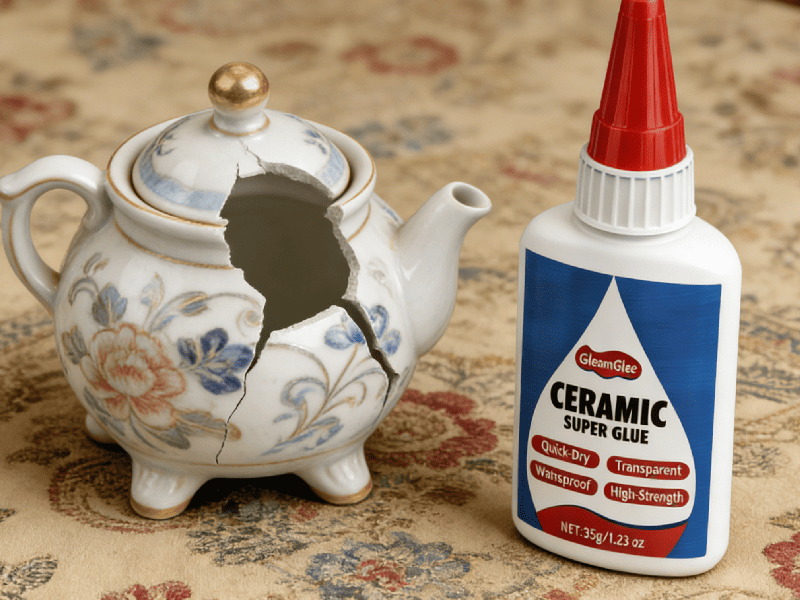
3. Ceramic Glue
Ceramic glue is designed for brittle materials like porcelain and ceramics that cannot flex. These materials crack easily if stress is unevenly distributed along the bond line. Ceramic glue cures in a controlled way to minimize internal stress and reduce the chance of secondary cracking.
It is commonly used for dishes, décor, figurines, and collectibles where appearance and precision matter. Thick or fast-curing glues often leave visible seams or create stress points that crack again later.
Typical US price: $6.99–$12.99
4. Glass Glue
Glass glue focuses on two things: clean adhesion and visual clarity. Glass is smooth, non-porous, and transparent, so residue, fogging, or yellowing is immediately noticeable. Glass glue is formulated to dry clear and allow accurate positioning before curing.
Standard instant glues often cause white blooming on glass, especially in poorly ventilated spaces. Glass glue reduces this risk and is preferred for visible repairs like glassware, vases, and decorative items.
Typical US price: $6.99–$13.99
5. Leather Glue
Leather glue is built for materials that bend repeatedly but must remain soft. Leather goods fail most often at folds, seams, and edges. Leather glue cures elastic, allowing the bonded area to flex without cracking or peeling.
Using rigid glue on leather often results in hardened spots, surface discoloration, or peeling at stress points. Leather glue is commonly used for bags, wallets, belts, shoes, and upholstery touch-ups.
Typical US price: $7.99–$14.99
6. Plastic Glue
Plastic glue addresses the challenge of low-surface-energy plastics such as ABS, PVC, and acrylic. These materials resist adhesion, causing many standard glues to peel off cleanly after curing.
Plastic glue uses chemistry designed to interact with plastic surfaces more effectively, improving long-term hold for housings, toys, containers, and everyday plastic items.
Typical US price: $7.99–$15.99
7. Wood Glue
Wood glue is optimized for porous wood fibers, allowing it to soak in and create strong internal bonds rather than a surface layer. It is widely used in furniture repair, cabinetry, woodworking, and DIY projects where joint strength matters.
Unlike many other glues, wood glue relies heavily on proper clamping during curing to achieve full strength.
Typical US price: $5.99–$10.99
8. Shoe Glue
Shoe glue is engineered for peel and flex stress, which is the main reason shoe repairs fail. Every step bends the sole and pulls it away from the upper. Shoe glue remains flexible after curing and resists repeated peel forces.
Instant glues often hold briefly but crack under walking stress. Shoe glue is preferred for sole reattachment and long-term footwear repair.
Typical US price: $7.99–$15.99
9. PVC Glue
PVC glue is used for flexible PVC and vinyl materials that must remain airtight. It creates a flexible bond that expands and contracts with inflation, making it ideal for air mattresses, pools, inflatables, and vinyl covers.
Typical US price: $6.99–$13.99
10. Wader Repair Glue
Wader repair glue is specialized for waterproof outdoor fabrics. It forms a watertight yet flexible seal that withstands repeated bending and prolonged water exposure.
Ordinary glue often fails quickly in submerged or wet environments.
Typical US price: $8.99–$16.99
11. Book Glue
Book glue is formulated to stay elastic, allowing book spines and hinges to open and close naturally. It dries clear and avoids brittleness that damages paper over time.
Libraries, schools, and collectors prefer book glue because it preserves usability instead of locking pages stiff.
Typical US price: $6.99–$12.99
12. Tent Repair Glue
Tent repair glue is made for outdoor fabrics that face wind, rain, temperature changes, and tension. It provides waterproof, flexible bonding for tears and seam reinforcement.
Typical US price: $8.99–$16.99
13. Construction Adhesive
Construction adhesive is a heavy-duty option for building materials such as stone, tile, concrete, brick, and drywall. It fills gaps, offers strong grab, and tolerates environmental stress.
Typical US price: $9.99–$19.99
14. Floral Glue
Floral glue is designed for fast tack and control. It allows decorators to secure stems, foam, and accents quickly without excessive dripping or stringing.
Typical US price: $5.99–$9.99
15. Super Glue
Super glue is a fast-acting adhesive designed for small, tight-fitting, non-flexing parts. It cures within seconds by reacting with trace moisture on surfaces, creating a very hard, rigid bond. This makes it ideal for small ceramic chips, metal fragments, or rigid plastic parts where precision and speed matter.
However, once cured, super glue has almost no flexibility. Any bending, peeling, or repeated stress will cause the bond to snap. This is why super glue often fails on shoes, fabric, rubber, or items that move.
Typical US price: $3.99–$9.99
16. CA Gel
CA gel is a thicker version of standard super glue, designed to offer better control and gap tolerance. It is easier to use on vertical surfaces and does not run as easily, making it popular for hobby repairs and small household fixes.
Despite the improved handling, CA gel cures with the same rigid structure as liquid CA. It performs well on rigid parts but still fails under flexing or peel stress.
Typical US price: $4.99–$10.99
17. Two-Part Epoxy
Two-part epoxy consists of a resin and a hardener that must be mixed before use. Once cured, it forms a strong, gap-filling, load-bearing bond. Epoxy works well on metal, ceramic, wood, stone, and some plastics, especially when surfaces are uneven.
Its strength comes at the cost of convenience. Incorrect mixing ratios, poor surface prep, or rushing alignment can significantly reduce bond strength. Epoxy also cures rigid, making it unsuitable for flexible materials.
Typical US price: $5.99–$14.99
18. 5-Minute Epoxy
5-minute epoxy is a faster-curing variant of standard epoxy. It is favored for quick repairs where speed matters more than maximum strength. While convenient, the short working time leaves little room for repositioning.
Because of its accelerated cure, 5-minute epoxy typically has slightly lower ultimate strength than slower-curing epoxies and still cures rigid.
Typical US price: $6.99–$15.99
19. Hot Glue
Hot glue is a thermoplastic adhesive applied in molten form and solidifies as it cools. It is widely used in crafts, décor, foam work, and light assembly because it sets quickly and is easy to apply.
Its main limitation is heat sensitivity. Hot glue softens again at elevated temperatures and has limited strength on smooth or load-bearing surfaces.
Typical US price: $6.99–$19.99
20. PVA White Glue
PVA white glue is a water-based adhesive commonly used for paper, cardboard, and light crafts. It is safe, non-toxic, and easy to clean, making it popular in homes and schools.
However, it has low strength and poor water resistance, and it does not bond well to non-porous surfaces like plastic or glass.
Typical US price: $2.99–$8.99
21. Carpenter’s PVA Glue
Carpenter’s PVA glue is a stronger, more durable version of white glue, optimized for wood joints. It penetrates wood fibers and creates strong internal bonds when properly clamped.
While effective for woodworking, it still relies heavily on correct clamping pressure and curing time to achieve full strength.
Typical US price: $4.99–$12.99
22. Polyurethane Glue
Polyurethane glue reacts with moisture and expands slightly as it cures. This expansion allows it to fill small gaps and bond wood to non-wood materials effectively. It is water-resistant once cured.
The expansion can also be a drawback, as excess glue foams out of joints and requires cleanup.
Typical US price: $6.99–$14.99
23. Contact Cement
Contact cement is applied to both surfaces, allowed to become tacky, and then bonded instantly upon contact. It provides strong surface bonds for laminate, rubber, leather, and some shoe applications.
Once the surfaces touch, repositioning is nearly impossible, making careful alignment critical.
Typical US price: $7.99–$19.99
24. Rubber Cement
Rubber cement creates a flexible, peelable bond and is often used for temporary applications, such as paper layouts, photo mounting, and craft positioning.
It is not designed for structural strength and loses adhesion under load or moisture.
Typical US price: $3.99–$9.99
25. Spray Adhesive
Spray adhesive provides even coverage over large areas, making it useful for posters, fabric-to-foam bonding, and craft work. Some versions are repositionable, while others are permanent.
Strength varies widely, and overspray can create mess or unintended bonding.
Typical US price: $8.99–$19.99
26. Silicone Adhesive / Sealant
Silicone adhesive is best known for waterproof sealing and flexibility. It remains elastic after curing and performs well in wet environments such as bathrooms and kitchens.
It is better described as a sealant than a structural adhesive and is difficult to paint or bond over once cured.
Typical US price: $6.99–$14.99
27. RTV Gasket Maker
RTV (Room Temperature Vulcanizing) gasket maker is a specialized silicone used in automotive and mechanical applications. It resists heat, oil, and vibration, making it ideal for sealing engine components.
It is not designed for general household bonding.
Typical US price: $6.99–$18.99
28. UV-Curing Resin Glue
UV resin glue cures instantly when exposed to ultraviolet light. It is commonly used for small, clear repairs and crafts where rapid curing is desired.
The main limitation is that areas not exposed to UV light will not cure properly.
Typical US price: $7.99–$19.99
29.Threadlocker
Threadlocker is designed to secure threaded fasteners and prevent loosening caused by vibration. It cures in the absence of air between metal threads.
It is not intended for surface bonding or gap filling.
Typical US price: $5.99–$14.99
30. Glue Stick
Glue sticks are solid adhesives for paper and light crafts. They are clean, easy to apply, and ideal for low-strength, temporary bonds.
They offer very limited durability and are sensitive to moisture.
Typical US price: $1.99–$6.99
30 Glue Types Comparisons
| Glue Type | Best Materials | Main Strength Focus | Flexibility | Typical US Price | Common Pitfall / Best Tip |
|---|---|---|---|---|---|
| Fabric Glue | Cotton, denim, knit | Wash + wear durability | High | $6.99–$11.99 | Use thin layers; cure before wash |
| Metal Glue | Steel, aluminum | Shear + vibration | Med | $7.99–$14.99 | Degrease surfaces |
| Ceramic Glue | Porcelain, ceramic | Clean brittle bonding | Low–Med | $6.99–$12.99 | Align first |
| Glass Glue | Glass | Clear finish | Low–Med | $6.99–$13.99 | Ventilate |
| Leather Glue | Leather | Peel resistance | High | $7.99–$14.99 | Avoid rigid glues |
| Plastic Glue | ABS, PVC | Plastic adhesion | Med | $7.99–$15.99 | Scuff + clean |
| Wood Glue | Wood | Fiber-lock joints | Low | $5.99–$10.99 | Clamp adequately |
| Shoe Glue | Rubber, EVA | Peel + flex | High | $7.99–$15.99 | Full cure before use |
| PVC Glue | Vinyl/PVC | Airtight seal | High | $6.99–$13.99 | Don’t inflate early |
| Wader Repair Glue | Waterproof fabrics | Waterproof seal | High | $8.99–$16.99 | Dry surface |
| Book Glue | Paper, spine | Elastic hinge | High | $6.99–$12.99 | Avoid brittleness |
| Tent Repair Glue | Nylon/poly | Waterproof flex | High | $8.99–$16.99 | Apply dry |
| Construction Adhesive | Tile, concrete | Gap fill + grab | Med | $9.99–$19.99 | Not for precision |
| Floral Glue | Foam, décor | Fast tack | Med | $5.99–$9.99 | Small dots |
| Super Glue (CA) | Small hard parts | Instant bond | Low | $3.99–$9.99 | Brittle on flex |
| CA Gel | Vertical gaps | Control | Low | $4.99–$10.99 | Still rigid |
| Two-Part Epoxy | Metal, ceramic | High strength | Low | $5.99–$14.99 | Mix accurately |
| 5-Min Epoxy | Quick fixes | Speed | Low | $6.99–$15.99 | Short work time |
| Hot Glue | Crafts | Fast tack | Med | $6.99–$19.99 | Heat softens |
| PVA White Glue | Paper | Safety | Low–Med | $2.99–$8.99 | Not waterproof |
| Carpenter PVA | Wood | Strong joints | Low | $4.99–$12.99 | Clamp pressure |
| Polyurethane Glue | Wood/mixed | Water-resistant | Med | $6.99–$14.99 | Foam control |
| Contact Cement | Laminate | Surface bond | Med | $7.99–$19.99 | Hard to reposition |
| Rubber Cement | Paper/photos | Peelable | High | $3.99–$9.99 | Not structural |
| Spray Adhesive | Large areas | Even coat | Low–Med | $8.99–$19.99 | Overspray |
| Silicone Sealant | Wet areas | Waterproof | High | $6.99–$14.99 | Residue issues |
| RTV Gasket Maker | Automotive | Heat/oil resist | High | $6.99–$18.99 | Not general glue |
| UV Resin Glue | Clear small parts | Instant cure | Low | $7.99–$19.99 | Shadow cure |
| Threadlocker | Screws/bolts | Anti-vibration | Low | $5.99–$14.99 | Not surface glue |
| Glue Stick | Paper | Clean use | Low | $1.99–$6.99 | Moisture weakens |
Conclusion
Glue problems are rarely about effort—they’re about choosing the wrong type. No adhesive truly works for everything, and chasing “all-purpose” or “instant-strong” claims often leads to cracked bonds, reopened repairs, and wasted time. The real difference comes from using material-specific glue that matches how an item moves, flexes, and is used in daily life.
This is why fabric glue stays flexible, shoe glue resists peel stress, book glue remains elastic, and construction adhesive handles gaps and weather. When the glue is designed for the material, repairs last longer, look cleaner, and don’t need to be redone.
For everyday users, this means fewer mistakes and more confidence. For brands and professional buyers, it means consistency, lower failure rates, and repeat customers. That shared outcome explains why so many DIY users and global partners choose GleamGlee—not for louder claims, but for adhesives that simply keep working.
If you’re ready to stop guessing, choose the glue made for your material. Whether you’re buying ready-to-ship products on Amazon or sourcing customized formulations for your brand, GleamGlee is built to support repairs that hold up in real life.





















