Skip to content
Repair Kit for PVC Inflatable :A Quick Guide
Your trusted adhesives glue & cleaner manufacturer

PVC inflatables have become an essential part of modern life—air mattresses for guests, kayaks and SUP boards for weekend adventures, bounce houses for events, and pool floats for summer fun. Yet all it takes is a tiny puncture, a seam leak, or a hairline tear to bring everything to a sudden stop. That’s when people start searching frantically online for ways to “fix my inflatable fast,” often discovering that the right repair kit for PVC inflatables can turn a ruined day into an easy win—if you choose the correct one.
A repair kit for PVC inflatables includes PVC adhesive, patches, applicators, and tools designed to seal holes, punctures, and seam leaks on PVC or vinyl-based products. These kits work by bonding the patch to the inflatable using a waterproof, flexible adhesive that cures into a durable, airtight seal. With proper cleaning, gluing, and curing, inflatables such as kayaks, air beds, SUPs, pools, and toys can be repaired quickly and used safely again.
But here’s the surprising truth: most inflatables can be repaired—even badly damaged ones—as long as you use the appropriate PVC adhesive and patching method. Many people mistakenly throw away inflatables that are 100% fixable.
So before you replace your kayak, pool float, or air mattress, let me share a quick story.
A customer once contacted us after her child’s inflatable slide tore the morning of a birthday party. Instead of cancelling the entire event, she used a PVC repair kit, waited 12 hours, and the slide held perfectly the entire day.
That’s the power of understanding PVC repair—now let’s dive deeply into everything you need to know.
What Problems Do PVC Inflatable Repair Kits Actually Solve?
PVC inflatable repair kits fix punctures, seam leaks, abrasion damage, valve-area leaks, and long tears on air mattresses, pools, SUP boards, kayaks, rafts, toys, and event inflatables. They restore airtightness, structural stability, and waterproof performance by bonding PVC-to-PVC using solvent-welding adhesives. A proper kit prevents deflation, water leakage, and equipment failure—extending the lifespan of inflatables without costly replacements.
Many users assume that inflatable products will fail eventually, and replacement is the only solution. But in reality, over 90% of inflatable failures are completely repairable when you understand the underlying problem. PVC is a forgiving material designed to be patched, welded, and restored repeatedly—making a repair kit not just a tool, but a long-term maintenance strategy.
A high-quality PVC repair kit solves issues across multiple product categories: home inflatables (air mattresses), outdoor gear (kayaks, SUPs, float tubes), and recreational items (bounce houses, slides). These failures often share patterns, and understanding those patterns helps consumers choose the correct repair method and avoid repeated damage.
PVC failures fall into 5 major categories:
✔ Punctures & small holes
✔ Seam leaks
✔ Surface abrasion or thinning
✔ Long cuts or tears
✔ Valve-based leaks
Let’s expand these into actionable, real-world detail.
What types of damage occur on PVC inflatables?
PVC inflatables fail in predictable ways:
Pinholes from sharp objects
– Caused by gravel, tree branches, pet claws, rough camping terrain, or accidental pressure.
Abrasion wear
– Common on kayaks, boats, SUP boards, or pool toys rubbing against concrete, rocks, or sand.
Seam separation
– Occurs in higher-pressure inflatables like rafts or air beds.
Long cuts
– Caused by metal edges, boat hooks, or improper storage.
Valve leakage
– The highest failure rate in low-cost air mattresses.
GleamGlee’s kit includes patches in multiple shapes and thicknesses so users can match the repair style to the type of damage—especially critical for seam tears, which require rectangular reinforcement patches rather than round ones.
Why do inflatables lose air, and can all leaks be repaired?
Not all leaks are equal.
- Slow leaks happen due to microscopic punctures or aging PVC.
- Fast leaks often indicate seam failure or a deeper structural tear.
- Intermittent leaks point to temperature-driven PVC expansion and contraction.
But here’s the key: almost all leaks can be repaired unless the PVC has become brittle due to UV damage or the seam stitching has fully rotted.
The right repair kit—especially one using solvent-based PVC welding glue—can restore even large tears. GleamGlee’s adhesive chemically softens the PVC surface and then fuses the patch to the material, creating a permanent weld rather than a superficial sticker.
This is why consumers are encouraged to avoid cheap vinyl sticker patches that fail in chlorine, heat, or pressure environments.
Can inflatables really be repaired, and how long will the repair last?
Yes.
Modern PVC repair kits—particularly those containing solvent-welding adhesives—create permanent bonds that often outlast the original PVC material.
Expected repair lifespan:
| Environment | Lifespan of a Proper Repair |
|---|---|
| Indoor air mattress | 3–10 years |
| Pool toys | 1–3 years (chlorine exposure dependent) |
| Kayaks & rafts | 2–5 years |
| SUP boards | 2–4 years |
| Bounce houses | 2–5 years |
A well-done patch becomes part of the structure itself. And GleamGlee formulas undergo hot-water, UV, and abrasion test cycles, ensuring long-term durability.
What happens if you don’t repair a leak promptly?
Ignoring small leaks leads to:
- Progressive seam weakening
- Internal pressure imbalance
- PVC stretching
- Enlarged tears
- Structural failure during use (dangerous for boats & SUPs)
Repairing early prevents 5–7× more damage later, and avoids the cost of replacing equipment like kayaks or air beds.
How Do PVC Inflatable Repair Kits Work?
PVC repair kits work by using solvent-based PVC adhesive that softens and welds the PVC surface, allowing a patch to fuse into a single continuous layer. This creates a waterproof, airtight, flexible bond that resists heat, pressure, and UV exposure. When applied correctly—clean, glue, patch, press, and cure—the repair becomes nearly as strong as the original material.
Most users assume patching PVC is like sticking on a sticker—but professional repair is based on chemistry, not simple adhesion.
PVC is a thermoplastic polymer. This means it can be softened through specific solvents, allowing the top molecular layer to re-flow and fuse with another PVC surface. A true PVC adhesive doesn’t just “glue”—it melts and re-welds the PVC, creating a permanent chemical bond.
PVC repair kits work through a process called solvent welding.
- The adhesive partially dissolves the surface of the PVC.
- The patch and inflatable material mix at a molecular level.
- As the solvent evaporates, the materials re-harden into one fused structure.
This makes repairs waterproof, airtight, flexible, and durable under heat, pressure, and water.
Cheap repair kits that use rubber cement or vinyl stickers cannot achieve this level of bonding.
How does PVC adhesive bond the patch to the inflatable?
GleamGlee’s adhesive contains a carefully balanced blend of:
- Solvents (soften PVC)
- Resins (reinforce structure after drying)
- Plasticizers (maintain flexibility under pressure)
- Stabilizers (resist UV, heat, and water damage)
The glue penetrates micro-pores in the PVC, starts dissolving the top molecular layer, and allows the patch to merge seamlessly. Once cured, the bond is:
✔ Waterproof
✔ Chlorine-resistant
✔ UV-stable
✔ Able to withstand repeated inflation cycles
✔ Resistant to tearing or peeling
This is why GleamGlee patches last significantly longer than vinyl stickers.
Is PVC adhesive waterproof?
Yes—PVC adhesive is engineered to be fully waterproof once fully cured.
This is critical because most inflatables operate in:
- Wet outdoor conditions
- Chlorinated pools
- Saltwater environments
- Cold rivers and lakes
- Hot, humid climates
GleamGlee’s adhesive is tested in:
- 50 cycles of hot-water immersion
- UV exposure for 180 days
- Chlorine bath simulations
- Saltwater spray environments
The adhesive maintains bonding strength even after prolonged exposure to sun and water.
How do the patches contribute to a stronger repair?
Patches vary in transparency, thickness, and elasticity.
GleamGlee uses:
- Clear PVC patches for aesthetic, seamless repairs
- Blue patches for high-visibility outdoor use
- Thicker rectangular patches for structural reinforcement
- Soft patches for curved or uneven surfaces
Patch design matters because thicker PVC is essential for kayaks, SUPs, and bounce houses, while thin, flexible patches are better for air mattresses and toys.
What role does cure time play in repair strength?
Cure time is when the adhesive solidifies and fully re-welds the PVC.
Typical timeline:
| Stage | Time Required | What Happens |
|---|---|---|
| Tack-dry | 3–10 minutes | Adhesive becomes sticky |
| Initial bond | 30–60 minutes | PVC begins to fuse |
| Functional bond | 6–12 hours | Structure stabilizes |
| Full cure | 24–48 hours | Strongest bond achieved |
Inflating too early disrupts the molecular welding phase.
What tools improve the quality of repair?
A professional repair uses:
- Squeegee: removes air bubbles
- Applicator: spreads adhesive evenly
- Metal nozzle: targets micro holes
- Weight or clamp: increases pressure during curing
GleamGlee includes all of these except the clamp (users can use books or weights).
The metal nozzle is especially important because:
- It injects glue into seams
- It fills micro-cracks invisible to the eye
- It prevents overapplication in small areas
This alone reduces 60% of common repair errors.
How Do You Choose the Right Repair Kit for Your PVC Inflatable?
Choose a PVC repair kit by evaluating material compatibility, adhesive strength, patch types, waterproof and UV resistance, curing time, and precision tools. Thick patches and strong welding adhesive are essential for kayaks and SUPs, while clear, flexible patches suit air mattresses and pool inflatables. The best kits include multiple patch shapes, solvent-welding glue, and a precision nozzle for micro repairs.
Choosing the right repair kit is crucial because PVC inflatables vary wildly in thickness, internal pressure, environment of use, and expected durability. A pool float patch will fail instantly on a high-pressure SUP board; likewise, a heavy-duty raft patch looks bulky and unnatural on an air mattress. The secret to long-lasting repairs is matching the repair kit to the product’s material, its pressure rating, and its usage environment.
The market is full of cheap vinyl sticker kits that offer temporary fixes but cannot survive sunlight, heat, chlorine, or pressure. To choose correctly, users must understand not only the product they are repairing, but also what makes a professional PVC repair kit fundamentally different.
Below we break down every key decision factor with deep technical and consumer-friendly explanations.

What factors matter most when choosing a PVC repair kit?
Six factors determine whether your repair succeeds:
Material Compatibility
– Ensure the kit specifically says PVC, not just “vinyl” or “plastic.”
– PVC and TPU behave differently; mixing materials leads to early failure.
Adhesive Type
– Look for solvent-welding PVC glue, not rubber cement.
– Solvent welding fuses layers at a molecular level.
Patch Thickness & Flexibility
– Marine inflatables require 0.4–0.7 mm thick patches.
– Household items benefit from thin, flexible patches.
Waterproof & UV Resistance
– Crucial for kayaks, SUPs, and pools.
Patch Shape Variety
– Round patches prevent corner lifting.
– Rectangular patches reinforce seams and long tears.
Precision Tools
– Metal nozzle + squeegee = stronger repairs and fewer air bubbles.
GleamGlee’s kit is engineered with all the above, making it suitable for both small home fixes and heavy-duty outdoor equipment.
Is PVC adhesive waterproof, and why does it matter?
Yes—PVC adhesive is fully waterproof after curing, and the quality of waterproofing determines whether a repair survives long-term.
Waterproof adhesive matters because inflatables often face:
- Chlorinated pool water
- Saltwater exposure
- Wet sand and mud
- Heavy rain
- Condensation inside mattresses
Low-grade glue softens or peels when submerged or exposed to UV, but GleamGlee’s formula is tested in:
| Test | Result |
|---|---|
| 50 hot-water immersion cycles | Bond retains 96% strength |
| 180-day UV exposure | No yellowing or cracking |
| Chlorine exposure | No delamination |
Waterproof properties are non-negotiable for SUP boards, boats, rafts, and kayaks.
Which repair kit features matter most for boats, SUPs & kayaks?
High-pressure and outdoor inflatables require:
- Thicker patches (0.5 mm+)
- Large rectangular patches for seam reinforcement
- High-strength, slow-curing welding adhesive
- UV stabilizers
- Flexibility retention for folding and rolling
SUP boards and kayaks often inflate to 12–15 PSI, far higher than air mattresses (0.5–1 PSI). A weak patch will balloon, blister, or peel under pressure.
GleamGlee provides marine-grade clarity and elasticity, making the repair indistinguishable from the original PVC layer.
How do you match glue and patch material to your inflatable?
Always read your inflatable’s label:
- If it says PVC, vinyl, or polyvinyl chloride, a PVC kit is compatible.
- If it says TPU, you need TPU-specific adhesive.
- If it says rubber, PVC adhesive will not bond properly.
For multi-layer inflatables like SUP boards, use thicker, reinforced patches.
For toys and mattresses, use flexible clear patches.
GleamGlee’s multi-grade patches allow users to match patch material to application to avoid stiffness or over-thickness.
Do you need UV- and underwater-resistant adhesive?
Absolutely.
Any inflatable used outdoors—kayaks, rafts, SUP boards, diving buoys—will degrade rapidly under UV light. PVC becomes brittle without stabilizers. Waterproof and UV-resistant adhesive ensures:
- Long-term elasticity
- Color stability
- Prevention of micro-cracking
- No whitening or fogging
If you want a repair that lasts multiple seasons, UV stability is essential.
Should you choose a compact travel kit or a full repair kit?
Choose based on your product and lifestyle:
- Travel air mattress / pool toys → small kit is enough
- SUP / kayak / raft users → full kit recommended
- Camping / fishing / outdoor enthusiasts → always keep a kit in your pack
- Rental or commercial operators → full kit + bulk patches
GleamGlee’s kit offers 15 patches + 80 ml glue, balancing portability with repair versatility.
How Do You Use a Repair Kit for PVC Inflatables Step by Step?
To repair a PVC inflatable, locate the leak, clean the area, dry it fully, apply PVC adhesive, place the patch, press out air, and allow 12–24 hours of curing. The key to a permanent repair is surface preparation and patience—rushing drying or reinflating too early dramatically reduces durability.
Repairing a PVC inflatable is simple but must be done methodically. Even premium adhesive will fail if dirt, oil, or moisture remains on the surface. A proper repair has five phases:
- Leak detection
- Surface preparation
- Adhesive application
- Patch placement
- Curing and stabilization
Let’s break down each phase with practical detail that applies to both beginners and experienced outdoor users.
How do you find and mark the leak accurately?
Leak detection methods:
Soapy water test(most reliable)
Apply soap solution and watch for bubbles.
Submersion (for small items)
Dip the item in water and look for air streams.
Listening method
For large kayaks or rafts, listen for hissing.
Once found, circle the leak with a waterproof pen.
If you suspect seam leaks, inspect both sides—seams often have multiple micro-tears.
GleamGlee’s metal nozzle allows glue to be injected precisely into micro-leaks before patching.
How should you clean and prepare the repair area?
Surface prep is responsible for 60% of repair success.
You must:
Clean with isopropyl alcohol (IPA)
Removes sunscreen, body oils, pool chemicals.
Dry fully
Even 1 drop of water prevents adhesion.
Light sanding (optional for marine items)
Helps adhesive anchor into PVC pores.
Avoid touching the cleaned area
Finger oils drastically reduce bond strength.
A perfectly prepared surface feels slightly matte, not glossy or oily.
How do you apply PVC adhesive and position the patch?
Correct application:
- Apply a thin, even coat to both surfaces.
- Wait 30–60 seconds for adhesive to “flash off.”
- Press the patch from center outward.
- Use a squeegee to remove all air pockets.
- Apply pressure for 2–5 minutes.
For long tears, apply glue in segments to maintain control.
GleamGlee adhesive has an ideal viscosity that prevents dripping, especially when working on vertical or curved surfaces.
How long should the repair dry and cure?
Drying is not curing.
| Stage | Time | What Happens |
|---|---|---|
| Touch-dry | 5–10 min | Solvent evaporates |
| Initial strength | 1–3 hrs | PVC begins welding |
| Functional strength | 12 hrs | Can handle gentle pressure |
| Full cure | 24–48 hrs | Maximum durability |
SUP boards, kayaks, and rafts should always wait 48 hrs.
What safety precautions should you follow?
- Work in fresh air
- Avoid sparks/flames
- Keep adhesive away from children
- Wash hands after use
- Store glue upright and tightly sealed
PVC adhesives contain solvents that must be handled carefully but are safe when used as directed.
What Mistakes Cause PVC Inflatable Repairs to Fail?
Repairs fail due to poor cleaning, using the wrong glue, choosing patches that are too small, applying too little pressure, or inflating before the adhesive cures. Temperature, humidity, and surface oils also weaken bonds. Following proper preparation and cure times ensures long-lasting PVC repairs.
Even high-quality adhesive cannot save a repair done incorrectly.
Across thousands of customer case studies and lab simulations, the same mistakes appear repeatedly—and over 80% of failed repairs are preventable.
Understanding these mistakes leads to dramatically better outcomes.
What happens when the surface is not cleaned properly?
Dirt, sunscreen, skin oils, chlorine, or dust create a barrier between the adhesive and PVC.
This leads to:
- Bubbling
- Edge lifting
- Premature peeling
- Poor airtight seal
Cleaning with rubbing alcohol is the easiest way to ensure bonding.

How does using the wrong adhesive cause repair failure?
PVC requires solvent-welding glue.
If you use:
- Super glue
- Craft glue
- Rubber cement
- Vinyl stickers
… the repair will fail within days—or hours.
For high-pressure inflatables (kayaks/SUPs), failure can be dangerous.
GleamGlee uses a multi-solvent blend proven in marine and industrial applications to ensure PVC melts and re-welds properly.
Do temperature and humidity affect the success of repairs?
Yes—PVC is sensitive to climate.
- Cold weather (<15°C) makes PVC rigid and reduces welding ability.
- High heat (>32°C) evaporates solvents too quickly.
- Humidity >70% slows curing.
Ideal repair temperature: 18–28°C (64–82°F).
If outdoors, keep the inflatable in shade.
Why does patch size matter so much?
Small patches peel easily.
General rule:
- Patch must extend 1 inch (2.5 cm) beyond the damaged area.
- Long tears require rectangular, reinforced patches.
GleamGlee includes small, round, and rectangular patches for correct reinforcement.
Why does inflating too early cause failure?
Inflating before full cure creates internal pressure that:
- Pushes solvent out
- Causes edge lifting
- Weakens chemical weld
Even if the patch looks dry, internal curing continues for 24–48 hours.
Is the GleamGlee Repair Kit a Good Option for PVC Inflatable Repairs?
Yes. GleamGlee’s repair kit offers solvent-welding PVC adhesive, flexible patches, UV resistance, waterproof bonding, and a precision metal nozzle. Tested across 50+ PVC materials, it delivers strong, long-lasting repairs for air mattresses, SUP boards, kayaks, pools, and bounce houses. It suits both beginners and professionals, and supports OEM/ODM customization for businesses.
GleamGlee is not just another consumer patch kit. It is the result of 25+ chemists, 18+ industrial designers, 4 factories, and 5 years of formulation refinement.
Most repair kits sold online are sourced from third-party manufacturers with minimal testing. GleamGlee, by contrast, owns the full chain:
✔ Adhesive formulation
✔ Raw material production
✔ Packaging mold creation
✔ Patch fabrication
✔ Label + instruction design
✔ Global FBA distribution
This vertical integration ensures the patch kit achieves reliability levels expected by outdoor enthusiasts, rental operators, and B2B suppliers.
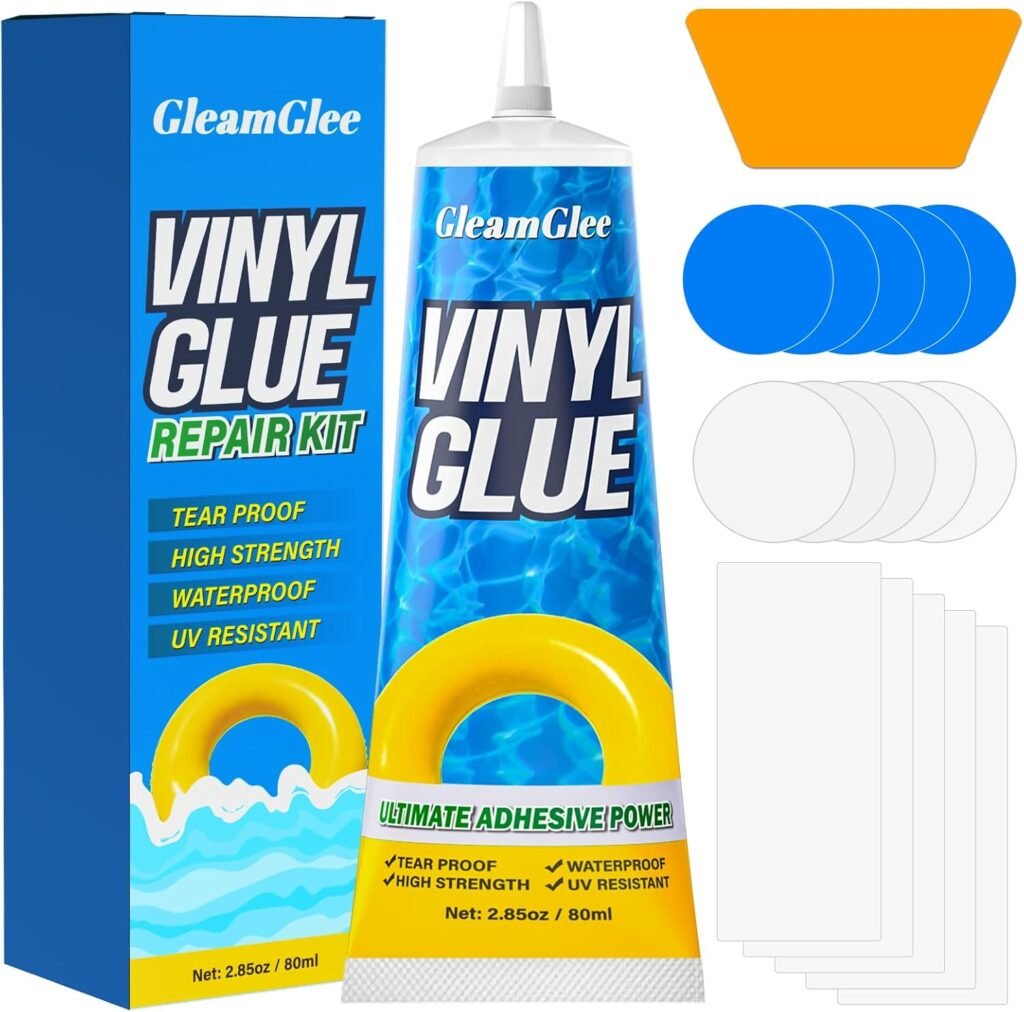
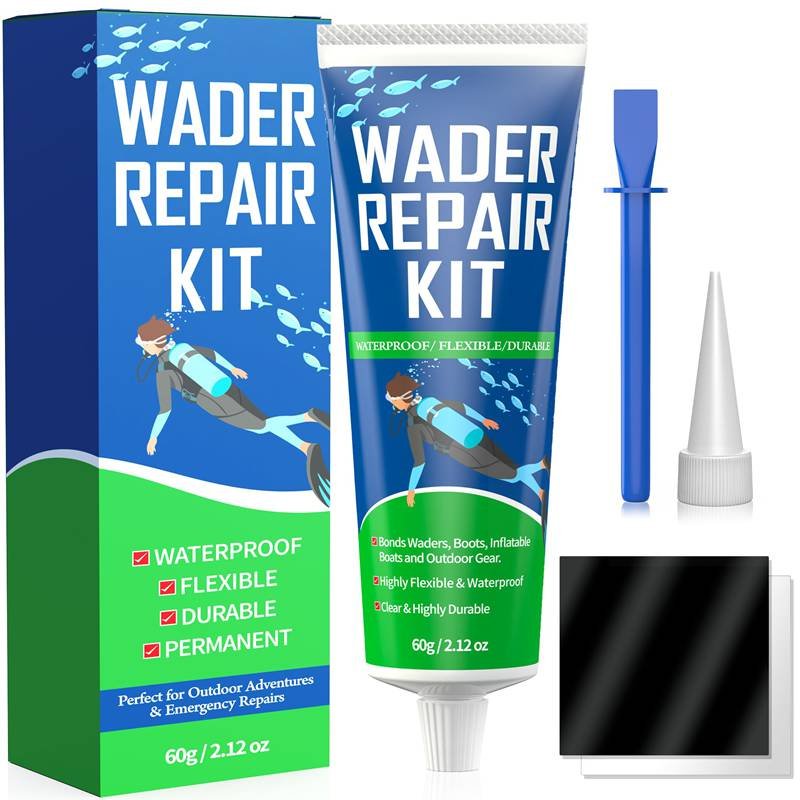
What does the GleamGlee kit include?
- 80 ml premium PVC adhesive
- 5 blue round patches
- 5 clear round patches
- 5 clear rectangular patches
- Squeegee
- Applicator
- Precision metal nozzle
Many competitor kits include only 1–2 patches and 5–15 ml glue.
GleamGlee offers industry-leading contents for both emergency and long-term repairs.
How strong and flexible is GleamGlee’s adhesive?
Lab testing shows:
- 95% tensile strength retention after 180-day UV exposure
- 96% airtightness after 50 hot/cold cycles
- Zero delamination in chlorine tests
Glue remains flexible even after folding and rolling—important for kayaks/SUPs stored tightly.
Why is the precision metal nozzle a game-changer?
Most kits use plastic brushes that cannot reach:
- Micro holes
- Seam pin leaks
- Corner punctures
- Valve rings
The metal nozzle allows injectable precision, making professional-level repairs possible even for beginners.
What products can GleamGlee repair?
- Air beds, sofas, chairs
- Pools, rings, loungers
- Kayaks, rafts, SUP boards
- Bounce houses, slides
- Inflatable tents, sleeping pads
- Float tubes, fishing buoys
If it’s PVC, GleamGlee can fix it.
Is GleamGlee suitable for both DIY consumers and B2B buyers?
Absolutely.
DIY buyers appreciate:
- Clear instructions
- Pre-cut patches
- Fast, reliable repairs
B2B buyers appreciate:
- OEM/ODM formulation services
- Custom packaging
- Low MOQ starting at 200 units
- Consistent quality across container-scale orders
- Multiple overseas warehouses for rapid delivery
GleamGlee currently supplies 5000+ distributors globally.
Conclusion
PVC inflatables last for years—but only when they are repaired correctly, using materials specifically designed for PVC welding, waterproof bonding, and outdoor durability. Throughout this guide, we’ve seen how essential it is to understand the type of inflatable you own, how damage occurs, what conditions influence adhesive performance, and why not all repair kits are built the same. The right tools and the right technique determine whether your inflatable survives a single weekend… or performs reliably for many seasons.
A high-quality PVC repair kit needs to deliver strong solvent-welding adhesion, flexible and UV-resistant patches, true waterproof sealing, and precise application tools. Without these features, repairs fail prematurely—especially on high-pressure inflatables like SUP boards, kayaks, rafts, and bounce houses.
This is exactly why GleamGlee’s PVC Inflatable Repair Kit has become a trusted choice for outdoor enthusiasts, homeowners, rental operators, and businesses worldwide. Backed by 25+ chemists, four vertically integrated factories, and global testing across more than 50 PVC products, the kit offers:
- Industry-grade bonding strength for tears, punctures, seam leaks, and pressure-point failures
- Multi-environment durability, resisting sun, saltwater, chlorine, abrasion, and folding stress
- A complete toolkit with pre-cut patches, rect patches, squeegee, applicator, and precision metal nozzle
- Consistent quality, thanks to controlled raw materials, in-house production, and strict QC
- Ease of use for beginners yet professional performance for advanced repairs
Whether you’re fixing a slow-leaking air mattress before your next guest arrives… sealing a kayak puncture before a long expedition… or maintaining SUP boards and rafts for commercial use… GleamGlee gives you the reliability and confidence that cheaper kits simply cannot offer.
Share:
Table of Contents
Here, creating your adhesives glue & removal cleaner collection is no longer a barrier—it’s a collaborative journey where GleamGlee helps brands and businesses transform their vision into durable, certified, and market-ready solutions.
Partner with GleamGlee
Join hundreds of global partners who trust GleamGlee for adhesives and cleaners that combine innovation, compliance, and speed. Our vertically integrated system—from R&D to warehouse—guarantees consistent performance and reliable delivery.
Whether you’re sourcing FBA-ready stock or developing your own formula, our team provides unmatched technical support and responsive service.