Skip to content

Floral Glue for Quick Flower Arrangement Fixes: An Expert-Led Guide
Your trusted adhesives glue & cleaner manufacturer

Flower arrangements rarely fail in a dramatic way. More often, one small detail causes the trouble: a rose begins leaning toward the edge of a bouquet, a ribbon lifts from a corsage, a sprig of greenery shifts during delivery, or an artificial flower head separates from its stem just before an event. These are exactly the situations where a well-chosen floral adhesive can save time without forcing you to rebuild an otherwise successful design.
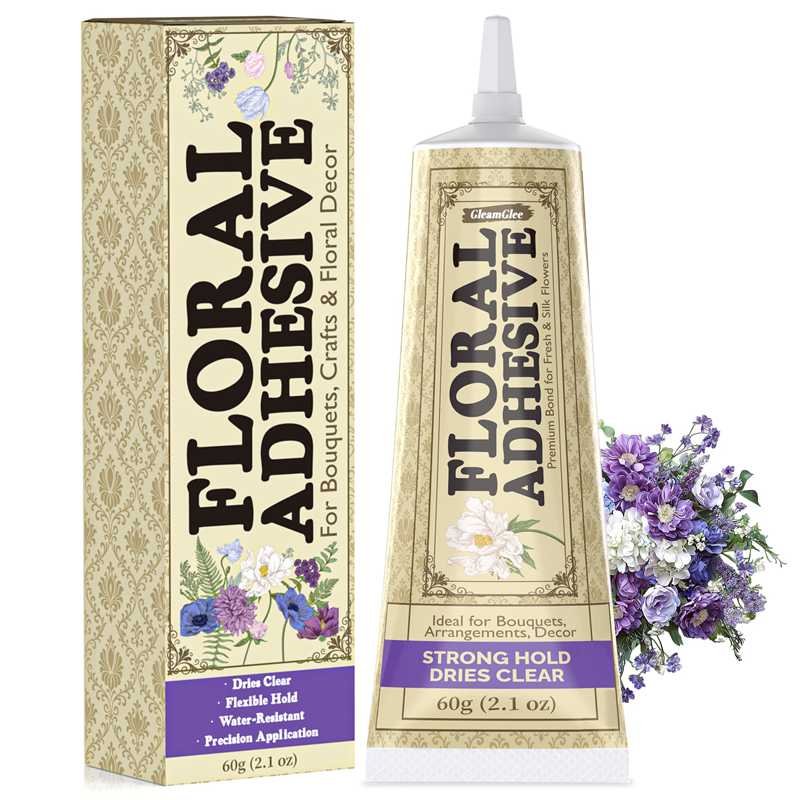
Floral adhesive can quickly repair loose flowers, small stems, petals, greenery, ribbons, corsages, boutonnieres, centerpieces, flower crowns, and lightweight decorative details. The cleanest repairs come from using an adhesive suited to the flower type, applying a controlled amount at a hidden contact point, allowing the bond to stabilize before handling, and using wire, tape, foam, or structural supports whenever the damaged area carries significant weight.
The key is knowing the difference between a small attachment problem and a structural problem. A loose bloom in a bridal bouquet may need only a discreet bonding point, while a heavy flower head on a broken stem may require reinforcement before adhesive is useful. Once that distinction becomes familiar, last-minute repairs become less stressful, and the adhesive becomes another precise floral tool rather than an emergency solution used without a plan.
What Flower Problems Can Adhesive Fix?
Floral adhesive works best on localized problems such as loose blooms, detached flower heads, shifting greenery, lifted ribbon, filler flowers, decorative accents, and small artificial components. It is most effective when the underlying bouquet, crown, centerpiece, or floral structure is already stable. When heavy stems, frames, arches, or load-bearing mechanics are failing, wire, tape, pins, clamps, foam, or structural supports should handle the main load.
Loose Blooms and Flower Heads
A flower that rotates, tilts, or starts slipping out of position does not automatically need to be removed. First examine whether its stem is still intact and whether the surrounding flowers are supporting it correctly. When a bloom simply needs extra positional control, floral adhesive can create a discreet contact point near the stem base, calyx, backing, or another hidden area where the flower naturally touches the arrangement. The contact area matters more than the amount of adhesive used, because a small, well-positioned bond generally performs better than a large bead bridging two surfaces that barely meet.
Detached artificial flower heads are often easier to repair because their stems and sockets are usually plastic, wire, or coated materials that can be examined clearly before bonding. Fresh flowers require more judgment because a badly damaged stem may also lose its ability to take up water. In that situation, shortening the stem, replacing the bloom, or reinforcing the flower may give a better result than simply joining the broken pieces. The aim is always to restore the design without creating a visible repair or placing unnecessary stress on delicate plant tissue.
Broken Stems and Weak Support
Minor stem damage can sometimes be stabilized, particularly when the flower is part of a wearable arrangement, preserved display, or artificial design. Fresh bouquet stems deserve more caution because they provide both physical support and hydration. A stem that is crushed, split, or badly bent may continue to weaken even after an adhesive repair, so the damaged area should be inspected before deciding whether gluing is appropriate. If the flower can be shortened and returned to a water source, that option may preserve the bloom more reliably.
Heavy flower heads also create leverage that a small adhesive joint may not be designed to handle. Florists often use hidden wire or floral tape to provide structural support before adding adhesive for positioning or finishing. Dried flowers present another challenge because the adhesive itself may remain secure while brittle plant tissue breaks beside the repaired area. For that reason, a dried-flower repair should be handled gently after completion rather than repeatedly bent or pulled to test whether the bond is holding.
Loose Greenery and Decorative Details
Greenery can look lightweight while still creating considerable leverage because broad leaves and branching stems catch on packaging, clothing, neighboring flowers, table edges, and transport materials. A loose piece of eucalyptus, ruscus, fern, or artificial foliage can often be stabilized with a small adhesive point placed where the stem naturally overlaps another part of the arrangement. The repair should be hidden behind a leaf, ribbon, stem bundle, or backing rather than spread across the visible surface of the foliage.
Ribbon, bows, tags, berries, beads, decorative fabric, and lightweight accessories are also good candidates for floral adhesive when their load is modest. A narrow nozzle is especially useful because it allows adhesive to be placed underneath an overlap rather than across the visible face of a ribbon. Porous decorative fabrics require restraint because excess adhesive may soak through, create a darker area, or leave a hardened ridge. Testing an inconspicuous area first is worthwhile when working with premium wedding or retail materials.
When Glue Is the Wrong Fix
Adhesive should not be used as the sole solution when the arrangement has a structural failure rather than a local attachment problem. A wedding arch that moves at its base, a hanging floral frame, a heavy cascading bouquet, or a large centerpiece with unstable foam requires mechanical reinforcement before individual flowers are secured. Adding more adhesive can sometimes hide the problem for a short period while leaving the underlying load path unchanged.
Large installations may require wire, mesh, cable ties, clamps, pins, foam cages, frames, or purpose-built support systems, depending on the design. Adhesive can then handle finishing details once the structure is secure. The same thinking applies to smaller arrangements. A heavy rose head on a weak stem may need hidden wire, while a loose filler bloom next to it may need only a tiny adhesive connection. Choosing the repair method according to the actual load produces cleaner, safer, and more predictable results.
| Floral Problem | Adhesive Suitability | Typical Movement | Better Support When Needed |
|---|---|---|---|
| Loose filler flower | Very suitable | Low | Usually unnecessary |
| Rotating small bloom | Suitable | Low to medium | Hidden wire for heavier heads |
| Detached artificial bloom | Suitable when materials match | Medium | Stem reinforcement |
| Loose ribbon or bow | Very suitable | Low | Stitching or wire for loaded areas |
| Brittle dried stem | Limited | Low | Hidden wire or rigid backing |
| Heavy fresh flower head | Limited alone | Medium to high | Floral wire and tape |
| Moving bouquet structure | Poor primary solution | High | Rebuild bouquet mechanics |
| Arch or hanging installation | Poor primary solution | Very high | Frame, clamps, ties, or engineered support |

Which Adhesive Works for Each Flower Type?
The right adhesive depends on whether the arrangement uses fresh flowers, artificial blooms, dried materials, fabric, plastic, floral foam, or mixed craft surfaces. Fresh flowers generally benefit from a floral-formulated adhesive designed for delicate plant material, while artificial designs allow a broader choice of bonding systems. Dried flowers require gentle, precise application because the plant material can be brittle even when the adhesive bond itself is strong.
Fresh Flowers
Fresh flowers are among the most demanding materials to bond because their surfaces may contain water, sap, wax, natural oils, and delicate plant tissue. They also move through different environments during a normal event workflow, including refrigerated storage, room-temperature preparation, delivery vehicles, outdoor venues, and humid reception spaces. These conditions make floral-specific adhesive more appropriate than assuming that a general craft glue will behave the same way.
A cold floral adhesive intended for fresh flowers should be used in small, controlled amounts and at carefully chosen connection points. The goal is not to coat large areas of the plant but to create a discreet bond on a cut stem end, calyx area, prepared backing, ribbon base, or another suitable contact point. When working with unfamiliar flowers, especially thin-petaled varieties or valuable wedding blooms, testing a few spare flowers first can reveal whether the surface, moisture level, or natural coating affects the finished appearance.
Artificial and Silk Flowers
Artificial flowers are usually more tolerant of adhesive because there is no living tissue to preserve, but their material construction can be much more complicated than it first appears. One artificial bloom may contain polyester fabric, molded plastic, steel wire, foam, paint, surface coating, and synthetic fillers. A glue that adheres well to one component may perform differently on another, so material compatibility should be considered before assembling a large batch.
Reusable wedding décor, wreaths, flower walls, gift boxes, artificial bouquets, and retail displays often benefit from a flexible bond because they are transported, stored, packed, unpacked, and repositioned many times. A very rigid connection may remain intact while the plastic or fabric next to it begins peeling or cracking. Clear drying is equally important on pale silk petals, translucent decorative materials, acrylic display boxes, and visible floral bases where excess adhesive can become more noticeable under bright lighting.
Dried and Preserved Flowers
Dried flowers have little internal moisture, yet they can be difficult to repair because their stems and petals become brittle. Materials such as dried hydrangea, baby’s breath, lavender, grasses, and thin preserved foliage may fracture under surprisingly light pressure. The best approach is usually to apply a minimal quantity of adhesive and avoid forcing two misaligned pieces together simply to create contact.
Preserved-flower artwork, wreaths, pressed-flower cards, shadow boxes, and decorative frames are often easier to bond because the finished piece remains relatively static. In these applications, a small clear adhesive point connecting the botanical material to wood, acrylic, paper, or a decorative backing can provide sufficient support. The repair should still be judged visually because porous dried materials can darken where too much adhesive is applied, and shiny residue can become obvious on high-end preserved arrangements.
Floral Glue, Hot Glue, Tape, or Wire?
Cold floral adhesive, hot glue, tape, and wire all solve different problems, so choosing between them should be based on the function of the connection rather than a simple comparison of strength. Cold floral adhesive is particularly useful for detailed fresh-flower work, corsages, crowns, boutonnieres, and visible areas where heat or bulky mechanics would be undesirable. Hot glue is more commonly suited to selected artificial flowers, containers, bases, foam-compatible craft applications, and other heat-tolerant materials.
Floral tape is useful for wrapping and bundling stems, covering wire, and creating unified floral units, while wire provides positioning and reinforcement for weak or heavy flowers. Many professional arrangements combine these methods. A focal flower may be wired for structure, the ribbon or backing may provide the design base, and smaller flowers may then be glued into place. A mixed-mechanics approach often produces a lighter, cleaner arrangement than trying to make a single adhesive perform every structural and decorative job.
| Method | Best Use | Fresh Flowers | Main Advantage | Main Limitation |
|---|---|---|---|---|
| Cold floral adhesive | Corsages, blooms, crowns, accents | Suitable when formulated for flowers | Clean localized bonding | Not a replacement for structural support |
| Hot glue | Artificial flowers, bases, selected craft materials | Limited | Rapid grab | Heat and visible bulk |
| Floral tape | Stem bundles and wired flowers | Suitable | Flexible wrapping and concealment | Does not bond flat surfaces by itself |
| Floral wire | Weak stems and positioning | Suitable | Strong structural control | Adds labor and material |
| Adhesive strip | Flat backings and accessories | Depends on substrate | Clean, fast contact | Surface and temperature dependent |
How Do You Apply Floral Adhesive Correctly?
Apply floral adhesive to clean, compatible contact points using only enough material to create complete contact. Position the flower before dispensing, place the adhesive on a concealed load-bearing area, and keep the component stable while the bond develops. Repeated movement during setting can weaken the connection, while excessive adhesive can spread onto petals, ribbon, foliage, or decorative surfaces without improving the underlying structure.
Prepare the Contact Area
Reliable bonding begins before the adhesive is opened. First place the flower in its intended position without glue and check whether the angle, weight, and contact area make sense. If the flower has to be pushed forcefully into position or immediately springs back, the design may need better support rather than more adhesive. A dry-fitting step helps reveal whether the repair is solving the right problem.
Loose debris, pieces of damaged plant tissue, old adhesive, dust, and excessive surface moisture should be addressed where appropriate. Artificial stems or decorative surfaces may benefit from gentle cleaning before bonding, while fresh flowers should be handled carefully so that preparation does not damage the plant. If a bloom has just come from refrigeration and visible condensation has formed, allowing the surface to stabilize before bonding can make the result more predictable.
Use a Controlled Amount
There is no universal quantity of floral adhesive that works for every flower. A small filler bloom, artificial peony, ribbon overlap, and plastic flower base all have different contact areas and movement patterns. The correct amount is the smallest quantity that covers the intended connection without squeezing visibly into the surrounding design. A narrow line or small drop is often more useful than a thick bead.
Excess adhesive can create several practical problems at once. It may migrate onto petals, soak through ribbon, leave a shiny edge, collect dust, stiffen flexible materials, or make the finished repair more obvious. More glue also cannot correct poor geometry. If two components barely touch, increasing the volume of adhesive does not create the same stability as improving their contact area. Precision metal nozzles are useful because they make repeatable, narrow application easier during both occasional repairs and high-volume florist work.
Choose the Right Bond Point
The best adhesive location is usually the hidden area where two components naturally meet and where the bond can resist the direction of movement. If a flower head continually rotates forward, the repair should control that rotation rather than simply attach the nearest two surfaces. If greenery lifts from a base, the adhesive should be applied where the stem already crosses a stable part of the arrangement.
Visible decorative surfaces deserve extra care. Ribbon is generally better bonded beneath an overlap, artificial flower heads are better joined around a stable socket or base, and foliage is better attached behind a leaf or stem junction. Wearable flowers need additional attention because thick or rigid adhesive deposits should not sit where they can rub against skin, hair, or clothing. Good floral bonding is as much about placement and comfort as it is about holding power.
Let the Repair Stabilize
A common source of repair failure is repeated movement during the early bonding stage. Designers may press a bloom into position, release it, adjust it again, rotate the arrangement, and then check whether it is holding. Every unnecessary movement can disturb the contact area before the bond has developed enough stability for handling.
Drying and setting times vary by formulation, application thickness, material, temperature, and humidity, so the product instructions should always take priority over a generic timing rule. A flower may reach initial handling stability relatively quickly while still needing additional time before refrigeration, packaging, transportation, or customer use. For event production, completing adhesive work before the last possible moment gives the arrangement more time to stabilize and reduces the need to handle fresh joints during delivery preparation.
| Application Stage | Practical Check | Common Error | Better Approach |
|---|---|---|---|
| Dry fitting | Flower sits naturally before glue is added | Deciding placement after dispensing | Position first |
| Preparation | Contact area is stable and free of loose debris | Bonding over damaged material | Prepare the exact joint |
| Dispensing | Adhesive remains inside hidden contact area | Applying a large bead | Use controlled flow |
| Placement | Both surfaces make real contact | Filling a large gap with glue | Improve the joint geometry |
| Initial hold | Flower remains still | Repositioning repeatedly | Support once and leave stable |
| Storage | Bond has developed enough for handling | Moving immediately into transport | Follow product instructions |

How Do You Fix Common Floral Arrangements?
Different floral arrangements require different repair methods because they experience different movement and loading. Bouquets are carried and rotated, corsages move constantly with the wrist, boutonnieres contact clothing, flower crowns flex with the wearer, and centerpieces are comparatively static. A successful repair should therefore consider how the finished design will be handled, displayed, refrigerated, transported, and worn rather than treating every loose flower the same way.
Bouquets
A bouquet should be inspected as a complete system before one loose flower is repaired. Hold it in the same upright orientation in which it will be carried, rotate it slowly, and look at focal flowers, greenery, stem binding, ribbon, cascading material, and any area that seems to move as a group. If several blooms shift together, the bouquet structure may need adjustment rather than individual adhesive repairs.
When only one small bloom has rotated or become loose, reposition it within the existing mechanics first. A small adhesive contact can then help maintain the intended angle if the neighboring stems or backing provide a suitable support point. Fresh stems that still depend on water should not be unnecessarily coated. Heavy cascading flowers deserve particular caution because their extended stems create leverage, and hidden wire may provide better structural control before adhesive is added for finishing.
Corsages and Boutonnieres
Corsages and boutonnieres are especially suitable for carefully controlled floral adhesive because they use compact flowers, small backings, ribbon, and highly visible detail. They also experience more movement than many table arrangements. Wrist corsages bend as the wearer moves, while boutonnieres interact with jackets, lapels, seat belts, hugs, and repeated repositioning throughout an event.
Before repairing a corsage, inspect the wristlet and base. If the base itself is loose, reattaching a bloom will not solve the underlying instability. Once the foundation is secure, a detached flower, ribbon, or small piece of greenery can be bonded to a suitable hidden contact point. Boutonnieres need particularly firm orientation because even a slight rotation can look obvious against a straight jacket lapel. Building a stable backing first usually gives a cleaner result than trying to glue a flower directly onto loose fabric.
Centerpieces and Flower Boxes
Centerpieces experience less continuous movement than wearable flowers, but they face different challenges during delivery and setup. Flowers can shift inside foam, decorative elements may move as arrangements are carried, and wide foliage can catch on packaging. If a bloom repeatedly rotates inside foam, determine whether the insertion point has enlarged or whether the support material itself has become unstable before adding adhesive.
Flower boxes have a similar issue because stems may look secure while the box is sitting flat but move when the package is carried at an angle. The internal support system should be stabilized first, followed by individual flower adjustments. In artificial flower boxes, clear adhesive can also secure decorative ribbon, small ornaments, and floral accessories when the materials are compatible. The goal is to prevent transport movement without making the arrangement rigid or visibly over-glued.
Flower Crowns and Wearable Designs
Flower crowns are demanding because almost every part of the design flexes. The crown bends during placement, follows head movement, touches hair, and may be worn for several hours. A repair that works perfectly on a stationary centerpiece can become uncomfortable or fail when placed on a flexible crown.
Begin with the structural base. If the wire, vine, ribbon, or headband is damaged, repair or replace that part before attaching flowers. Lightweight blooms, foliage, and filler flowers can then be secured at concealed points that follow the natural curve of the crown. Thick adhesive deposits should be kept away from areas that can touch the scalp, forehead, or ears. A good flower-crown repair moves with the design rather than creating a hard point that fights against normal flexing.
How Do You Prevent Adhesive Repairs from Failing?
Most floral adhesive failures come from unsuitable surfaces, poor contact, excess moisture, movement during setting, or asking a small bond to carry more structural load than it should. Reliable repairs begin with correct diagnosis and surface preparation. Adhesive should create a stable connection between compatible materials, while wire, tape, frames, foam, or other mechanical supports handle heavy loads and large movement.
Control Moisture and Temperature
A cured adhesive described as water resistant or waterproof does not automatically mean it will bond successfully when applied to a heavily wet surface. Surface water and condensation can interfere with contact during application, particularly on smooth stems, plastics, ribbon, or coated decorative materials. Fresh flowers naturally create humid working conditions, so the bonding area should be evaluated rather than assuming that every damp surface will behave the same way.
Temperature also affects both the adhesive and the arrangement. Floral work may move between refrigeration, room-temperature preparation, outdoor winter events, warm vehicles, and humid venues within a few hours. Products intended for professional floral use should therefore be tested under the conditions in which they will actually be used. For large event orders, testing the complete process—from cooler storage through bonding, transport, and venue setup—provides more useful information than evaluating a sample only on a dry workbench.
Improve Surface Contact
A strong adhesive cannot compensate for weak material underneath it. Glue applied over dust, old adhesive, loose plant tissue, flaking paint, oily coatings, or deteriorating foam may remain attached to the contamination while the contamination separates from the flower. This can create the impression of adhesive failure even though the true problem is the surface.
Contact geometry matters just as much. Two round stems crossing at a single small point offer limited bonding area, especially when a flower head creates leverage. Improving the way the components meet, using a backing, repositioning the flower, or reinforcing the stem can often improve reliability more effectively than increasing the amount of adhesive. When a repair fails repeatedly in exactly the same place, it is usually worth reassessing the joint design before adding another layer of product.
Reduce Movement During Setting
Every adhesive needs a stable interface during the early stage of bonding. Repeatedly lifting, rotating, or checking the flower can disturb that interface and make the connection less uniform. The arrangement should therefore be positioned accurately before application, then supported long enough for the bond to develop the handling strength required by the product.
This is especially important during event production, when teams are working quickly and finished pieces are moved from workstation to packaging area in rapid succession. A clear workflow can reduce unnecessary handling. Staff can prepare flowers first, complete adhesive work in batches, place finished pieces in a protected setting area, and only move them to cool storage or delivery packaging once the bond has stabilized. Good production timing often prevents more failures than simply choosing a stronger adhesive.
Know When the Load Is Too High
Load is not determined only by the weight of a flower. Leverage, vibration, repeated bending, wind, transport movement, and the direction of force can be equally important. A relatively light bloom placed at the end of a long flexible stem may place more stress on a repair than a heavier flower positioned close to a stable backing.
Large outdoor installations, suspended floral designs, flower walls, wedding arches, and stage arrangements should therefore use appropriate structural hardware. Adhesive can secure finishing flowers and decorative details, but it should not be the sole system preventing a heavy structure from moving or falling. The same principle applies on a smaller scale to bouquets and wearable designs. A hidden wire supporting a heavy bloom often allows a much smaller, cleaner adhesive connection to perform its intended job successfully.
What Should Florists Look for in Floral Adhesive?
Florists should evaluate floral adhesive for clear drying, flexibility, material compatibility, moisture resistance, controlled dispensing, storage behavior, setting consistency, and packaging reliability. Professionals purchasing repeatedly should also consider batch consistency, documentation, nozzle performance, supply continuity, label requirements, and the manufacturer’s ability to support different packaging or private-label programs. A useful product must perform predictably across real floral workflows rather than only during a single demonstration.
Clear Finish and Flexible Bonding
Appearance is part of adhesive performance in floral work. Wedding photographers use high-resolution cameras, retail displays are illuminated from several directions, and corsages, crowns, and boutonnieres are viewed at close range. A technically secure bond can still look unprofessional if it leaves a cloudy patch, glossy ridge, or hardened lump beside a delicate flower.
Flexibility matters for a different reason. Bouquets swing slightly while being carried, wrist corsages bend, crowns follow the shape of the head, and reusable artificial garlands are packed and unpacked repeatedly. A bond that tolerates limited normal movement may place less stress on nearby flowers, ribbon, and artificial materials. Clear appearance and flexibility should still be evaluated alongside actual compatibility because no single visual property guarantees reliable adhesion across every flower species or craft surface.
Precision Dispensing and Daily Workflow
Packaging design affects how easily a florist can use the adhesive. A large uncontrolled opening can release excess material, damage petals, slow production, and create inconsistent repairs between different staff members. A fine nozzle is useful for narrow stems, ribbon overlaps, corsage backings, flower crowns, artificial flower sockets, and small decorative accessories where accuracy matters more than dispensing speed.
A precision metal nozzle can also reduce waste because the operator can place adhesive directly at the intended connection rather than wiping away material from surrounding surfaces. This becomes more important as production volume increases. A florist making one bouquet may tolerate occasional excess, while a workshop preparing dozens of corsages or artificial flower products benefits from repeatable flow. Nozzle cleaning, cap sealing, and correct storage should therefore be considered part of everyday adhesive handling rather than an afterthought.
Reliability and Commercial Evaluation
A flower shop may judge a product after several weddings, while a retailer, distributor, online brand, or private-label program needs a broader evaluation process. Testing should include the flowers and surfaces that customers will actually use, including fresh stems, ribbon, artificial silk petals, molded plastics, dried materials, foam, and decorative craft surfaces where relevant.
The failure mode is just as important as whether the bond survives. If the adhesive separates cleanly from the surface, compatibility may be the issue. If the plant tissue or fabric tears while the adhesive remains attached, the joint may already be stronger than the surrounding material. Packaging should also be tested because nozzle blockage, leakage, cap sealing, tube deformation, and label durability can affect customer satisfaction even when the formulation performs well. Professional evaluation looks at the complete product experience rather than strength alone.
Private Label and Wholesale Programs
Retail and private-label floral adhesive programs involve more than placing a logo on an existing container. The complete commercial product may include formulation selection, fill quantity, tube or bottle format, precision nozzle, artwork, multilingual instructions, carton design, compliance information, and production planning. Brands entering specialist floral, craft, wedding, or online retail markets can often benefit from testing smaller customized programs before committing to large inventories.
For suitable GleamGlee customization projects, entry quantities can begin around 200 units depending on the formulation and packaging requirements. Design work can be prepared in as little as two days for suitable projects, customized samples commonly require approximately 7–14 days, and normal mass-production planning is around 20 days, with certain expedited programs potentially shortened to approximately 15 days when materials and capacity allow. Exact timing should always be confirmed because formula changes, custom molds, testing, packaging availability, and seasonal production schedules can affect the final plan.
| Commercial Evaluation Point | What to Check | Practical Evidence |
|---|---|---|
| Formula consistency | Similar behavior across production batches | Samples and batch QC |
| Floral compatibility | Fresh, artificial, dried, ribbon, foam | Multi-material testing |
| Dispensing control | Fine, repeatable flow | Nozzle and packaging samples |
| Visual finish | Clear, discreet cured appearance | Light and dark material tests |
| Packaging integrity | Leakage, cap seal, nozzle condition | Storage and transport trials |
| Documentation | Market-appropriate safety information | SDS and relevant files |
| Customization | Label, packaging, branding, formula options | Approved samples and artwork |
| Entry quantity | Suitable for initial market testing | Around 200 units for suitable projects |
| Sample schedule | Enough time for real evaluation | Commonly around 7–14 days |
| Production planning | Supports launch and replenishment | Commonly around 20 days, project-dependent |

Conclusion
Quick floral repairs are easiest when adhesive is treated as a precise part of floral mechanics rather than as a universal solution. Loose petals, small blooms, greenery, ribbon, artificial flower heads, corsages, boutonnieres, and decorative accents can often be stabilized quickly when the materials are compatible and the contact point is properly prepared. Heavy stems, unstable bouquets, arches, and installations need structural support first, with adhesive reserved for localized finishing and positioning.
For everyday users, the most useful habits are simple: identify what actually failed, position the flower before applying glue, use a controlled amount, hide the bond whenever possible, and allow the repair to stabilize before handling or transport. These steps make the arrangement cleaner and reduce the temptation to add more adhesive when the real problem is poor contact or insufficient support.
For florists, event professionals, retailers, and floral-product brands, consistency matters just as much as a successful individual repair. A practical floral adhesive should dispense cleanly, dry discreetly, work with the intended materials, and fit naturally into a repeatable production process. When formulation, packaging, application control, and floral mechanics work together, quick repairs become a normal part of confident floral design rather than a stressful last-minute rescue.

Frequently Asked Questions
Can You Use Glue on Fresh Flowers?
Yes, but the adhesive should be suitable for fresh floral work rather than selected simply because it is a strong general-purpose glue. Fresh flowers contain moisture and delicate plant tissue, and they may later be placed in refrigerated or humid conditions. Use a small amount on an appropriate contact point, avoid covering large areas of petals or water-dependent stems, and test unfamiliar flower varieties before working on a valuable bouquet or large event order.
What Glue Is Best for Fresh Flower Arrangements?
A cold floral adhesive formulated for fresh flowers is generally the most practical choice for bouquets, corsages, boutonnieres, flower crowns, and small arrangement repairs. Useful characteristics include clear drying, controlled application, flexibility, and resistance to the moisture conditions found in floral work. The best product still depends on the exact flower species, surface condition, working temperature, and repair location, so application instructions and small-scale testing remain important.
Can Floral Glue Be Used on Artificial Flowers?
Floral adhesive can work very well on artificial flowers, but material compatibility should be checked because artificial blooms may combine fabric, molded plastic, wire, foam, coatings, and paint. A product that bonds well to a polyester petal may behave differently on a smooth plastic stem. For wreaths, flower walls, artificial bouquets, and reusable décor, flexible and clear-drying bonds are particularly useful because the arrangements are often transported, stored, and handled many times.
Is Floral Glue Better Than Hot Glue?
Floral glue and hot glue are designed for different situations, so neither is universally better. Cold floral adhesive is usually more suitable for fresh flowers, wearable designs, detailed repairs, and situations where heat or visible bulk would be undesirable. Hot glue can be useful for selected artificial flowers, containers, bases, and craft structures that tolerate heat. Professional floral work often combines adhesive, tape, wire, and other mechanics according to the load and material involved.
How Do You Keep Flowers from Falling Out of an Arrangement?
Start by checking whether the stem insertion, foam, binding point, or internal structure is stable. If the underlying mechanic is sound and only one small flower is moving, a discreet adhesive connection may help. If multiple flowers shift together, the arrangement probably needs better structural support rather than individual glue repairs. Heavy blooms may benefit from wire, deeper insertion, better stem positioning, or another mechanic that reduces the amount of load placed on the adhesive.
Does Floral Adhesive Dry Clear?
Many floral adhesives intended for visible floral and craft work are designed to dry clear, which helps keep repairs discreet on bouquets, corsages, crowns, ribbons, and artificial flowers. Clear drying does not make excess adhesive invisible, however. A thick bead can still reflect light or create a visible ridge. The cleanest finish comes from combining a transparent formula with precise dispensing, hidden placement, good surface contact, and the smallest amount of adhesive needed for the connection.
Share:
Table of Contents
Here, creating your adhesives glue & removal cleaner collection is no longer a barrier—it’s a collaborative journey where GleamGlee helps brands and businesses transform their vision into durable, certified, and market-ready solutions.
Partner with GleamGlee
Join hundreds of global partners who trust GleamGlee for adhesives and cleaners that combine innovation, compliance, and speed. Our vertically integrated system—from R&D to warehouse—guarantees consistent performance and reliable delivery.
Whether you’re sourcing FBA-ready stock or developing your own formula, our team provides unmatched technical support and responsive service.