Skip to content

PVC Glue for Summer Waves Pool Repair: A Definitive Guide
Your trusted adhesives glue & cleaner manufacturer

A Summer Waves pool can lose a surprising amount of water through a puncture that is almost impossible to see. The difficult part is usually not finding a product labeled “PVC glue.” The real challenge is choosing the right type of adhesive for a flexible pool liner rather than a rigid plumbing joint, then matching that adhesive with the correct patch, preparation method, and curing time. Flexible PVC walls move continuously under water pressure, sunlight, swimmers, temperature changes, and repeated seasonal setup, so a repair that feels strong on the first day can still fail if the materials are poorly matched.
For most Summer Waves liner leaks, a flexible PVC or vinyl repair adhesive used with a compatible patch is more appropriate than conventional PVC pipe cement. Small punctures, localized cuts, moderate tears, and some underwater leaks can often be repaired successfully when the surrounding liner remains healthy. Long seam separation, brittle material, repeated patch failure, or widespread liner deterioration usually deserves closer assessment and may eventually make replacement more practical.
Picture this common weekend problem: the pool looked normal Friday night, but by Saturday morning the waterline has dropped noticeably. You locate a tiny tear close to the lower wall and grab the first “pool PVC glue” you find online, only to discover that it was formulated for rigid plumbing. Understanding the material before opening the adhesive can save hours of frustration, unnecessary draining, repeated patching, and sometimes the liner itself.
What Material Is a Summer Waves Pool Made Of?
Many Summer Waves pool liners use flexible PVC or vinyl-based sheet material, often reinforced with polyester mesh to increase tear resistance and dimensional stability. The exact construction varies by model and component, so the safest approach is to identify whether the damaged area belongs to the flexible liner, inflatable ring, rigid plumbing, hose, fitting, or valve before selecting an adhesive.
How Can You Identify PVC or Vinyl?
The large flexible wall and floor sections of many above-ground Summer Waves pools behave very differently from the hard PVC used in household plumbing. Flexible liner material bends easily by hand and changes shape slightly as the pool fills, swimmers move, and temperature changes affect the sheet. Reinforced versions may contain polyester mesh between PVC layers, giving the liner greater dimensional stability while still allowing it to flex rather than acting like a rigid plastic panel.
Do not identify the repair material only by color or surface feel. The pool may contain several different materials within a very small area, including a flexible liner, molded drain fitting, hard filter connector, rubber-like gasket, flexible hose, and rigid pipe. An adhesive that performs very well on a liner patch may be unsuitable for a cracked valve housing, while a plumbing cement intended for rigid PVC should not automatically be used across a flexible pool wall.
The model number is particularly useful when the pool has several replaceable components. Check the product label, manual, packaging, replacement-parts diagram, or original listing before making assumptions. If the damaged area still feels smooth, flexible, and structurally sound several centimeters beyond the puncture, it is generally a better repair candidate than material that has become chalky, stiff, cracked, severely abraded, or covered with multiple previous repairs.
Which Pool Parts Can Be Glued?
Small liner punctures, isolated cuts, short tears, abrasion damage, and selected inflatable sections are among the most common candidates for adhesive-and-patch repair. These areas normally benefit from an adhesive that remains flexible after curing because the pool wall continues to move every time the water shifts. A repair that creates one hard, inflexible spot can concentrate stress around the edge instead of moving naturally with the surrounding PVC.
Rigid pipes and molded plumbing parts belong to a different repair category. Conventional PVC pipe cement is designed for tightly fitted hard pipe and fittings and works as part of a rigid plumbing joint. That does not make it a general-purpose liner repair material simply because the liner and the pipe may both be described as PVC. Always read the intended application rather than choosing solely by the material name printed on the front label.
Damage around filter openings, lower wall transitions, drains, molded fittings, and manufactured seams deserves greater caution. These locations may experience higher or more complex loads than the center of a flat liner panel. A patch can sometimes seal a localized defect, but an expanding gap or stressed joint may indicate a mechanical problem that adhesive alone cannot permanently correct.
| Pool Component | Typical Behavior | Common Repair Approach | Practical Risk |
|---|---|---|---|
| Flexible sidewall | Bends under water load | Flexible PVC/vinyl adhesive plus patch | Low to moderate |
| Pool floor | Flexible and abrasion-prone | Wide-overlap PVC/vinyl patch | Low to moderate |
| Inflatable top ring | Expands and contracts | Inflatable-compatible flexible adhesive | Moderate |
| Manufactured seam | Carries concentrated tension | Patch only when damage is localized and stable | Moderate to high |
| Rigid PVC pipe | Hard and non-flexing | Pipe-specific PVC cement | Separate plumbing application |
| Molded valve or fitting | Rigid component | Component repair or replacement | Moderate to high |
Are All Summer Waves Repairs the Same?
Two leaks with the same visible length can require completely different solutions. A clean 10-millimeter puncture caused by a sharp object in the middle of healthy wall material is relatively straightforward because the surrounding liner is still structurally continuous. A 10-millimeter opening along a seam may be more serious because forces can continue pulling the joined sections apart after the patch has been applied.
Pool design also influences how the liner behaves. Framed pools support the wall differently from quick-set models with inflatable rings, while floors experience abrasion, pressure, and contact with the ground. Upper walls move more freely with water motion, and seams experience concentrated stress where separate sections meet. Repair decisions should therefore consider not only the material but also the direction and frequency of movement at the damaged location.
Before applying any adhesive, classify the problem by material, damage type, location, and surrounding condition. That simple inspection prevents one of the most frequent repair mistakes: treating every leak as though it were a small hole that merely needs a larger amount of glue. Good repair work begins with understanding how the failure happened and whether the surrounding material is still capable of supporting the patch.

Which PVC Glue Works for Summer Waves Pools?
For flexible Summer Waves liner repairs, choose an adhesive specifically intended for flexible PVC, vinyl, inflatables, or pool-liner patching. The product should remain flexible after curing, bond reliably to the chosen patch, and provide suitable water resistance for the intended repair. The words “PVC glue” alone are not enough because rigid pipe cement and flexible repair adhesive solve very different problems.
Is PVC Pipe Cement Suitable?
PVC pipe cement is primarily designed to join rigid pipes and fittings that fit tightly together. In many plumbing systems, the cement chemically softens the mating surfaces so they fuse into a hard, stable joint after the solvent evaporates. Pool and spa pipe products are often marketed with swimming-pool imagery, but their intended application usually involves filtration plumbing rather than flexible vinyl or PVC liner sheets.
A Summer Waves liner behaves in the opposite way. It bends under hand pressure, responds to changes in water load, moves as swimmers use the pool, and experiences daily heating and cooling outdoors. An adhesive layer used in that environment should normally be able to move with the liner rather than producing an excessively rigid repair zone that transfers stress to the surrounding material.
The product instructions often reveal the difference immediately. Pipe cement commonly discusses pipe diameter, fitting type, primer, pipe schedule, pressure, and plumbing installation. Flexible repair products usually mention vinyl, PVC sheet, pools, inflatables, rafts, kayaks, air mattresses, punctures, tears, or patches. When choosing a Summer Waves repair product, the intended substrate is more important than the broad word “PVC.”
What Should a Pool Glue Do?
A useful flexible-pool adhesive must perform under conditions that are more demanding than a simple indoor craft bond. The repaired area may remain wet for long periods, warm substantially under direct sunlight, cool at night, flex under water pressure, and move repeatedly during cleaning and swimming. Initial tack alone tells you very little about how the bond will behave after weeks of normal pool use.
Look for clearly stated compatibility with flexible PVC or vinyl, waterproof performance appropriate to the application, flexibility after full cure, compatibility with the supplied or chosen patch, practical working time, and clear curing instructions. Outdoor repairs also benefit from formulations designed to tolerate repeated environmental exposure rather than products intended only for sheltered indoor bonding.
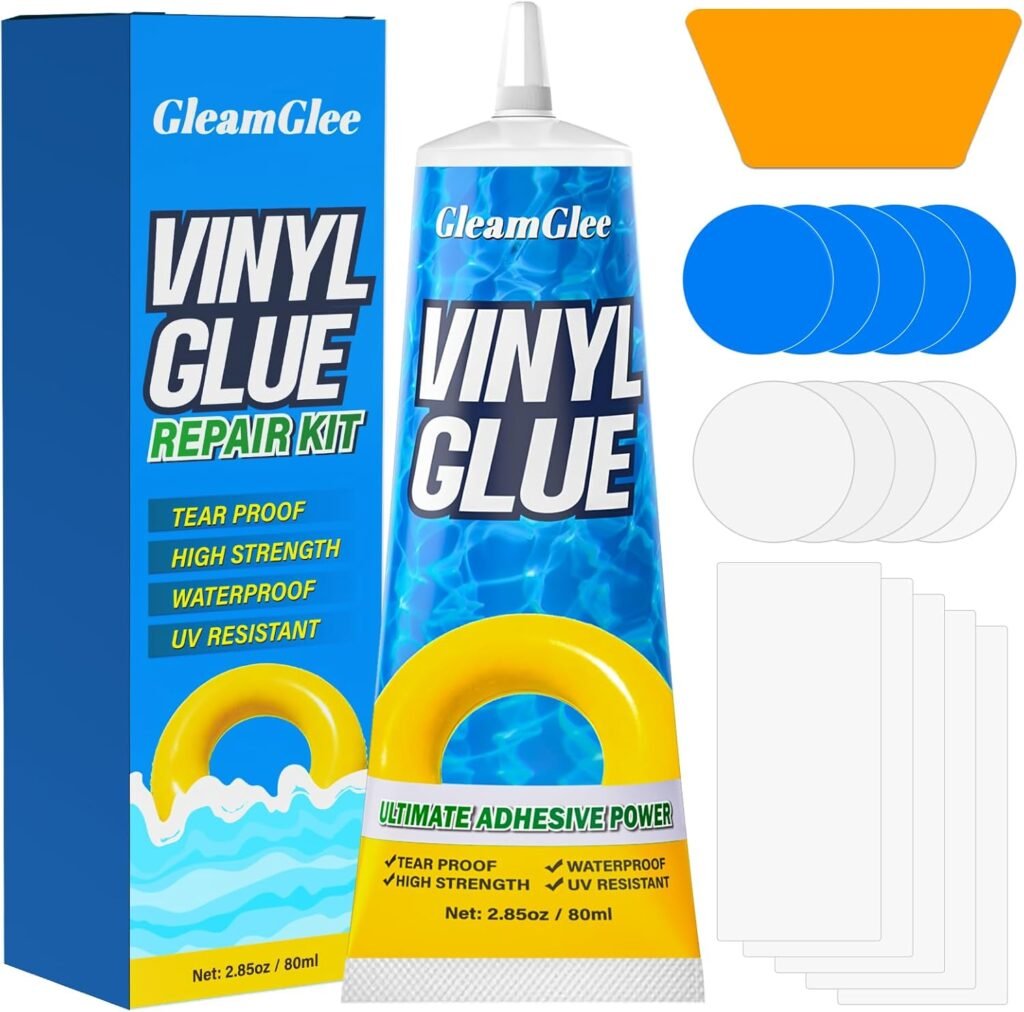
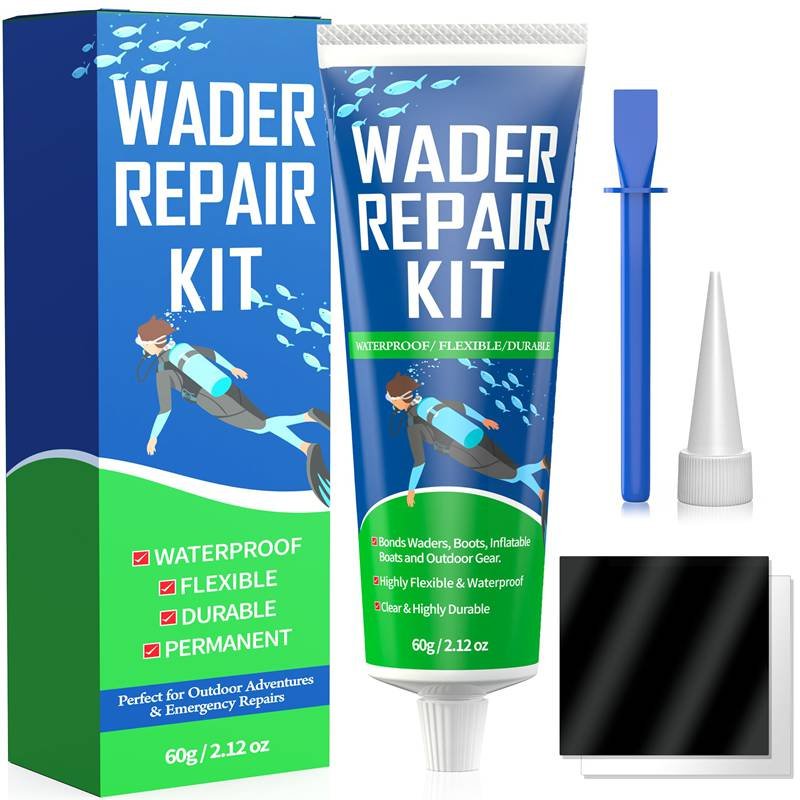
The GleamGlee PVC repair kit is designed around this complete-system approach rather than glue alone. The set includes an 80 ml adhesive, five blue round patches, five clear round patches, five clear rectangular patches, a squeegee, and an applicator. Its precision metal nozzle helps with controlled application around small holes, while the supplied product specifications state that bond strength continues developing over approximately 24 hours.
Do You Need Glue and a Patch?
For most true holes, cuts, and tears, combining adhesive with a patch creates a more dependable repair than simply filling the opening with glue. The patch increases the bonded surface area and distributes forces across healthy material around the damaged point. Without sufficient overlap, stress can remain concentrated at the edge of the original cut, making the same area more likely to reopen during normal liner movement.
A practical reference for small liner repairs is to extend the patch approximately 25 millimeters, or about one inch, beyond the visible damaged area whenever the repair system allows it. Larger or irregular tears may need more coverage because the weakened zone often extends beyond what can be seen when the liner is relaxed.
Patch shape matters as well. Round or oval patches are useful for small punctures because they have no sharp corners that can easily lift. Rectangular patches are practical for longer tears, but rounding the corners before application can reduce peeling stress. The objective is not simply to cover the hole; it is to create a smooth transition between repaired and undamaged liner.
| Damage Type | Adhesive Alone | Adhesive + Patch | Practical Choice |
|---|---|---|---|
| Tiny pinhole | Sometimes possible depending on product | Better safety margin | Patch when accessible |
| Short clean cut | Usually not preferred | Yes | Flexible patch repair |
| Medium tear | No | Yes | Larger patch with wide overlap |
| Thin abraded area | No | Yes | Cover complete weakened region |
| Local seam defect | Rarely sufficient | Sometimes | Inspect seam stress first |
| Rigid fitting crack | No | No | Component repair or replacement |
Which Patch Material Works Best?
The most useful patch is one that is compatible with both the adhesive and the liner while remaining flexible enough to move naturally with the pool wall. Clear PVC or vinyl patches are popular because they are visually discreet and allow you to monitor the underlying repaired zone. Colored patches can also work well where appearance is less important or where the repair kit uses different materials for specific applications.
Patch thickness should not be treated as a simple “thicker is stronger” comparison. A very thick patch may resist puncture well but conform poorly to a curved or moving surface, while an extremely thin patch may lack enough body to bridge a larger tear. For general flexible pool repair, secure surface contact and similar movement characteristics are often more important than choosing the thickest possible material.
When using a complete kit, keeping the supplied adhesive and patches together also reduces uncertainty about material compatibility. For users who regularly maintain pools, kayaks, inflatable beds, or other PVC equipment, storing several patch shapes can make future repairs quicker because the shape can be matched to the actual damage instead of cutting one oversized sheet for every problem.
How Do You Prepare a Summer Waves Pool Leak?
Preparing a Summer Waves leak means locating the real source, examining several centimeters of liner around it, cleaning the bonding surface, and selecting a patch that reaches well beyond damaged material. Good preparation often matters more than using extra adhesive. Dirt, body oil, algae film, trapped moisture, poor patch sizing, or weakened surrounding liner can undermine even a high-quality repair product.
How Do You Find a Small Leak?
Slow leaks are often harder to locate than they are to repair because water can travel along folds, seams, or the exterior wall before becoming visible. Start by marking the water level at a fixed point and observing whether the drop continues over several hours. If appropriate for the pool configuration, comparing water loss with the filtration system operating and stopped can also help distinguish a liner problem from plumbing-related leakage.
Inspect common problem areas carefully, including floor creases, lower walls, previous repair sites, filter openings, drain fittings, manufactured seams, and inflatable rings. Tiny punctures are easy to lose once the surface has been dried, cleaned, or moved, so mark the location with a liner-safe removable marker before beginning preparation.
One hole does not always mean one isolated problem. If several pinholes appear within a small area, inspect the surrounding PVC for abrasion, thinning, cracking, stiffness, or chemical deterioration. Repeatedly patching individual points can become frustrating when the real problem is a larger weakened region that should either receive a broader repair or prompt consideration of liner replacement.
How Should You Clean the Area?
Adhesive can only bond properly to the surface it actually contacts. Sunscreen, skin oil, algae residue, dirt, scale, and loose material can form a weak layer between the patch and liner. For a durable bond, preparation should expose a stable liner surface while avoiding cleaners that might damage the flexible PVC or any protective surface treatment.
Follow the instructions supplied with the repair adhesive rather than assuming a strong household solvent is automatically better. Aggressive solvents can soften printing, change the surface texture of some plastics, or weaken flexible materials if used incorrectly. Unless specifically approved by the repair-product manufacturer, substances such as paint thinner, gasoline, or highly aggressive solvent cleaners are unnecessary risks.
For a dry repair, remove surface water and allow the area to dry as directed before applying adhesive. Keep the liner reasonably flat so the patch can make continuous contact without folds. Underwater-qualified repair systems follow a different method because they are designed to displace water at the bonding interface, so the product instructions should always determine whether a wet or dry process is appropriate.
How Large Should the Patch Be?
The patch should cover the complete damaged zone and extend onto healthy liner in all directions. For small holes and short tears, approximately 25 millimeters or one inch of overlap beyond the visible damage is a practical reference. A 10-millimeter cut therefore needs a substantially larger patch rather than one trimmed to match the length of the slit exactly.
Inspect beyond the visible opening before deciding the size. A tear measuring 25 millimeters may be surrounded by another 15 or 20 millimeters of stretched, whitened, or abraded material. In that situation, the patch should cover the entire weakened zone because bonding only to damaged PVC simply relocates the point where failure may occur.
Round the corners of rectangular patches before application whenever practical. Smooth curves distribute peeling forces more evenly and are less likely to catch during cleaning or handling. Oversizing indefinitely is not necessary, however, because excessively large patches can become difficult to position smoothly on curved surfaces and may trap more air or water during installation.
| Visible Damage | Useful Overlap Reference | Practical Example Patch Size |
|---|---|---|
| 2–3 mm pinhole | About 25 mm around damage | 50–60 mm round patch |
| 10 mm cut | About 25 mm on each side | Around 60 mm patch |
| 25 mm tear | About 25–40 mm beyond tear | Roughly 75–100 mm patch |
| 50 mm tear | About 30–50 mm beyond weak area | Roughly 110–150 mm patch |
How Do You Assess the Surrounding Liner?
The material immediately around a leak is often more important than the hole itself. Healthy flexible PVC should normally remain cohesive, reasonably smooth, and able to bend gently without cracking. Warning signs include chalking, visible thinning, surface flaking, multiple pinholes, stiffness, widespread whitening, or tearing that grows with very light handling.
Inspect several centimeters beyond the damaged area instead of concentrating only on the point where water escapes. If the liner has been scraped against the ground or a hard object, the visibly leaking point may be only the deepest part of a larger abrasion. Covering the complete compromised area provides a more realistic repair than putting a tiny patch directly over the first visible hole.
Previous repair history is another valuable clue. One patch that failed after poor preparation does not necessarily mean the liner is unusable. Several correctly applied patches failing in the same location can indicate seam movement, incompatible repair materials, or deterioration of the substrate itself. At that point, the better question is no longer how much more glue to apply, but whether the surrounding liner can still support a stable bond.

How Do You Repair a Summer Waves Pool?
A typical Summer Waves liner repair involves locating and cleaning the damage, choosing a compatible flexible PVC or vinyl patch with adequate overlap, applying the correct adhesive, placing the patch without wrinkles, removing trapped air or water, maintaining even pressure, and allowing the bond to develop before normal loading. Small punctures are relatively straightforward, while larger tears, seams, and underwater repairs require greater care.
How Do You Patch a Small Hole?
Begin by dry-fitting the patch before adhesive is applied. Confirm that it extends well beyond the puncture and sits flat without wrinkles. Once adhesive has been introduced, repeated repositioning can trap contamination, create uneven film thickness, or reduce contact between the patch and the healthy liner, so accurate placement on the first attempt is preferable.
For a conventional dry repair, mark the leak, clean and dry the area according to the adhesive instructions, select a properly sized patch, round sharp corners, apply a controlled and even adhesive layer, and position the patch smoothly from one edge toward the other. Firm pressure should then be distributed across the entire patch to remove trapped air rather than concentrated only at the center.
Using more adhesive than necessary does not automatically create a stronger repair. Excess glue can make the patch slide, squeeze out unpredictably around the edges, and increase cleanup without improving the interface. Uniform coverage, correct patch overlap, compatible materials, and proper curing conditions are more useful than simply making the adhesive layer thicker.
A small squeegee or flat applicator can help spread pressure more evenly, while a precision nozzle is useful around pinholes and narrow tears. The GleamGlee repair kit includes both types of tools, which is practical for users who want to control the amount of adhesive and reduce the chance of air pockets under transparent patches.
How Do You Repair a Larger Tear?
A larger tear needs more than a proportionally larger amount of glue. It requires a wider stable bonding zone, careful inspection of the liner around the damage, and a patch large enough to distribute stress into healthy material. A clean accidental cut in otherwise flexible liner is usually a better candidate than a tear that developed because the PVC has become thin, stretched, or brittle.
Avoid pulling the tear edges together with excessive force before patching. Distorting the liner can create additional tension that remains after the repair and encourages peeling around the patch perimeter. Instead, return the liner as closely as possible to its normal relaxed geometry and allow the patch to bridge the damaged area without creating an unnatural fold.
A 50-millimeter tear, for example, may reasonably need an overall repair patch in the range of roughly 110 to 150 millimeters depending on the condition of the surrounding material and the repair system. Those figures are practical examples rather than universal limits, because tear orientation, wall curvature, and existing stress can change the required coverage significantly.
When damage becomes very long, reaches a highly stressed location, or continues expanding after the pool is loaded, a simple DIY patch becomes less predictable. In that situation, replacement or manufacturer-approved repair guidance may provide better value than repeatedly enlarging the same patch.
How Do You Repair a Seam Leak?
A seam leak should be treated more cautiously than a normal puncture because the seam is already a manufactured joining zone carrying mechanical load. First determine whether the problem is a small localized hole near the seam or whether the joined sections themselves are beginning to separate over a measurable length.
A short, stable seam defect may sometimes accept a large flexible patch when the surrounding material remains strong. The patch should extend beyond the complete damaged area into sound liner, and any visible distortion should be included in the assessment. When the opening grows noticeably as the pool fills, however, the adhesive is being asked to resist continuing separation rather than merely seal a static leak.
Measure the affected section before and after loading the pool. If a small gap clearly lengthens under water pressure, continues curling, or repeatedly defeats properly applied patches, stop assuming the problem is insufficient glue. The underlying seam may be mechanically unstable, and adding progressively larger patches can delay rather than solve the decision to replace the liner.
Seams located near lower wall transitions or other highly loaded areas deserve particular caution because the forces are not always visible when the pool is empty. A repair that looks excellent during application may behave very differently after thousands of liters of water begin pressing against the wall.
Can You Repair the Pool Underwater?
Some flexible liner repairs can be performed underwater, but only when the specific adhesive or patch system is explicitly intended for wet or submerged application. The word “waterproof” does not automatically mean “can be applied underwater.” Many products are waterproof only after full cure and still require a dry surface during installation.
For an approved underwater repair, prepare and size the patch before entering the water. Apply the adhesive according to the manufacturer’s instructions, position the patch directly over the leak, and press firmly while moving trapped water outward from the center toward the edges. Smooth, controlled pressure is particularly important because water pockets can reduce the contact area.
Underwater repairs are attractive because draining an above-ground pool may waste hundreds or thousands of gallons of treated water. However, repairing below the waterline also gives you less control over cleaning, visibility, and patch positioning. If lowering the water only slightly exposes the damage without creating other problems, a dry application can sometimes provide easier and more predictable working conditions.
The safest rule is straightforward: use underwater application only when the product documentation specifically supports it. Do not convert a dry-use adhesive into an underwater repair product simply because the cured film is described as waterproof.
How Long Should PVC Glue Cure?
PVC repair adhesive normally passes through a working stage, an initial set stage, and a longer full-cure period. A patch that feels stationary after a short time may not yet have developed its final strength. For the GleamGlee PVC repair system described here, the supplied product information states that bond strength continues developing for approximately 24 hours, making early loading unnecessary whenever the repair can remain undisturbed.
When Can You Use the Pool Again?
Understanding the difference between working time, initial set, and full cure helps prevent premature failure. Working time is the period during which the patch can still be positioned. Initial set means the adhesive has begun holding the patch in place. Full cure is the longer period needed for the bond to reach the performance expected by the manufacturer under normal service conditions.
For inflatable sections, loading too early is particularly risky because air pressure stretches the repaired material. A patch can feel dry at the surface while the adhesive layer underneath is still developing strength. Pool walls create a similar problem when a repair is exposed immediately to substantial water pressure or strong repeated movement.
Where the chosen product indicates that bond strength continues increasing for approximately 24 hours, leaving the repair unloaded for the full period is a sensible conservative approach whenever possible. This figure should not be generalized to every adhesive, because formulations vary considerably and some dedicated underwater systems are designed to function while the pool remains filled.
Temperature, adhesive-film thickness, substrate condition, and application environment also influence curing behavior. Moderate conditions generally make patch placement easier, while a liner that is extremely hot from direct sunlight may shorten working time and make controlled positioning more difficult.
What Makes a Pool Patch Fail?
Patch failure usually comes from a combination of material incompatibility, contamination, insufficient overlap, trapped air or water, premature loading, or deterioration of the liner itself. It is useful to think of the repair as three connected layers: patch, adhesive, and liner. A problem at any one of those interfaces can cause the entire repair to fail.
If the adhesive remains attached to the patch but separates cleanly from the pool wall, surface preparation or liner compatibility may be the problem. If the adhesive stays bonded to the liner but releases from the patch, patch compatibility becomes more suspicious. When both patch and adhesive remain intact while the liner tears immediately beside them, the surrounding PVC may already be structurally weakened.
Outdoor use adds further demands. A pool wall can become very warm under strong sun and noticeably cooler at night, while swimmers and circulating water repeatedly flex the material. A repair system should therefore tolerate real movement rather than simply produce a hard bond that looks impressive in a stationary test.
Repeated failure in the same location should trigger reassessment rather than simply another application of glue. The actual cause may be an expanding seam, an abraded liner section, or material deterioration that no adhesive can permanently reverse.
How Do You Check the Repair?
Do not evaluate success only by looking at the patch immediately after application. Establish a baseline by marking the water level or taking a measurement from a fixed point before the repair. After the full recommended cure, return the pool gradually to normal conditions and observe whether the water level continues falling beyond what can reasonably be explained by splash-out or evaporation.
Inspect the patch perimeter closely for curling, small channels, wrinkles, bubbles, or visible moisture migrating under an edge. Transparent patches are particularly useful in this respect because changes around the original puncture can often be seen without removing the repair.
For inflatable sections, restore air gradually if the product instructions allow it and watch how the patch behaves as the material expands. Sudden full inflation places more stress on a fresh repair than a controlled return to operating pressure.
A repair that remains stable for one hour is encouraging but not conclusive. Inspect it again after a full day and after several normal pool-use cycles. Long-term performance matters more than the initial appearance of the adhesive.
| Inspection Point | What to Look For | Action if a Problem Appears |
|---|---|---|
| Immediately after placement | Flat contact and no major bubbles | Reposition only if instructions allow |
| After initial set | Edge lifting or movement | Avoid loading and reassess |
| After full cure | Continued leakage | Check material, overlap, and compatibility |
| After several uses | New tearing beside patch | Inspect liner deterioration or seam stress |
How Long Does Full Strength Take?
Full strength is controlled by formulation, temperature, adhesive thickness, substrate condition, and exposure to moisture. Flexible repair adhesives may appear dry at the surface long before the internal bond has reached its intended performance. This is why phrases such as “fast setting” and “fully cured” should not be treated as interchangeable descriptions.
For the GleamGlee PVC repair adhesive, supplied product information states that bond strength continues developing over roughly 24 hours. When practical, leaving a dry repair undisturbed throughout that period provides a more conservative path before significant pressure, stretching, or repeated flexing is introduced.
Cold environments may slow many adhesive systems, while very hot liner surfaces can shorten working time and complicate placement. Performing the repair in moderate conditions, away from the hottest part of the day, often makes it easier to apply an even adhesive film and position the patch without rushing.
The most reliable cure time is always the one specified for the actual adhesive being used. Avoid borrowing a cure period from another brand or another repair category simply because both products are described as PVC glue.

When Should You Replace the Pool Liner?
Replacing the liner becomes more sensible when damage is widespread, the surrounding PVC is brittle or severely thinned, several new leaks appear, a seam continues separating, or correctly applied patches repeatedly fail. Repair works best when the defect is localized and the surrounding material remains strong enough to support a flexible bond. Adhesive cannot restore a liner that is deteriorating across a large area.
Are Large Tears Repairable?
Some larger tears can be repaired when the surrounding liner is still flexible, strong, and structurally stable. Tear length alone is not the deciding factor. Location, direction, cause, surrounding damage, and the amount of stress applied during normal use are equally important when judging whether a patch can provide a durable repair.
A 75-millimeter accidental cut in the center of otherwise healthy wall material may actually be a better repair candidate than a 20-millimeter opening along a highly stressed seam. Larger repairs require wider patch coverage, consistent adhesive contact, and careful placement because even a small wrinkle can create a pathway for water to reach the damaged region.
Inspect the liner several centimeters beyond the tear. If it remains flexible and shows no cracking or thinning, a properly sized patch may extend useful service life significantly. If the material tears with light handling, looks brittle, or contains numerous nearby pinholes, repairing only the visible cut may provide temporary improvement while the surrounding liner continues to fail.
The purpose of repair is to preserve equipment that still has useful life. When the patch must effectively replace a large section of weak material rather than bridge a localized defect, liner replacement becomes the more realistic long-term option.
Are Seam Failures More Serious?
Seam failures can be more serious than ordinary punctures because a seam is a manufactured joining zone that already carries tension. A patch can potentially seal a small stable defect, but it may not stop a seam that continues separating every time water pressure pushes against the wall.
Document the damaged length before and after the pool is loaded. A seam that remains unchanged under normal pressure is a different problem from one that grows visibly. If separation continues after one correctly performed repair, the adhesive may not be the main limitation. The joining structure itself can be failing beyond the point where a surface patch provides dependable reinforcement.
Localized seam damage can sometimes be addressed with generous patch overlap when the surrounding PVC remains healthy. Long separation, severe distortion, curling seam edges, or repeated failures deserve a more cautious response because an unexpected increase in leakage can release a significant quantity of pool water quickly.
For a newer pool, warranty status should also be checked before undertaking extensive permanent repairs. A replacement component or manufacturer-approved solution can sometimes be more appropriate than modifying a relatively new liner repeatedly.
Is Repair Better Than Replacement?
Repair is usually the better first option when there is one localized puncture or tear, the surrounding PVC remains flexible, and the patch can be installed on clean stable material. It uses less material, avoids unnecessary waste, saves the labor of a full liner change, and can return an otherwise serviceable pool to normal use at relatively low cost.
Replacement becomes more rational when the liner itself rather than the isolated damage has become the weak link. Multiple unrelated leaks, widespread cracking, severe abrasion, brittle sections, advancing seam separation, or frequent new failures indicate that the substrate may no longer provide a dependable bonding surface.
The decision should also include water loss, downtime, repeated repair attempts, and confidence in the next repair. Five inexpensive patches applied to the same deteriorating area may cost less than a new liner in direct materials but provide poor overall value if every repair requires draining, cleaning, curing, and refilling.
A complete flexible repair kit remains useful for small everyday problems because it allows owners to repair pools, inflatable beds, kayaks, rafts, and similar PVC items instead of discarding them prematurely. The important boundary is knowing when a repair extends useful life and when it merely postpones inevitable replacement.
When Should You Stop Patching?
Stop adding patches when every new repair simply moves the leak to the edge of the previous one or another nearby weak spot. That pattern suggests that the surrounding material is failing, even if the adhesive itself remains firmly attached. Continuing to cover increasingly large areas can hide deterioration without restoring the liner’s original structural condition.
A practical warning sign is the appearance of several leaks in the same general area over a short period. Other concerns include cracking during gentle flexing, new pinholes adjacent to old patches, repeated seam movement, visibly thin sections, or situations where the patch stays intact while the liner tears directly beside it.
Repair products such as the GleamGlee PVC kit are best used for localized punctures and tears where the substrate still has useful life. Its flexible waterproof adhesive, multiple patch shapes, applicator, squeegee, and precision nozzle make it suitable for maintaining a range of PVC and rubber inflatables, but no adhesive should be presented as a substitute for structurally sound liner material.
Knowing when to stop is part of good repair practice. A well-executed patch should solve an isolated failure. When the entire surrounding section repeatedly creates new failures, replacement is no longer an admission that repair “did not work”; it is the technically appropriate response to a liner that has reached the limits of reliable service.

Conclusion
Repairing a Summer Waves pool successfully is less about finding the strongest product on the shelf and more about matching the repair system to the material, location, and failure mechanism. Flexible PVC and vinyl liners need an adhesive and patch combination capable of moving with the wall, remaining stable around water, and distributing stress into healthy surrounding material. Rigid pipe cement belongs in the plumbing system, not automatically on the liner.
Preparation also has a major influence on the result. Accurately locate the leak, inspect the surrounding PVC, clean the bonding area, provide generous patch overlap, remove trapped air or water, and respect the adhesive’s curing requirements. For GleamGlee’s flexible PVC repair system, the provided product specification states that bond strength continues developing over approximately 24 hours, making patient curing worthwhile whenever the repair can remain unloaded.
The best repair is one you do only once. A small puncture in a healthy Summer Waves liner can often be handled efficiently with a well-designed PVC repair kit, while an expanding seam or brittle liner deserves a more cautious decision. Understanding that difference saves water, reduces repeated repair work, protects the remaining liner, and helps owners keep a usable pool in service without trying to force an adhesive to solve damage that has already become structural.
Frequently Asked Questions
Can You Use PVC Glue on a Summer Waves Pool?
Yes, but the product should be intended for flexible PVC or vinyl liner repair rather than chosen simply because it contains the words “PVC glue.” Summer Waves liners bend and move under water pressure, so the repaired area normally needs to remain flexible after curing. A compatible PVC or vinyl patch used with the adhesive is generally more appropriate for punctures and tears than rigid pipe cement intended for plumbing.
What Is the Best Glue for a Summer Waves Pool Liner?
The most suitable adhesive is one specifically formulated for flexible PVC, vinyl, inflatables, or pool-liner patching and clearly rated for the intended wet or outdoor environment. Useful characteristics include flexibility after cure, waterproof performance, reliable bonding to compatible patches, and clear curing instructions. For practical home repair, a complete kit containing adhesive, several patch shapes, and application tools can also reduce uncertainty about material compatibility.
Can I Repair a Summer Waves Pool Without Draining It?
Some leaks can be repaired without completely draining the pool when the adhesive or patch system is specifically designed for underwater or wet application. A product being waterproof after curing does not necessarily mean it can bond underwater. If the chosen adhesive requires a dry surface, lowering the water level below the damaged area usually gives better control over cleaning, patch placement, and curing conditions.
How Long Should PVC Glue Dry Before Refilling a Pool?
Drying and full curing are not the same stage, so always follow the instructions for the specific repair adhesive. For the GleamGlee PVC repair adhesive described in this article, supplied product information states that bond strength continues developing for approximately 24 hours. When practical, avoiding full water pressure, inflation, or heavy movement during that period gives the repair more time to develop a stable bond.
Can You Repair a Summer Waves Pool Seam Leak?
A small, stable seam defect may sometimes be repaired with a flexible liner-compatible adhesive and a patch that extends well beyond the damaged area. Long or expanding seam separation is more serious because the joined sections may still be pulling apart under water pressure. If the opening grows after filling or repeatedly defeats properly installed patches, liner replacement or manufacturer-approved repair should be considered.
How Big Should a Pool Liner Patch Be?
For a small puncture or tear, approximately 25 millimeters, or about one inch, of patch material beyond the visible damage in every direction is a useful practical reference when the chosen repair system allows it. Larger tears and abraded areas may require more overlap because weakened material can extend beyond the visible opening. Rounded corners are generally preferable because they reduce obvious points where peeling can begin.
How Do I Know When a Summer Waves Liner Should Be Replaced?
Replacement deserves consideration when several new leaks appear, the PVC has become brittle or visibly thin, an important seam keeps separating, previous repairs repeatedly fail, or new tears form immediately beside well-bonded patches. Those patterns suggest that the liner material itself is deteriorating rather than suffering from one isolated puncture, making additional patches less likely to provide dependable long-term service.
Share:
Table of Contents
Here, creating your adhesives glue & removal cleaner collection is no longer a barrier—it’s a collaborative journey where GleamGlee helps brands and businesses transform their vision into durable, certified, and market-ready solutions.
Partner with GleamGlee
Join hundreds of global partners who trust GleamGlee for adhesives and cleaners that combine innovation, compliance, and speed. Our vertically integrated system—from R&D to warehouse—guarantees consistent performance and reliable delivery.
Whether you’re sourcing FBA-ready stock or developing your own formula, our team provides unmatched technical support and responsive service.