 Skip to content
Porcelain Glue for Plates, Cups, and Vases
Clear, controlled porcelain repair for close-fitting plate fragments, cup handles, decorative vases, keepsakes, and other small household ceramic breaks.
- Repair clean porcelain breaks with a single-component cyanoacrylate formula that applies directly from the bottle without measuring, mixing, or adding hardener.
- Use the medium-viscosity liquid and included precision tips to place a thin adhesive layer along narrow edges, curved fragments, and small contact points.
- Press accurately aligned pieces for 5–10 seconds, support curved or unbalanced parts when needed, then leave the repair undisturbed for a 24-hour full cure.
- Choose repair locations carefully: direct food-contact surfaces, drinking rims, dishwasher use, microwave use, large missing sections, and wide gaps require separate evaluation.

Start With the Porcelain Item You Need to Repair
Plates, cups, and vases share porcelain surfaces, but their break geometry, handling, moisture exposure, appearance, and post-repair use can differ substantially.

Porcelain Plates
Decorative plates and display plates often prioritize pattern alignment and a low-visibility repair line. A clean detached fragment that returns closely to its original position can suit a thin CA bond. Dry-fit from the decorated face first, check the back for complete contact, and keep adhesive away from visible glaze. Dinnerware used for food requires an additional decision because repair suitability for porcelain does not automatically establish direct food-contact suitability.

Porcelain Cups
Cup repairs require closer attention to load and location. An intact handle with two clean contact points can be evaluated because GleamGlee supports controlled application along narrow porcelain edges. Both attachment points must align at the same time. A break through the drinking rim, interior wall, or another direct beverage-contact area requires different safety considerations. Press the aligned handle for 5–10 seconds, support it if needed, and reserve 24 hours for full cure.

Porcelain Vases
Vases introduce curved surfaces, gravity, and possible moisture exposure. Small rim fragments, decorative exterior pieces, and close-fitting curved sections can suit precision bonding when they remain stable during curing. Dry-fit the curve before dispensing because a slight rotational error becomes visible across the vessel profile. For a vase intended to hold water, distinguish an external decorative repair from a crack below the normal water line. Continuous water-holding performance should not be assumed from general water resistance alone.
Is GleamGlee the Right Porcelain Glue for Your Break?
The strongest match comes from close-fitting pieces, clean contact faces, controlled adhesive volume, accurate alignment, stable support, and enough time for complete curing.
Where GleamGlee Fits Porcelain Repair Best
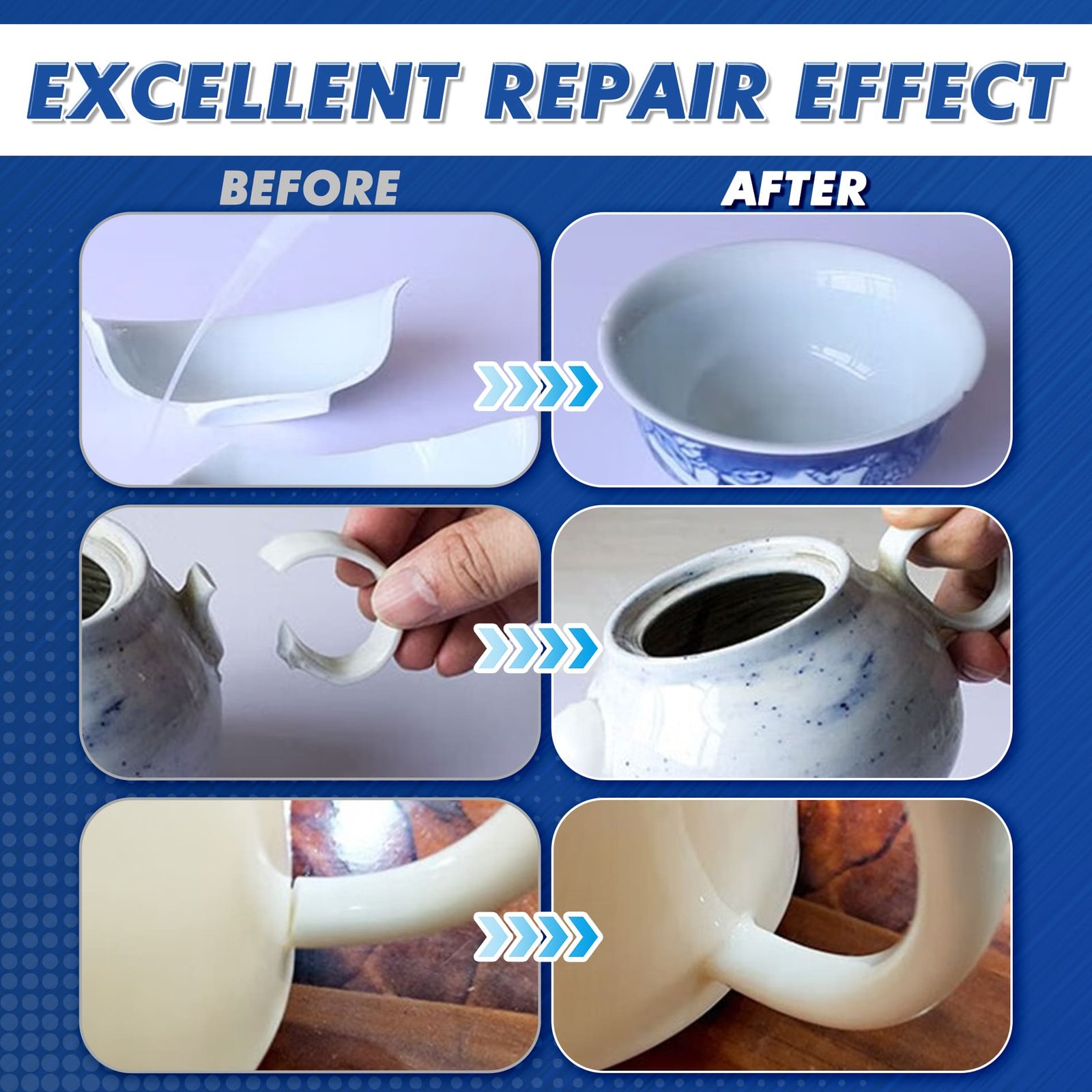
GleamGlee Ceramic Glue is a single-component cyanoacrylate adhesive designed primarily for ceramic, porcelain, and pottery repairs. Its medium-viscosity liquid format is best matched with small, close-fitting breaks where the original pieces remain available and can return accurately to their former position. Common examples include a detached porcelain mug handle, a clean fragment from a decorative plate, a vase rim piece, an external decorative component, a porcelain ornament, or another narrow household break.
A close-fitting joint matters because CA adhesive works through a thin bond layer rather than rebuilding a missing section. Before opening the bottle, place the pieces together without glue. The break should close naturally without a visible cavity or forceful bending. Check the joint from several angles. For patterned porcelain, confirm pattern alignment as well as physical contact.
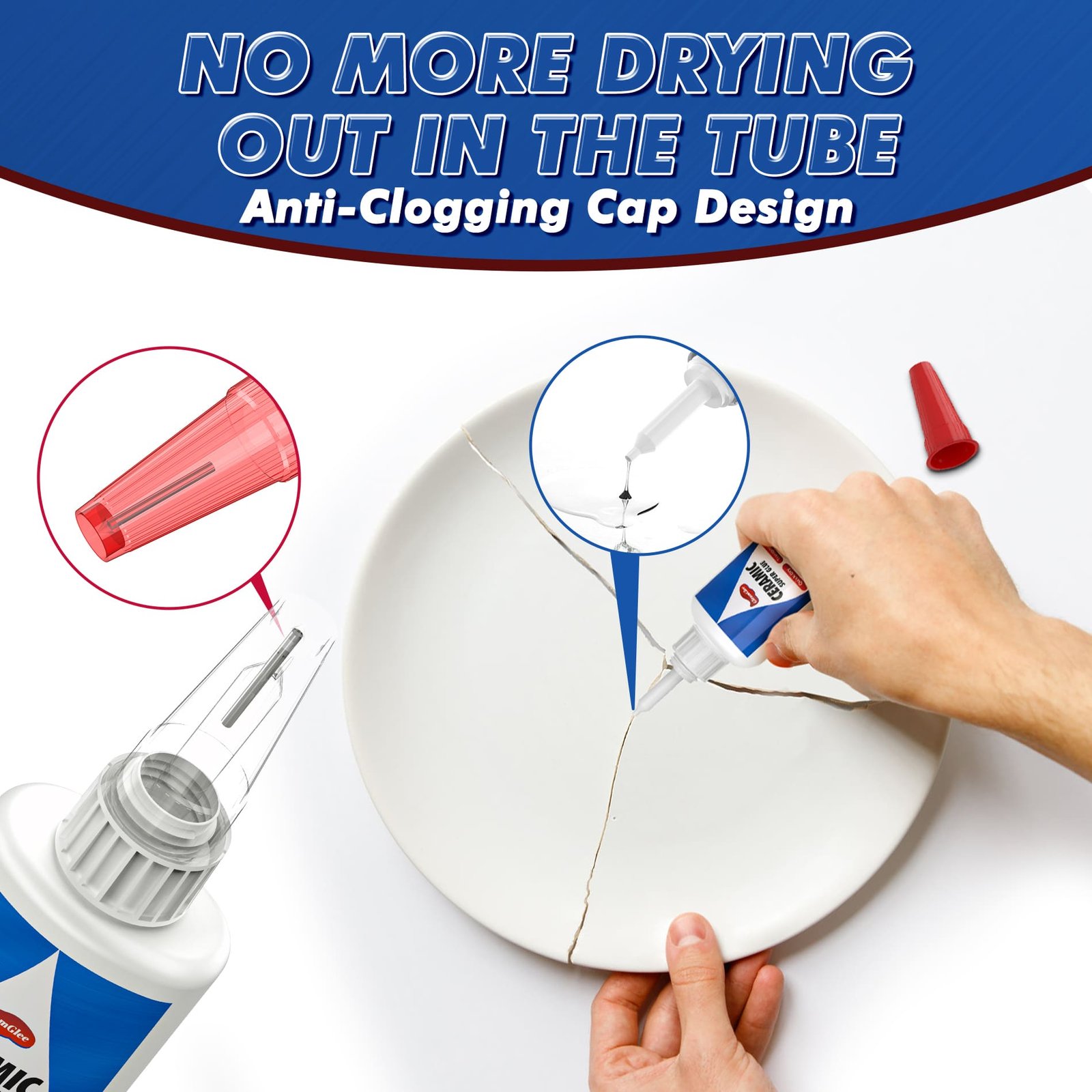
The 35g bottle includes four precision applicator tips. Bringing the dispensing point close to the fractured edge helps control a small amount along a narrow surface. Medium viscosity offers more placement control than an extremely thin liquid while remaining suitable for fine contact areas. Apply a thin, even layer rather than filling the break with excess adhesive.
After alignment, press the pieces firmly for 5–10 seconds. Initial holding only means the pieces are beginning to stay positioned. Curved vase sections, two-point mug handles, or unbalanced fragments may still need low-tack tape or a soft support. Keep the object stable for 24 hours before regular handling or moisture exposure.
When a Different Repair Method Makes More Sense
Not every porcelain problem is a bonding task. A missing chip, broad cavity, uneven joint, or section where the original material has disappeared requires volume to be rebuilt. Liquid CA glue is not ceramic filler, repair putty, tile mortar, or structural construction adhesive. A compatible epoxy, repair compound, professional restoration method, or replacement may offer a better fit when the pieces cannot contact each other closely.
Use location as another screening factor. GleamGlee can be considered for suitable external cup components and decorative porcelain, but the available product documentation does not establish food-contact certification for repaired eating or drinking surfaces. A crack through a cup rim, cup interior, plate eating surface, or another area directly contacting food or beverages should not be treated as automatically safe simply because the adhesive cures clear.
Dishwasher and microwave compatibility also remain separate questions. Water resistance after full cure does not prove resistance to repeated dishwasher heat, detergent chemistry, spray force, or thermal cycling. Heat-resistant positioning for normal household surroundings does not establish microwave, oven, stovetop, or direct-flame suitability.
Vases need similar judgment. An exterior decorative repair and a crack located below the normal water line face different exposure. Occasional moisture resistance should not be expanded into an unsupported continuous-immersion or leakproof claim.
High-value antiques, irreplaceable heirlooms, museum pieces, severely fragmented porcelain, or repairs where failure could cause injury deserve professional assessment before adhesive is applied.
GleamGlee Porcelain Repair Facts at a Glance
Use verified specifications to evaluate adhesive chemistry, bottle size, application control, timing, finish, materials, pack options, and appropriate household repair conditions.
| Product Detail | Verified Information |
|---|---|
| Brand | GleamGlee |
| Product | Ceramic Glue / Porcelain Repair Adhesive |
| Amazon ASIN | B0DJSQRHYN |
| Adhesive Type | Single-component cyanoacrylate, also called CA or instant adhesive |
| Formula | Clear, medium-viscosity liquid |
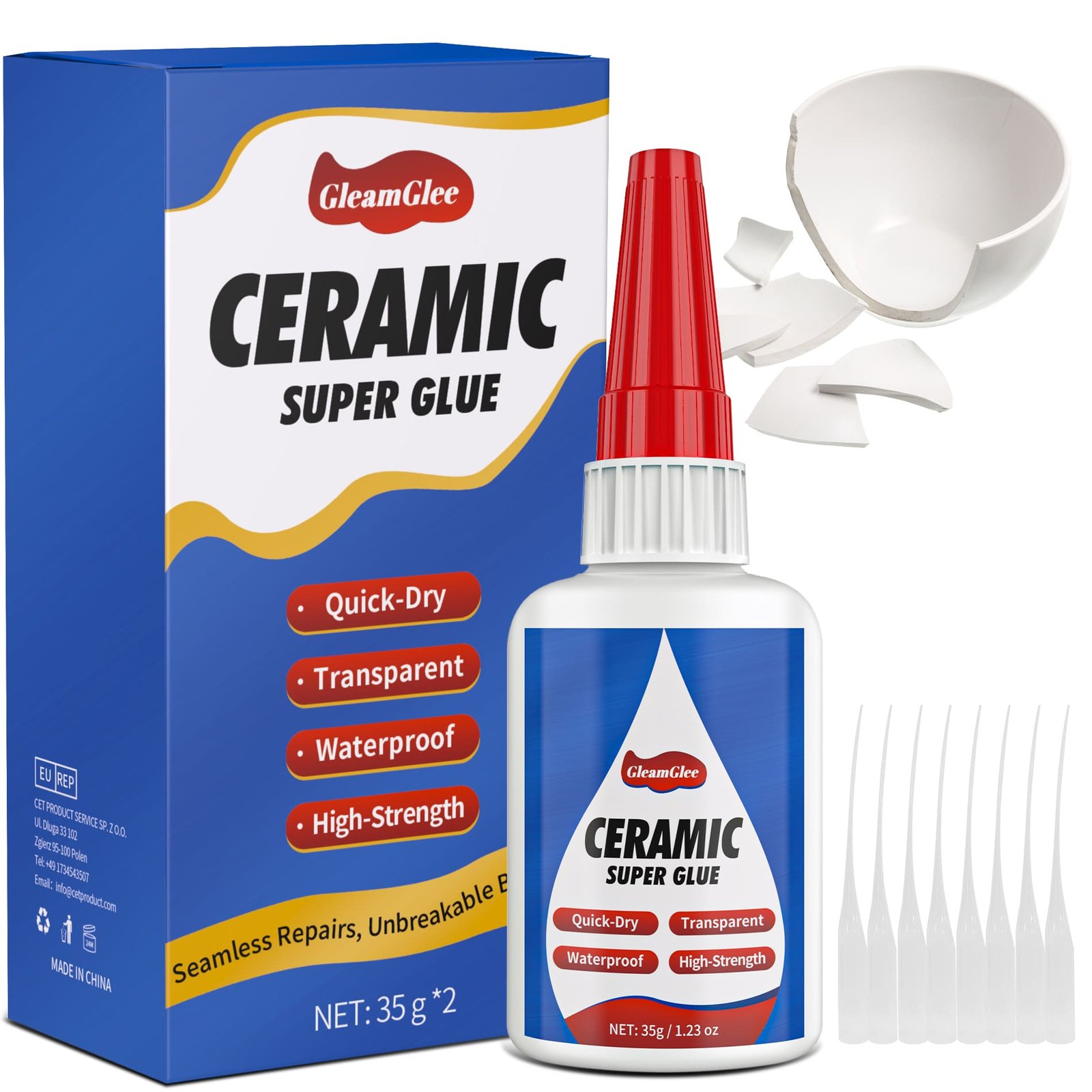
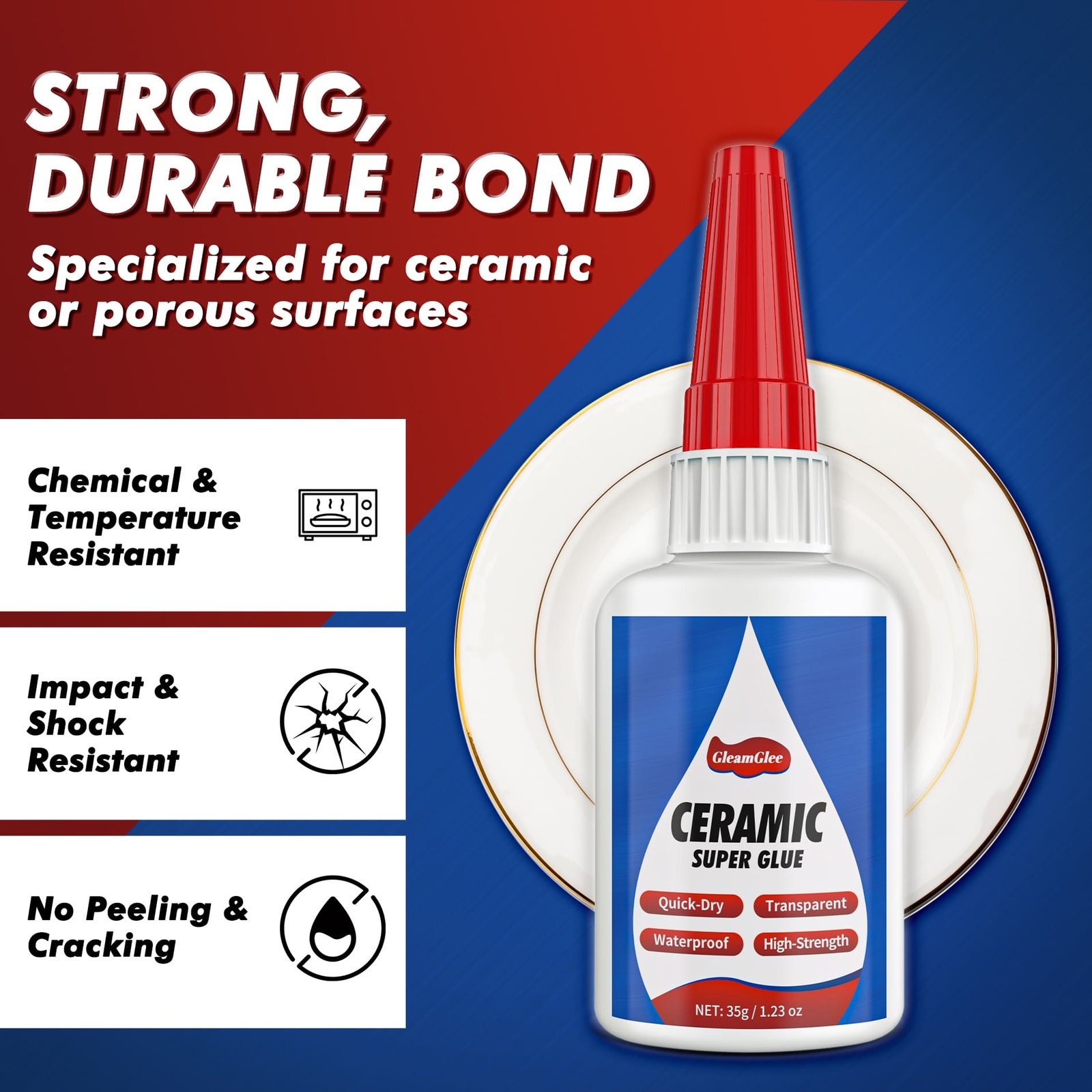
| Single Bottle | 35g / 1.23 oz |
| Included Tips | 4 precision applicator tips per 35g bottle |
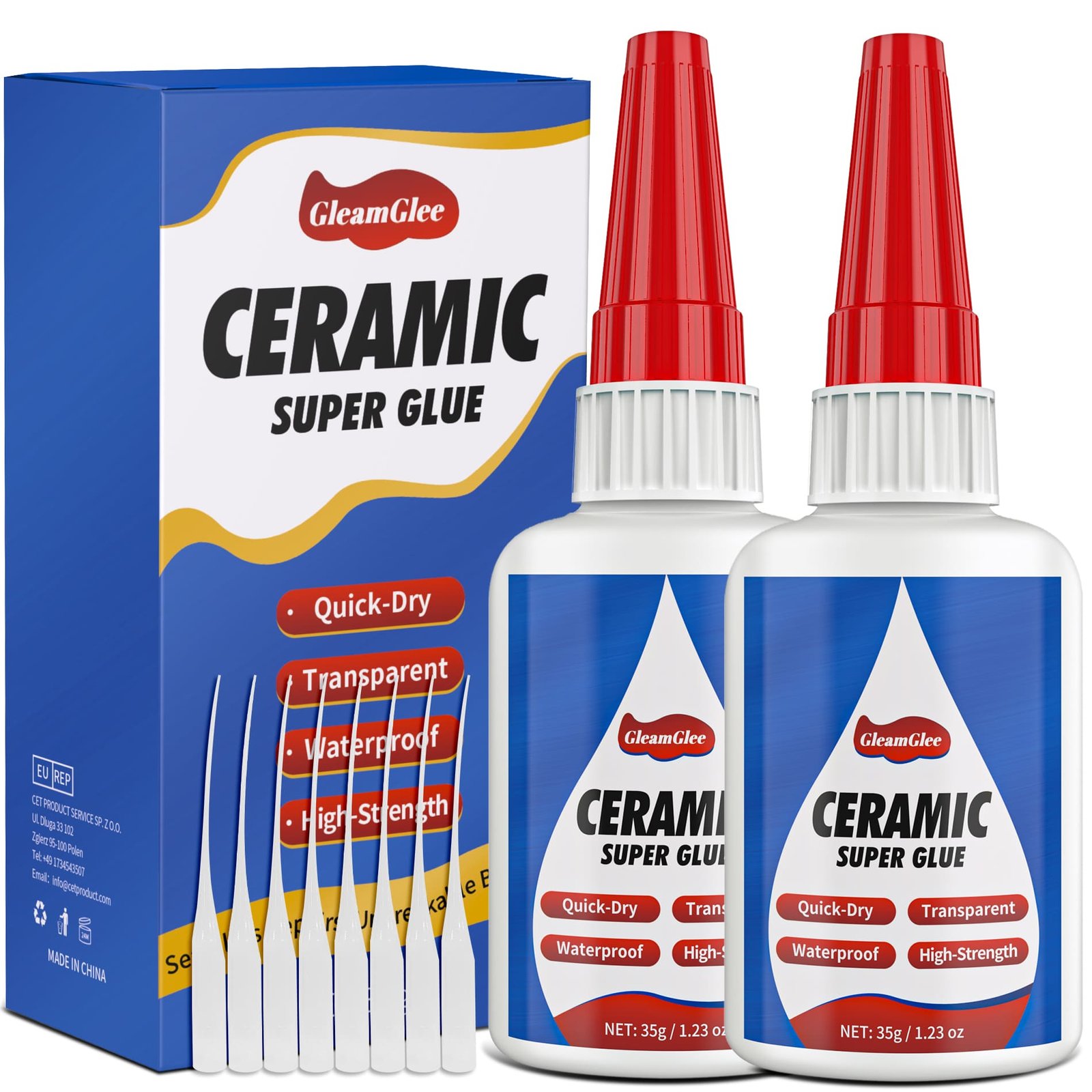
| Two-Pack | 2 × 35g with 8 precision applicator tips |
| Mixing | No mixing or separate hardener required |
| Suggested Press Time | 5–10 seconds after accurate alignment |
| Full Cure | 24 hours |
| Cured Appearance | Clear |
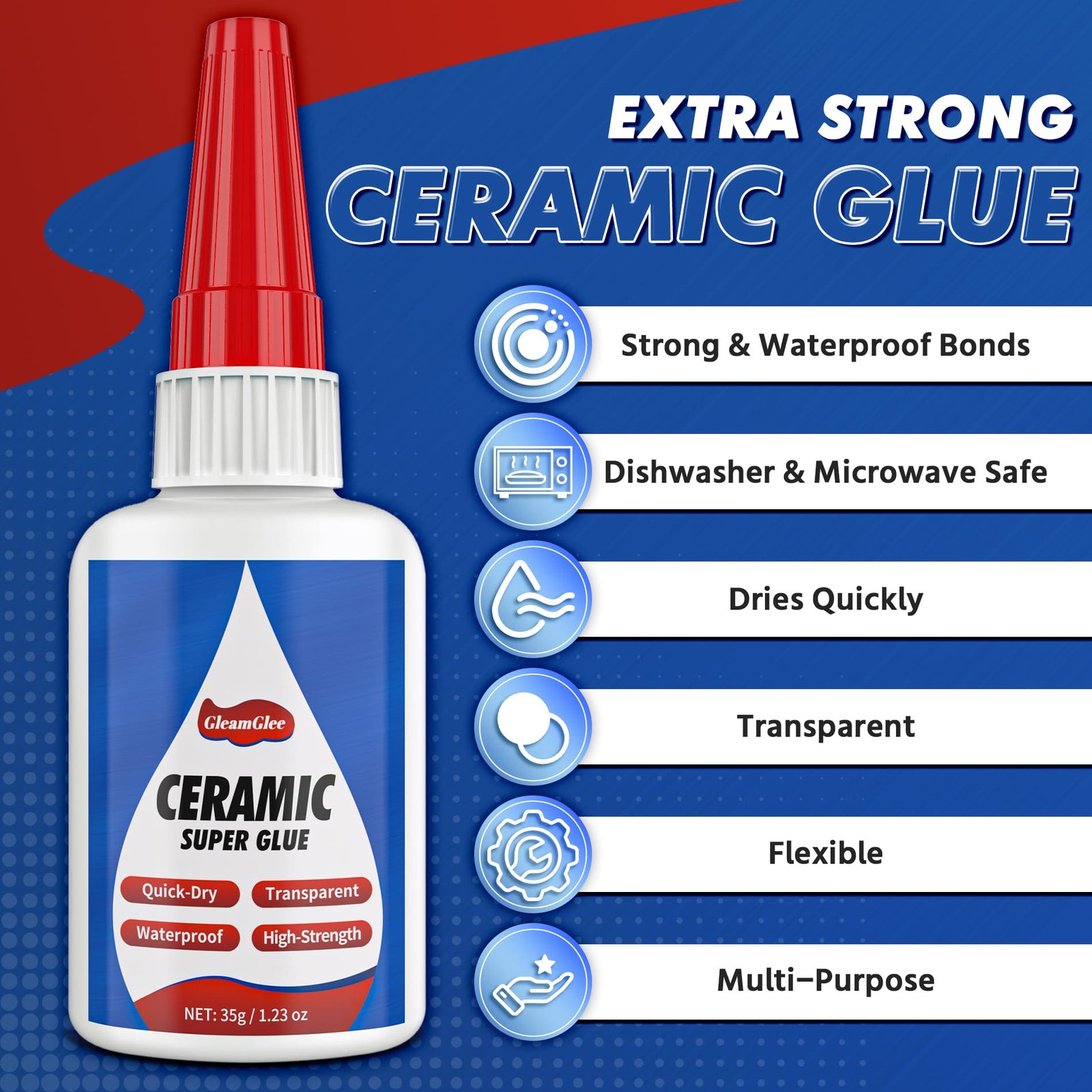
| Moisture Positioning | Water-resistant after full cure |
| Heat Positioning | Heat-resistant for normal household use |
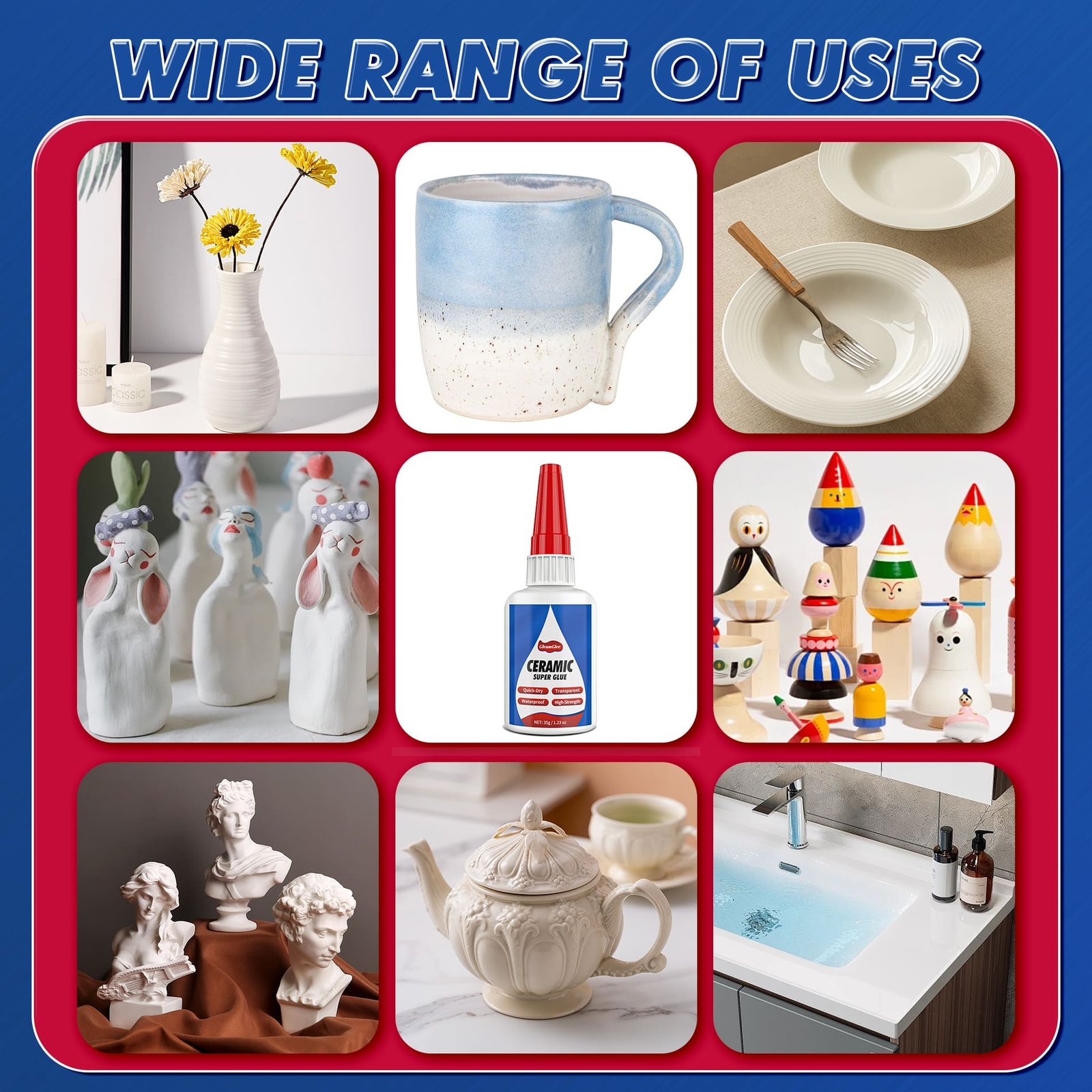
| Primary Materials | Ceramic, porcelain, and pottery |
| Additional Listed Materials | Tile, plastic, wood, metal, glass, and concrete |
| Best Joint Type | Small, close-fitting breaks with narrow bond lines |
| Bottle Design | Resealable bottle for repeat use |
| Manufacturer Warranty | 1 Year Manufacturer |
| Purchase Channel | Amazon US |
Six Qualities Matter When Choosing Glue for Porcelain Repairs
Leading household repair options differ in chemistry and format, but strong purchase decisions repeatedly return to joint fit, appearance, control, speed, cure, and use conditions.
Correct Joint Match
A porcelain adhesive should match the physical break before any performance claim matters. Clean fragments that return tightly together favor a thin bonding approach. Wide gaps, missing ceramic, or badly eroded edges need another system. GleamGlee is positioned for small, close-fitting porcelain repairs rather than filling cavities. Dry-fitting first provides more useful information than choosing only from labels such as “strong,” “instant,” or “ceramic.”
Clear Cured Appearance
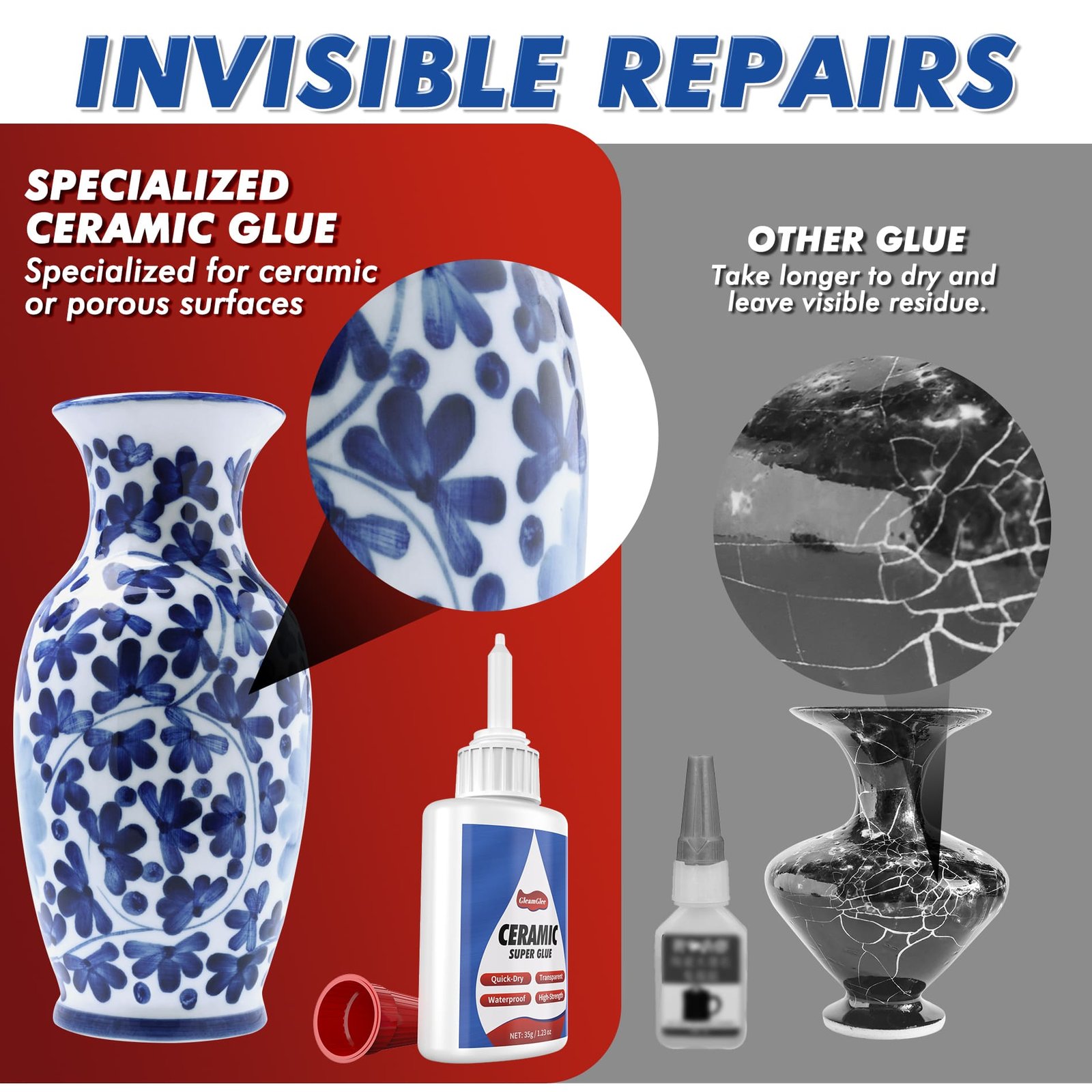
White porcelain, painted china, patterned plates, and decorative vases make squeeze-out easy to notice. A clear cured adhesive reduces the contrast of the bond line, especially when the pieces are aligned accurately and adhesive volume stays low. Clear glue cannot erase an original fracture, chipped glaze, missing color, or poor alignment. A realistic repair goal is a discreet joint rather than a guaranteed invisible restoration.
Controlled Application
Porcelain break lines are frequently narrow, curved, and visually exposed. A standard bottle opening may dispense more adhesive than a small fracture needs. Four precision tips supplied with each 35g GleamGlee bottle help bring the dispensing point closer to cup-handle edges, plate fragments, vase curves, and decorative details. Gentle bottle pressure and a short flow test remain important because precision accessories reduce risk but do not replace careful handling.
Fast Initial Hold
A fast-setting adhesive reduces the time spent manually holding small ceramic pieces, especially on awkward curves. GleamGlee recommends pressing aligned surfaces for 5–10 seconds. Speed is useful only when preparation is complete before dispensing. The user should already know the orientation, support method, and final position because rapid initial grab leaves less time for repeated correction after the surfaces touch.
Complete Cure Planning
Initial grip and complete curing solve different problems. The first helps stop pieces from sliding. The second allows the bond to develop a more stable condition before ordinary handling. GleamGlee specifies a 24-hour full cure. A responsible repair schedule therefore includes preparation, application, temporary support, a full day of undisturbed curing, and final inspection rather than treating a few seconds of pressure as permission for immediate use.
Real Use Boundaries
Plate, cup, and vase repairs do not face identical conditions. Food contact, hot beverages, dishwashers, microwaves, continuous water storage, and repeated handle loading all create separate questions. Strong porcelain-glue selection includes knowing where a product should not be stretched beyond available evidence. GleamGlee supports water-resistant, heat-resistant household positioning after cure, while unsupported food-contact, dishwasher, microwave, oven, and continuous-immersion claims should remain off the repair plan.
Porcelain Plate Repairs Begin With the Intended Use
Decorative display, edge damage, pattern alignment, and direct food contact create different repair decisions even when every item is made from similar porcelain.
Decorative Display Plates
A display plate with a clean detached fragment is one of the strongest fits for controlled porcelain repair. Place the fragment without adhesive and align the decoration from the front. Turn the plate over and confirm the fracture closes along the back as well. Apply a thin coat to the contact surface, join once, press for 5–10 seconds, then support the plate flat for 24 hours. Clear curing helps keep a closely aligned seam less noticeable.
Plate Edge Fragments
An external rim fragment may be repairable when the original piece remains intact and the break closes without a cavity. Rounded rims can encourage sliding, so rehearse hand position and prepare light support before dispensing. Keep the adhesive inside the fracture rather than coating surrounding glaze. If the repaired area forms part of the actual eating surface or will repeatedly contact food, do not assume ordinary porcelain compatibility establishes food-contact suitability.
Eating Surface Damage
A dinner plate cracked through the food-contact area raises a different question from a decorative plate on a stand. Available GleamGlee documentation does not establish a food-contact certification for repaired eating surfaces. Clear appearance, water resistance, or a dry cured bond do not substitute for such documentation. A sentimental plate with a central crack can still be preserved for display, photography, storage, or decorative use without returning the repaired surface to food service.
Porcelain Cup Repairs Need Load Heat and Location Checks
Cup handles, thin walls, drinking rims, external decoration, and repeated lifting expose different areas to different forces and require separate repair decisions.

Broken Cup Handles
A detached handle commonly has upper and lower contact points. Both must meet the cup body at the same time without rocking. Dry-fit first, mark orientation if necessary, then apply a thin layer to the effective fracture surfaces. Align once and press for 5–10 seconds. A handle remains a loaded component during normal use, so keep it supported through the 24-hour cure and inspect both joints carefully before deciding how the cup will be used afterward.

Exterior Cup Pieces
Small porcelain pieces detached from the exterior of a decorative, souvenir, or collectible cup can offer a simpler task than a structural handle. The main concerns are pattern continuity, narrow contact area, and visible squeeze-out. Use a precision tip, place only enough adhesive across the fractured face, and support the piece so gravity cannot rotate it during cure. Clear adhesive helps preserve the surrounding design when application and alignment remain controlled.

Rim and Interior Breaks
A break crossing the drinking rim or inner cup surface belongs to a different risk category. GleamGlee documentation does not currently establish food-contact approval or direct drinking-surface suitability. Do not extend “designed for porcelain” into a food-safety promise. A favorite cup with such damage may still be restored for display, pen storage, dried flowers, or another decorative purpose after an appropriate repair, but normal drinking use needs verified supporting documentation.

Fine China Pieces
Fine porcelain tea cups may have thin walls, gilding, decals, hand-painted decoration, or collector value. Large clamp pressure can create additional damage, while overflow can mark delicate details. Complete the dry fit first and use a minimal adhesive layer. Soft supports and low-tack tape are usually more appropriate than forceful clamping. Antique, high-value, irreplaceable, or professionally restored china should be assessed by a specialist before irreversible adhesive work begins.
Porcelain Vase Repairs Need Curved Support and Moisture Planning
Vase shape makes alignment harder than flat ceramic, while rim position, body location, base damage, and water exposure change the repair decision.

Vase Rim Fragments
A small rim fragment can be a manageable repair when the piece is complete and the fracture surfaces meet closely. Dry-fit from several angles because a tiny rotational error can interrupt the vessel silhouette. Apply a thin layer with the precision tip, align the curve, and hold for 5–10 seconds. Low-tack tape can help prevent the fragment from sliding while the adhesive progresses toward its 24-hour full cure.

Curved Body Pieces
Curved body fragments are more likely to shift under gravity. Complete a no-glue rehearsal and prepare a padded cradle, folded support, or other stable fixture before opening the bottle. Align decorative patterns as well as the fractured edge. Place the adhesive inside the contact area and avoid flooding the glaze. A clear cured bond can help keep a closely fitted repair discreet, but the original fracture line may remain visible under close inspection.

Base Damage
A vase base carries the weight of the vessel and anything placed inside it. Small external decorative base pieces can be considered separately from a fracture running across the structural bottom. Rocking, missing sections, broad gaps, or a crack that may allow water to reach the bond continuously deserves greater caution. A filler, epoxy system, professional repair, or conversion to dry decorative use may be more appropriate than relying on thin CA adhesive alone.

Water-Holding Vases
GleamGlee is positioned as water-resistant after full cure and suitable for occasional moisture exposure. Water resistance does not automatically establish continuous immersion, permanent leak sealing, or a tested duration for holding water above a repaired crack. An exterior decorative repair can remain distinct from a body or base fracture below the normal water level. For uncertain water-path repairs, use the vase for dried arrangements or decorative display unless appropriate performance evidence supports another use.
Check Six Break Conditions Before Applying Porcelain Glue
Most successful small repairs begin with diagnosis, not dispensing; inspect joint fit, missing material, crack access, surface condition, loading, and intended use first.
Close-Fitting Edges
Join the pieces without glue. A suitable break should return close to its original shape with broad contact across the fractured surfaces. Small irregularities are normal, but a large open cavity indicates a different repair task. Mark the correct orientation before dispensing, especially on uniform white porcelain where fragments may appear similar. Accurate dry-fitting improves both bond geometry and finished appearance.
Missing Material
Look for chips that are no longer present. Liquid CA adhesive can connect available surfaces but cannot recreate missing porcelain. Filling the cavity with additional glue does not convert it into repair putty. When a gap changes the item’s shape, alignment, stability, or appearance, consider a compatible repair compound, epoxy filler, professional restoration process, or decorative acceptance of the loss.
Crack Accessibility
A visible hairline does not always provide an accessible contact surface. A fully closed crack may be too narrow for controlled medium-viscosity adhesive placement. A separated clean break gives direct access to both faces. A crack that can open slightly without causing further damage requires careful assessment. Never force a fracture wider simply to make room for glue because additional stress can extend the damage.
Surface Cleanliness
Dust, grease, hand oil, old adhesive, cleaner residue, and loose ceramic particles can sit between the surfaces. Remove contamination using a method appropriate for the porcelain finish, then allow both sides to dry completely. Protect gilding, painted decoration, decals, vintage finishes, and porous unglazed areas from aggressive cleaning. The adhesive should contact stable porcelain rather than a contaminating layer.
Joint Loading
A display plate fragment carries less repeated force than a mug handle. A vase ornament experiences different loading than the base of a water-filled vessel. Ask whether the repair will be displayed, lightly handled, lifted repeatedly, exposed to impact, or required to support weight. A successful initial bond does not remove the need to judge how force reaches the repaired joint during actual use.
Intended Use
Define the repaired item’s future before applying adhesive. Decorative display offers different requirements from eating, drinking, dishwashing, microwaving, or prolonged water storage. Available GleamGlee facts support porcelain repair, clear curing, normal household heat resistance, and water resistance after full cure. They do not establish every possible use environment. Selecting a realistic post-repair role prevents a technically neat bond from being used outside verified limits.
How to Repair Porcelain With GleamGlee Ceramic Glue
Follow six controlled stages to protect alignment, visible glaze, application accuracy, initial positioning, temporary support, and the full 24-hour curing period.

Clean Both Surfaces
Remove loose ceramic dust, dirt, grease, old adhesive, and other residue from both fractured faces using a method compatible with the object. Protect painted artwork, decals, gold trim, antique finishes, and delicate glaze. Do not flood cavities with cleaner. Allow every contact surface to dry completely because moisture and residue can interrupt direct contact between adhesive and stable porcelain.

Apply Thinly
Place a thin, even layer across one contact surface. Narrow lines suit continuous fractured edges, while very small contact points need only a controlled amount. More glue does not automatically produce a stronger repair. Excess adhesive can hold pieces slightly apart, squeeze onto visible glaze, create a more noticeable bond line, and make clean alignment harder. Stop dispensing once the effective contact area has been covered.

Align and Press
Bring the pieces together in the rehearsed orientation. Avoid sliding repeatedly across the fracture because movement can spread glue beyond the intended area. Press firmly in the closing direction for 5–10 seconds. For a mug handle, confirm both upper and lower joints. For a plate, check pattern continuity. For a vase, check the curved silhouette. Add low-tack tape or a stable soft support when geometry or weight may cause movement.

Cure for 24 Hours
Place the object in a stable, dry location where it cannot roll, tip, twist, or be handled accidentally. Leave the repair undisturbed for 24 hours before ordinary use or moisture exposure. Do not interpret the first successful hold as complete curing. After the full period, inspect alignment, visible squeeze-out, stability, and intended use boundaries before returning the object to display or another appropriate household role.
Separate Five Seconds of Pressure From Full Cure
Fast initial positioning reduces holding time, but a stable household repair still requires continued support, undisturbed curing, and inspection before the porcelain returns to use.
Before Contact
Complete alignment planning before glue touches the porcelain. Dry-fit the fragments, identify where your fingers or support tools will sit, and prepare low-tack tape or a padded cradle for awkward shapes. A single-component instant adhesive rewards preparation because the useful adjustment window is short. Plates need pattern alignment, mug handles need two contact points synchronized, and vase fragments need a plan to prevent rotation along the curve.
Five to Ten Seconds
After the pieces meet accurately, hold firm closing pressure for 5–10 seconds. The purpose is to help the adhesive begin fixing the joint in position. Do not twist, rock, pull, or repeatedly separate the surfaces during the countdown. Larger, curved, or unbalanced pieces can still require tape or external support afterward. The 5–10-second figure is press time for initial positioning, not a statement of full final strength.
Twenty-Four Hours
Keep the repair stable for a full 24 hours before ordinary handling or moisture exposure. Avoid washing, filling, loading, twisting, hanging, or aggressive testing during the curing period. After 24 hours, examine the joint in good light and confirm the item’s appropriate future use. Food-contact, dishwasher, microwave, prolonged water-holding, and other special environments remain separate decisions even after the adhesive has fully cured.
Choose CA Epoxy Silicone or Putty by Repair Type
No adhesive chemistry wins every porcelain repair; select according to joint fit, missing material, adjustment time, appearance, sealing needs, and post-repair use.
| Repair Method | Best Match | Main Advantages | Important Limits |
|---|---|---|---|
| GleamGlee CA Ceramic Glue | Small, clean, close-fitting porcelain fragments, cup handles, decorative plate pieces, vase details | No mixing, clear cure, thin bond line, 5–10 second press, four precision tips | Limited gap filling; fast alignment window; food-contact and dishwasher suitability not established |
| Two-Part Epoxy | Uneven surfaces, modest gaps, heavier rigid pieces, repairs needing more positioning time | Better gap filling, longer alignment window, many clear or filled formulas available | Requires mixing; usually thicker bond line; cure can be slower; use claims vary by formula |
| Silicone Adhesive | Flexible sealing, joints where movement or moisture sealing is the primary task | Flexible cured bead, useful for sealing selected compatible surfaces | Thick visible bond line; not ideal for precise rejoining of a narrow porcelain fracture |
| Repair Putty | Missing chips, cavities, rebuilt edges, shaped cosmetic filling | Can replace some missing volume and may be shaped or finished | Usually visible; requires finishing; not a substitute for every structural porcelain repair |
| Hot Glue | Temporary craft placement and selected low-demand decorative work | Simple application and longer positioning than instant CA | Thick bond line, limited precision on clean porcelain fractures, application heat, weaker fit for refined visible repair |
Match Plate Cup and Vase Repairs to Safe Use
A porcelain object can be physically repairable while its original function still needs limits based on food contact, heat, moisture, loading, and break location.
| Object and Damage | GleamGlee Fit | Important Boundary | Recommended Post-Repair Direction |
|---|---|---|---|
| Decorative porcelain plate with clean detached fragment | Strong fit when edges close accurately | Protect pattern and glaze; cure 24 hours | Display after full cure |
| Dinner plate edge away from eating surface | Possible physical repair | Food-contact status still depends on actual use location | Consider decorative or limited non-food use |
| Crack through plate eating surface | Not enough evidence for normal food service | Food-contact suitability not verified | Retire to display or use documented food-contact repair method |
| Mug handle with two complete contact points | Suitable repair geometry when both points align | Handle carries repeated bending and cup weight | Cure 24 hours and inspect; avoid unsupported safety assumptions |
| External decorative cup piece | Good small repair candidate | Keep glue away from rim and interior | Decorative or appropriate external use after cure |
| Cup rim or interior break | Physical porcelain bonding may be possible | Direct drinking or beverage contact not verified | Convert to decorative use or select documented solution |
| Decorative vase rim or exterior fragment | Good fit for close-fitting pieces | Curved support and alignment matter | Display after full cure |
| Vase crack below water line | Requires extra evaluation | Continuous water-holding performance not established | Dry flowers or decorative use unless separately verified |
| Vase base with missing material | Poor fit for CA alone | Gap filling and vessel weight become central | Consider epoxy, putty, professional repair, or replacement |
Keep Visible Porcelain Repairs Cleaner With Better Glue Control
Clear adhesive helps most when a repair also uses accurate dry-fitting, minimal volume, protected glaze, controlled squeeze-out, and stable alignment through complete curing.

Align Before Applying
A transparent adhesive cannot correct a misaligned floral pattern, crooked plate profile, rotated vase fragment, or mug handle that meets only at one end. Assemble the object without glue first and study it under good light. Mark orientation outside the bond area when necessary. The cleanest visual result comes from making the first glued contact resemble the successful dry fit as closely as possible.

Use a Thin Layer
CA adhesive performs best on close-fitting joints with a controlled bond line. Excess liquid can squeeze onto white glaze, painted decoration, gold trim, or glossy surfaces where even clear residue becomes visible under reflected light. Cover the effective contact surface without flooding it. A thin application also helps the original porcelain edges close more completely instead of being held apart by unnecessary adhesive thickness.

Control the Nozzle
Each GleamGlee 35g bottle includes four precision applicator tips. A narrow tip reduces the distance between bottle and break, improving visibility around mug-handle edges, plate fragments, vase rims, and small decorative details. Test flow before application and squeeze gently. Precision comes from the combination of tip size, hand stability, bottle pressure, and a planned path rather than from the nozzle alone.

Judge Results Honestly
A successful clear repair can look discreet when the fractured surfaces meet accurately, but porcelain retains evidence of damage. Chipped glaze, missing pigment, tiny edge loss, original fracture shadows, and slight surface differences may remain visible. Photograph the finished object in normal lighting and at close range rather than hiding the seam with overexposure or retouching. Honest visual evidence builds stronger confidence than an unrealistic “invisible repair” promise.
Four Product Details Support Controlled Porcelain Repair Work
Capacity, applicator count, medium-viscosity flow, and ready-to-use chemistry give GleamGlee a focused role across several small household and decorative ceramic projects.
35g Single Bottle
A single GleamGlee Ceramic Glue bottle contains 35g / 1.23 oz of adhesive. The format provides material for multiple small household, decorative, and craft repairs without claiming a fixed number of projects, because usage changes with fracture length, contact area, porosity, and application thickness. Prepare every repair location before opening the bottle, dispense only the amount needed for complete contact, and reseal the container after use.
Four Precision Tips
Every single bottle includes four precision applicator tips. The narrow extensions help deliver adhesive along cup-handle fracture faces, plate edges, vase fragments, recessed details, and small ceramic components. A two-bottle option includes eight tips. Multiple tips are useful when several repair sessions are planned, but each tip should still be inspected for clean flow before application. Never force excessive bottle pressure through an obstructed applicator.
Medium-Viscosity Liquid
The formula is a medium-viscosity liquid rather than a thick filler paste. It can spread into a thin layer across close-fitting porcelain contact areas while providing more placement control than an extremely free-flowing liquid. Medium viscosity does not make it suitable for wide cavities or missing ceramic. Those situations need a material capable of rebuilding volume rather than simply increasing the amount of liquid adhesive inside the gap.
Ready-to-Use CA
GleamGlee uses a single-component cyanoacrylate formula. No resin-to-hardener ratio, measuring cup, mixing stick, or separate activator is required for normal application. Open, fit the precision tip, apply a thin layer, align, press, support, and cure. Fewer preparation steps are especially useful for small porcelain fragments, but fast initial grab makes dry-fitting even more important because adjustment time is shorter than many two-part epoxy systems.
Avoid Six Mistakes That Make Porcelain Repairs Harder
Poor fit, excess glue, rushed alignment, weak support, early use, and wrong repair selection can undermine otherwise suitable ceramic adhesive and sound porcelain.
Skipping Dry-Fitting
Applying glue before confirming fragment orientation turns a simple repair into a race against initial grab. Assemble every piece first, check the decorated surface, inspect the fracture from behind, and rehearse final hand movement. Number multiple fragments when necessary. A 5–10-second pressure recommendation is an advantage only when the user already knows where each piece belongs.
Using Too Much
A thick adhesive layer does not automatically make a porcelain joint stronger. Excess can prevent the fracture faces from fully closing, squeeze onto visible glaze, make pattern alignment more difficult, and leave a larger cured ridge. Use enough to wet the effective contact area in a thin layer. Wide gaps should be diagnosed as filling problems rather than solved by increasing liquid glue volume.
Forcing Poor Fits
Tape and clamps should maintain a correctly fitted joint, not force warped or incomplete pieces into position. If a fragment rocks, leaves a large open gap, or requires substantial pressure to close, stop and inspect for missing material or incorrect orientation. Excessive force can extend cracks through brittle porcelain, especially around thin tea cups, plate rims, and older decorative ware.
Letting Pieces Slide
Curved vase fragments and cup handles can move after hand pressure ends. Prepare low-tack tape, a padded cradle, or another stable support before dispensing. Apply support in a direction that prevents rotation or separation without crushing the object. Check the seam from several angles after support is installed because tape can accidentally pull a correctly aligned fragment out of position.
Testing Too Early
The piece may feel attached after several seconds, but initial hold is not complete cure. Pulling a handle, washing a plate, moving a vase, or twisting a fragment soon afterward can disturb an incompletely cured joint. Keep the object stable for 24 hours. Inspect visually after curing instead of proving strength through dramatic pulling, hanging weights, filling with boiling water, or impact demonstrations.
Ignoring Use Limits
A successful bond does not automatically restore every original function. A repaired display plate and a repaired dinner plate have different requirements. A vase ornament and a crack below the water line have different exposures. A cup handle and a drinking-rim fracture have different safety considerations. Match the post-repair use to available evidence rather than assuming “porcelain compatible” means “approved for every porcelain application.”
Two Porcelain Repair Scenarios Show Different Priorities
These realistic project examples demonstrate how break geometry changes the repair plan without inventing testimonials, laboratory strength values, or unsupported end-use claims.

Display Plate Fragment
Problem: A decorative porcelain plate loses one clean edge fragment while the main plate remains stable.
Repair logic: Dry-fit the fragment from the decorated face, verify the pattern continues correctly, then inspect the back for full fracture contact. Apply a thin adhesive layer with a precision tip, press for 5–10 seconds, and keep the plate flat for 24 hours.
Result goal: Restore the plate’s overall outline and preserve a low-visibility display seam. The repair is evaluated as decorative rather than proof of food-contact suitability.

Cup Handle Repair
Problem: A porcelain mug handle separates cleanly at both attachment points without missing ceramic.
Repair logic: Confirm upper and lower contact faces close simultaneously. Clean and dry both joints, rehearse alignment, apply a thin controlled layer, then make one accurate placement. Press for 5–10 seconds and add low-tack support if the handle tends to rotate.
Result goal: Reconnect an intact external component after a 24-hour cure. Inspect carefully before handling and keep food-contact, hot-liquid, dishwasher, and microwave claims within documented limits.
Product Packs Reviews and Amazon Details Before You Order
Use stable product specifications for planning and the live Amazon listing for dynamic rating, stock, pricing, delivery, promotion, and variation information.
Current Rating Snapshot
At the time the supplied product facts were collected, the broader GleamGlee adhesive variation family displayed a 4.4 out of 5 star rating across approximately 3,964 ratings. The parent variation also includes adhesive types beyond Ceramic Glue, so the figure should not be presented as thousands of ceramic-glue-only reviews. Verify the current live rating and review count before displaying either number permanently.
Ceramic Repair Feedback
Ceramic-related feedback identified in the supplied research commonly highlights controlled application, quick initial holding, a clear cured appearance, and strong results on suitable small ceramic repairs. Long narrow applicators and the ability to complete small repairs with limited adhesive are recurring positive themes. Individual results still depend on fracture fit, surface preparation, glue amount, alignment, curing, load direction, and whether the specific task matches a thin CA bond.
Packs and Purchase
The single option contains one 35g / 1.23 oz bottle with four precision applicator tips. The double option contains 2 × 35g and eight tips. GleamGlee also lists a 1 Year Manufacturer warranty in the supplied product information. Open the current Amazon ASIN before ordering to confirm pack availability, seller, price, promotions, delivery date, stock, rating, recent reviews, and any marketplace terms that may change over time.
Know When Porcelain Glue Alone Is Not Enough
Choosing epoxy, filler, professional restoration, replacement, or decorative retirement can be the better decision when the damage or intended use exceeds a thin CA bond.
Wide Gaps or Missing Pieces
GleamGlee is optimized for close-fitting surfaces rather than reconstructing missing porcelain. A large cavity, chipped-away section, eroded edge, or irregular void can prevent the remaining pieces from forming a thin continuous contact area. Adding more liquid glue cannot replace the missing material. Consider a compatible repair putty, filling epoxy, professional restoration system, or replacement depending on appearance, structure, value, and intended use.
Food and Drink Contact
A kitchen object is not automatically suitable for normal food service after repair. The supplied GleamGlee facts do not establish food-contact certification, FDA food-contact approval, or direct drinking-surface suitability. Cracks across a plate eating area, cup rim, cup interior, or another location contacting beverages or food should receive a method with relevant documentation or be reassigned to decorative use. Clear curing and water resistance are different properties from food-contact compliance.
Dishwasher or Microwave Use
Dishwasher compatibility has not been verified in the supplied documentation. A dishwasher combines heat, detergent, water spray, moisture, and repeated cycling. Microwave and oven suitability also require separate evidence. General heat-resistant positioning for normal household surroundings should not be expanded into microwave-safe, oven-safe, or direct-high-heat claims. Hand cleaning of an appropriate external decorative repair is a different condition from repeated automated washing or heating.
Valuable or Complex Porcelain
Antiques, museum objects, family heirlooms, rare porcelain, professionally painted pieces, gold-decorated china, and multi-fragment breakage can lose historical, financial, or sentimental value through irreversible home repair. A professional conservator can assess fragment sequence, reversible materials, color matching, missing sections, and long-term display requirements. Choosing professional help is especially sensible when a failed DIY attempt would make later restoration more difficult.
Porcelain Glue Frequently Asked Questions
Review ten direct answers covering plates, cups, vases, application amount, pressing time, full cure, appearance, moisture, food-contact limits, and Amazon purchasing.
1. Can GleamGlee glue broken porcelain plates?
Yes, for suitable small, close-fitting porcelain fragments where the original pieces can return accurately to position. Decorative and display plates are especially straightforward candidates. Dry-fit first, use a thin adhesive layer, press for 5–10 seconds, and allow 24 hours for full cure. A repair crossing the eating surface requires separate food-contact consideration because porcelain compatibility alone does not establish food-contact suitability.
2. Can I repair a broken porcelain cup handle?
An intact handle can be evaluated when its upper and lower fracture surfaces meet the cup body closely. Clean both contact points, dry-fit them together, apply a thin layer, align once, and press for 5–10 seconds. Support the handle through the 24-hour full cure. If cracking extends into the cup interior or drinking rim, consider decorative use rather than assuming normal beverage use is restored.
3. Can GleamGlee repair a porcelain vase?
Yes, GleamGlee can suit small close-fitting vase fragments, rim pieces, and exterior decorative breaks. Curved surfaces should be dry-fitted and supported so they cannot slide during curing. The cured adhesive is positioned as water-resistant, but continuous water-holding or prolonged immersion has not been established by the supplied facts. Cracks below the normal water line need additional evaluation.
4. Does GleamGlee porcelain glue dry clear?
Yes. GleamGlee cures clear, helping closely aligned porcelain repair lines remain less noticeable. A clear adhesive cannot remove an original crack, chipped glaze, missing pigment, or alignment error. Use a thin layer, protect surrounding decoration, and keep squeeze-out low. Honest close-up inspection may still reveal the repaired fracture, especially under side lighting on glossy white porcelain.
5. How long should I press the pieces?
Press accurately aligned porcelain pieces firmly for about 5–10 seconds. The interval supports initial positioning rather than complete curing. Curved, heavy, or unbalanced fragments may still need low-tack tape or a stable support after hand pressure ends. Avoid twisting or repeatedly separating the joint once contact begins. Keep the object undisturbed for 24 hours before ordinary handling or moisture exposure.
6. How long does porcelain glue take to cure?
GleamGlee specifies a 24-hour full cure. The pieces may begin holding much sooner, but initial grab should not be confused with final use readiness. Leave the repair stable, dry, unloaded, and protected from accidental movement for the complete period. After 24 hours, inspect the seam and confirm whether the intended use remains inside the documented product boundaries.
7. How much glue should I use?
Apply a thin, even layer that covers the effective contact surface. More adhesive does not automatically produce a stronger porcelain repair. Excess glue can keep fractured edges slightly apart, squeeze onto glazed decoration, create a larger visible ridge, and make alignment harder. The included precision tips help control narrow lines and small contact areas. Wide cavities or missing pieces require another repair material.
8. Is GleamGlee food safe for plates and cups?
Food-contact suitability has not been verified in the supplied GleamGlee Ceramic Glue documentation, so the adhesive should not be marketed as food safe or approved for direct eating and drinking surfaces. External cup components and decorative porcelain are separate situations from cup interiors, drinking rims, or plate eating areas. For direct food-contact repairs, use a method supported by relevant documentation or retire the item to decorative use.
9. Can repaired porcelain go in the dishwasher?
Dishwasher compatibility has not been verified in the supplied product information. Water resistance after full cure does not establish performance through repeated hot-water cycles, detergent exposure, spray force, and thermal changes. Do not publish a dishwasher-safe claim without supporting test documentation. Where an appropriate repair remains external and non-food-contact, choose a gentle cleaning method consistent with the object and current product instructions.
10. Where can I buy GleamGlee Ceramic Glue?
GleamGlee Ceramic Glue is available through Amazon US under ASIN B0DJSQRHYN. A single pack contains 35g / 1.23 oz of adhesive and four precision applicator tips; the two-pack contains 2 × 35g and eight tips. Check the live listing for current price, stock, delivery timing, seller, promotions, ratings, reviews, and pack availability before ordering.





















