 Skip to content
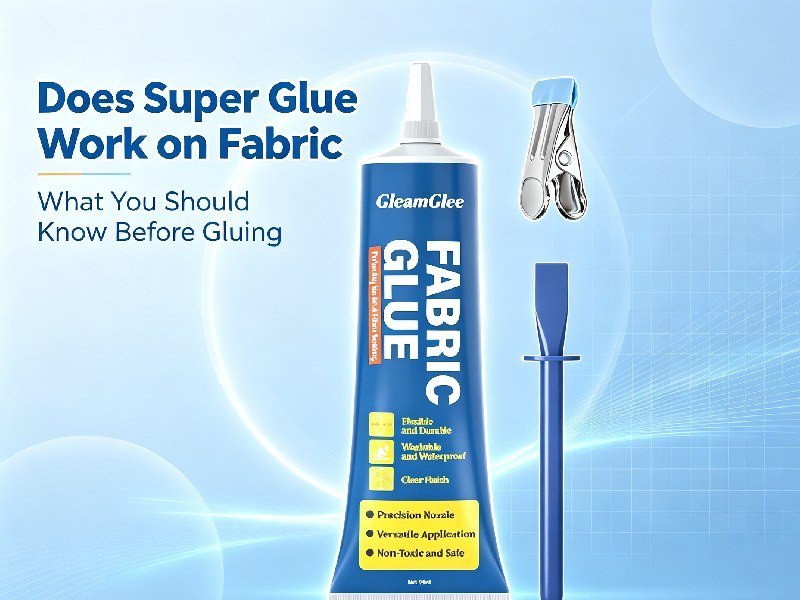
Does Super Glue Work on Fabric : What You Should Know Before Gluing
Super glue has an almost magical reputation: apply one tiny drop, press two surfaces together, and the repair seems finished within seconds. That makes it tempting when a shirt tears, a trouser hem comes loose, a patch starts peeling, or a decoration falls off a costume. But fabric is not a rigid ceramic cup or a piece of metal. It bends, stretches, absorbs moisture, rubs against skin, and moves through repeated washing, drying, and ironing cycles.
Super glue can bond some fabrics, but it is rarely the best choice for washable clothing or flexible textile repairs. Most conventional super glues cure into a relatively rigid layer that may stiffen the fabric, bleed through porous material, leave visible marks, or crack during repeated movement. Cyanoacrylate can also react rapidly with cotton and wool, producing enough heat to damage fibers or burn skin. A purpose-made fabric glue is usually more suitable when the repair must remain soft, clear, flexible, washable, and comfortable.
The important question is therefore not simply whether super glue can stick to fabric. The better question is whether the finished bond will continue behaving like fabric. A repair that feels strong after thirty seconds may become brittle after one wash or uncomfortable after one day of wear. Understanding the adhesive, the textile, and the real use of the repaired item is what separates a quick fix from a reliable repair.
Does Super Glue Work on Fabric?
Super glue can bond some fabrics, especially in small areas with limited movement. However, conventional cyanoacrylate usually cures harder than the surrounding textile, so it may create stiff spots, visible marks, or cracks during bending. For clothing, hems, patches, and washable repairs, a flexible fabric adhesive is generally more appropriate.
What Happens When Super Glue Touches Fabric?
Most household super glues use cyanoacrylate chemistry. The adhesive begins polymerizing when it encounters small amounts of moisture on the bonding surface. On metal, ceramic, glass, or rigid plastic, this produces the fast, hard bond people expect. On fabric, the result is less predictable because the liquid can travel between fibers before curing.
A thin super glue may wick several millimeters beyond the intended repair, especially on cotton, felt, lace, lightweight linings, and loosely woven textiles. As the glue hardens, it locks individual fibers and yarns together. The repaired area may feel more like a thin plastic plate than a soft piece of fabric.
Gel-type super glue spreads less than a thin liquid formula, but it can still create a hard and visible spot. The reduced flow may make it easier to control, yet it does not change the basic fact that most conventional cyanoacrylates are not designed to remain soft under repeated flexing.
Some super glue products list fabric as a compatible substrate. That means the adhesive may form a bond with certain textile surfaces. It does not automatically mean the product is suitable for frequently washed garments, stretch materials, broad hems, or areas that touch the skin. Material compatibility and practical suitability are two different questions.
Is the Bond Strong or Just Fast?
Super glue may feel impressively strong during an initial pull test. On porous fabric, the liquid can travel around individual fibers and create many small mechanical anchor points. This may produce a bond that is difficult to pull apart in a straight line.
The problem usually appears when the repair starts moving. Fabric rarely experiences only direct tension. A trouser hem folds, a knee patch stretches, a curtain flexes, a shoe lining rubs, and a bag interior repeatedly collapses and opens. These movements create peel, flex, and edge-lifting forces that are harder for a rigid adhesive layer to tolerate.
A bond can therefore have high initial strength but poor real-world durability. A piece of denim may stay attached to another sample on a workbench but fail after repeated wear, laundering, or folding. The repaired section may also remain bonded while the untreated fibers beside it begin tearing.
For textile applications, strength should include more than initial grip. Useful performance also depends on:
- Flexibility after full curing
- Resistance to edge peeling
- Wash and moisture resistance
- Compatibility with fabric dyes and coatings
- Resistance to repeated folding and abrasion
- Comfort when worn against the body
Fast curing is convenient, but flexibility and durability usually matter more for clothing and household textiles.
When Is It Useful?
Super glue may be useful for a tiny, low-movement textile task where softness, appearance, and washing are not major concerns. Examples include stabilizing the end of a synthetic cord, securing a small rigid decoration inside a display item, or fixing a hidden fabric component in a craft model.
It may also serve as a temporary positioning aid in manufacturing or repair work before stitching or another permanent assembly step is completed. Even in these situations, the amount should be carefully controlled.
Super glue is much less suitable for:
- Broad trouser or curtain hems
- Stretch clothing and sportswear
- Soft patches on wearable garments
- Upholstery contact areas
- Children’s clothing or toys
- Frequently washed textiles
- Areas touching skin
- Load-bearing seams
In bag and accessory manufacturing, super glue should not replace stitching at handles, shoulder straps, buckle anchors, zipper ends, or other structural points. These areas experience repeated dynamic loading and need engineered reinforcement.
A quick fix should not be mistaken for a permanent textile repair. A hard glue spot can temporarily stop fraying while concentrating stress at the edge, causing the neighboring fibers to tear later.
Is It a Permanent Repair?
A repair is only permanent if it continues working under the conditions the item will actually face. For fabric, those conditions may include folding, stretching, body heat, perspiration, detergent, warm water, abrasion, ironing, and seasonal temperature changes.
Super glue may remain attached to individual fibers while the repair itself becomes unusable. The hardened area may feel uncomfortable, split along a fold line, or cause the surrounding textile to fail. On coated synthetics, the adhesive may attach to a surface finish rather than to the fabric itself and peel away when the coating moves.
Before treating a repair as permanent, evaluate it after full curing rather than after the first few minutes. Bend the sample repeatedly, pull gently at the edge, and inspect it for whitening, cracking, or hard ridges. If the item will be washed, test a scrap through the intended laundering cycle.
A flexible textile adhesive is more suitable because it is designed for surfaces that keep changing shape. It can distribute stress across the repair instead of creating a rigid boundary between glued and unglued fabric.
Which Fabrics Can Super Glue Bond?
Super glue may adhere to polyester, nylon, denim, felt, and mixed fabrics, but performance varies with weave, coatings, absorbency, and movement. Synthetic fabric may tolerate small spot bonds better than highly absorbent natural fibers. Cotton and wool require particular caution because cyanoacrylate can generate heat. Stretch fabrics are usually poor candidates because rigid glue cannot follow repeated elongation.
| Fabric | Likely Initial Result | Main Risk | More Suitable Option |
|---|---|---|---|
| Polyester | May bond in small areas | Coatings, stiffness, edge peeling | Flexible fabric adhesive |
| Nylon | Variable | Water-repellent finishes may reduce adhesion | Nylon-compatible repair adhesive |
| Denim | Often grips strongly | Absorption, stiffness, cotton heat reaction | Washable fabric glue |
| Felt | Bonds quickly | Deep penetration and hard patches | Thick, controlled fabric glue |
| Cotton | Rapid bonding possible | Heat, staining, brittleness | Textile-specific adhesive |
| Wool | Rapid reaction possible | Heat and fiber damage | Wool-safe fabric adhesive |
| Stretch blends | May hold initially | Cracking during elongation | Stretch-compatible adhesive |
Polyester and Nylon
Polyester and nylon are broad textile categories rather than single, predictable surfaces. Two polyester fabrics can behave completely differently if one is an open woven craft fabric and the other is coated, water-resistant outdoor material. Nylon may also be treated with silicone, polyurethane, durable water repellent finishes, dyes, or lubricants that interfere with adhesion.
Cyanoacrylate may successfully grip untreated synthetic fibers, particularly where the weave allows the liquid to flow around individual filaments. However, thin super glue can leave a hard, shiny patch, while coated nylon may produce a weak surface bond that peels away. A successful ten-minute test does not prove the repair will survive laundering, rain, abrasion, or repeated folding.
For synthetic textiles, test four things before proceeding:
- Does the glue discolor the visible surface?
- Does it bleed through to the opposite side?
- Does the cured area remain flexible after 24 hours?
- Does the bond survive bending and a gentle pull at the edge?
A flexible fabric adhesive is normally the safer option for clothing, backpacks, curtains, shoe linings, and accessories. For coated outdoor fabrics, use a product specifically approved for that coating rather than assuming all “nylon glue” applications are alike.
Denim and Felt
Denim and felt can appear easy to glue because both provide plenty of fiber surface area. In practice, their absorbency creates problems. Liquid super glue may disappear into the textile before the pieces are aligned, leaving too little adhesive at the bond line and too much hardened resin inside the fabric.
Most denim is cotton-rich, which also introduces the risk of a rapid heat-producing reaction. A tiny controlled application may behave differently from a large spill, but users should not assume that “more glue means a stronger patch.” Excess adhesive can increase heat, stiffness, discoloration, and strike-through.
Felt presents another challenge. Its nonwoven fiber structure absorbs liquid in several directions, so the final hard area may extend well beyond the visible application point. This can be acceptable for a rigid craft ornament, but uncomfortable and unattractive on clothing or a stuffed toy.
For denim patches, felt appliqués, craft shapes, and decorative repairs, a thicker fabric adhesive gives more control. The ideal formula should sit at the interface long enough for positioning, cure clear, and remain flexible. Official fabric-adhesive guidance commonly identifies denim and felt as appropriate materials for flexible, no-sew glue products.
Cotton and Wool
Cotton and wool require more than an ordinary compatibility test. Conventional cyanoacrylate can react rapidly with these fibers and release significant heat. Medical reports have documented thermal burns after domestic super glue was spilled onto cotton clothing.
The risk increases when a larger quantity of thin adhesive spreads through fabric that is resting against the skin. The material creates a broad reaction area, allowing heat to build faster than it can escape. Vapor or smoke may also be produced.
Important precautions include:
- Do not pour conventional super glue onto cotton or wool.
- Do not wear cotton gloves while handling cyanoacrylate.
- Do not use cotton balls or wool cloths to wipe up spills.
- Remove contaminated clothing carefully if it can be done safely.
- Do not press a heating fabric against the body.
- Seek medical guidance if pain, smoke, or burns develop.
For cotton shirts, jeans, curtains, bedding, wool garments, and other natural-fiber products, use an adhesive specifically formulated and labeled for textile applications.
A product called fabric glue may use a very different chemistry from conventional super glue. The label and safety instructions should always be checked instead of assuming that all clear adhesives behave in the same way.
Stretch Fabrics
Stretch fabric exposes the basic mismatch between rigid adhesive and moving textile. Leggings, sportswear, elastic cuffs, dance costumes, swimwear, ribbed knits, and spandex blends may repeatedly extend by tens of percent during normal use. A cured adhesive layer that cannot elongate with the fabric becomes a mechanical weak point.
The first failure may occur inside the glue, at the adhesive-fabric interface, or in the textile directly beside the hardened section. Even when the bond does not fully detach, it may create ripples, puckering, discomfort, and a visible flat spot that prevents the garment from draping naturally.
A basic home test can reveal the problem. Apply adhesive to two scrap pieces, allow a complete cure, and stretch the sample repeatedly in the same direction as the finished garment. Check whether the glue turns white, cracks, separates at the edge, or prevents recovery.
For highly elastic clothing, sewing is generally the most dependable structural repair. When a no-sew method is required, choose a fabric adhesive specifically described as flexible or stretch-compatible. Do not rely solely on a label saying the glue “bonds fabric”; look for performance language related to movement, laundering, and flexibility after curing.
What Problems Can Super Glue Cause?
Super glue can create stiff areas, dark marks, white blooming, brittle edges, heat, smoke, and poor wash durability on fabric. Thin formulas may spread beyond the repair, while rigid cured adhesive may crack during movement. Cotton and wool present an additional heat hazard. Even when the initial bond looks successful, laundering and ironing can expose weaknesses that were not obvious during application.
| Problem | Typical Cause | What the User May Notice | Practical Prevention |
|---|---|---|---|
| Hard patch | Rigid cured adhesive between fibers | Uncomfortable or unnatural feel | Use flexible fabric glue |
| Bleed-through | Low viscosity or too much glue | Dark or glossy front surface | Apply a thin layer and use backing |
| White residue | Cyanoacrylate vapor blooming | Frosty marks near the repair | Use less glue and improve ventilation |
| Edge cracking | Repeated bending of a rigid bond | White lines or lifted edges | Match flexibility to the textile |
| Heat or smoke | Rapid reaction with cotton or wool | Hot fabric, vapor, burn risk | Avoid cyanoacrylate on these fibers |
| Wash failure | Incomplete cure or unsuitable formula | Peeling after laundering | Follow cure and care instructions |
Hardness and Brittleness
Fabric feels soft because its fibers and yarns move independently. They bend, slide, compress, and open as the material drapes. When rigid adhesive penetrates the weave, it locks those moving parts into a solid polymer mass.
The treated area may feel like a thin piece of plastic embedded in the textile. This affects comfort, appearance, and durability. A hard patch can rub against skin, prevent a garment from hanging naturally, or create a visible flat spot.
Applying more adhesive usually makes the problem worse. A thick deposit does not automatically provide a stronger repair. It increases stiffness and transfers stress to the boundary between the glued and unglued fabric. That boundary becomes a hinge point where cracking or tearing may begin.
The effect is most obvious on shirts, linings, lightweight curtains, and soft upholstery, but it can also affect heavy canvas and denim. Even thick textiles may develop a sharp edge around a rigid repair.
Gel or rubber-modified super glues may resist impact better than basic formulas, but they are not necessarily soft enough for clothing. Textile performance should be judged by how naturally the repaired section moves after curing, not by how hard the adhesive feels.
Marks and Blooming
A clear adhesive can still create a highly visible repair. When super glue penetrates woven fabric, it fills the air spaces between fibers and changes the way light passes through the material. The treated area may look darker, shinier, or permanently wet.
White marks are often caused by cyanoacrylate blooming. Vapor from uncured adhesive moves to nearby surfaces and polymerizes into a pale or frosty residue. This effect is particularly visible on black fabric, dark synthetic leather, glossy decorations, clear plastic, and coated accessories.
The best way to reduce visible damage is controlled application:
- Use the smallest amount needed.
- Test a hidden seam or matching scrap.
- Place a non-stick barrier behind thin fabric.
- Keep the work area ventilated.
- Avoid pressing wet glue beyond the repair edge.
- Allow the bond to cure without repeated movement.
Removing cured super glue from fabric is difficult. Acetone may soften some cyanoacrylate residues, but it can also remove dye, dissolve synthetic fibers, or damage surface coatings. A removal method should always be tested on a hidden area first.
A textile adhesive formulated to dry clear and non-yellowing is normally safer for visible repairs.
Heat and Safety
Cyanoacrylate curing is an exothermic process, meaning the chemical reaction releases heat. On many rigid surfaces, the reaction is controlled enough that the temperature rise is not noticeable. Cotton and wool can accelerate the reaction dramatically.
When a larger amount of thin super glue spreads through cotton fabric, a large reaction area is created almost instantly. Heat may build rapidly and cause painful burns. Medical cases have included serious injuries requiring professional treatment.
If glue on fabric begins to heat, smoke, or produce pain, the task should be stopped immediately. Do not press the material against the skin or wipe it with another cotton or wool cloth.
General safety practices include:
- Work in a ventilated area.
- Keep adhesive away from eyes and mouth.
- Avoid large-volume application.
- Wear protective equipment compatible with cyanoacrylate.
- Read the product label and safety data sheet.
- Keep adhesive away from children.
- Follow local medical or poison-control guidance after significant exposure.
This hazard is one of the strongest reasons not to use conventional super glue casually on cotton garments, jeans, towels, wool clothing, or bedding.
Washing and Ironing
Water resistance is not the same as washability. A super glue may survive occasional moisture on a ceramic or plastic object while failing quickly on a garment.
A washing machine exposes the repair to several stresses at once:
- Water penetrates the textile and bond line.
- Detergent may affect the adhesive interface.
- Drum movement repeatedly folds and rubs the repair.
- Spinning creates peel and shear forces.
- Drying adds heat and further movement.
Failure commonly begins at an exposed edge. Water and movement gradually lift the rigid bond, or the surrounding fibers weaken beside it.
Ironing creates additional risk. Heat may soften, discolor, weaken, or change the adhesive. It can also make a visible hard spot more obvious. Direct contact with an iron should never be assumed safe unless the adhesive instructions specifically permit it.
Purpose-made fabric adhesives usually provide clearer care guidance. GleamGlee Fabric Glue is designed to be machine washable and ironable after a complete 24-hour cure. The textile care label still takes priority, and delicate fabrics should always be tested before heat is applied.

Is Fabric Glue Better Than Super Glue?
Fabric glue is usually better for garments, hems, patches, curtains, crafts, linings, and other flexible repairs. It provides more working time, spreads more evenly, and is designed to move with the textile after curing. Super glue is faster, but its rigid finish, uncontrolled absorption, and safety risks make it unsuitable for many everyday fabric applications.
| Feature | Conventional Super Glue | Flexible Fabric Glue |
|---|---|---|
| Initial grab | Usually within seconds | Usually several minutes |
| Positioning time | Very short | Better for aligning hems and patches |
| Cured feel | Often hard or rigid | Designed to remain soft and flexible |
| Thin fabric control | May wick through rapidly | Usually easier to spread evenly |
| Washing | Product-dependent | Often formulated for washable repairs |
| Visible finish | May darken or bloom | Commonly clear and non-yellowing |
| Stretch performance | Usually limited | Better when labeled stretch-compatible |
| Cotton and wool | Heat reaction risk | Use a textile-specific formula as directed |
| Best use | Tiny rigid or hidden details | Wearable and flexible textile projects |
Different Design Goals
Super glue and fabric glue solve different technical problems. Cyanoacrylate is designed for rapid bonding between closely fitting surfaces. It performs well when components are small, rigid, and unlikely to move after assembly.
Fabric adhesive is designed for porous materials that continue bending and shifting after the repair. It usually provides a longer working time for positioning and forms a softer film after curing. This makes it easier to smooth a hem, align a patch, or place decorative trim accurately.
The strongest adhesive is not always the most suitable adhesive. A rigid bond may be excellent for a ceramic handle but poor for a cotton cuff. Textile applications require balance between adhesion, flexibility, penetration control, wash resistance, and appearance.
The choice should be based on the finished item:
- Rigid decorative model: super glue may work.
- Washable trouser hem: fabric glue is more suitable.
- Stretch costume: stretch-compatible fabric glue or sewing is better.
- Cotton garment repair: conventional cyanoacrylate should be avoided.
- Decorative sequin: use a controlled textile adhesive.
- Load-bearing seam: use stitching or mechanical reinforcement.
Choosing by end use prevents the common mistake of selecting an adhesive only because it sets quickly.
Flexibility After Curing
Flexibility is the difference users notice immediately after a repair. A good fabric adhesive should allow the textile to fold without creating a sharp ridge. It should recover from normal movement instead of cracking or turning white.
Not every product labeled craft glue provides the same flexibility. Buyers should look for clear claims such as:
- Remains flexible after drying
- Suitable for clothing and textiles
- Washable after full cure
- Appropriate for hems and patches
- Non-brittle finish
- Designed for repeated movement
Application thickness also matters. Even a flexible adhesive can create a lump if too much is used. A thin, continuous layer generally performs better than several heavy beads because it distributes stress more evenly.
GleamGlee Fabric Glue is formulated to remain soft and elastic after curing. It is intended for clothing, jeans, curtains, ribbons, patches, appliqués, sequins, and similar projects where movement and appearance are important.
Its fine-point applicator helps users place a controlled amount rather than saturating the fabric.
Clear and Washable Bonds
“Dries clear” should mean more than the liquid becoming transparent. A successful visible repair should avoid yellowing, glossy edges, dark strike-through, and white vapor residue.
The result still depends on fabric color, thickness, and absorbency. Even a clear formula can remain visible if it is applied too heavily. A hidden test is therefore important before treating a valuable garment or decorative textile.
Washability also applies only after complete curing. Washing during the initial set may weaken the bond before the adhesive film has fully developed.
A practical washable fabric adhesive should provide:
- Clear or non-yellowing finish
- Flexible cured film
- Controlled penetration
- Resistance to normal laundering
- Adequate edge adhesion
- Compatibility with common textile care conditions
GleamGlee Fabric Glue is designed for a crystal-clear, flexible finish and can be machine washed after full curing. The recommended initial setting time is approximately 6–10 minutes, followed by a complete 24-hour cure before washing, ironing, stretching, or normal wear.
Choosing by End Use
The adhesive should be selected according to the repaired item, not according to whichever tube is already available.
Ask the following questions:
- Will the repair bend or stretch?
- Will it touch the skin?
- Will the item be washed or ironed?
- Is the repaired area visible?
- Is the fabric cotton or wool?
- Does the seam support weight?
- Would failure create a safety hazard?
A rigid display craft and a pair of washable jeans need different adhesive properties. A decorative patch and a backpack shoulder strap also require different repair methods.
For wearable and washable items, fabric glue is normally the better starting point. For highly stretched sportswear, specialist stretch adhesive or sewing may be required. For seat belts, climbing products, protective clothing, loaded bag straps, and safety equipment, consumer adhesive should not replace an approved professional repair.
The best adhesive is the one that continues matching the material after curing.
How Do You Glue Fabric Correctly?
Test the adhesive on a hidden area, clean and dry the fabric, apply a thin even layer, align the parts, and keep them still during the initial set. Allow the complete stated cure before washing, ironing, stretching, or loading the repair. Most failures result from overapplication, contaminated surfaces, rushed alignment, or using the item too soon.
| Step | Practical Action | GleamGlee Timing | Common Mistake |
|---|---|---|---|
| Test | Apply to a scrap or hidden seam | Check after full cure | Judging the glue while wet |
| Prepare | Clean, dry, and flatten the textile | Before application | Gluing over oil or fabric softener |
| Apply | Use a thin, even layer | Immediately | Saturating the weave |
| Align | Position without excessive sliding | During working time | Smearing glue outside the repair |
| Set | Press and keep the area still | About 6–10 minutes | Pulling the layers apart to check |
| Cure | Avoid washing, ironing, and stress | 24 hours | Using the item too early |
Test the Material
A hidden test is the fastest way to avoid ruining a garment. Select an offcut, seam allowance, inside fold, or matching scrap made from the same textile.
Use the same amount of adhesive and the same construction planned for the final repair. A tiny dot does not accurately represent a broad patch or folded hem, so the test should be reasonably similar to the real application.
After full curing, evaluate:
- Color change
- Gloss or white residue
- Bleed-through
- Flexibility
- Edge adhesion
- Comfort
- Response to folding
- Wash performance
Check the sample under both daylight and indoor lighting. Some glossy marks are visible only from certain angles.
For commercial products, test the actual production fabric and coating. Dye lots, softeners, waterproof treatments, backing layers, and print finishes can change adhesion. This is especially important for coated nylon, polyester lining, satin, velvet, printed textiles, vehicle fabric, and synthetic leather combinations.
Testing provides more reliable evidence than a generic statement that the adhesive works on fabric.
Prepare the Surface
Adhesive performance begins with a clean surface. Dust, lint, skin oil, detergent residue, fabric softener, waterproofing spray, silicone, and loose fibers can prevent direct contact between glue and textile.
Wash the fabric first when the care label allows it, but avoid fabric softener because it can leave a lubricating film. Let the material dry completely before applying adhesive.
For items that cannot be washed, remove lint gently and use only a cleaner approved for the material. A solvent that works on metal may remove dye or damage a polymer coating on fabric.
Lay the textile flat and return torn edges to their natural position. Trim only loose fibers that cannot be repositioned. Do not enlarge the damaged area by cutting aggressively.
Place parchment paper, release film, or another suitable non-stick barrier behind the repair. This prevents adhesive from passing through and bonding unwanted layers together.
Good preparation may take longer than applying the glue, but it often determines whether the repair survives.
Apply the Right Amount
A thin, continuous layer is usually more effective than a thick bead. The goal is to wet the bonding fibers without flooding the weave.
Use different application patterns for different tasks:
- Hem: narrow line or thin band inside the fold
- Patch: light coating across the back with edge coverage
- Sequin: dot smaller than the decoration
- Ribbon: narrow line applied in short sections
- Torn seam: thin layer inside the overlap
- Felt craft: controlled layer that does not saturate the material
Do not squeeze the layers together so forcefully that wet adhesive spreads onto the visible surface. Press evenly and stop adding glue if it begins appearing beyond the repair edge.
A precision nozzle provides better control for detailed work. GleamGlee Fabric Glue uses a fine-point tip for hems, cuffs, patches, trims, appliqués, rhinestones, and costume details. The cap also includes an internal pin to help reduce clogging between projects.
More glue does not necessarily create more strength. Correct placement and complete contact matter more than volume.
Allow Full Cure
Initial setting and full curing are not the same. The repair may stop moving after several minutes while the adhesive is still developing its final strength and flexibility.
Keep the layers aligned during the initial set. Clips, pins, tape, or flat weights may help when suitable, but they should not come into direct contact with wet adhesive.
Avoid lifting the repair edge to check whether it has bonded. Repeated movement breaks the developing contact between the adhesive and fibers.
For GleamGlee Fabric Glue:
- Initial setting: approximately 6–10 minutes
- Full curing: approximately 24 hours
- Washing: after full cure
- Ironing: after full cure and according to the textile care label
- Heavy stretching: after full cure
Temperature, humidity, fabric absorbency, and adhesive thickness may affect actual timing.
During curing, do not wash, iron, fold aggressively, stretch, or wear the item. A repair that feels secure after ten minutes may still be vulnerable internally.

What Can You Repair With Fabric Glue?
Fabric glue can repair small tears, seams, hems, patches, appliqués, ribbons, trims, costume decorations, curtains, bags, fabric linings, soft furnishings, and craft projects. The repair must match the product’s stated capabilities and the textile’s care requirements. Fabric glue is not a universal replacement for structural sewing, especially on load-bearing seams, safety equipment, or highly stretched garments.
| Project | Fabric glue suitability | Important limitation |
|---|---|---|
| Trouser or curtain hem | High | Allow full cure before use |
| Decorative patch | High | Test for bleed-through |
| Small ripped seam | Moderate to high | Not for heavily loaded seams |
| Sequins and ribbons | High | Confirm decoration compatibility |
| Backpack lining | Moderate | Avoid load-bearing strap joints |
| Sofa cover | Moderate | Consider abrasion and cleaning |
| Plush-toy seam | Limited | Safety and child-use requirements apply |
| Car headliner | Formula-dependent | Heat resistance must be verified |
| Stretch sportswear | Limited | Use stretch-compatible adhesive |
| Safety garment or climbing gear | Not recommended | Use approved professional repair |
How Do You Repair Tears and Seams?
Fabric glue works best on small, clean tears where the edges can be brought together or overlapped without excessive tension. Place a backing patch behind the damaged area when the textile is thin or the tear would otherwise reopen.
Apply a narrow layer of adhesive to the backing patch or inside seam allowance. Align the weave and press the repair flat. Avoid allowing the glue to spread onto the visible front. Hold the area in position for the recommended setting time and allow full curing.
A glued repair may not be appropriate when:
- The seam supports body weight or heavy loads.
- The tear is located at a highly stretched joint.
- The fabric is waterproof protective equipment.
- Failure could create a safety hazard.
- The garment requires professional dry cleaning.
- The material is rare, antique, or highly valuable.
For a shirt, decorative cushion, curtain, costume, or lightweight lining, fabric glue can provide a practical no-sew repair. For backpack straps, climbing equipment, seat belts, protective clothing, or heavily stressed workwear, professional stitching or an approved repair system is necessary.
GleamGlee Fabric Glue is intended for everyday clothing, home-textile, accessory, and craft repairs rather than safety-critical structural bonding.
How Do You Hem Clothes Without Sewing?
No-sew hemming is one of the most useful fabric-glue applications. It works particularly well for curtains, skirts, costume garments, tablecloths, lightweight trousers, and decorative textiles where the folded edge is broad enough to create a stable bond.
Begin by measuring and marking the final length. Fold the fabric and press the crease according to the garment’s care instructions. Place a thin, even line of fabric glue inside the fold, staying back slightly from the visible edge to reduce squeeze-out. Press the layers together from the center outward.
Use clips, pins, or a flat weight to hold the hem while it sets. Avoid pinning directly through wet adhesive because the tool may become bonded or leave visible residue. Allow the full cure period before wearing, washing, or ironing.
A glued hem is less suitable when the garment is highly elastic, transparent, very delicate, frequently dry-cleaned, or subjected to heavy pulling. It is also difficult to reverse cleanly, so temporary fashion alterations may be better handled with removable hemming tape or professional sewing.
GleamGlee’s 6–10-minute setting window allows users time to align the fold before the 24-hour full cure.
Can You Attach Patches and Appliqués?
Fabric glue is well suited to decorative patches and appliqués because it spreads the load across a larger area. It can also hold detailed shapes that would be tedious to stitch by hand.
Choose a patch that extends beyond the damaged area. Rounded corners are less likely to catch and peel than sharp points. Apply a thin adhesive layer to the back, including controlled coverage near the perimeter. Position it carefully because moving a wet patch can smear glue outside the repair.
Press from the middle toward the edges to remove trapped air. Place clean release paper over the patch and use an even flat weight if recommended. After curing, inspect every edge before washing.
GleamGlee Fabric Glue can be used with plain patches, embroidered patches, felt shapes, appliqués, denim repairs, workwear decoration, and costume pieces. Margaret, a home-craft enthusiast described in GleamGlee’s customer feedback, used the adhesive to attach an embroidered patch over a tear in a favorite casual shirt. She valued the controlled application, fast initial setting, and clean appearance.
For uniforms, licensed merchandise, or children’s garments, commercial buyers should also validate wash resistance, decoration materials, labeling requirements, and end-use safety.
Can You Glue Sequins, Ribbons, and Buttons?
Sequins, ribbons, rhinestones, beads, lace, and lightweight decorative buttons are common fabric-glue applications. The challenge is achieving enough contact without leaving visible adhesive around a small object.
For sequins and rhinestones, place a controlled dot that is slightly smaller than the decoration. Use tweezers or a placement tool rather than fingers. For ribbon and lace, apply a narrow line to the hidden side and work in short sections so alignment remains manageable.
Buttons require more judgment. A flat decorative button can be glued successfully when it carries no load. A functional shirt, trouser, coat, or bag button is repeatedly pulled and twisted, so sewing remains the more reliable method.
Before bonding plastic decorations, check compatibility. Some plastics have low surface energy, and certain coatings, foils, paints, or mirrored finishes may be affected by adhesive. Loctite notes that common super glues may not bond polyethylene, polypropylene, PTFE, silicone, or certain foams reliably.
GleamGlee Fabric Glue is designed for ribbons, appliqués, sequins, rhinestones, costume trims, wedding decorations, and similar detailed work. Its fine nozzle helps keep the finished surface cleaner.
Can You Repair Curtains, Bags, and Crafts?
Fabric adhesive is useful beyond clothing. Curtains can be hemmed, decorative trim can be attached, table runners can be reinforced, and cushion covers can be repaired without setting up a sewing machine. It also works for felt ornaments, fabric banners, scrapbooks, costumes, tote bags, pencil cases, book covers, and holiday decorations.
For bags and accessories, distinguish cosmetic repairs from structural repairs. A loose lining, decorative patch, frayed interior edge, or lightweight trim may be suitable for glue. A shoulder strap attachment, zipper end, loaded seam, or buckle anchor normally requires stitching or another engineered construction method.
Furniture and vehicle interiors require additional caution. Sofa covers and office-chair fabric experience abrasion. Automotive headliners and trims face elevated temperatures. An adhesive must be validated for the actual service environment rather than chosen solely because “fabric” appears on the label.
GleamGlee Fabric Glue is available in a 50 g single-tube package and a 50 g two-tube package for household repairs, fashion projects, school crafts, events, costumes, and home textiles. It provides a clear, flexible bond, a precision applicator, an initial set of approximately 6–10 minutes, and a complete cure in 24 hours.
For retailers, distributors, Amazon sellers, DIY chains, fashion-accessory brands, and private-label buyers, GleamGlee also supports customized fabric-glue projects. Available services include formula development, benchmarking of existing market products, logo and packaging customization, multilingual label design, regulatory documentation, and multiple packaging formats.
Private-label customization can start from 200 units. Packaging artwork may be prepared in as little as two days, typical samples can be delivered in 7–14 days, and standard mass production is approximately 20 days depending on the formula, packaging, compliance requirements, and order volume. GleamGlee’s integrated adhesive, packaging, label-printing, and raw-material facilities support consistent production from formulation through finished goods.
To request pricing, samples, a custom fabric-glue formula, or private-label packaging, contact GleamGlee with your intended fabrics, target market, pack size, annual quantity, desired cure time, wash requirements, and regulatory destination. The technical and sales teams can then recommend a suitable existing formula or prepare a customized development plan.





















