Skip to content
What Is OBI Construction Adhesive for Home Renovation:A Professional Guide
Your trusted adhesives glue & cleaner manufacturer

A home renovation project rarely fails because the idea was bad. It usually fails because one small detail was underestimated: the surface was dusty, the tile was heavier than expected, the wall was not flat, the adhesive was too runny, or the repair was touched before it had enough time to cure. This is why many people searching for OBI construction adhesive are not only looking for “strong glue.” They are looking for a practical way to finish small repairs without turning one loose tile or one garden stone into a full renovation job.
OBI construction adhesive is a strong multi-surface adhesive used for home renovation tasks such as fixing tiles, bonding wood panels, attaching stone, repairing brick, securing drywall trim, and handling indoor or outdoor repairs. A good construction adhesive should match the material, stay in place during application, resist moisture when needed, and form a durable bond after full curing.
For many homeowners, this type of adhesive sits between light household glue and heavy professional mortar. It is easier than mixing cement, cleaner than drilling into finished walls, and more flexible than using screws where they may damage tile, stone, panels, or rented interiors. A small tube can solve several common problems around a home: a loose backsplash tile, a moving patio stone, a bathroom trim gap, a small wall panel, or a decorative stair riser.
The real value is convenience plus control. A homeowner may start with one cracked kitchen tile and then realize the same adhesive can help with a garden path, a basement wall repair, a vanity backsplash, or a decorative wood panel. That is the reason this topic has strong search value: people want a product that feels simple, but they also want confidence that the repair will not fall apart after rain, heat, cleaning, steam, or daily use.
What Is OBI Construction Adhesive?
OBI construction adhesive is a strong renovation adhesive used for bonding, mounting, and repairing common building materials around the home. It is often chosen when screws, nails, cement mortar, or drilling feel too messy, too slow, or unnecessary for a small repair. In real home renovation, this usually means fixing loose tiles, attaching wood trims, bonding stone pieces, securing decorative wall panels, repairing brick details, or handling small concrete and drywall repairs.
A good OBI construction adhesive is not just “strong glue.” It needs the right texture, surface grip, working time, and curing reliability. If the adhesive is too thin, it may slide on vertical walls. If it is too thick, it may be hard to squeeze and spread evenly. If it cures too fast, the material may be hard to adjust. If it cures too slowly, a tile or panel may move before the bond becomes stable.
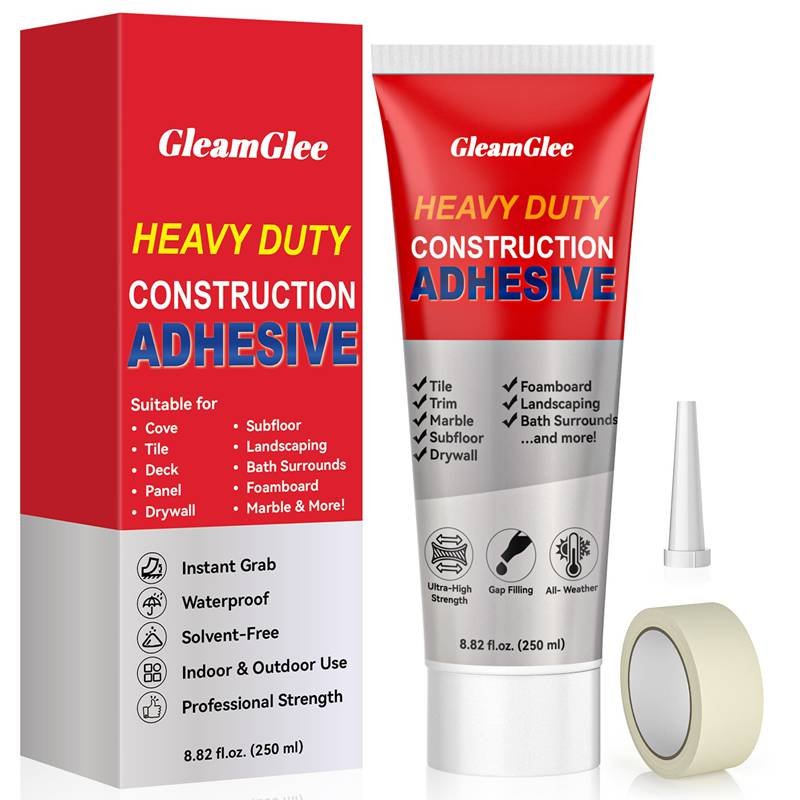
For practical home use, construction adhesive works best when it combines multi-surface bonding, clean application, low odor, and enough coverage for more than one repair. GleamGlee Construction Adhesive is designed for concrete, tile, stone, wood, drywall, stucco, brick, rough surfaces, uneven surfaces, and vertical applications. Each 8.8 oz tube provides up to about 30 feet / 9 meters of coverage depending on bead size, making it useful for small repairs, weekend DIY projects, and multi-area home renovation work.
What Does OBI Construction Adhesive Do?
OBI construction adhesive bonds renovation materials that ordinary household glue cannot handle well. It is made for stronger, heavier, and rougher surfaces such as tile, stone, concrete, brick, drywall, stucco, and wood. In a home renovation setting, it can help secure a loose bathroom tile, attach a kitchen backsplash piece, bond a wood trim strip, reset a garden stepping stone, fix a decorative wall panel, or hold small masonry-style repair pieces in place.
Its main job is to create a stable contact layer between two surfaces. This matters because renovation surfaces are rarely perfectly flat. A tile back may have ridges. Brick may be rough. Concrete may have tiny holes. Stone may touch the base only at a few high points. A construction adhesive with enough body can fill these small gaps and create better contact.
Common jobs include:
- Fixing loose ceramic or stone tiles
- Bonding wood panels, trims, and skirting boards
- Attaching decorative stone or brick-facing pieces
- Repairing concrete, patio, or garden details
- Securing backsplash tiles behind sinks or counters
- Installing small wall panels without visible screws
- Supporting DIY mosaic, tabletop, or decorative projects
For visible areas, clean application is just as important as strength. A strong repair with glue squeezed around the edges still looks poor. This is why a precision tip, medium texture, and controlled bead size matter in real use.
Is OBI Construction Adhesive Strong?
OBI construction adhesive can be strong when it is used on the right surface, with the right amount, and with enough curing time. Strength is not only about the adhesive formula. It also depends on whether the surface is clean, dry, stable, and strong enough to carry the bonded material. A powerful adhesive applied onto dusty concrete, greasy tile, wet drywall, or loose paint will still fail because the weak layer underneath breaks first.
There are several kinds of strength that matter in home renovation:
| Strength Point | What It Means | Real Repair Example |
|---|---|---|
| Initial hold | Helps the piece stay in place before curing | A wall tile does not slide down |
| Final bond | Holds the material after full curing | A patio stone stays fixed after use |
| Gap filling | Handles uneven contact surfaces | Stone bonds to rough concrete |
| Weather resistance | Performs through rain, heat, or cold | Outdoor tile or garden repair lasts longer |
| Surface grip | Bonds to different materials | Tile, wood, brick, stone, drywall |
For indoor jobs, strength is often tested by daily touch, cleaning, moisture, and vibration. For outdoor jobs, rain, sunlight, freezing weather, and foot traffic add more pressure. For vertical jobs, the adhesive must fight gravity before it cures. GleamGlee Construction Adhesive is designed with professional-grade strength for concrete blocks, tile, stone, wood panels, brick, drywall, and rough or vertical surfaces, making it suitable for many non-structural repair and renovation tasks.
Where Does OBI Construction Adhesive Fit?
OBI construction adhesive fits the space between light household glue and heavy professional installation materials. It is stronger than craft glue, cleaner than cement mortar for small repairs, and easier than drilling when the project does not require mechanical fasteners. This makes it useful for homeowners and DIY users who want a practical repair method without turning a small issue into a full construction job.
It works well in many home areas:
| Area | Common Use | Why Construction Adhesive Helps |
|---|---|---|
| Bathroom | Wall tiles, vanity backsplash, trim | Handles moisture-prone repair areas when cured properly |
| Kitchen | Backsplash, tile repair, island trim | Clean finish around visible surfaces |
| Basement | Concrete, drywall, utility repair | Useful for rough and mixed surfaces |
| Garden | Stone, patio, stepping stones | Better for outdoor bonding needs |
| Living room | Panels, trims, feature wall pieces | No visible nails or screws |
| Entryway | Floor edges, wall accents, tile pieces | Handles high-use home areas |
It is important not to treat construction adhesive as the answer to every building problem. It is excellent for bonding and repair, but it should not replace structural anchors, waterproof membranes, professional tile systems, or load-bearing construction methods. A loose wall tile is a suitable job. A heavy overhead stone piece is not a safe adhesive-only job. A vanity backsplash is reasonable. A shower floor system needs more than adhesive.
GleamGlee Construction Adhesive is especially useful where the job needs strength, control, and a clean look: bathroom tiles, kitchen backsplashes, decorative stone, wood trims, wall panels, garden repairs, and small commercial maintenance tasks.
Who Needs OBI Construction Adhesive?
OBI construction adhesive is useful for people who handle small repairs, visible home upgrades, rental maintenance, DIY renovation, and light contractor work. It is not only for professionals. Many users need it because one small damaged area makes the whole room look unfinished: one loose tile in a bathroom, one moving stone near a patio, one detached trim strip, or one cracked backsplash piece.
Different users need it for different reasons:
| User Type | Main Need | Product Feature That Helps |
|---|---|---|
| Home DIY users | Quick repair without special tools | Hand-squeeze tube and precision tip |
| Renters | Less drilling in finished walls | No-drill bonding for suitable surfaces |
| Property managers | Fast small repairs between tenants | Multi-surface use and clean finish |
| Small contractors | Extra repair adhesive on site | Strong hold on tile, stone, wood, concrete |
| Retailers | Practical product for DIY shelves | Broad home repair demand |
| Amazon sellers | Product with many search uses | Tile, stone, wood, concrete, wall repair keywords |
| Private-label brands | Custom adhesive product line | Low MOQ, label design, OEM support |
GleamGlee also fits business needs. The company supports private label and custom construction adhesive projects with low MOQ from around 200 units, 7–14 day sample preparation, around 20-day mass production, and rush production around 15 days depending on order details. Packaging can be customized with brand logo, multilingual instructions, warning labels, and market-specific design. For sellers targeting Europe, the UK, North America, or Japan, this helps turn a practical renovation adhesive into a ready-to-sell product line with clearer positioning and better shelf appeal.
Which Jobs Need OBI Construction Adhesive?
OBI construction adhesive is useful for home renovation jobs where the material needs a firm, lasting bond but drilling, screwing, or mixing mortar feels too much for the size of the repair. It fits many small-to-medium repair tasks, especially tile repair, wood trim bonding, stone fixing, brick details, drywall accessories, backsplash work, patio repairs, and decorative wall upgrades.
It is most suitable for non-structural bonding jobs. That means it can help hold tiles, panels, trims, stones, and decorative materials in place, but it should not replace load-bearing anchors, professional waterproofing systems, or mechanical fasteners for heavy overhead objects. A loose bathroom wall tile is a good job. A heavy ceiling-mounted stone panel is not a safe adhesive-only job.
For practical use, the best jobs are usually those that need three things at the same time: strong hold, clean appearance, and easy application. GleamGlee Construction Adhesive fits these needs with a medium-consistency formula, precision-tip cap, low-odor use, fixing tape for curing support, and an 8.8 oz tube that can cover up to about 30 feet / 9 meters depending on bead size and application thickness.
| Job Type | Good Use Case | Why OBI Construction Adhesive Helps |
|---|---|---|
| Tile repair | Loose wall tile, backsplash tile, mosaic tile | Cleaner than mixing mortar for small repairs |
| Wood bonding | Trim, panels, skirting boards, decorative slats | Less drilling, cleaner visible finish |
| Stone fixing | Garden stones, patio edges, stone accents | Fills small uneven surface gaps |
| Wall repair | Panels, trims, drywall details, brick-effect décor | Helps secure visible surfaces neatly |
| Kitchen work | Backsplash, island trim, tile edge repair | Good control around finished surfaces |
| Bathroom work | Vanity backsplash, wall tile, trim pieces | Useful when applied dry and cured properly |
| Outdoor repair | Patio pieces, balcony tiles, garden path details | Needs weather-resistant bonding after curing |
Can OBI Construction Adhesive Fix Tiles?
OBI construction adhesive can fix tiles when the repair area is small or medium in size, the backing surface is stable, and the tile is not part of a full structural or waterproof tile system. It is useful for bathroom wall tiles, kitchen backsplash tiles, mosaic pieces, vanity splashbacks, decorative stair risers, tabletop tile projects, and small replacement work before regrouting.
Tile repair is one of the most common uses because a single loose tile can make a room look unfinished. In many cases, the entire wall does not need to be removed. The damaged or loose piece can be cleaned, reset, pressed into place, supported while curing, and finished with grout or sealant if the project requires it. This saves time, reduces mess, and avoids buying a large bag of tile mortar for one or two pieces.
Suitable tile jobs include:
- Reattaching one loose bathroom wall tile
- Fixing a kitchen backsplash tile behind a sink or countertop
- Bonding decorative mosaic tiles onto a frame, mirror, table, or planter
- Resetting a loose stair riser tile used for decoration
- Repairing a vanity backsplash or small tiled border
- Replacing a cracked tile in a low-impact wall area
- Attaching lightweight ceramic or stone-look wall tiles
Tile jobs need clean preparation. The back of the tile should be free from old loose mortar, dust, grease, and powder. The wall base should be dry and firm. If the surface behind the tile is soft, wet, moldy, or crumbling, the base must be repaired before adhesive is used. Adhesive can create a strong bond only when the material underneath can hold that bond.
| Tile Job | Suitable for OBI Construction Adhesive? | Practical Note |
|---|---|---|
| One loose kitchen backsplash tile | Yes | Good small repair use |
| Bathroom wall tile near sink | Yes | Surface should be dry before bonding |
| Decorative mosaic project | Yes | Use small controlled dots or beads |
| Full shower floor installation | No | Needs full waterproof tile system |
| Heavy floor tile in high traffic area | Depends | May need proper tile mortar |
| Tile on soft or wet wall | No | Repair the wall first |
For visible tile work, the amount of adhesive matters. Too much adhesive can squeeze out around the edges, push the tile higher than nearby pieces, or slow down curing. A controlled bead is better than a thick layer. GleamGlee Construction Adhesive is helpful here because the precision-tip cap allows cleaner placement, while fixing tape can hold the tile in position as it cures.
Can OBI Construction Adhesive Bond Wood?
OBI construction adhesive can bond wood trims, panels, skirting boards, decorative slats, light boards, and small wooden repair parts. Wood is often a good material for construction adhesive because it has a slightly porous surface and gives the adhesive more grip than glossy, sealed materials. It is commonly used in living rooms, bedrooms, kitchens, hallways, entryways, and finished basements.
Wood bonding is especially useful when a clean appearance is important. Screws and nails can leave visible holes. Drilling may split narrow trim. Some decorative panels look better when the front surface stays untouched. In these jobs, adhesive allows the wood to sit flat against the wall, floor edge, or cabinet area without exposed fasteners.
Good wood-related jobs include:
- Attaching skirting boards or baseboards
- Fixing loose door or window trim
- Bonding decorative wall slats
- Installing lightweight wood panels
- Securing kitchen island trim pieces
- Repairing small wooden fittings
- Adding decorative wood strips to furniture or walls
Wood still needs preparation. Sawdust, wax, oil, varnish, peeling paint, or moisture can weaken bonding. If the adhesive sticks to dust or loose coating instead of solid wood, the repair may fail. Smooth painted wood may need light sanding in the bonding area. Outdoor wood should be dry before application because damp wood can move and affect curing.
| Wood Condition | Bonding Risk | Better Practice |
|---|---|---|
| Freshly cut wood | Sawdust blocks contact | Brush or wipe before bonding |
| Varnished wood | Surface may be too slick | Lightly roughen hidden contact area |
| Painted wood | Paint layer may lift | Remove loose paint first |
| Warped wood | Tension pulls repair apart | Use support or mechanical help |
| Outdoor wood | Moisture movement | Bond only when dry |
| Narrow trim | Adhesive squeeze-out | Use thin controlled beads |
For long trims or panels, adhesive should be applied in a bead pattern that gives enough contact without overflowing at the edges. Pieces may need tape every 20–30 cm while curing, especially on vertical surfaces. GleamGlee’s medium-consistency formula is practical for these jobs because it can be squeezed by hand, placed accurately, and controlled better than very runny glue.
Can OBI Construction Adhesive Hold Stone?
OBI construction adhesive can hold stone for many decorative and repair jobs, especially when the stone is used on stable surfaces and is not part of a load-bearing structure. Stone is common in patios, garden paths, terraces, fireplace surrounds away from direct flame, wall accents, plant pot decoration, stone cladding, and outdoor repair details.
Stone is heavier and less forgiving than many materials. The adhesive must handle weight, uneven contact points, weather exposure, and surface dust. Natural stone may have rough backs, chipped edges, porous areas, or sealed surfaces. Patio stones may have soil or sand underneath. Decorative stone pieces may be placed on vertical walls where gravity pulls them down before curing. These details should be checked before bonding.
Useful stone jobs include:
- Fixing a loose garden stepping stone
- Securing a patio edge piece
- Attaching decorative stone tiles to a feature wall
- Bonding small stone pieces around a planter
- Repairing balcony or terrace tile details
- Making mosaic stone decorations
- Resetting loose stone trim in non-structural areas
Outdoor stone repair needs extra planning. The surface should be dry, clean, and firm. Rain should be avoided during early curing. Foot traffic should be blocked until the adhesive has developed enough strength. If the stone is placed vertically, support is needed until it can stay stable. A heavy stone should never be trusted only by “it feels stuck after a few minutes.” Early grip is not the same as final cured strength.
| Stone Job | Main Stress | What Helps |
|---|---|---|
| Garden stepping stone | Foot traffic and weather | Dry surface and full curing |
| Patio edge piece | Rain, heat, movement | Clean base and firm pressure |
| Stone wall accent | Gravity and weight | Fixing tape or temporary support |
| Mosaic stone décor | Small piece alignment | Controlled adhesive dots |
| Fireplace surround trim | Heat nearby | Avoid direct flame zones |
| Balcony tile repair | Weather and vibration | Choose dry curing time |
GleamGlee Construction Adhesive is suitable for stone, concrete, brick, tile, and rough surfaces. Its gap-filling ability is useful because stone does not always sit flat. The adhesive can fill small voids and help create a better contact layer. For outdoor users, the value is not only strong bonding, but also weather-ready performance after proper curing.
Can OBI Construction Adhesive Repair Walls?
OBI construction adhesive can repair and improve walls by bonding trims, decorative panels, tile pieces, brick-effect sheets, lightweight stone accents, drywall details, baseboards, backsplashes, and wall-mounted finishing materials. It is useful for non-structural wall work where a clean finish is more important than heavy mechanical fastening.
Wall work is common because many visible home defects happen on vertical surfaces. A loose trim strip, a missing tile, a cracked backsplash piece, a detached panel edge, or a moving decorative brick piece can make the room look unfinished. Construction adhesive can help repair these details without creating new screw holes or damaging the visible surface.
Suitable wall jobs include:
- Fixing loose bathroom wall tiles
- Installing kitchen backsplash pieces
- Attaching decorative wall panels
- Securing baseboards and trims
- Repairing drywall accessories or light wall details
- Bonding brick-effect or stone-effect décor
- Installing small feature wall sections
The main problem with wall repairs is sliding. Gravity can pull the material downward before the adhesive has cured. This is why the first few minutes after pressing are important. Marking the position before application helps. Fixing tape, spacers, or temporary braces can hold the piece in place. The material should be checked after several minutes to make sure it has not moved.
| Wall Job | Common Problem | Better Method |
|---|---|---|
| Wall tile repair | Tile slides down | Use spacers and fixing tape |
| Trim bonding | Ends lift away | Tape ends firmly while curing |
| Decorative panel | Uneven wall contact | Apply beads across key contact areas |
| Drywall detail | Weak paper surface | Keep load light and wall dry |
| Stone-effect décor | Weight pulls outward | Use support during curing |
| Backsplash repair | Messy edge squeeze-out | Keep adhesive away from outer edges |
GleamGlee Construction Adhesive includes fixing tape, which is useful for wall repairs because many home users do not have clamps or tiling tools. The adhesive also dries cleanly and applies through a precision tip, helping visible wall projects look neater. For best results, the wall should be clean, dry, stable, and strong enough to hold the bonded material. Heavy shelves, large mirrors, overhead parts, or safety-sensitive items should still use proper mechanical fixing.

Which Surfaces Fit OBI Construction Adhesive?
OBI construction adhesive fits many common home renovation surfaces, including concrete, brick, drywall, tile, stone, wood, stucco, plaster, and some mixed-material surfaces. The best match is not decided by the material name alone. It also depends on surface strength, dust level, moisture, coating, weight, and whether the bonded item will stay flat, hang vertically, or face outdoor weather.
For small home repairs, the safest surfaces are clean, dry, stable, and slightly textured. Concrete, brick, stone, and unfinished wood usually give stronger grip because the adhesive can bite into small pores and surface texture. Smooth tile, painted drywall, sealed stone, and glossy surfaces need more careful cleaning because oil, soap film, polish, paint, or dust can block direct contact.
GleamGlee Construction Adhesive is designed for concrete, tile, stone, wood panels, drywall, stucco, brick, rough surfaces, uneven surfaces, and vertical surfaces. Each 8.8 oz / 247 ml tube can cover up to about 30 feet / 9 meters depending on bead size and application thickness, making it suitable for several small repair areas around a home instead of one single use.
| Surface | Fit Level | Common Use | Main Risk | Better Practice |
|---|---|---|---|---|
| Concrete | High | Patio tile, stone, basement repair | Dust, moisture, powdery surface | Brush clean and keep dry before bonding |
| Brick | High | Garden wall, brick detail, stone accent | Loose mortar, flaking paint | Remove weak particles first |
| Drywall | Medium | Trim, light panels, backsplash | Paper tearing, weak paint | Keep load light and surface stable |
| Tile | Medium to high | Bathroom wall tile, backsplash, mosaic | Glossy surface, soap film | Degrease, dry, support while curing |
| Wood | High | Trim, skirting, panels, slats | Dust, wax, bending | Sand lightly and hold firmly |
| Stone | High | Patio, cladding, garden pieces | Weight, uneven contact, weather | Use enough support and dry curing time |
| Stucco / Plaster | Medium | Wall accents, trims, repairs | Loose surface texture | Scrape loose areas and test first |
Does OBI Construction Adhesive Work on Concrete?
OBI construction adhesive works well on concrete when the surface is solid, clean, dry, and free from loose powder. Concrete is one of the most suitable materials for construction adhesive because it has texture and pores that help the adhesive grip. It is common in patios, balconies, basement floors, garage walls, garden paths, outdoor steps, utility rooms, and workshop areas.
Concrete repairs often look simple, but the surface condition decides the result. Old concrete may have dust, chalky powder, water marks, oil stains, algae, cement residue, or tiny loose particles. If adhesive is applied over this weak top layer, the bond may fail because the surface layer breaks away, not because the adhesive itself is weak. For outdoor concrete, trapped moisture is another issue. A damp base can slow curing, reduce grip, or cause the repaired part to loosen after rain or temperature change.
For better concrete bonding, the surface should be brushed hard before application. A stiff brush, scraper, or vacuum can remove loose dust better than a soft cloth. Oil stains should be cleaned carefully and dried. For patio stones or outdoor tiles, choose a dry weather window so the adhesive has enough time to cure before rain. For basement repairs, check for moisture coming through the concrete. If the area stays damp all the time, the moisture problem should be solved before bonding.
Common concrete jobs include:
- Reattaching a loose patio tile to a concrete base
- Bonding garden stepping stones or edge pieces
- Repairing small concrete block details
- Securing stone trim around outdoor features
- Fixing basement wall accessories or protective strips
- Attaching decorative tile or stone to concrete surfaces
- Repairing small garage, workshop, or utility-room details
| Concrete Situation | Can Use OBI Construction Adhesive? | Practical Note |
|---|---|---|
| Dry concrete patio | Yes | Brush dust away before bonding |
| Concrete with oil stains | Only after cleaning | Oil blocks adhesive contact |
| Damp basement wall | Not ideal | Moisture source should be checked |
| Powdery old concrete | Only after surface prep | Remove weak top layer first |
| Outdoor step repair | Yes, if non-structural | Avoid walking before full curing |
| Loose concrete surface | No | Base must be repaired first |
For GleamGlee Construction Adhesive, concrete is a strong use case because the formula is made for rough and uneven surfaces. The medium-consistency texture helps fill small surface gaps without flowing away too quickly. For visible concrete-to-stone or concrete-to-tile repairs, the precision tip also helps control the bead so the finished repair looks cleaner.
Does OBI Construction Adhesive Work on Brick?
OBI construction adhesive works on brick for many non-structural home repair and renovation jobs. Brick usually has a rough, porous surface, so it can provide good grip when it is dry and stable. It is often used for garden walls, basement walls, decorative brick features, fireplace surrounds away from direct flame, brick-effect panels, exterior trim, and small masonry-style repairs.
The main issue with brick is not always the brick itself. The weak point is often the mortar, old paint, dust, or weathered surface. Older brick walls can release sand-like particles when rubbed. Painted brick may have peeling layers. Outdoor brick may hold moisture after rain. If adhesive is applied onto loose mortar dust or peeling paint, the repair may pull away with that weak layer. The adhesive may still be attached to the loose paint, but the paint is no longer attached to the wall.
Before bonding to brick, scrape away any loose material. Brush the surface until it feels firm. If the brick is painted, check whether the paint is hard and firmly attached. If the paint flakes off when scratched, remove the weak section before applying adhesive. If the brick is outdoors, wait until it is fully dry. Brick can look dry on the surface while still holding moisture inside the pores, especially after rain or in cold weather.
Good brick-related uses include:
- Attaching decorative stone pieces to a garden wall
- Bonding small brick-effect or stone-effect wall pieces
- Securing trim around brick surfaces
- Fixing loose non-structural masonry details
- Mounting lightweight decorative panels on interior brick
- Repairing outdoor edging or accent pieces
- Supporting DIY mosaic or craft projects on brick bases
| Brick Condition | Bonding Result | What to Do |
|---|---|---|
| Firm, dry, unpainted brick | Strong fit | Brush and apply adhesive |
| Dusty brick | Weak fit | Scrub or brush until dust stops lifting |
| Painted brick | Depends on paint strength | Test paint adhesion first |
| Damp brick | Risky | Let dry fully before bonding |
| Crumbling mortar | Poor fit | Repair mortar first |
| Outdoor brick in winter | Slower curing | Allow extra curing time and avoid frost |
For brick work, bead placement matters. A rough brick surface may need a slightly thicker bead than a smooth tile because the adhesive must fill small surface gaps. However, too much adhesive can still squeeze out or slow curing. GleamGlee Construction Adhesive is useful here because it can bond rough and vertical surfaces while remaining easy to control by hand.
Does OBI Construction Adhesive Work on Drywall?
OBI construction adhesive can work on drywall for light to moderate renovation tasks, but drywall needs more caution than concrete or brick. Drywall is common in bedrooms, hallways, living rooms, finished basements, kitchens, and utility spaces. It is often used for trims, small wall panels, lightweight decorative pieces, backsplash sections, and drywall accessories.
The key point is that drywall is only as strong as its paper face and inner gypsum core. A construction adhesive can stick firmly to drywall, but if the bonded item is too heavy or pulls outward, the drywall paper may tear. This is why drywall should not be treated like concrete. A lightweight trim strip is usually reasonable. A large stone slab, heavy shelf, or overhead item is not suitable for adhesive-only installation on drywall.
Painted drywall also needs checking. If the paint is peeling, chalky, damp, or poorly attached, the adhesive may bond to the paint instead of the wall. When the paint layer fails, the repair fails. In bathrooms and kitchens, drywall may also hold moisture. A soft, swollen, moldy, or crumbling section should be repaired before adhesive is applied. Construction adhesive should not be used to hide water damage.
Drywall uses that usually fit better:
- Attaching lightweight wood trim
- Fixing baseboards or skirting boards
- Bonding thin decorative wall panels
- Installing small backsplash pieces in dry or splash areas
- Securing lightweight wall details
- Repairing loose edge strips or finishing pieces
- Holding decorative elements that do not carry weight
Drywall uses that need caution:
- Heavy shelves
- Large mirrors
- Stone slabs
- Overhead panels
- Pull-out hooks
- Wall-mounted items under repeated force
- Repairs over damp or damaged drywall
| Drywall Job | Fit Level | Reason |
|---|---|---|
| Lightweight trim | Good | Low weight and flat contact |
| Thin wall panel | Good if supported | Needs even bead and curing support |
| Small backsplash tile | Often suitable | Keep surface dry and clean |
| Heavy shelf | Poor | Pull-out force can tear drywall |
| Large mirror | Poor without mechanical fixing | Safety risk if adhesive fails |
| Damp drywall repair | Not suitable | Moisture problem must be fixed first |
For drywall, use controlled beads rather than a thick layer. Press the material evenly and support it with tape until curing is stable. GleamGlee’s fixing tape can help hold trims and light panels in place. For any object that could fall and cause damage or injury, mechanical fasteners should still be used.
Does OBI Construction Adhesive Work on Tile?
OBI construction adhesive can work on tile for many small repair and decorative renovation jobs, especially wall tiles, backsplashes, mosaic pieces, vanity areas, stair risers, tabletops, and tile borders. Tile is one of the most searched use cases because homes often develop one or two loose tiles long before the whole area needs replacement.
Tile is more complicated than it looks. Ceramic, porcelain, glass, stone, and mosaic tile all behave differently. Some tile backs are rough and easy to grip. Some are smooth or dusty. Some are glazed. Some natural stone tiles are porous and may absorb adhesive or show marks. Bathroom tiles may have soap film. Kitchen tiles may have grease. Old tiles may have mortar residue on the back. These small details decide whether the bond feels solid after curing.
For tile bonding, the surface should be cleaned carefully. Soap film, oil, old loose mortar, grout dust, and cleaner residue should be removed. The surface should be dry before adhesive is applied. For wall tile, support is important because the tile may slide before curing. For backsplash work, adhesive should be kept away from visible edges to avoid squeeze-out. For mosaic pieces, small dots or short beads give better control than thick lines.
Good tile-related uses include:
- Reattaching one loose bathroom wall tile
- Repairing kitchen backsplash pieces
- Bonding decorative ceramic or stone mosaics
- Attaching tile accents to stair risers
- Fixing a vanity backsplash
- Creating tiled tabletops or framed mosaic art
- Repairing tile borders or edge pieces
Tile jobs that need caution:
- Full shower floor installation
- Constant wet zones without waterproofing
- Heavy floor tile in high-traffic areas
- Tile over loose or wet wall backing
- Large-format tile without support
- Tile exposed to heat or flame beyond product limits
| Tile Type | Bonding Concern | Better Practice |
|---|---|---|
| Ceramic tile | Generally easy if clean | Remove dust and apply controlled beads |
| Porcelain tile | Smooth, dense surface | Clean well and support during curing |
| Glass tile | Adhesive may show through | Test first on a spare piece |
| Natural stone tile | Possible staining or uneven backing | Test first and avoid excess adhesive |
| Mosaic tile | Small pieces can shift | Use dots and keep alignment stable |
| Old tile repair | Old mortar may block contact | Scrape loose material first |
GleamGlee Construction Adhesive is practical for tile because it works on vertical surfaces, applies neatly through a precision-tip cap, and includes fixing tape for curing support. For bathroom and kitchen areas, the repair should stay dry and undisturbed until the adhesive has cured properly. A clean tile repair is not only about strength. It also needs level placement, neat edges, and enough curing time before water, steam, or cleaning touches the area.
How to Use OBI Construction Adhesive?
OBI construction adhesive should be used with a clear process: prepare the surface, apply the right bead size, press the material into position, hold it firmly, and allow enough curing time before water, pressure, cleaning, or foot traffic touches the repair. Most failed repairs happen because the adhesive was applied too quickly on dust, grease, moisture, loose paint, or an unstable backing surface.
The best result comes from treating the repair like a small installation job, not just a glue task. A loose tile, wood trim, patio stone, or wall panel needs the same basic checks: Is the surface strong? Is it dry? Is it clean? Is the material too heavy? Does it need tape, spacers, or temporary support while curing? These simple checks prevent sliding, hollow spots, messy edges, and weak bonding.
GleamGlee Construction Adhesive is designed for practical home renovation work. The 8.8 oz / 247 ml tube can cover up to about 30 feet / 9 meters depending on bead thickness. The medium-consistency formula is easy to squeeze by hand, the precision-tip cap helps control the adhesive line, and the included fixing tape helps hold materials while curing. This makes it suitable for tile repair, wood trims, wall panels, stone pieces, concrete bases, brick details, kitchen backsplashes, bathroom vanity areas, and outdoor repair work.
| Step | Main Goal | What to Check | Common Mistake |
|---|---|---|---|
| Step 1 | Prepare the surface | Clean, dry, stable base | Applying over dust or grease |
| Step 2 | Apply adhesive | Correct bead size and placement | Using too much adhesive |
| Step 3 | Press and hold | Full contact and alignment | Letting tile or panel slide |
| Step 4 | Cure properly | No water, weight, or movement too early | Testing the bond too soon |
Step 1: Clean Before OBI Construction Adhesive
Before using OBI construction adhesive, the surface must be clean, dry, and stable. This step decides most of the final bond strength. Adhesive cannot bond properly through dust, loose mortar, grease, soap film, sawdust, damp concrete, peeling paint, old glue, or powdery tile backing. If the weak surface layer breaks away, the repair fails even when the adhesive itself is strong.
Different materials need different preparation. Concrete and brick should be brushed hard because they often release fine dust. Tile should be degreased, especially in kitchens and bathrooms where oil, soap, scale remover, or cleaning residue may remain on the surface. Wood should be free from sawdust, wax, varnish flakes, and moisture. Drywall should be checked for soft spots, peeling paint, or water damage. Stone should be brushed clean and fully dried before bonding.
A practical surface check:
- Rub the surface with a clean cloth. If dust or color comes off, clean again.
- Press the surface with a finger or tool. If it crumbles, repair the base first.
- Check for moisture. If the area feels damp or darkened, let it dry.
- Remove old loose adhesive or mortar with a scraper.
- For glossy tile or sealed stone, test a hidden area first.
- For painted surfaces, remove peeling paint before bonding.
For a bathroom wall tile, clean both the tile back and the wall cavity. For a garden stone, clean the stone and the concrete base. For wood trim, wipe away dust along the full length. A clean surface may add 5–15 minutes, but it can prevent the repair from failing after the first cleaning, rainy day, or temperature change.
Step 2: Apply OBI Construction Adhesive
OBI construction adhesive should be applied in controlled beads, not as a thick layer spread everywhere. The correct amount depends on surface type, material weight, bead size, and whether the repair is vertical or horizontal. Too little adhesive may leave weak contact points. Too much adhesive may squeeze out, slow curing, push the material out of level, or create a messy edge.
For small wall tiles, short beads or dots near the center and edges usually give better control. For long wood trims, apply a thin continuous bead or several broken beads along the back. For panels, vertical beads or a loose zigzag pattern can help spread pressure evenly. For rough stone or concrete, a slightly thicker bead may be needed to fill small gaps, but the adhesive should still stay inside the contact area.
| Project Type | Suggested Application | What to Avoid |
|---|---|---|
| Small tile repair | Dots or short beads | Adhesive too close to tile edge |
| Kitchen backsplash | Thin to medium beads | Thick layer that raises tile height |
| Wood trim | Long narrow bead | Overfilling the edges |
| Wall panel | Vertical beads or zigzag | Large blank areas with no contact |
| Stone repair | Medium bead on high-contact points | Applying on dusty or wet stone |
| Concrete repair | Medium bead after brushing surface | Bonding to loose powder |
GleamGlee’s precision-tip cap helps place adhesive neatly. This is important around visible tiles, stone borders, white trims, painted walls, and kitchen backsplashes. For a cleaner result, keep the adhesive slightly away from exposed edges. After pressing, any small squeeze-out should be removed before it cures. Once construction adhesive hardens, cleaning becomes much harder and may damage the surrounding finish.
Step 3: Press with OBI Construction Adhesive
After applying OBI construction adhesive, the material should be pressed firmly and evenly into place. Pressing spreads the adhesive, improves contact, removes small air gaps, and helps the material sit flat. A repair that is only lightly placed against the wall may look correct at first but can have hollow spots behind it. Hollow areas reduce strength and may cause movement later.
For tiles, press the piece into position and check that it sits level with nearby tiles. For wood trim, press along the full length, not only at the center. For wall panels, press from the center outward to reduce trapped air and improve contact. For stone pieces, apply firm pressure without squeezing all adhesive out of the bond line. For drywall, press carefully because too much force can damage the wall surface.
Vertical surfaces need extra holding support. Gravity can pull tile, trim, stone, or panels downward while the adhesive is still wet. GleamGlee includes fixing tape to help hold materials during curing. Spacers, painter’s tape, light braces, or temporary supports can also help. After 5–10 minutes, check the position again because some materials shift slowly after the first press.
Useful holding methods:
- Fixing tape for tiles, trims, and small wall panels
- Tile spacers for backsplash and bathroom tile alignment
- Light clamps for wood pieces when the surface allows it
- Temporary braces for heavier vertical panels
- Weights for horizontal stone or patio pieces
- Edge marks with pencil or tape before pressing
Once the material is aligned, avoid lifting and resetting it again and again. Too much movement can disturb the early adhesive contact. If repositioning is needed, do it quickly before the adhesive starts to set.
Step 4: Cure OBI Construction Adhesive
OBI construction adhesive must cure before the repaired area is exposed to water, weight, cleaning, vibration, or regular use. A piece may feel stable shortly after pressing, but that does not mean the adhesive has reached full strength. The outside edge may firm up first while the thicker inner layer is still soft. Early stress can weaken the bond before it fully forms.
Curing time depends on bead thickness, temperature, humidity, air movement, surface type, and material weight. Thick beads cure more slowly. Cold rooms slow down curing. Humid bathrooms may need longer. Non-porous surfaces such as tile-to-tile or tile-to-sealed-stone can also take longer than porous surfaces like wood or concrete. Outdoor repairs need a dry weather window, especially before rain or frost.
| Repair Area | Avoid During Curing | Better Plan |
|---|---|---|
| Bathroom tile | Shower steam, water splash, wiping | Repair after the last use of the day |
| Kitchen backsplash | Grease, steam, cleaning | Avoid cooking directly near the repair |
| Patio stone | Foot traffic, rain, frost | Block the area until fully stable |
| Wall trim | Pulling, bumping, tape removal too early | Leave support in place longer |
| Wood panel | Vibration and edge lifting | Press again lightly if edges lift early |
| Concrete repair | Moisture and loose debris | Keep the area dry and covered if needed |
A simple curing rule works well: position it once, support it firmly, and do not test it too early. Pulling on a tile, stepping on a stone, or wiping a backsplash before the bond is ready can damage the repair. For visible projects, patience also protects the appearance. The adhesive line stays cleaner, the material remains aligned, and the repair looks closer to a professional finish.
What Tips Help OBI Construction Adhesive?
OBI construction adhesive works better when it is used with control, patience, and the right surface judgment. Most repair problems do not happen because the adhesive is too weak. They happen because the surface was dusty, the material was too heavy for the base, the adhesive was applied too thickly, or the repair was touched before the bond had enough time to cure.
The best tips are simple but important: use the right amount, press the material evenly, hold it in position, keep the repair dry during curing, and test unusual surfaces before applying adhesive to a visible area. These details matter more on tiles, stone, concrete, brick, drywall, and vertical surfaces because those materials can be heavy, rough, smooth, porous, or moisture-sensitive.
GleamGlee Construction Adhesive is designed to make these steps easier. The medium-consistency formula helps reduce dripping on walls. The precision-tip cap helps control the bead. The included fixing tape helps hold tiles, trims, panels, or stone pieces while the adhesive cures. Each 8.8 oz / 247 ml tube can cover up to about 30 feet / 9 meters depending on bead size, so careful application also saves product and keeps the repair cleaner.
| Tip | Why It Matters | Best Use Area |
|---|---|---|
| Use controlled beads | Reduces squeeze-out and uneven height | Tile, trim, backsplash |
| Hold while curing | Prevents sliding and crooked repair | Wall tile, panel, stone |
| Keep dry during curing | Protects early bond strength | Bathroom, kitchen, outdoor |
| Test first | Avoids staining or poor grip | Glass tile, stone, painted surface |
| Match load to surface | Prevents drywall tear or heavy-piece failure | Panels, stone, wall repair |
| Clean edges early | Keeps finished repair neat | Visible tile, stone, wood trim |
Use Less OBI Construction Adhesive
Using less OBI construction adhesive often gives a cleaner and stronger-looking repair than using too much. A thick layer may feel safer, but it can create several problems. The bonded material may sit higher than the surrounding surface, adhesive may squeeze out around the edges, curing may take longer, and the repair may look messy. This is especially noticeable on kitchen backsplashes, bathroom wall tiles, white trims, decorative stone, and stair risers.
A controlled bead is usually better than flooding the full surface. For small tiles, short beads or dots can create enough contact without pushing adhesive into the grout line. For wood trim, a narrow bead along the back is often cleaner than spreading adhesive across the whole piece. For rough stone, a slightly thicker bead may be needed, but it should still stay inside the contact area.
Practical bead control tips:
- Keep adhesive about 3–5 mm away from visible tile or trim edges when possible
- Use small dots for mosaic pieces instead of long thick lines
- Use thin beads for lightweight trim and medium beads for tile or stone repair
- Avoid filling every corner if the adhesive will squeeze out when pressed
- Wipe small squeeze-out marks before they cure
- Do not use extra adhesive to hide a weak, dusty, or wet surface
| Repair Type | Better Amount | Common Overuse Problem |
|---|---|---|
| Small wall tile | Several dots or short beads | Tile sits too high |
| Backsplash tile | Thin to medium beads | Glue enters grout line |
| Wood trim | Narrow continuous bead | Edge overflow |
| Stone piece | Medium bead on contact points | Slow curing and messy sides |
| Wall panel | Vertical beads or zigzag | Uneven panel surface |
| Mosaic craft | Small dots | Adhesive shows between pieces |
GleamGlee’s precision-tip cap helps control this part of the job. This is valuable because visible renovation work is judged by appearance as much as strength. A neat bead gives a cleaner edge, wastes less adhesive, and reduces the need for difficult cleanup after curing.
Hold OBI Construction Adhesive Firmly
Holding OBI construction adhesive firmly during curing is one of the easiest ways to prevent repair failure. Many materials look stable immediately after pressing, but they can still move slowly over the next few minutes. Wall tiles can slide down. Trim ends can lift. Stone accents can tilt forward. Panels can open at the corners. Once the position shifts, the final bond may still become strong, but the finished repair looks crooked or uneven.
Vertical repairs need the most support. A tile on a bathroom wall, a decorative panel in a hallway, or a stone accent on a garden wall is fighting gravity before the adhesive cures. Fixing tape, tile spacers, painter’s tape, temporary braces, or light clamps can help keep the material in the correct position. For long trims, tape should be placed at several points rather than only at the center. A practical spacing is about every 20–30 cm along the trim, especially near corners and ends.
Holding tips for cleaner repair:
- Mark the final position before applying adhesive
- Press the full surface, not only one corner
- Use fixing tape before the piece begins to slide
- Check alignment again after 5–10 minutes
- Support heavy pieces longer than light pieces
- Do not remove tape or braces too early
| Material | Holding Method | Detail to Watch |
|---|---|---|
| Bathroom tile | Fixing tape + spacers | Tile can slide before curing |
| Wood trim | Tape every 20–30 cm | Ends often lift first |
| Wall panel | Temporary brace or tape | Corners may open |
| Stone accent | Brace from below | Weight pulls forward |
| Mosaic pieces | Flat board or light pressure | Small pieces shift easily |
| Baseboard | Tape and steady pressure | Wall may not be perfectly flat |
GleamGlee includes fixing tape to solve this common problem. This small accessory is useful for normal repair work because many homes do not have clamps, tile supports, or professional installation tools. A stable hold during curing makes the repair straighter, cleaner, and more durable.
Let OBI Construction Adhesive Cure
Letting OBI construction adhesive cure properly is not optional. A repair can feel firm on the outside while the inner adhesive layer is still soft. If the repaired area is touched, washed, loaded, stepped on, or exposed to water too early, the bond may weaken before it reaches full strength. This is a common reason why tile, stone, trim, and outdoor repairs fail after looking successful at first.
Curing depends on bead thickness, temperature, humidity, airflow, surface type, and material weight. A thin bead on wood trim may become stable faster than a thick bead behind stone. A cold basement may slow curing. A humid bathroom may need longer. Tile-to-tile or tile-to-glass repairs may cure more slowly than repairs involving porous surfaces such as concrete, brick, or unfinished wood.
Better curing habits:
- Keep bathroom tile repairs away from shower steam and splashing water
- Avoid wiping a kitchen backsplash repair too early
- Block foot traffic around patio stones or stair riser repairs
- Leave tape or support in place until the piece is stable
- Avoid outdoor repair right before rain, frost, or strong heat
- Follow the product label for curing time and longer waiting if the bead is thick
| Repair Area | What to Avoid While Curing | Safer Plan |
|---|---|---|
| Bathroom wall tile | Water, steam, wiping | Repair after the final use of the day |
| Kitchen backsplash | Cooking steam, grease, cleaning | Keep the area dry and untouched |
| Patio stone | Rain, foot traffic, frost | Choose a dry weather window |
| Wood trim | Pulling, bumping, edge lifting | Keep tape on longer |
| Wall panel | Vibration and corner movement | Use support until stable |
| Brick or concrete repair | Moisture and loose dust | Cover or protect if needed |
The best repair plan includes curing time from the beginning. A job that takes 15 minutes to apply may still need many hours before it is ready for normal use. Patience is cheaper than removing a failed repair, cleaning hardened adhesive, and starting again.
Test OBI Construction Adhesive First
Testing OBI construction adhesive first is important when the surface is expensive, glossy, painted, sealed, natural stone, glass, or highly visible. A small test can reveal whether the adhesive grips properly, whether it leaves marks, whether it changes the color of the surface, and whether the working time feels suitable for the job. This step is especially useful for decorative tiles, marble, glass mosaics, painted panels, sealed stone, and unusual wall finishes.
Some surfaces are more sensitive than they look. Natural stone can sometimes darken or stain if too much adhesive is applied. Glass tile may show adhesive through the back. Painted drywall may fail if the paint layer is weak. Sealed brick may not grip the same way as raw brick. Glossy tile may need more careful cleaning before bonding. A small hidden test can prevent a visible mistake.
Simple test method:
- Choose a hidden area or spare material piece
- Clean the surface the same way as the real repair area
- Apply a small amount of adhesive
- Press it against a similar surface
- Let it cure according to the label
- Check grip, color change, residue, and removal difficulty
| Surface to Test | Reason |
|---|---|
| Glass tile | Adhesive may show through |
| Natural stone | Possible darkening or staining |
| Painted drywall | Paint may peel before adhesive fails |
| Sealed brick | Surface may be less absorbent |
| Glossy ceramic | Smooth surface may reduce grip |
| Decorative panel | Finish may react or mark |
| Handmade tile | Uneven back may need different bead pattern |
Testing is also useful before bulk use. For retailers, contractors, property managers, or private-label sellers, a small test reduces misuse and complaints. GleamGlee can support custom instructions, multilingual labels, packaging diagrams, and usage guidance for different markets. Clear instructions help the product perform better because many adhesive failures come from wrong surface choice, poor cleaning, or rushed curing rather than the formula itself.

What Mistakes Hurt OBI Construction Adhesive?
OBI construction adhesive usually fails because the job was rushed, the surface was not ready, or the bonded material was too heavy for the base underneath. The adhesive may be strong, but it still needs direct contact with a clean surface, enough pressure during installation, and enough time to cure before the repair is used. Dust, grease, water, loose paint, weak drywall, and early movement can all reduce bond strength.
Most repair problems can be avoided before the tube is opened. A loose bathroom tile should be checked for hidden moisture. A patio stone should be cleaned of soil and concrete powder. A wood trim should be free from sawdust and wax. A drywall repair should be checked for soft paper or peeling paint. These small checks often decide whether the repair lasts for months or fails after the first shower, cleaning, rainy day, or footstep.
GleamGlee Construction Adhesive is designed for concrete, tile, stone, wood, drywall, stucco, brick, rough surfaces, uneven surfaces, vertical applications, indoor repairs, and outdoor projects. But even a strong 8.8 oz / 247 ml construction adhesive tube with up to about 30 feet / 9 meters of coverage must be used correctly. The most damaging mistakes are dirty surfaces, wet areas before curing, heavy loads without support, and rushed curing.
| Mistake | What It Causes | Where It Happens Most | Better Method |
|---|---|---|---|
| Applying over dust | Weak surface contact | Concrete, brick, stone | Brush or scrape until firm |
| Applying over grease | Slipping or peeling | Kitchen tile, backsplash | Degrease and dry first |
| Bonding wet surfaces | Slow or weak curing | Bathroom, basement, outdoor | Let the area dry fully |
| Using too much adhesive | Squeeze-out, slow curing, uneven height | Tile, trim, panels | Use controlled beads |
| No support while curing | Sliding or crooked repair | Wall tile, stone, trim | Use fixing tape or spacers |
| Loading too early | Bond breaks before full strength | Patio, stair, wall panel | Wait before use |
| Wrong surface strength | Base tears or crumbles | Drywall, old plaster, weak mortar | Repair the base first |
Dirty Surfaces Hurt OBI Construction Adhesive
Dirty surfaces are one of the biggest reasons OBI construction adhesive does not perform well. Adhesive needs to touch the real material, not a weak layer sitting on top of it. If the surface has dust, oil, soap film, cement powder, old adhesive flakes, sanding dust, loose paint, or outdoor dirt, the adhesive may bond to that contamination instead of the tile, stone, wood, brick, or concrete itself. The repair may feel firm at first, then loosen once it is exposed to water, cleaning, movement, or temperature change.
This problem is very common in kitchens, bathrooms, basements, patios, and old houses. Kitchen backsplash tiles often carry a thin grease layer that is hard to see. Bathroom tiles may have soap film, limescale, shampoo residue, or moisture around the edges. Concrete can release powder even when it looks solid. Brick mortar can crumble under light brushing. Wood trim can hold sawdust along the back edge. Painted drywall may look clean, but peeling paint can separate from the wall after bonding.
Before applying adhesive, the surface should pass a simple contact test. Rub it with a dry cloth or glove. If powder, grease, color, or loose particles come off, the surface is not ready. Press the area gently with a tool or finger. If it crumbles, flakes, or feels soft, the base should be repaired first. Construction adhesive can build a strong bond only when the material underneath is strong enough to hold.
- For concrete: brush with a stiff brush and remove powder before bonding.
- For tile: remove soap film, oil, cleaner residue, and old loose mortar.
- For wood: wipe off sawdust, wax, oil, and peeling varnish.
- For brick: remove loose mortar dust and check painted areas.
- For drywall: avoid bonding over damp, swollen, or peeling surfaces.
- For stone: clean soil, moss, dust, and loose grit from the contact area.
| Surface Contamination | Visible Sign | Repair Risk | Better Preparation |
|---|---|---|---|
| Cement dust | Gray powder on cloth | Adhesive bonds to powder | Brush, scrape, vacuum |
| Kitchen grease | Slight shine or slippery feel | Tile may peel | Degrease and dry |
| Soap film | Dull, waxy bathroom surface | Weak tile grip | Wash and dry fully |
| Loose paint | Flaking or chalky paint | Paint lifts off wall | Remove weak paint |
| Sawdust | Fine dust on wood back | Poor wood contact | Wipe or vacuum |
| Damp dirt | Dark, cool outdoor surface | Slow curing | Let dry before bonding |
Wet Areas Test OBI Construction Adhesive
Wet areas can weaken OBI construction adhesive when the repair is applied before the surface is dry or used before the adhesive has cured. Water-resistant performance after curing is not the same as applying adhesive onto a wet, dirty, or damaged surface. This is an important difference for bathrooms, kitchens, basements, balconies, garden paths, patios, laundry rooms, and outdoor tile repairs.
Bathroom repairs need the most care. A loose tile near a sink, bathtub, or shower may have hidden moisture behind it. If the wall behind the tile feels soft, dark, swollen, or crumbly, adhesive alone will not solve the problem. The wet backing must be fixed first. Around kitchen backsplashes, grease and steam can also reduce adhesion if the surface is not cleaned properly. Outdoors, rain, morning dew, frost, and damp concrete can interfere with early curing.
Wet-area jobs should be divided by risk. A vanity backsplash or kitchen splash zone is usually more manageable than a shower floor. A patio edge repair is easier than a constantly soaked poolside area. A basement wall with occasional dryness is different from one with continuous moisture coming through the concrete. The more water exposure the area receives, the more important curing time, sealing, grout, and waterproof construction details become.
| Wet Area | Adhesive Use Level | Main Risk | Better Practice |
|---|---|---|---|
| Kitchen backsplash | Good for small repair | Grease and steam | Clean, dry, avoid cooking steam during curing |
| Bathroom vanity tile | Good if dry | Soap film and splash | Repair after the area is dry |
| Shower wall edge | Use caution | Hidden moisture | Check backing and seal properly |
| Shower floor | Usually not adhesive-only | Constant water and foot pressure | Use proper tile system |
| Basement concrete | Depends on moisture | Damp base | Check for water source first |
| Outdoor patio | Good if dry | Rain and temperature change | Choose dry weather window |
| Pool surround | Use caution | Frequent water exposure | Needs suitable system and full curing |
Useful wet-area habits:
- Do not apply adhesive to a wet tile, damp wall, or rain-soaked stone.
- Avoid shower steam and splashing water during early curing.
- Do not clean the repaired edge aggressively before the bond is stable.
- Use grout or sealant where the project requires water protection.
- For outdoor work, check the weather before starting the repair.
- Allow extra curing time in cold, humid, or enclosed spaces.
GleamGlee Construction Adhesive is suitable for kitchens, bathrooms, basements, and outdoor repair when the surface is properly prepared and the adhesive is allowed to cure. The strongest wet-area repair is built in stages: dry surface first, controlled adhesive application second, firm support third, then enough curing time before water exposure.
Heavy Loads Stress OBI Construction Adhesive
Heavy loads can damage OBI construction adhesive when the bonded item is too heavy, poorly supported, or attached to a weak base. The issue is not only the weight of the material. Pull direction, wall strength, vibration, surface texture, and long-term movement all matter. A stone piece lying flat on concrete is very different from a stone piece hanging on a drywall wall. A tile pressed against a wall is different from a shelf pulling outward.
Construction adhesive is very useful for non-structural bonding, but it should not be treated as a replacement for anchors, screws, brackets, or professional fixing methods when safety is involved. A small backsplash tile, wood trim, decorative wall panel, garden stepping stone, or stone border can be a suitable job. A heavy mirror, overhead panel, load-bearing shelf, ceiling-mounted item, or large stone slab should not rely only on adhesive.
The base surface is often the weakest part of the system. Drywall paper can tear. Old plaster can crumble. Painted brick can peel. Weak mortar can break away. Tile installed over a damaged wall can detach. If the surface underneath cannot carry the load, even a strong adhesive bond may fail because the base separates first.
| Load Situation | Example | Risk Level | Safer Method |
|---|---|---|---|
| Flat weight on solid base | Garden stone on concrete | Lower | Clean base, press firmly, cure fully |
| Vertical shear | Bathroom wall tile | Medium | Use spacers and fixing tape |
| Pull-away force | Hook, shelf, protruding trim | High | Add mechanical fixing if needed |
| Overhead load | Ceiling panel or heavy décor | Very high | Avoid adhesive-only installation |
| Weak wall base | Damp drywall, old plaster | High | Repair the base first |
| Moving load | Stair riser, patio piece | Medium to high | Block use until cured |
Heavy-load mistakes to avoid:
- Do not bond heavy items to drywall without checking wall strength.
- Do not use adhesive alone for overhead or safety-risk installations.
- Do not assume “works on stone” means every stone piece is suitable.
- Do not apply adhesive over weak paint, loose plaster, or crumbling mortar.
- Do not remove support too early from vertical stone or tile pieces.
- Do not allow foot traffic on patio or stair repairs before curing.
For heavier non-structural pieces, support is essential. Use fixing tape, spacers, braces, weights, or clamps depending on the surface. GleamGlee includes fixing tape to help hold materials during curing, which is useful for wall tiles, trim, panels, and smaller stone accents. For heavier objects, extra support or mechanical fixing should be considered.
Rushed Curing Weakens OBI Construction Adhesive
Rushed curing is a common reason OBI construction adhesive repairs fail. A tile, trim, stone, or panel may feel stable shortly after being pressed into place, but the adhesive inside the bond line may still be soft. If the repair is moved, cleaned, loaded, stepped on, or exposed to water too early, the bond can weaken before it reaches full strength.
Curing speed depends on bead thickness, air flow, temperature, humidity, material type, and surface porosity. A thin bead behind wood trim may firm faster than a thick bead behind a stone piece. A repair between porous concrete and stone may behave differently from tile-to-tile bonding. A cold basement, humid bathroom, or sealed surface can slow curing. Thick adhesive layers also need more time because the inner section dries more slowly than the outside edge.
Many rushed-curing failures happen because the repair looks finished. A tile is aligned, the adhesive is hidden, and the surface appears clean. But curing continues after appearance looks complete. Pulling on the repair to “test it,” wiping the edge too soon, walking on a stone, taking a shower nearby, or removing tape early can all break the forming bond.
| Repair Type | Rushed Action | Possible Failure | Better Plan |
|---|---|---|---|
| Bathroom tile | Shower used too soon | Moisture weakens bond | Repair after final daily use |
| Kitchen backsplash | Wiped or steamed early | Edge loosens | Keep dry and untouched |
| Patio stone | Walked on too soon | Stone shifts or lifts | Block foot traffic |
| Wood trim | Tape removed early | Ends lift away | Leave support longer |
| Wall panel | Corners touched early | Gaps open | Support until stable |
| Outdoor repair | Rain before curing | Weak bond line | Choose dry weather |
Better curing habits:
- Keep repaired bathroom areas dry during early curing.
- Avoid cooking steam near a fresh kitchen backsplash repair.
- Do not walk on outdoor stone, patio, or stair repairs too soon.
- Leave fixing tape in place until the piece no longer shifts.
- Avoid pulling, tapping, or stress-testing the repair early.
- Allow extra time for thick beads, cold rooms, humid air, or non-porous surfaces.
GleamGlee Construction Adhesive is designed for strong, practical renovation work, but curing time must still be respected. The cleanest repair is not the one finished fastest. It is the one that stays aligned, cures undisturbed, and holds through daily use, cleaning, moisture, heat, cold, and movement.
Why Choose GleamGlee OBI Construction Adhesive?
GleamGlee OBI Construction Adhesive is designed for practical renovation work where strength, clean application, surface compatibility, and reliable supply all matter. It is suitable for concrete, tile, stone, wood panels, drywall, stucco, brick, rough surfaces, uneven surfaces, and vertical applications. For daily home repair, this means one tube can handle several common jobs instead of forcing users to buy different products for every small repair.
The product is especially useful for visible home areas such as bathrooms, kitchens, basements, patios, garden paths, stair risers, wall panels, and decorative stone details. A renovation adhesive is not judged only by how strong it sounds on the label. It is judged by whether it squeezes out smoothly, stays where it is placed, holds the material while curing, dries neatly, keeps odor low indoors, and performs after rain, heat, cleaning, or repeated use.
GleamGlee also supports bulk supply, private label, packaging design, formula adjustment, multilingual instructions, and compliance documents for global markets. With 25+ R&D specialists, 18+ design specialists, four specialized factories, more than 3,000 packaging molds, and annual processing capacity above 12 million units, GleamGlee can support both small trial orders and scalable retail supply.
| GleamGlee Strength | Practical Value |
|---|---|
| 8.8 oz / 247 ml tube | Useful size for multiple home repair jobs |
| Up to 30 ft / 9 m coverage | Cost-effective for trims, tiles, panels, and repairs |
| Medium-consistency formula | Easier hand application and better vertical control |
| Precision-tip cap | Cleaner bead placement and less waste |
| Fixing tape included | Helps hold tiles, trims, panels, and stone while curing |
| Low-odor formula | More comfortable for kitchens, bathrooms, and indoor spaces |
| Multi-surface bonding | Works on tile, concrete, stone, wood, brick, drywall, stucco |
| Indoor and outdoor use | Suitable for home interiors, patios, gardens, and utility areas |
| OEM / private label support | Suitable for retailers, Amazon sellers, and adhesive brands |
| Low MOQ from about 200 units | Easier for new product launch and market testing |
Strong OBI Construction Adhesive Bond
GleamGlee OBI Construction Adhesive is built for strong bonding across the materials most often used in home renovation: concrete, tile, stone, wood panels, drywall, stucco, and brick. These materials are not easy for ordinary household glue. They are heavier, rougher, more porous, and often exposed to moisture, temperature changes, or daily movement. A renovation adhesive needs enough strength to grip the surface and enough body to fill small gaps between uneven materials.
The formula is suitable for indoor and outdoor repair work. Indoors, it can help with bathroom wall tiles, kitchen backsplashes, wood trims, wall panels, stair riser accents, and basement repair details. Outdoors, it can be used for patio pieces, garden stepping stones, balcony tile details, stone trim, and decorative landscape repairs when the surface is clean, dry, and properly supported during curing.
A strong bond is not only about holding power after drying. The repair also needs early stability. If a wall tile slides during curing, the final strength no longer matters because the alignment is already wrong. GleamGlee’s medium-consistency texture helps reduce dripping on vertical surfaces, while the included fixing tape helps hold materials in place before the adhesive reaches full strength.
| Repair Area | Material Combination | GleamGlee Advantage |
|---|---|---|
| Bathroom wall | Tile to drywall, tile to plaster, tile to cement board | Controlled bead and low-odor use |
| Kitchen backsplash | Ceramic tile to wall surface | Clean application around visible edges |
| Patio repair | Stone or tile to concrete | Gap filling and weather-ready bonding after curing |
| Garden path | Stone to concrete or masonry base | Strong hold for rough surfaces |
| Living room wall | Wood panel to painted wall | Cleaner finish without exposed screws |
| Basement repair | Concrete, brick, drywall details | Useful for mixed renovation surfaces |
| Decorative work | Mosaic, tile, stone, small panels | Precision application for detailed work |
For best performance, the surface still needs preparation. Dusty concrete, greasy tile, wet brick, weak drywall, or loose paint can damage any adhesive bond. GleamGlee provides the strength, but the surface must be ready to receive it. Clean, dry, stable surfaces give the adhesive the best chance to perform.
Clean OBI Construction Adhesive Application
GleamGlee OBI Construction Adhesive is made for clean application, which matters in real renovation because many repairs are visible. A strong adhesive that leaves messy glue marks around tile edges, stone borders, or white trims will still look unprofessional. Bathrooms, kitchens, stair risers, wall panels, and decorative stone areas need a bond that is both strong and neat.
The medium-consistency formula helps the adhesive stay where it is placed. It is not too watery for vertical surfaces and not too stiff for hand squeezing. This balance is useful for users working without professional caulking tools or heavy equipment. The precision-tip cap allows a cleaner bead, which helps reduce over-application, edge overflow, and waste.
Clean application is especially useful in these jobs:
- Kitchen backsplash repair where adhesive marks are easy to see
- Bathroom wall tile repair near white grout lines
- Wood trim installation on painted walls
- Decorative stone work around entrances or fireplaces away from direct flame
- Stair riser tile accents where alignment and edge finish matter
- Wall panel bonding where corner gaps are noticeable
- Mosaic work where excess adhesive can show between small pieces
| Application Detail | Why It Matters |
|---|---|
| Controlled bead size | Prevents excess adhesive from squeezing out |
| Precision-tip cap | Helps place adhesive in narrow areas |
| Medium texture | Reduces dripping on wall surfaces |
| Hand-squeeze design | Easier for small repair jobs |
| Fixing tape | Helps prevent sliding before curing |
| Clean edge control | Makes visible repairs look more finished |
For tile repair, adhesive should usually stay slightly away from the outer edge so it does not squeeze into the grout line. For wood trim, a narrow bead along the back gives better control than covering the entire surface. For stone, a medium bead can fill rough contact points without overflowing. GleamGlee’s application design helps reduce the common DIY problems of using too much product, creating uneven height, and spending extra time cleaning cured residue.
Low-Odor OBI Construction Adhesive Formula
GleamGlee OBI Construction Adhesive uses a low-odor formula that is more comfortable for indoor renovation spaces. This matters because construction adhesive is often used inside finished homes, not only on open job sites. A small repair may happen in a bathroom, kitchen, hallway, laundry room, basement, apartment, rental property, or office space where strong chemical odor would be unpleasant.
Low odor is especially valuable for repairs that cannot be moved outdoors. A bathroom wall tile must be repaired in the bathroom. A kitchen backsplash must be repaired in the kitchen. A stair riser, wall panel, or baseboard trim must be fixed in place. In these settings, a more comfortable formula makes the work easier to complete without making the whole room feel harsh or difficult to use afterward.
Low odor does not mean ignoring safety habits. The product should still be used according to the label, with normal ventilation where possible. Skin contact should be avoided, the cap should be closed after use, and the product should be kept away from children. But compared with strong-smelling adhesives, a low-odor construction adhesive feels more suitable for everyday home use.
| Indoor Use Area | Common Concern | GleamGlee Benefit |
|---|---|---|
| Bathroom | Small enclosed space | Lower odor during tile or trim repair |
| Kitchen | Repair near food-prep areas | Cleaner, more comfortable working experience |
| Basement | Limited airflow | Better use comfort during small repairs |
| Apartment | Less space and shared air | More suitable for indoor DIY work |
| Rental property | Fast turnover repair | Easier for maintenance work |
| Office / shop | Repair during business downtime | Less odor disturbance |
This point also matters for retail and e-commerce positioning. Many shoppers compare adhesives by strength first, but complaints often come from odor, mess, hard squeezing, poor instructions, or difficult cleanup. GleamGlee’s low-odor, easy-control design answers those daily use concerns more directly than strength claims alone.
Bulk OBI Construction Adhesive Supply
GleamGlee can supply OBI Construction Adhesive as a finished branded product or as a custom private-label product for retailers, Amazon sellers, DIY chains, hardware distributors, e-commerce brands, and cleaning or repair product companies. This is important because construction adhesive is not a one-time trend product. It connects with long-term demand in home repair, tile repair, garden maintenance, rental property repair, DIY renovation, and small contractor work.
GleamGlee’s factory system supports formula development, packaging selection, label printing, multilingual instructions, compliance documents, and bulk production. The company operates across R&D, raw materials, product processing, packaging materials, and label printing, which helps control quality and reduce delays. For a new adhesive product launch, this can be more useful than simply finding a low-cost supplier.
Key business support includes:
| Capability | GleamGlee Detail | Business Value |
|---|---|---|
| R&D team | 25+ chemists, material scientists, engineers | Formula testing and product improvement |
| Design team | 18+ product, packaging, graphic specialists | Better packaging, labels, and usage graphics |
| Production capacity | More than 12 million units annually | Stable supply for large orders |
| Packaging molds | 3,000+ mold options | More choices for tubes, caps, bottles, and sets |
| Label printing | Waterproof, chemical-resistant, multilingual labels | Faster market-ready packaging |
| Compliance support | CLP, REACH, UKCA, GHS, SDS support | Easier entry into EU, UK, US, and other markets |
| Low MOQ | Around 200 units for customization | Easier small launch and product testing |
| Sampling | Usually 7–14 days | Faster product confirmation |
| Mass production | Around 20 days | Practical planning for retail and online sales |
| Rush production | Around 15 days when available | Better support for urgent launches |
| Overseas warehouse | US, UK, Germany support | Faster regional delivery options |
Private-label construction adhesive can be positioned in several ways depending on the market:
- No-drill wall adhesive for apartments and home décor
- Tile repair adhesive for bathrooms and kitchens
- Stone and concrete adhesive for patios and garden paths
- Wood trim adhesive for indoor renovation
- Low-odor construction adhesive for home use
- Multi-surface adhesive for DIY repair kits
- Outdoor repair adhesive for seasonal maintenance
- Retail shelf product for hardware and home improvement stores
GleamGlee can also help with packaging ideas, such as single tubes, two-pack sets, repair kits with fixing tape, scraper or nozzle accessories, multilingual instruction cards, and e-commerce-ready packaging. For Amazon sellers, clear instructions, high-contrast packaging, usage diagrams, and strong product positioning can reduce returns and improve conversion. For distributors and retail stores, compliance-ready labels and stable supply help reduce purchasing risk.
Ready for OBI Construction Adhesive Orders
GleamGlee OBI Construction Adhesive is suitable for both direct product ordering and custom product development. For ready product orders, the formula can support common home renovation tasks such as tile, concrete, stone, wood, drywall, stucco, brick, kitchen, bathroom, basement, and outdoor repairs. For custom projects, formula, packaging, capacity, label language, and product positioning can be adjusted based on the target sales channel.
A practical order discussion usually includes these details:
| Information Needed | Why It Helps |
|---|---|
| Target market | Determines language, compliance, packaging style |
| Sales channel | Amazon, retail shelf, DIY store, distributor, Shopify |
| Tube size | Affects price, coverage, shipping weight, shelf appeal |
| Formula focus | Low odor, fast grab, outdoor use, tile repair, stone repair |
| Packaging style | Single tube, multi-pack, kit, boxed set, blister pack |
| Label language | English, German, French, Italian, Spanish, Dutch, Japanese |
| Compliance needs | SDS, CLP, REACH, UKCA, GHS, UFI if required |
| MOQ and timeline | Helps plan sampling, production, and shipment |
| Shipping method | FBA, overseas warehouse, pallet, container, courier |
For Western markets, common product priorities include low odor, clean application, waterproof or water-resistant performance after curing, easy hand squeezing, strong vertical hold, clear instructions, and premium packaging. For OBI-style home renovation positioning, the product should look practical, trustworthy, and easy to understand within a few seconds.
GleamGlee can provide samples for formula testing, packaging review, label design, and market positioning. Orders can begin from low MOQ custom runs of around 200 units, with sample preparation usually taking 7–14 days and mass production around 20 days after confirmation. For urgent projects, rush production can be discussed based on material availability, packaging complexity, and order quantity.
Conclusion
OBI construction adhesive is a practical choice for home renovation work because it helps solve many small but visible repair problems without drilling, mixing mortar, or replacing a whole section. It can be used for loose tiles, kitchen backsplashes, wood trims, wall panels, stone pieces, concrete details, brick surfaces, and outdoor repair areas when the surface is clean, dry, and stable. The best results come from choosing the right job, preparing the surface carefully, applying controlled beads, pressing firmly, and allowing enough curing time before water, cleaning, weight, or foot traffic affects the repair.
For everyday renovation, the most important lesson is simple: construction adhesive is strong, but the surface must be stronger than the problem. Dusty concrete, greasy tile, wet bathroom walls, peeling paint, weak drywall, and loose mortar can all reduce bonding performance. A good repair starts before the adhesive is applied. Clean the surface, check for moisture, remove weak layers, support vertical pieces with tape or spacers, and avoid rushing the curing process. These small details help the adhesive form a cleaner, stronger, and longer-lasting bond.
GleamGlee OBI Construction Adhesive is designed for real home repair needs, including concrete, tile, stone, wood, drywall, stucco, brick, rough surfaces, vertical bonding, indoor repairs, and outdoor projects. With an 8.8 oz / 247 ml tube, up to about 30 feet / 9 meters of coverage, a medium-consistency formula, precision-tip cap, fixing tape, low-odor use, and multi-surface performance, it is suitable for both consumer repair projects and custom product development. For branded product orders, OEM packaging, private-label formulas, bulk supply, or renovation adhesive quotations, GleamGlee can support samples, label design, compliance documents, and scalable production for Europe, North America, Japan, and other international markets.
Share:
Table of Contents
Here, creating your adhesives glue & removal cleaner collection is no longer a barrier—it’s a collaborative journey where GleamGlee helps brands and businesses transform their vision into durable, certified, and market-ready solutions.
Partner with GleamGlee
Join hundreds of global partners who trust GleamGlee for adhesives and cleaners that combine innovation, compliance, and speed. Our vertically integrated system—from R&D to warehouse—guarantees consistent performance and reliable delivery.
Whether you’re sourcing FBA-ready stock or developing your own formula, our team provides unmatched technical support and responsive service.