Skip to content
Glass looks solid and simple—but anyone who has tried to repair a broken wine glass stem, a chipped vase, or a loose mirror panel knows how frustrating glass bonding can be. Many people instinctively reach for super glue, only to watch the bond fail days later, turn white, or snap under the slightest pressure. The reality is that glass behaves very differently from wood, plastic, or fabric, and using the wrong adhesive almost guarantees disappointment.
The challenge is not a lack of “strong” glues on the market. The problem is that strength alone does not equal compatibility. Glass is non-porous, chemically inert, and unforgiving to adhesives that rely on absorption or surface roughness. Temperature changes, moisture, vibration, and even gravity can slowly undo a poor bonding choice. This is why professional glaziers, restorers, and manufacturers use adhesives that look very different from the tubes found in a typical junk drawer.
The best glue for glass depends on the job, but dedicated glass glue or specialized clear adhesives designed for non-porous surfaces offer the strongest and most reliable results. Super glue can work for small, tight-fit repairs, but it often becomes brittle and fails over time. For permanent glass bonding, choose an adhesive that dries clear, resists moisture, and is formulated specifically for glass-to-glass or glass-to-metal applications.
Still, the “right” glue changes depending on whether you’re fixing a decorative item, a load-bearing joint, or an outdoor glass surface. In the sections below, we’ll break down why glass is difficult to glue, what really happens when you use super glue, and how professionals achieve clean, long-lasting glass repairs that don’t fail unexpectedly.
What Makes Glass Difficult to Glue Compared to Other Materials?
Glass is difficult to glue because it is non-porous, chemically inert, and extremely smooth. Most adhesives cannot penetrate or mechanically lock onto glass surfaces, causing weak surface-level bonds. Temperature changes, moisture, and vibration further stress these bonds, leading to cracking or sudden failure. Successful glass bonding requires adhesives specifically designed for non-porous materials and precise surface preparation.
At first glance, glass seems like an ideal material to glue: hard, solid, and stable. In reality, glass is one of the least adhesive-friendly materials you can work with. Compared to wood, fabric, plastic, or even metal, glass presents a unique combination of physical and chemical challenges that explain why so many glass repairs fail—often days or weeks after they seem “fixed.”
Understanding these challenges helps users avoid the most common (and costly) mistakes.
Why does glass resist adhesion at a molecular level?
The primary issue is that glass is non-porous and chemically inert.
Materials like wood, paper, leather, and fabric have microscopic pores and fibers. Adhesives seep into these structures and harden, creating a strong mechanical lock. Glass has no such pores. The adhesive must rely entirely on surface adhesion, which is far weaker if the chemistry is not perfectly matched.
In addition, glass has very low surface energy. Many common glues are formulated to bond with plastics or organic materials—not silica-based surfaces like glass. Without chemical compatibility, the glue may dry hard but never truly bond.
This is why general-purpose glues often peel cleanly off glass, leaving the surface intact but the repair failed.
How does glass smoothness reduce bonding strength?
Glass is manufactured to be extremely smooth, and smoothness is the enemy of adhesion.
Adhesives bond best when they can grip microscopic irregularities. Even metals, which appear smooth, usually have enough surface texture for mechanical anchoring. Glass does not.
When glue dries on glass, it often forms a thin skin rather than an interlocked structure. Under stress—twisting, pulling, or vibration—the bond has nothing to resist movement.
This explains why:
- A glued glass item may hold when untouched
- But fail instantly when picked up, washed, or bumped
Without a formulation designed to chemically interact with glass, smoothness becomes a structural weakness.
Why do temperature changes and moisture break glass glue bonds?
Glass expands and contracts with temperature—even small changes matter.
Hot water, sunlight, steam, or cold air cause subtle dimensional shifts. Rigid adhesives (like many fast super glues) cannot flex with this movement. Over time, stress builds at the bond line until it cracks or releases.
Moisture adds another layer of difficulty. Water can:
- Penetrate weak adhesive interfaces
- Reduce surface tension
- Accelerate bond degradation
This is why repairs that seem fine in dry rooms fail in kitchens, bathrooms, or outdoors.
Why does glass bonding fail suddenly instead of gradually?
Unlike fabric or rubber, glass gives no visual warning.
With porous materials, adhesive failure often shows gradual loosening or stretching. Glass bonds tend to fail catastrophically—one moment intact, the next completely separated.
This happens because:
- Stress accumulates invisibly at the interface
- The adhesive cannot redistribute load
- Once the limit is reached, the bond snaps cleanly
For users, this creates the frustrating experience of a “perfect repair” that suddenly fails without warning.
How is glass different from metal, plastic, or wood when gluing?
| Material | Why It Bonds More Easily Than Glass |
|---|---|
| Wood | Porous fibers absorb adhesive |
| Fabric | Interwoven fibers create mechanical lock |
| Plastic | Can soften or chemically react with glue |
| Metal | Micro-texture allows surface grip |
| Glass | Non-porous, smooth, chemically inert |
This comparison explains why a glue that works “on everything else” often fails on glass.
Which Types of Glue Work Best on Glass—and Why?
The best glues for glass are those specifically designed for non-porous surfaces, such as dedicated glass glue, certain epoxies, silicone adhesives, and UV-curing glass adhesives. These glues bond chemically rather than relying on absorption, remain stable under moisture and temperature changes, and often dry clear. Super glue can work for small, low-stress repairs but is not reliable for long-term or load-bearing glass bonding.
Not all glues fail on glass—but most general-purpose glues do. The adhesives that work well on glass share one key trait: they are engineered to bond without relying on pores, fibers, or surface roughness.
Below is a clear breakdown of the main glue categories that actually work on glass, why they work, and when each is the right (or wrong) choice.
Why dedicated glass glue is usually the best all-around option
Dedicated glass glue is formulated specifically for silica-based, non-porous surfaces. Instead of soaking in, it creates a strong surface bond that resists peeling, moisture intrusion, and thermal stress.
Key reasons glass glue performs well:
- Optimized surface energy compatibility with glass
- Thin, controlled bond lines that dry crystal clear
- Balanced rigidity (strong but not overly brittle)
- Fast initial set with long-term durability
This makes glass glue ideal for:
- Glass-to-glass bonding
- Visible repairs (vases, glassware, décor)
- Small to medium household fixes
For most consumers, glass glue is the safest and most forgiving choice, especially when appearance matters.
When epoxy works better than glass glue
Epoxy adhesives excel when strength and gap-filling matter more than appearance.
Epoxy consists of two parts that chemically react to form a rigid, high-strength bond. On glass, epoxy works best when:
- Bonding glass to metal or stone
- Repairing thicker or uneven breaks
- Handling moderate structural loads
However, epoxy has trade-offs:
- Thicker bond lines can be visible
- Some formulas yellow over time
- Longer cure times require patience
Epoxy is often chosen for functional repairs, not decorative ones.
Why silicone adhesives are ideal for wet or flexible environments
Silicone adhesives bond well to glass and stay flexible after curing. This flexibility allows them to absorb movement rather than cracking.
Silicone is the best choice for:
- Aquariums and terrariums
- Bathrooms and kitchens
- Windows, mirrors, and glass fixtures
- Outdoor glass exposed to temperature swings
Limitations include:
- Lower rigidity (not ideal for load-bearing joints)
- Visible seams in some applications
When water resistance and longevity matter more than invisibility, silicone outperforms rigid glues.
How UV-curing glass adhesives achieve invisible professional results
UV glass adhesives cure only when exposed to ultraviolet light. This allows perfect alignment before curing, which is why they are used by professionals.
Advantages:
- Ultra-clear, invisible bonds
- Controlled curing process
- Excellent for precision work
Disadvantages:
- Requires UV lamp
- Less practical for casual DIY
UV adhesives are best for display glass, optical components, and high-end décor, not everyday household repairs.
What happens when you use super glue on glass—and why it’s limited
Super glue (cyanoacrylate) bonds glass quickly, but speed is misleading.
Pros:
- Instant grab
- Easy to find
- Useful for tiny, tight-fit repairs
Cons:
- Brittle bond that cracks under stress
- Poor gap filling
- White frosting and haze on glass
- Weak performance under moisture and heat
Super glue is best viewed as a temporary or light-duty solution, not a permanent glass adhesive.
Comparison Table: Which glue type works best for glass?
| Glue Type | Works on Glass? | Best Use Case | Main Limitation |
|---|---|---|---|
| Glass glue | Excellent | Clear, decorative repairs | Not structural |
| Epoxy | Very good | Strong mixed-material bonds | Visible seams |
| Silicone | Excellent | Wet / outdoor glass | Less rigid |
| UV adhesive | Excellent | Invisible precision bonding | Requires UV |
| Super glue | Limited | Tiny, low-stress fixes | Brittle, short life |

How Do You Choose the Right Glue for Your Specific Glass Repair?
To choose the right glue for a glass repair, identify four factors first: the type of glass, how the item will be used, the environment it will be exposed to, and whether the repair is visible or load-bearing. The best glass adhesive is the one that matches real-world conditions—moisture, stress, temperature—not simply the strongest glue available.
Most glass repair failures happen before the glue is even opened—because the wrong type of adhesive was chosen for the situation. Professionals do not start by asking “Which glue is strongest?” They start by asking “What will this glass experience after repair?”
Below is a clear, step-by-step decision framework that mirrors how manufacturers, restorers, and experienced DIY users choose glass glue correctly.
What type of glass are you repairing—and does it matter?
Yes, it matters more than most people think.
Different glass items behave differently under stress:
- Thin decorative glass (vases, figurines, ornaments) is sensitive to visibility and micro-cracks
- Thick household glass (shelves, table inserts, cabinet panels) carries weight and shear stress
- Tempered or automotive glass experiences vibration and temperature cycling
- Specialty glass (stained glass, mirrors, coated glass) may react poorly to harsh solvents
For delicate or decorative items, clarity and controlled bonding are more important than brute strength. For thicker or functional glass, structural integrity matters more than invisibility.
Choosing glue without considering glass type often leads to either visible damage or premature failure.
Will the repaired glass be decorative or functional?
This is the single most important decision point.
Decorative repairs prioritize:
- Crystal-clear drying
- Thin bond lines
- Minimal residue
Examples: vases, glass art, picture frames, collectibles.
Functional repairs prioritize:
- Load resistance
- Impact tolerance
- Long-term durability
Examples: glass shelves, cabinet doors, tabletops, handles.
Using a decorative adhesive on a functional repair may look good—but fail. Using a structural adhesive on a decorative repair may hold—but look permanently damaged.
What kind of stress will the bond experience over time?
Glass rarely fails from being pulled straight apart. Most failures come from shear, vibration, or repeated micro-movement.
Ask these questions:
- Will gravity constantly pull on the joint?
- Will the item be picked up, twisted, or washed?
- Will it experience vibration (cars, doors, appliances)?
For high-shear or vibration environments, slightly flexible adhesives outperform rigid ones. For static, low-stress items, rigid clear bonds are usually sufficient.
Ignoring stress type is why many repairs “work” initially but fail weeks later.
Where will the glass be used—dry room, wet area, or outdoors?
Environment dramatically changes glue performance.
- Dry indoor areas allow most glass adhesives to perform well
- Bathrooms and kitchens require moisture and detergent resistance
- Outdoor glass must survive UV exposure and temperature swings
For example, a glue that works perfectly on a shelf may fail quickly on a bathroom mirror. Environmental mismatch is one of the most common reasons users leave negative reviews—not because the glue was bad, but because it was misapplied.
Does appearance matter after the repair?
Visibility is often underestimated.
If the repair line is visible:
- Thick adhesives will distort light
- Yellowing becomes obvious over time
- Excess squeeze-out permanently ruins aesthetics
For visible seams, users should prioritize:
- Clear curing
- Thin application control
- Non-fogging formulas
For hidden joints, appearance can be sacrificed in favor of strength.
How to choose the right glue for glass repairs
| Repair Scenario | Top Priority | Recommended Glue Type |
|---|---|---|
| Decorative glass item | Invisible finish | Clear glass glue / UV adhesive |
| Glass shelf or panel | Strength | Epoxy / reinforced glass glue |
| Bathroom mirror | Moisture resistance | Silicone-based glass adhesive |
| Outdoor glass décor | Flexibility | Weather-resistant glass adhesive |
| Small chip or crack | Speed + clarity | Fast-setting glass glue |
How Do You Properly Prepare Glass Before Applying Glue?
To properly prepare glass for glue, remove all oils, dust, soap residue, and moisture, then avoid touching the cleaned surfaces. Use a lint-free cloth with isopropyl alcohol (or acetone when appropriate), let the glass fully dry, and test-fit parts before applying adhesive. Preparation matters because glass is non-porous—any invisible film can prevent bonding and cause repairs to fail later.
If there’s one place where glass repairs succeed or fail, it’s surface prep. Glass is smooth and non-porous, so glue can’t “soak in” and forgive mistakes the way it can with wood or fabric. That means any invisible contamination—finger oils, dish soap, polishing spray, even moisture—can weaken adhesion enough to cause sudden failure days later.
The goal is simple: create the cleanest, driest, most stable bonding interface possible. Professionals treat this as a mini process, not a quick wipe.
Below is a practical, real-world preparation framework you can follow at home.
What should you remove from glass before gluing—and why does it matter?
You’re not just removing visible dirt. You’re removing films—thin layers that block adhesion.
Common contaminants that ruin glass bonding:
- Fingerprints and skin oils (most common)
- Dish soap residue (surfactants that stay behind after rinsing)
- Glass cleaner residue (often contains silicone or shine agents)
- Polishing products (wax-like layers = bond killer)
- Dust and micro-particles (prevent full surface contact)
- Moisture (weakens many adhesives during early cure)
Because glass bonds at the surface, even a “barely-there” film can cause the glue to cure into a hard layer that doesn’t truly attach—leading to clean peel-off failures.
Which cleaners work best for prepping glass for glue?
The safest, most widely recommended prep solvents for glass bonding are:
- Isopropyl alcohol (IPA 70%–99%): excellent degreaser, evaporates cleanly
- Acetone (when appropriate): stronger degreaser, fast evaporation, great for stubborn residues
Use them with a lint-free cloth (microfiber or lab wipes). Paper towels can leave fibers that weaken the bond line.
Quick rule:
If your cloth leaves lint, your glue will bond to lint—not glass.
Important safety note: Always ventilate when using solvents, and avoid acetone on coated surfaces (some mirrors, tinted films, or certain finishes).
What should you avoid when cleaning glass before gluing?
This is where many DIY users get tricked, because products marketed for “shiny clean glass” are often terrible for bonding.
Avoid:
- Standard glass cleaners (may leave anti-streak agents)
- Soapy water as a final step (soap film remains even after rinsing)
- Vinegar-based cleaners (can leave residue and don’t degrease oils well)
- Windex-type sprays right before gluing (too many additives)
- Hand lotion / sanitizer contact (adds oils and polymers)
If you must wash with soap first (heavy grime), do it early—then finish with alcohol for the final degrease.
How do you dry glass correctly so moisture doesn’t sabotage the bond?
Drying isn’t “optional,” and it’s not just about visible water. Moisture can hide in:
- micro-cracks
- chipped edges
- tight joints
- textured or etched areas
Best practices:
- Let cleaned glass air dry for a few minutes after solvent wipe
- If needed, use a cool hair dryer (not high heat) to evaporate trapped moisture
- Ensure the bonding area is room temperature—cold glass can condense moisture from air
Pro tip: If the glass feels cold to touch in a humid room, wait. Condensation is a silent bond killer.
Why is “test fitting” and alignment part of preparation?
With many glass adhesives, especially fast-setting formulas, you don’t get a second chance. Proper prep includes planning the moment after glue touches glass.
Before applying adhesive:
- Dry-fit the pieces to confirm perfect alignment
- Decide how you’ll hold them (tape, clamp, jig, gravity support)
- Make sure the joint closes properly with minimal gaps
If parts shift during cure, you get:
- weaker bonds
- visible seams
- trapped bubbles
- stress points that crack later
Think like a pro: preparation isn’t only cleaning—it’s eliminating surprises.
How do you handle chips, cracks, or uneven break lines before gluing?
Glass breaks are often not perfectly flat. That matters because many glues don’t fill gaps well.
If the break line is uneven:
- Choose an adhesive that tolerates micro-gaps (often epoxy or specialty glass glue)
- Avoid sanding glass aggressively (can worsen cracks)
- Focus on maximizing contact area through accurate positioning
Do not “grind” glass edges at home unless you have proper tools and safety training. Micro-cracks spread easily and can turn a repair into a hazard.

How Do You Apply Glass Glue Correctly for a Clear, Strong Bond?
Apply glass glue in a thin, even layer on clean, dry, aligned surfaces. Join the parts immediately, hold them steady without sliding, remove squeeze-out quickly, and let the bond fully cure before using or washing. For the clearest, strongest bond, use minimal glue (more is not better), avoid trapped bubbles, and respect full cure time—not just the initial set time.
Most people think glass repairs fail because they didn’t use enough glue. In reality, the opposite is more common: too much glue, too much movement, and too little patience.
Glass bonding is about controlling the bond line. You want:
- maximum surface contact
- minimum glue thickness
- zero movement during the early set
- full curing before stress
Below is a practical step-by-step system you can use for glass-to-glass repairs, plus adjustments for glass-to-metal and glass-to-plastic.
How much glass glue should you use—and why “more” usually makes it weaker
For most glass repairs, the strongest joint is created by a thin adhesive film, not a thick blob.
Why too much glue is a problem:
- It creates a thicker bond line that can trap air and moisture
- It increases squeeze-out, making the repair messy and visible
- It can cure unevenly, leaving soft spots inside
- It reduces true glass-to-glass contact area
A good rule of thumb:
- Hairline cracks and tight breaks: very thin line or micro-dots
- Small parts / chips: tiny dots spread by contact pressure
- Uneven breaks: controlled bead, but still minimal (choose gap-tolerant adhesive)
If you can see a thick glue ridge after curing, you likely used too much.
Where should you apply the glue—one side or both?
For many glass glues, applying to one side is enough, as long as you spread it into a thin film when joining.
Use this guide:
- Tight, clean breaks (glass-to-glass): glue one side, then press together
- Porous mixed surfaces (glass-to-ceramic/stone): consider both sides lightly
- Glass-to-metal: apply a thin layer to glass and a thin layer to metal (improves wetting)
- Vertical surfaces: apply to the surface that can best hold the glue without running
The key is not “double glue = double strength.” The key is even wetting—the glue must actually contact the surface rather than sitting in beads.
How do you align glass parts without weakening the bond?
Alignment mistakes are one of the top causes of long-term failure.
What weakens the bond:
- sliding parts back and forth after contact
- twisting to “adjust” once glue starts setting
- lifting and re-seating multiple times
Best practice:
- Dry fit first (from H2 4)
- Mark alignment points with a removable tape guide
- Apply glue
- Join once—cleanly and confidently
- Hold steady until initial set
If you miss alignment, it’s often better to stop and restart (clean off and re-prep) than to keep sliding. Sliding introduces micro-gaps and air bubbles that become failure points.
Do you need clamping—or can you glue glass without it?
Clamping is not always required, but stability is.
Use light pressure whenever possible:
- painter’s tape wrap for small items
- rubber bands for jars and cylindrical pieces
- foam supports or folded towels for delicate objects
- gravity positioning for flat joints (lay it flat)
Avoid excessive clamping pressure because:
- it can squeeze out too much adhesive
- it can shift alignment
- it can crack thin or stressed glass
Clamping decision rule:
- If the parts naturally sit together perfectly, you may not need clamps.
- If there’s any tendency to separate or shift, you need a holding method.
How do you prevent bubbles, fogging, or white haze on glass?
Clarity issues are usually caused by air, vapor, or contamination, not the glue “being bad.”
To prevent bubbles:
- apply glue slowly and avoid whipping the tube
- press together from one side to the other (pushes air out)
- don’t over-apply
To prevent fogging/white haze (common with super glue):
- avoid cyanoacrylate near visible surfaces if you care about appearance
- keep airflow moderate (not strong fan directly on joint)
- use adhesives designed for glass that cure cleanly
- avoid sealing in moisture
If appearance matters, prioritize:
- non-fogging formulas
- controlled nozzles for thin application
- minimal squeeze-out
How long should you wait—set time vs full cure time?
This is where many DIY repairs fail: people treat “it feels stuck” as “it’s cured.”
Set time = when the item stops sliding
Handling time = when you can gently move it
Full cure time = when it reaches real strength and resistance
General guidance:
- Fast-setting glass glue may set in seconds
- But full strength often requires hours to 24 hours
- Epoxy may require 24–72 hours depending on formulation
- Silicone typically needs 24 hours+ for full cure
Practical user rule:
If the repair will be washed, loaded, or stressed, wait at least 24 hours unless the product label clearly states otherwise.
Application Workflow (Step-by-Step, user-ready)
- Prepare: Clean, degrease, dry, and dry-fit
- Plan holding: Tape, supports, gravity setup ready
- Apply glue: Thin line/dots—minimal but continuous
- Join once: Align and press without sliding
- Hold steady: Maintain position until set
- Clean squeeze-out: Wipe carefully before it cures (if safe for your glue type)
- Cure fully: Leave undisturbed for full cure window
- Test gently: Start with light stress before normal us
Second, super glue often causes white frosting or haze on glass. This happens when vapors cure on nearby surfaces—a cosmetic issue that permanently damages decorative or visible glass items.
Third, super glue has poor gap-filling ability. Any unevenness between surfaces reduces bond strength dramatically. Even microscopic gaps can lead to failure.
Super glue can work for very small, non-load-bearing repairs—such as temporarily fixing a chipped edge—but it is rarely the best choice for permanent or visible glass repairs.
Is Glass Glue Safe, Durable, and Long-Lasting for Real Use?
Glass glue is safe and long-lasting when it is correctly chosen, properly applied, and used within its intended limits. High-quality glass adhesives can remain strong for years under normal household conditions, resisting moisture, temperature changes, and light impact. However, glass glue is not suitable for all situations—structural, safety-critical, or high-heat glass should be professionally repaired or replaced.
When users ask whether glass glue is “safe” or “permanent,” they are really asking three different questions:
- Will it hold under real-world use?
- Will it fail suddenly or gradually?
- Is it appropriate for this specific glass item?
The answers depend far more on context and expectations than on marketing claims. Below is a clear, realistic breakdown of durability, safety, and long-term performance.
How durable is glass glue under everyday household conditions?
Under normal indoor conditions, a properly bonded glass joint can last many years.
Most modern glass adhesives are engineered to resist:
- Routine handling and light impact
- Washing and cleaning
- Normal indoor temperature fluctuations
- Household humidity
For items like vases, glass décor, picture frames, cabinet glass, or mirrors, durability is rarely the limiting factor—misuse is.
Problems usually arise when repaired glass is:
- Loaded beyond its original design
- Twisted or bent repeatedly
- Exposed to environments the glue wasn’t designed for
When used as intended, glass glue does not “wear out” on its own.
How do moisture, heat, and temperature changes affect glass glue?
Environmental stress is the biggest durability variable.
- Moisture: High-quality glass glue and silicone-based adhesives maintain strength in humid spaces. Poorly matched adhesives may weaken over time, especially at edges.
- Heat: Most consumer glass glues tolerate normal hot-water washing but are not designed for stovetops, ovens, or open flame.
- Temperature cycling: Repeated hot–cold changes cause expansion and contraction. Flexible or glass-formulated adhesives handle this better than brittle ones.
This explains why:
- A glued glass vase may last years indoors
- The same glue may fail quickly on outdoor lanterns or car lights
Durability is not just about strength—it’s about compatibility with the environment.
Will glass glue fail gradually—or suddenly?
Glass glue failures are usually sudden, not progressive.
Unlike fabric or rubber joints, glass does not stretch or deform. Stress accumulates invisibly at the bond line until it reaches a threshold—then releases cleanly.
This is why:
- A repair may feel solid for months
- Then detach unexpectedly after a small bump or temperature change
To reduce this risk:
- Avoid overloading repaired glass
- Allow full cure time before use
- Choose adhesives with some flexibility when movement is expected
Sudden failure does not mean the glue was “bad”—it often means the use case exceeded design limits.
Is glass glue food-safe, non-toxic, or safe for drinking glasses?
This is one of the most misunderstood topics.
Most glass glues are safe to handle when cured, but that does not automatically mean food-safe.
Important distinctions:
- “Non-toxic after curing” ≠ certified food-contact safe
- Decorative repairs on drinkware are usually fine
- Functional use with hot liquids is not recommended unless explicitly certified
Best practice:
Repaired glassware should be treated as decorative or light-duty, not primary food-contact items—unless the adhesive explicitly states food-safety compliance.
How long does a glass glue repair realistically last?
In realistic terms:
- Decorative repairs: several years or longer
- Functional indoor repairs: years if stress is limited
- Wet-area repairs: long-lasting if moisture-resistant adhesive is used
- Outdoor repairs: lifespan varies greatly with weather exposure
Glass glue does not “expire” once cured—but external stress shortens service life.
A repair that lasts 5–10 years indoors is considered excellent performance in real-world conditions.
When is glass glue NOT safe or recommended?
There are clear cases where DIY glass glue should not be used:
Structural glass (load-bearing shelves, railings)
Safety-critical glass (windshields, tempered safety panels)
High-heat glass (ovens, stovetops, fireplaces)
Pressure-containing glass (large aquariums without certified adhesive)
Cracked tempered glass (cannot be safely repaired)
In these situations, replacement or professional repair is the only responsible option.
What does “permanent” actually mean for glass glue?
In real life, “permanent” means:
- Stable under expected use
- Durable for years, not days
- No gradual weakening under normal conditions
It does not mean:
- Indestructible
- Suitable for all environments
- Equivalent to factory-manufactured glass
Understanding this distinction prevents disappointment—and unsafe use.

Conclusion
Gluing glass successfully is not about luck, and it’s not about using the “strongest” adhesive you can find. As this guide has shown, glass behaves very differently from wood, plastic, or fabric. Its smooth, non-porous surface, sensitivity to temperature change, and tendency to fail suddenly all mean that choosing the right type of glue—and using it correctly—is essential.
When you understand why glass is difficult to bond, which types of glue actually work on glass, how to choose the right adhesive for your specific repair, and how to prepare, apply, and cure the glue properly, glass repair stops being trial-and-error. Instead, it becomes a predictable, repeatable process. Decorative items can be restored cleanly and invisibly. Functional household glass can remain secure for years under normal use. And just as importantly, you learn when not to use glue—avoiding unsafe repairs on structural, high-heat, or safety-critical glass.
For everyday users, the takeaway is simple:
match the adhesive to the glass, the environment, and the stress it will face—then respect preparation and cure time. Done right, glass glue can deliver durable, professional-looking results that save money and extend the life of items you care about.
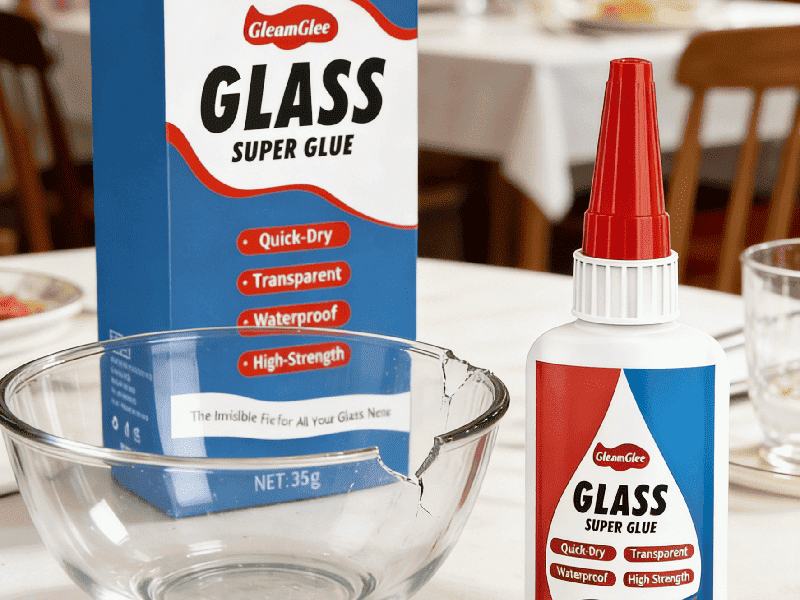
If you’re a consumer looking for a reliable, easy-to-use solution, professional-grade glass adhesives from GleamGlee are available with fast Amazon fulfillment, clear instructions, and precision applicators designed for clean results.
If you’re a brand owner, Amazon seller, distributor, or retailer, GleamGlee also offers custom glass glue formulations, private-label packaging, low MOQs, and global fulfillment support—helping you bring proven glass repair solutions to your market with confidence.
Whether you’re fixing one broken glass item or building a product line, the right glass glue—and the right partner—turns fragile problems into lasting solutions.