Skip to content
What Is the Best Glue for Leather?
The best glue for leather is not one magic product, but the adhesive that matches your leather type, stress level, and repair goal. This guide explains how leather glue works, which glues fit specific jobs, how to apply them correctly, and how to choose reliable products or OEM suppliers.
Best Glue for Leather
How to Choose, Use, and Avoid Costly Mistakes
When leather peels, cracks, or separates at the seams, you usually have two options: pay for an expensive repair, or attempt it yourself. In both cases, the success or failure of the repair depends heavily on choosing the right glue and using it correctly.
Leather is a living, flexible material. It bends with every step in your shoes, carries weight in bags and belts, and stretches and compresses in car seats and sofas. A glue that works perfectly on rigid plastic or ceramic can be a disaster on leather—turning soft surfaces into stiff, cracking lines.
In this page, you will learn:
- How leather glue works and why leather behaves differently from other materials.
- Which types of glue are best for shoes, bags, belts, upholstery, and crafts.
- A step-by-step method to glue leather for a strong, flexible bond.
- The most common mistakes that cause leather glue to fail.
- What to check before buying leather glue or choosing an OEM supplier.
- How GleamGlee can support you with ready-made products or custom leather glue solutions.
Whether you are fixing a luxury handbag, reattaching a shoe sole, or building a full private-label leather repair line, this guide is designed to be a practical, expert-level reference.
Why Choosing the Right Leather Glue Really Mattersks
Using the wrong glue on leather can ruin an expensive product. Because leather is porous, flexible, and often high-value, your adhesive must bond the fibers without turning them stiff, brittle, or discoloured.
Why leather is different from other materials
Leather behaves very differently from rigid substrates:
- Porous & fibrous – Effective glue must penetrate leather fibers and anchor inside the structure.
- Flexible & dynamic – Shoes, straps, handles and seats bend thousands of times; the glue has to flex with them.
- Sensitive to heat and chemicals – Aggressive solvents or high-heat curing can shrink or discolor the leather.
- Often expensive or sentimental – A failed repair may mean losing a luxury bag, heirloom jacket, or favorite boots.


What goes wrong with the wrong glue
- Porous & fibrous – Effective glue must penetrate leather fibers and anchor inside the structure.
- Flexible & dynamic – Shoes, straps, handles and seats bend thousands of times; the glue has to flex with them.
- Sensitive to heat and chemicals – Aggressive solvents or high-heat curing can shrink or discolor the leather.
- Often expensive or sentimental – A failed repair may mean losing a luxury bag, heirloom jacket, or favorite boots.
Real-world examples
- A luxury leather handbag edge repaired with generic super glue quickly turns glossy and rigid, and the edge cracks again within a week.
- A car seat patch glued with foam spray adhesive peels away the moment someone shifts their weight.
- Shoe soles reattached with low-strength craft glue separate in wet weather, because the glue is not water-resistant.
The conclusion: “Any strong glue” is not a safe answer. You need the right chemistry for leather.

Key Factors When Choosing the Best Glue for Leather
Instead of asking “Which brand is best?”, start with the key factors: leather type, stress level, flexibility, visibility, and environment. These determine which glue properties you really need.
Core decision factors
1. Flexibility after curing
- High-flex zones (shoe toes, straps, handles) demand a flexible glue that bends thousands of times without cracking.
- Low-flex zones (decorative pieces, labels) can tolerate slightly stiffer adhesives.
2. Bond strength and durability
- Daily-wear shoes and working belts require higher strength than an occasional-use clutch bag.
- Consider shear strength (sliding forces) and peel strength (edges being pulled open).
3. Open time and working time
- Beginners benefit from glues with a longer working time to adjust alignment.
- Fast-setting glues are convenient for tiny parts but risky for bigger seams.
4. Color, transparency, and non-yellowing
- For visible edges and patches, you want glues that dry clear and resist yellowing or whitening.
- On dark leather, any white residue is very visible.
5. Water, sweat, and temperature resistance
- Outdoor boots, motorcycle gear, and sports bags need excellent resistance to moisture and temperature swings.
- Car interiors can reach high temperatures in the sun, stressing the glue line.
6. Viscosity, penetration, and gap filling
- Low-viscosity glues penetrate fibers and are ideal for tight seams.
- Higher-viscosity or thixotropic glues are better for gap filling or uneven surfaces.
7. Compatibility with coatings and finishes
- Many modern “leathers” are actually PU-coated or heavily finished. The glue must adhere to that finish, not just the underlying hide.
- For suede or nubuck, you must avoid glues that leave shiny spots.
Leather type × problem × recommended glue behavior
Use this decision table as a quick reference:
| Leather Type | Typical Problems | Recommended Glue Characteristics |
|---|---|---|
| Full-grain leather | Edge lifting, seam opening | High strength, flexible, good penetration, non-brittle |
| Top-grain / corrected | Edge delamination, lining separation | Medium-viscosity, flexible, non-yellowing, invisible line |
| Suede / nubuck | Peeling layers, fuzzy surfaces | Penetrating, low-soak staining, matte finish, flexible |
| PU / synthetic leather | Surface peeling, layer separation | PU-compatible, flexible, strong adhesion to coatings |
| Patent leather | Cracks at folds, layer separation | Highly flexible, non-whitening, safe for glossy finishes |
| Leather shoes (uppers) | Toe box lifting, side separation | High flexibility, impact resistance, water resistance |
| Leather soles / heels | Sole detachment, heel peeling | High strength + flex, strong water & temperature resistance |
| Belts, straps, handles | Edge splitting, lamination failure | Flexible contact cement, strong edge bonding |
| Car seats / sofas | Seam splitting, patch repairs | Low odor, flexible, non-yellowing, upholstery-safe |
How to use this in practice
- If your repair is highly visible, prioritize appearance (clear, non-yellowing) and thin, smooth glue lines.
- If your repair is highly stressed (soles, straps), prioritize flexible strength and durability.
- If you are developing a product line, you may need multiple SKUs: one for shoes, one for upholstery, one for crafts, each tuned to these factors.

Which Types of Glue Work Best for Different Leather Scenarios?
Different leather repairs call for different adhesive chemistries. Contact cement, PU leather glue, water-based leather adhesive, cyanoacrylate, epoxy, and leather filler each have strengths and limitations.
Overview of main leather glue types
| Glue Type | How It Works / Features | Best For Leather Scenarios | Main Drawbacks |
|---|---|---|---|
| Solvent-based contact cement | Apply to both sides, let dry, then press; strong & flexible | Shoe soles, belts, laminations, heavy-duty straps | Strong odor, needs ventilation, less forgiving |
| PU leather glue (flexible) | Polyurethane-based, elastic, good for bending | Shoes, bags, straps, outdoor leather items | Needs correct curing time, can foam if misused |
| Water-based leather adhesive | Lower odor, easy clean-up, eco-friendlier | Upholstery, indoor crafts, light-to-medium stress bonds | Lower initial grab, needs pressure & time |
| Cyanoacrylate (super glue) | Very fast, tiny drops, strong on small areas | Small hardware, logos, trim pieces, minor edge touch-ups | Brittle, can whiten, not for large flex zones |
| Epoxy resin | Two-part, gap filling, very high strength | Thick leather + metal parts, rigid fixtures, structural elements | Stiff, poor choice for bending areas |
| Leather filler / compound | Thick paste that bonds & fills cracks or holes | Filling cracks, rebuilding edges, cosmetic surface repairs | Requires sanding, coloring, not main load joint |
| Spray adhesive | Thin, wide coverage, repositionable | Temporary bonding, pattern layout, foam + leather layering | Not suitable as primary high-stress joint |
Scenario-based recommendations
Reattaching a leather shoe sole
- Use solvent-based contact cement or PU leather glue.
- Ensure both surfaces are roughened and cleaned; follow the open time carefully.
Repairing a cracked leather belt edge
- Use flexible contact cement or PU leather glue, then finish with edge paint.
- Avoid brittle super glues that will snap when the belt bends.
Patching a leather sofa or car seat
- Use a low-odor, water-based leather adhesive for the patch.
- For surface cracks, use leather filler, then recolor.
Attaching a small logo patch or metal hardware
- For small rigid areas, cyanoacrylate can work if flex is minimal.
- For more movement, choose a flexible PU glue in very thin layer.
When to combine products
Many professional leather repairs use a combination of products:
- Glue to reattach or strengthen the base structure.
- Filler to rebuild missing areas or cracks.
- Color and finish to visually blend the repair.

How to Glue Leather Step by Step for a Strong, Flexible Bond
Technique matters as much as the glue itself. This step-by-step method helps you get a strong, flexible, tidy bond that lasts.
Preparation: diagnose, clean, and test
1. Diagnose the damage
- Is the damage a clean separation, partial peeling, crack, or missing piece?
- Decide whether you need only glue, or glue plus filler and color.
2. Identify leather and stress level
- High-flex (shoe toe, strap) vs. medium-flex (bag side) vs. mostly static (logo patch).
- Choose glue accordingly (see Modules 3 and 4).
3. Clean the surfaces
- Remove dust, dirt, oils, and old adhesive.
- For most jobs, use a leather-safe cleaner or isopropyl alcohol on a cloth.
- Never soak leather; use light, repeated wipes.
4. Roughen smooth surfaces when appropriate
- Gently scuff glossy edges or coated surfaces with fine sandpaper (e.g. 400–600 grit).
- Avoid scuffing delicate finishes, patent leather, suede, or nubuck.
Gluing process

1. Dry-fit and mark alignment
- Press parts together without glue to ensure a perfect fit.
- Mark key alignment points with pencil or masking tape.

2. Respect open time and assembly time
- For contact cement, open time is often 5–15 minutes before pressing.
- Press too early and the bond is weak; too late and it may not stick properly.

3. Press firmly and evenly
- Align carefully, then commit: contact cement in particular does not like re-positioning.
- Use clamps, tape, elastic bands, or weights to apply even pressure along the joint.

4. Maintain pressure during initial curing
- Keep pressure for 30–60 minutes where possible.
- For belts or flat parts, a roller pass can help eliminate air pockets.
5. Apply the glue correctly
Contact cement / PU leather glue
- Apply a thin, even layer to both surfaces using a brush or small spatula.
- Avoid pooling near edges.
- Let the solvent flash off until surfaces feel tacky, not wet.
Water-based leather adhesive
- Follow the manufacturer’s instructions (one or both sides).
- Maintain a uniform film; avoid thick blobs.
Cyanoacrylate (super glue)
- Apply tiny dots or a very thin line, only on small areas.
- Never flood porous leather; it can soak through and stain.
Curing, finishing, and inspection
- Allow full curing time
- Most leather glues reach handling strength in 1–2 hours but need 12–24 hours for full cure.
- Avoid flexing, stretching, or heavy use during this period.
- Clean up squeeze-out
- Fresh glue: wipe gently with a cloth or cotton swab, following product instructions.
- Cured glue: carefully trim with a sharp blade or fine abrasive, avoiding the leather surface.
- Finish the edges if needed
- For belts and straps, sand lightly and apply edge paint or dressing.
- For visible areas, consider using leather conditioner to blend sheen.
| Step | Common Mistake | Correct Action |
|---|---|---|
| Surface cleaning | Gluing over dust, old glue, or skin oils | Thoroughly clean with leather-safe cleaner or alcohol wipe |
| Surface preparation | No scuffing on very smooth surfaces | Lightly roughen glossy edges if leather type allows |
| Glue application | Thick, uneven layers, especially near edges | Apply a thin, even film and avoid flooding edges |
| Open time | Pressing together while glue is still wet | Wait until glue is tacky-dry, not wet |
| Pressing & alignment | Adjusting after full contact cement contact | Dry-fit and mark before, press once with firm alignment |
| Curing | Flexing or using the item too early | Respect full curing time (often overnight) |
| Cleanup | Scraping aggressively and scratching leather | Use gentle scraping or trimming, then edge finishing |
Buyer Checklist: How to Choose Leather Glue or a Leather Glue Supplier
Before buying leather glue—or choosing a factory to produce it—use a simple checklist. It will save you from weak bonds, safety issues, and disappointing products.
For consumers buying leather glue
Key self-assessment questions
- What exactly am I repairing (shoes, bag, belt, jacket, sofa, car seat)?
- Is this a high-flex, high-stress area or mostly decorative?
- Will the repair be visible from the outside?
- Will the item face rain, sweat, sunlight, or heat?
- Do I need low-odor or indoor-safe glue?

| Question | What to Look For |
|---|---|
| Is it clearly for leather? | Label mentions “leather glue” or use cases like leather shoes/bags |
| Is the bond flexible? | Phrases like “flexible”, “non-brittle”, “for bending areas” |
| How visible will the repair be? | “Dries clear”, “non-yellowing”, “no whitening on leather” |
| Is it suitable for my scenario? | Clear icons or text for shoes, belts, upholstery, crafts |
| How complex is usage? | Simple, illustrated instructions; included applicators or tips |
| Is odor an issue? | Water-based or low-odor formulas for indoor repairs |
For B2B buyers and brands (OEM/ODM)
If you are a retailer, brand owner, or Amazon seller, you must evaluate both the product and the partner.
Questions about the adhesive
- Can you share technical data sheets (strength, viscosity, solids, open time)?
- Do you have specific formulas for leather (shoes, upholstery, luxury goods)?
- Can you adjust viscosity, open time, flexibility, color, scent if required?
- What compliance documentation can you provide for my market (EU, US, UK)?
Questions about the supplier
- Do you have your own R&D labs and chemists, or only trade products?
- Can you handle both small pilot orders and large-scale production?
- Can you develop packaging and artwork in multiple languages?
- Do you have experience with Amazon FBA and major retail chains?

| Dimension | What to Check | Why It Matters |
|---|---|---|
| Technical support | Own lab, chemists, test data, sample testing | Ensures glue truly fits your leather use cases |
| Customization | Tailored viscosity, open time, flexibility, packaging | Lets you differentiate your brand |
| Compliance | REACH, VOC, local safety and labeling standards | Essential for EU/US/UK markets |
| Capacity & MOQ | Flexible MOQ plus scalable production | Start small, then grow without changing supplier |
| Design capability | In-house packaging and label design team | Faster launches, more consistent branding |
| Channel know-how | Experience with Amazon, Walmart, Temu, etc. | Fewer surprises in logistics, reviews, and returns |
Common Mistakes That Cause Leather Glue to Fail
Most leather glue “problems” are process mistakes, not product defects. Avoid these errors and your repairs will immediately last longer.
Typical mistakes and consequences
1. Skipping cleaning and old glue removal
- Consequence: Bond peels away from contamination, not from leather itself.
- Fix: Always degrease and remove loose, old glue before applying new adhesive.
2. Using brittle glue in high-flex areas
- Consequence: Hard glue line cracks, taking leather fibers with it.
- Fix: Use flexible leather glue or contact cement for soles, straps, and bends.
3. Applying glue too thickly
- Consequence: Trapped solvent, uneven curing, bulky edges, visible ridges.
- Fix: Apply thin, even films; multiple thin coats beat one thick coat.
4. Ignoring open time and cure time
- Consequence: Weak initial grab or under-cured polymer network.
- Fix: Follow the manufacturer’s timing instructions carefully.
5. Not pressing evenly
- Consequence: Hollow spots, air pockets, partial bonding.
- Fix: Use clamps, rollers, or firm hand pressure along the entire joint.
6. Testing flex too early
- Consequence: Microscopic tears inside the glue layer reduce final strength.
- Fix: Wait for full cure (often 12–24 hours) before flexing.
7. Using the same glue for incompatible materials
- Consequence: Poor adhesion to PU coatings, metal, or foam layers.
- Fix: Match glue chemistry to both the leather and the secondary material.
Quick pre-glue checklist
Before you open the bottle, ask:
- Is the surface clean and dry?
- Is the leather slightly roughened (if appropriate)?
- Have I tested the glue on a hidden area for staining?
- Do I know the correct open time and cure time?
- Do I have a way to apply even pressure?

Why GleamGlee Is a Reliable Partner for Leather Glue and Leather Repair Solutions
GleamGlee is more than a brand label. Behind each adhesive are real factories, chemists, designers, and an ecommerce team that understands how customers use leather repair products in the real world.
Who GleamGlee is
GleamGlee is a U.S.-registered consumer brand focusing on:
- Adhesive glues
- Repair and fix solutions
- Home and surface cleaning products
Behind the brand is a cross-border structure with:
- 4 specialized factories in China: daily chemical processing, packaging, label printing, and raw materials.
- 25+ chemists, material scientists, and process engineers in the lab.
- 18+ product and packaging designers handling structure and visual design.
This gives us full-chain capability from formula development → packaging → mass production → quality control → global distribution.

Channels and customer types
GleamGlee operates across:
- 7 major Amazon marketplaces (US, CA, UK, DE, FR, IT, ES)
- Additional platforms such as eBay, Walmart, Temu, ETSY
- B2B and B2C independent sites for global customers
We serve:
- Consumers looking for reliable repair and cleaning products.
- Amazon and Shopify brands seeking private-label adhesives and cleaners.
- Retailers and distributors needing custom or store-brand leather glues.

What this means for leather glue and leather repair lines
For leather-focused projects, GleamGlee can:
- Develop specialized leather glues for shoes, bags, belts, upholstery, or automotive use.
- Adjust viscosity, flexibility, open time, and curing speed according to your application.
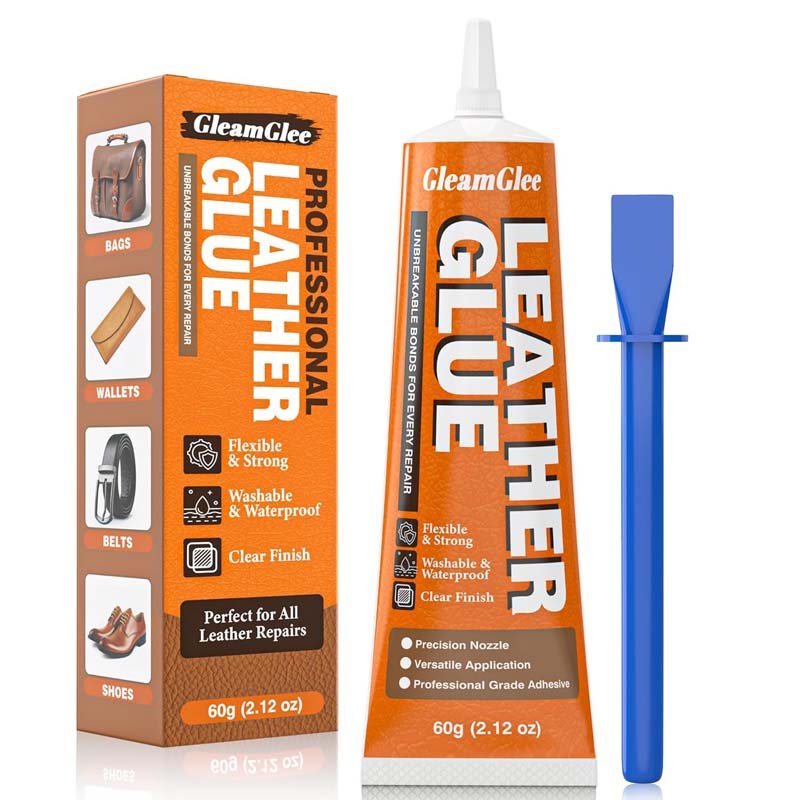
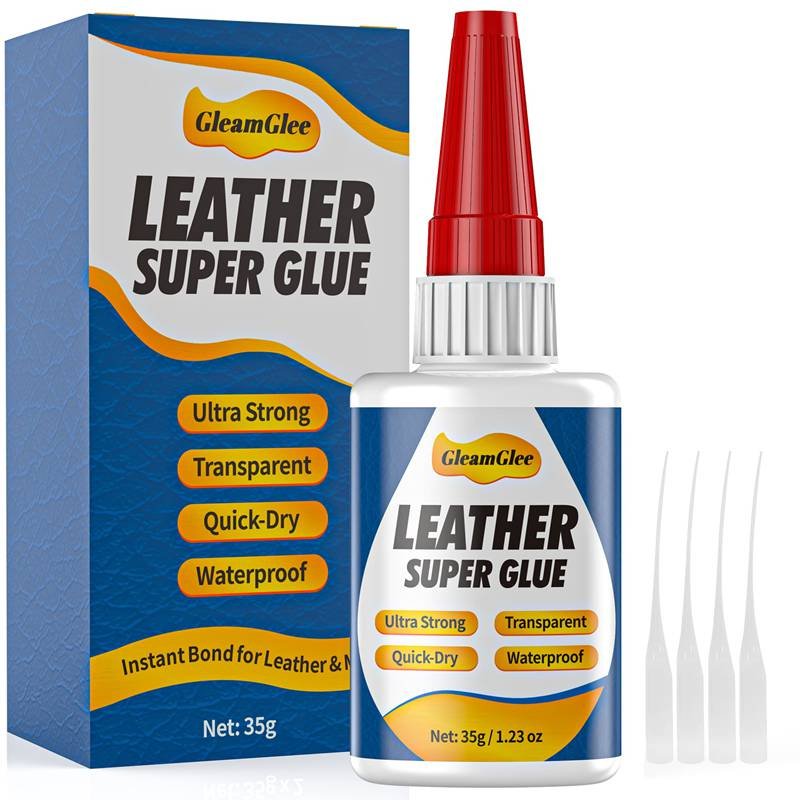
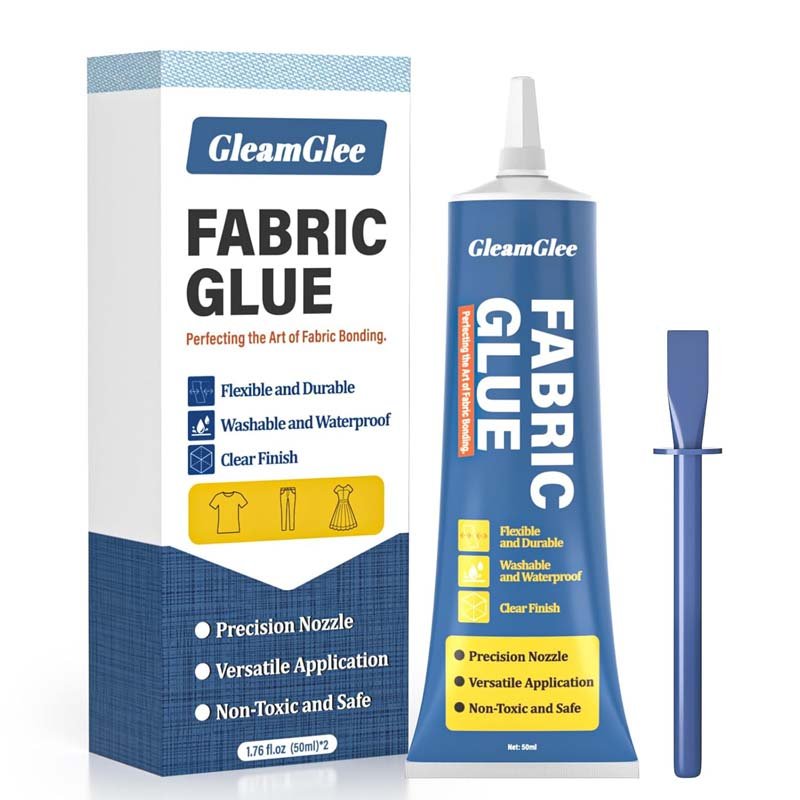
- Produce consumer-ready tubes, bottles, brush-on formats, or complete repair kits.
- Design English and multilingual packaging aligned with your brand positioning.
- Support launches on Amazon, Walmart, Temu, and independent sites, based on real marketplace experience.
By combining technical R&D with strong design and ecommerce know-how, GleamGlee can act as your technical partner, manufacturer, and marketing ally in the leather glue category.
FAQs About Leather Glue and Leather Repair
Short, direct answers help users—and search engines—quickly understand how leather glue behaves in real life. These FAQs can also be reused in product pages and customer support.
1. Can I use any super glue on leather?
Super glue can work for very small, low-flex repairs, but it is usually too brittle for larger, bending areas like soles, straps, and handles. For most repairs, a flexible leather glue or contact cement is safer.
2. Will leather glue make the area stiff?
It depends on the formula. Many general-purpose glues dry hard. A dedicated leather glue is designed to remain flexible after curing, so the repaired area moves with the leather instead of forming a hard ridge.
3. Is leather glue waterproof?
Many leather glues, especially those for shoes and outdoor items, are water-resistant or waterproof. Always check the product description for water or weather resistance if your item will face rain, puddles, or sweat.
4. How long does leather glue need to cure?
Initial handling strength often appears after 30–60 minutes, but full strength usually requires 12–24 hours. Avoid heavy load and flex until this curing time has passed.
5. Can I wash or clean leather after gluing?
After full cure, most leather glues tolerate normal wiping and gentle cleaning. Avoid harsh solvents or aggressive scrubbing directly on the glued seam.
6. Can leather glue be removed if I make a mistake?
Some glues can be softened with specific solvents, but this always carries a risk of damaging the leather or its finish. It’s better to test on scrap leather first and treat most leather glues as permanent.
7. Which glue is best for leather shoes?
For reattaching soles or high-stress parts, use contact cement or flexible PU leather glue. For small upper repairs and edges, a precision-tip leather glue that cures flexible is ideal.
8. Which glue is best for leather sofas and car seats?
Choose low-odor, flexible, upholstery-safe adhesives. For cosmetic cracks, combine leather filler with color repair products.
9. Can I color or dye over leather glue?
Many leather fillers and some glues can be sanded and colored. Keep glue layers thin and smooth, then apply compatible leather dye or paint to blend the repair.
10. Do I need professional tools to glue leather?
No. Basic tools—clean cloths, a small brush or spatula, sandpaper, and clamps or tape for pressure—are usually enough. Professional tools simply make the process faster and more repeatable.

Next Step with GleamGlee: Get the Right Leather Glue or OEM Solution
Once you understand which glue you need, the next step is choosing the right product or partner. GleamGlee can support both individual users and brands looking to build leather repair product lines.
For individual users (C-end)
If you are repairing your own leather items:
- Look for GleamGlee adhesive and repair products on Amazon and other marketplaces.
- Choose SKUs that clearly match your scenario—shoes, bags, belts, or upholstery.
- Follow the step-by-step method in this guide and in the product instructions.
- Keep before/after photos; they help you track what works best for future repairs.

For brands, retailers, and B2B buyers
If you want to launch or expand a leather glue or leather repair range, you can approach GleamGlee as a combined R&D + manufacturing + ecommerce partner.
Send us:
- Your target products and use cases (e.g., “leather shoe sole glue”, “upholstery repair kits”).
- Your target markets (US, EU, UK, etc.) and compliance needs.
- Preferred packaging formats (tube, bottle with brush, kit with tools).
- Expected MOQ and timeline for testing and launch.

We can:
- Recommend existing leather glue formulas or customize new ones for your brand.
- Design and localize packaging for your key markets.
- Help you position SKUs specifically for Amazon, Walmart, Temu or Shopify.
If you are serious about leather repair and want a technically solid, market-ready solution, GleamGlee is ready to help you move from idea to formula, from formula to product, and from product to global customers.