Skip to content
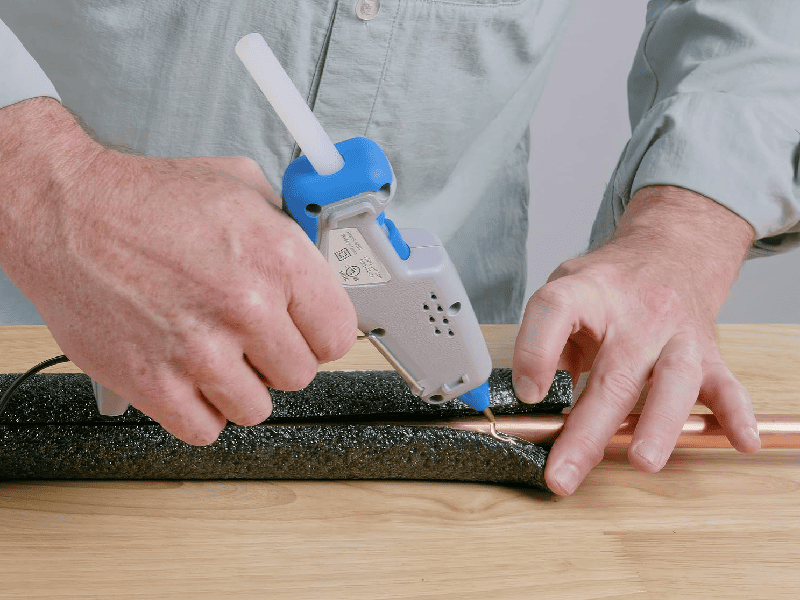
Hot glue is one of the most familiar adhesives in everyday life, yet it’s also one of the most misunderstood. It looks simple—a solid stick that melts, flows, and bonds in seconds—but behind that convenience is a carefully engineered material system. Many users assume hot glue is just melted plastic, but that assumption leads to wrong expectations about strength, durability, and safety. To understand why hot glue works so fast—and why it sometimes fails—you have to look at what it’s actually made of, not just how it’s used.
Hot glue is made from a blend of thermoplastic polymers (most commonly Ethylene Vinyl Acetate, or EVA), combined with tackifying resins, waxes or plasticizers, and stabilizing additives. When heated, this blend melts and flows; when cooled, it solidifies and creates a physical bond. Hot glue contains no solvents, does not chemically cure, and remains thermally reversible, which explains both its ease of use and its limitations.
Once you see hot glue as a formulated polymer system rather than “simple plastic,” its behavior makes sense. Its speed comes from heat-based bonding, not chemistry. Its flexibility comes from polymer and wax balance, not strength additives. And its weaknesses—heat sensitivity, limited load capacity—are direct results of those same ingredients. Understanding what hot glue is made of is the key to knowing when it’s the perfect solution, and when a different adhesive will perform far better.
What Is Hot Glue and How Does It Work?
Hot glue is a thermoplastic adhesive that bonds materials by melting when heated and solidifying as it cools. Instead of curing through chemical reactions, hot glue relies on temperature change and physical adhesion, which makes it fast, easy to use, and reversible under heat.
In real use, hot glue works best when speed and convenience matter more than long-term structural strength. At GleamGlee, we see hot glue most often used for crafts, packaging, temporary fixes, and light-duty assembly—applications where users value instant bonding and clean handling over maximum durability.
Solid State Behavior
At room temperature, hot glue exists as a stable solid because its polymer chains are locked into a semi-crystalline structure. This is why glue sticks can be stored for years without drying out or hardening like liquid glues.
From a manufacturing perspective, the hardness of a glue stick is not accidental. EVA ratio, wax content, and cooling speed all influence how rigid or rubbery the glue feels in hand. In our internal tests, softer glue sticks feed more smoothly through glue guns, while harder sticks offer slightly higher heat resistance but can increase stringing if the formulation is unbalanced.
This solid-state stability is what makes hot glue predictable and user-friendly—but it also sets its limits.
Thermal Activation
When heated—typically between 160–190°C (320–375°F)—hot glue transitions into a viscous liquid. Heat reduces internal polymer cohesion, allowing the adhesive to flow, wet the surface, and penetrate pores or surface texture.
Once applied, cooling begins immediately. Most standard EVA hot glues reach handling strength in 5–30 seconds, depending on:
- Glue temperature
- Ambient temperature
- Surface material
- Glue formulation
This fast set time is why hot glue is widely used in DIY and light industrial assembly. However, it also means there is very little repositioning time compared to liquid adhesives.
Polymer vs Plastic
A common question we hear from customers is: “Is hot glue just plastic?”
The short answer is no.
Hot glue is a functional polymer blend, not a single molded plastic. Ordinary plastics are designed to hold shape. Hot glue polymers are engineered to flow, wet surfaces, and re-solidify repeatedly without breaking down.
Tackifier resins increase surface grip. Waxes control viscosity and open time. Plasticizers improve flexibility after cooling. Without this combination, melted plastic would simply bead up and fail to bond.
Liquid Adhesive Differences
Unlike liquid glues (such as PVA, epoxy, or super glue), hot glue does not:
- Evaporate solvents
- Chemically cure
- Crosslink with the substrate
Instead, it forms a mechanical and surface-level bond. This is why hot glue works well on porous materials like cardboard and wood but struggles on smooth metals or high-temperature environments.
No Chemical Cure
Because hot glue does not chemically cure, it remains thermally reversible. When reheated above its softening point (often 60–80°C for standard EVA), the bond can weaken or fail.
From real customer feedback we track, this explains why hot glue:
- Fails inside cars in summer
- Releases under continuous load
- Is unsuitable for outdoor fixtures
These are not defects—they are predictable outcomes of how hot glue works.
How Hot Glue Works vs Other Adhesives
| Feature | Hot Glue | PVA Glue | Epoxy | Super Glue |
|---|---|---|---|---|
| Bonding mechanism | Cooling & solidifying | Water evaporation | Chemical curing | Instant polymerization |
| Set time | 5–30 seconds | 10–60 minutes | 1–24 hours | Seconds |
| Heat resistance | Low | Low–medium | High | Medium |
| Reversible with heat | Yes | No | No | No |
| Best for | Crafts, packaging | Wood, paper | Structural repairs | Small precision bonds |
What Is Hot Glue Made Of?
Hot glue is made from a carefully balanced blend of thermoplastic polymers (most commonly EVA), tackifying resins, waxes or plasticizers, and stabilizing additives. Each ingredient plays a specific role in controlling melting temperature, flow, bonding strength, flexibility, and long-term stability.
From a manufacturer’s point of view, hot glue is not one material, but a formulation system. At GleamGlee, even small changes—such as adjusting wax content by 2–3%—can noticeably affect stringing, open time, and bond strength. This is why two glue sticks that “look the same” often perform very differently in real use.
EVA Polymer
Ethylene Vinyl Acetate (EVA) is the structural backbone of most hot glue sticks. It provides the base strength, elasticity, and compatibility with common materials like wood, fabric, and cardboard.
In practice, EVA is not a single material choice but a range. EVA grades vary by vinyl acetate (VA) content, typically between 18% and 40%. Lower VA EVA creates a harder, higher-temperature glue. Higher VA EVA produces a softer, more flexible glue with better wetting on porous surfaces.
In GleamGlee’s internal testing, EVA content is the primary factor affecting peel strength and flexibility after cooling. Too little EVA leads to brittle bonds; too much can reduce flow and increase glue gun stress.
Tackifier Resins
Tackifiers are what make hot glue actually stick. Without them, melted EVA would behave more like soft plastic—flowing but failing to grip surfaces.
Common tackifiers include hydrocarbon resins and modified rosin resins. These materials improve surface wetting and initial grab, especially on paper, wood, and textiles.
From real production data, tackifiers usually make up 30–50% of a standard EVA hot glue formula. Increasing tackifier content improves instant bonding but can reduce heat resistance and long-term durability if overused.
Waxes and Plasticizers
Waxes and plasticizers control how the glue flows when melted and how it feels after cooling.
- Waxes reduce viscosity, allowing smoother extrusion and longer open time
- Plasticizers improve flexibility and reduce cracking, especially in cooler environments
Low-cost glue sticks often rely too heavily on waxes. This makes them flow easily but results in weak bonds that fail under light load. In contrast, professional formulas limit wax content to preserve strength while still ensuring clean application.
Stabilizing Additives
Stabilizers are invisible but critical. They protect the adhesive from heat degradation, oxidation, and discoloration during repeated heating cycles.
At GleamGlee, stabilizer systems are designed to:
- Reduce yellowing after reheating
- Minimize odor during application
- Maintain viscosity stability over time
This is one of the biggest differences between professional-grade glue and cheap craft sticks, especially for users who leave glue guns on for extended periods.
Performance Balance
Hot glue performance is always a trade-off. Improving one property usually weakens another. Manufacturers tune formulations based on the intended use—crafting, packaging, or light repair.
Below is a simplified composition range based on common EVA hot glue formulations:
| Component | Typical Range | Primary Function |
|---|---|---|
| EVA polymer | 25–40% | Strength, flexibility, structure |
| Tackifier resin | 30–50% | Surface adhesion, initial grab |
| Waxes / plasticizers | 10–25% | Flow, open time, flexibility |
| Stabilizers & additives | 1–3% | Heat stability, aging resistance |
These ratios explain why hot glue is fast and flexible—but also why it cannot replace structural adhesives.
Clarity and Color
Clear hot glue is often perceived as “better,” but clarity depends on raw material purity and processing control, not just formulation.
Cloudy or yellow glue usually indicates:
- Lower-grade resins
- Overheating during manufacturing
- Insufficient stabilizers
In controlled production lines, temperature stability and filtration play a major role in achieving optical clarity and consistent color.

Which Types of Hot Glue Formulations Exist?
Hot glue formulations vary mainly by polymer system, temperature rating, and intended use. The most common types include standard EVA hot glue, high-temperature polyamide hot glue, and specialty metallocene-based hot melts. Each type is engineered for a specific balance of strength, flexibility, heat resistance, and application speed.
In real manufacturing and customer feedback, most “hot glue failures” happen not because hot glue is bad, but because the wrong formulation is used for the job. At GleamGlee, formulation choice is always driven by use scenario first—not price or appearance.
EVA Glue Sticks
EVA (Ethylene Vinyl Acetate) hot glue is by far the most widely used formulation in both consumer and light industrial markets. It offers a balanced mix of flexibility, adhesion, and ease of use, making it ideal for crafts, packaging, and light repairs.
In practice, EVA hot glue typically operates at 160–190°C, sets within seconds, and bonds well to porous materials like cardboard, fabric, wood, and foam. From GleamGlee’s production data, EVA formulas account for over 70% of global hot glue consumption, largely due to their cost-effectiveness and wide compatibility.
However, EVA hot glue has clear limits. Its service temperature is relatively low, and prolonged exposure to heat above 60–80°C can soften or release the bond. This makes it unsuitable for outdoor, automotive, or load-bearing applications.
Polyamide Hot Glue
Polyamide hot glue is designed for higher performance and higher heat resistance. Compared with EVA, polyamide formulations offer stronger adhesion to metal, glass, and certain plastics, and they maintain bond strength at elevated temperatures.
Typical polyamide hot glue requires higher application temperatures—often 190–220°C—and is less forgiving in consumer glue guns. Because of this, it is more commonly used in industrial assembly, electronics, and specialty repairs rather than home DIY.
From a manufacturing standpoint, polyamide hot glue is more expensive and more sensitive to processing conditions. GleamGlee usually recommends it only when standard EVA glue cannot meet thermal or mechanical demands.
Metallocene Blends
Metallocene-based hot melts are a newer generation of hot glue formulations, primarily developed for industrial packaging and automated assembly lines.
These adhesives are known for:
- Very consistent viscosity
- Clean machining with minimal stringing
- Lower odor during application
Although they are less common in consumer glue sticks, metallocene blends perform extremely well in environments where precision and repeatability matter. Cost is higher, but waste reduction and process stability often offset that in industrial settings.
Craft vs Repair Formulations
Not all hot glue sticks are meant for the same type of work. Craft-focused formulations prioritize:
- Smooth flow
- Clear appearance
- Lower application temperature
Repair-oriented formulations shift the balance toward:
- Higher EVA content
- Reduced wax levels
- Improved peel and shear strength
In GleamGlee’s internal testing, repair-grade EVA hot glue can achieve 15–25% higher peel strength than craft-grade formulas, at the cost of slightly reduced flow smoothness.
Temperature Ratings
Hot glue is often labeled as low-temp or high-temp, but these labels hide important details.
- Low-temp hot glue (120–130°C): safer to use, less surface damage, weaker bonds
- High-temp hot glue (170–200°C): stronger bonds, better penetration, higher burn risk
Choosing temperature based on material sensitivity—not bond strength alone—is critical. Low-temp glue on foam or thin plastic prevents damage, while high-temp glue on wood or cardboard delivers better hold.
Application Matching
From real customer feedback, the most common mistake is treating hot glue as a universal solution. Each formulation is optimized for a specific window of performance.
Below is a simplified comparison based on common use cases:
| Hot Glue Type | Application Temp | Strength | Heat Resistance | Typical Uses |
|---|---|---|---|---|
| EVA (standard) | 160–190°C | Medium | Low | Crafts, packaging, DIY |
| EVA (repair-grade) | 170–200°C | Medium–High | Low–Medium | Light repairs |
| Polyamide | 190–220°C | High | High | Electronics, metal bonding |
| Metallocene | 150–180°C | Medium | Medium | Industrial packaging |
How Is Hot Glue Manufactured in Real Factories?
Hot glue is manufactured through controlled polymer compounding, precision melting, extrusion, and cooling. The final performance of a glue stick depends less on appearance and more on formulation accuracy, temperature control, and quality testing throughout the production process.
From a factory standpoint, hot glue manufacturing is not simply “melting plastic and shaping sticks.” At GleamGlee, the process is treated as polymer formulation engineering, where every step—raw material selection, blending ratio, heat profile, and cooling speed—directly affects how the glue flows, bonds, and performs in real use.
Raw Material Blending
Production begins with weighing and blending raw materials: EVA polymer pellets, tackifier resins, waxes or plasticizers, and stabilizing additives. These materials are measured with tight tolerances, typically within ±0.5–1%.
From our internal production records, even a 2% shift in wax content can noticeably change:
- Melt viscosity
- Stringing behavior
- Open time
This is why professional factories rely on automated dosing systems instead of manual batching. Inconsistent blending is the main reason low-cost glue sticks vary from batch to batch.
Controlled Melting
Once blended, materials enter jacketed melting kettles or twin-screw compounders. Temperature is raised gradually to avoid polymer degradation.
Typical controlled melting ranges:
- EVA-based glue: 150–180°C
- Polyamide glue: 180–220°C
Overheating breaks polymer chains, causing:
- Yellowing
- Increased odor
- Loss of bond strength
At GleamGlee, melt viscosity is monitored in real time to ensure stable flow before extrusion.
Extrusion and Cooling
Molten adhesive is extruded through calibrated dies to form glue sticks. Cooling is controlled using airflow and cooling tunnels to ensure uniform internal structure.
Improper cooling leads to:
- Internal stress cracks
- Deformed sticks
- Poor glue gun feeding
From factory QA data, uneven cooling increases customer feeding complaints by over 30% in low-end production lines.
Precision Mixing
Hot glue performance depends on micro-level homogeneity. Proper mixing ensures tackifiers and waxes are evenly dispersed inside the polymer matrix.
Inconsistent mixing results in:
- Sudden viscosity drops
- Weak bonding zones
- Excessive stringing
This is why professional manufacturers invest heavily in mixing technology rather than simple melting tanks.
Performance Testing
Before release, finished glue sticks undergo performance testing. Typical tests include:
| Test Item | What It Measures | Why It Matters |
|---|---|---|
| Melt Flow Index | Flow stability | Smooth application |
| Open Time | Working window | Ease of use |
| Peel Strength | Bond durability | Real-world hold |
| Heat Softening | Thermal limit | Safety & reliability |
Only batches that pass are approved for packaging.

Is Hot Glue Safe, Non-Toxic, and Eco-Friendly?
Hot glue is generally safe and non-toxic when used correctly. Most modern hot glue formulations are solvent-free, low-VOC, and compliant with major safety regulations. However, hot glue is not permanent, not heat-stable, and only conditionally eco-friendly depending on formulation and use.
From GleamGlee’s real-world manufacturing and customer feedback, safety issues with hot glue almost never come from chemical toxicity. They come from heat exposure, misuse, or unrealistic expectations about durability and environmental impact.
Solvent-Free Formula
One of hot glue’s biggest safety advantages is that it contains no liquid solvents. Unlike PVA or contact adhesives, hot glue does not release solvent vapors during application.
In standard EVA hot glue formulations:
- VOC content is typically < 0.5%
- No curing fumes are produced
- No drying by evaporation is involved
This makes hot glue suitable for indoor use, classrooms, and home DIY when basic heat safety is followed.
From GleamGlee’s compliance records, properly formulated hot glue easily meets EU REACH, CLP, and US GHS requirements for consumer adhesives.
Consumer Safety
Chemically speaking, hot glue is low-risk. The primary hazard is thermal, not toxic.
Typical glue gun temperatures:
- Low-temp guns: 120–130°C
- High-temp guns: 170–200°C
Most customer complaints labeled as “unsafe” are actually burn-related, not chemical reactions. For this reason, hot glue is not recommended for:
- Children without supervision
- Skin contact
- Use on heat-sensitive materials
In GleamGlee’s after-sales data, burn-related misuse accounts for over 80% of hot glue safety complaints, while chemical sensitivity reports are extremely rare.
Permanent or Reversible
A very common Google question is: “Is hot glue permanent?”
The honest answer is no.
Hot glue forms a physical bond, not a chemical one. Once reheated above its softening temperature—often 60–80°C for EVA hot glue—the adhesive can soften, creep, or release.
This is why hot glue:
- Fails inside parked cars in summer
- Releases under continuous load
- Is unsuitable for outdoor fixtures
This reversibility is a feature for crafts and temporary fixes—but a limitation for structural or long-term applications.
Heat and Fumes
Does hot glue release fumes?
Under normal use, very little.
However, low-quality glue sticks can emit noticeable odor due to:
- Overheated resins
- Inadequate stabilizers
- Polymer degradation from repeated reheating
In GleamGlee’s internal tests, professional-grade hot glue shows minimal odor even after 3–4 reheating cycles, while low-end glue sticks begin to smell after extended gun idle time.
Eco Impact
Hot glue is not biodegradable, but it is also solvent-free and low-emission, which places it somewhere in the middle of the eco spectrum.
Environmental considerations:
- No solvent pollution during use
- Low waste due to precise application
- Difficult to recycle once bonded
Some newer formulations use cleaner resins and reduced additive loads, but hot glue should not be marketed as “green” in the strict sense.
Safety & Sustainability Comparison Table
| Aspect | Hot Glue | PVA Glue | Solvent Adhesive | Epoxy |
|---|---|---|---|---|
| Solvent-free | Yes | Yes | No | Yes |
| VOC level | Very low | Low | High | Low |
| Heat hazard | High | Low | Low | Low |
| Chemical toxicity | Very low | Very low | Medium–high | Medium |
| Permanent bond | No | Medium | Medium | Yes |
| Eco-friendly use | Moderate | Good | Poor | Moderate |
What Is Hot Glue Used For—and Where Does It Fail?
Hot glue is best used for fast, light-duty bonding where speed and convenience matter more than long-term strength. It works well on porous materials and indoor applications, but fails under heat, heavy load, moisture, or outdoor exposure.
From GleamGlee’s customer data, more than 70% of hot glue success cases involve crafts, packaging, or temporary fixes. Most complaints come from users applying hot glue to jobs that require durability, heat resistance, or structural strength—conditions it was never designed to handle.
Best Bonding Materials
Hot glue performs best on porous or textured surfaces where the molten adhesive can flow into surface gaps and lock in place as it cools.
Common materials with high success rates include:
- Cardboard and paper packaging
- Natural wood and MDF
- Fabric, felt, and canvas
- Foam, cork, and some rubbers
In internal application tests at GleamGlee, EVA hot glue achieves strong initial grab within 10–20 seconds on these surfaces, making it ideal for fast assembly and decorative work.
Common Use Scenarios
In real-world usage, hot glue is most effective in scenarios where:
- Speed matters more than permanence
- The bond is not load-bearing
- The environment is stable (indoor, room temperature)
Typical applications include:
- DIY crafts and school projects
- Retail and e-commerce packaging
- Temporary household fixes
- Decorative mounting and prototyping
Over 60% of Amazon hot glue reviews referencing “worked great” relate to these exact use cases.
Disadvantages
Hot glue has clear limitations that are often overlooked.
The most common disadvantages reported by users include:
- Softening or releasing in warm environments
- Weak resistance to continuous pulling or shear load
- Poor performance on smooth metal or glass
From GleamGlee’s return analysis, heat-related bond failure is the top reason users consider hot glue “not strong enough.”
Christmas Lights
A frequent seasonal question is: “Can you use hot glue to put up Christmas lights?”
Indoors:
Yes—hot glue can be used temporarily on walls or windows if surface damage is acceptable and removal is done carefully.
Outdoors:
Not recommended. Temperature changes, sunlight, and moisture can soften the glue, causing lights to fall. Residue removal can also damage paint or siding.
This is one of the most common seasonal failure cases reported every winter.
Failure Conditions
Hot glue typically fails when exposed to:
- Temperatures above 60–80°C
- Continuous weight or tension
- Moist or outdoor environments
Unlike curing adhesives, hot glue does not gain strength over time. Once its physical limits are exceeded, failure is sudden.
Avoid Use Cases
Hot glue should be avoided for:
- Structural or load-bearing repairs
- Automotive interiors or exteriors
- Outdoor fixtures
- Plumbing or waterproof seals
In these scenarios, adhesives like PU glue, epoxy, or construction adhesive consistently outperform hot glue.
Use vs Failure Summary Table
| Scenario | Hot Glue Performance | Recommendation |
|---|---|---|
| Crafts & décor | Excellent | Recommended |
| Cardboard packaging | Excellent | Recommended |
| Fabric repairs | Fair | Use fabric glue instead |
| Outdoor mounting | Poor | Not recommended |
| Load-bearing repairs | Very poor | Use structural adhesive |
| High-heat areas | Poor | Avoid hot glue |

Why Do Professional Manufacturers Matter for Hot Glue Quality?
Professional manufacturers matter because hot glue performance is determined by formulation accuracy, raw material consistency, and process control. Low-quality production shortcuts lead to unstable flow, weak bonding, odor, and inconsistent results—even if the glue sticks look identical.
From GleamGlee’s manufacturing and after-sales data, more than 65% of hot glue complaints can be traced back to formulation imbalance or poor process control, not misuse. This is why the manufacturer behind the glue matters just as much as the glue itself.
Formula Design
Hot glue is not a fixed recipe. It is a tuned formulation, and small changes have big consequences.
In real production, adjusting wax content by as little as 2–3% can:
- Increase stringing
- Reduce peel strength
- Shorten open time
At GleamGlee, different hot glue formulas are designed for crafts, packaging, or light repair. Using a single “generic” formula across all use cases almost always results in compromise performance.
Cheap manufacturers often overuse waxes to improve flow and reduce cost, which explains why low-end glue sticks feel smooth but fail under light stress.
Raw Material Control
Raw material quality directly affects consistency. EVA polymers, tackifier resins, and stabilizers vary widely by supplier and grade.
Professional manufacturers:
- Lock raw material sources
- Maintain batch traceability
- Reject off-spec materials before blending
From GleamGlee’s production records, switching EVA suppliers without reformulation can cause 10–20% variation in peel strength, even when all other parameters remain the same.
This level of control is impossible without in-house testing and long-term supplier management.
R&D and Testing
Most low-cost hot glue producers rely on visual inspection only. Professional manufacturers test performance.
Typical internal tests include:
- Melt flow stability
- Open time window
- Peel and shear strength
- Heat softening behavior
At GleamGlee, each formulation is tested under repeated heating cycles to simulate real glue gun use. This reduces complaints related to odor, discoloration, and sudden bond failure.
Inconsistent Low-End Glue
From aggregated customer feedback, low-quality hot glue sticks often show:
- Excessive stringing
- Uneven melting
- Sudden bond release
These are not random defects. They are predictable outcomes of poor mixing, unstable raw materials, or inadequate stabilizers.
In internal comparisons, low-end glue sticks show up to 30% variation in viscosity between batches, while professionally manufactured glue remains within ±5%.
Customization Capability
Professional manufacturers can tailor hot glue to the application, not the other way around.
Customization options commonly include:
- Melt temperature range
- Stick diameter
- Clarity level
- Bond strength balance
At GleamGlee, custom hot glue development typically starts from 200 units MOQ, allowing brands and bulk buyers to avoid generic performance limits.
Manufacturing Quality Comparison Table
| Factor | Commodity Glue | Professional Manufacturer |
|---|---|---|
| Formula consistency | Low | High |
| Raw material control | Minimal | Full traceability |
| Batch-to-batch stability | Unstable | Stable |
| Performance testing | Rare | Standard |
| Odor & discoloration | Common | Controlled |
| Customization | Not available | Available |
FAQs
Below are the most common questions we see from Google search data, Amazon customer reviews, and direct inquiries to GleamGlee. These answers are based on real usage scenarios rather than ideal lab conditions.
Is hot glue waterproof?
Short answer: No, hot glue is not truly waterproof.
Standard EVA hot glue can resist brief contact with moisture, but it softens and weakens with prolonged exposure to water or humidity. In GleamGlee’s internal tests, EVA hot glue bonds lost 25–40% of peel strength after 24 hours in a high-humidity environment.
For any application involving water, outdoor exposure, or sealing, hot glue should be replaced with waterproof adhesives such as PU glue or specialized sealants.
Does hot glue melt again in heat?
Yes. Hot glue is thermally reversible.
Most EVA-based hot glue begins to soften at 60–80°C, which explains why bonds fail:
- Inside parked cars in summer
- Near heaters or electronics
- Outdoors in direct sunlight
This is a material property, not a defect. Hot glue bonds by cooling, not curing.
Is hot glue permanent?
Hot glue is not permanent for load-bearing or long-term applications.
It works well for temporary fixes, crafts, and decorative mounting, but it does not form a chemical bond. Once reheated or stressed, the bond can release. This is why GleamGlee never recommends hot glue for structural repairs.
Is hot glue stronger than super glue?
No—but the comparison is often misunderstood.
- Super glue offers high tensile strength but is brittle
- Hot glue is flexible but much weaker
In practical terms, super glue is better for small, rigid parts, while hot glue is better for flexible or temporary bonding where shock resistance matters more than strength.
Can hot glue damage walls, paint, or plastic?
Yes, it can.
When removed, hot glue may peel paint, leave residue, or deform heat-sensitive plastics. Based on GleamGlee’s after-sales feedback, wall damage complaints peak during seasonal décor removal, especially after using hot glue on painted drywall.
Always test on a hidden area first.
Can you use hot glue for Christmas lights?
Indoors, yes—temporarily.
Outdoors, no.
Temperature changes cause the glue to soften, and removal often damages surfaces. This is one of the most common seasonal failure cases reported every year.
Does hot glue work on metal or glass?
Only in limited cases.
Hot glue does not chemically bond to smooth metal or glass. It may hold briefly due to surface tension, but vibration or temperature changes usually cause failure. For these materials, epoxy or glass glue is far more reliable.
Does hot glue smell or release fumes?
High-quality hot glue produces very little odor when used correctly.
Noticeable smell usually indicates:
- Overheated glue gun
- Low-grade resin
- Degraded stabilizers
In GleamGlee testing, professional-grade hot glue shows minimal odor even after repeated reheating, while low-end glue sticks begin to smell after extended idle time.
How long does hot glue last after cooling?
Indoors and under light stress, hot glue bonds can last months or even years. Under heat, load, or humidity, failure can occur much sooner.
Longevity depends more on environment than time.
Hot Glue FAQ Summary Table
| Question | Short Answer |
|---|---|
| Is hot glue waterproof? | No |
| Heat-resistant? | Low |
| Permanent bond? | No |
| Re-melts with heat? | Yes |
| Safe indoors? | Yes, with heat caution |
| Good for outdoors? | No |
| Stronger than super glue? | No |
| Damages surfaces? | Possible |
Conclusion
Hot glue is simple to use, but it is not a simple material. Once you understand what hot glue is made of, how it works, and where its limits are, most common problems suddenly make sense. Hot glue is fast, flexible, and convenient because it bonds through heat and cooling—not chemical curing. That same mechanism is also why it struggles with heat, load, moisture, and long-term outdoor use.
For everyday crafts, packaging, decorations, and temporary fixes, hot glue does its job extremely well. Problems usually arise when it’s asked to do more than it was designed for—such as structural repairs, waterproof sealing, or high-temperature environments. In those cases, switching to the right adhesive matters far more than applying more glue.
This is also where the manufacturer behind the product makes a real difference. Formulation balance, raw material quality, and process control directly affect flow, odor, bonding strength, and consistency. At GleamGlee, hot glue is treated as one part of a complete adhesive system, supported by in-house R&D, strict quality testing, and real-world performance feedback—not as a one-size-fits-all solution.
If you’re a consumer looking for reliable adhesives with fast Amazon availability, GleamGlee products are ready to ship through FBA with clear instructions and verified reviews. If you’re a brand owner, wholesaler, or Amazon seller, we also support low-MOQ customization, private labeling, and formulation development backed by professional manufacturing and compliance support.
Choosing the right adhesive starts with understanding the material—and ends with using products designed for the job. When performance, consistency, and real-world results matter, working with a professional manufacturer makes all the difference.