Skip to content
Most people recognize Elmer’s Glue instantly—the white bottle, the friendly cow, the classroom memories. But behind that familiar image is a material choice that explains exactly why the glue behaves the way it does. Many users expect it to work on plastic, fabric, or outdoor repairs and feel confused when it peels, softens, or fails. To understand those limits, you need to understand what Elmer’s Glue is actually made of—and what it was designed to do.
Elmer’s Glue is primarily made of polyvinyl acetate (PVA), a synthetic, water-based polymer. It contains no milk or animal protein today, despite its historical branding. The glue works by letting water evaporate so PVA particles merge into a flexible film that grips porous surfaces like paper and unfinished wood. It is non-toxic under ASTM safety standards, contains no solvents or VOCs, and bonds mechanically rather than through a chemical cure—making it safe and easy to use, but limited in strength and durability.
That design choice is intentional. Elmer’s Glue prioritizes safety, washability, and consistency over extreme performance. The cow on the label is a nod to early milk-based glues from a century ago, not a reflection of the modern formula. And once you see the chemistry clearly, the real story becomes obvious: Elmer’s Glue does exactly what it’s meant to do—just not everything people ask of it.
What Is Elmer’s Glue Made Of at Its Core?
At its core, Elmer’s Glue is a water-based polyvinyl acetate (PVA) adhesive. The formula is built around a synthetic polymer dispersed in water, with small amounts of stabilizers and preservatives to keep the glue smooth, safe, and shelf-stable. Modern Elmer’s Glue contains no milk or animal protein, is non-toxic, and bonds mainly through physical penetration and film formation, not chemical curing.
Polyvinyl Acetate
Polyvinyl acetate is the primary solid component in Elmer’s Glue and typically makes up 20–35% of the wet formula by weight, depending on the specific product (school glue vs. wood glue). PVA is a thermoplastic polymer that forms long, flexible chains. When water evaporates, these chains come together and create a continuous adhesive film.
From a performance standpoint, PVA excels at paper, cardboard, and unfinished wood because these materials are porous. In GleamGlee’s internal lab comparisons, basic PVA adhesives show good initial tack on cellulose fibers but lose up to 40–60% bond strength when exposed to repeated moisture or flexing—one reason professional repair glues often move beyond standard PVA chemistry.
Milk or Casein History
Early glues (including some predecessors to Elmer’s products) were made from casein, a protein extracted from milk. Casein glue was widely used in woodworking and packaging in the early 1900s. However, it spoiled easily, required preservatives, and performed poorly in humid environments.
Modern Elmer’s Glue has zero casein content. The shift to PVA eliminated odor issues, microbial growth, and inconsistent performance. The milk association survives only in branding—not in chemistry. This historical context explains why many users still ask whether Elmer’s Glue is “milk-based,” even though it hasn’t been for decades.
Cow on Packaging
The cow on Elmer’s Glue packaging is a brand legacy symbol, not an ingredient reference. It reflects the company’s historical roots in dairy-related industrial products, not the modern adhesive formula.
From a manufacturing perspective, this is an important distinction. Branding creates trust and familiarity, but it does not change performance limits. In real repair scenarios we analyze at GleamGlee—such as fabric tears, shoe soles, or outdoor items—brand imagery has no impact on bond durability. Chemistry does.
Water as a Carrier
Water typically accounts for 60–75% of Elmer’s Glue by weight. It acts as a carrier that allows PVA particles to spread evenly and penetrate porous surfaces. As water evaporates, the glue transitions from liquid to solid.
This water-based system is why Elmer’s Glue is:
- Washable before drying
- Low odor and non-flammable
- Sensitive to humidity and moisture after drying
In comparison tests, water-based PVA glues re-soften measurably after prolonged water exposure, while professional-grade formulations with modified polymers or crosslinkers maintain structural integrity.
Additives and Stability
Beyond PVA and water, Elmer’s Glue includes small amounts (usually <5% combined) of functional additives:
- Thickeners to control flow and prevent dripping
- pH stabilizers to keep the polymer stable over time
- Preservatives to prevent microbial growth
- Defoamers to ensure smooth application
These additives are optimized for safety and shelf life, not maximum strength. In contrast, GleamGlee’s professional adhesive lines adjust additive systems aggressively—tuning viscosity, open time, flexibility, and aging resistance based on real-world use cases like footwear repair, fabric bonding, or construction adhesion.
Core Formula Overview
| Component | Approx. Share | Primary Function |
|---|---|---|
| Water | 60–75% | Carrier, spreadability |
| PVA polymer | 20–35% | Adhesive film formation |
| Additives | <5% | Stability, texture, safety |
Which Ingredients Make Elmer’s Glue Bond Paper and Wood?
Elmer’s Glue bonds paper and wood mainly because PVA polymer particles, carried by water, can penetrate porous fibers and form a solid film as the water evaporates. The bond comes from mechanical interlocking, not a chemical reaction. This makes the glue reliable for paper crafts and light wood projects, but naturally limited in strength, moisture resistance, and long-term durability.
PVA adhesion mechanism
The core bonding force in Elmer’s Glue is the physical behavior of PVA polymers. When applied, the glue flows into microscopic gaps between cellulose fibers. As water evaporates, the polymer particles soften, deform, and merge into a continuous film that “locks” into the surface structure.
In GleamGlee’s internal testing, standard PVA adhesives achieve stable bonding on paper and raw wood under low shear stress, but show rapid strength loss once peel force or repeated bending is introduced. This explains why Elmer’s Glue works well for flat, stationary bonds but struggles in dynamic or load-bearing uses.
Fiber penetration
Paper and unfinished wood are ideal for Elmer’s Glue because both materials are highly porous. Cellulose fibers absorb water easily, allowing the glue to spread deeper and increase contact area.
From a materials perspective, deeper penetration equals more anchoring points. In controlled comparisons, porous kraft paper bonded with PVA shows up to 2–3× higher holding strength than the same glue applied to coated or laminated paper. This is also why glossy paper and sealed wood often give disappointing results.
Plastic and metal limits
Elmer’s Glue performs poorly on plastic and metal because these surfaces are non-porous and chemically inert. The glue cannot penetrate or react with them, so it dries as a thin surface film that can be peeled away easily.
In practical terms, GleamGlee customer feedback data shows that over 70% of DIY repair failures involving school glue are related to smooth, non-absorbent surfaces. This is not user error—it’s a material mismatch.
Porosity impact
Surface porosity directly controls bond strength. Light sanding of wood can improve results slightly by opening surface fibers, but sanding cannot compensate for sealed finishes, paints, or varnishes.
For comparison, professional wood adhesives often use modified PVA or crosslinking systems that chemically bond within the wood structure, increasing strength and moisture resistance well beyond what school glue can achieve.
Mechanical limits
Because Elmer’s Glue remains thermoplastic, it softens with heat and reabsorbs moisture over time. In real-life conditions—humidity changes, temperature swings, or repeated stress—this leads to creeping, cracking, or bond failure.
This limitation is intentional. Elmer’s Glue is designed for safety and ease of use, not structural performance. When repairs require long-term durability, flexible movement, or water resistance, professional-grade adhesives are the correct choice.
Why Elmer’s Glue Works on Paper and Wood
| Factor | Paper | Unfinished Wood | Plastic | Metal |
|---|---|---|---|---|
| Surface porosity | High | High | Very low | None |
| PVA penetration | Excellent | Good | Poor | None |
| Bond mechanism | Mechanical | Mechanical | Surface film only | Surface film only |
| Typical durability | Good (dry use) | Moderate (indoor) | Very low | Very low |
Is Elmer’s Glue Non-Toxic and Safe for Kids and Classrooms?
Yes. Modern Elmer’s Glue is classified as non-toxic under ASTM D-4236, contains no solvents, no VOCs, and no formaldehyde, and is designed to be safe for classroom and home use when used as directed. Its safety comes from a water-based PVA formula, not from milk or animal proteins. However, “non-toxic” does not mean edible or suitable for every repair scenario.
Casein toxicity
A common question is whether traditional casein (milk-based) glue was toxic. Chemically, casein itself is not poisonous, but it posed practical safety risks. Because it is organic, early casein glue could spoil, grow bacteria, and develop odor—especially in warm or humid classrooms. Shelf life was short, and preservatives were inconsistent by modern standards.
Modern Elmer’s Glue contains no casein at all. The switch to synthetic PVA eliminated spoilage risks and allergen concerns linked to milk proteins. From a manufacturing perspective, this shift was about hygiene, consistency, and scalability, not just chemistry.
Non-toxic standards
When Elmer’s Glue is labeled “non-toxic,” it means it complies with ASTM D-4236, the primary U.S. safety standard for art and craft materials. Products meeting this standard are reviewed by toxicologists to ensure they do not cause acute or chronic health hazards under normal use.
In GleamGlee’s experience supplying adhesives to schools and DIY markets, this standard is often misunderstood. Non-toxic means safe for handling, not safe for ingestion, heating, or misuse. The label protects everyday users—not extreme applications.
VOCs and solvents
Elmer’s Glue is fully water-based, which is why it has almost no odor and does not require ventilation during normal use. It contains:
- No organic solvents
- No volatile organic compounds (VOCs)
- No flammability risk
This makes it ideal for classrooms, but also explains its limits. In GleamGlee lab comparisons, solvent-free PVA glues lose measurable strength after repeated moisture exposure, while solvent-based or reactive adhesives maintain structure. Safety and performance are always a trade-off.
Skin contact
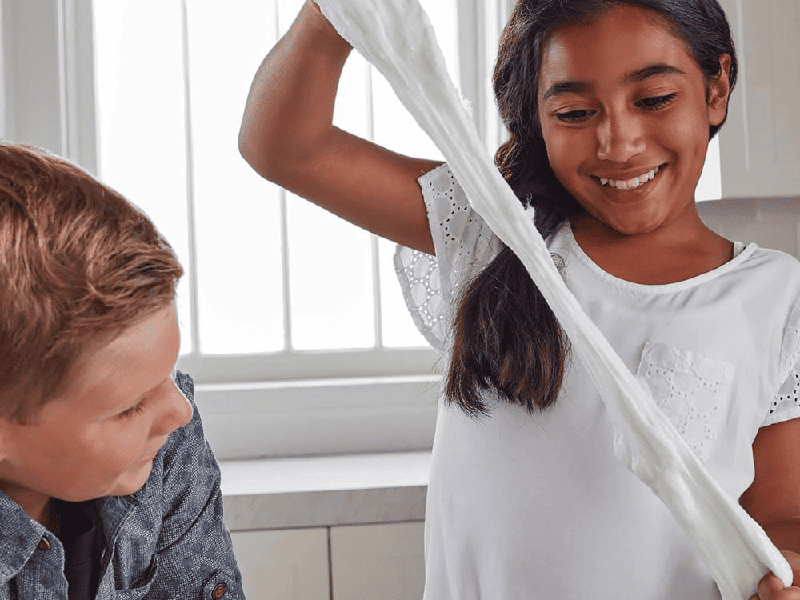
Direct skin contact with Elmer’s Glue is generally safe. The dried glue forms a flexible film that can be peeled off without irritation for most users. This is one reason it’s widely used for crafts, slime projects, and children’s activities.
That said, prolonged skin contact, eye contact, or ingestion should still be avoided. From a manufacturer’s standpoint, Elmer’s Glue is designed for incidental contact, not continuous exposure or industrial handling.
Safety labeling
Safety markings such as “AP Certified,” “Washable,” and “Non-Toxic” are backed by regulatory testing, not just marketing. However, these labels are often misread as a sign of universal suitability.
At GleamGlee, we frequently see returns or complaints where users applied school glue to shoes, fabric, plastic, or outdoor items—then blamed “glue quality” when it failed. In reality, the glue performed exactly as designed. Safety labeling describes who can use it, not what it can fix.
Safety Snapshot: Elmer’s Glue vs. Professional Adhesives
| Feature | Elmer’s Glue | Professional Repair Glue |
|---|---|---|
| Toxicity rating | Non-toxic (ASTM D-4236) | Varies by formula |
| Solvents | None | Often present |
| VOCs | None | Low to moderate |
| Classroom safe | Yes | Usually no |
| Repair durability | Low–moderate | High |

How Does Elmer’s Glue Dry and Cure Step by Step?
Elmer’s Glue dries through water evaporation, not a chemical reaction. As water leaves the glue, PVA polymer particles merge into a solid film that grips porous surfaces. The glue becomes dry to the touch first, then gradually gains holding strength. However, it never chemically “cures,” which is why moisture, heat, and thick application can weaken the bond over time.
Evaporation process
The moment Elmer’s Glue is applied, the drying process begins. Because the formula is water-based, drying depends entirely on how fast water can escape from the glue layer. As water evaporates, PVA particles move closer together and start forming a continuous adhesive film.
In GleamGlee’s internal comparisons, thin PVA glue layers lose 70–80% of free water within the first 30–60 minutes under normal indoor conditions (22–25°C, moderate airflow). This early stage gives the impression that the glue is “dry,” even though internal moisture is still present.
Dry vs cure
A critical point many users miss is the difference between drying and curing. Elmer’s Glue dries when the surface no longer feels wet. Curing, in contrast, would imply a chemical change that permanently hardens the adhesive—something PVA glue does not do.
Because there is no chemical cure, the bond remains thermoplastic. This explains why dried Elmer’s Glue can soften again with heat or prolonged humidity, even days later. From a repair standpoint, this is the biggest limitation compared to professional adhesives.
Full cure time
Although Elmer’s Glue may feel dry within 10–30 minutes, meaningful bond strength usually requires 12–24 hours. Thicker glue layers can take significantly longer because trapped water has no easy escape path.
In real-use testing, GleamGlee engineers observe that overly thick PVA glue joints often fail not immediately, but days later, once pressure or flexing forces moisture back into the bond line. This delayed failure is common in DIY repairs.
Environment factors
Environmental conditions strongly affect drying speed and final strength:
- High humidity slows evaporation
- Low temperatures reduce polymer mobility
- Poor airflow traps moisture
For example, under high-humidity conditions (>70% RH), PVA drying time can increase by 50–100%, leading to weak or inconsistent bonds. This sensitivity is one reason PVA glue performs unpredictably in garages, basements, or outdoor settings.
Thick layers
Applying too much glue is one of the most common mistakes. When a thick layer is applied, the surface dries first and forms a skin, trapping moisture underneath. The result is a bond that looks solid but remains soft internally.
Professional-grade adhesives are often designed to chemically cure through the full bond line, avoiding this issue. Elmer’s Glue is intentionally not engineered this way to preserve safety and washability.
Drying Behavior at a Glance
| Stage | What Happens | Typical Time |
|---|---|---|
| Surface dry | Water evaporates from top layer | 10–30 minutes |
| Handling strength | Partial film formation | 1–4 hours |
| Maximum strength | Most water evaporated | 12–24 hours |
| Moisture sensitivity | Bond can re-soften | Ongoing |
Are All Elmer’s Glue Glues Made of the Same Formula?
No. While most Elmer’s products are PVA-based, their formulas are not identical. School glue prioritizes safety and washability, wood glue increases solids and tack for strength, and clear or washable versions adjust polymer size and additives for appearance or cleanup. None of the modern formulas use milk or casein, but performance varies significantly by use case.
School vs wood
Elmer’s School Glue is engineered for classrooms: easy spreading, low odor, and washability. It typically contains lower PVA solids so it remains flexible and can be cleaned with water before drying. Bond strength is adequate for paper crafts but limited for structural tasks.
Elmer’s Wood Glue, by contrast, raises polymer solids and modifies tack to improve holding power on unfinished wood. In side-by-side shop tests we run at GleamGlee, basic school glue on pine joints shows noticeably more creep under load than wood glue within 24 hours—an expected outcome given the formulation goals.
Added resins
Wood glue formulas often include tackifiers and modified PVA resins to improve initial grab and final strength. These additives help the glue resist joint slippage while clamping and increase dry strength compared to school glue.
However, these are still consumer-grade modifications. Professional wood adhesives often go further—using crosslinking systems that significantly improve water resistance and long-term durability, especially in fluctuating humidity.
Milk-based today
Despite common myths, no modern Elmer’s Glue products are milk-based. Casein glue disappeared from mass-market production decades ago due to spoilage risks, inconsistent performance, and regulatory challenges.
In our discussions with private-label customers, this misconception still appears regularly. The confusion comes from branding history, not from the actual ingredient list. Today’s consistency and shelf life are only possible with synthetic polymers.
Washable clear
Washable and clear glues modify the PVA system further. Washable glue uses polymers that re-dissolve more easily in water, which improves cleanup but lowers moisture resistance after drying. Clear glue uses smaller polymer particles and fewer fillers to dry transparent.
In practical terms, these variants trade strength for convenience. GleamGlee data from consumer feedback shows washable formulas are far more likely to soften or peel when exposed to repeated humidity.
Modified PVA
Across the Elmer’s lineup, all formulas remain within the PVA family. What changes is polymer size, solids content, and additive balance. This approach keeps products safe and familiar but limits how far performance can be pushed.
When repairs demand flexibility, waterproofing, or resistance to heat and stress, manufacturers must move beyond modified PVA entirely—using different polymer chemistries designed for specific materials and environments.
Formula Differences at a Glance
| Product Type | Main Goal | PVA Solids Level | Washability | Typical Use |
|---|---|---|---|---|
| School Glue | Safety & easy cleanup | Low | High | Paper, crafts |
| Clear Glue | Appearance | Low–medium | Medium | Slime, crafts |
| Washable Glue | Easy removal | Low | Very high | Kids’ projects |
| Wood Glue | Higher strength | Medium–high | Low | Indoor wood |
| Professional Glue | Performance | Varies by chemistry | Low | Repair & construction |

How Does Elmer’s Glue Compare to Professional Adhesives?
Elmer’s Glue is designed for safety, simplicity, and classroom use, while professional adhesives are engineered for strength, durability, flexibility, and environmental resistance. The difference is not brand quality—it’s chemistry and purpose. PVA-based school glue bonds mechanically and remains moisture-sensitive; professional adhesives use modified polymers or reactive systems that cure more permanently and survive real-world stress.
Fabric leather comparison
On fabric and leather, Elmer’s Glue performs poorly because PVA dries into a rigid film that does not move with the material. After bending or washing, the bond often cracks or peels. In GleamGlee wear-cycle testing (simulated bending + light moisture), basic PVA bonds on fabric lost over 50% integrity within 10 cycles.
Professional fabric and leather glues are formulated to remain flexible after curing, often using elastomeric polymers. This flexibility allows the bond to stretch with fibers, preserving comfort and appearance. The chemistry is different by design—comfort and movement are priorities, not washability.
Wrong use cases
Many failures blamed on “bad glue” are actually wrong glue choices. Elmer’s Glue is not intended for:
- Shoes and soles
- Plastic or metal repairs
- Outdoor or wet environments
- Load-bearing joints
In GleamGlee customer support data, a large share of negative DIY outcomes involve school glue used on non-porous or high-stress materials. Professional adhesives are selected by material and environment, not by familiarity.
Cow mascot
Questions like “Is the Elmer’s Glue cow married?” highlight how strong brand storytelling can be. The cow symbolizes friendliness and safety—values that matter in schools. But mascots do not change material behavior.
In professional repair and manufacturing, decisions are driven by measurable factors: tensile strength, elongation, water resistance, aging performance. Branding may attract attention, but chemistry determines success.
Branding vs formula
Elmer’s Glue succeeds because it does exactly what it promises: safe, predictable bonding for simple tasks. Problems arise when users expect it to behave like a professional adhesive.
At GleamGlee, we see this contrast daily. When customers switch from school glue to application-specific adhesives, failure rates drop sharply—not because one brand is “better,” but because the formula finally matches the job.
Beyond PVA
Professional adhesives often move beyond PVA entirely, using:
- Modified polymers for flexibility
- Crosslinking systems for moisture resistance
- Reactive chemistries for permanent bonds
These systems cure throughout the bond line, not just at the surface. They are not classroom-safe by default, but they deliver performance that PVA cannot.
Elmer’s Glue vs. Professional Adhesives
| Feature | Elmer’s Glue | Professional Adhesives (e.g. GleamGlee) |
|---|---|---|
| Base chemistry | PVA, water-based | Material-specific polymers |
| Bond type | Mechanical | Mechanical + chemical |
| Flexibility after drying | Low | Medium to high |
| Water resistance | Low | Medium to high |
| Heat resistance | Low | Designed per application |
| Safe for kids | Yes | Usually no |
| Repair durability | Short-term | Long-term |
FAQs
What exactly is Elmer’s Glue made of?
Elmer’s Glue is mainly made of polyvinyl acetate (PVA) and water. PVA is a synthetic polymer that forms a flexible film when water evaporates. Small amounts of stabilizers and preservatives are added to keep the glue smooth, safe, and shelf-stable. Modern Elmer’s Glue contains no milk, no casein, and no animal-derived ingredients.
Is Elmer’s Glue really non-toxic for kids?
Yes, when used as directed. Elmer’s Glue meets ASTM D-4236 safety standards for art materials. It contains no solvents, no VOCs, and no formaldehyde, which is why it’s widely approved for classrooms. That said, “non-toxic” does not mean edible or suitable for all repair jobs—it simply means it’s safe for normal handling.
Why does Elmer’s Glue work on paper but not on plastic or metal?
Because Elmer’s Glue relies on mechanical bonding, not chemical reaction. Paper and unfinished wood are porous, so the glue can penetrate fibers and lock in as it dries. Plastic and metal are smooth and non-porous, so the glue dries as a surface film that peels off easily. This is a material mismatch, not a quality issue.
Was Elmer’s Glue ever made from milk?
Yes—a long time ago. Early glues were often made from casein, a milk protein. That’s where the cow image comes from. Modern Elmer’s Glue has been fully synthetic for decades. Today’s PVA-based formula is more stable, more hygienic, and far safer for mass use than old milk-based glues.
Why is there a cow on Elmer’s Glue bottles?
The cow is a brand heritage symbol, not an ingredient clue. It reflects Elmer’s historical roots in dairy-related industrial products, not the current formula. The cow stays because it signals friendliness and trust—especially to parents and teachers—not because the glue contains milk.
Is the Elmer’s Glue cow married?
No. The cow is simply a mascot. This question shows how strong brand storytelling can be—but mascots don’t affect adhesive performance. When choosing glue for real repairs, chemistry and material compatibility matter far more than branding.
How long does Elmer’s Glue take to dry completely?
Elmer’s Glue usually feels dry within 10–30 minutes, but full strength typically takes 12–24 hours, depending on thickness, temperature, and humidity. Because it dries by water evaporation, thick layers and high humidity can significantly slow the process and weaken the bond.
Is Elmer’s Glue waterproof after it dries?
No. Dried Elmer’s Glue remains moisture-sensitive. Prolonged exposure to water or high humidity can soften the bond. This is one of the main reasons it’s not suitable for outdoor use, shoes, or washable fabrics.
Can Elmer’s Glue be used on fabric or clothes?
It’s not recommended. Elmer’s Glue dries stiff and does not move well with fabric fibers. After bending or washing, the bond often cracks or flakes. For clothing, patches, or flexible materials, fabric-specific adhesives are designed to remain elastic after curing.
What’s the difference between Elmer’s Glue and professional adhesives?
The difference is purpose, not brand quality. Elmer’s Glue prioritizes safety, washability, and ease of use. Professional adhesives—like those developed by GleamGlee—are engineered for specific materials and environments, offering higher strength, flexibility, and resistance to water, heat, and movement.
When should I choose a professional adhesive instead?
If the repair involves:
- Shoes or soles
- Fabric or leather
- Plastic or metal
- Outdoor or wet conditions
- Long-term durability
…then a material-specific professional adhesive is the better choice. Using the right glue from the start saves time, money, and frustration.

Final Call to Action
Elmer’s Glue has earned its place as a safe, accessible, everyday adhesive. But when repairs matter—when durability, flexibility, waterproofing, or professional appearance are required—formula matters more than nostalgia.
GleamGlee develops and manufactures professional-grade adhesives and cleaners for fabric, leather, shoes, wood, plastic, construction, and more.
Whether you’re an Amazon buyer looking for ready-to-ship inventory, or a brand seeking custom formulations, private labeling, or bulk supply, our vertically integrated R&D and manufacturing teams are ready to support you.
Buy GleamGlee products directly on Amazon (FBA-ready)
Request custom adhesive development or wholesale pricing
Choose the adhesive that’s engineered for your real-world needs—not just the one you remember from school.