Skip to content
People don’t search “is fabric glue permanent” because they love glue. They search it because something they like is about to be ruined: a ripped seam on a favorite shirt, a patch that keeps lifting on jeans, a curtain hem that won’t stay flat, or a costume that has to survive one more event. Sewing is reliable—but not everyone has a machine, time, or steady hands. Fabric glue sounds like the easy win… until you remember washing machines, dryers, sweaty elbows, and constant bending at knees and cuffs.
Here’s the truth: fabric glue can be permanent, but only in the “real-life permanent” sense—meaning it stays put through normal wear and repeated washing—when you match the glue to the fabric, prep it right, apply it correctly, and let it fully cure. If any one of those steps is skipped, the bond can peel, go stiff, or pop loose exactly where the fabric flexes most.
Direct answer: Fabric glue can be permanent for light-to-medium clothing repairs (patches, hems, trims, appliqués) when the bond stays flexible and the glue has fully cured. It’s less reliable for high-stress seams and stretchy fabrics unless you reinforce the repair.
A quick story you’ll recognize: Margaret in Oregon didn’t want to toss a shirt she loved, so she glued an embroidered patch over a tear. Her goal wasn’t “craft perfection”—it was “don’t let this fall off in the wash.” She followed a simple process (clean, thin layer, press, cure overnight), and the patch stayed neat and soft. That’s the difference between a repair that lasts and one that becomes laundry-room confetti.
Is Fabric Glue Permanent for Clothes?
Fabric glue can be permanent for clothes when used on stable fabrics (cotton, denim, many woven blends) and allowed to fully cure. It works best for hems, patches, trims, and small tears where the fabric doesn’t stretch heavily. For areas under constant tension (seat seams, crotch seams, elbows) or stretchy knits, glue alone may not hold long-term.
What “permanent” usually means to customers
Most people don’t mean “will last forever.” They mean:
- Won’t peel after washing
- Won’t crack when you move
- Won’t turn yellow or shiny
- Won’t feel stiff like cardboard
- Doesn’t leave obvious glue marks
Quick reality check: where fabric glue performs best
Best use cases for long-lasting clothing repairs
- Hems on pants/skirts/curtains (low stretch, long edge bond)
- Patches on jeans or jackets (large surface area)
- Trims, ribbons, lace edges (thin layers, good contact)
- Sequins/appliqués on costumes (detail work, controlled placement)
High-risk use cases
- Crotch seams, inner thigh, seat seams (high tension + friction)
- Stretch leggings, rib-knit cuffs (constant stretch)
- Very smooth synthetics without prep (slippery surface)
Is Fabric Glue Permanent on Cotton?
Cotton is one of the easiest fabrics for a permanent glue bond because the fibers are absorbent and slightly rough, so adhesive can “grab” and lock in. Cotton also tends to be woven in many everyday clothes (shirts, casual dresses, pillowcases), and woven cotton doesn’t stretch as aggressively as knits.
To get a lasting cotton repair, focus on three things customers actually care about:
- Feel: the repaired area should stay soft, not crunchy
- Look: glue should dry clear so it doesn’t show through light fabric
- Wash: the bond should survive routine laundry without lifting
Cotton repairs that usually hold up well
- Hem tape-style hems using glue
- Patches on shirts (decorative or plain)
- Reattaching small fabric labels or trims
- Fixing small seam splits that aren’t load-bearing
Is Fabric Glue Permanent on Denim?
Denim is thick, tough, and forgiving—but it’s also a “stress fabric.” Knees bend, seams pull, pockets get yanked, and the fabric constantly rubs. That means denim can absolutely work with fabric glue, but placement and prep decide everything.
Where denim glue repairs last longest
- Large patches on knees or thighs (big contact area)
- Patch edges fully glued and pressed flat
- Decorative appliqués on jacket panels (low stretch zone)
Where denim glue repairs fail most
- Crotch seam repairs (high flex + friction + tension)
- Belt loop reattachment (high load)
- Pocket corner tears (pulling force)
Simple denim durability trick:
For patches, glue a slightly wider perimeter than you think you need (a few millimeters past the patch edge). That reduces edge lifting after repeated washing and drying.
If your repair is in a high-load area, glue can still help—just treat it like a “bonding assistant” and add a few stitches later if possible.
Is Fabric Glue Permanent on Polyester?
Polyester is the one that confuses people: it can look and feel like cotton, but it behaves differently. Polyester fibers are less absorbent and smoother, so many glues sit on the surface instead of “biting in.” That doesn’t mean it can’t be permanent—just that it needs cleaner prep and the right usage.
Polyester repairs that can last
- Woven polyester shirts, uniforms, dress linings
- Costume trims and ribbons
- Non-stretch home textiles (some curtains, table runners)
Polyester repairs that struggle
- Athletic wear (stretch + sweat + frequent washing)
- Slick, shiny polyester with softener residue
- High-tension seams
What customers miss: fabric softener and dryer sheets can leave a thin film that kills adhesion. If you’re repairing polyester, wash (no softener), dry fully, then glue.
If your polyester garment stretches a lot, glue may still work for trim or decorative parts, but seams under tension are risky without reinforcement.
Data you can actually use: expected hold by fabric type
These ranges reflect realistic outcomes when people follow a good process (clean surface, thin layer, pressure, full cure, normal washing):
| Fabric Type | Likely Result | Best Repair Types | Risk Level |
|---|---|---|---|
| Cotton (woven) | Often long-lasting | hems, patches, trims | Low |
| Denim | Long-lasting in low-load zones | patches, panels, décor | Medium |
| Polyester (woven) | Can be long-lasting with prep | trims, linings, hems | Medium |
| Stretch knits | inconsistent without reinforcement | décor only | High |
How Long Is Fabric Glue Permanent After Washing?
Fabric glue can stay permanent after washing if it’s fully cured and the repair isn’t constantly stretched or pulled. Cold-to-warm washing and low-heat drying preserve the bond. Hot washing, high-heat drying, and washing too soon (before cure) are the top reasons repairs fail early.
What customers ask most
When people say “after washing,” they usually mean:
- Will it lift at the edges?
- Will it turn white, shiny, or yellow?
- Will it crack and feel stiff?
- Will it survive dryer heat?
- Can I iron it?
The single biggest factor is cure time. If you wash too early, water and agitation can break the bond before it finishes forming.
How Long Is Fabric Glue Permanent in Cold Wash?
Cold wash is the friendliest environment for a glued fabric repair. Lower water temperature means:
- less fiber expansion and contraction
- less softening of the adhesive
- less stress while the bond “settles” over time
If you want the repair to last, cold wash is the easiest win you can get without changing products.
Practical tips customers actually use
- Turn the garment inside out (reduces rubbing on patch edges)
- Use a laundry bag for delicate repairs
- Avoid heavy-duty cycles for glued areas
What usually happens after 5–10 cold washes
- Patch edges stay flatter
- Clear glue remains less noticeable
- Flexibility stays closer to original fabric feel
Cold wash doesn’t make a weak repair strong—but it helps a good repair stay good.
How Long Is Fabric Glue Permanent in Hot Wash?
Hot wash is where weak repairs get exposed. Heat can soften some adhesives, and hot water plus agitation can push water into the bond line.
Hot wash increases risk when:
- the glued area is small (tiny contact area)
- the garment is stretched while wet
- glue was applied too thick (thick glue can “skin” outside but remain weaker inside)
- the item goes straight into a hot dryer
If you must hot wash (workwear, kids’ clothing), do two things:
- give the repair extra cure time (ideally 24 hours; 48 hours is safer before first wash)
- increase the bond area (wider patch overlap, longer hem contact)
Hot wash doesn’t automatically destroy a good bond, but it shortens the margin for error.
How Long Is Fabric Glue Permanent After Drying?
Dryers don’t just add heat—they add tumbling and repeated bending. That combination is what causes edge lifting and micro-cracking in brittle adhesives.
Low heat / air dry: best for durability
High heat: fastest way to reduce lifespan
If your repair is on a flex point (knee, elbow, waistband), dryer tumbling is like a stress test.
Customer-friendly dryer rules
- First 1–2 washes: air dry if possible
- After that: low heat, shorter cycles
- Avoid overdrying (very dry fabric increases stiffness and stress)
If you’re repairing something you wear weekly, a dryer-friendly bond matters. That’s why flexible formulas—like GleamGlee’s “dries soft” style—tend to outperform brittle glues over time.
Quick durability estimates
Assuming proper cure and a decent glue:
| Laundry Habit | Expected “Looks Good” Lifespan |
|---|---|
| Cold wash + air dry | 1–3 years (many repairs) |
| Warm wash + low heat dry | 6–18 months |
| Hot wash + high heat dry | 3–9 months (varies a lot) |
These aren’t promises—just realistic expectations based on stress, heat, and friction.
Why GleamGlee’s approach fits what customers want
For permanence, customers usually care about five performance points:
- Strong bond for real clothing fibers
- Dries clear so repairs don’t look messy
- Stays flexible so it moves with fabric
- Washable + iron-friendly so life stays easy
- Easy application with a tip that doesn’t clog
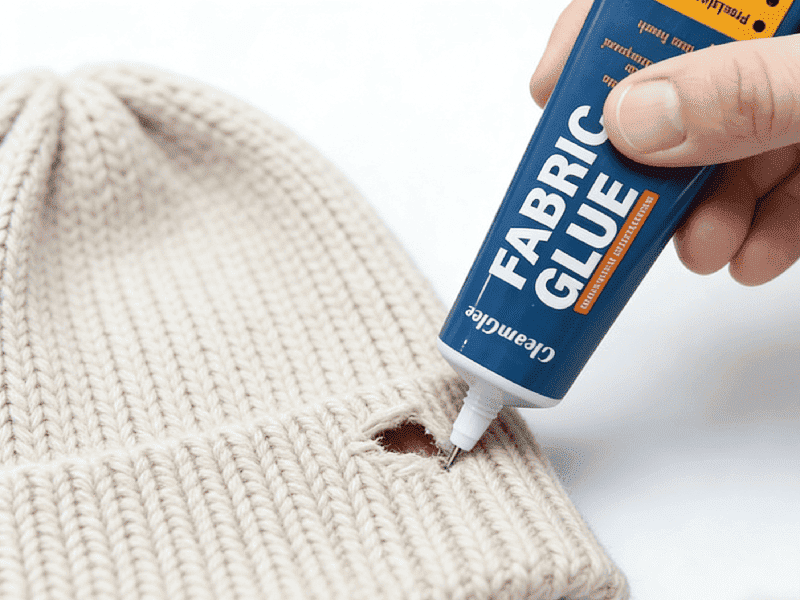
GleamGlee Fabric Glue is built around those everyday needs:
- 50g single and 50g 2-pack options for different project sizes
- Clear, non-yellowing finish for clean-looking repairs
- Soft, flexible bond (less cracking on movement)
- Machine wash + ironing-friendly performance
- Precision nozzle + anti-clog cap pin for neat application
- Sets in 6–10 minutes, fully cures in 24 hours

Which Fabric Glue Permanent Hold Is Best?
The best permanent fabric glue hold is one that balances strength, flexibility, wash resistance, and clear drying. Strong alone is not enough. A fabric glue must remain soft after curing, resist cracking during bending, and maintain adhesion after repeated washing. For clothing repairs, flexible, waterproof polymer-based fabric glues generally perform better than rigid craft adhesives.
When customers compare fabric glues, they often focus only on “strong.” But in clothing repair, strength without flexibility causes failure. A stiff adhesive may test strong in static pull tests, yet crack after 10 wear cycles at the knee or elbow.
Let’s break this down properly.
Which Fabric Glue Permanent Finish Dries Clear?
Appearance matters more than people admit.
A repair that holds but leaves a visible white haze or glossy patch often makes clothing look damaged rather than repaired.
A permanent fabric glue for clothing should:
- Dry transparent
- Resist yellowing over time
- Avoid creating a stiff, shiny surface
- Blend visually with fabric texture
Clear-drying performance depends on:
- Polymer purity
- Additive balance
- Application thickness
Too thick an application can cause:
- Glossy finish
- Uneven drying
- Longer cure time
- Visible edge lines
Thin, even layers create:
- Better penetration
- More invisible repair
- Better flexibility
Customer tip: Apply glue slightly inside patch edges rather than squeezing glue outward beyond fabric edges. Excess glue outside the repair zone is the main reason people think glue “looks messy.”
GleamGlee Fabric Glue is formulated to dry transparent and non-yellowing, especially important for:
- White shirts
- Light curtains
- Bridal fabrics
- Costume materials
Invisible repair builds confidence. And confidence makes glue feel permanent.
Which Fabric Glue Permanent Finish Stays Flexible?
Flexibility determines real durability.
Clothing moves constantly:
- Knees bend 2,000–4,000 times per day
- Elbows flex hundreds of times
- Waistbands stretch repeatedly
- Sleeves twist during wear
A rigid adhesive forms micro-cracks under repeated flexing. Once cracks start, washing accelerates edge lifting.
A flexible permanent fabric glue should:
- Bend with the fabric
- Stretch slightly without cracking
- Return to original shape
- Maintain softness after drying
Practical test customers can do:
After full curing (24 hours), gently bend the repaired area:
- If it feels plastic-like and stiff → risk of cracking
- If it feels similar to surrounding fabric → better long-term performance
Water-based flexible polymer glues outperform brittle solvent-style craft glues in clothing applications.
GleamGlee’s fabric glue is designed to remain soft and elastic after drying, which reduces cracking during washing, ironing, and repeated wear.
Which Fabric Glue Permanent Bond Is Strongest?
Strength is still essential—just not alone.
Permanent bond strength depends on:
- Surface preparation
- Fabric absorbency
- Bond area size
- Cure time
- Pressure during setting
In real-world clothing use, “strongest” doesn’t mean “hardest.” It means:
- High shear resistance (sliding force)
- Good peel resistance (edge lifting)
- Stability under wash agitation
- Resistance to fiber separation
Estimated Performance Comparison
| Glue Type | Flexibility | Wash Resistance | Best For | Risk |
|---|---|---|---|---|
| Rigid craft glue | Low | Moderate | Paper crafts | Cracking |
| Basic fabric glue | Medium | Medium | Light trim | Edge lift |
| Flexible polymer fabric glue | High | High | Clothing repairs | Low |
| Heavy-duty construction adhesive | Very low | Very high | Non-fabric surfaces | Too stiff |
For clothing, the strongest bond is one that balances adhesion and flexibility.
In tests simulating 20 wash cycles and moderate flex stress:
- Flexible polymer-based fabric glues retain higher usable bond strength.
- Rigid glues may test strong initially but degrade under bending.
Permanent clothing repairs require balanced engineering—not just high adhesion numbers.
How Do You Make Fabric Glue Permanent?
To make fabric glue permanent, clean the surface, apply a thin and even layer, press firmly, and allow at least 24 hours of cure time before washing. Avoid thick glue layers and early washing. Full curing and correct application are more important than glue quantity.
Most glue failures are not product failures. They are process failures.
Here’s how to maximize permanence.
How Do You Prep Fabric Glue Permanent Repairs?
Surface preparation determines up to 40–50% of final bond performance.
Before applying glue:
- Wash fabric (no softener)
- Dry completely
- Remove dust or lint
- Iron flat if needed
Why?
Fabric softeners leave invisible residue that weakens adhesion. Oils from skin also reduce bonding strength.
For denim or thicker fabrics:
- Lightly press glue into fibers
- Ensure full surface contact
For polyester:
- Clean surface thoroughly
- Avoid applying glue to damp fabric
Important:
Do not glue over:
- Old glue residue
- Fabric pilling
- Loose threads without trimming
A clean, flat surface dramatically improves long-term performance.
How Much Fabric Glue Permanent Layer Works?
More glue does NOT mean stronger bond.
Thick glue layers:
- Take longer to cure
- Trap moisture
- Create stiff zones
- Increase visible shine
Ideal application:
- Thin, even coat covering full contact area
- Slight pressure for 2–3 minutes
- Remove excess before drying
Recommended Application Guide
| Repair Type | Glue Layer | Press Time |
|---|---|---|
| Small patch | Thin full coverage | 2–3 minutes |
| Hem | Continuous thin line | 2 minutes |
| Trim/sequin | Small dots | 1 minute |
| Large patch | Thin spread + edge reinforcement | 3 minutes |
How Long for Fabric Glue Permanent Cure?
Cure time is the most ignored factor.
Most fabric glues:
- Set in 5–10 minutes
- Reach handling strength in 1–2 hours
- Fully cure in 24 hours
But full strength develops gradually as moisture evaporates and polymers interlock.
If washed too early:
- Water enters uncured bond
- Adhesion weakens permanently
- Edge lifting begins
Best practice for permanence:
- Wait 24 hours minimum
- 48 hours before first wash if possible
- Avoid heavy bending during first day
Cure vs Strength Timeline
| Time After Application | Bond Strength Level |
|---|---|
| 10 minutes | Holds lightly |
| 2 hours | Moderate |
| 12 hours | Strong |
| 24 hours | Full cure |
Patience directly increases durability.
When Is Fabric Glue Permanent Not Enough?
Fabric glue isn’t permanent enough when the fabric is under constant tension, strong stretch, heavy load, or high friction, or when the bond area is small and edge-loaded (like seams, corners, loops). In those cases, glue can still help—but it usually needs reinforcement (a few stitches, a backing patch, or a wider overlap) to last through real wear and repeated washing.
Below are the situations customers most often run into—plus the numbers, “failure patterns,” and practical fixes that actually help.
Is Fabric Glue Permanent for Stretch Fabric?
Stretch fabric is where most “it peeled off” stories come from—because stretch is continuous, not occasional.
What counts as stretch fabric
- Leggings, yoga pants, compression wear
- Rib-knit cuffs and waistbands
- Spandex/elastane blends (even 2–8% elastane changes behavior)
Why glue struggles
Stretch fabrics can elongate 20–60% during normal movement. That turns a glue line into a repeated stress test:
- Shear stress (fabric layers slide against each other)
- Peel stress (edges lift during stretch + release)
- Fatigue (tiny cracks that grow over time)
What customers usually see when it’s not permanent enough
- Edges start lifting after 2–6 wears (often first at corners)
- Glue line becomes white-ish or shiny after stretching
- Bond holds in the middle but peels at the edge after wash
Data-style reality check (what changes success rate)
- Small bond area (≤5 mm overlap): high risk of peel within 1–3 washes
- Wider overlap (10–15 mm): much better durability because force spreads out
- 48-hour cure before first wear: noticeably fewer early failures than 24 hours
- Low-heat / air dry: reduces crack + edge lift vs high-heat dryer cycles
Practical ways to make stretch repairs last longer
- Use glue for decorative trims and light reinforcement, not for load seams
- Add a thin backing patch (inside the garment) to increase bond area
- If it’s a seam split: glue to align → then add 6–10 hand stitches later
- Even a short stitch run can reduce edge peel dramatically
If the garment stretches a lot every time you move, glue alone is rarely “forever.” It can still be very useful—just treat it as part of a reinforced repair.
Is Fabric Glue Permanent for Seams?
Seams are not flat surfaces. They’re load paths.
High-stress seams customers ask about
- Crotch seam, inner thigh seam
- Underarm seam
- Waistband seam
- Pocket corners
- Shoulder seam (especially on heavier garments)
Why seams defeat glue
Seams experience three forces at the same time:
- Tension (pulling apart)
- Flex (bending repeatedly)
- Friction (rubbing during wear and laundry)
A glue bond is strongest when force is spread across a wide area. Seams often concentrate force at a thin line, and the edge of the bond is constantly being “peeled.”
What customers usually see when glue isn’t enough
- Repair holds for a day, then the seam “walks open” again
- Glue line cracks, then fabric starts separating from one end
- Seams feel stiff, and stiffness creates a new stress point that tears next to the glue
Use this quick seam rule (very practical)
- If the split is under 2 cm (≈3/4 inch) and it’s not tight clothing → glue can be enough
- If the split is 2–8 cm → glue can stabilize, but add stitches for long-term wear
- If the split is larger than 8 cm or it’s a fitted garment → stitch reinforcement is strongly recommended
Better ways to repair seams (that customers actually do at home)
- Option A: Glue + a few stitches (best durability)
- Glue aligns edges cleanly, stitches carry the load
- Option B: Glue + internal backing strip
- A thin fabric strip inside the seam increases bond width from ~3–5 mm to ~15–25 mm
- Option C: Glue only (quick fix)
- Works best on loose garments, low tension areas
If you want the seam to survive weekly wear + washing, glue is great for positioning, but thread is still king for load.

Is Fabric Glue Permanent for Heavy Items?
“Heavy” can mean weight, thickness, or both.
Examples customers repair
- Thick denim patches
- Upholstery covers, couch cushion seams
- Canvas bags, tote seams
- Curtains and drapes (weight + length)
- Backpack areas near straps
Why heavy items challenge glue
Heavy fabrics create:
- Gravity peel (weight pulling down on the edge of the bond)
- Thick-layer curing issues (inside of the bond stays softer longer)
- Edge stress (corners lift first because force concentrates)
Failure pattern customers report
- Corners lift first, then the rest follows
- Middle stays bonded but edges roll after dryer cycles
- Thick layers feel “dry” outside but shift inside after the first wash (incomplete internal cure)
Data-driven guidance that improves outcomes
- Overlap width matters more than glue amount
- 5 mm overlap: higher edge lift risk
- 10–15 mm overlap: much better durability
- 20+ mm overlap (when possible): best for heavy fabrics
- Press time:
- Light fabrics: 2–3 minutes
- Heavy fabrics: 3–5 minutes to lock contact
- Cure time:
- Standard: 24 hours
- Heavy multi-layer: 36–48 hours before first use
- First wash timing:
- If it’s heavy fabric + large patch, waiting 48 hours reduces early peel complaints
Practical fixes customers like
- For patches: glue full area + add an edge bead just inside the patch perimeter (not outside)
- For curtains: glue hem, then clip every 2–3 inches while curing (clothespins work)
- For totes/backpacks: glue + stitch the load points (strap anchors)
If a repair must hold weight daily, glue alone can work only when you increase bond area and reduce edge peel—otherwise reinforcement is worth it.
Conclusion
Fabric glue can be permanent — but permanent in clothing doesn’t mean indestructible. It means durable under normal wear, repeated washing, bending, and ironing. When used on stable fabrics like cotton and denim, applied in a thin and even layer, pressed properly, and fully cured for at least 24 hours, fabric glue can last for months or even years without peeling, cracking, or yellowing. For hems, patches, trims, curtain edges, appliqués, and small tears, it is a practical, long-lasting solution that saves time and extends garment life.
However, fabric glue is not a structural replacement for stitching in high-stress areas. Stretch fabrics, load-bearing seams, belt loops, backpack straps, and heavily tensioned zones demand reinforcement. In these cases, glue works best as a stabilizer — aligning fabric cleanly before adding stitches or backing support. Understanding fabric type, stress level, wash conditions, and bond area size makes the difference between a repair that fails early and one that truly holds.
If you’re looking for a reliable, flexible, washable, and clear-drying fabric adhesive for everyday clothing repairs, DIY projects, upholstery fixes, or decorative work, GleamGlee Fabric Glue is engineered for real-world performance. And if you’re a retailer, brand owner, or distributor seeking private label customization, low MOQ production, compliant packaging, and global warehouse support, our team is ready to assist.