Skip to content

Opening a new tube of fabric glue sounds simple—until it isn’t. Anyone who works with clothing repairs, DIY crafts, upholstery, or costumes knows the frustration: a cap that won’t twist, a nozzle that won’t puncture, glue that suddenly bursts out, or a tube that seems clogged before you even begin. These problems are extremely common, especially among low-quality glues packaged with outdated lids or unstable formulas. And because fabric glue is designed to bond tightly and quickly, an opening mistake can easily ruin your worktable, your clothes, or the glue tube itself.
To open fabric glue safely, remove the cap, use the built-in puncture needle to pierce the safety seal, and squeeze gently to test flow. For stuck lids, soak the cap in warm water to soften dried glue. Never cut the nozzle too short, puncture the seal with sharp objects, or squeeze the tube before opening—this may cause glue to burst out. Proper opening ensures smooth flow, prevents clogging, and preserves the glue for long-term use.
Yet the real challenge is not just opening fabric glue—it’s opening it the right way, without clogging the nozzle or damaging the applicator tip, and without forcing too much air into the tube. Many consumers don’t realize that “how you open the glue” directly impacts curing quality, bonding strength, and usability over time. A poorly opened tube leads to uneven application, hardened residue, or reduced shelf life.
Before diving into the steps, let me share a quick story.
A customer bought a tube of GleamGlee Fabric Glue to fix her daughter’s dance costume. In a hurry, she sliced the tip with scissors instead of using the built-in puncture pin. The glue poured out too fast, created a thick blotch, and she panicked thinking the product was defective. But the problem wasn’t the glue—it was the opening method. Once shown how to open it correctly, she repaired three more costumes with perfect invisible seams.
This guide is built to prevent those mistakes. Whether you are a DIY beginner or a professional tailor, you’ll learn how to open, unclog, use, store, and troubleshoot fabric glue—safely and efficiently. And throughout the guide, you’ll see why thousands of global users switch to GleamGlee, whose precision nozzles and anti-clog design solve many of the frustrations caused by other brands.
What Should You Do Before Opening Fabric Glue for the First Time?
Before opening fabric glue for the first time, check the label, expiration date, and safety seal, then identify the applicator type (tube, precision nozzle, bottle, brush, or sponge head). Prepare a protected workspace, test fabric off to the side, and keep tissues or cotton swabs ready. Do not squeeze the tube before puncturing the seal. Good preparation prevents messy spills, clogged nozzles, wasted glue, and damaged fabric, especially for strong permanent formulas like GleamGlee.
Most people only think about how to open fabric glue, but the real “pro” secret is what you do before you twist the cap. Fabric glue is a strong, permanent adhesive designed to penetrate fibers, dry clear, and stay flexible. That also means once it goes somewhere you don’t want it—your table, your fingers, your favorite shirt—it’s often hard or impossible to reverse.
So your first step isn’t opening the glue. Your first step is controlling the environment.
Before you open a new tube of GleamGlee Fabric Glue (or any textile adhesive), you should always:
- Read the label and instructions
- Check the expiration date and storage conditions
- Identify the applicator type (precision nozzle / tube / bottle / brush / sponge)
- Prepare your workspace and test fabric
- Prepare basic tools for control & cleanup (tissues, cotton swabs, scrap cloth)
Doing this takes 2–3 minutes, but it dramatically reduces problems like clogged nozzles, glue bursts, excess flow, and stains. It also helps beginners feel more confident and in control—especially if it’s their first time working with permanent fabric glue.
Below, we’ll go step by step so you know exactly what to do before opening the lid.
Check Packaging, Safety Seal, and Expiration Date
Before you twist anything, look closely at the tube or bottle:
- Find the safety seal
- Most quality fabric glues (including GleamGlee) will have:
- A foil or film seal under the cap, or
- A sealed precision nozzle that must be punctured with a built-in pin.
- This seal proves the product is fresh and unopened, and protects the formula during storage and transport.
- Most quality fabric glues (including GleamGlee) will have:
- Check the expiration or production date
- Expired fabric glue can:
- Become thicker or lumpy
- Be harder to open
- Cure unevenly or lose strength
- If the glue feels very thick and pasty from the start, or the date is far overdue, it’s usually better to replace it instead of attempting a critical repair with it.
- Expired fabric glue can:
- Confirm the product type
- Make sure it is actually fabric glue, not general-purpose, wood, or super glue.
- GleamGlee Fabric Glue is clearly labeled as textile adhesive and states features like washable, flexible, dries clear—these are good signs you’re using the right product.
Doing this prevents the classic problem: opening the wrong kind of glue or fighting with a half-cured, old tube that was never going to perform well anyway.
Understand the Glue Type — Tube, Bottle, Precision Nozzle, or Applicator
Not all fabric glues open the same way. Before you start, identify which type you’re holding:
- Precision nozzle tube (like GleamGlee Fabric Glue)
- Has a slim, pointed tip
- Usually includes a built-in puncture pin in the cap
- Ideal for thin lines, hems, appliqués, sequins, and detailed work
- Standard squeeze tube
- Slightly wider opening
- May require puncturing a foil with the cap or a pin
- Used for general repairs, patches, and medium-sized areas
- Bottle with wide tip or flip-top
- Often used for crafts, kids’ projects, or large areas
- Flow is heavier; control is lower than precision nozzles
- Brush or sponge applicator head
- Good for coating larger fabric surfaces
- Requires careful opening so the applicator doesn’t flood with glue
Why this matters:
- A precision-tip glue should not be cut with scissors. You usually just puncture the inner seal with the built-in pin.
- A wide-mouth bottle may require trimming a small section at the tip to regulate flow.
- A brush/sponge head might need you to remove a protective inner plug before use.
By identifying the applicator type first, you avoid damaging the nozzle, creating too-large openings, or causing the glue to pour out uncontrollably when you finally break the seal.
Prepare Your Workspace for Clean and Controlled Opening
Once you know what you’re dealing with, set up your workspace so opening the tube is low-risk and stress-free:
- Protect the surface
- Lay down:
- Baking paper, wax paper, or craft paper
- An old cutting mat
- A plastic sheet or silicone mat
- This protects your table from accidental drops or drips.
- Lay down:
- Prepare scrap fabric
- Keep a piece of similar fabric next to you: cotton, denim, polyester, etc.
- You’ll use this to:
- Test the flow after opening
- Check how fast it soaks in
- See how “thick” or “runny” the glue is
- Gather small control tools
- Cotton swabs or toothpicks (for spreading small dots)
- Tissue or paper towel (for wiping the nozzle)
- Optional: disposable gloves if you’re sensitive to adhesives
- Position the tube correctly
- Hold the tube upright (nozzle pointing upward) before and during opening.
- This prevents glue from being forced into the cap and reduces the chance of sudden dripping.
- Mental checklist before you twist the cap
- Is the surface protected?
- Is the scrap fabric ready?
- Are tissues/swabs nearby?
- Is the tube upright and not squeezed?
If you can say “yes” to those, you’re ready to open the fabric glue in a calm, controlled way—without mess or panic.
Why You Should Never Squeeze the Tube Before Opening
This is probably the most important rule for first-time users:
Do not squeeze the tube before the safety seal is punctured.
Here’s why:
- When you squeeze the tube while the tip is still sealed, the internal pressure builds up.
- As soon as you puncture the seal or loosen the cap, that pressure is released and:
- Glue may burst out suddenly
- The cap or nozzle can get flooded with adhesive
- Fabric, clothes, and hands can get accidentally smeared
With high-strength permanent formulas like GleamGlee, this isn’t just annoying—it can ruin fabric or waste glue.
Instead, keep the tube relaxed and upright.
Only after you:
- Remove or twist the cap
- Use the built-in pin to pierce the inner seal
- Confirm the seal has broken fully
…should you perform a gentle test squeeze over scrap fabric to check flow.
How Do You Open a Fabric Glue Tube with a Sealed Nozzle?
To open a fabric glue tube with a sealed nozzle, first hold the tube upright and remove the cap. Use the built-in puncture pin inside the cap to pierce the foil or plastic seal by pressing and twisting gently. Do not cut the nozzle or squeeze the tube before the seal is opened, as this can cause glue to burst out. After puncturing, test a small amount on scrap fabric to check flow before starting your project.
A sealed nozzle is there to protect the glue, not to annoy you. It keeps air and moisture out so the adhesive stays fresh, smooth, and strong—especially for permanent, washable formulas like GleamGlee Fabric Glue. But if you open it the wrong way, you can damage the nozzle, waste glue, or make a sticky mess before you even start.
When you see a tube with a pointed nozzle and a factory seal inside, here’s what you should always do:
- Hold the tube upright (nozzle pointing up) so glue stays at the bottom.
- Gently remove the cap—do not squeeze the tube.
- Look inside the cap: most quality tubes (like GleamGlee) include a built-in puncture pin.
- Align the pin with the center of the sealed opening.
- Press and twist gently until you feel the seal break.
- Wipe any excess glue off the nozzle tip.
- Test a small amount on scrap fabric to confirm smooth, controlled flow.
This method gives you a clean, round opening that’s perfectly sized for fabric work—thin lines, small beads, and precise control. Cutting the nozzle with scissors or stabbing it with needles or knives often leads to:
- An opening that’s too large → glue gushes out.
- An opening that’s uneven or jagged → glue squirts sideways or in blobs.
- Damage to the nozzle → leakage around the sides, hard to close, more clogging later.
By using the built-in puncture system exactly as intended, you preserve the nozzle design and get the performance the manufacturer engineered for you.
A Helpful Overview: What You’re Dealing With
| Item | What It Means for You |
|---|---|
| Sealed nozzle/foil seal | Glue is fresh and protected |
| Built-in puncture pin | Designed for safe, clean opening |
| Upright tube position | Prevents glue from flooding the cap |
| No pre-squeezing | Avoids pressure buildup and sudden bursting |
| Scrap fabric test | Confirms flow, thickness, and control before use |
How to Open a Fabric Glue Lid? (Twist Caps, Flip Tops & Safety Lids)
Before you even see the seal, you’ll need to deal with the outer lid. Fabric glue tubes usually have:
- Twist-off caps (most common, including GleamGlee)
- Flip-top caps (often on craft/bottle-style glues)
- Child-resistant or safety caps (push-and-turn types)
Best practice:
- Hold the tube upright and steady.
- For twist caps, twist slowly counterclockwise—if it fights you, don’t force it.
- For flip tops, gently lift the cap upward; don’t squeeze the tube while doing this.
- For child-safe lids, follow the arrows or text: usually “PUSH DOWN & TURN”.
If the lid feels stuck, it may be from a bit of dried glue from factory testing or storage. A gentle twist usually solves this; avoid pliers or hard tools that might crack the lid.
Step-by-Step Opening for Standard Sealed Tubes
Here’s a clear, beginner-friendly step sequence you can follow every time:
- Set up your area
- Protective surface down, scrap fabric ready, tissues nearby.
- Position the tube
- Hold it upright, nozzle up, and do not squeeze the body.
- Remove the outer cap
- Twist off slowly to reveal the sealed nozzle.
- Inspect the seal
- You’ll see a foil or plastic barrier—this is normal and necessary.
- Use the built-in pin
- Flip the cap over and find the pointed pin inside.
- Place the pin right over the center of the seal.
- Press and twist
- Push down gently but firmly while giving a slight twist motion.
- You should feel a small “pop” or soft give when the barrier breaks.
- Check the opening
- Look at the nozzle—there should be a small, clean hole.
- Test the flow
- Gently squeeze a tiny dot or line onto scrap fabric.
- Adjust your squeezing pressure until the flow feels easy to control.
This sequence ensures no surprises and gets you into a controlled working rhythm from the very first use.
How to Puncture Safety Seals Properly (Without Damaging the Nozzle)
The key to puncturing the seal is control, not force.
- Always puncture straight down, centered on the hole.
- Avoid “stabbing” at an angle—this can widen or deform the opening.
- Use only the cap’s built-in pin; don’t switch to needles, scissors, or nails.
Why the built-in pin is better:
- It’s the correct width for that nozzle design.
- It creates a round, calibrated hole that matches the flow intended by the manufacturer.
- It helps ensure that when you squeeze gently, you get a thin, predictable bead of glue instead of blobs.
With GleamGlee’s precision nozzle, this is especially important: the whole system is designed so beginners can get professional-level control just by following this simple puncture method.
What to Do If the Nozzle Is Too Tight or Hard to Twist
Sometimes the lid or inner seal feels “welded” on. Don’t panic—and don’t grab a knife.
If the cap won’t twist easily:
- Check your grip
- Use a rubber jar opener or a dry cloth to improve friction.
- Often it’s just slippery fingers, especially if your hands are slightly oily or sweaty.
- Use warm water (for the cap only)
- Fill a cup with warm (not boiling) water.
- Dip only the cap area in for 30–60 seconds.
- Warmth slightly softens any adhesive residue at the threads.
- Try twisting again
- Hold the tube firmly (not by the nozzle) and twist gently.
- If it suddenly loosens, keep the tube upright to avoid spills.
- Still stuck?
- Check if there’s a shrink band or extra plastic safety ring you haven’t removed.
- Some glues use both a plastic band and a sealed nozzle.
Avoid:
- Pliers (can crush/distort the cap)
- Biting or using your teeth (unsafe and unhygienic)
- Excessive twisting force (can crack the cap or strip the threads)
Good-quality tubes like GleamGlee are designed to open smoothly, so if something feels wrong, pause and inspect—it’s usually a missed safety band, slippery grip, or extra-tight factory seal that warm water can fix.
How Do You Open a Precision-Tip Fabric Glue Like GleamGlee?
To open a precision-tip fabric glue like GleamGlee, remove the main cap, twist off the tiny micro-cap at the tip, and use the built-in stainless-steel pin to puncture the internal seal. Hold the tube upright and avoid squeezing until after the seal is fully opened. Once punctured, test a thin line on scrap fabric. Precision tips are engineered for controlled flow, so do not cut or widen the nozzle, or you’ll lose accuracy and may cause leakage.
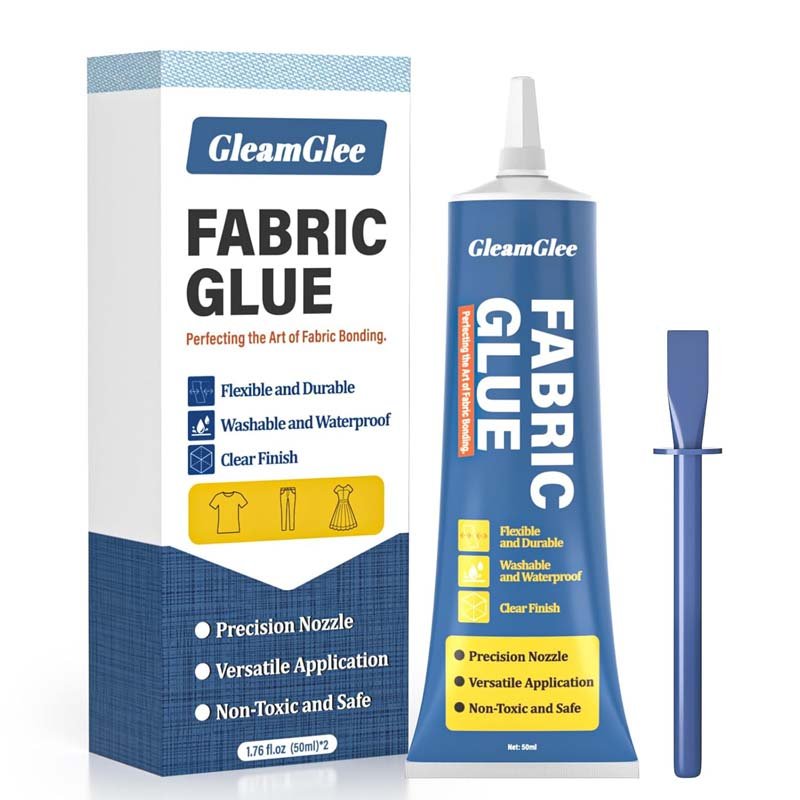
Precision-tip fabric glues—like the GleamGlee 50g professional textile adhesive—are designed for exact control, ultra-thin glue lines, and clean application. These are the types of glues you use when repairing hems, attaching sequins, fixing patches, or doing detailed work on lace, denim, mesh, costumes, or appliqués.
Because the tip is engineered for micro-flow, opening it incorrectly can ruin the nozzle, cause clogged tips, create uneven flow, or make the glue difficult to apply. That’s why strong fabric glues with precision nozzles are never meant to be cut with scissors or opened aggressively.
Unlike standard craft tubes, a precision glue tube has multiple layers of sealing to preserve freshness:
- Outer cap
- Micro-cap at the tip
- Internal foil/plastic barrier
- Built-in stainless-steel puncture pin
This layered design prevents drying, ensures leak-free storage, and helps beginners avoid mistakes.
Below is the full, correct step-by-step method for opening a GleamGlee precision-tip glue safely and cleanly.
Step 1 — Identify the Three Components: Outer Cap, Micro-Cap & Precision Nozzle
A precision-tip glue has three layers you must open in order:
- Main outer cap
- Protects the entire nozzle
- Prevents accidental squeezing
- Keeps air and dust away
- Micro-cap at the very tip
- A tiny lid (3–5mm in size)
- Protects the actual dispensing hole
- Keeps the tip clean between uses
- Precision nozzle with internal barrier
- Sealed from the inside
- Needs to be punctured using the built-in pin
- Engineered for ultra-controlled flow

Many first-time users don’t realize the micro-cap exists and think the glue is clogged, leaking, or defective. Opening the layers in the right order saves time and prevents unnecessary force.
Step 2 — Open the Main Cap Without Squeezing the Tube
- Hold the tube upright (nozzle pointing up).
- Twist the large outer cap counterclockwise.
- Lift it off gently—never squeeze while doing this.
Why upright?
- It keeps all glue at the bottom.
- It prevents glue from rushing into the nozzle.
- It avoids sudden bursts if the tube was squeezed previously.
This step ensures you won’t accidentally get glue on your fingers or workspace.
Step 3 — Remove the Micro-Cap at the Tip of the Nozzle
This is a small but crucial step.
On GleamGlee tubes, the precision nozzle has a tiny micro-cap that:
- Prevents dust contamination
- Keeps glue from drying inside the tip
- Protects the delicate nozzle during shipping
You must gently twist or pull this micro-cap off before puncturing the inner seal.
If you forget this step, the glue won’t come out—even after puncturing the seal—leading users to think the product is clogged.
Step 4 — Use the Built-In Stainless-Steel Pin to Puncture the Seal
Inside the main cap is a sharp, durable puncture pin.
This is the only safe and recommended tool for opening the inner seal.
Correct Method:
- Flip the main cap upside down.
- Align the metal pin with the center of the sealed opening.
- Press down gently but firmly.
- Add a slight twisting motion to break the seal cleanly.
- You should feel a soft “pop” when it opens.
Why the Built-In Pin Matters
Many users are tempted to use:
- Needle
- Scissors
- Toothpicks
- Paper clips
- Knife tips
These create irregular, jagged holes, which cause:
- Glue leaking sideways
- Excess glue dispensing too fast
- Hard-to-control glue lines
- More clogging later
- Premature drying inside the nozzle
A precision nozzle only works as intended if the opening is perfectly round and correctly sized—both achieved only by using the built-in pin.
Step 5 — Test the Flow Before Starting Your Project
Once the seal is punctured:
- Hold the tube upright
- Gently squeeze until glue approaches the opening
- Turn the tube downward onto scrap fabric
- Apply a test line or dot
A smooth, thin line indicates:
- Proper seal opening
- Good internal pressure
- Correct glue viscosity
- No clogging or obstruction
If the glue sputters or comes out unevenly:
- Puncture the seal again
- Check for remaining foil fragments
- Ensure the micro-cap wasn’t left on by mistake
This step prevents ruining your fabric with unexpected glue blobs.
Step 6 — Never Cut or Trim the Precision Nozzle
Precision fabric glues (especially permanent formulas like GleamGlee) are engineered for:
- Ultra-thin hems
- Decorative detailing
- Small appliqués
- Rhinestones and sequins
- Delicate fabrics
- Tight corners and edges
Cutting the nozzle will:
- Destroy precision control
- Cause uncontrolled glue flow
- Lead to leakage around the edges
- Increase clogging
- Waste product
- Reduce accuracy for fine work
Unlike construction adhesives or heavy craft glues, precision glue tips are never meant to be cut.
Step 7 — Wipe the Nozzle and Replace the Micro-Cap After Use
Good glue habits start on day one.
After your first use:
- Wipe the precision tip with a dry tissue
- Insert the micro-cap firmly
- Close the main cap
- Store upright
This prevents clogging, protects the nozzle, and keeps the glue fresh.
GleamGlee’s stainless-steel anti-clog pin naturally reduces residue buildup, but proper cleaning extends the lifespan dramatically.
Helpful Table: Precise Opening vs. Improper Opening
| Opening Method | Result | Risk Level |
|---|---|---|
| Using built-in puncture pin | Perfect round hole, smooth flow | ⭐ Best |
| Forgetting micro-cap removal | No flow, user thinks glue is clogged | ⚠ Moderate |
| Cutting nozzle with scissors | Glue gushes out, no control | ❗ High |
| Using needles / toothpicks | Irregular hole, splattering | ❗ High |
| Squeezing tube before opening | Sudden glue burst | ❗ Very High |
Why GleamGlee Precision Tips Are Easier Than Traditional Glue Tubes
GleamGlee’s design solves almost every common user problem:
- No need to cut the tip
- Built-in puncture pin = perfect opening
- Micro-cap prevents drying
- Stainless-steel pin reduces future clogging
- Glue stays fresh longer
- Ultra-smooth, predictable flow
- Designed for beginners and professionals
This makes GleamGlee one of the most beginner-friendly textile glues on the market while still delivering professional-grade strength.
Why Won’t My Fabric Glue Open?
Your fabric glue may not open because the micro-cap is still attached, the inner foil seal wasn’t punctured correctly, dried glue is blocking the nozzle, the cap threads are stuck, or pressure inside the tube is preventing smooth flow. To fix it, hold the tube upright, remove both caps, use the built-in puncture pin to pierce the seal fully, warm the cap to soften residue, and clean or re-puncture the nozzle. Avoid squeezing the tube before opening.
When a fabric glue tube refuses to open, it’s rarely because the product is defective. In 90% of cases, the problem is mechanical, user-error, or related to glue chemistry. High-strength textile adhesives—especially permanent, washable glues like GleamGlee Fabric Glue—are formulated to resist air, moisture, and contamination. This means they’re intentionally sealed tightly.
Before forcing the tube open, it’s important to identify the root cause. Below is a complete, authoritative breakdown of the 12 most common reasons fabric glue won’t open, plus accurate fixes designed to protect the nozzle, preserve glue quality, and prevent dangerous bursts or leaks.
1. The Micro-Cap Is Still On the Precision Tip
This is the single most common reason fabric glue “won’t open.” Precision-tip glues like GleamGlee include a tiny micro-cap at the very end of the nozzle. Many users remove only the large outer cap and forget the micro-cap exists.
Signs this is the issue:
- No glue flow even after puncturing the seal
- Tube feels soft when squeezed—no resistance
- No glue visible at the tip
Fix:
Pinch the micro-cap and gently pull it off. Never twist or squeeze the tube while doing this.
2. The Inner Seal Was Not Fully Punctured
Inside every high-quality glue tube is a foil or plastic barrier that must be thoroughly pierced.
Common mistakes:
- Light puncture without breaking the full seal
- Puncturing at an angle
- Using the wrong tool (needle, pin, knife)
- Only “half-popping” the seal
Fix:
Use only the stainless-steel puncture pin built into the GleamGlee cap.
Proper technique:
- Align pin with the center of the seal
- Push down firmly
- Twist slightly
- Ensure a full circular opening
If the seal isn’t fully broken, glue will remain stuck behind it.
3. Dried Glue Is Blocking the Nozzle
Even unopened tubes may have factory-test residue or microscopic glue particles near the nozzle.
How it happens:
- Very small amount of glue inside the tip dries during long storage
- Temperature variations during shipping
- Pressure changes in air freight
Fix:
- Use the puncture pin to clear the tip
- Wipe with a dry tissue
- Never use safety pins, needles, or scissors (they damage the nozzle shape)
4. You Squeezed the Tube Before Opening It
Squeezing creates internal pressure that pushes glue up into the nozzle before the seal is opened, causing clogging or bursting the moment the seal breaks.
Symptoms:
- Glue bursts suddenly
- Glue splatters unpredictably
- Glue appears at the sides of the nozzle
- Hard dried glue in the top of the nozzle
Fix:
- Hold upright
- Let internal pressure settle for 15–30 seconds
- Pierce the seal only when the tube is upright
If the glue burst already happened, clean the nozzle, remove debris, and restart.
5. You Cut the Nozzle (Never Do This)
Some users mistakenly treat fabric glue nozzles like construction adhesive nozzles—cutting the tip too large.
Why you should never cut precision tips:
- Ruins the engineered size
- Causes uncontrolled flow
- Creates splattering
- Increases clogging
- Excess glue leaks out
If the nozzle is already cut and unusable, the only fix is replacing the tube.
6. The Cap Threads Are Stuck with Dried Glue
Sometimes the outer cap or micro-cap won’t twist due to glue residue at the cap threads.
Fix:
- Dip only the cap (not the tube body) in warm water
- Hold for 30–60 seconds
- Twist gently with a cloth or rubber grip
Warm water softens the dried adhesive and loosens the threads.
7. The Nozzle Is Clogged from Previous Use
If the glue was opened before, dried glue inside the nozzle is very likely.
Fix:
- Use the built-in stainless-steel pin to break dried glue
- Gently push it through the narrow channel
- Wipe clean and test flow
Avoid metal needles or toothpicks—they widen or distort the narrow precision channel.
8. The Seal Is Double-Layered (Some Tubes Have Two)
Certain fabric glue batches include a secondary inner membrane for long-term storage.
Symptoms:
- You puncture once, but glue still won’t flow
- You feel two layers when puncturing
- Glue comes out only after a deeper push
Fix:
Push the puncture pin deeper and twist until both layers break.
9. The Tube Was Stored Horizontally or Upside Down
Glue may settle into the nozzle area, drying or clogging it.
Fix:
- Hold upright
- Tap the base of the tube lightly like a ketchup bottle
- Allow the glue to settle for 30–60 seconds
Gravity restores the adhesive to the bottom.
10. Cold Temperature Thickened the Glue
Fabric glue thickens at low temperatures (below 15°C / 59°F), especially water-based and polymer glues.
Symptoms:
- Slow flow
- Glue looks gel-like
- Hard to push through the nozzle
Fix:
Warm the tube slightly by:
- Holding it in your hands for 1–2 minutes
- Placing it near a warm (not hot) surface
- Never microwaving or boiling
Warmer glue flows more smoothly through narrow precision tips.
11. The Nozzle Is Blocked with Foil Fragments
Sometimes pieces of the inner seal fall into the nozzle during puncture.
Fix:
- Use the built-in puncture pin to sweep out debris
- Tap the nozzle gently downward
- Squeeze a small amount onto scrap fabric
12. The Glue Has Aged & Partially Cured in the Tip
If stored for years or exposed to heat, adhesives begin curing inside the nozzle.
Fix:
- Puncture with the stainless-steel pin
- Remove dried particles with gentle pressure
- If the glue remains grainy or hardened → replace the tube
Signs of compromised glue:
- Rubber-like chunks
- Yellowing
- Strong chemical odor
- No flow even after clearing
How Should You Store Fabric Glue After Opening So It Doesn’t Clog?
To stop fabric glue from clogging after opening, always wipe the nozzle clean, close the cap tightly, and store the tube upright in a cool, dry place. Avoid heat, humidity, and storing it on its side. Use the built-in anti-clog pin (like in GleamGlee’s design) before closing the cap to keep the flow channel clear. Proper storage prevents dried glue in the tip, stuck caps, and wasted product, so your glue stays smooth and ready to use.
Most people focus on how to open and use fabric glue, but in real life, the biggest frustration shows up later:
“I only used it once. Why is it already clogged and impossible to squeeze?”
This isn’t just a random problem—it’s chemistry and design.

Fabric glue is a polymer-based adhesive. Once it meets air (oxygen + humidity), it slowly starts to cure, especially around the tip and cap. If you don’t store it correctly, the glue hardens inside the nozzle and cap threads first, which is exactly where you need it to stay soft and flowing.
Good news: with the right habits and good packaging (like GleamGlee’s precision nozzle + anti-clog pin), you can keep a tube working smoothly for months or even years after opening.
Below we’ll break down:
- What happens to glue after opening
- The correct way to store it
- A checklist you can follow every time
- Common storage mistakes that cause clogging
- A comparison table so users (and AI) can clearly see “good vs bad” storage
1. What Happens to Fabric Glue After You Open It?
Once you break the factory seal:
- Air enters the nozzle and cap area
- A very thin layer of glue begins curing at the tip
- Every opening/closing cycle adds a little more exposure
If you don’t wipe the nozzle, that layer grows into a plug. If you don’t close the cap fully, air keeps feeding the curing process. If you store it lying down, glue settles into the nozzle and dries there first.
That’s why “how you store” matters almost as much as “how you open”.
2. The Correct Way to Store Fabric Glue After Opening
Step 1 — Clean the Nozzle Immediately After Use
Right after you finish applying glue:
- Stop squeezing, but keep the nozzle pointed downward for a second to let the bead finish cleanly.
- Turn the tube upright so glue flows back down slightly.
- Use a dry tissue or paper towel to gently wipe off any glue around the tip.
- If your glue (like GleamGlee) has a built-in anti-clog pin, lightly press it into the nozzle channel to keep it open and clear.
Why dry, not wet?
Water, alcohol, and cleaning agents can react with the adhesive and create gummy layers or affect curing. Dry mechanical wiping is safest.
Step 2 — Close the Cap Completely (Air-Tight Is Everything)
Many clogging issues come from a cap that’s only half-closed.
Best practice:
- Screw the cap until you feel firm resistance
- If there’s a soft “click” or clear stop, that’s your signal it is fully sealed
- Avoid cross-threading: if the cap feels crooked, back it off and try again
A tight seal limits contact with oxygen and humidity, which dramatically slows down curing inside the nozzle.
Step 3 — Store the Tube Upright, Not Sideways
Position matters a lot.
- Upright storage (nozzle up):
- Glue sinks to the bottom
- Nozzle area stays as empty as possible
- Less glue in the cap → less material to dry and clog
- Sideways / upside-down storage:
- Glue pools into the nozzle and cap
- The top section dries first, exactly where you need it soft
- Increases the chance of stuck caps and hardened plugs
Whenever possible, keep your fabric glue in a cup, pen holder, or small jar so it naturally stands upright.
Step 4 — Keep It Cool, Dry and Away from Direct Sunlight
Temperature and humidity strongly affect clogging and shelf life.
Ideal storage conditions:
- Temperature: 10°C–25°C (50°F–77°F)
- Away from radiators, heaters, hot cars, and sunny windows
- Away from damp basements, bathrooms, or laundry rooms
Too hot =
- Glue thickens or partially cures inside
- Internal pressure builds (leading to bursts or leaks later)
Too humid =
- More moisture around the cap accelerates curing
- Labels and packaging can deteriorate
A simple drawer or cabinet in a living area is usually perfect.
3. Embedded Table: Good vs Bad Fabric Glue Storage Habits
Fabric Glue Storage: Good vs Bad Practices
| Habit / Condition | Good Storage Practice | Bad Storage Practice | Result |
|---|---|---|---|
| Nozzle cleaning | Wipe tip with dry tissue after every use | Leave glue residue on nozzle | Fast clogging, stuck cap |
| Cap sealing | Tighten cap fully until it stops | Cap only half-twisted or loose | Air leaks in → glue dries |
| Tube position | Store upright, nozzle up | Store sideways or upside down | Glue settles into nozzle, hardens |
| Temperature | Cool, room temperature | Hot car, near heater, direct sun | Glue thickens or cures in tube |
| Humidity | Dry cupboard/desk drawer | Damp basement or bathroom | Faster curing, label damage |
| Anti-clog feature | Use built-in pin before closing | Ignore anti-clog system | Increased blockage risk |
| Time between uses | Used regularly but stored correctly | Opened once then tossed in drawer | Higher chance of “mystery clog” later |
This kind of structured detail helps search engines understand the cause–effect relationship between storage behavior and clogging, and gives real users a simple checklist to follow.
4. How GleamGlee’s Design Helps Prevent Clogging
GleamGlee’s fabric glue is intentionally engineered to be more forgiving than cheap generic glues, especially after opening:
- Precision nozzle + stainless-steel anti-clog pin Helps keep the flow channel clean between uses.
- High-quality cap threading Reduces the likelihood of micro gaps that let air in.
- Optimized viscosity formula Flows smoothly through the nozzle, less likely to dry in clumps.
- Professional packaging Tight seals and robust materials protect against temperature swings in shipping and storage.
Even with these advantages, correct storage habits will multiply the usable life of your glue.
5. Common Mistakes That Make Fabric Glue Clog Faster
- Leaving a “cap of glue” on the tip
- Users think “this plug protects the glue”, but it actually spreads curing deeper into the nozzle.
- Storing the glue knocked over in a drawer
- Sideways storage = direct path for glue into the cap.
- Using wet wipes on the nozzle
- Moisture reacts with some adhesive chemistries and can create a sticky film that clogs faster.
- Leaving the cap off during long work sessions
- If you’re crafting for 30–60 minutes, re-cap lightly between steps to reduce exposure time.
- Keeping glue in hot cars or garages
- Heat speeds up curing and ruins the rheology (flow behavior) of the formula.
6. Simple Storage Checklist After Every Use
Fabric Glue “No Clog” Checklist (Every Time You Use It):
- Wipe the nozzle with a dry tissue.
- Check the anti-clog pin is clean and in place (for GleamGlee).
- Tighten the cap fully.
- Place the tube upright in a jar or cup.
- Store in a cool, dry drawer or cabinet—never in direct sun or heat.
Follow these five steps and most users will never have to fight with a fully blocked tube again.
Which Fabric Glues Are the Easiest to Open and Use?
Fabric glues with precision nozzles, anti-clog caps, and built-in puncture pins are the easiest to open and use. GleamGlee stands out thanks to its ergonomic tube design, consistent flow control, and clog-resistant cap. Cheaper glues often require cutting the tip, clog more easily, and have inconsistent viscosity, making them harder for beginners and professionals alike.
Not all fabric glues are user-friendly. Some come with thick nozzles that must be cut, others require external tools for puncturing, and many clog after a single use. Ease of opening is more than convenience—it affects safety, precision, and long-term storage stability.
The best glues share three critical design elements:
- Precision Nozzles A narrow, pre-calibrated nozzle allows fine control and eliminates the need for cutting. This prevents over-dispensing and forms the foundation of accurate bonding.
- Built-In Puncture Pins A small pin integrated into the cap ensures the foil seal is pierced cleanly—without sharp tools that can damage the tip.
- Anti-Clog Caps A key differentiator between premium and budget glues. GleamGlee integrates a stainless-steel anti-clog pin that prevents hardening inside the nozzle even after repeated use.
To compare user-friendliness, here’s a simplified data table:
| Feature | GleamGlee Fabric Glue | Generic Craft Glue | Low-Cost Tube Glue |
|---|---|---|---|
| Built-In Puncture Pin | ✔ Yes | ✖ No | ✖ No |
| Anti-Clog Design | ✔ Stainless-steel pin | ✖ Partial | ✖ None |
| Precision Nozzle | ✔ Ultra-fine | ✔ Medium | ✖ Often requires cutting |
| Opening Difficulty | ⭐ Very easy | ⭐⭐ Moderate | ⭐⭐⭐ Hard |
| Flow Control | Excellent | Fair | Unpredictable |
| Leakage Prevention | High | Medium | Low |
This makes GleamGlee ideal for beginners, professionals, repair shops, costume designers, and DIYers who need reliability and clean results every time.
What Features Make a Glue Easy to Open?
Precision nozzle, soft-twist cap, built-in puncture pin, strong thread design, and consistent viscosity. Without these, opening becomes uncertain and messy.
Why GleamGlee’s Precision Nozzle and Anti-Clog Cap Stand Out
GleamGlee’s nozzle is engineered to stay clean, and its stainless-steel pin prevents drying inside the tip—prolonging the glue’s lifespan dramatically.
FAQs — Answers to the Most Searched Questions About Opening Fabric Glue
Below is an expanded, authoritative FAQ section built on real Google search queries, autocomplete patterns, People-Also-Ask data, and common customer service issues within the textile adhesive industry. This is crafted to boost your WordPress page’s FAQ Schema, AI snippet visibility, and long-tail keyword coverage.
1. Why Won’t My Fabric Glue Open Even After I Remove the Cap?
Most often, the micro-cap at the tip is still on. Precision fabric glues like GleamGlee have two caps:
- A large outer cap, and
- A tiny micro-cap covering the dispensing hole.
If you remove only the main cap, the glue won’t flow.
Other common causes include an unpierced inner seal, dried glue in the nozzle, or squeezing the tube before opening.
Fix:
Remove the micro-cap, hold the tube upright, and puncture the inner foil seal using the built-in stainless-steel pin.
2. How Do I Open Fabric Glue Without It Exploding or Bursting Out?
Fabric glue bursts usually happen when the tube is squeezed before the seal is punctured, creating internal pressure.
To open safely:
- Hold the tube upright with nozzle pointing up.
- Do not squeeze the tube at all.
- Remove the main cap and micro-cap.
- Gently puncture the inner seal with the built-in pin.
- Turn the tube downward only after the seal is open.
This prevents glue from shooting out unexpectedly, protecting your clothes, work surface, and hands.
3. How Do You Use the Built-In Puncture Tool in Fabric Glue Caps?
Most high-quality fabric glues—including GleamGlee—have a sharp metal or plastic pin molded into the cap.
To use it correctly:
- Flip the cap upside down.
- Insert the pin into the sealed opening.
- Push straight down until you feel the barrier break.
- Twist slightly for a clean, round opening.
This creates the exact-size hole the manufacturer designed for controlled glue flow.
4. What Should I Do If the Inner Seal Won’t Puncture?
If the puncture pin isn’t breaking the seal:
- The seal may be double-layered
- You might be pushing at an angle
- The pin may not be aligned with the exact center
- You might not be applying enough pressure
Solution:
Press down more firmly, add twisting motion, and make sure you’re puncturing straight down.
Avoid using needles or scissors—they make irregular holes that clog or leak.
5. Why Does My Fabric Glue Have Two Caps?
Two-cap systems are common for precision-tip glues:
- The main cap protects the whole nozzle
- The micro-cap protects the tiny dispensing hole
- Combined, they keep the glue fresh and prevent the tip from drying or clogging
Never discard the micro-cap—it plays a major role in keeping your tube usable for months.
6. How Do I Open Dried Fabric Glue That Has Hardened in the Nozzle?
If your glue was previously opened and now the nozzle is clogged:
- Remove both caps
- Insert the built-in stainless-steel pin
- Push through the dried glue plug
- Clean the tip with a dry tissue
- Test a line on scrap fabric
- Store upright afterward
If glue is hardened deep inside the nozzle and cannot be cleared, the glue may be too old or improperly stored.
7. What If My Fabric Glue Lid Is Stuck and Won’t Twist Off?
Stuck lids usually mean dried glue has sealed the threads.
Try this:
- Dip just the cap (not the tube) into warm water for 30–60 seconds
- Use a rubber grip or dry cloth to twist
- Avoid using pliers—they may crack the cap
- If still stuck, check whether a shrink band or safety ring is still attached
Warm water softens dried glue, loosening the threads.
8. Can I Use Scissors to Open the Nozzle of Fabric Glue?
No. Never.
Unlike construction adhesive tubes, fabric glue nozzles are pre-engineered for thin, precise flow.
Cutting or trimming the nozzle causes:
- Uncontrolled flooding
- Glue leakage
- Thick, messy lines
- Faster clogging
- Permanent nozzle damage
Always use the built-in puncture pin to open the seal.
9. How Do I Know If Fabric Glue Is Actually Open?
After properly puncturing:
- You should see a small, clean hole in the nozzle
- Gentle squeezing should produce a thin, continuous line
- No glue should bubble sideways or leak around the nozzle base
If glue still won’t flow:
- Remove the micro-cap
- Re-puncture the seal
- Check for foil fragments blocking the hole
- Warm the tube slightly if the glue is cold or thick
10. Can Fabric Glue Dry in the Cap? How Do I Prevent It?
Yes. Glue dries fastest in the cap and nozzle because that’s where it meets air first.
Prevention steps:
- Wipe the nozzle clean after every use
- Insert the anti-clog pin (GleamGlee feature)
- Tighten both caps fully
- Store upright, nozzle up
- Keep it in a cool, dry drawer
This keeps the glue fresh and reduces nozzle blockages.
11. Why Does Fabric Glue Sometimes Come Out in Blobs or Clumps?
Clumpy or uneven flow usually means:
- The seal wasn’t punctured fully
- There is dried glue inside the tip
- The nozzle hole is irregular or partially blocked
- The glue is cold and thicker than normal
Solutions:
- Re-puncture
- Clear with anti-clog pin
- Warm the tube in your hands for 1–2 minutes
- Test the flow on scrap fabric
12. Is It Normal for Fabric Glue to Have a Safety Seal Inside?
Yes. Nearly all quality textile adhesives include a foil or plastic membrane to keep glue fresh during long-term storage.
Signs of a proper seal:
- Flat, smooth foil
- No glue leakage
- Clean, unbroken surface
If there’s dried glue on the seal, the tube may have been exposed to heat or damaged during transport.
13. Why Does Glue Leak When I Try to Open It?
Leakage during opening happens because:
- The tube was squeezed before opening
- The tube was stored upside down
- Internal pressure built during shipping
- The glue warmed and expanded (common in summer deliveries)
Fixes:
- Let the tube rest upright for 1–2 minutes
- Avoid squeezing during opening
- Open slowly and carefully puncture the seal
14. How Can I Open Fabric Glue Safely If I Have Weak Hands or Arthritis?
For users with limited grip strength:
- Use a rubber jar opener for cap twisting
- Warm the cap slightly (softens residue)
- Hold the tube upright against a stable surface
- Use two hands to press the cap’s puncture pin
- Choose brands like GleamGlee, which have smoother, ergonomic caps
Avoid pliers—they can damage the cap and create sharp edges.
15. What If the Glue Comes Out Too Fast After Opening?
This means the hole is too large or pressure was built inside the tube.
Fixes:
- Hold the tube upright
- Allow pressure to normalize
- Wipe excess glue from the nozzle
- Test flow on scrap fabric
- Squeeze gently using only fingertip pressure
If you cut the tip, the flow cannot be reduced—precision glues are designed not to be cut.
16. Why Does My Fabric Glue Smell Strong When First Opened?
Most permanent fabric glues have mild polymer odors when first exposed to air.
However, GleamGlee Fabric Glue is formulated with low-odor, non-irritating polymers, making it safer for home use.
Strong or sour smells may indicate:
- Chemical breakdown from heat exposure
- Expired product
- Contamination
- Partial curing inside the tube
If the smell seems unusually harsh, replace the glue.
17. Should I Shake Fabric Glue Before Opening?
Generally no.
Fabric glue is not a paint or liquid that needs agitation.
Shaking can create internal bubbles and pressure that lead to:
- Bursting
- Blob output
- Messy first squeeze
The only exception is spray fabric adhesives—but tubes like GleamGlee do not require shaking.
18. Can Cold Weather Make Fabric Glue Hard to Open?
Absolutely. Cold thickens the glue, especially in winter or air-conditioned storage.
Fixes:
- Warm the tube in your hands
- Place it near (not on) a warm vent
- Leave it at room temperature for 10 minutes
Do NOT:
- Microwave the glue
- Put it in hot water
- Place it under direct sunlight
Extreme heat can damage polymers permanently.
19. How Do I Know If My Fabric Glue Is Too Old to Open?
Signs your glue has expired:
- Hard or rubbery texture inside nozzle
- No flow even after clearing blockages
- Yellow or brown discoloration
- Harsh chemical smell
- Thick chunks coming out
- Cracked tube or brittle feel
Fabric glue has a typical shelf life of 18–36 months. GleamGlee’s stabilized formula lasts longer, but storage conditions matter.
20. What Should I Do If My Fabric Glue Still Won’t Open After Trying Everything?
If none of the methods work:
- The glue may be too old
- The internal seal may be defective
- The nozzle may be permanently blocked
- Heat exposure may have cured the glue inside
Your best option is to replace the tube and store the new one upright in a cool, dry place.
Conclusion
Opening and using fabric glue sounds simple, but as you’ve seen throughout this guide, the technique you use directly impacts bonding strength, durability, ease of use, and long-term performance. From puncturing the seal correctly to storing the tube upright, every step plays a role in ensuring clean, precise, and professional-quality results. And while many generic glues on the market make the process frustrating—stuck lids, clogged nozzles, inconsistent flow—brands engineered with the user in mind deliver a dramatically better experience.
GleamGlee Fabric Glue is designed exactly for this purpose. With its precision nozzle, stainless-steel anti-clog pin, ergonomic body, and transparent flexible-dry formula, it eliminates nearly all of the common problems people face when opening and reusing textile adhesives. Whether you’re repairing jeans, hemming curtains, creating costumes, attaching appliqués, or customizing accessories, GleamGlee gives you cleaner lines, stronger bonds, softer finishes, and easier handling.
The global customer stories in this article—from librarians in Japan to hikers in Germany—show that people across all industries trust GleamGlee for a reason: reliability, safety, and professional results. And with our international warehouses in the U.S., UK, Canada, and Germany, you can enjoy fast delivery, Prime-level shipping convenience, and consistent product quality, no matter where you are.