 Skip to content
What Is the Best Glue for Leather Bag Repair?
A leather bag is not a static object. It bends, warms up in your hand, rubs against clothing, and often carries conditioners or waxes that make bonding harder. That’s why many “quick fixes” look fine for a day and then lift again—especially on edges, piping, and strap tabs where stress is constant.
The best glue for leather bag repair is usually a flexible, clear-drying leather adhesive—not a brittle instant glue. For edge lifts and trim, choose a flexible contact-style bond that stays bendable. For small seams, use a precise, low-soak adhesive applied in thin coats. For strap tabs and high-stress points, prioritize flexible strength plus longer clamp time and full curing. Clean/degrease first, apply minimal glue, press firmly, and let it cure 12–24 hours.
- Which glue type matches your repair scenario (with a selection table)
- How leather finishes and oils change adhesion
- A workshop-style process: prep → apply → clamp → cure → cleanup
- Mistakes that ruin repairs (and how to fix them)
- A decision checklist you can follow in minutes
Why This Repair Needs the Right Glue
Leather bags combine flexible materials, coatings, stitching tension, and daily movement. The wrong adhesive can turn rigid, whiten, or peel because it can’t handle bending and oils. Understanding why repairs fail helps you choose a glue that stays bonded and looks natural.
Why leather bag repairs are different from “normal” gluing
1.Leather moves (flex + shear stress)
Edges, piping, and strap tabs repeatedly bend. If an adhesive cures hard like glass, micro-cracks form, then the edge lifts again.
2.Leather often has surface oils, waxes, and conditioners
Even “clean-looking” leather can hold invisible residues that block bonding. Many repair failures come from skipping degreasing or gluing over conditioner.
3.Many bags have coatings and edge paint
Coated leather can be smooth and non-porous. Edge paint can be brittle and already failing underneath. You may need light keying (gentle abrasion) and removal of loose edge paint for a stable bond.
4. Appearance matters
A repair that holds but looks cloudy, shiny, or stained is still a failure—especially on dark leather, glossy finishes, or luxury-style bags.


Common failure stories
“It bonded, then peeled in a week.”
Usually oil contamination, weak pressure time, or wrong adhesive for flex.
“It dried white/cloudy.”
Common with brittle or incorrect adhesives and certain finishes.
“It soaked in and left a dark mark.”
Too much glue on absorbent leather, suede-like finishes, or unsealed edges.
“The edge feels stiff and sharp now.”
Adhesive cured too hard or glue applied too thick.
Key Factors to Choose the Right Glue
Instead of searching for the “strongest” glue, choose the adhesive profile that matches leather movement, finish type, and repair location. Use these factors as a quick diagnostic framework so you can pick a glue that bonds cleanly and stays flexible over time.

The 9 factors that matter most
1. Common failure stories
- Good: remains slightly rubbery or flexible
- Bad: cures rigid and brittle (cracks when bent)
2. Clear-drying + non-whitening
- Prioritize adhesives designed to dry clear and stay clear.
- Always test on a hidden area if the bag is dark, glossy, or coated.
3. Viscosity + flow control
- Edges/trim: medium body helps create an even bond line
- Seams/tiny lifts: controlled, precise flow prevents mess
- Too runny = seepage and staining. Too thick = messy ridges.
4. Open time
- More open time helps alignment for long edges and piping.
- Too fast makes misalignment and uneven edges more likely.
5. Bond to coated leather
- Some coatings need light keying to bond reliably.
- If you cannot safely key the surface, choose the safest minimal method and clamp longer.
6. Water + heat resistance
- Bags encounter humidity, rain, hand warmth, and car interiors.
- Choose adhesives with reasonable moisture/heat tolerance for daily use.

7. Rework tolerance
- Some adhesives allow easier cleanup; others set and become difficult to remove.
- If appearance is critical, choose an approach that supports clean edges and minimal squeeze-out.
8. Repair size + stress level
- A 1 cm edge lift ≠ a strap tab tear.
- The higher the stress, the more you need longer clamp time and full cure.
9. Leather type
- Smooth/coated: better for controlled bonding
- Suede/nubuck: high risk of dark spots; minimal adhesive only
- PU or coated synthetic: may need different prep and gentle abrasion
Glue Types & Best Uses
Different repairs demand different adhesive behavior. This section clarifies which glue styles match leather bag problems—edge lifts, seams, tabs, lining, and trim—while highlighting “avoid” choices that commonly cause whitening, stiffness, staining, or early peel.
Practical guidance: what “glue style” means here
- Flexible leather adhesive (general): stays bendable, good appearance
- Contact-style flexible bond: strong along edges/trim when pressed properly
- Precision low-soak adhesive: minimal seepage for seams and small gaps
- Brittle instant adhesive (avoid for flex zones): can crack/whiten
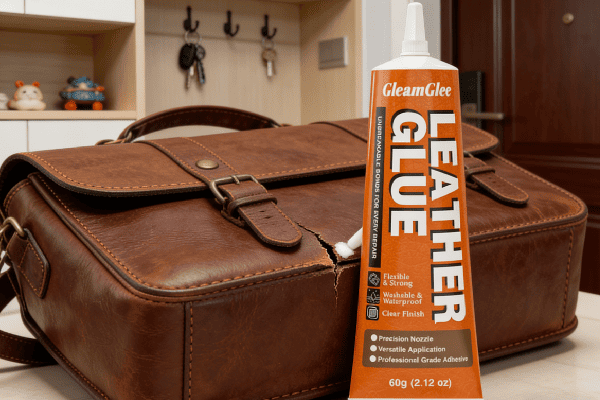
Best Glue Style by Repair Scenario
| Repair Scenario | Stress Level | Recommended Adhesive Profile | Why It Works | Avoid |
|---|---|---|---|---|
| Edge paint lifting / edge trim peeling | High (daily flex) | Flexible, clear-drying; contact-style press bond | Stays bendable; bonds evenly along edge | Brittle instant glue; thick blobs |
| Piping / binding separation | High | Flexible contact-style bond + careful alignment | Long seam needs even bonding and press | Fast-grab glues that misalign |
| Small seam separation (non-structural) | Medium | Precision, low-soak flexible adhesive (thin coat) | Prevents seep-through; neat repair line | Runny glue; over-application |
| Strap tab loosening (load-bearing) | Very high | Flexible strong adhesive + longer clamp/cure | Needs pressure and time to hold load | “5-second fixes” |
| Lining edge lifting (fabric-to-leather) | Medium | Flexible multi-material adhesive, thin coats | Reduces bleed-through and ripples | Thick glue that causes bumps |
| Decorative patch re-bond | Low–Medium | Clear flexible adhesive, controlled placement | Appearance matters; minimal squeeze-out | Anything that cures shiny/white |
| Small corner peel (coated leather) | Medium | Flexible adhesive + light keying if safe | Coatings can be slick; keying improves grip | Gluing over oils/no prep |
Leather Type Risk Notes
| Leather / Surface | Risk Level | What to Watch | Best Practice |
|---|---|---|---|
| Smooth finished leather | Low–Medium | Surface oils, edge paint cracks | Degrease well, thin coats, clamp evenly |
| Coated/glossy leather | Medium–High | Poor adhesion without keying | Gentle keying on bond zone + longer clamp |
| Suede / nubuck | High | Dark spots, stiffness, visible marks | Use minimal adhesive; test first; avoid large-area gluing |
| PU / synthetic leather | Medium | Top layer may resist some glues | Light keying + thin coats; avoid harsh solvents |
Workshop-Style Leather Bag Repair Workflow
This module compares adhesive types specifically in the context of cotton fabric, focusing on flexibility, wash durability, visual impact, and real-world use conditions. The goal is not to rank products, but to match adhesive behavior to cotton scenarios.
Tools and setup
- Lint-free cloth + cotton swabs
- Gentle cleaner + a finish-safe degreasing step
- Fine abrasive (800–1200 grit) or gentle pad (for bond zone only)
- Clips/clamps + protective paper/card to prevent marks
- Tape to mark alignment (optional but helpful)
Step 1 — Diagnose the repair
Ask three questions:
- Where is the stress? (edge/piping/tab = high stress)
- What is the surface? (smooth vs coated vs suede-like)
- How clean is it really? (conditioner/wax residue is common)
Step 2 — Dry-fit and plan alignment
- Before applying adhesive, press the lifted area into place and confirm it sits flat.
- Use small pieces of tape as alignment markers for long edges or piping.
Step 3 — Clean and degrease correctly
- Clean dust and grime first.
- Then degrease the bond zone lightly.
- Let it dry fully before adhesive (moisture + oils reduce bond strength).
Step 4 — Light keying
- For coated/glossy surfaces, very gentle abrasion on the bond zone only improves grip.
- Do not abrade visible panels; keep keying confined to the hidden mating area.
Step 5 — Apply adhesive in thin, even coats
- Use a precision tip or toothpick for narrow edges.
- Apply the minimum needed to wet the surface—avoid puddles.
- For longer edges, work in sections to maintain control.
Step 6 — Press, then clamp with protection
- Press firmly for initial contact.
- Clamp with protective paper/card to prevent indentations.
- Use even pressure; too much pressure can squeeze glue out and starve the bond.
Step 7 — Respect clamp time and full cure
- Small edge lifts: often 30–60 minutes clamp, then rest.
- High-stress areas: longer clamp and 12–24 hours cure before use.
- Avoid bending the repair during early cure.
Step 8 — Clean up squeeze-out safely
- Prevention is best: thin coats reduce squeeze-out.
- If cleanup is needed, do it gently and early when possible.
- Never aggressively scrape coated leather—finish damage is permanent.
Process Timing & Control
| Repair Type | Clamp Time (Typical Range) | Full Cure (Practical Range) | Notes |
|---|---|---|---|
| Small edge lift | 30–60 min | 12–24 hrs | Avoid flexing during cure |
| Piping/binding | 1–3 hrs | 24 hrs | Work in sections for alignment |
| Seam gap (small) | 30–90 min | 12–24 hrs | Precision application matters |
| Strap tab (high stress) | 4–8 hrs | 24+ hrs | Consider reinforcement if load-bearing |
Troubleshooting: Why Repairs Fail And How to Fix Them
When a leather repair fails, it usually fails for predictable reasons: contamination, wrong adhesive behavior, poor pressure time, or early handling. Use this section as a diagnostic guide: identify the failure mode, then apply the corrective action so your second attempt holds and looks cleaner.
Failure mode 1: Peels cleanly like tape
Likely cause: oils/conditioners/wax; poor degreasing; bonding to a slick coating
Fix: re-clean + degrease; consider gentle keying on bond zone; clamp longer.
Failure mechanism 2: Smooth surfaces provide low mechanical grip
Likely cause: adhesive cured too hard/brittle; wrong glue for flex zones
Fix: switch to a flexible adhesive profile; keep glue thin; allow full cure.
Failure mode 3: White/cloudy residue or haze
Likely cause: incompatible adhesive, over-application, or finish reaction
Fix: test on hidden area next time; use thinner application; prioritize clear-drying non-whitening profiles.
Failure mode 4: Dark stains or soak-through
Likely cause: too much glue on absorbent material (especially suede/nubuck)
Fix: minimal adhesive, spot-test, and avoid large-area bonding on suede-like finishes.
Failure mode 5: Clamp marks / dents
Likely cause: clamping directly on leather or uneven pressure
Fix: always use protective paper/card; reduce pressure; use wider clamps for distributed force.
“Quick save” actions
- If misaligned, correct immediately during open time—don’t “force it later.”
- If squeeze-out appears, remove gently early if the adhesive permits safe cleanup.
- If the area is high stress, extend clamp time and postpone use for a full day.

How Does GleamGlee Approach Leather Bag Repairs in Real-World Use?
A reliable leather repair is a system: diagnose the finish, match a flexible adhesive profile, control flow, standardize clamp time, and confirm cure before use. As an adhesives and repair-focused brand, GleamGlee designs products and instructions to make repairs repeatable and clean for everyday users.
How we think about “best glue” for leather bags
1. Start with the failure risks, not marketing claims
We prioritize real failure points we see repeatedly:
- Leather oils and conditioners blocking adhesion
- Coated finishes reducing grip
- Flex zones cracking hard adhesives
- Messy squeeze-out ruining appearance
2. Match adhesive behavior to repair physics
Edges/piping: need flexible, uniform bonding along a line
Seams: need precision, low soak, neat appearance
Tabs/strap anchors: need flexible strength + longer pressure and cure
This is why a one-size-fits-all recommendation often disappoints.
3. Make application controllable for normal users
The practical difference between “works” and “looks professional” is control:
- thin coats instead of blobs
- precision placement on narrow edges
- predictable open time for alignment
- clear clamp and cure guidance
4. Capability context
GleamGlee operates as a consumer brand across major e-commerce platforms and maintains an in-house R&D and design capability to optimize formulas, packaging, and user instructions for real repair scenarios.
What Else Should You Know Before Gluing a Leather Bag?
These FAQs address what people ask most before repairing a leather bag: glue choice by scenario, safety on finishes, clamp and cure times, cleanup, and when DIY is not recommended. They’re written to be actionable—so you can decide quickly and reduce risk.

1. What glue is best for leather bag edge repair?
A flexible, clear-drying leather adhesive is usually best because edges flex constantly. The key is thin application and firm, even pressure so the bond line stays smooth.
2. Can I use super glue (instant glue) on a leather bag?
It’s risky on edges, piping, and straps because it can cure hard and crack. It may also whiten on some finishes. If appearance and flexibility matter, choose a flexible leather-appropriate adhesive profile.
3. How long should I clamp a leather bag repair?
Clamp time depends on stress level. Small edge lifts often need 30–60 minutes; strap tabs and high-stress points may need several hours. Regardless, wait 12–24 hours before heavy use to allow full cure.
4. Do I need to sand leather before gluing?
Not always. On coated/glossy surfaces, gentle keying on the bond zone can improve adhesion. Avoid abrading visible panels—only the hidden contact area.
5. How do I prevent glue squeeze-out from ruining the look?
Use thin coats and press evenly. Dry-fit first so you don’t need to slide pieces around after glue. If squeeze-out happens, handle cleanup early and gently based on the adhesive’s safe cleanup method.
6. Will glue stain leather or darken it?
It can, especially on absorbent leathers and suede/nubuck. Always spot-test on a hidden area and use minimal adhesive.

7. What if the repair peels again after a few days?
That usually indicates contamination (oils/conditioners), insufficient clamp time, or wrong adhesive behavior (too brittle). Re-prep thoroughly, consider gentle keying for coated finishes, and extend clamp time.
8. Can I glue leather to fabric lining inside a bag?
Yes, but apply thin coats to prevent seep-through and ripples. Use gentle pressure and allow full cure before stuffing the bag.
9. Is the repair waterproof?
Many flexible adhesives resist moisture once cured, but “waterproof” depends on the bond line, leather finish, and cure time. Avoid water exposure during the first day after repair.
10. When should I avoid DIY and use a professional repair service?
If the bag is high value, the damage is structural (large tears, major panel separation), the finish is delicate, or you need hardware replacement or re-stitching, a professional repair may be safer.
11. What’s the safest approach for luxury-style coated leather?
Minimal intervention: careful degreasing, controlled thin coats, and longer clamp time. Spot-test first and keep all prep limited to the hidden bonding zone.
12. How can I make a repair look “invisible”?t?
Control the bond line: thin adhesive, clean alignment, even pressure, and full cure before handling. Most “visible repairs” come from excess glue and rushed alignment.
Leather Bag Repair Checklist: How Do You Pick the Best Glue Fast?
This is your fast decision system. Use it before you glue anything: identify the leather and stress level, choose the correct adhesive profile, and follow the prep–press–cure rules. It reduces the two biggest risks: visible marks and early peel.
A) 2-Minute Diagnosis Checklist
- Leather type: smooth / coated-glossy / suede-like / PU
- Damage type: edge lift / piping / seam gap / tab/strap anchor / lining
- Stress level: low (decor) / medium (seam) / high (edge/piping) / very high (strap tab)
- Contamination risk: recently conditioned? waxed? handled often?
- Appearance sensitivity: dark leather, glossy finish, luxury-style bag
B) Pre-Repair Preparation Checklist
- Dry-fit the lifted area so you know the final position.
- Protect surrounding areas (optional: low-tack tape).
- Clean visible dirt, then degrease bond zone lightly.
- Allow full drying time.
- If coated/glossy, consider gentle keying on hidden bond zone only.
- Prepare clamps and protective paper/card before applying glue.

C) Adhesive Profile Selector
| If your repair is… | And the surface is… | Choose an adhesive that… | Your main priority |
|---|---|---|---|
| Edge/trim lift | Smooth leather | Dries clear + stays flexible | Flex durability + clean look |
| Edge/trim lift | Coated/glossy | Bonds well to low-porosity + allows alignment | Adhesion + longer clamp |
| Seam gap (small) | Smooth/semicoated | Is precise + low-soak | Neat line + no seepage |
| Strap tab loosening | Any | Provides flexible strength + needs longer clamp | Load durability |
| Lining separation | Fabric + leather | Works multi-material + thin coats | No bleed-through |

D) Clamp & Cure Rules
- Thin glue beats more glue. Excess creates mess and weaker bonds.
- Even pressure beats high pressure. Too much pressure squeezes glue out.
- Full cure beats fast handling. Wait 12–24 hours before real use.
E) Post-Repair Aftercare Checklist
- Keep the area flat and undisturbed during cure.
- Avoid heat, moisture, and heavy load for the first day.
- If the repair is on a strap tab, gradually reintroduce load (don’t max it immediately).
- Avoid applying conditioner directly on the bond line until fully cured.
Next Step
If you want a cleaner, lower-risk repair, start with a short diagnosis. A correct recommendation depends on leather finish, damage shape, and stress level. Share a few details and you can avoid the most common failure points—wrong glue behavior, poor prep, and rushed curing.
What to send
- Leather type: smooth / coated / suede-like / PU
- Damage location: edge / piping / seam / strap tab / lining
- Damage size: length of lift (cm/in) and whether material is missing
- Usage pattern: daily carry, heavy load, outdoor/humidity exposure
- Whether conditioner or wax was used recently


What you’ll get back
- The recommended adhesive profile for your exact scenario
- Prep steps (clean/degrease/keying) tailored to the finish
- Application approach (thin coat method, alignment tips)
- Clamp time + full cure guidance based on stress level
- A short “avoid list” to prevent visible damage
Optional internal links
- Leather repair basics (surface prep & finish types)
- How to remove adhesive residue safely from leather
- Waterproofing vs bonding: what “water-resistant” really means for repairs
- Repair vs replacement decision guide for high-value bags





















